Connect with us

Tech

M5 Ultra Mac Studio vs M3 Ultra Mac Studio: Apple's AI desktop, compared

Published

on

Apple’s top-tier Mac, the Mac Studio, has been given a big AI bump with the M5 Ultra. Here’s how it compares against the M3 Ultra model it replaces.

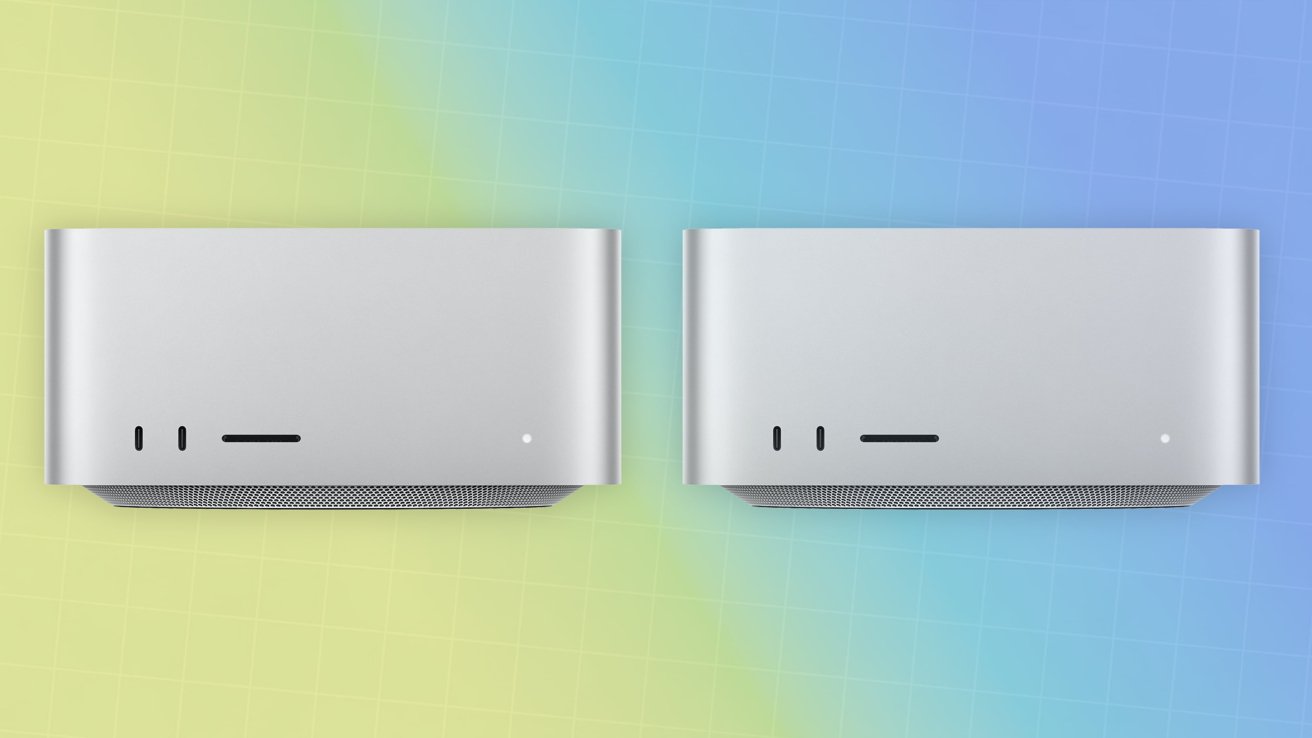
Two silver desktop computer boxes side by side, front view, each with ports and a small indicator light, against a soft gradient background of yellow, green, and blue
The Mac Studio now has M5 Ultra, an upgrade from the M3 Ultra.

The new Mac Studio arrived on Tuesday, with the all-new M5 Ultra now the top-of-the-range chip for tough productivity workloads. Apple is positioning it squarely as a desktop for doing a lot of AI-related processing, including running models locally.
The design stays faithful to the outgoing model, so the story lives inside the chip. This time, the headline is artificial intelligence rather than raw core counts.
Continue Reading on AppleInsider | Discuss on our Forums

Source link

Continue Reading
Click to comment

You must be logged in to post a comment Login

Leave a Reply

Tech

AI Companion Robots Are Closing the Human Connection in Modern Homes

Published

on

This article is brought to you by Ollobot.

From about 2017, individuals began to truly connect with the initial wave of companion robots. These devices had personality, moved around, joked, and answered when you spoke to them. Most early companion robots, however, were still limited by simple voice-command interactions and narrow functionality. Once the novelty wore off, many ended up sitting unused on shelves. As some of those companies went out of business and turned off their servers, many owners likened it to losing a pet.

What Ollobot describes as “gentle intelligence” is a useful way to think about where the serious work in this category is going. Not toward more powerful assistants, but toward more present ones.

The problem companion robots were trying to solve

Loneliness is not a niche issue. According to one study, nearly one out of three elderly adults resides alone, meaning they do not have daily companions. Research also shows that children whose parents have migrated for work, leaving them in the care of relatives, were 2.5 times more likely to experience loneliness than children whose parents remain with them. Among working adults living alone in urban environments, similar patterns of social isolation emerge, even if they are less visible.

Advertisement

Over the years, technology has time and again attempted to solve this problem via video calls, smart speakers, and messaging apps without much success. Those tools are geared towards communication between people that already have relationships. They do not create presence. They schedule it. That is the gap that a new generation of AI companion robots is being engineered to fill.

Today’s AI robots are different

Today’s companion robots are not just cute and cuddly. They are designed with psychological research, clinical insight and long-term interaction models to be truly useful in real homes.

Three fundamental shifts define the current generation:

  1. From reactive to proactive response. Older robots relied on you speaking to them, but modern robots monitor a room with cameras, microphones, and surroundings sensors to initiate interactions without your input, and they can pick up on your emotions.
  2. From function-oriented to emotion-oriented design. The original pitch for companion robots was about what they could do. The question driving the serious work now is how they make you feel, which is a harder engineering problem and a more honest framing of what the product is actually for.
  3. From standalone hardware to connected ecosystems. Leading brands are creating platforms rather than devices with software included as a built-in layer and remote access from the beginning.

The global AI companion market size was valued at US $36.8 billion in 2025 and is projected to grow from $48 billion in 2026 to $318 billion by 2033, at a compound annual growth rate of 31 percent from 2026 to 2033.

Three household scenarios and interaction models

Ollobot’s advanced AI family companion robot OlloNi SS1 addresses a number of gaps in what existing technology offers.

Advertisement

Elderly individuals living alone. The combination of proactive interaction, fall detection, and persistent presence addresses both safety and companionship without the social overhead of asking family members to check in more frequently.

Children in households where parents work far from home. The SS1 functions as a consistent companion that already knows a child, their preferences, their moods, and their routines. The remote connection features allow parents to stay present without requiring a scheduled call, and the life recording system gives them a passive window into their child’s days that feels less clinical than a monitoring camera.

Single professionals living alone in cities. The SS1 adapts to daily routines, builds up a preference model over time, and provides ambient social presence without demands.

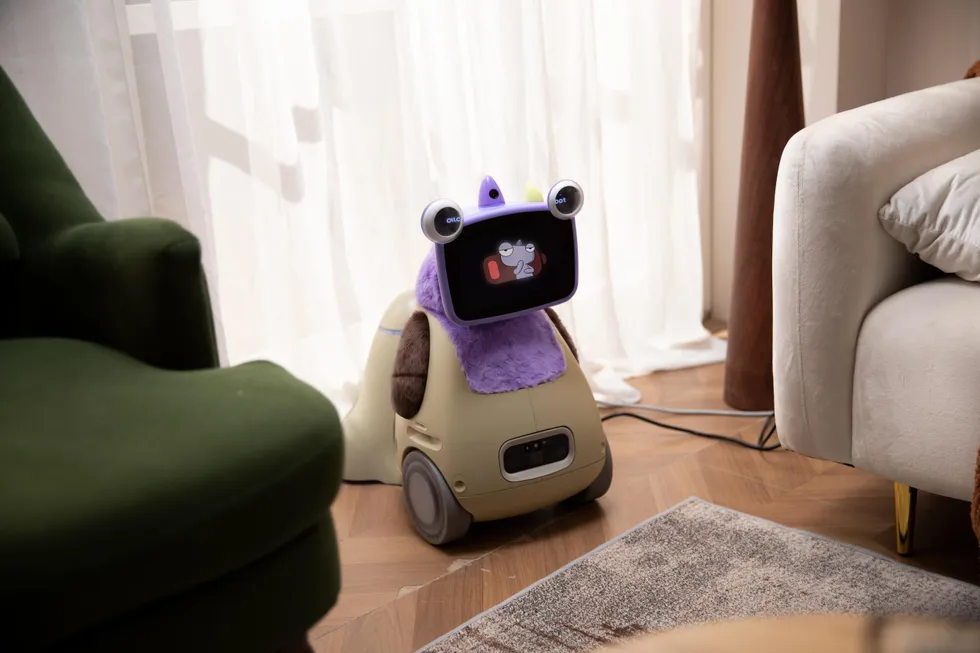
Cute home robot with a purple cover and cartoon face displayed on its screen. OlloNi SS1 adapts to daily routines over time.Ollobot

What OlloNi SS1 is doing differently?

Ollobot’s goal in building intelligent companion robots is to address the gaps in technology and capability, using innovation not to automate tasks but to fill emotional voids.

Advertisement

Much of the robotics industry has historically pursued human imitation — machines that speak, look, or behave like people. The SS1 is instead designed around familiarity and long-term coexistence rather than realism.

The system integrates multiple subsystems operating in parallel, including visual perception, audio processing, mobility control, and interaction management. It is equipped with a multi-chip AI 4K vision module capable of facial recognition and motion tracking. One small but revealing detail is the inclusion of a physical privacy cover for the camera — a mechanical solution to concerns that software settings alone may not fully resolve.

Person playing with a red plush robot toy that has a glowing digital face and eyes OlloNi SS1 can actively integrate into family activities, and it can autonomously move closer to capture memorable moments or reposition itself to remain engaged in ongoing interactions.Ollobot

The robot supports advanced mobility across multiple indoor surfaces, including wooden floors, ceramic tiles, and low-pile carpets, with slope climbing capability up to 3.5 degrees. Rather than remaining in a fixed location, it can move naturally throughout the home to stay close to household members as daily activities unfold.

For example, the OlloNi SS1 may greet family members when they arrive home, follow an older adult from the living room to the kitchen while continuing a conversation, remind a child to take a study break after a prolonged period of inactivity, or notice that someone appears unusually quiet and gently check in. During family activities, it can autonomously move closer to capture memorable moments or reposition itself to remain engaged in ongoing interactions.

Advertisement

The robot continues to evolve over time, with over-the-air updates that deliver new features, performance improvements, and AI enhancements

It also incorporates fall detection with optimized accuracy for safety monitoring scenarios. A 6-microphone array enables omnidirectional voice pickup with an effective voice capture range of up to 5 meters, supporting reliable wake-word detection and far-field interaction.

To support continuous companionship, much of the robot’s AI processing takes place directly on the device through its “heart module” architecture, with 16 GB of memory and 64 GB of local storage. This enables the system to retain household memories, recognize familiar faces, and respond with lower latency, making interactions feel more natural even during everyday routines.

Because companion robots are expected to remain available throughout the day rather than only during brief interactions, the SS1 is designed for extended operation, offering up to 12 hours of standby time and around 5 hours of active interaction on a single charge. This allows it to accompany users through meals, conversations, playtime, and other daily activities without frequent interruptions.

Advertisement

Close-up of toy robot with glowing red heart and purple fur on a beige body. To support engaging interactions, much of the robot’s AI processing takes place directly on the device through its “heart module” architecture.Ollobot

Like the relationships it is designed to build, the robot continues to evolve over time. Running on Android OS with over-the-air (OTA) updates, the system continuously receives new features, performance improvements, and AI enhancements, allowing its capabilities to grow alongside the household it serves.

The robot’s behavioral model also improves over time. Rather than reacting to isolated commands, it attempts to establish a baseline understanding of household routines and individuals. Changes in behavior — prolonged quietness, unusual inactivity, or emotional cues — become triggers for interaction.

Presence instead of utility

Several features in the OlloNi SS1 illustrate this emphasis on presence and continuity in its interactions.

The system can identify different household members, including pets, and adapt responses accordingly. Remote communication features allow family members to connect through the device without treating every interaction like a scheduled call. Environmental sensors support contextual reminders tied to weather or room conditions.

Advertisement

Its “2+1” multi-display configuration is also designed around emotional communication. Two circular side displays function as expressive “emotional eyes,” while a separate primary display handles information and structured interaction. The separation allows emotional signaling and functional communication to operate independently, creating more intuitive nonverbal interaction even when no dialogue is taking place.

Cute red robot pet in checkered shirt sits on rug in cozy, warmly lit living room The robot’s behavioral model improves over time. Rather than reacting to isolated commands, it attempts to establish a baseline understanding of household routines and individuals.Ollobot

The SS1 also includes an automated life-recording system built on facial recognition and behavioral-event detection that can capture moments such as laughter, physical closeness, or group interaction automatically. An integrated AI vlog engine can then organize those moments into edited short-form videos with automated sequencing and soundtrack generation. The design intent is to preserve spontaneous domestic moments without requiring active documentation behavior from users.

An integrated AI vlog engine can organize recorded moments into edited short-form videos with automated sequencing and soundtrack generation

Visual data is processed primarily on the device through the SS1’s on-device AI architecture, with household memories stored locally and managed within Ollobot’s proprietary ecosystem instead of being shared with third-party smart home platforms. Access to recordings and live feeds is restricted to authorized users through the companion app, while encrypted communication helps protect data during remote access. Users also retain direct control over recording preferences, and the physical camera privacy cover provides an additional hardware-level safeguard whenever visual monitoring is not desired.

Advertisement

Remote communication is similarly structured around persistence rather than transaction. Traditional video calls are episodic and screen-bound; the SS1 instead acts as a continuously present interface embedded inside the household environment. Through autonomous mobility, environmental awareness, and persistent household memory, remote family members interact with an ongoing domestic context.

The larger shift to “gentle intelligence”

Ultimately, gentle intelligence is not about making robots behave more like humans — it is about helping them fit more naturally into human lives. Each OlloNi SS1 unit develops a unique behavioral profile based on its household. Two units running in different homes for a year will have become meaningfully different from each other, shaped by the specific people, habits, and rhythms of where they live.

That kind of long-term personalization is what early companion robots never had. It is also what makes the difference between a product that ends up on a shelf and one that actually earns its place in a home.

Learn more at ollobot.com.

Advertisement

Source link

Continue Reading

Tech

The Witcher 3 is getting a major free remaster in September, new expansion arrives in 2027

Published

on

Something to look forward to: CD Projekt Red had already promised plenty of Witcher news at Gamescom, and it delivered more than expected. The studio has announced The Witcher 3: Wild Hunt Remastered, a substantial overhaul launching September 29 as a free upgrade for existing owners. It also provided the first proper look at Songs of the Past, a new paid expansion arriving in 2027.

The Witcher 3 Remastered appears to go considerably further than simply sharpening up the visuals of the 2015 RPG. CD Projekt Red says the new edition will update graphics, performance, combat, movement, progression, and several other parts of the game.

Visual improvements include upgraded textures for environments, characters, and monsters, along with denser foliage and revised lighting, rendering, and ray tracing. Combat is also being reworked with new animations, finishing moves, and a more adaptive camera.

Other changes include improved traversal, revised horse controls, enhanced monster behavior, new Witcher Sign effects, a redesigned skill tree, transmogrification, an expanded photo mode, and cross-platform mod support.

Advertisement

The upgrade launches September 29 on PC, PlayStation 5, and Xbox Series. The Witcher 3 will also receive a native Nintendo Switch 2 version, while CD Projekt Red is bringing the game to Battle.net through a new partnership with Blizzard.

Existing owners on eligible platforms will receive Remastered at no additional cost.

CD Projekt Red had another surprise for anyone who only owns the base game. Hearts of Stone and Blood and Wine, the two acclaimed expansions released in 2015 and 2016, are now being made available to existing Witcher 3 owners for free. That means players can revisit essentially the complete current Witcher 3 experience before another major adventure arrives next year.

“Songs of the Past” revealed

CD Projekt Red also showed the first footage from Songs of the Past, The Witcher 3’s first new expansion since Blood and Wine a decade ago. The expansion sends Geralt to Letten, a previously unseen region portrayed as a peaceful rural land built around farming, festivals, and local folklore. Naturally, things aren’t quite as idyllic as they initially appear, with an old threat lurking beneath the surface.

Advertisement

Geralt will encounter new enemies, reconnect with familiar characters, and gain additional abilities. One of the more noticeable additions shown so far is a new chain weapon, which should give Geralt another option for controlling and attacking enemies.

Songs of the Past is being developed by CD Projekt Red alongside Fool’s Theory, the Polish studio behind The Thaumaturge. Fool’s Theory is also leading development of the remake of the original Witcher. Songs of the Past will be a paid expansion. It will launch sometime in 2027 for PC, PlayStation 5, Xbox Series, and Nintendo Switch 2.

CD Projekt Red previously indicated that the expansion would be comparable in scope to Blood and Wine, which introduced the large Toussaint region and added dozens of hours of new content.

The company plans to reveal considerably more during Gamescom. Five days of Witcher-focused REDstreams are scheduled from August 26 through August 30, including gameplay presentations, interviews, and behind-the-scenes material covering both Remastered and Songs of the Past.

Advertisement

All of this will help fill what remains a fairly long wait for the franchise’s next numbered installment.

The Witcher 4, which shifts the spotlight from Geralt to Ciri, is currently targeting a 2028 release. CD Projekt Red co-CEO Michał Nowakowski emphasized that 2028 remains a target rather than a firm launch date, leaving room for the project to move if additional development time is required.

Whenever The Witcher 4 does arrive, it is expected to begin an unusually busy period for the studio. CD Projekt Red has said it wants to release three Witcher games within six years, with its collaboration with Epic Games on Unreal Engine 5 intended to help shorten development cycles between installments.

Beyond The Witcher 4 and the original game’s remake, the company has another Witcher project in development, alongside the next Cyberpunk game and an entirely new IP.

Advertisement

For now, though, CD Projekt Red is making its 11-year-old RPG the center of attention again. Between a free overhaul in September and a full expansion next year, The Witcher 3 is getting a much bigger second life than anyone would have expected this far after launch.

Source link

Advertisement
Continue Reading

Tech

Do Plug-In Hybrids Have A Reliability Problem?

Published

on


Findings by Consumer Reports and JD Power suggest that plug-in hybrids are far less reliable than their internal combustion counterparts, but digging into the numbers and research methodology reveals it’s not quite that simple. First, although Consumer Reports’ survey found owners of electric vehicles and plug-in electric vehicles report about 80% more problems on average than owners of internal combustion engine vehicles, it lumped EVs and PHEVs together. Without breaking out the PHEV number, it’s hardly a definitive answer, and it’s further complicated by there being far fewer EV and PHEV models on the market than ICE vehicles, which means a few bad apples can seriously skew the data.

When it comes to assessing reliability, it’s also crucial to consider how the data is sourced. Consumer Reports surveyed owners of about 380,000 vehicles from its own subscriber base, which means most of its data was self-reported. That’s a problem, because it means it’s highly anecdotal. As with online reviews, disgruntled owners tend to be more inclined to respond to surveys than satisfied ones. JD Power’s 2026 reliability report has similar problems, in that it also relies heavily on self-reported information, but it recruits respondents using vehicle registration and ownership information, rather than an existing subscriber base. Additionally, JD Power began collecting repair data from dealerships in April 2026, which will add credibility to subsequent reports.

Advertisement

Some PHEVs are less reliable than others

However, regardless of these methodology caveats, both Consumer Reports and JD Power found a significant difference between the reliability (or perceived reliability) of PHEVs and other vehicles. But further digging suggests how well a PHEV performs varies enormously between makes and models, and can also vary substantially by powertrain within the same model family.

For instance, the Mazda CX-90 is available as both a gas-powered inline-six and as a PHEV. We said of the PHEV variant that the mixture of power sources can leave, “the two halves of the drivetrain occasionally feeling like they’re fighting rather than collaborating.” Meanwhile, we scored the ICE variant 9/10 and said, “it’s Mazda’s overall package that leaves its sizable SUV feeling genuinely special.” But don’t just take our word for it, Edmunds was similarly impressed by the gas-powered model, but underwhelmed by its PHEV sibling.

Conversely, Toyota’s Rav4 Prime PHEV consistently bests its ICE stablemate in reviews, with the 2021 model year iteration managing 87/100 on JD Power’s quality and reliability score (and an overall score of 82/100), outperforming other compact SUVs like the Jeep Cherokee and Honda CR-V in the process. Moreover, the SlashGear team has consistently found Toyota’s PHEVs highly reliable, and the RAV4 Prime even made our list of nine of the most reliable SUV models made by Toyota. PHEVs as a category may be less reliable than other powertrain options, but within their ranks, which one you choose makes a huge difference.

Advertisement


Source link

Advertisement
Continue Reading

Tech

Nvidia is about to report its fastest growth in seven quarters

Published

on

Nvidia is expected to report quarterly revenue of $92.18bn, close to double the same period last year and its fastest growth in seven quarters, with analysts forecasting a further rise to $104.20bn in the current quarter.

The numbers are not really the issue anymore, because the scrutiny has moved to how much of that demand the company is underwriting itself after arranging $500bn of financing for customers this month.

The commercial question for the quarter is the transition to Rubin. Shipments of the next-generation processors begin this autumn, and how quickly customers move off Blackwell determines whether the guidance holds.

Morgan Stanley expects Rubin to contribute nearly $9bn in the current quarter, on the argument that it unlocks a large improvement in what the bank calls AI factory economics. Nvidia has already said Vera Rubin is in full production with OpenAI deploying at scale.

Advertisement

The financing arrangements are where the analyst questions have concentrated. Alongside the $500bn package, Nvidia guaranteed up to $105bn for OpenAI’s Ohio data centre, which places the chipmaker somewhere between supplier and lender to its own customers.

“This makes them a kind of central banking figure in the AI space,” said Brian Mulberry of Zacks Investment Management. “The real risk is total AI exposure with no diversification.”

Credit markets have already registered the point. Nvidia’s roughly $750bn of announced AI commitments pushed its own credit default swaps to record levels, which is the bond market saying it would like to see the demand stand on its own.

The structural worry is not that customers cannot pay. It is that a supplier financing purchases of its own product records revenue that looks independent of it, and nobody outside the company can easily separate the two from the income statement.

Advertisement

Customer concentration compounds it. A handful of hyperscalers and model labs account for a very large share of Nvidia’s revenue, and several of them appear on both sides of the ledger as buyers and as recipients of its investment or financing.

Competition is the other pressure, and it is no longer theoretical. Amazon, Google, and Meta all have custom silicon programmes; AMD and Intel are pushing on inference, and inference is the workload that grows fastest once models are deployed rather than trained.

Inference also has different economics to training. It rewards cost per token rather than raw throughput, which is the ground on which custom silicon competes best and where Nvidia’s architectural advantage is least decisive.

Market sentiment has been unusually mixed for a company posting these figures. Nvidia shares are up 11.8% for the year but have lagged the major indices recently, and it briefly lost its position as the world’s most valuable company to Apple.

Advertisement

Cost pressure is now visible in Nvidia’s own pricing too. The company has told customers that AI server prices are rising by more than 15% because of memory shortages, which passes the DRAM crunch straight to the buyers it is simultaneously helping to finance.

The bull case has not gone anywhere in the meantime. Demand for inference capacity keeps outrunning supply; the buildout has years of announced projects behind it, and no competitor has yet matched the software stack that keeps customers on Nvidia hardware once they are there.

The guidance will carry more weight than the reported quarter. A beat on revenue with a soft outlook would confirm what the credit market has been signalling, and a strong outlook invites the follow-up question of how much of it is committed capacity the company arranged the money for.

Neither answer settles the underlying argument. Nvidia can keep growing at this rate for as long as the buildout continues, and the buildout continues for as long as capital keeps arriving, which is a circular sentence describing a circular arrangement.

Advertisement

Source link

Continue Reading

Tech

Updated M6 Mac mini arrives in RAM and SSD constrained environment

Published

on

In an uncharacteristic August launch, Apple has updated the Mac mini, retaining the same design, adding the M6 and M5 Pro processors, and a new record-high starting price.

The release comes almost two years after the then-redesigned M4 Mac mini was released. There’s nothing different externally, with the major change being the M6 processor.

And it comes after wait times were as long as two months on the morning of August 25 for the M4 version of the hardware. It will almost certainly sell out rapidly upon release, and we advise that if you want one, you order one when the preorder period starts.

“Today, we’re debuting the next giant leap in performance and AI compute for Apple silicon with the incredibly advanced M6 and the most powerful M-series chip yet, M5 Ultra,” said Sri Santhanam, Apple’s vice president of Silicon Engineering Group. “Built using the cutting-edge 2 nm process, M6 combines a new CPU complex, two additional CPU and GPU cores, a Dual 16-core Neural Engine, and more unified memory bandwidth to power through workloads with amazing energy efficiency.”

Advertisement

“And for the ultimate desktop performance and the ability to run massive AI models, M5 Ultra features a massive GPU, now with Neural Accelerators, and more unified memory bandwidth, pushing the boundaries of what a desktop can do.”

M6 has a 12-core CPU with two super cores, four performance cores, and six efficiency cores. Apple says the combo delivers up to 1.2x faster multithreaded performance as compared to M5, and up to 2.4x faster than M1.

Also, the M6 features a 12-core GPU, each with an accompanying Neural Accelerator. Apple also says that this delivers a nearly 30 percent increase in peak GPU compute for AI compared to M5, and more than eight times faster compared to M1.

“Mac mini has always been our most versatile Mac. Whether it’s being used as a home computer, powering a professional studio, or as an always-on agentic device, it’s the little Mac that can do it all,” said Johny Srouji, Apple’s chief hardware officer.

“Today, we’re taking this versatility even further. With a more powerful CPU and graphics, Neural Accelerators in the GPU, and higher memory bandwidth, Mac mini with M6 delivers a whole new level of AI performance. And with up to an 18-core CPU and 20-core GPU, Mac mini with M5 Pro is an ultracompact powerhouse for complex pro workflows. We can’t wait to see all the incredible ways people will use it next.”

Advertisement

The new M6 chip supports up to 32GB of unified memory. That RAM also provides up to 170GB/s of unified memory bandwidth.

Both Mac mini M5 and Mac mini M5 Pro models include Wi-Fi 7 and Bluetooth 6, as well as upgraded 2.5Gb Ethernet. A 10Gb option is available at an extra cost.

Thunderbolt 5 is not universal. On the back, there are three Thunderbolt 4 ports on the Mac mini with M6. The Mac mini with M5 Pro has three Thunderbolt 5 ports, along with HDMI and Ethernet.

At the moment, there is no sign of the first units being made in America. At some point later in 2026 they are expected to be assembled in Houston, TX.

Advertisement

Pricing and availability

Customers can preorder the new Mac mini with M6 and M5 Pro starting August 25. Neither model ships until September 22.

Mac mini with M6, 12-core CPU, 12-core GPU, dual 16-core Neural Engine, 16GB of RAM, and a 256GB SSD starts at $899.

Mac mini with M5 Pro, 15-core CPU, 16-core GPU, 24GB of RAM, and a 512GB SSD starts at $1,699.

A $100 discount is available on both models for US military members and in the education store. The $899 price is the Mac mini’s highest starting price yet.

Advertisement

Source link

Continue Reading

Tech

Apple unveils new Mac mini with M6 and M5 Pro chips

Published

on

‘Customers increasingly … [use] Mac mini as a powerful platform for agentic AI’, Tim Cook said in July.

After rumours of an impending announcement were published this morning, Apple has officially revealed its first new Mac mini desktop computer in nearly two years, with two new models featuring the company’s new M6 and M5 Pro chips respectively.

With the M6 chip – also newly announced today (25 August) – the Mac mini can deliver up to four-times faster AI performance, two-times faster storage and graphics, and 40pc faster CPU performance, according to Apple.

The M6 is the company’s first 2nm chip, which features a larger 12-core CPU complex with “the world’s fastest CPU core” according to Apple, along with a larger 12-core GPU with neural accelerators, a dual 16-core neural engine, and up to 170 gigabits per second (Gb/s) of unified memory bandwidth.

Advertisement

Meanwhile, the M5 Pro features up to an 18-core CPU and up to a 20-core GPU – with neural accelerators in each GPU core – with an “enhanced shader core and third-generation ray tracing for complex work” in 3D design, VFX, and game development. The Mac mini with the M5 Pro also supports up to 64GB of unified memory and 307Gb/s of memory bandwidth.

The Mac mini with M6 is priced from $899, while the version with the M5 Pro is priced at $1,699.

The new Mac mini was announced after Bloomberg reported on its impending reveal earlier today.

Sources told the publication earlier today that the new device was expected in the coming days – the tech giant has since officially unveiled the device.

Advertisement

This is likely the last new product launch under CEO Tim Cook, who is set to retire on 1 September.

The upgrade to Apple’s Mac mini line follows a growth in demand for the small, portable device popularly used to run AI applications locally.

“We’re seeing customers increasingly … [use] Mac mini as a powerful platform for agentic AI [or] deploying clusters of Mac Studio systems to run frontier-class models locally,” Cook said at the company’s last earnings call in July.

The machine is available for pre-order starting today, according to the company, with the product set to launch on 22 September.

Advertisement

The Mac mini is one of a number of Apple products set to launch soon, including the iPhone 18 Pro, Apple’s first foldable smartphone, a new range of Apple Watches, updated AirPods and a smart home device.

The company is also readying a new Apple TV set-top box, a HomePod mini smart speaker and a revamped iPad mini with an OLED screen.

The memory chip crunch has hit consumer device developers hard. Earlier this year, Apple announced that it was hiking prices for several of its products, including Macs and iPads, as a result of the global chip shortage.

“The rapid expansion of AI data centres has created an extraordinary surge in demand for memory and storage”, a company spokesperson said at the time, adding that Apple had “never seen a component price increase this much, this quickly”.

Advertisement

According to Counterpoint Research, global smartphone shipments are poised to drop nearly 14pc in 2026, with prices expected to jump by as much as 13pc.

The Mac mini has been a particular problem for Apple in supply chain terms, with deliveries taking weeks or months to be completed. Cook said that the company’s new advanced manufacturing centre in Houston, Texas will be assembling Mac minis starting “later this year”.

With additional reporting by Colin Ryan

Don’t miss out on the knowledge you need to succeed. Sign up for the Daily Brief, Silicon Republic’s digest of need-to-know sci-tech news.

Advertisement

Updated, 3.55pm, 25 August 2026: This article was amended to include up-to-date information on the new Mac mini, as the device was officially announced shortly after our article was published.

Source link

Advertisement
Continue Reading

Tech

SpaceX Plans to Build a $100 Billion Spaceport In Louisiana

Published

on

SpaceX plans to spend up to $100 billion building a new Starship launch facility in Vermilion Parish, Louisiana, which the state says could eventually “support thousands of launches annually.” CNBC reports: Once built, Starbase, LA will serve as the main launch facility for Starship, SpaceX’s in-development rocket that’s the largest ever built and designed to be fully reusable. Musk has aspirations to massively expand SpaceX’s Starlink satellite network, to launch orbital data centers and to someday colonize Mars. Those ambitions, and justification for SpaceX’s nearly $2 trillion market cap, hinge on the success of Starship.

SpaceX said, in a video posted to its website on Tuesday, that the search for a site to build launch pads and have access to ample fuel for its operations took about seven years. Musk said in the video that the company would bring “probably 10,000 really exciting jobs” to Louisiana with the spaceport. A fact sheet posted online by the state of Louisiana said SpaceX is expected to generate an estimated “3,000 direct new jobs over the next 10 years” in the state, and “8,100 indirect new jobs.” SpaceX said it would work on a “historic coastal restoration” in Louisiana, in partnership with the state to “bring the marsh back” and ensure the wetlands around its new facility will have “storm protection.”

Read more of this story at Slashdot.

Advertisement

Source link

Continue Reading

Tech

Vitamix Promo Codes and Deals: $25 Off + Free Shipping

Published

on

I’ve been hooked on smoothies in an almost superstitious way ever since college: A fruit smoothie is like a good luck charm, promising the health you feel you deserve despite all your other bad decisions. But in my more recent adult life, a good blender is the passport to taqueria salsas, Oaxacan-style mole, and all the delicate emulsions I once had to buy at restaurants and in jars.

Well, Vitamix crushes the blender game, but usually comes with a price tag to match. Luckily Vitamix promo codes crop up at various points during the year, and we’re here to help you stay up to date on those discounts.

Vitamix blender

The spin cycle is this machine’s sweet spot.

Vitamix New Ascent X5 With Stainless Steel Container

Vitmix’s top-of-the-line blender model, Ascent X5, is now constructed with a stainless steel container. The 48-ounce stainless steel container is not only huge and hygienic, the machine itself combines an intuitive touch interface with a refined, timeless design. The non-reactive stainless steel material resists stains, odors, and corrosion, and expertly handles hot, cold, and acidic ingredients. This futuristic gadget also has an automatic self-cleaning program and ten blending programs for popular items like smoothies, soups, frozen cocktails and more for a precise blend, every time.

Get a $50 Vitamix Promo Code Plus Free Shipping

Vitamix has tons of ways to save on these handy kitchen gear items, including $50 off when you register your email. All you have to do is input your email on Vitamix’s website, and you’ll get a discount of up to $50 sent straight to your inbox. Plus, you’ll get free shipping on orders of $100 or more.

Advertisement
Image of a Vitamix blender

IMAGE COURTESY OF VITAMIX

Does Vitamix Offer Free Shipping?

Glad you asked. Vitamix is offering free standard shipping for orders above $99. This pretty much means that ground shipping is free for blenders at the current discounts. Priority shipping is not free, however.

The WIRED Gear Team’s Favorite Vitamix Blenders

WIRED has long been singing the praises of the classic Vitamix 5200. The model made a blender convert out of contributing reviewer Joe Ray after he realized that the “model of preference for blender aficionados around the world” was also his key to home mole and Oaxacan-style cookery.

A similar road-to-Damascus moment beset WIRED contributing reviewer Heather Arndt Anderson when she tested the Vitamix Ascent X2, also currently on a $50 promo discount. “The more I thought about it,” she wrote, “the more I realized that maybe I’ve never been a blender person because I never had a good blender.” Anderson also made a big batch of mole and avoided passing out from chile fumes, then moved on to homemade masa and a Georgian walnut spread. She regretted only that the blender wasn’t easier to clean.

After testing through a number of brands’ blenders, WIRED contributing reviewer Emily Peck marveled that even the basic Vitamix Explorian E310 churned almonds frictionlessly into butter without even need of a presoak.

Advertisement

Source link

Continue Reading

Tech

JetBrains local model needs a $2,700 Mac mini to run it

Published

on

Apple just announced the Mac mini with M5 Pro and you’ll need one with 64GB of RAM to run the Junie Local model, a free 27B parameter coding agent that compares to Sonnet 4.5 or GPT-5.

JetBrains developed Junie as a coding agent that runs on your Mac and calls out to models the user chose. That always required some configuration and sending data off to some other AI product, so JetBrains has built Junie Local.

According to a blog post by JetBrains, Junie Local installs with a single command, takes about 20GB of space, and requires at least an M5 Mac with 64GB of RAM. Apple’s recently announced Mac mini costs $2,699 to meet that spec with an M5 Pro processor.

It runs using Qwen3.6-27B at 4-bit and is entirely local. There is no need for tokens or sending data to someone else’s server.

Advertisement

JetBrains targeted the M5 processor as the base spec due to the Neural Accelerator having 8-bit arithmetic instructions, which enables around 40% more prefill throughput. Qwen has a newer version, 3.8, but 3.6 was chosen since it’s faster without the “reasoning” required for 3.8.

The blog post suggests that JetBrains testing placed the 27B parameter coding agent on par with Sonnet 4.5 at a 10,000-token reasoning limit. GPT-5 at medium effort scored slightly higher.

Here’s what JetBrains had to say about the minimum spec requirements:

We know that an M5 Mac with 64 GB of RAM is a big ask. We are not going to pretend otherwise, and we know it puts Junie Local out of reach for many people reading the post.

That is simply what it costs to run a 27B model well today, and it is the number we are working hardest to bring down. The aim is a lower memory floor, wider hardware, and more of the stack optimized. If the lofty requirements are the reason you cannot try Junie Local, rest assured that we are working to bring them down.

Advertisement

JetBrains says that the Mac is a starting point, not the whole plan. It has started work for DGX Spark and RTX 5090, and they’ve looked at supporting 24GB cards.

Junie Local is free to install. Type /local into Junie and it installs. Switch back to cloud models using /model

Source link

Advertisement
Continue Reading

Tech

The death of the human web? Report finds over a third of web pages pushed live since the launch of ChatGPT show evidence of being written by AI

Published

on


  • AI authorship is increasingly employed for web pages, Pew Research Center report claims
  • Over 33% of pages published since the launch of ChatGPT reportedly show signs of AI generation
  • Of the 10,000-page sample used in the study, 10% of pages had signs of AI authorship

An incredible 35% of web pages published since the launch of ChatGPT show signs of AI authorship, new research has claimed.

A study from the Pew Research Center, which used automated tools to assess a sample of 10,000 web pages, also found that in the entire sample – based on data from the Common Crawl project – almost 10% of all pages had signs of AI creation.

Source link

Advertisement
Continue Reading

Trending

Copyright © 2025