
Crypto World
Warsh Jackson Hole keynote puts financial innovation first

The symposium theme is “Financial Innovation: Implications for Payments and Policy.” Warsh divested a dozen blockchain positions before taking office. He appointed Marc Andreessen to co lead the Fed’s AI task force. Friday’s speech could move crypto markets on policy content alone.
Summary
- The 2026 Jackson Hole Economic Policy Symposium runs August 27 to 29 with the theme “Financial Innovation: Implications for Payments and Policy,” the first time digital payments and financial technology have been the organizing center of the event.
- Fed Chair Kevin Warsh’s personal portfolio disclosed in his April 2026 ethics filing included stakes across more than a dozen blockchain protocols and DeFi ventures, all divested upon confirmation.
- Warsh appointed Marc Andreessen to co lead the Productivity and Jobs task force alongside Stanford economist Charles I. Jones and Microsoft Xbox CEO Asha Sharma, drawing attention from crypto investors despite the panel’s AI focus.
- Bitcoin broke $80,000 on August 25 as the crypto market rallied more than 20 percent for the week, with traders positioning ahead of Friday’s keynote.
- The stablecoin market has grown past $230 billion in outstanding tokens, JPMorgan is running dollar pegged deposit tokens on a public blockchain, and the GENIUS Act provides the first federal framework for payment stablecoin issuance.
Every Fed chair gets one first Jackson Hole speech. It sets the tone for their tenure, signals their priorities, and reveals how they think about the economy’s most pressing structural questions. Kevin Warsh’s first keynote arrives at a moment when the stablecoin market exceeds $230 billion, when tokenized deposits are settling real transactions on public blockchains, and when the United States is building its first comprehensive stablecoin regulatory framework under the GENIUS Act. The theme he chose tells you what he considers the structural question: “Financial Innovation: Implications for Payments and Policy.”
This is not the typical Jackson Hole speech about inflation forecasts and interest rate guidance. It is a speech about whether programmable money changes how monetary policy works. For crypto markets, the distinction matters more than the content.
Why the theme matters
Jackson Hole themes are chosen years in advance by the Federal Reserve Bank of Kansas City in consultation with the Fed chair. The 2026 theme, “Financial Innovation: Implications for Payments and Policy,” is the first in the event’s history to place digital payments and financial technology at its organizing center. Previous themes have addressed inflation, labor markets, monetary policy frameworks, and global trade. None has centered on the mechanics of how money moves. The theme reflects a genuine central banking problem. Stablecoins, tokenized deposits, and faster payment rails have become practical tools in global finance fast enough to outrun regulatory frameworks. Central banks are still determining whether and how programmable money alters the transmission of interest rate policy. When the Fed raises rates, the traditional mechanism works through bank deposits and money market funds. If a growing share of dollar denominated value sits in stablecoins that do not pay interest, the relationship between the federal funds rate and broader financial conditions changes in ways that monetary economists are only beginning to model. The symposium is expected to draw participation from central banks working through CBDC frameworks and regulators overseeing stablecoin and tokenized asset markets globally. The academic papers presented alongside the keynote will address payment system architecture, the macroeconomic effects of instant settlement, and the regulatory challenges of cross border digital payments. For the first time, these are not fringe topics at Jackson Hole. They are the organizing principle.
Who Kevin Warsh is
Warsh took office as Fed chair on May 22, 2026, after Senate confirmation on a 58 to 42 vote. He previously served as a Federal Reserve governor from 2006 to 2011, where he was the youngest governor in the Fed’s history and gained a reputation for skepticism toward quantitative easing. After leaving the Fed, he became a fellow at the Hoover Institution and served on the boards of several technology companies. His April 2026 ethics filing revealed personal investments across more than a dozen blockchain protocols and DeFi ventures, all of which he pledged to divest upon confirmation. The filing drew immediate attention because no previous Fed chair had disclosed crypto holdings of any kind. Warsh did not discuss the positions publicly, but the disclosure confirmed that he entered office with direct experience as a crypto investor, not just as a policymaker observing the space from a distance. The experience matters because Jackson Hole speeches are not scripted by staff. The chair personally shapes the framing, the priorities, and the analytical lens. A chair who held DeFi positions understands yield farming, liquidity pools, and protocol governance in a way that a chair whose exposure was limited to policy briefings does not. Whether that understanding leads to supportive or skeptical language on Friday is the open question.
The Andreessen appointment
On July 9, Warsh announced five independent task forces to examine Fed communications, balance sheet policy, inflation frameworks, economic data, and the impact of artificial intelligence on productivity and employment. Marc Andreessen, co founder of Andreessen Horowitz (a16z), was appointed to co lead the Productivity and Jobs task force. Andreessen Horowitz is one of the largest investors in both AI companies and crypto startups. The firm’s crypto portfolio includes investments in Coinbase, Uniswap, Compound, and dozens of other protocols and infrastructure companies. None of the task force announcements mention crypto, digital assets, or stablecoins directly. The mandate is to study how AI and emerging technologies reshape economic growth and labor markets. But the appointment is being read by crypto markets as a directional signal. The reasoning: Warsh could have chosen any technology leader for the AI task force. He chose one whose firm has deployed billions into crypto infrastructure. Even if the task force never addresses digital assets, the selection reveals Warsh’s comfort level with the technology ecosystem that includes crypto as a core component. The task force will present preliminary findings to the Board of Governors in early 2027. If those findings reference digital payment infrastructure, tokenized assets, or blockchain based settlement, the crypto policy signal strengthens. If they remain narrowly focused on AI productivity effects, the appointment was about AI, not crypto, and the market read was premature. The broader composition of Warsh’s task forces also matters. Alongside Andreessen, Warsh appointed Doug McMillon, CEO of Walmart, to co lead a separate task force on communications. The combination of Silicon Valley venture capital and corporate retail in the Fed’s advisory structure signals a chair who views the economy through the lens of technology adoption and consumer facing innovation, not just banking system mechanics. This philosophical orientation may shape how Warsh frames financial innovation at Jackson Hole: as a consumer benefit driven by competition, rather than as a systemic risk requiring containment. Five task forces examining five aspects of Fed operations, none explicitly addressing digital assets, but all touching infrastructure that digital assets intersect with: communications (how the Fed signals to increasingly automated markets), balance sheet policy (how Treasury purchases interact with stablecoin reserve demand), inflation frameworks (whether digital payment efficiency is disinflationary), data (whether blockchain data should supplement traditional economic indicators), and AI productivity (whether tokenized labor markets alter employment dynamics). The crypto market is reading the subtext, and at Jackson Hole, subtext becomes text.
What Warsh might say about payments
The symposium theme constrains the keynote to financial innovation and payments. Within that frame, several topics carry crypto market implications.
Stablecoin oversight. The GENIUS Act creates a federal framework for payment stablecoins. Warsh could endorse the framework, signal that the Fed wants additional supervisory authority over stablecoin issuers, or express concern about systemic risk from a $230 billion market that operates outside the traditional banking system. Each of these positions moves markets differently.
Tokenized deposits. JPMorgan’s Kinexys platform and the Clearing House tokenized deposit network represent bank driven innovation that operates within existing regulatory perimeters. Warsh praising tokenized deposits while being cautious about stablecoins would signal a preference for bank mediated innovation over crypto native alternatives. The reverse would signal openness to non bank competition in payments.
CBDC position. Previous Fed leadership under Jerome Powell adopted a cautious “study but do not commit” approach to a digital dollar. Warsh has not publicly stated his CBDC position since taking office. A Jackson Hole speech is the natural venue to define it. Any language that explicitly deprioritizes a Fed CBDC in favor of private stablecoin innovation would be the most bullish possible signal for the crypto market.
Interest rate transmission. The most technically consequential topic is whether stablecoins alter monetary policy transmission. If a growing share of dollar value sits in non interest bearing stablecoins, rate changes have less impact on financial conditions. Warsh acknowledging this dynamic publicly would validate a thesis that crypto economists have advanced for years but that the Fed has not previously engaged with at the chair level.
How Jackson Hole has moved crypto before
Jackson Hole speeches do not typically address crypto directly. But they move crypto markets indirectly through their effect on dollar liquidity expectations, interest rate outlooks, and risk appetite. In 2024, Jerome Powell’s Jackson Hole speech signaled that rate cuts were approaching, triggering a broad risk asset rally that lifted bitcoin roughly 6 percent in the 48 hours following the speech. The mechanism was straightforward: lower rates increase the relative attractiveness of non yielding assets like bitcoin by reducing the opportunity cost of holding them. In 2022, Powell’s hawkish Jackson Hole speech crashed risk assets, with bitcoin falling approximately 10 percent as markets repriced the likelihood of aggressive rate hikes. The speech contained no mention of crypto, but the macro signal was sufficient to trigger a sell off. Warsh’s 2026 keynote has the potential to move crypto on both macro and policy channels simultaneously. If the speech signals rate flexibility (macro bullish) while endorsing stablecoin innovation (policy bullish), the combined effect would be more powerful than either signal alone. If the speech signals rate rigidity while expressing concern about stablecoin systemic risk, the reverse applies. The key difference from previous Jackson Hole speeches is that the theme itself is about financial innovation. Warsh does not need to mention crypto or stablecoins in passing; the topic is central to the entire symposium. Any language about digital payments, programmable money, or non bank payment innovation will be parsed for crypto market implications in real time.
The XRP and institutional backdrop
The timing of Warsh’s keynote coincides with a period of record institutional activity in crypto markets that directly relates to the payments innovation theme. XRP ETF trading volume hit an all time high of $125 million on August 20, the same week Ripple CEO Brad Garlinghouse appeared at the Wyoming Blockchain Symposium alongside SEC Chairman Paul Atkins. JPMorgan’s Kinexys platform completed a live cross border tokenized Treasury redemption on the XRP Ledger in under five seconds. These are not speculative experiments. They are live transactions settling real financial instruments on public blockchains, the exact category of financial innovation that the Jackson Hole theme addresses. If Warsh references tokenized settlement, cross border payments, or institutional adoption of blockchain rails in his keynote, the connection to this week’s market activity becomes explicit. Bitcoin spot ETFs absorbed $2.2 billion in six consecutive days of inflows, with total assets approaching $100 billion. Solana staking ETFs crossed $1 billion in cumulative inflows. The institutional infrastructure for crypto has reached a scale that central bankers can no longer characterize as experimental or marginal. Warsh’s speech arrives at a moment when the data supports either endorsement or caution, and the direction he chooses will define how the Fed engages with digital asset markets for the remainder of his tenure.
The rate question underneath the innovation theme
Jackson Hole speeches nominally focus on their stated theme, but markets always listen for rate signals embedded in the broader narrative. The federal funds rate sits at 4.75 to 5.00 percent. Core PCE inflation, the Fed’s preferred measure, has been declining but remains above the 2 percent target. GDP growth has been resilient. The labor market shows signs of cooling but has not deteriorated sharply. Warsh inherits a policy stance that many market participants consider too tight given the progress on inflation. He has not yet chaired an FOMC meeting that cut rates. A Jackson Hole speech that frames financial innovation as a source of productivity growth and disinflationary pressure would implicitly support the case for rate cuts by suggesting that technology driven efficiencies are helping bring inflation down without requiring further monetary restriction. The opposite framing is also possible. Warsh could argue that financial innovation creates new risks, that stablecoin growth introduces unmonitored leverage, and that the Fed needs to maintain its current stance until the regulatory framework catches up with market developments. This framing would be hawkish on both rates and crypto policy simultaneously. The correlation between rate expectations and crypto prices has been persistently positive in 2026. Lower rates push capital toward risk assets, increase the relative appeal of non yielding assets like bitcoin, and loosen financial conditions in ways that benefit leveraged trading. A speech that is dovish on rates and supportive of financial innovation would be a dual catalyst. A speech that is hawkish on rates and cautious on innovation would be a dual headwind.
The global central banking audience
Warsh’s keynote is not delivered in isolation. Jackson Hole brings together central bankers from dozens of countries, many of whom are further along in their digital currency strategies than the United States. The European Central Bank has advanced its digital euro to the preparation phase. The Bank of England is consulting on a digital pound. The Bank of Japan has completed technical experiments with a digital yen. China’s digital yuan has been in live circulation since 2020. For these central bankers, the question is not whether digital money exists but how it interacts with monetary policy. Warsh’s speech will be received differently by an ECB official who has committed to a CBDC than by a Singaporean regulator who has embraced private stablecoins. The diversity of the audience means that Warsh cannot simply endorse or reject digital innovation. He must articulate a position that engages with the full spectrum of approaches, from central bank issued digital currencies to purely private stablecoin networks. This global context shapes what Warsh can say about the United States approach. If he endorses private stablecoins as the preferred model for dollar denominated digital payments, he is implicitly arguing that the United States does not need a CBDC because private sector innovation has already solved the payment efficiency problem. If he signals interest in a Fed digital dollar, he is implicitly positioning the United States alongside the ECB and the Bank of England in the CBDC camp, which crypto markets would read as competitive pressure on private stablecoins.
What the market is pricing
Bitcoin broke $80,000 on August 25 after rallying more than 20 percent for the week. The crypto market added approximately $400 billion in market capitalization in seven days. Bitcoin spot ETF inflows hit $2.2 billion in six consecutive days, the strongest streak since October 2025. The rally preceded the Jackson Hole speech, not followed it. This suggests the market is positioning for a broadly favorable outcome, whether that means a dovish rate signal, a supportive payments innovation statement, or both. If Warsh delivers a speech that matches or exceeds these expectations, the rally extends. If the speech is narrowly technical without clear policy signals, the positioning may unwind as a “sell the news” event. Options markets show elevated implied volatility for bitcoin through August 29, with the at the money implied volatility for weekly options approximately 15 percent higher than the 30 day average. The skew favors calls, indicating that options traders are paying more for upside protection than downside, consistent with bullish positioning ahead of a catalyst.
What would prove this thesis wrong
Two conditions would undermine the “Jackson Hole matters for crypto” thesis. First, if Warsh delivers a purely academic speech about payment system architecture without any language that can be interpreted as policy direction, the crypto market may conclude that the Fed views financial innovation as a technical topic rather than a policy priority. Second, if the speech includes language cautioning against the systemic risks of stablecoins or explicitly endorsing a Fed CBDC, the market would reprice the Warsh era as less crypto friendly than his personal portfolio history suggested. The most likely outcome falls between the extremes. Warsh will probably acknowledge that private stablecoin innovation has outpaced regulatory frameworks, signal that the Fed prefers a supervisory role over direct issuance, and avoid specific rate guidance. This middle ground is mildly bullish for crypto but not a catalyst for a breakout move beyond what the market has already priced. The risk for traders is not a hostile speech. It is a forgettable one. If Warsh delivers technically competent remarks about payment system architecture without any language that reveals his personal views on digital assets, the market loses the information it was pricing in. A speech that signals nothing is more damaging to the current rally than a speech that signals mild caution, because it removes the catalyst without replacing it with an alternative narrative.
What to watch
Friday morning keynote timing. Warsh speaks Friday, August 28. Markets typically react within minutes of key phrases being reported by wire services. The crypto market trades 24 hours, meaning the reaction begins immediately and does not wait for equity market open.
Stablecoin language. Any mention of stablecoins, payment tokens, or private digital money in the keynote text will be the most closely parsed language. Endorsement of the GENIUS Act framework would be explicitly bullish. Calls for additional Fed oversight would be moderately bearish.
CBDC positioning. If Warsh deprioritizes a Fed digital dollar in favor of private sector innovation, stablecoin tokens and crypto broadly rally. If he revives the digital dollar discussion, the market may interpret it as competitive pressure on private stablecoins.
Rate guidance. Any signal about the September FOMC meeting embedded in the speech moves all risk assets, crypto included. The federal funds rate currently sits at 4.75 to 5.00 percent. Markets are pricing approximately 40 percent probability of a cut in September.
Post speech Q and A. Jackson Hole includes a discussion period. Unscripted comments in response to questions from other central bankers and economists often contain more directionally useful information than the prepared text.
When is Kevin Warsh’s Jackson Hole speech?
Kevin Warsh delivers his keynote address on Friday morning, August 28, 2026, at the Jackson Hole Economic Policy Symposium hosted by the Federal Reserve Bank of Kansas City. The symposium runs from August 27 to 29.
What is the 2026 Jackson Hole theme?
The theme is “Financial Innovation: Implications for Payments and Policy.” It is the first Jackson Hole theme to place digital payments and financial technology at its organizing center.
Did Kevin Warsh own crypto before becoming Fed chair?
His April 2026 ethics filing disclosed stakes across more than a dozen blockchain protocols and DeFi ventures. He pledged to divest all positions upon confirmation and took office on May 22, 2026.
Why did Warsh appoint Marc Andreessen to a Fed task force?
Warsh appointed Andreessen to co lead the Productivity and Jobs task force studying how AI and emerging technologies reshape economic growth. While the mandate does not mention crypto, Andreessen Horowitz is one of the largest investors in both AI and crypto infrastructure.
How does Jackson Hole affect crypto prices?
Jackson Hole speeches move crypto markets primarily through their effect on dollar liquidity expectations and interest rate outlooks. In 2024, Jerome Powell’s dovish signal lifted bitcoin approximately 6 percent. The 2026 speech has additional potential to move markets on payments policy content due to the financial innovation theme.
What might Warsh say about stablecoins?
The keynote could endorse the GENIUS Act framework for private stablecoin oversight, signal that the Fed wants additional supervisory authority, or express concern about systemic risk from a $230 billion stablecoin market. Each position carries different market implications.
Will Warsh talk about a digital dollar?
His CBDC position has not been publicly stated since taking office. Jackson Hole is a natural venue to define it. Any language deprioritizing a Fed CBDC in favor of private stablecoin innovation would be the most bullish possible signal for crypto markets.
Should crypto traders watch Jackson Hole this year?
The financial innovation theme makes this the most crypto relevant Jackson Hole in history. Unlike previous years where crypto implications were indirect (through rate signals), the 2026 theme places payments, stablecoins, and digital innovation at the center. The keynote text, discussion period, and academic papers will all carry potential market signals. This is educational analysis, not investment advice.
Disclaimer. This article was written on August 26, 2026. All figures reflect data available on that date and may have changed. This is educational analysis and does not constitute investment advice. Monetary policy decisions and financial innovation frameworks are subject to change.

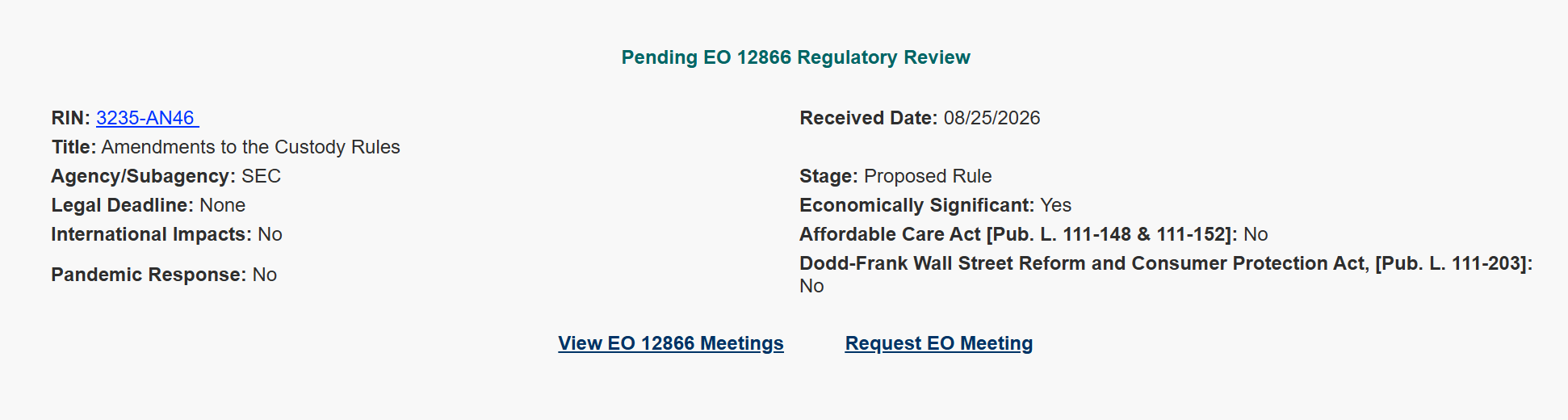
The Securities and Exchange Commission (SEC) sent its crypto custody rule rewrite to the White House on Tuesday. The text is secret. The filing’s labels are not, and one of them gives the direction away.
The proposal, called Amendments to the Custody Rules, reached the Office of Management and Budget (OMB) on August 25. The rule decides how investment advisers may hold client crypto.

What the SEC Crypto Custody Filing Tags Reveal
The OMB record carries two labels. The first is economically significant. That tag marks rules with at least $100 million in yearly economic impact.
The second label matters more. The filing sits in the deregulatory column under Executive Order 14192. President Donald Trump signed that order in January 2025. It tells agencies to scrap ten rules for every new one they write.
So before anyone reads a single line, the direction is on record. The SEC plans to loosen crypto custody duties, not tighten them.
The agenda abstract adds two more facts. It names crypto assets directly, and it targets a formal proposal for October. That step opens a public comment period.
A Reversal Two Years in the Making
Today’s rule forces advisers to park client assets with a qualified custodian, usually a bank or broker-dealer. Few of those firms would touch crypto. That left advisers with almost no compliant way to hold it.
Former Chair Gary Gensler pushed the other way. His 2023 Safeguarding Rule would have widened custody duties, and his staff probed advisers over custody. The agency withdrew that plan in June 2025.
Since then, named players have shaped the rewrite. Venture firm Andreessen Horowitz asked the SEC to modernize crypto custody rules.
In December 2025, lawyers from Delphi Ventures and Multicoin Capital sent the agency a custody framework. It asks for room to use multi-signature and multi-party computation (MPC) wallets. These tools split key control, so no one party can move the assets.
One Week, Two Proposals, and a Senate Clock
The custody filing landed one week after the SEC proposed Regulation Crypto Assets, a fundraising regime for tokens. The pair covers both ends of the market. One sets how projects raise money. The other sets how institutions hold it.
“As we continue the Commission’s efforts to provide clarity for crypto markets, and as Congress works to establish a lasting regulatory framework, Regulation Crypto Assets seeks to provide … clear pathways to raise capital under the federal securities laws,” SEC Chairman Paul Atkins made the point in the agency’s August 18 statement.
Congress, meanwhile, is stuck. The House passed the Clarity Act 294-134 in July 2025. The bill would split crypto oversight between the SEC and the Commodity Futures Trading Commission (CFTC). It has sat in the Senate since, and now faces a 60-vote test around September 15. Its passage odds remain shaky.
The SEC is not waiting for that vote. Two signals come next. How long OMB holds the rule, and which firms request meetings while the text stays sealed.
The post SEC Crypto Custody Rule Hits the White House: Lighter Standards Ahead? appeared first on BeInCrypto.


The bitcoin treasury company has built nearly four years of preferred-dividend coverage while continuing to repurchase STRC below par.

XRP is trading at $1.43 as the token settles into a tight range after last week’s fireworks. The bigger number nobody’s talking about yet: how much further this consolidation phase could drag before the next real directional signal fires. Here’s our XRP price analysis.
So where will XRP go next? The answer might matter less than what’s happening several rungs down the market-cap ladder.
The backdrop here is a violent round trip. XRP erased its most bearish technical signal last week and ripped 46% in seven days, briefly pushing past a $91 billion market cap and touching $1.55 intraday. The Average Directional Index hit 44.8 during that run, which confirms genuine trend strength, not noise.
Then the wall showed up. Two straight down days followed, with the latest daily candle closing at $1.45 after opening near $1.48, and the spot has since ground lower to current levels.
Extreme greed just returned to crypto markets for the first time since 2024, yet XRP’s pullback shows sentiment alone doesn’t override exhausted momentum. That tension between macro optimism and micro technicals is exactly where this XRP price analysis needs to start.
Discover: The Best Token Presales
Can XRP Price Hit $1.55 Again This Week?
At $1.43, XRP sits 4.5% off yesterday’s levels and well below the $1.7 high printed during the breakout top. Volume has thinned noticeably compared to the vertical leg from the $1.00 August low, a pattern typical of relief rallies losing steam rather than trends reversing outright.
Short-term pivots place immediate support near $1.31–$1.30, with layered resistance stacking from $1.51 up to $1.62. Zoom out, and the structural floor near $1.00 remains the level that matters most, and a break below opens downside toward $0.96–$0.88.

If XRP can reclaim $1.50 on rising volume, it can retest $1.62. Or continued chop might happen between $1.30 and $1.50 while the market digests the prior leg.
But a break below $1.30 drags the price back toward the $1.00 floor. The pair itself is trading in an unusually narrow intraday band, reinforcing the indecision.
Trade XRP on Bybit and Get a Chance to Win Our $1,000 USDT Airdrop
Bitcoin Hyper Targets Early Mover Upside as XRP Stalls Below Resistance
Anyone who bought the $1.00 bottom is sitting comfortably. But at a $90 billion market cap, XRP’s remaining upside from here requires enormous capital inflow just to move the needle another 10%.
The above math is precisely why traders with risk appetite are increasingly scanning presale markets for asymmetric setups instead.
Bitcoin Hyper ($HYPER) is positioning itself as the first Bitcoin Layer 2 with native SVM integration with smart contract execution built for speeds faster than Solana itself, layered onto Bitcoin’s base-layer security.
The presale has raised $33 million so far, with tokens priced at $0.0136852 and a high 35% staking rewards currently live. Its Decentralized Canonical Bridge aims to solve Bitcoin’s long-standing programmability gap like slow transactions, high fees, zero smart contract flexibility, without compromising the security model that makes BTC valuable in the first place.
Research Bitcoin Hyper before the presale window closes.
Discover: The Best Crypto to Diversify Your Portfolio
The post XRP Price Analysis: Where Will Ripple Token Go Next? appeared first on Cryptonews.
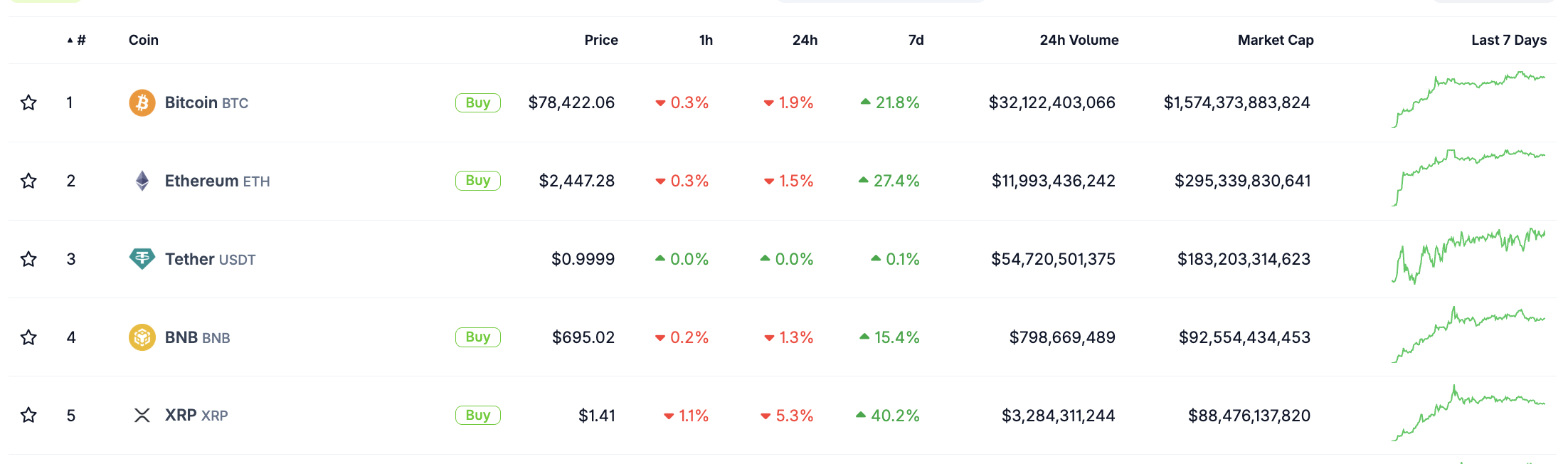
XRP is trading at $1.41, down 2% over the past 24 hours in a mild pullback after one of the sharpest weekly moves in the top-10. The token is still up more than 45% over seven days, and the question everyone’s asking is whether this is the start of something bigger or just a leveraged bounce running out of road.
XRP gained 50% over the trailing week, outpacing every other major altcoin, with a 40% move over 30 days despite still sitting 20% down year-to-date. Analyst Ali Charts flagged a 650% spike in active addresses, from 47,180 to 356,070.

All the signs are pointing to a move that is typically associated with sharp participation surges and, historically, elevated volatility. Receiving addresses reportedly jumped by over 698%, and three consecutive days of record Bitwise XRP ETF volume indicate “real accumulation.”
Whale positioning tells a more nuanced story than the retail hype cycle suggests. Long positions that dipped after initial profit-taking are climbing again. This means that smart money that already booked gains and is now rebuying the dip in a pattern that usually precedes continuation, not collapse, provided macro conditions cooperate.
Discover: The Best Token Presales
Can XRP Hit $1.60 This Week?
At just above $1.40, XRP sits in a post-breakout consolidation zone. Technical structure points to resistance at $1.51, $1.53, $1.57, and $1.62, while support is layered at $1.31, $1.30, and a much stronger floor near $1.00. The 24-hour flatness-to-slight-decline pattern suggests traders are digesting the prior surge rather than reversing it outright.
The bull case comes if XRP closes above $1.51 on sustained ETF inflow volume, opening a run toward $1.62-plus, with some analyst models citing $2.50 upside if fresh catalysts emerge. Consolidation between $1.31 and $1.52 could also happen, but a break below $1.30 invalidates near-term bullish structure and puts the $1.00 zone back in play.
$10 this year would require roughly a 7x move, which is not impossible in crypto, but nothing in the current data (ETF flows, address growth, whale re-entry) points to a catalyst of that magnitude yet. Worth tracking, not betting the farm on.
Trade XRP on Bybit and Get a Chance to Win Our $1,000 USDT Airdrop
Maxi Doge Targets Early Mover Upside as Ripple Token Tests Key Levels
XRP holders riding this rally have reason to feel validated, as a 45% weekly gain is nothing to scoff at. But XRP’s $80 billion market cap means even a run to $2.50 is “only” a double.
For traders chasing asymmetric upside, that math starts looking thin against something still in presale.
Enter Maxi Doge ($MAXI), an Ethereum-based meme token built around 1000x-leverage trading culture, think gym-bro energy meets degenerate trading floor.
The presale has raised $4.8 million at a current price of $0.0002835, with dynamic APY staking already live for early buyers. Standout features include holder-only trading competitions with leaderboard rewards and a dedicated Maxi Fund treasury for liquidity and partnerships.
The tagline, “never skip leg-day, never skip a pump,” sums up the pitch: lift, trade, repeat.
Research Maxi Doge before the presale window closes.
Discover: The Best Crypto to Diversify Your Portfolio
The post XRP Soars, But What’s Really Happening? Can Ripple Blast Past $10 This Year? appeared first on Cryptonews.

TIME and Statista have launched the 2026 list of Best Employers, based on independent employee surveys conducted in countries around the world. In Australia, Statista gathered 200,000 evaluations from employees across a wide range of sectors. These surveys asked open-ended questions about employees’ willingness to recommend their own employer and their willingness to recommend other employers in the same industry. The top 300 employers, ranked based on these results, were named Australia’s Best Employers 2026.
Although U.S.-based Apple leads the list, the majority of Australia’s top-ranked employers are locally based. These include New Zealand-founded fintech Xero (no. 2), homegrown software giant Atlassian (no.4), newer unicorn Canva (no.9), and more esoteric tech companies like casino slot machine manufacturer Ainsworth Game Technology (no. 10) and digital-first contractor Built Construction (no.8). The prevalence of tech firms as hotspots for talent signals a wider boom amid Australia’s startup scene, which in recent years has been attracting attention and investments from venture capitalists. According to a 2026 report from Side Stage Ventures, startups in Australia are using venture funding more efficiently than any other country, producing 1.22 unicorns for every $1 billion invested.
See the full list of Australia’s Best Employers of 2026 below:

The clip on Barron Trump follows a similar video released by the IRGC-affiliated Tasnim News Agency in July, which focused on First Lady Melania Trump, Barron’s mother. The July video also outlined alleged vulnerabilities in her security to carry out an assassination attempt, and ended with a threat: “Barron Trump, wait for us!”
Trump has been the subject of such threats from Iran since his first term. Iranian leaders have long targeted Trump since he ordered the airstrike that killed Iranian General Qasem Soleimani in early 2020.
Trump further enraged Iran when the U.S. launched a war with it in late February, with its revered Supreme Leader Ayatollah Ali Khamenei killed in the early strikes. His son and successor, Mojtaba Khamenei, has since vowed to avenge the death.
Portrayals of the deaths of Trump and his family have since been central imagery to Iran’s revenge narrative. Last month, a mural depicting portraits of the U.S. First Family on top of coffins draped in the American stars and stripes appeared in Palestine Square in central Tehran. The same month, in Enqelab Square, the site of pro-Khamenei demonstrations, especially following his passing, a billboard showed what appears to be Trump’s body peeking out of a coffin.
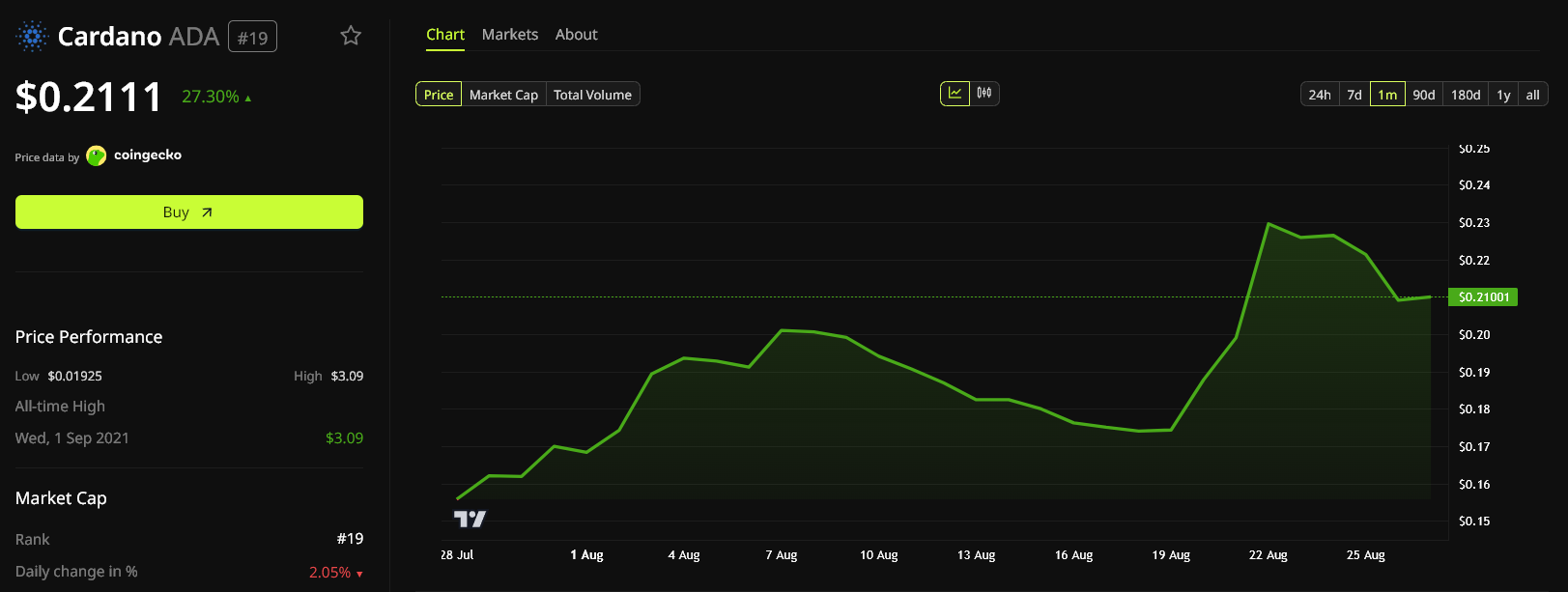
Cardano founder Charles Hoskinson says the network will “win this fight,” as ADA rebounds 26% and criticism of the ecosystem grows louder. He also revealed that cooperation with Ethereum developers could produce a working integration within months.
The comments offer Hoskinson’s clearest answer yet to claims that Cardano is losing relevance.
Hoskinson Pushes Back Against Cardano Critics
During a recent interview on The Breakdown with David Gokhshtein, Hoskinson addressed mounting criticism of Cardano’s ecosystem directly.
That criticism has intensified following ADA’s sharp decline from previous market highs, alongside ongoing governance disputes and struggles affecting some ecosystem projects. Some observers have questioned whether Cardano can maintain its position among leading crypto networks.
“It’s 2026, and we’re still talking about Cardano. We’re still inviting Charles to conferences, treating Cardano as newsworthy, accepting its sponsorship money, and giving it airtime on podcasts. Then we wonder why this industry struggles for credibility. We deserve the reputation we have. No serious industry keeps rewarding irrelevance like this,” ARK Invest’s Lorenzo Valente previously noted on X.
Hoskinson rejected that narrative, continuing to encourage the community to focus on the network’s long-term potential rather than short-term price action. He has previously stated his ambition for ADA to eventually become the largest crypto by market cap.
“Don’t bet against me, we’re gonna win this fight,” Hoskinson said, responding to questions about the network’s ability to recover and compete going forward.
Follow us on X to get the latest news as it happens.
ADA price performance offered some support for his optimism. The altcoin gained roughly 26% over the last week, according to BeInCrypto data.
Beyond price action, Hoskinson pointed to concrete development work underway.
Ouroboros Leios aims to significantly increase Cardano’s transaction-processing capacity, while Hydra remains a key Layer-2 initiative designed to support faster, more efficient transactions as the network competes with Ethereum and Solana on scalability and adoption.

Cardano Founder Backs Collaboration With Ethereum
After years of rivalry, Hoskinson said Cardano and Ethereum developers should work together. He wants Ethereum to explore Cardano’s UTXO-based technology, which changes how transactions and smart contracts are processed.
He said the collaboration would require no funding or apologies over past disputes and could produce a working integration within months.
“… it’s not like we would just be like no we don’t want to work with you. We’d be actually that’s great for both ecosystems. This is a natural easy academic and engineering collaboration which requires no transfer of money, no apologies, just an acknowledgement and just an desire to work together,” Cardano founder noted.
For Cardano, such cooperation could give its technology a much larger stage. It would also help Cardano connect more closely with Ethereum and show that ideas developed within its ecosystem can have value beyond ADA’s price.
Subscribe to our YouTube channel to watch leaders and journalists provide expert insights.
The post Charles Hoskinson Says Cardano Will Win, But With Ethereum’s Help appeared first on BeInCrypto.

Revolut began rolling out EURR, its first euro-denominated stablecoin, on August 26. The launch starts with selected customers in Portugal, Poland and Denmark, with wider EEA availability planned later this year.
But for European users, the obvious question is why use EURR when Revolut already offers USDC — or when users can simply keep euros in their account?
Three Things We Know About Revolut’s New Stablecoin
Revolut does not actually issue EURR. Bridge Building S.A., a Luxembourg-regulated company owned by Stripe’s Bridge, issues the token. Holders can redeem EURR with Bridge at €1 per token.
Also, its clearest difference from USDC is currency exposure. USDC tracks the US dollar, so its value in euros moves with EUR/USD. EURR tracks the euro, letting users move euro-denominated value onto Ethereum or Polygon without first taking dollar exposure.
However, this is still a tiny rollout. Bridge’s reserve page showed just 374 EURR in circulation at launch, backed by €374 in cash deposits. That makes EURR closer to a controlled pilot than an established rival to USDC.
Note: Stablecoins have become the most in-demand product for banking platforms. In fact, 39 US banking groups are currently developing their own stablecoin network.
What Revolut Still Hasn’t Explained
The biggest unanswered question is why the average Revolut customer should use EURR at all.
Revolut says EURR will connect fiat, crypto, external wallets and blockchains. But it has not announced a clear pricing advantage over USDC.
Its current fee schedule already allows supported fiat-to-stablecoin conversions without transaction fees within certain plan limits.
It is also unclear whether EURR withdrawals will be cheaper than USDC, where outside liquidity will come from, or whether Revolut will add payment or rewards features.
For now, EURR solves one clear problem. It lets Europeans take euros on-chain without converting them into digital dollars.
The post 3 Things to Know About Revolut’s New Euro Stablecoin appeared first on BeInCrypto.


A draft proposal would allow validators to deposit with quantum-resistant keys, then permanently stop accepting the format the network runs on today.
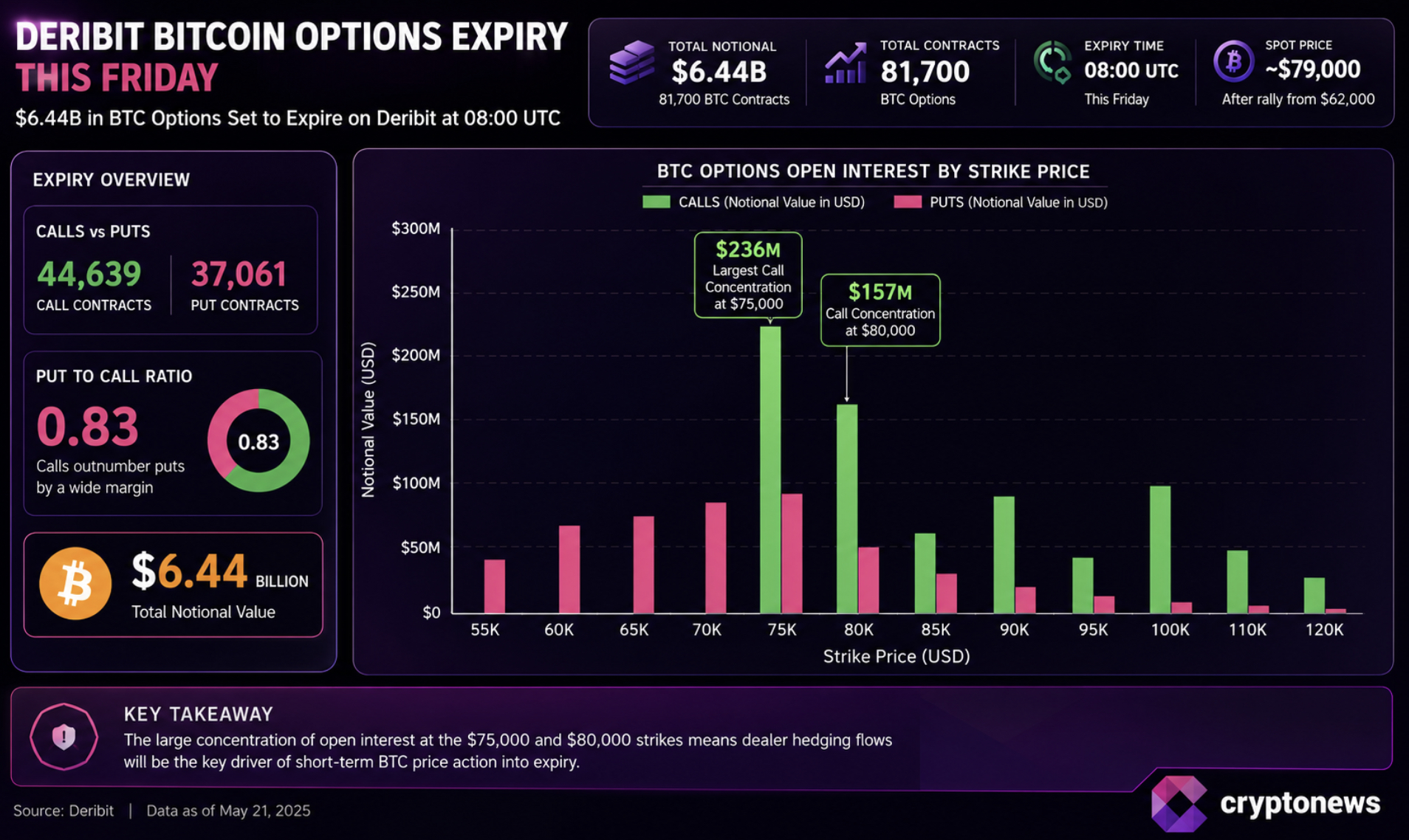
Bitcoin traders face a $6.44 billion options expiry on Deribit at 08:00 UTC this Friday, covering 81,700 BTC contracts as spot hovers near $79,000 after a rapid climb from $62,000. The size and positioning of that expiry, concentrated at the $75,000 and $80,000 strikes, puts dealer hedging flows squarely in control of short-term price action heading into settlement.

The expiry consists of 44,639 call contracts against 37,061 puts, producing a put-to-call ratio of 0.83, according to Deribit data. That skew shows calls outnumber puts by a wide margin, though the ratio alone doesn’t confirm directional conviction as some of those calls sit inside spreads or covered positions rather than outright bullish bets.
The $75,000 strike carries the largest call concentration at $236 million in notional value, with $80,000 close behind at about $157 million. Bitcoin’s rally pushed both strikes in the money, meaning holders can exercise profitably before accounting for premiums and fees.
Discover: The Best Token Presales
Gamma Hedging and the Pinning Risk at $80,000
Market makers hedge options exposure by trading spot or futures against their book, and that hedge ratio shifts fastest when the price sits near a heavily populated strike, or a dynamic known as gamma hedging. Deribit Chief Risk Officer Shaun Fernando said more than $500 million in notional value is positioned within 5% of Bitcoin’s current market price.
Fernando said that, adding that the concentration “may result in unusual pinning around key strikes or accelerate moves through them.” Which outcome dominates depends on dealers’ net positioning as information that the aggregate open-interest tape doesn’t fully reveal, so neither a pin near $80,000 nor a clean breakout above it can be treated as confirmed ahead of time.
A pinned market would see BTC hover close to $80,000 as dealers offset nearby moves; a decisive break in either direction could instead force dealers to trade with the move. That tension echoes the broader question of whether Bitcoin can clear resistance and extend toward levels discussed in recent technical coverage targeting $89,000.
Trade Bitcoin on Bybit and Get a Chance to Win Our $1,000 USDT Airdrop
Bitcoin Max Pain Near $68,000 Isn’t a Target
The expiry’s max-pain level, or the settlement price at which the largest volume of options expires worthless, sits near $68,000. It’s a $11,000 below spot. Max pain doesn’t account for hedging flows, entry prices, positions held off-exchange, or spot demand, and it has a poor track record of predicting actual settlement prices on expiries this size.
Reaching $68,000 by Friday would require a far larger reversal than a simple retreat to the $75,000 strike cluster, and nothing in current positioning suggests that move is underway. The figure is worth tracking as a reference point, not treating it as a forecast.

If Bitcoin holds within a tight band around $80,000 into the 08:00 UTC deadline, expect dealer hedging to reinforce that range rather than break it, consistent with a pinning scenario. If BTC instead pushes decisively through $80,000 or slips back under $75,000, gamma hedging could accelerate the move in whichever direction it breaks, given how much exposure is stacked at both strikes.
BTC volatility is also likely to compress once Friday’s contracts settle and near-term hedging demand rolls off, a pattern typical after large Deribit expiries.
The size of this settlement raises the odds of sharper intraday swings into Friday, but it doesn’t by itself dictate which way Bitcoin ultimately goes.
Discover: The Best Crypto to Diversify Your Portfolio
The post Dealer Hedging Puts Bitcoin $80,000 Zone in Focus appeared first on Cryptonews.

BREAKING: XRP Is about to run HARD.

Fires in Stourbridge which destroyed 19 homes started accidentally

ETMarkets Smart Talk | Large caps look better for next 24 months, but hidden gems remain in smallcaps: Divam Sharma





-

 Fashion5 days ago
Weekend Open Thread: Madewell – Corporette.com
-

 Business4 days ago
Musk’s Tesla, SpaceX Confirm $16.8 Billion ‘Terafab’ Chip Plant as World’s Largest Building in Texas
-

 Crypto World4 days ago
anatomy of crypto’s biggest liquidation event since 2021
-

 Crypto World2 days ago
A $30 Billion AI Fund Implodes, Now the SEC Is Investigating Wall Street’s Role
-

 Politics4 days ago
6 months on, Irish renters crushed by effects of government housing bill
-

 Crypto World15 hours ago
SpaceX stock could rise 75% to $240, JPMorgan says
-
 NewsBeat4 days ago
The ‘Lucky Dip Gang’ causing carnage for clicks: After five thugs were killed speeding in the wrong direction on a motorway, GUY ADAMS investigates a sick new trend… and why police aren’t even allowed to pursue them
-

 Business3 days ago
Mystery AI Model ‘Ox Alpha’ Draws Developers With Free Access as Chinese Lab Origins Remain Debated
-

 News Videos6 days ago
Don’t Leave Your Financial Future To Chance | August 19, 2026
-

 Business7 days ago
Marvell Shares Jump 7% as Google Chip Deal Confirms Custom AI Silicon Partnership, Analysts
-

 Business6 days ago
Five Below: Kids Discount Retailer Reaps Rich Rewards
-

 Business2 days ago
Moderna CEO warns China is pouring state money into mRNA technology
-

 Business5 days ago
UK firms in critical financial distress rise 9% to 53,756
-

 Business2 days ago
NVIDIA Stock Drops Nearly 2 Percent to $210 on Seventh Losing Day Ahead of Critical AI Earnings
-

 Sports3 days ago
Deshaun Watson fires back at Browns fans after being booed: ‘It’s a disrespectful thing’
-

 Crypto World6 days ago
Optimism-funded team's deciding vote shifts $49 million in OP tokens away from users
-
 Entertainment7 days ago
10 Most Perfect Fantasy Shows of the Last 25 Years
-

 Tech6 days ago
OpenAI confirms ChatGPT is down as logins and signups fail
-

 Business6 days ago
PayPal and Venmo now accepted for tuition at several universities
-
 Crypto World3 days ago
Google Gemini AI Predicts Ethereum Could Become the Trade Retail Misses in 2026
You must be logged in to post a comment Login