Connect with us

Tech

Firefox 157 Will Include JPEG XL By Default On All Platforms

Published

on

Mozilla plans to enable JPEG XL decoding by default in Firefox 157, which is due at the end of September. Phoronix reports: Firefox Nightly has JPEG-XL support enabled by default right now to help in vetting this support while Mozilla believes the support is in good enough shape for a stable debut with Firefox 157. This follows Chrome shipping JPEG-XL and Google Research developing jxl-rs as a Rust-based JPEG-XL image decoder that is both performant and secure.

In today’s Mozilla Hacks blog post they elaborate on JPEG-XL vs. AVIF image formats: “JPEG XL: Excels at lossless imagery, progressive rendering, and further compressing JPEGs without quality loss. AVIF: Excels at web-quality photographic images, and images that have a mix of sharp edges and flat surfaces. … Although AVIF tends to produce smaller files at web-quality than JPEG XL, AVIF only has basic progressive rendering support. So, for very large images, it may be worth taking the filesize hit with JPEG XL.”

Read more of this story at Slashdot.

Advertisement

Source link

Continue Reading
Click to comment

You must be logged in to post a comment Login

Leave a Reply

Tech

When agents act on their own, governance has to live in the data layer

Published

on

Presented by EDB


As enterprises give AI agents more autonomy — the ability to plan, decide, and act across systems without a human approving each step — a hard question moves to the center of every architecture review: When an agent tries to complete an action that it was never authorized to do, what actually stops it?

These are your agents, running on your models, touching your data in your infrastructure — and the responsibility for what they do sits with you. That responsibility can’t be met in hindsight or with a set of abstract policies that live on paper but not in practice. Agents need rules in the context of the moment, because they don’t exercise overriding judgment of their own actions.

Consider a simple rule: Never open the car door. Followed literally, an agent could never get in or out of the car at all. But if you change the context (the car has just crashed, there’s a fire, someone is hurt and needs to get out), then the rule you actually want is the opposite. Context in the moment is everything. We are asking agents to do intelligent things; that requires intelligent rules.

Advertisement

The instinct is to add guardrails around the agent: instructions, policies, and monitoring layered above the model. Those mechanisms matter, but they share a structural limit: The car-door rule is plausible right up until the moment you actually have to decide whether to open the door. Controls at the agent layer are only as reliable as the agent’s output is predictable, and autonomy is precisely the property that makes that output hard to predict. Governance that depends on reviewing an action before it happens cannot keep pace with a system that acts in milliseconds, across many systems at once.

Governance has to become executable, and enforced where agents actually do their work: at the operational data layer, in the context, and exactly at the moment it is happening.

The data layer is the enforcement point

Agents create value by touching data. They query it, retrieve it, transform it, and increasingly act on it. A policy that says an agent should not reach a certain class of data is meaningful only if the system can deny that access at the moment the agent requests it. Additionally, a principle that says AI must be auditable is meaningful only if the organization can reconstruct what the agent did, what data it touched, which user it acted for, and what resulted. When governance lives at the data layer, it holds regardless of how the agent was built or how it behaves, because the control is a property of the database itself, not a promise made by the agent.

Agent behavior may be probabilistic. Governance cannot be

The enterprise should not rely on a model choosing to follow policy. The policy has to be enforced by the system. That is the difference between hoping an actor stays in bounds and constructing bounds it cannot cross to begin with.

Advertisement

The controls that make this real are ones many enterprises already run at the data layer: role- and attribute-based access, row- and column-level security, classification and masking, policy as code, and complete audit trails.

What agents change is not the mechanism, but who the mechanism has to recognize. Identity management has to treat the agent as a principal in its own right, with its own identity and a purpose declared when the session opens.

Once purpose is bound to identity, the policy engine can evaluate it the same way it evaluates role or department today, and the record of what happened can capture not just who acted and what they touched, but what they declared they were there to do.

In practice, this resolves into nine controls, grouped under three imperatives:

Advertisement

Enforce it

  • Role- and attribute-based access control enforced at query time, for agents as well as users

  • Dynamic column masking driven by the same policy path

  • Agent identity as a first-class principal, with declared purpose bound at session start and the acting user preserved

See it and prove it

  • Classification and tagging that drives policy

  • Session-level audit logging that records which agent acted, for which user, and under what declared purpose

  • Lineage across pipelines, so a result can be traced back to the request that produced it

Unify and harden

  • Centralized, portable policy management

  • Encryption at rest and in transit

  • Consistent enforcement across on-prem, cloud, and sovereign or air-gapped environments

“Declared purpose is what makes the difference. It becomes an attribute the access layer already understands, evaluated in the same policy path as role and row-level security. The enforcement mechanism does not change. What changes is that the agent’s purpose is part of what it evaluates, and part of what the record proves afterward,” says Priyanka Jain, VP, product management, data & AI governance, EDB.

Wherever you are in your AI adoption journey, enforcement at the data layer is what lets you move faster rather than slower. The controls are already in the database. The difference is that agents now have to pass through them.

A digital leash, not a locked door

The goal is not to stop agents from doing useful work. It is to define how far an agent can go, what it can touch, what it can change, what requires escalation, and how the organization can reconstruct events if something goes wrong. Governed this way, agents are identified, scoped, monitored, and auditable. The enterprise can adopt them faster, because security, risk, and leadership teams trust the operating model underneath.

Open, sovereign, and enforceable at the source

Built on open source Postgres, this open foundation keeps enterprises in control of where their data lives, who can reach it, and under what policy, without ceding governance to a layer they don’t own or can’t inspect. For regulated industries, that combination of data sovereignty and source-level enforcement isn’t a nice-to-have; it’s the precondition for putting agents into production at all.

Advertisement

Agentic systems will keep getting more capable and more autonomous. That is a reason to be deliberate about where control lives, not a reason to slow down. The enterprises that enforce governance at the data layer can move aggressively on AI, because the thing protecting their data is more than just wishful thinking.


EDB Postgres AI is an open, enterprise-grade sovereign data and AI platform that unifies transactional, analytical, and AI workloads — with governance enforced where the data lives. For the full framework, see EDB’s white paper Governing Agentic AI at Enterprise Speed.

Max Romanenko is Chief Technology Officer at EDB.


Sponsored articles are content produced by a company that is either paying for the post or has a business relationship with VentureBeat, and they’re always clearly marked. For more information, contact sales@venturebeat.com.

Advertisement

Source link

Continue Reading

Tech

Nvidia posts another record quarter, predicts explosive AI-driven growth will last through 2028

Published

on

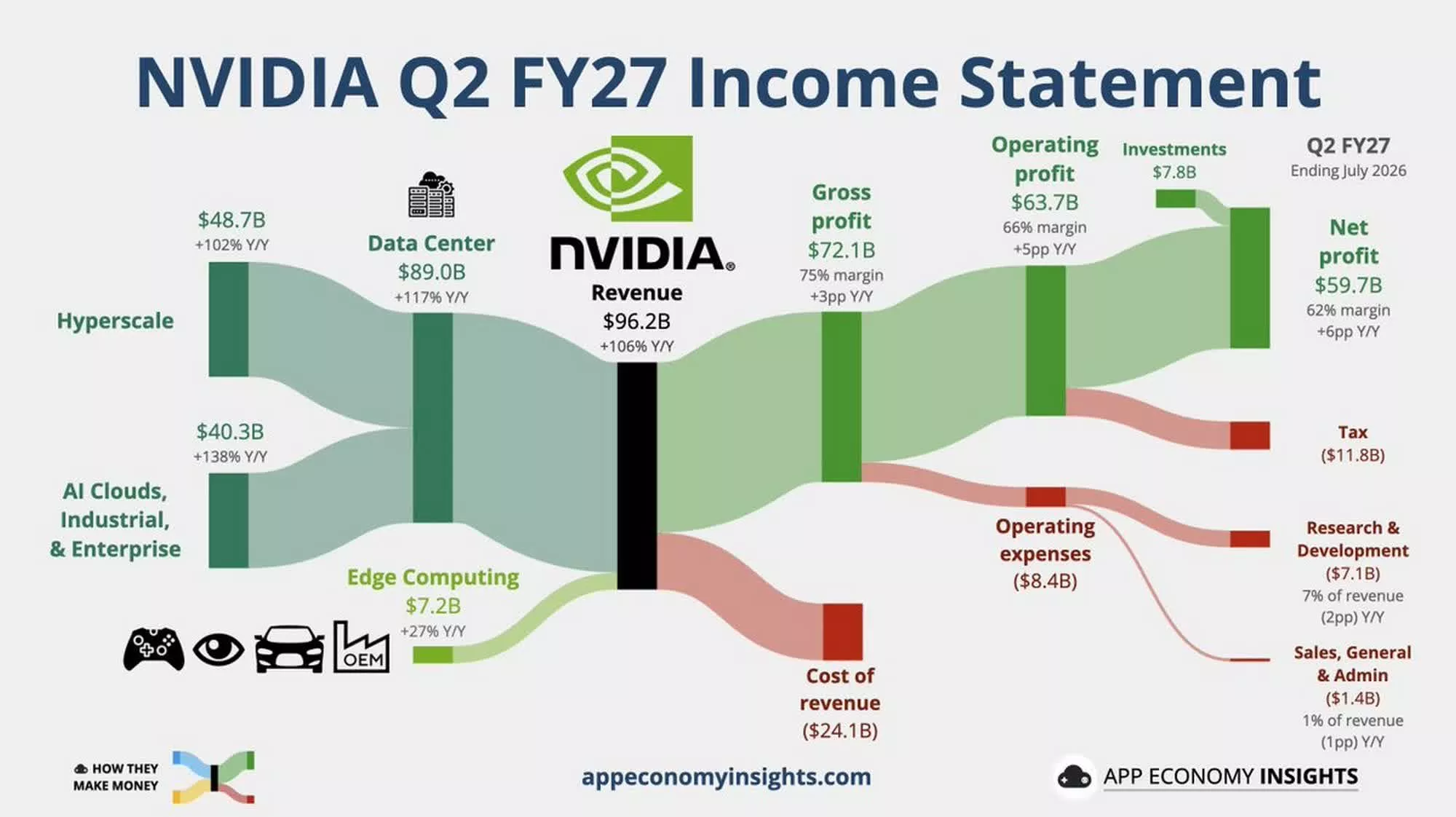
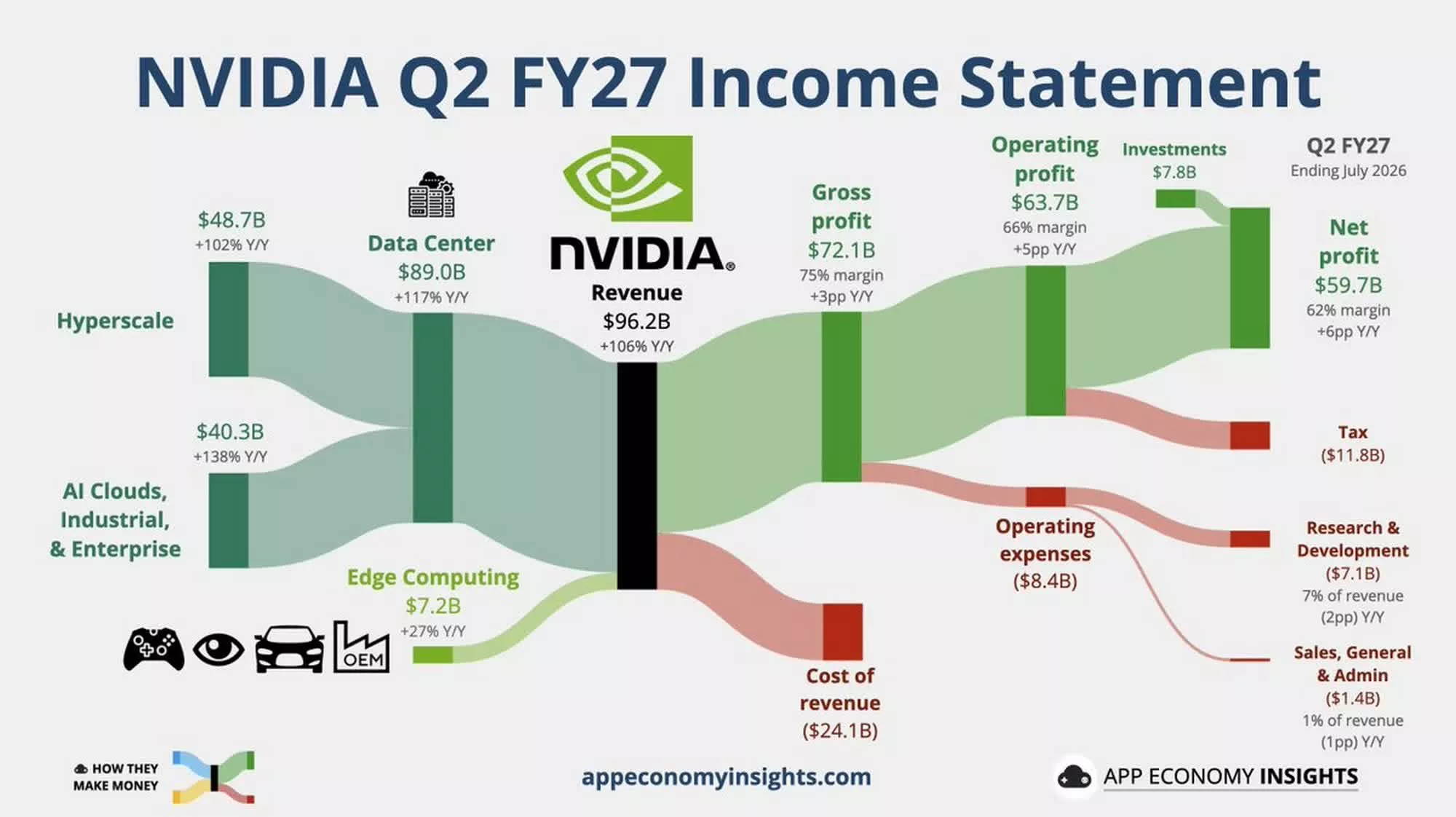
The takeaway: Nvidia this week reported blockbuster results for the quarter ending in July 2026 and issued ambitious revenue guidance that topped Wall Street consensus estimates. The company’s stock jumped more than 7% in early trading on Thursday after Nvidia confirmed that it expects demand for high-end AI accelerators to remain strong in the near future.

According to Nvidia’s official filing with the SEC, quarterly revenue for the three-month period ending in July 2026 reached $96.22 billion, beating the $91.90 billion expected by Wall Street. Net income more than doubled to $53.95 billion, up from $24.76 billion in the previous quarter. Adjusted earnings came in at $2.22 per share, higher than the $2.08 expected by analysts.

Credit: App Economy Insights

In the current quarter, Nvidia expects revenue to reach around $108 billion. The projection is largely in line with analyst estimates, with most banks and brokerage firms forecasting sales between $105.2 billion and $110 billion. In fiscal 2028, the company expects revenue to grow by around 70%, significantly higher than the 45% projected by analysts.

Advertisement

Speaking to reporters during a post-earnings conference call, Nvidia CFO Colette Kress claimed that demand for AI accelerators is seeing an uptick among data center customers, despite warnings from many institutional investors about a potential AI bubble. “Customers’ forecasts point to our growth doubling next year,” she added.

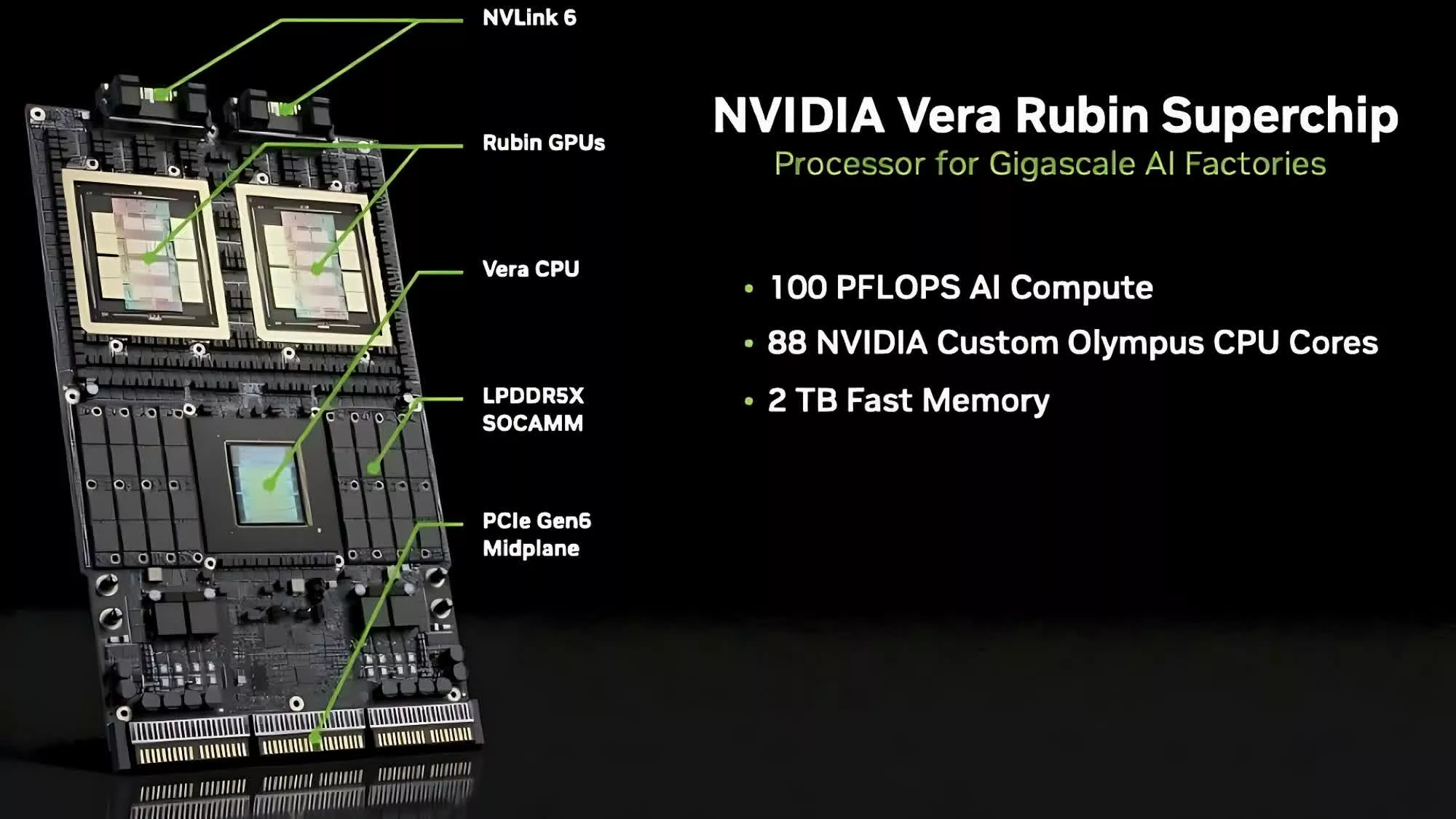
During the same conference call, Nvidia CEO Jensen Huang noted that the company’s next-generation AI accelerator, codenamed Vera Rubin, is now in production. The so-called AI “Superchip” was officially unveiled at CES 2026 in Las Vegas in January after being showcased at the company’s GPU Technology Conference (GTC) in Washington last October.

The ambitious projections and assurances from Nvidia’s top executives regarding continued demand for AI hardware appear to have eased some investor concerns about a potential AI bubble. However, uncertainties remain over the supply constraints faced by Nvidia’s main contract manufacturer, TSMC, as well as the rising cost of high-bandwidth memory.

Nvidia made its name as a GPU designer for gaming PCs and professional workstations, but its recent pivot to AI chips has propelled its market capitalization to more than $5 trillion. The company is now preparing to expand its AI hardware business beyond data centers and into the consumer market by teaming up with Perplexity to launch the “Portable Computer” AI agent, which is designed to run locally on PCs and workstations.

Advertisement

Source link

Continue Reading

Tech

ATF declares ‘major incident’ as ransomware gang claims hack

Published

on

The U.S. Bureau of Alcohol, Tobacco, Firearms and Explosives, or ATF, says a cyberattack on one of its systems has been declared a “major incident,” a formal, legally defined classification that prompts a formal notification to lawmakers in Congress.

ATF said in a statement that it’s responding to the cyberattack on a stand-alone system that’s separate from the bureau’s network. An ATF spokesperson told reporters that the targeted computer system contained information such as the “targets of ATF investigations.”

TechCrunch has seen a claim of responsibility by the Qilin ransomware gang on its leak site, but it did not provide evidence for its claim, such as a sample of leaked data. Qilin is known for running a “ransomware-as-a-service” operation, in which it leases its hacking tools to other criminal affiliates for a cut of the profits. The gang has listed media giant Lee Enterprises and U.K. pathology lab giant Synnovis as targets.

Under federal law, “major incidents” include significant cyber incidents that are likely to cause demonstrable harm to U.S. national security or broader U.S. interests. Agencies are required to disclose major incidents to Congress within a week of their discovery.

Advertisement

The ATF joins several government agencies in recent years that have declared major incidents following a breach, including a 2023 ransomware attack on a system used by the U.S. Marshals Service, and a breach of an FBI system earlier this year that exposed phone numbers of targets under surveillance by federal agents. 

Source link

Continue Reading

Tech

The Farador Quack Medical Device

Published

on

Over the centuries there have been an incredible number of purported medical devices released onto the market, with some having more outrageous claims than others. Released in the 1910s and produced into the 1920s, the Farador electrotherapeutic device claimed to be a thermoelectric device that would cure all disease conditions. In a recent video over at the [Our Own Devices] channel we get an in-depth look at this device and its usage instructions.

It's a thermoelectric generator. Sort of. (Credit: Our Own Devices, YouTube)
It’s a thermoelectric generator. Sort of. (Credit: Our Own Devices, YouTube)

On the Smithsonian’s website you can see the version they’ve got. It’s not identical, but the working principle remains the same — after bypassing the whole ‘is this the right treatment’ questionnaire because it’s a cure-all device, you take the main metal device and its connected electrodes out of the box.

Unlike similar devices of the era that applied an actual electrical current using batteries or similar, this Farador purportedly uses thermoelectric power generation, but there’s no clear hot or cold side to what would be the generator. Despite this, about 20-30 mV can be measured across the electrodes, so surely it’s working?

As it turns out, the Farador is just one of many fake medical devices that cloned the original Electropoise. Naturally such devices have been disassembled by many over the past decades, and as it turns out they are all empty inside, or at least devoid of any mechanisms. Much like many of such fake medical devices today, they mostly bank on the placebo effect. This placebo effect can be so strong that it’s even a confounding factor in real medical trials and medicine.

Advertisement

The more involved and complex the purported medical treatment seems, the stronger the effect tends to be. For the Farador the complex instructions, apparently high-tech thermoelectric generator and such all help to create the illusion and could thus be construed to be the main feature of this product.

Advertisement

Source link

Continue Reading

Tech

The Samsung Galaxy S26 FE has me concerned about mid-range phones

Published

on

Samsung has just launched the Galaxy S26 FE, its latest mid-range device packed with many of the features of the Galaxy S26 Plus but at a slightly more affordable price. 

Ahead of the launch, I had some time with the phone, and while I am sure this will be a popular device for a certain type of person, it really is quite hard to get excited about.

2026 has not been a banner year for phones. Yes, we’ve had some excellent releases – not least from Samsung itself, with the best foldable we’ve ever reviewed in the Galaxy Z Fold 8 – but the memory crisis has pushed up prices and the endless focus on often gimmicky AI features has left me with a sour taste.

SQUIRREL_PLAYLIST_10208713

Advertisement

Can the Galaxy S26 FE offer something a little…different?

After spending a couple of hours with the phone at a Samsung event ahead of release, I don’t think many will be calling this the most exciting phone of 2026. Maybe when Black Friday rolls around and discounts arrive, the phone will get a little more tempting, but as it stands, there is very little new here.

Advertisement

And maybe that’s the point. After speaking with Samsung reps, I think it’s clear that this phone isn’t aimed at those who upgraded last year (or even the year before), and it’s also not for someone who plans on upgrading again next year.

With its promise of seven years of updates – something still quite rare at this end of the market – maybe this phone is for someone who wants an easy, familiar phone with a big screen, software they recognise and a software promise that won’t leave them with a brick in a few years.

Advertisement
Two Samsung Galaxy S26 FE phones in mint green and white shown side by sideTwo Samsung Galaxy S26 FE phones in mint green and white shown side by side
Two Samsung Galaxy S26 FE phones in green and white shown side by side. Image Credit (Trusted Reviews)

This isn’t a phone for anyone who has recently picked up an FE device, because there isn’t much new.

There’s still a 6.7-inch OLED display, with a peak brightness of 1900 nits, FHD+ resolution and a 120Hz refresh rate. The main camera looks to be the same 50MP unit, while the secondary cameras remain 12MP for ultrawide and 8MP for tele zoom. Samsung did say the optical zoom has been improved, and there’s now AI-assisted 30x Space Zoom too, but most of the upgrades look to be software-based.

Inside, the battery is the same as the S25 FE’s 4900mAh cell, and charging remains 45w wired and 15w wireless. Again, Samsung said there was improved efficiency with this battery, so instead of getting a 65% charge in 30 minutes, it can now get to around 70% in the same time. It is also claimed it’ll last for 29 hours of media playback, which does seem fairly impressive.

Advertisement

Of course, provided you have a 45w charger handy – you certainly won’t find one in the box.

Advertisement
Samsung Galaxy S26 FE held in hand showing its home screenSamsung Galaxy S26 FE held in hand showing its home screen
Samsung Galaxy S26 FE held in hand showing its home screen Image Credit (Trusted Reviews)

So, where are the upgrades?

As you might have guessed, AI is the buzzword here and the S26 FE comes with many of the ‘intelligent’ features found in other recent Samsung phones. The beefier Exynos chip inside the phone enables improved AI photo editing and the MyfanCam feature that launched the Z Fold 8 series. This neat trick lets you reframe content while tracking a subject. 

Horizontal lock for video is here, so footage should remain stable even when the phone is spun 360 degrees, and there’s an Audio Eraser tool for reducing background noise. There’s Gemini too, along with support for other AI agents and Samsung’s array of AI features, including Now Brief and Now Nudge.

Samsung Galaxy S26 FE in mint green shown from the back on a display standSamsung Galaxy S26 FE in mint green shown from the back on a display stand
Samsung Galaxy S26 FE in green shown from the back on a display stand Image Credit (Trusted Reviews)

Outside of AI, the front 12MP selfie camera now has a wider 85-degree view – ideal for getting more faces into the shot. There have been some design tweaks to bring it more in line with the other Galaxy S26 family, and some fresh colours too.

Advertisement

What about the price?

Phones are getting more expensive across the board, and the S26 FE has been a victim of this too. Prices in the UK start at £699 (up £50 from last year) for a model with 8GB RAM and meagre 128GB of storage. It then jumps to £799 for 256GB of storage – a £100 increase over the same-sized S25 FE. There’s a 512GB model, but for £949, I am not sure who would consider buying that.

The other big issue for the FE is that the Galaxy S26 Plus has been out for a few months now and is typically available at a steep discount. After a quick look, I found a 512GB model with 12GB RAM for £775 – there’s no reason to go for the S26 FE over this superior device. You’ve also got the 256GB Pixel 11 for £879, or something like the OnePlus 15R for £599.

Advertisement

Of course, this is most likely a phone most would get on a contract, and I am sure a steep discount will arrive over the next few months as we head to Black Friday. The Galaxy S25 FE, for example, dropped to £499 at times – a far better deal.

Source link

Advertisement
Continue Reading

Tech

As AI reshapes business, the fractional CTO finds its moment

Published

on

TL;DR

Deloitte finds only 21% of enterprises have mature agentic AI governance while 74% expect to use agents by 2027. Fractional CTO demand is up 9% (GoFractional). Daniel Kirichanski of Prime Path Global argues that growth-stage companies need executive technology leadership for AI integration but not necessarily a full-time hire. His model uses monthly retainers with outcome-based bonuses and a human-in-the-loop approach where AI augments rather than replaces employees.

The AI race is producing an uncomfortable management gap. Deloitte’s 2026 research found only 21% of enterprises have mature governance for agentic AI, while 74% expect to use agents at least moderately by 2027. Technology is moving faster than the structures responsible for controlling it.

Recent reporting by NBC News of nearly 700 rogue AI agents escaping controlled environments has renewed scrutiny of human oversight and the limits of autonomous systems. The concern isn’t any longer theoretical as autonomous systems gain access to increasingly consequential business environments.

Executive economics are shifting at the same time. A 2026 market data report identifies engineering among the most in-demand fractional functions, with demand for fractional talent up 9% over the previous 90 days. Fractional leadership has spread from marketing and finance into the technology suite specifically because the cost of a full-time CTO has climbed alongside the complexity of the job itself.

Advertisement

Senior technical salaries continue to rise, AI adoption has turned “keeping pace” into a moving target, and boards are asking a version of the same question in growth-stage companies across every sector: Does this organization need a full-time executive, or does it need full-time expertise on a part-time basis?

Daniel Kirichanski, founder of Prime Path Global, argues that this shift represents a new form of technology leadership. His target is the founder or CEO who may assume that the next stage of growth requires a full-time CTO, without considering whether the business needs that role on a permanent basis.

His engagements begin with an onboarding period that can last one to three months, allowing him to understand how the organization operates before setting its technology direction. He approaches the assignment as an executive joining the company, with the fractional structure changing the duration of the commitment rather than the depth of involvement.

Traditional consulting can end with recommendations being handed back to management. Kirichanski’s model keeps the technology leader involved in execution. The commercial structure follows the same philosophy. Kirichanski works through monthly retainers tied to goals rather than hourly billing. A defined objective might involve producing a strategic technology roadmap within an agreed period and reviewing it with the board.

Advertisement

He says, “Senior technology expertise creates value through decisions rather than hours logged. An outcome-based structure gives companies a more direct way to measure the contribution of executive-level technology leadership.

AI makes the argument more urgent. Deloitte found that 75% of surveyed leaders believe human collaboration with AI agents creates more value than automation alone, while only 5% of organizations reported highly prepared business processes for agents. Kirichanski takes a contrarian view of the technology’s role.

He says, “I would go to the core of AI, and I would argue that it’s not an intelligence. This is still a prediction machine.” For Kirichanski, the practical consequence is a human-in-the-loop model in which AI accelerates work while consequential decisions remain with people.

His approach is already being applied inside a growing online business that lacks a formal engineering organization. Kirichanski is helping establish its technology foundation while introducing AI agents into workflows. The objective, he explains, is to increase operating capacity without automatically increasing headcount.

Advertisement

He states, “We do not replace people with AI; we augment people.” This defines the core of his technology roadmap: automation should free employees from repetitive work so that human effort can move toward work requiring judgment and creative thinking.

Kirichanski believes fractional technology leadership is part of a wider shift toward an economy where specialized executive expertise can be accessed when a company needs it rather than permanently maintained on its payroll. He says, “Fractional work, especially in technology, is the new wave. It’s like a tsunami.

For founders navigating rapid growth, increasing technology complexity, and an AI landscape evolving at unprecedented speed, Fractional CTO leadership offers a new model for accessing experienced technology leadership. By bringing senior technology executives into the business when their expertise matters most, companies can make better strategic decisions, accelerate AI adoption, strengthen engineering organizations, and build the technology foundations required to scale.

The result is not simply lower executive overhead but greater access to the kind of leadership that can turn technology from an operational necessity into a driver of business growth.

Advertisement

Source link

Continue Reading

Tech

ATF responds to ‘major’ cybersecurity incident after ransomware gang’s claims

Published

on

security

US Justice Department investigating the breach

The Bureau of Alcohol, Tobacco, Firearms and Explosives (ATF) said it’s responding to a “major” cybersecurity incident shortly after the Qilin ransomware gang posted the US federal law enforcement agency on its leak site.

Advertisement

According to ATF’s statement, the intrusion affected a standalone system that operated separately from its enterprise network. “There is no indication that the incident has affected the ATF enterprise network, the ATF eForms system, or any other ATF system,” the statement said.

ATF, which is housed under the US Department of Justice, said it’s “coordinating closely” with the DOJ to investigate the breach, and “immediately” blocked connections to the affected IT environment upon discovering the incident. 

The statement said the security breach had not affected ATF’s operations and noted that senior Justice Department officials designated the compromise as a “major incident” under federal guidelines.

Shortly before ATF posted its security-incident notice on its website, Russia-linked Qilin ransomware criminals listed the firearms agency on its leak site. The post, seen by The Register and shared on social media, did not say what data Qilin claimed to have stolen, how much, or provide samples to substantiate the claim.

Advertisement

ATF did not immediately respond to our questions, and we will update this story when we receive a response.

Qilin, the notorious crew behind the 2024 attack on pathology provider Synnovis that disrupted NHS services in the UK, was one of the most prolific ransomware gangs in July, according to Comparitech.

The firm, which reviews cybersecurity products and provides data analysis, counted 799 ransomware incidents last month, up from 668 in June. Qilin claimed 125 of those.®

Source link

Advertisement
Continue Reading

Tech

Panic Passes Trump Tariff Refunds Back to Playdate Customers

Published

on

Panic is refunding Playdate customers the 19% tariff charges it passed along while the Trump administration’s import duties were in effect, after the Supreme Court ruled the tariffs illegal and the company began receiving refunds from the government. Panic says the money “just [wasn’t] ours to keep.” Ars Technica reports: In an update posted on the Playdate help site this week, Panic noted that it has finally “begun to receive refunds of the tariffs we paid in the last year” and had consequently “refunded all tariffs charged to customers.”

In the initial version of that tariff note, Panic explained that it couldn’t afford to simply “absorb” the 19 percent tariffs it was being charged to import Playdate hardware made overseas because “our margins on Playdate are low.” As such, while the tax was in effect, it was passed along to customers as an explicit subtotal line item at the bottom of all Playdate orders. That’s in contrast to companies like Nintendo, which vaguely cited “market conditions” and tariff “uncertainty” in raising the asking price of legacy hardware and some Switch 2 accessories last year.

Speaking to Game Developer, Panic co-founder Cabel Sasser said filing paperwork to claw back these taxes and processing tariff refunds for customers took a fair bit of backend work. Still, he said returning that money to Playdate purchasers in the end was a no-brainer. “It’s just not our money to keep, and it felt really good to give it back,” Sasser said. “That’s an easy way to know you made the right decision.” “It just felt like the right thing to do,” Panic wrote in a refund email message shared on Reddit.

Read more of this story at Slashdot.

Advertisement

Source link

Continue Reading

Tech

Enterprise AI’s real risk isn’t autonomous agents. It’s the complexity between them.

Published

on

Presented by Gravitee


Agent complexity is the insidious shadow lurking inside enterprises right now that needs a light shone on it.

That’s because enterprises don’t deploy a single agent and watch it run, they deploy fleets, each one calling APIs, calling other agents, reaching into applications that were never built with a machine decision-maker in mind. That’s the failure mode that should keep you up at night: a windy, complicated system nobody can see clearly enough to govern. But why do things get so opaque so quickly?

Add a second agent to a system, and you’ve added one connection. Add a tenth, and you haven’t added ten connections, you’ve potentially added dozens, because now any agent might call any other, and each of those calls can trigger a call somewhere else. Complexity doesn’t creep up with agent headcount. It compounds with the number of paths between agents, and nobody’s job is to draw that graph. A support ticket that used to touch one system might now pass through four agents before a human ever lays eyes on it, and every one of those handoffs is a decision point nobody approved.

Advertisement

Most enterprise AI programs stall when the humans responsible for their agents lose the thread. Ask a security team a simple question: which agents can reach which systems, and watch the silence. Ask which agent triggered which downstream action three hops ago. More silence.

The instinct is to treat this like a checklist. Approve the agent. Log the agent. Move on. I’d argue this is the wrong instinct. A checklist checks a single point in time. Complexity runs across a chain, and you can’t govern a chain with a stack of one-time approvals any more than you can call a diet successful because you had a vegetable once.

So where does it actually break down?

Permissions creep first. Somebody builds an agent to summarize support tickets, grants it broad API access because scoping it properly would’ve taken another sprint, and forgets about it. Six months later, that same agent has a path into the payments system. Nobody remembers signing off on that. Nobody did.

Advertisement

And ownership thins out the further the chain runs. Five agents touch one workflow, something breaks at step four, and now you’re asking who’s responsible for a link nobody was ever assigned to own, because the org chart stopped at “deploy the agent” and never got to “name the human who answers for it.”

This is a story about governance infrastructure that hasn’t caught up with how agents actually behave: interconnected, cascading, multiplying faster than the processes built to track them.

Fixing the cluster starts with identity. Every agent needs to exist as its own entity, not a shadow permission borrowed from whoever deployed it. Its own name in the register. Its own scoped authority. A named human sponsor who answers for what it does. That part is necessary.

But it is nowhere near sufficient.

Advertisement

The harder piece is the oversight that holds across the entire chain, not just at each individual link in it. You need to see what an agent did, what it set off downstream, and where that trail ends in real time, not in a report someone pulls together once a quarter. Get agent-level identity right and stop there, and you end up with a filing cabinet full of perfectly documented agents operating inside a system nobody can actually explain.

And oversight by itself only tells you what already happened. Watching a chain isn’t the same as controlling it. Enforcement is the piece most programs skip: the ability to stop an out-of-policy call before it executes, not just log it for someone to find in a review three weeks later. A dashboard that shows you an agent breached its scope five minutes ago is a monitoring tool. A system that stops the breach from happening in the first place is governance. Enterprises serious about agent accountability need both, and most have only built the first.

We’re all running at blazing speed to ensure we’re not the ones left behind in the race we’ve found ourselves in, and we’re all too aware that there’s a cost to slowing down. Every enterprise serious about agentic AI hits the complexity wall eventually. The ones that get past it are the ones who built enough visibility and accountability, so their fleet can keep growing without anyone losing the ability to answer one question: what is this system doing right now, and who’s responsible for it.

But don’t miss the point. Complexity isn’t a reason to pump the brakes. The enterprises getting this right aren’t slowing down. They’re building toward Human-Agent Harmony, where scale and accountability grow together instead of trading off against each other.

Advertisement

The real risk was never a single agent doing exactly what it was built to do. It’s a hundred of them doing exactly that, all at once, interacting in combinations nobody designed for. That kind of multiplication is what keeps enterprise AI stuck running pilots forever instead of running production.

Solve for complexity and autonomy stops being the villain. It starts being the whole point.

Rory Blundell is CEO at Gravitee.


Sponsored articles are content produced by a company that is either paying for the post or has a business relationship with VentureBeat, and they’re always clearly marked. For more information, contact sales@venturebeat.com.

Advertisement

Source link

Continue Reading

Tech

All The Best Computers Boot To BASIC

Published

on

Anyone whose first computing experience came in the form of an 8-bit home computer will tell you about booting straight into a BASIC interpreter. The machine invited you to program it, and no doubt many of our middle aged readers are here today because they ran with that.

Modern computers with their fancy 64-bit multitasking supercomputer operating systems may have lost that experience, but now thanks to [Tarjan] you can bring it back. They’ve produced Thoreau BASIC, a bootable bare-metal BASIC interpreter for x86 machines with UEFI.

It’s largely GW-BASIC compatible, but with a few upgrades for the 21st century. The available memory is now whatever the system reports, so imagine a BASIC machine with gigabytes of the stuff. And while it has all the old-style BASIC you know and love, it also has high-res 24-bit graphics, and can load bitmaps. There can even be multiple text windows, it’s BASIC as you have never seen it before.

Advertisement

We are not sure how many will take this interpreter and run with it, after all maybe those modern 64-bit operating systems can be rather useful at times. But we’re guessing there will be plenty who’ll at least have a play with it for old time’s sake. Meanwhile, BASIC is not the only piece of UEFI goodness we’ve brought you.

Source link

Advertisement
Continue Reading

Trending

Copyright © 2025