
Crypto World
SEC’s Proposed Crypto Cules Probably Won’t Spark New ICO Boom


After what feels like a lifetime in the making, the SEC’s proposed new Regulation Crypto Assets rules could finally make public token sales easier in the United States.
The proposal would allow qualifying issuers to raise up to $75 million during any 12-month period, and potentially allow projects to return to investors to raise more funds year after year as they build out their networks.
That could create a new, staged model for token fundraising, and potentially make early allocations more attractive to investors betting on higher valuations later.
But before you put the champagne on ice, it’s unlikely to bring back the freewheeling initial coin offering mania of 2017, according to Lee Reiners, a Duke University lecturing fellow and financial regulation expert. He tells Magazine:
“My initial view is that the $75 million exemption could make public token offerings more feasible, but it is unlikely to produce a return to the ICO boom.”
Could projects raise $75M every year?
The Securities and Exchange Commission’s proposal, unveiled Aug. 18, creates two exemptions for certain investment contracts involving crypto assets.

SEC Proposes New Regulation Crypto Assets. Source: SEC
The first is a one-time exemption for startups for offerings of up to $5 million over four years, and the second is a larger fundraising exemption allowing up to $75 million in each 12-month period.
Related: MiCA cracks down on USDT in Europe… but no one else cares
The latter is modeled in part on Regulation A and comes with disclosure and ongoing reporting requirements.
Does the rolling nature of the $75 million limit mean a project could simply raise $75 million, build for a year, then come back for another $75 million?
The answer appears to be yes.
Drew Hinkes, partner at Winston & Strawn, tells Magazine the 12-month limitation would allow for “serial raises” of $75 million every 12 months, “provided they are actually distinct offerings.”
So what’s the catch?
Lilya Tessler, partner and leader of Sidley’s Global FinTech and Blockchain group, says that while “nothing prevents an issuer from relying on the exemption more than once,” each raise “isn’t automatic.”
Subsequent raises would require filing a new offering statement and undergoing an SEC staff review, and issuers would have to keep filing annual and semiannual reports. They would also need to “disclose what the issuer raised under the exemption in the prior 12 months so the cap can be verified,” Tessler says.
Still, the proposed rules offer a substantial upgrade from the status quo. A project seeking $225 million in total, for example, could potentially raise the funds in chunks and return to investors later with a more developed network — and a higher valuation.
Could a cap create ICO-style FOMO?
That raises another obvious question. Could the $75 million ceiling make early token allocations more sought-after, unleashing a frenzy of get-rich-quick-induced FOMO in the first round?
Possibly. Reiners says that’s one potential outcome:
“If investors expect a successful issuer to conduct later offerings at a higher valuation, an initial allocation may become more attractive precisely because it is limited.”
However, that’s not dissimilar to how many token and equity sales are currently structured. SpaceX sold fewer than 5% of its total equity during the recent IPO. “Scarcity in both token sales and exempt securities offerings of traditional securities long predate this proposal — issuers have always been able to limit round sizes and can continue to do so,” says Tessler.
Non accredited investors also won’t be able to go “all in” on any one token sale like they have in the past. Tessler says the SEC’s proposal limits them to buying “10% of the greater of their income or net worth,” regardless of which round they participate in.
Related: White hat hacker recovers $2M from faulty 2016 ICO smart contract
Why this probably won’t be 2017 all over again
There are other reasons not to expect 2017 to return — not least because a generation of crypto investors have been burned by the extravagant promises and terrible tokenomics of previous ICOs. Up to 90% of projects funded via ICOs between 2017 and 2019 ended up failing. Reiners points out that fundraising markets are “shaped by investor appetite, token economics, liquidity, custody, and the reputational damage left by the last ICO cycle.”
The SEC estimates that around 130 offerings would use the two new exemptions each year, and around 475 issuers will potentially use the broader investment contract safe harbor. That’s less of a tsunami and more of a steady trickle.

SEC proposed long-awaited regulation for primary token issuance. Source: Galaxy.
But the SEC proposal is still very positive for token issuers trying to navigate a legal minefield around securities laws in the US — the kind Tezos and Telegram would have chewed their right arms off after their multimillion-dollar US securities-law battles.
Rather than force issuers to self-evaluate whether their offerings fit within existing securities law frameworks, the SEC is proposing an explicit regulatory pathway for raising capital. As crypto lawyer Jake Chervinsky says, “not one day too soon.”
What happens when the token starts trading?
There are some potential minefield though. The SEC’s proposal says the investment contract associated with a crypto asset can continue to transfer to subsequent purchasers in secondary market transactions until the crypto asset separates from the issuer’s representations or promises.
In other words, if the team selling a non-security token suggest that investors in the secondary market can reasonably expect to profit from essential managerial team efforts, then it could become subject to an investment contract.
Related: ‘We refused to do an ICO’: The truth behind Canton’s tokenomics
Hinkes sees that creating a potential problem:
“If a transaction of a non-security covered crypto asset causes the transfer of the investment contract from cryptoasset seller to cryptoasset buyer, there is a risk that the sale of the crypto asset would be viewed as a securities transaction.”
That could become a problem for exchanges and other trading venues.
A new route for fundraising — but old risks remain

SEC moves forward with Reg Crypto. Source: Jake Chervinsky
The potential for tokens to fall into a no man land between security and non-security also worries Reiners. He says that projects could learn how to operate within the new framework without addressing the underlying investor protection concerns:
“A public offering exemption could become a vehicle for regulatory arbitrage […] A token issuer may satisfy the formal conditions for an exempt sale while continuing to market an asset whose value depends heavily on the issuer’s managerial efforts.”
That would leave retail investors in the same grey area as a decade prior, exposed to “opaque disclosures, concentrated insider holdings, and aggressive promotion.”
Magazine: Bitget CEO isn’t buying the Bitcoin rally — She’s waiting for $50K
Cointelegraph publishes long-form journalism, analysis and narrative reporting produced by Cointelegraph’s in-house editorial team with subject-matter expertise. All articles are edited and reviewed by Cointelegraph editors in line with our editorial standards. Some articles contain affiliate links, from which Cointelegraph may earn a commission. These relationships do not influence which products we review or our editorial conclusions. Content published in here does not constitute financial, legal or investment advice. Readers should conduct their own research and consult qualified professionals where appropriate. Cointelegraph maintains full editorial independence.


When money is tight, 47% of respondents seek lower-cost or free ways to experience joy, while 42% save up before spending. Some make steeper trade-offs: 20% cut back on necessities, and 13% take on debt or use credit.
In the previous three months before the survey, 38% of respondents cut back on dining out, 34% on shopping, 27% on entertainment, 25% on travel, and 21% on their hobbies. People were less willing to sacrifice time with or money spent on loved ones. Just 17% cut back on social time with friends, 11% on spending to help others, and 9% on their pets.
For many Americans, luxury looks less like extravagance and more like breathing room. When asked what counts as luxury today, 56% of respondents said vacations. But that was followed by half of respondents who said having money left after paying bills was a luxury. Around 47% of respondents said being able to save and still enjoy life, and eating out without worrying about the bill were also luxuries.


Cointelegraph is committed to providing independent, high-quality journalism across the crypto, blockchain, AI, and fintech industries.
All news, reviews, and analyses are produced with full journalistic independence and integrity. For more details on our standards and processes, please read our Editorial Policy.
Crypto World
Rallies as Agentforce ARR Surges Over 240% and Strong AI Growth Drives Record Q2 Results

TLDR
- Salesforce CRM rallies after Q2 results show strong AI growth and higher guidance.
- Agentforce ARR jumps over 240% as Salesforce expands enterprise AI adoption.
- Salesforce raises FY27 revenue outlook after delivering record quarterly results.
- Strong margins and cash flow growth support Salesforce’s latest market rally.
- Data 360 growth accelerates as Salesforce strengthens its AI platform strategy.
Salesforce Inc. (CRM) stock jumped after hours as quarterly results showed stronger demand for artificial intelligence products and services. The company reported record second quarter results with revenue growth, higher margins, and expanding enterprise adoption. Salesforce raised its fiscal 2027 revenue outlook after strong performance across its platform.
Agentforce Growth Lifts Salesforce Platform Performance
Salesforce expanded its Agentforce business as annual recurring revenue exceeded $1.5 billion during the second quarter. The figure increased more than 240% year over year, reflecting stronger demand for automated business solutions. Agentforce and Data 360 annual recurring revenue reached nearly $3.9 billion after rapid expansion.
The company delivered 7 billion Agentic Work Units across Agentforce and Slack since launch. It processed 3.2 billion units during the second quarter, showing increased platform activity. Slack reported stronger growth as Slackbot users increased more than 150% quarter over quarter.
Salesforce recorded higher data usage as Data 360 processed 104 trillion records during the quarter. The figure represented a 355% year over year increase from broader customer adoption. The platform also handled 22 terabytes of unstructured data during the period.
Salesforce Reports Strong Financial Results and Raised Outlook
Salesforce generated $11.3 billion in second quarter revenue, marking an 11% year over year rise. Subscription and support revenue reached $10.8 billion after including the Informatica contribution. The company also posted stronger profitability with a 20.5% GAAP operating margin.
The company reported diluted earnings per share of $4.29, increasing 119% year over year. Non-GAAP diluted earnings per share reached $5.90, rising 103% from the previous year. Operating cash flow increased 71% to $1.3 billion during the quarter.
Salesforce raised its fiscal 2027 revenue forecast to between $46.1 billion and $46.4 billion. The updated guidance represents annual growth of 11% to 12% for the business. The company expects subscription and support revenue growth to remain above 12%.
Salesforce Expands AI Strategy Through New Business Initiatives
Salesforce continues strengthening its enterprise platform through new artificial intelligence capabilities and acquisitions. The company expects Contentful and Fin transactions to close during the third quarter. These additions will support broader platform expansion and customer service improvements.
The company maintained its fiscal 2027 non-GAAP operating margin target at 34.3%. It also expects free cash flow growth to remain between 4% and 5% year over year. Salesforce continues executing its $25 billion accelerated share repurchase program.
Salesforce remains focused on improving business workflows through data management and automation tools. The latest results highlight continued demand for enterprise technology solutions. The company’s quarterly performance shows stronger momentum across its products and services.

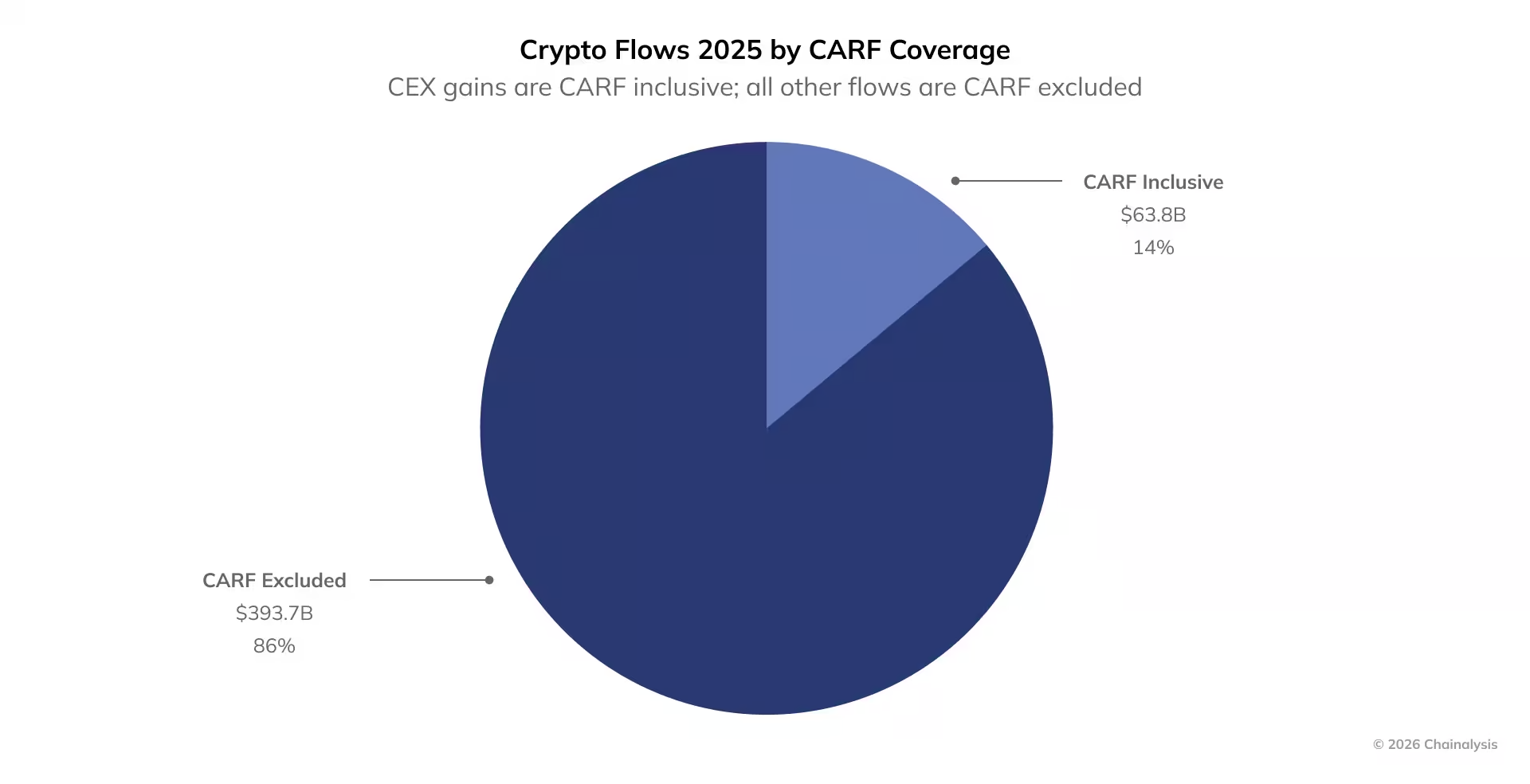
Crypto users generated at least $457 billion in taxable activity on public blockchains in 2025, Chainalysis estimates. Americans produced $112.6 billion of it, more than any other country.
Tax offices will see almost none of it. The global reporting rules now rolling out capture just 14% of those flows.
Where the $457 Billion in Crypto Taxable Activity Sits
The Chainalysis estimate spans six blockchains, including Bitcoin, Ethereum, and Solana. It counts trading gains, income from mining, staking, and lending, and everyday crypto payments.
Trades locked inside centralized exchange order books never touch a blockchain. The real total is therefore higher.
Payments were the standout, making up $64.6 billion of the US total, which dwarfs the $30.1 billion in trading gains. That matters because payments are among the flows tax agencies struggle most to track.
North America led all regions with $134.6 billion, just ahead of the European Union’s $125.1 billion.
For smaller economies, the money is hard to ignore. Nigeria’s $4.4 billion in taxable flows equals 12.3% of everything its government collects. Kenya’s $1.1 billion equals 5.6%. Portugal’s $2 billion was double its national deficit.
Numbers like these keep lawmakers circling. Brussels has already faced pushback over a $23 billion revenue forecast. Berlin, meanwhile, is weighing Germany’s crypto tax exemption in its 2027 budget.
CARF Rules Will Capture Only a Sliver
Governments thought they had an answer. In 2022, the Organisation for Economic Co-operation and Development (OECD) released the Crypto-Asset Reporting Framework (CARF).
It borrows the playbook that cracked open offshore bank accounts, making exchanges report customer transactions across borders. Data sharing starts in 2027.
However, CARF only works where a company stands in the middle. Chainalysis maps just 14% of on-chain taxable activity to events the framework covers. The other 86% moves through decentralized exchanges, peer-to-peer transfers, and self-custody wallets that report to no one.

The gaps run deeper, where mining rewards, staking yields, and lending income largely escape CARF. The rules are not retroactive, so years of past activity stay dark. Exchanges often cannot see what a coin cost when it was bought elsewhere.
The US shows the scale of the problem. Senators have pointed to studies suggesting a crypto tax gap of at least $50 billion a year.
Meanwhile, the Form 1099-DA rules born in the 2021 infrastructure law are projected to recover $28 billion over a decade. Spread out, that is less than $3 billion a year against a $50 billion annual hole.
Dozens of jurisdictions begin exchanging CARF data in 2027, with more joining by 2029. The framework will finally give tax offices a window into crypto. The harder question is what they do about the 86% still outside it.
The post Governments Can See Just 14% of the $457 Billion Crypto Tax appeared first on BeInCrypto.
The world’s leading cryptocurrency exchange warned its users that certain operations will be temporarily halted later this week.
Prior to that, it revealed the delisting of three altcoins, which will take effect at the start of September.
What Binance Users Need to Know
The company announced that it will briefly suspend deposits and withdrawals on the Ethereum network on August 27 to support wallet maintenance. The process is expected to take about one hour, after which operations will resume.
As usual, Binance assured that it will handle all technical requirements involved for all affected users and said that trading of tokens on the aforementioned network will not be impacted.
Upgrades of this type are routine and typically carry no significant complications for clients. The company supported wallet maintenance on the Ethereum blockchain in May this year, and months later it temporarily paused TRX deposits and withdrawals to perform a similar process. There were no reports of issues, and operations were quickly restored.
Besides backing such upgrades, Binance is known for thoroughly reviewing all digital assets listed on its platform and removing those that fail to meet the necessary criteria, including the team’s commitment to the project, network stability against attacks, community engagement, trading volume, liquidity, and other factors.
As a result of its latest analysis, it decided to terminate all services with ICON (ICX), Secret (SCRT), and Storj (STORJ). The delisting is scheduled for September 3, when all spot trading pairs of the aforementioned tokens will be removed.
The announcement came less than a week ago, and since then the involved coins have been charting painful declines. SCRT, for instance, has registered another 25% collapse in the past 24 hours alone.

Similar Effect in the Past
Price slumps following such news shouldn’t come as a surprise. After all, Binance remains the biggest crypto exchange, and withdrawing support results in shrinking liquidity, diminished availability, and reputational damage.
A similar thing happened at the start of August when the company said goodbye to Across Protocol (ACX), Hashflow (HFT), PIVX (PIVX), Vulcan Forged PYR (PYR), Vanar (VANRY), and Viction (VIC). Back then, PIVX and PYR took the biggest blow, both nosediving by approximately 20% in a single day.
Double-digit declines were observed with Alchemix (ALCX), Ardor (ARDR), NFPrompt Token (NFP), and Marlin (POND) in June, when Binance delisted them as well.
The post 2 Important Binance Updates Concerning ETH and Other Altcoin Traders appeared first on CryptoPotato.

Epidemiologists believe it could be among the largest documented foodborne illness events in U.S. history.
“We’ve never seen anything like that before,” Hamilton says.
The volume of food affected is higher than average
While the total number of recalls has been about average, USDA-regulated recalls affected more than 37 million pounds of food during the first half of 2026—the highest it has been in a decade.
At the same time, epidemiologist and former CDC adviser Katelyn Jetelina says that it’s very hard to tell just how bad this summer’s outbreaks have been—and our lack of federal data does not help.
“Our data is just not great in the United States,” she tells TIME. “We’re patching things together to try to figure out what is reality versus concern and public perception, and it’s hard to know where the line is.”


Dolly Parton knew a thing or two about working 9 to 5. Working out was another matter.
“If you tell me I’ve got to do an exercise routine…I dread it so bad,” she told Allure in 2021. Her workaround was “rejoicing exercises”: a freewheeling combination of gospel music, singing, stretching, shouting, and praising. “I do more ‘rejoicing’ than I do ‘working out,’” she said. She occasionally added a few floor exercises and squats—especially, as she put it, “diddly-squats.”
In doing so, she stumbled upon an important truth: Movement doesn’t have to feel like punishment to count.
“Dolly honored herself through movement,” says Michelle Segar, a lifestyle-change sustainability scientist at the University of Michigan and author of The Joy Choice: How to Finally Achieve Lasting Changes in Eating and Exercise. Parton tossed out the rules about what exercise was supposed to look like and designed something that reflected what she needed. “She knew this was for her,” Segar says. “And because it was for her, she had to design it for herself.”
That instinct—to stop chasing the supposedly perfect workout and start with movement that feels good, meaningful, or restorative—could make it easier to keep moving over time. Here’s what we all can learn from Parton’s views on exercise and movement.
“Rejoicing exercises” were quintessentially Dolly
Parton’s routine combined the forces that shaped so much of her life: faith, music, and creative self-expression. She began singing in her maternal grandfather Jake Owens’ church at age 6, and later described feeling divinely inspired as a songwriter, says Leigh H. Edwards, a professor of English at Florida State University and author of Dolly Parton, Gender, and Country Music.
“She often approached her expression on her own terms,” Edwards says, “just as she did when she created her own Dolly image and charted her own trailblazing path for her career.” Exercise was no exception.
Judy Eaton, a professor of psychology at Wilfrid Laurier University in Ontario, teaches positive psychology—the study of how people flourish, rather than only how they struggle. She calls Parton “the poster child for positive psychology.”
Many of Eaton’s students arrive knowing Parton only from Hannah Montana. Eaton introduces them to her as an example of gratitude, optimism, and authenticity; after Parton passed away, former students emailed to say they were grateful her class had helped them understand who she was as a person.
Stop looking for the “right” way to exercise
Many people have absorbed the idea that there’s one correct way to exercise. “We as a society have been taught you’re supposed to exercise in this way for this long, and your body has to feel this way,” Segar says. “You have to breathe hard.” If you can’t—or simply don’t like it—“you don’t do it.”
Public-health guidelines are useful for describing how much activity is associated with certain health benefits. But they don’t necessarily tell people how to fit movement into hectic, unpredictable lives. Fitness marketing has strengthened the idea that a workout only counts when it meets a particular standard, Segar says, creating an all-or-nothing trap: Do the “right” workout, or do nothing.
Parton built her routine around what she would actually do. Instead of deciding exercise wasn’t for her, she decided the gym-and-sweat version wasn’t for her. “We don’t start with the right way,” Segar says. “We start with our way.”
Dr. George Hennawi, physician executive director of geriatrics and senior services at MedStar Health, sees particular value in that approach as people age. When he asks his patients what it means to age successfully, their answers usually involve continuing to do what they already love—whether that’s traveling, gardening, singing, or spending time with their grandchildren.
“She flipped the equation,” Hennawi says of Parton. “What makes me happy? How do I define living successfully, living happily, aging well?” Her answer, as he sees it: “I don’t love exercise—let me bring exercise to the stuff that I love to do.”
That also means reconsidering why you’re moving. Goals like losing weight or preventing a disease years from now can be “abstract, future, often even shame-producing reasons for exercise,” Segar says. Parton’s reason was immediate and personal: She wanted to rejoice. “She’s using movement to fuel herself and live her life,” Segar says, “not to comply with doctor’s orders or to meet some standard of beauty.”
Ask how you want movement to make you feel
“Joyful movement” is a useful phrase, but Segar encourages people to expand their vocabulary. Not every worthwhile walk will make you giddy. It might instead make you feel grounded, energized, connected, or less stressed. It could help you shift out of work mode before walking through your front door—or give you five quiet minutes before the rest of the day begins.
Start by asking: “What do you want to feel while you’re moving?” Segar suggests. Then choose an activity likely to deliver that feeling.
The answer will look different for everyone. “For one person, it could be, ‘I’m going to close my door and put on headphones and dance for five minutes,’” Segar says. Someone else might grab a colleague and walk the stairs at lunch, or chase their kids around the backyard. A walk might serve an entirely different purpose: “I want to transition from my work brain to my family brain,” someone might decide, and head around the block before going home.
Think of movement as a menu rather than a prescription. “You choose what you want based on what you feel like,” Segar says—and that might change daily. “When we toss out the rules, physical movement can be the mechanism for achieving those things.”
Connecting movement to something personally meaningful can also make it more motivating. “Doing things because we have to is never the right way to get us to engage in them more,” Eaton says. “If tying it to something that’s really meaningful to you gets you doing it, then all the better.” For Parton, that meant singing gospel songs and praising—a routine she traced to her Pentecostal upbringing.
Positive emotions can create momentum, too. Eaton points to psychologist Barbara Fredrickson’s broaden-and-build theory: “If you can make yourself experience positive emotions, it makes you more willing to try new things,” she says. A favorite song might put you in the mood to start moving; movement can lift your mood further, making it easier to come back for more.
Rejoicing exercises could engage the mind along with the body, Hennawi adds. “When you’re dancing and singing, you’re stimulating your brain,” he says. “You’re stimulating your body, and you’re connecting all those dots.”
Create your own rejoicing exercises
There’s no official choreography—and prescribing one would miss the point. Choose music you love, if that helps. Dance, stretch, sway, walk, garden, or wave your arms around your living room. Try it for five minutes instead of waiting until you have time for 30. The goal is to finish feeling better than when you started.
Here’s one very Baltimore example from Hennawi: Suppose an older adult’s idea of joy is watching the Ravens and eating ice cream. Without missing a play, they could add arm raises or gentle knee and hip movements while watching on the couch. “Can you add a tiny little bit of exercise?” he asks. “We can do it incrementally, step by step.”
Eaton suspects Parton wouldn’t have issued instructions for copying her routine. The point isn’t to move exactly like Dolly. It’s to move more like yourself. “I think she’d just say, ‘Do what feels good to you,’” she says.

Better Mortgage and Coinbase have moved their Bitcoin-backed mortgage offering out of the early-access phase and made it generally available to US homebuyers, the companies announced Wednesday. The product is designed to let borrowers use Bitcoin as collateral for a down payment without selling their BTC, while still securing a Fannie Mae-backed home loan.
Under the structure described by Coinbase, buyers take a Fannie Mae-backed mortgage alongside a separate down payment loan that is secured by Bitcoin. Borrowers must pledge BTC worth at least 250% of the down payment loan, with the pledged assets transferred to Better’s custodial setup through Coinbase Prime.
Key takeaways
- Better and Coinbase say the Bitcoin-backed down-payment feature is now broadly available to US borrowers.
- Coinbase’s Help Center states the pledged BTC must be at least 250% of the down payment loan value.
- Bitcoin price drops do not automatically trigger margin calls or changes to mortgage terms.
- Better can liquidate pledged BTC if a borrower becomes 60 days delinquent.
- Eligible Coinbase One members may receive a 1% Better rebate, subject to a $10,000 cap for closing costs and fees.
How the token-backed mortgage is structured
The core of the offering is a two-part financing model. First, borrowers obtain a Fannie Mae-backed home loan. Second, they use a separate down payment loan that is collateralized with Bitcoin, allowing the borrower to retain exposure to BTC rather than converting it to fiat for the down payment.
Coinbase says both loans share the same interest rate and amortization schedule, and are repaid through a single monthly payment. It also states that the pledged Bitcoin is returned after the mortgage is fully repaid or refinanced—subject to the applicable loan terms.
In practice, the collateral requirement is designed to cushion volatility. The 250% pledge-to-loan threshold means the down payment collateral is over-collateralized relative to the down payment loan itself.
What happens if BTC falls or payments slip
One of the most important investor and borrower questions is whether Bitcoin volatility would force liquidation in response to price movements alone. According to Coinbase, declines in the Bitcoin price by themselves do not trigger margin calls or cause changes to the mortgage terms.
Instead, the main trigger for collateral action is tied to repayment performance. Coinbase states that Better may liquidate the pledged BTC if a borrower becomes 60 days delinquent on payments. That distinction matters: the risk mechanism is linked to mortgage delinquency and loan obligations rather than an automatic adjustment based purely on market price swings.
Eligibility and borrower requirements
Coinbase says the program is limited to US residents and requires a verified Coinbase account. Borrowers also remain subject to Better’s standard credit, income, and other underwriting requirements, meaning the offering does not remove conventional mortgage qualification criteria.
For certain users, there is an additional incentive. Coinbase One members are eligible for a 1% rebate from Better, according to Coinbase, with the rebate capped at $10,000. Coinbase says that rebate can be used toward closing costs and fees, aligning part of the benefit with transaction costs tied to home purchases or refinancing.
Better and Coinbase first unveiled the token-backed mortgage in March through an early-access program, and now the feature has been rolled out more broadly.
Earlier coverage described the initial rollout of Coinbase’s token-backed down payment concept for Fannie Mae loans here: Coinbase launches token-backed down payments for Fannie Mae loans.
Why this expands beyond one product: crypto in US mortgage underwriting
This Bitcoin-backed mortgage arrives amid a broader push to incorporate digital assets into US mortgage risk assessment and eligibility frameworks. In June 2025, the Federal Housing Finance Agency (FHFA) directed Fannie Mae and Freddie Mac to develop proposals to consider cryptocurrency held on US-regulated centralized exchanges as an asset when assessing risk for single-family mortgages—without requiring that the crypto be converted to US dollars.
The FHFA directive also asked the two government-sponsored enterprises to evaluate risk-mitigation steps for crypto’s volatility and to submit proposed changes for board approval before the FHFA’s review. In other words, the regulatory prompt focused on how to incorporate digital assets into underwriting and risk management, not merely on allowing them as a marketing feature.
Other lenders have started taking similar steps. Cointelegraph previously reported that mortgage lender and servicer Newrez announced in January that it would recognize certain cryptocurrency holdings when evaluating mortgage applications starting in February, including for home purchases and refinancing. That effort points to an emerging trend: crypto is moving from a niche “side asset” consideration toward a more formal underwriting input, even if the exact mechanics vary by lender.
Housing affordability backdrop and what to watch next
The timing also matters given the broader affordability environment. The Federal Reserve Bank of St. Louis, citing data from the US Census Bureau and the Department of Housing and Urban Development, compiled figures showing median sales prices for new US homes around $400,000 in 2026—levels that remain historically elevated even as they have eased since earlier peaks.
For borrowers who hold Bitcoin, token-backed down payments could be attractive if they want to avoid selling during a volatile period. But the product still depends on traditional mortgage underwriting, and the collateral is not fully risk-free: the program’s terms allow liquidation if payments fall behind for 60 days.
Going forward, market participants will likely watch how widely the product expands, how lenders continue to refine collateral and delinquency mechanics, and whether broader FHFA-driven underwriting proposals translate into more standardized approaches across the mortgage industry.
Wall Street research company Bernstein expects Bitcoin to recover from its latest downturn, reclaim its 2025 high and set new records in the coming years heading into the peak of its historical cycle.
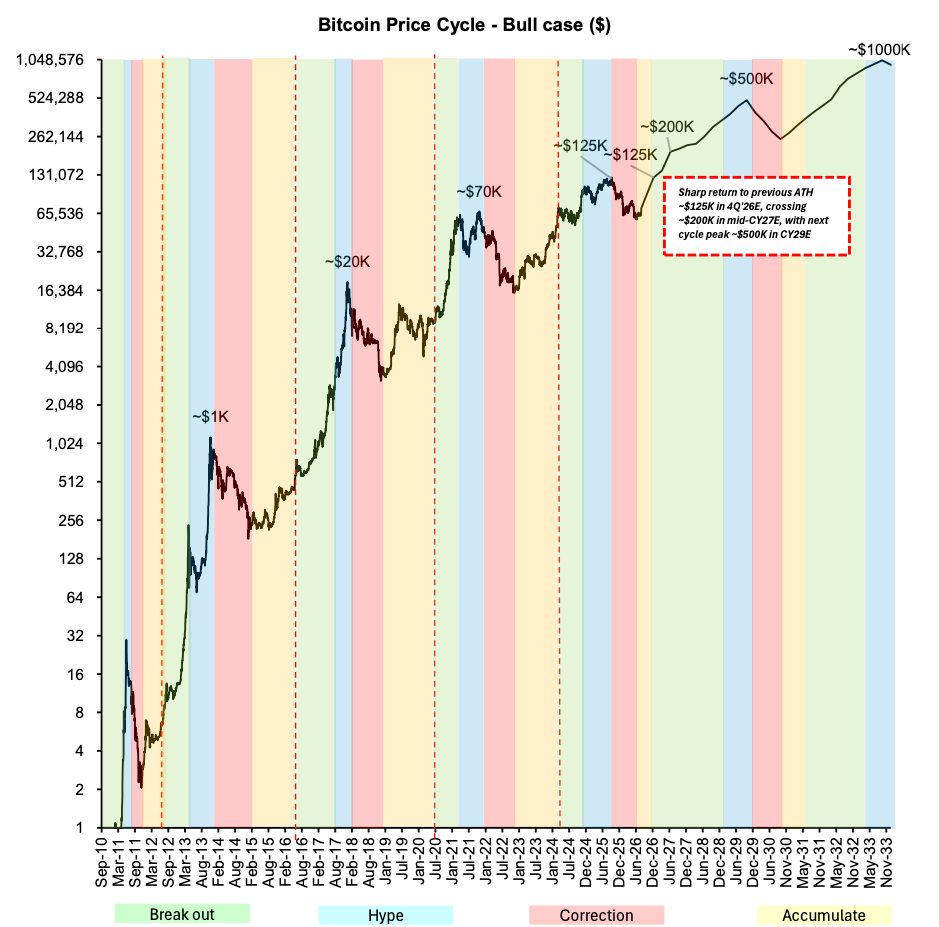
Bernstein expects Bitcoin (BTC) to reclaim $125,000 by late 2026 under both its base and bull cases, according to a research report published Wednesday and seen by Cointelegraph.
The company said Bitcoin gained 28% over the previous 10 days after falling about 50% from its October 2025 peak, a rebound that could signal the end of the current bear cycle.
The analysts’ call comes as institutional investors and corporate Bitcoin buyers play a bigger role in the market, which Bernstein said provided greater downside support during the latest cycle and contributed to a smaller drawdown than the 75% to 90% declines of previous cycles.
Next cycle could see Bitcoin reach $300,000
Bernstein’s base case puts Bitcoin at $150,000 by mid-2027 before reaching a cycle peak of about $300,000 in 2029. Its bull case puts the biggest crypto at $200,000 by mid-2027 and $500,000 in 2029.
The company maintained its longer-term BTC target of about $1 million by 2033 under both scenarios.
Bernstein’s forecast is based on Bitcoin’s historical four-year cycles, which the company links to the halving, an event that cuts the amount of new Bitcoin awarded to miners roughly every four years. Bernstein divides each cycle into four phases: breakout, hype, drawdown and accumulation.
Source: Bernstein
The company then estimates Bitcoin’s potential price during those cycles by comparing it with the marginal cost of producing Bitcoin, or the estimated cost for the least efficient miners to produce new coins.
Related: Strategy’s $66B Bitcoin machine hinges on capital markets, not BTC price: Report
“We assume that the price-to-marginal cost multiple will behave in a similar manner to previous 4-year cycles,” Bernstein analysts said.
Under Bernstein’s base case, that multiple falls from 1.4 times at Bitcoin’s $125,000 peak in 2025 to 1.25 times at a projected $300,000 peak in 2029 and about 1.2 times at $1 million in 2033.
Strategy could ramp up Bitcoin buying
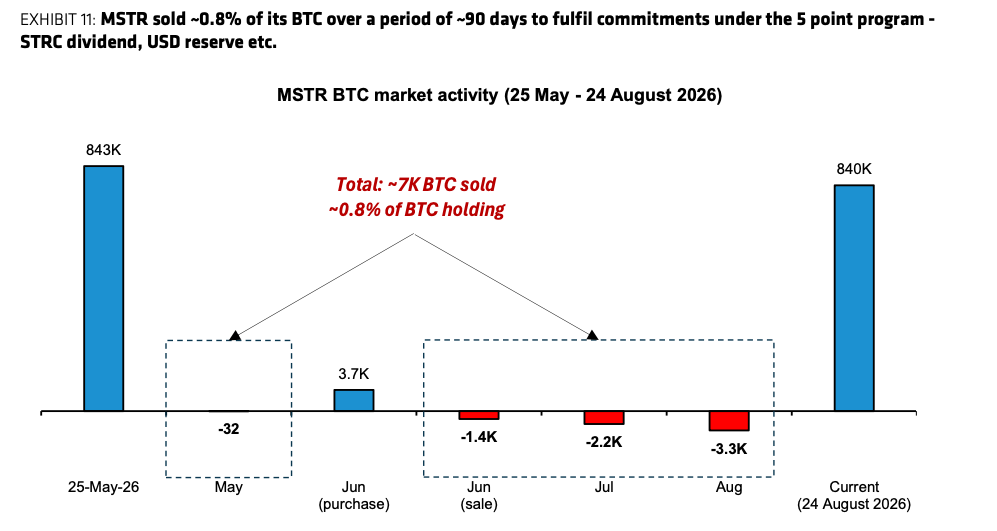
Bernstein also expects a Bitcoin recovery to improve the outlook for Strategy, the world’s largest corporate Bitcoin holder. Strategy holds 840,447 BTC, equivalent to about 4% of Bitcoin’s maximum supply of 21 million coins.
The analysts maintained their “Outperform” rating on Strategy but cut its MSTR price target to $350 from $450, citing accelerated equity dilution and its updated Bitcoin cycle outlook. MSTR closed at $126.83 on Tuesday, up 3.4% on the day, according to Yahoo Finance.
Source: Bernstein
Bernstein said continued Bitcoin strength, combined with a recovery in Strategy’s Stream (STRC) preferred stock to around $100, could allow the company to “go kinetic again” with Bitcoin purchases after selling around 7,000 BTC in 2026. STRC closed at $97.15 on Tuesday, according to Yahoo Finance.
Recent analysis from Regime Intelligence said Strategy’s Bitcoin treasury may be less vulnerable to a crypto market crash than to a prolonged loss of capital-market access, a risk that could threaten its ability to fund roughly $1.76 billion in annual obligations without selling BTC.
Magazine: Bitget CEO isn’t buying the Bitcoin rally — She’s waiting for $50K


Cointelegraph is committed to providing independent, high-quality journalism across the crypto, blockchain, AI, and fintech industries.
All news, reviews, and analyses are produced with full journalistic independence and integrity. For more details on our standards and processes, please read our Editorial Policy.

Bitcoin Changes What It Means To Own Money

Trump order targets foreign equipment used across the US power grid

Americans Feel Guilty Splurging on Joyful Things





-

 Fashion5 days ago
Weekend Open Thread: Madewell – Corporette.com
-

 Crypto World23 hours ago
SpaceX stock could rise 75% to $240, JPMorgan says
-

 Business4 days ago
Musk’s Tesla, SpaceX Confirm $16.8 Billion ‘Terafab’ Chip Plant as World’s Largest Building in Texas
-

 Crypto World5 days ago
anatomy of crypto’s biggest liquidation event since 2021
-

 Crypto World2 days ago
A $30 Billion AI Fund Implodes, Now the SEC Is Investigating Wall Street’s Role
-

 Politics4 days ago
6 months on, Irish renters crushed by effects of government housing bill
-
 NewsBeat5 days ago
The ‘Lucky Dip Gang’ causing carnage for clicks: After five thugs were killed speeding in the wrong direction on a motorway, GUY ADAMS investigates a sick new trend… and why police aren’t even allowed to pursue them
-

 Business4 days ago
Mystery AI Model ‘Ox Alpha’ Draws Developers With Free Access as Chinese Lab Origins Remain Debated
-

 Crypto World20 hours ago
Did Trump Just Move SpaceX Stock With One Truth Social Post?
-

 News Videos7 days ago
Don’t Leave Your Financial Future To Chance | August 19, 2026
-

 Business6 days ago
Five Below: Kids Discount Retailer Reaps Rich Rewards
-

 Business2 days ago
Moderna CEO warns China is pouring state money into mRNA technology
-

 Business5 days ago
UK firms in critical financial distress rise 9% to 53,756
-

 Business2 days ago
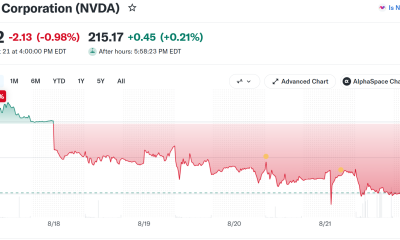
NVIDIA Stock Drops Nearly 2 Percent to $210 on Seventh Losing Day Ahead of Critical AI Earnings
-

 Sports4 days ago
Deshaun Watson fires back at Browns fans after being booed: ‘It’s a disrespectful thing’
-

 Crypto World6 days ago
Optimism-funded team's deciding vote shifts $49 million in OP tokens away from users
-

 Tech7 days ago
OpenAI confirms ChatGPT is down as logins and signups fail
-

 Crypto World4 days ago
Google Gemini AI Predicts Ethereum Could Become the Trade Retail Misses in 2026
-

 Business7 days ago
PayPal and Venmo now accepted for tuition at several universities
-
 Crypto World5 days ago
Nvidia Stock Suffers Longest Losing Streak Since 2022: Will Q2 Earnings End It?
You must be logged in to post a comment Login