
Crypto World
Elon Musk Grok Bot Promise: We Will Make You Whole if AI Loses Your Money



Elon Musk backed a bold Grok Bot promise on Wednesday. If the AI agent loses money while running an investor’s bank account, xAI will make the user whole, he says.
One investor is taking him up on it. Yet the numbers tell a different story. It starts with a $100 liability cap sitting in xAI’s own terms.
Inside the Grok Bot Bank Account Experiment
Teslaconomics, a Tesla and xAI investor, asked a simple question on Wednesday. Had anyone connected Grok Bot to a bank account? In a post on X (Twitter), he said the agent could track spending, pay bills, and catch strange charges.
He even wondered whether he still needed a personal banker. His partner reportedly told him an outright no. She fears what an AI with that much access could do.
However, Elon Musk is confident, and even guaranteed reimbursement should the Grok bot mess up.
Follow us on X to get the latest news as it happens
Grok Bot launched in beta on August 11. According to xAI, each agent runs day and night on its own cloud computer. It signs into websites like a human and keeps working while its owner sleeps.
The experiment also fits Musk’s bigger money push. X Money went live with peer-to-peer payments in June.
A $100 Liability Cap Sits Behind the Grok Bot Promise
While Musk’s pledge sounds like insurance, his company’s paperwork says otherwise. xAI’s consumer terms offer outputs and agentic actions on an as-is basis.
Those terms cap most claims at the fees a user paid, or $100, whichever is greater. Bot access comes with a $30 monthly SuperGrok plan, so a year of fees totals $360. That is pocket change next to a drained checking account.
A reply on X (Twitter) does not rewrite that contract. Unless xAI puts the guarantee in writing, any refund rests on Musk’s goodwill.
US banking rules add a sharper edge. Regulation E, the federal rule covering electronic transfers, protects customers from unauthorized payments. However, a transfer loses that label when the customer handed over account access.
Give a bot your login, and standard fraud protections may not apply.
History gives skeptics more ammunition. In May, hidden instructions inside a malicious NFT tricked an AI into moving money, a technique called prompt injection. The attack drained roughly $150,000 from a Grok-linked Bankr wallet. About 80% of the funds later came back.
Weeks later, a separate breach hit 14 user wallets on the same platform, and Bankr pledged full reimbursement. No verified case of Grok Bot mishandling a real bank account has surfaced so far.
Even so, prompt injection could prove costlier when the target holds live bank logins instead of a crypto wallet.
The Grok bot experiment may therefore double as marketing for a product xAI wants inside daily money management. The first real error will show what Musk’s words are worth.
The answer may be a quiet refund, or a very public test of that $100 cap.
The post Elon Musk Grok Bot Promise: We Will Make You Whole if AI Loses Your Money appeared first on BeInCrypto.


Dell Computer was incorporated in 1984, borne from Michael Dell’s fascination with making computers while enrolled in a Texas college. Shares began trading in 1988, then doubled in five months starting in November 1990. Dell stock doubled again between June 1992 and November 1992. Dell’s quarterly earnings then turned down, and in 1993, it plummeted more than 70%. So there…
Copyright ©2026 Investor’s Business Daily, LLC. All rights reserved. 87990cbe856818d5eddac44c7b1cdeb8

A new survey from the National Institute on Retirement Security (NIRS) finds that most Americans remain wary of including cryptocurrency in workplace retirement plans. The research comes as U.S. policymakers work to broaden the range of alternative assets available in 401(k) and other defined-contribution plans—potentially placing crypto more directly in retirement-savings conversations.
According to the NIRS survey, 77% of Americans view cryptocurrency included in workplace retirement plans as risky, with 46% describing it as “very risky.” In parallel, 53% oppose employers offering crypto as an investment option.
Key takeaways
- 77% of respondents say crypto exposure in workplace retirement plans is risky, including 46% who call it very risky.
- 53% oppose employers adding crypto to retirement plan investment lineups.
- Concerns about retirement security are rising: 80% say the U.S. faces a retirement crisis, up from 67% in 2020.
- Debt and affordability pressures persist: 77% say debt blocks them from saving adequately.
- Regulatory direction is shifting: multiple federal actions have moved away from prior “extreme care” language and toward a framework that may facilitate alternative-asset inclusion.
Survey signals distrust even as retirement pressures mount
The NIRS report ties its crypto findings to broader anxieties about retirement outcomes. 80% of survey respondents said the U.S. faces a retirement crisis—an increase from 67% in 2020—while 61% said they are concerned about achieving financial security in retirement.
Affordability challenges also appear central to the survey’s picture. The research reports that 68% say it is becoming harder to prepare for retirement, and 77% say debt prevents them from saving enough. In that context, investor protection and risk tolerance are likely to remain key fault lines for any plan sponsors considering crypto-like exposures.
The survey was conducted by Greenwald Research between Oct. 24 and Nov. 14, 2025, surveying 1,203 Americans aged 25 and older. Results were weighted by age, gender, and income.
From “extreme care” to neutrality: a policy pivot
While public opinion in the NIRS survey skews negative toward crypto in employer retirement plans, regulatory posture has been moving in the other direction. The NIRS report points to changes under the Trump administration and federal regulators aimed at expanding access to alternative assets in defined-contribution plans.
One turning point came when the U.S. Department of Labor rescinded guidance from May 2025 that had urged 401(k) plan fiduciaries to exercise “extreme care” when considering cryptocurrency investments. In its place, the Department of Labor returned to a neutral approach that neither endorses nor discourages crypto as an investment option.
The policy shift accelerated further after Aug. 7, 2025, when President Donald Trump signed an executive order intended to “democratize access to alternative assets for 401(k) investors.” The order calls for expanding access to alternative assets in defined-contribution retirement plans, including those carried by investment vehicles that hold digital assets, while directing the Labor Department and the U.S. Securities and Exchange Commission to consider regulatory changes.
Labor Department guidance continues to broaden the door
Following the executive order, the Department of Labor also rescinded earlier language. A few days later, it rescinded a 2021 guidance document that had discouraged 401(k) fiduciaries from considering alternative assets, saying investment decisions should instead be assessed through a neutral, principles-based framework.
More recently, the Department of Labor has moved from rescinding older guidance toward outlining how fiduciaries could evaluate alternative assets within plan lineups. In March 2026, it proposed rules describing how 401(k) fiduciaries could include alternative assets—again, with the stated goal of providing structures that reduce litigation risk. The proposal would require fiduciaries to consider factors such as fees, liquidity, valuation, and performance.
Still, the debate is far from settled. The NIRS report notes pushback from lawmakers, including Sens. Bernie Sanders and Elizabeth Warren and Rep. Bobby Scott, who urged the Department of Labor in June to withdraw the proposal. Their objections, as described in earlier coverage from Cointelegraph, cite crypto’s volatility and argue that safeguards for investors are insufficient.
Why the divide matters for retirement investors
The NIRS survey and the ongoing regulatory shift point to a significant mismatch between how Americans perceive crypto risk and how the regulatory framework may evolve around retirement-plan menus.
For plan sponsors and fiduciaries, this gap is likely to shape how proposals land with employers, participants, and policymakers. Even if rules become clearer about what diligence should look like, the core question for retirement consumers is whether crypto exposures align with retirement risk tolerance—especially when the same survey shows many Americans are already struggling with affordability and debt constraints.
For participants, the next phase to watch is whether proposed Labor Department rules finalize in a way that meaningfully changes what employers can offer, and how regulators address the specific concerns raised by lawmakers—particularly around volatility, liquidity, and valuation transparency.
As NIRS data underscores, public skepticism is high; the coming regulatory decisions and any resulting plan changes will therefore be tested not only by legal standards, but by whether they can earn participant trust in the context of retirement security.
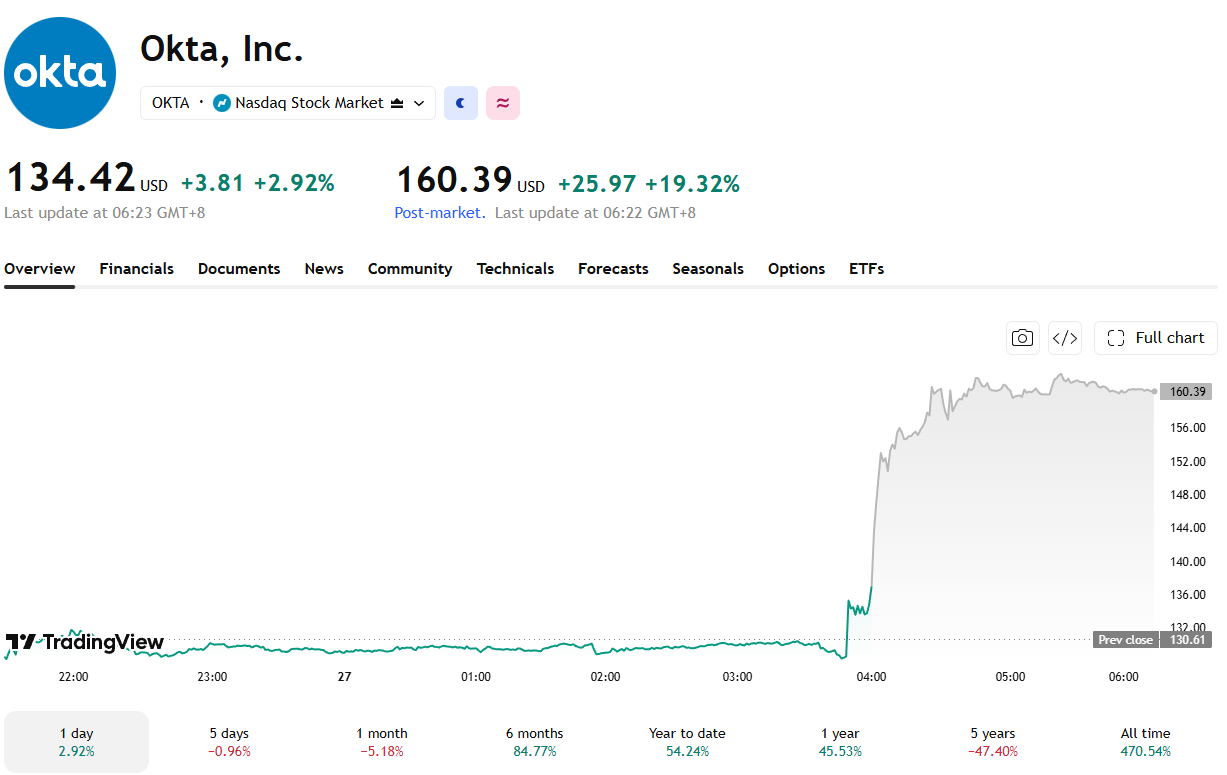
Several stocks outpaced Nvidia (NVDA) in after-hours trading Wednesday, even as Nvidia earnings beat second quarter revenue and profit estimates.
Okta, Salesforce, CrowdStrike, and Veeva Systems all posted bigger percentage gains than Nvidia after their own quarterly results topped Wall Street forecasts.
Nvidia Earnings Beat Estimates, But Others Beat the Rally
Nvidia posted adjusted earnings of $2.22 per share on revenue of $96.22 billion for its fiscal second quarter. Both figures topped the $2.10 per share and $92.17 billion analysts polled by LSEG had expected.
Guidance also came in strong. Management pointed to $108 billion in third quarter revenue, above consensus estimates. Despite the beat, the stock added only 4% after hours, a modest reaction given the scale of the numbers.
Okta and Salesforce Led the After-Hours Gainers
Okta (OKTA) jumped about 19% postmarket, the largest gain among Wednesday’s reporters. The identity management company posted adjusted earnings of $1.05 per share on $805 million in revenue. Analysts surveyed by LSEG had expected 97 cents per share and $795 million. Okta also raised its full year earnings and revenue guidance.

Salesforce (CRM) rose about 13% after adjusted earnings more than doubled to $5.90 per share on an investment gain. Revenue reached $11.35 billion against an $11.32 billion consensus, according to LSEG data. A hold on that gain would add roughly 160 points to the Dow Jones Industrial Average on Thursday.

CrowdStrike (CRWD) added about 10% after beating on both revenue and earnings per share. Its third quarter guidance matched estimates on profit and came in higher on revenue. Veeva Systems (VEEV), a life sciences software maker, climbed about 7% after topping expectations on both lines. The company also raised its outlook for the current quarter and full year.
Smaller Moves and One Decliner
Agilent Technologies (A) rose 4%, matching Nvidia’s gain. Third quarter revenue of $1.88 billion beat a $1.84 billion FactSet estimate.
Everpure (P), the data storage company formerly known as Pure Storage, gained about 2%. The company earned an adjusted 70 cents per share on $1.19 billion in revenue. Both figures beat the 58 cents and $1.1 billion FactSet had projected.
Urban Outfitters (URBN) fell about 5% despite in-line results. Its earnings excluded a one-time tariff refund benefit.
Wednesday’s mixed reactions show that earnings beats alone don’t move stocks equally. Guidance quality and forward commentary shaped the size of each swing. Investors will watch whether these gains hold once Thursday’s trading session gets underway.
The post These 4 Stocks Outgained Nvidia After Their Own Q2 Beats appeared first on BeInCrypto.


Hyperliquid Policy Center and trade[XYZ] have asked the CFTC to permit regulated perpetual contracts tied to WTI crude, Brent crude, and Henry Hub natural gas after their markets recorded more than $500 billion in cumulative volume.
Summary
- trade[XYZ] has operated perpetual markets on Hyperliquid since October 2025.
- The groups said continuous trading could help U.S. firms hedge energy exposure during weekends.
- Crude perpetual prices anticipated nearly 75% of the Sunday reopenings examined in a cited study.
- The filing proposes stablecoin margin, leverage limits, and regulated onchain market infrastructure.
Hyperliquid Policy Center and trade[XYZ] said in an Aug. 26 joint filing that U.S. regulators can bring energy perpetual contracts into regulated markets without waiting for new legislation.
Submitted in response to a Commodity Futures Trading Commission review, the letter calls for a legal path covering contracts linked to West Texas Intermediate crude, Brent crude, and Henry Hub natural gas. trade[XYZ], the first major third-party market deployer on Hyperliquid, has offered such products since October 2025.
Its markets have generated more than $500 billion in cumulative trading volume, according to the filing, which cited Bloomberg. The figure covers several asset classes available through trade[XYZ], including its energy products.
Unlike dated futures, perpetual contracts do not expire. Traders instead make recurring funding payments designed to keep each contract close to the price of its reference asset, allowing a position to remain open without being transferred into a new delivery month.
Energy perpetuals could fill weekend hedging gaps
Continuous access formed a central part of the groups’ case, particularly when geopolitical events moved oil prices while established U.S. futures venues were closed.
After conflict in the Middle East disrupted energy exports on Feb. 28, airlines, refiners and fund managers with crude exposure could not change their positions through regulated U.S. futures markets until trading resumed on Sunday evening, the filing said. Oil-linked perpetual contracts on Hyperliquid continued operating through the weekend.
According to the groups, about two-thirds of the oil price change between Friday’s close and the benchmark’s Sunday reopening had already occurred in the onchain market. Brent later reached nearly $120 per barrel by March 9, while jet fuel prices doubled within weeks, according to news reports cited in the filing.
Research published by Hyperliquid Policy Center also compared crude perpetual prices with the benchmark’s later reopening level. Across nearly 75% of the weekend closures studied, the perpetual contract finished closer to Sunday’s opening price than the benchmark’s previous Friday close.
The same study found no statistically measurable decline in the quality of CME WTI reopening prices after trade[XYZ] launched its crude contract, according to the filing. Hyperliquid Policy Center used the finding to argue that perpetuals can trade alongside dated futures without weakening the established benchmark.
Dated futures would remain useful for companies that need physical settlement, exposure to a particular delivery month, or positions based on the shape of the futures curve. Perpetuals, by comparison, could serve participants seeking continuous price exposure without regularly rolling a contract into its next expiry.
Contract size could also affect access. The filing noted that one benchmark WTI futures contract covers 1,000 barrels, representing around $70,000 in notional exposure at recent prices, while the median off-hours crude trade on trade[XYZ was about $1,300.
In May, an oil-perpetual partnership between Intercontinental Exchange and OKX showed that established market operators were also examining round-the-clock energy products. ICE agreed to license its Brent and WTI prices for perpetual contracts offered by OKX in selected markets outside the United States.
CFTC review has opened a US regulatory path
The CFTC requested public comments in June on two connected issues: extending standard energy futures to continuous trading and listing perpetual contracts tied to physical or storable energy commodities.
Its review covers reference-price reliability, manipulation risks, surveillance, position limits, margin, clearing, customer safeguards, and possible effects on physical energy markets. After adding questions and receiving requests for more time, the agency extended the submission deadline to Aug. 26.
CFTC Chair Michael Selig said the agency needed a “clear, data-driven record” as regulated entities considered longer trading hours and new contract designs. The commission has not approved energy perpetuals, and the public consultation does not guarantee that it will authorize them.
A regulated route already exists for some digital-asset products. As crypto.news reported in May, the CFTC approved Kalshi’s Bitcoin perpetual as the first federally regulated contract of its kind in the United States.
The approval treated Kalshi’s non-expiring product as a futures contract, although the CFTC limited its analysis to that contract and similarly structured products referencing digital commodities with deep and continuously active spot markets. Energy products require separate consideration because crude oil and natural gas have physical markets, delivery systems, and benchmarks that operate differently from Bitcoin.
Hyperliquid Policy Center has also sought an equity framework from the CFTC and the Securities and Exchange Commission. In an Aug. 24 submission, the group argued that qualifying equity perpetuals should be treated as security futures when they carry the established features of futures contracts.
Onchain systems would support continuous operations
For energy contracts, the latest filing asks the CFTC to adopt a technology-neutral framework rather than require a particular market structure. Exchanges and clearinghouses would need to demonstrate compliance with existing CFTC core principles before operating continuously.
Hyperliquid Policy Center and trade[XYZ] said onchain systems can run trading, margin checks, clearing, settlement, and surveillance at all hours. Under trade[XYZ]’s model, positions are funded in advance, while margin is recalculated with each transaction rather than waiting for a scheduled settlement period.
According to the filing, standard order-book liquidations have handled 97.9% of all notional volume liquidated across trade[XYZ] markets. Predefined backstop and tail-loss processes covered the remainder.
Because transactions, margin changes and liquidations appear on a public ledger, the groups said regulated operators could conduct real-time surveillance without adding separate reporting requirements for every market participant. Any U.S. operator would still have to meet applicable rules on market integrity, customer protection, and recordkeeping.
A July data integration added Hyperliquid and trade[XYZ] prices to TradingView, allowing users to monitor onchain markets covering commodities, equities, foreign exchange and crypto outside standard exchange hours.
Stablecoins could provide weekend margin
The filing also asks the CFTC to recognize eligible stablecoins and tokenized traditional assets as margin for cleared derivatives. Unlike transfers through banks that close on weekends, blockchain-based collateral can move while a continuous market remains open.
Current CFTC policy already permits certain digital assets in some cleared derivatives transactions. Under the agency’s crypto collateral pilot, participating futures commission merchants may accept Bitcoin, Ether and qualifying stablecoins, subject to reporting, capital and risk-management requirements.
Hyperliquid Policy Center and trade[XYZ] want the commission to clarify how such treatment would apply to energy markets. Their proposal does not call for crypto collateral in uncleared swaps, which remain outside the existing pilot.
Along with collateral rules, the groups proposed leverage limits set according to the asset class and plain-language disclosures explaining funding payments and liquidation processes. Market-integrity measures would also have to address price manipulation and the reliability of reference benchmarks during periods when physical energy markets are inactive.
Several CFTC requirements are written around conventional operating hours, including deadlines tied to the next “business day.” The filing asks the regulator to explain how such terms would apply when an exchange, clearing system, and collateral network continue running through nights, weekends, and holidays.
The final request calls for regulated operators to use onchain infrastructure for execution, margin, clearing, settlement, and recordkeeping whenever the systems satisfy existing CFTC core principles.
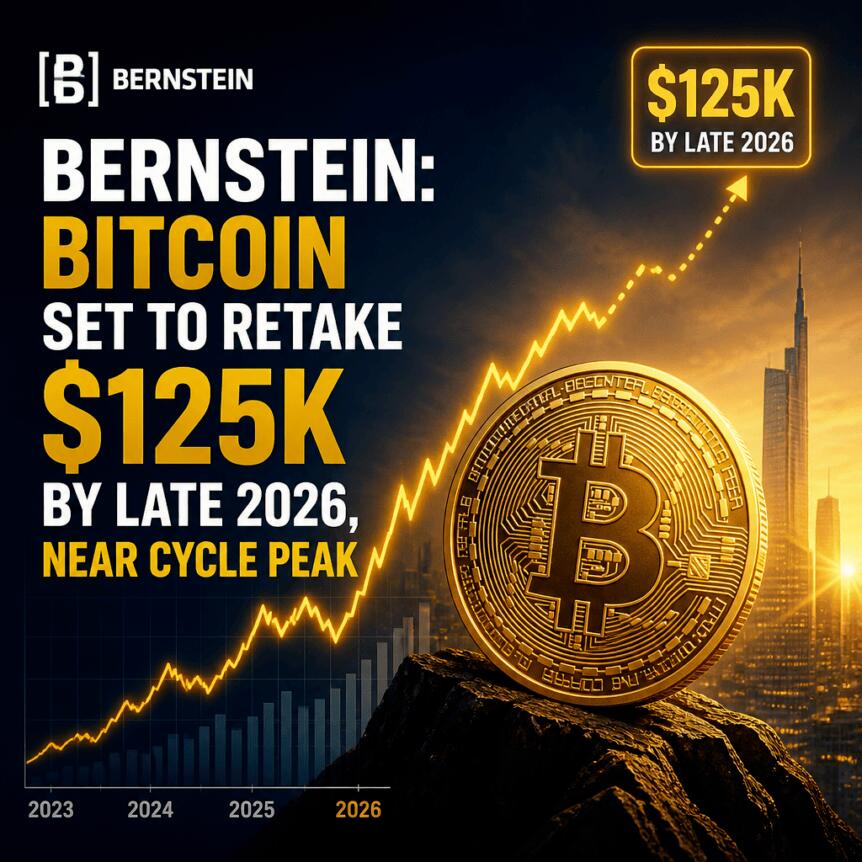
Wall Street research firm Bernstein is forecasting a rebound in Bitcoin, arguing that the recent selloff could mark the transition away from the current bear phase and toward a new advance driven by institutional and corporate participation.
In a research report published Wednesday and seen by Cointelegraph, Bernstein expects Bitcoin to retake its 2025 high and push into fresh cycle highs over the next several years, with targets ranging from $125,000 by late 2026 to as high as $500,000 by the end of the decade under a bull case.
Key takeaways
- Bernstein expects Bitcoin to recover toward $125,000 by late 2026, positioning that level as a milestone tied to the firm’s cycle framework.
- The base case targets $150,000 by mid-2027 and a cycle peak of about $300,000 in 2029; the bull case ranges up to $500,000 in 2029.
- Bernstein maintains a longer-term Bitcoin target of roughly $1 million by 2033 in both scenarios.
- The firm links the forecast to Bitcoin’s historical four-year cycle phases and to the relationship between price and miners’ marginal production costs.
- Bernstein’s view is also intended to support its outlook on Strategy (the largest corporate Bitcoin holder), suggesting stronger conditions could enable further BTC accumulation.
Why Bernstein thinks the downturn is nearing an end
Bernstein’s argument is rooted in Bitcoin’s historical cycle behavior. The firm said Bitcoin gained 28% over the preceding 10 days after falling roughly 50% from its October 2025 peak, a rebound it says could indicate the end of the present bear cycle.
The report also points to changes in the market’s participant mix. Bernstein said institutional investors and corporate Bitcoin buyers have been playing a larger role, which it argues has provided greater downside support than in earlier cycles. As a result, it cited a smaller drawdown than the roughly 75% to 90% declines seen in previous turnarounds.
For investors, that matters because the cycle thesis implies the timing and character of drawdowns may not repeat identically. Bernstein is not only forecasting higher prices—it is also asserting that the depth of weakness may be structurally different when large, persistent buyers are part of the backdrop.
Cycle-based targets: from $125,000 to as high as $500,000
Bernstein’s pricing model is built on Bitcoin’s historical four-year cadence, which the firm ties to the halving event that reduces the amount of new BTC awarded to miners approximately every four years.
In its framework, each cycle is split into four phases: breakout, hype, drawdown, and accumulation. Bernstein then estimates likely price levels across those phases by comparing Bitcoin’s market pricing to the estimated marginal cost of producing new coins—specifically, the cost for the least efficient miners to mine Bitcoin.
Under the base case, Bernstein expects:
- Bitcoin to reach $125,000 by late 2026
- $150,000 by mid-2027
- about $300,000 at a cycle peak in 2029
Under the bull case, the firm raises the targets to:
- $200,000 by mid-2027
- $500,000 at a cycle peak in 2029
Bernstein also maintained a long-term target of about $1 million by 2033 under both scenarios.
How marginal production costs are folded into the forecast
Central to Bernstein’s approach is an assumption about the “price-to-marginal cost multiple,” meaning how many times Bitcoin’s price trades relative to miners’ estimated marginal production costs.
The firm said it expects that multiple to behave similarly to previous four-year cycles. In its base-case path, Bernstein projected the multiple falling from 1.4 times at a 2025 peak around $125,000 to roughly 1.25 times at a projected 2029 peak around $300,000, and to about 1.2 times by the $1 million mark in 2033.
This is a key nuance for readers: the forecast doesn’t rely only on generic “cycle hype” or momentum. It attempts to formalize the relationship between network economics and market pricing, which—if the assumptions hold—can help explain why the firm expects higher peaks even as valuation multiples compress over time.
Still, that compression is an assumption. Traders and long-term holders watching this thesis may want to track whether market conditions allow marginal-cost dynamics to remain a meaningful reference point, especially if demand growth, regulatory changes, or changes in miner behavior alter cost structures.
Strategy’s potential to buy more Bitcoin if prices firm up
Bernstein’s report also ties its Bitcoin recovery expectations to Strategy, describing a scenario in which continued strength could improve conditions for additional BTC purchases.
The firm noted that Strategy holds 840,447 BTC, representing about 4% of Bitcoin’s maximum supply of 21 million coins. Bernstein maintained an “Outperform” rating on the company but adjusted its MSTR price target down to $350 from $450, citing accelerated equity dilution and its updated view of the Bitcoin cycle.
Bernstein said that if Bitcoin stays strong—and if Strategy’s Stream (STRC) preferred stock recovers to around $100 (STRC was reported at $97.15 on Tuesday)—the firm believes Strategy could “go kinetic again” with additional Bitcoin buying. Bernstein pointed to a selloff of about 7,000 BTC in 2026 as part of its broader framework.
At the same time, Bernstein’s view is not only about upside. The report referenced analysis from Regime Intelligence arguing that Strategy’s Bitcoin treasury may be less threatened by a market crash than by a prolonged loss of capital-market access. That risk, Regime Intelligence said, could impair Strategy’s ability to fund roughly $1.76 billion in annual obligations without selling BTC.
Put differently, Bernstein is effectively forecasting that the next leg up could improve Strategy’s operational flexibility—but that access to funding channels could still determine how aggressively corporate buyers add to their holdings.
What to watch next
Bernstein’s model puts major milestones—$125,000 in late 2026 and substantially higher cycle targets later—at the center of its thesis. Investors should watch whether Bitcoin’s rebound broadens into sustained strength rather than a short-lived rally, and whether corporate buyers like Strategy can continue adding BTC without being constrained by financing conditions and dilution pressures.


Six long-dormant Bitcoin wallets have transferred 553.59 BTC worth $40.15 million after remaining inactive for periods ranging from nearly 12 years to more than 15 years.
Summary
- Six wallets moved 553.59 BTC between Aug. 16 and Aug. 26.
- The holdings were worth $40.15 million when the transactions occurred.
- Two addresses carry labels linking them to a New York dormant-wallet lawsuit.
- Only one transfer reached a destination associated with a known crypto company.
Galaxy Research tracked the six movements from wallets dating to 2011, 2012, and 2014, although blockchain records do not reveal who controlled most of the addresses or why the owners transferred their holdings.
Five transfers went to addresses without known exchange links, offering no on-chain evidence that the Bitcoin was sold. The final transaction sent 40 BTC to an address labeled Boerse Stuttgart Digital, a German provider of crypto custody and trading infrastructure.
Bitcoin wallets move 553 BTC over 10 days
Beginning on Aug. 16, the first wallet transferred 8.54 BTC in block 962,770 after remaining inactive since June 13, 2011. Galaxy valued the holdings at about $538,000 when they moved, compared with an estimated acquisition price of around $14 per coin.
Using the difference between the historical and transfer prices, the holdings had gained about 461,981%. The figure represents an unrealized return unless the owner sold the coins, which the blockchain transaction does not establish.
Two days later, a wallet last active on Aug. 10, 2012, transferred 212 BTC worth approximately $13.66 million. The address carried the label “Noah Doe #1396 · Salomon Client Dusted,” connecting it to a New York lawsuit involving thousands of dormant Bitcoin addresses.
At an estimated historical price of $12 per BTC, the 212 BTC position had risen by roughly 557,640% when it moved. No public label identified the receiving address as an exchange or trading platform.
Hours after the 212 BTC transaction, another early holder moved 10.74 BTC. The coins had remained in place since June 17, 2011, and were worth about $692,000 at the time of the transfer. Neither side of the transaction had a public identity label.
Dormant-wallet activity resumed on Aug. 22, when two large transfers occurred within about two hours. One address moved 150 BTC worth $11.75 million after sitting inactive since Dec. 26, 2014.
Galaxy labeled the wallet “Noah Doe #1680,” making it the second address in the group connected to the New York case. Based on Bitcoin’s price when the address became inactive, the holdings had appreciated by an estimated 23,701%.
Three 2011 addresses move $10.37 million
Later on Aug. 22, a cluster of three addresses dating to 2011 transferred a combined 132.31 BTC in block 963,519. Galaxy valued the transaction at approximately $10.37 million.
The address beginning “1EG5DvjR” moved Bitcoin valued at $4.45 million, representing a potential gain of about 629,068%. A second address, beginning “1928FWqd,” transferred roughly $404,000 of BTC after its estimated value rose by 625,826%.
A third address, beginning “1EBzWeno,” accounted for $5.51 million of the total. Galaxy calculated that the holdings had appreciated by approximately 807,639%, based on an estimated original Bitcoin price of about $10.
On Aug. 26, the sixth wallet sent 40 BTC in block 964,127 after remaining inactive since May 28, 2012. The transaction occurred at 10:54 UTC and directed the holdings to an address labeled Boerse Stuttgart Digital.
Although the sender remains unidentified, the destination makes the movement different from the other five transfers, which went to addresses without public entity labels. The transfer to a custody provider does not by itself show whether the owner planned to sell, change custodians, or reorganize the holdings.
Galaxy estimated a cost basis near $5 per Bitcoin for the 40 BTC position. At the transfer price, its value had increased by approximately 1,535,911%, the largest percentage gain among the six wallets.
Large movements from old Bitcoin addresses have occurred repeatedly in 2026. On Aug. 20, 28 dormant wallets transferred 1,314.41 BTC worth $94.03 million, including 1,214.42 BTC from addresses created in 2014.
Earlier in July, a separate wallet transferred 5,908 BTC worth about $383 million after more than eight years without activity. The coins went to a new address rather than a publicly labeled exchange wallet.
New York case challenges dormant Bitcoin ownership
Two of the latest six wallets appear in a New York Supreme Court case brought by a pseudonymous plaintiff identified as Noah Doe and two Wyoming entities.
The lawsuit seeks control of 39,069 dormant addresses under Article 7-B of New York’s Personal Property Law, which covers lost property. The targeted addresses reportedly held about 3.7 million BTC when the complaint was filed, including wallets associated with Bitcoin creator Satoshi Nakamoto and the Mt. Gox hacker.
According to filings covered by crypto.news, New York Supreme Court Justice Kathy J. King paused the proceedings in June and blocked the plaintiffs from seeking a default judgment before a scheduled July hearing.
The plaintiffs had sent small “dust” transactions to thousands of addresses with messages intended to notify their controllers about the claim. Galaxy uses the term “Salomon-dusted” for addresses that received the notices, explaining the labels attached to two wallets in the latest group.
Activity from named wallets has affected the case because the complaint said that addresses that moved funds would be removed. In July, the plaintiffs dropped 44 wallets after they became active following the filing.
Galaxy Research head Alex Thorn said the removed addresses held 21,443 BTC when the lawsuit began. They later moved 46,334 BTC and held about 3,097 BTC when he reported the change.
“Every single one had moved coins onchain since the case was filed,” Thorn said on July 8.
M&A attorney Ian R. Cohen and the Digital Chamber have opposed the plaintiffs’ legal position. Their filings argue that a self-custodied Bitcoin address does not become abandoned solely because it has recorded no outgoing transactions for an extended period.
Security concerns may explain some old-wallet activity
Separate concerns about hardware-wallet security have also prompted long-term holders to move Bitcoin, though no public evidence directly connects four of the latest six wallets to a compromised device.
A firmware flaw affecting certain Coldcard devices led attackers to reconstruct weak seed phrases and drain Bitcoin beginning in late July. Galaxy estimated in early August that four attack waves had removed about 1,816 BTC from 5,294 addresses.
Coinkite, Coldcard’s manufacturer, traced the problem to a firmware change introduced in March 2021. The error weakened the randomness used to create seeds on some devices, making affected private keys easier to calculate than intended.
Wallets established in 2011, 2012, or 2014 predate the flawed Coldcard firmware, but their owners could have imported older keys into affected devices at a later date. No on-chain data cited by Galaxy confirms that such a migration occurred.
For US holders, merely moving Bitcoin between addresses under the same person’s control does not create a taxable disposal. The Internal Revenue Service states that a transfer between wallets, accounts, or addresses belonging to the same taxpayer is not a taxable event, although network fees paid with cryptocurrency may involve separate recordkeeping considerations.


Unstoppable Domains has dropped plans to seek ICANN recognition for its own Web3 domain extensions after finding that compliance, application, and auction costs would exceed the sales it expected to recover.
Summary
- Unstoppable Domains did not apply for its Web3 extensions during ICANN’s 2026 round.
- Customers who bought affected blockchain domains will receive refunds, according to founder Matthew Gould.
- ICANN received more than 1,600 primary applications during its 15-week submission period.
- The company remains involved as a service provider for applications including Telegram’s proposed .gram domain.
Unstoppable Domains says ICANN costs became too high
Unstoppable Domains said it did not submit ICANN applications for nine of its Web3 extensions, including .crypto, .wallet and .blockchain, before the 2026 application round closed. The decision ends its plan to add conventional DNS support to the affected blockchain-based domains.
According to the company’s founder, Matthew Gould, the expected cost of compliance, preparing each application, and competing in possible auctions exceeded the amount Unstoppable believed it could recover through domain sales. ICANN may place applicants into contention when two or more parties request the same extension, creating another potential expense beyond the initial application and evaluation process.
The company has notified affected customers by email and plans to refund purchases tied to extensions that it did not take into the 2026 application round. However, Unstoppable has not publicly released a complete list of eligible extensions, the amount covered by each refund, or the process customers must follow to receive their money.
Questions from holders have centered on whether refunds will cover every domain sold with the expectation of eventual ICANN recognition. Some customers said they retained their names because Unstoppable had repeatedly discussed bringing selected extensions into the standard internet system.
Gould responded that the domains will continue to operate as on-chain assets. Owners can still use supported names as readable aliases for cryptocurrency addresses and for other functions inside compatible wallets and decentralized applications, even though the names will not automatically work in conventional browsers through ICANN’s root system.
The decision ends a commitment dating to 2019
Since 2019, Unstoppable Domains has promoted the prospect that extensions such as .crypto and .wallet could eventually connect Web3 naming with the traditional internet. Gaining ICANN approval would have allowed an accepted extension to work through ordinary DNS infrastructure instead of relying mainly on compatible wallets, applications, browser settings or dedicated resolution services.
In June 2024, crypto.news reported that Unstoppable and Blockchain.com were preparing a .blockchain application for the next ICANN round. The companies said at the time that approval could allow .blockchain names to support normal websites and email while retaining Web3 functions.
Another partnership followed in May 2025, when Brave and Unstoppable launched the .brave domain for the browser’s users. Brave said the Polygon-based names could replace long wallet addresses, support decentralized websites, and operate across several blockchain networks. Both companies were also exploring an ICANN application that could bring .brave into the conventional DNS.
Without ICANN recognition, a blockchain domain and a DNS name using the same text can exist in separate naming systems. Standard browsers generally resolve ICANN-approved names by default, while Web3 names depend on supporting software. Owners may therefore retain their on-chain names without gaining the universal browser access previously tied to Unstoppable’s application plans.
For U.S. customers, the immediate effect is commercial rather than a new regulatory restriction. Unstoppable is based in the United States, while ICANN is a California nonprofit public-benefit corporation responsible for coordinating unique internet identifiers. Neither organization has said the refund plan changes the ownership of already-minted blockchain domains.
ICANN received more than 1,600 applications
ICANN opened the 2026 round on April 30 and accepted submissions for 15 weeks before closing the window at 11:59 p.m. UTC on Aug. 12. It was the first opportunity in years for companies, communities and other organizations to request new generic top-level domains.
In an Aug. 13 update, ICANN said it had received more than 1,600 primary applications. More than 1,100 also contained proposed replacement strings that could be considered if the preferred extension is unavailable or cannot proceed.
Most submissions arrived during the final days of the window, according to ICANN. The organization said the final count depended on applicants paying their evaluation fees, which were due either on Aug. 19 or seven days after the relevant invoice was issued, whichever date came later.
After an administrative review, ICANN plans to publish the public portions of the submissions on what it calls Reveal Day. The disclosure will identify the requested extensions, their applicants, and any strings sought by more than one party. Competing requests may then move through objection, evaluation, resolution, or auction procedures under the applicant guidebook.
Unstoppable has not withdrawn from ICANN-related business altogether. Gould said the company will continue participating as a service provider for partner applications, separating that work from the decision not to pursue its own established Web3 extensions.
Telegram and ENS are still pursuing conventional domains
Among the partner projects, Telegram has applied for .gram in the 2026 round, with Unstoppable acting as its registry service provider. Telegram founder Pavel Durov said ICANN approval could allow more than one billion users to register second-level addresses such as a username followed by .gram.
Durov also said Telegram users could build interactive websites linked to the proposed addresses using a single prompt. The company has not disclosed pricing, allocation rules or a launch date, while ICANN approval remains necessary before .gram can enter the standard domain system.
Ethereum Name Service has taken a separate route. Earlier in August, ENS token holders approved a foundation overhaul that created a five-member board and gave the reorganized entity authority to represent the protocol before ICANN and other internet standards bodies.
The ENS Foundation plans to pursue .ens as a conventional top-level domain, which could allow ENS-linked names to interact with browsers, websites and email services through established DNS infrastructure. ENS does not plan to seek .eth because three-letter country-code strings based on the ISO 3166-1 standard are reserved under ICANN’s application rules.
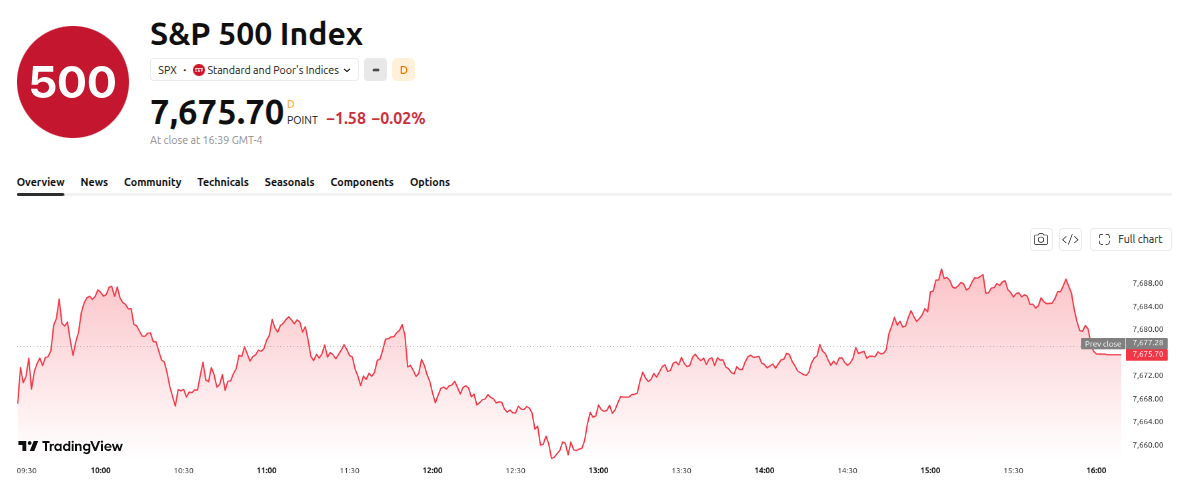
The S&P 500 edged lower despite favorable results from NVIDIA, which comfortably beat the market’s expectations, while core PCE inflation held steady in July.
The cash session had closed nearly flat hours earlier, at 7,675.70 points, ahead of the quarterly report.
The S&P 500’s Cautious Path Into Earnings
NVIDIA carries the single largest weight of any company in the S&P 500, making its quarterly report one of the most consequential single events for the index each year. That outsized influence explains why the benchmark spent Wednesday’s session trading in a tight, hesitant range.

The index had climbed 0.32% on Tuesday to 7,677.28, its third straight winning session, as retreating Treasury yields broadly lifted technology shares.
That momentum stalled on Wednesday, with futures slipping modestly in the hours before the report as investors digested the morning’s inflation data and positioned defensively ahead of the print.
The core personal consumption expenditures price index, the Federal Reserve’s preferred inflation gauge, rose 0.2% month over month and 3.3% year over year in July, exactly in line with economists’ expectations. That reading gave the Fed no fresh reason to tighten policy, though it did little to resolve the broader uncertainty weighing on the index.
Follow us on X to get the latest news as it happens.
The headline figure ran a bit hotter. Total PCE climbed 0.2% monthly and 3.7% annually, both readings 0.1 percentage points above forecasts, leaving the rate-cut debate unresolved just as NVIDIA prepared to report.
The 30-year Treasury yield had touched levels not seen in nearly two decades the previous week, and two days of falling yields had helped technology stocks recover some lost ground. The inflation report alone was not enough to reverse that underlying pressure, leaving the S&P 500 vulnerable to any disappointment from the day’s main event.
NVIDIA Beat Expectations, but the Market Didn’t Celebrate
NVIDIA (NVDA) closed the regular session at $209.66, down 1.59% from the previous close, according to TradingView data. In after-hours trading, however, shares jumped to $218.72, up 4.32%, as the market digested a quarter that beat consensus by a wide margin.
NVIDIA reported revenue of $96.2 billion, well above the roughly $92 billion consensus, representing a 106% year-over-year increase. Earnings per share came in at $2.22, comfortably beating the $2.09 estimate and more than doubling the $1.05 posted a year earlier.
Gross margin stood at 75%, though the company guided for a slight dip to 74% next quarter. Hyperscaler revenue more than doubled to $48.7 billion, while the AI cloud, industrial, and enterprise segment added $40.3 billion, up 138%.
Subscribe to our YouTube channel to watch leaders and journalists provide expert insights.
CEO Jensen Huang described demand as accelerating, saying AI has reached its inflection point and that compute now generates real revenue. Despite that optimistic tone, S&P 500 futures reflected some early hesitation, as investors weighed the report against the index’s broader valuation concerns tied to its heavy concentration in AI-linked names.
That reaction is not entirely unusual. NVIDIA has spent several consecutive quarters in which, even after beating Wall Street’s estimates, its shares have struggled to hold gains, as the market demands increasingly ambitious guidance to justify its valuation. The company has posted only modest gains so far in 2026, well below the pace of prior years.
Fed Chair Kevin Warsh’s speech at Jackson Hole on Friday now looms as the next major catalyst for markets.
The post S&P 500 Edges Lower Despite Favorable NVIDIA Results and Stable Core PCE appeared first on BeInCrypto.
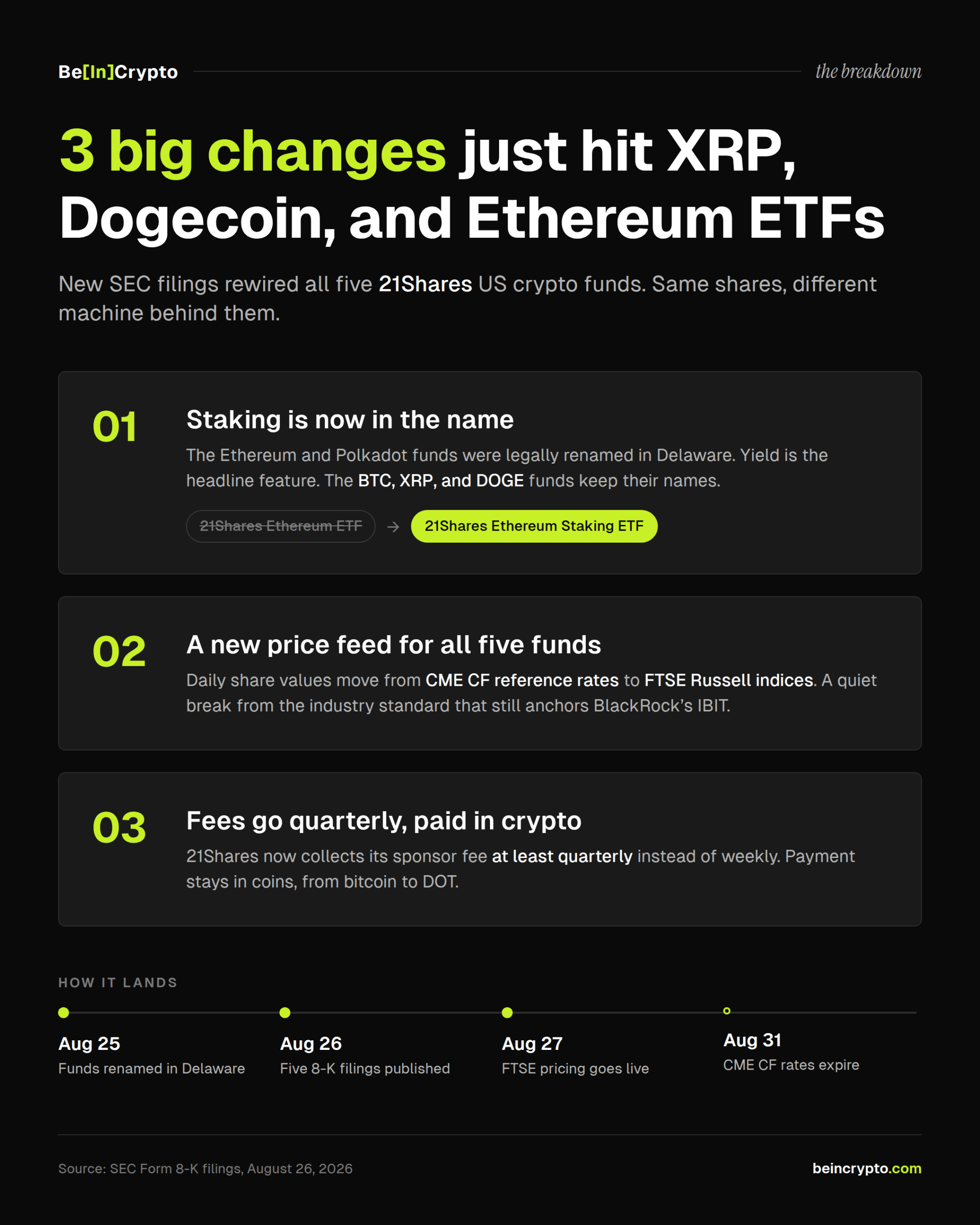
Three changes just hit the 21Shares Ethereum ETF and its four sister funds for Bitcoin, XRP, Dogecoin, and Polkadot. New SEC filings show new fund names, a new pricing source, and a new fee schedule.
Holders keep the same shares. Behind the label, however, the products start working differently on Thursday.

Staking Moves Into the Ethereum ETF’s Name
Start with the names. On August 25, 21Shares renamed two funds in Delaware. The 21Shares Ethereum ETF became the 21Shares Ethereum Staking ETF. The Polkadot (DOT) fund became the 21Shares Polkadot Staking ETF. Five 8-K filings published this week confirmed the changes.
Not every fund got a new name. The Bitcoin (BTC) fund, run with Cathie Wood’s ARK Invest, stays ARKB. The XRP and Dogecoin (DOGE) funds keep their names too.
The Ethereum fund has staked its ether since earlier this year and publishes a reward schedule. So the rename changes the label, not the machine. Yield is now the headline feature, written into the product’s legal name.
That label matters because the yield race is crowding fast. BlackRock launched a separate staked fund, ETHB, on February 18. Its original spot fund, ETHA, still does not stake. Fidelity went further on August 10. It filed to stake FETH’s ether and pay holders quarterly cash. Investors keep 85% of those rewards, while fees take the rest.
Big money has noticed. Intesa Sanpaolo, Italy’s largest bank, cut its Bitcoin fund stake by 94% last quarter and tripled its staked-Ethereum position. Recent flow data tells the same story. Buyers are chasing yield over price.
New FTSE Pricing and Quarterly Fees Land Thursday
The second change is the price feed. From Thursday, August 27, all five funds will value shares using FTSE indices. FTSE Russell is the London Stock Exchange Group arm behind the Russell 2000.
The switch follows 21Shares ending its CF Benchmarks license. Those CME-branded rates expire for the funds on August 31.
That is a quiet break from an industry standard. CF Benchmarks’ rates still anchor IBIT, BlackRock’s giant Bitcoin fund. Even ETHB, BlackRock’s staked fund, prices against a CME CF rate. The benchmark sets each fund’s daily net asset value, so the switch touches every holder’s statement.
The third change is fees. 21Shares will now collect its sponsor fee at least quarterly instead of weekly. Payment stays in coins, from Bitcoin to DOT.
One caution belongs next to the shiny new names. Staked ether can take weeks to exit a crowded withdrawal queue, a gap raised around Morgan Stanley’s Ethereum ETP. Thursday’s flows will show whether yield on the label wins the money.
The post 3 Big Changes Just Hit XRP, Dogecoin, and Ethereum ETFs appeared first on BeInCrypto.


Chainalysis has estimated that potentially taxable onchain crypto activity exceeded $457 billion worldwide in 2025, while transactions within the practical reach of international reporting rules represented only 14% of the total.
Summary
- Potentially taxable onchain crypto activity exceeded $457 billion globally during 2025.
- CARF-covered transactions represented only 14% of the activity identified by Chainalysis.
- The United States led individual countries with an estimated $112.6 billion.
- DeFi, private wallets, income streams, and peer-to-peer payments create reporting gaps.
Chainalysis said in an Aug. 26 crypto tax report that the other 86% included decentralized exchange activity, peer-to-peer transfers, onchain income and crypto payments that fall outside the practical scope of the OECD’s Crypto-Asset Reporting Framework.
The analytics firm examined realized gains, income, and payments across Bitcoin, Ethereum, Solana, Tron, BNB Smart Chain, and Base. Its income category covered mining, staking, lending, and gambling, while the payments estimate included merchant services and transfers that resembled peer-to-peer payments.
Activity recorded inside centralized exchanges was excluded because trades, staking, and lending conducted within their internal systems do not appear on public blockchains. The report also did not cover every blockchain, transaction type, or trading venue, leading Chainalysis to describe the $457 billion estimate as a “lower boundary.”
US crypto activity accounted for $112.6 billion
At $112.6 billion, the United States generated the largest amount of any country. Chainalysis divided the US figure into $64.6 billion in payments, $30.1 billion in gains, and $17.9 billion in income.
North America ranked first among regions with $134.6 billion, placing it ahead of the European Union at $125.1 billion and East Asia at $54.7 billion. Germany followed the US in the country table with $24.1 billion, while China accounted for $21 billion and the United Kingdom recorded $19.4 billion.
India ranked fifth with $19 billion, followed by Brazil at $16.1 billion, Canada at $15.1 billion, and Japan at $13.2 billion. Russia and Thailand generated an estimated $13 billion and $12.5 billion, respectively.
The calculations represent activity that could be taxable under commonly used rules rather than the amount of tax owed or unpaid. Chainalysis noted that local exemptions, tax rates, and classifications differ, meaning authorities would not collect the full value as revenue.
For US taxpayers, selling crypto for dollars, swapping one token for another, and spending digital assets can create taxable disposals under Internal Revenue Service rules. Mining and staking rewards can also count as ordinary income, while buying crypto with dollars or moving assets between wallets controlled by the same person generally does not create a taxable event, according to a recent US crypto tax guide.
US custodial brokers began filing Form 1099-DA for customer disposals made during the 2025 tax year. Gross proceeds are reported first, while cost-basis reporting phases in for covered transactions made in 2026.
According to Chainalysis, the US crypto tax gap was estimated at roughly $50 billion annually in 2022. The report cited congressional projections showing that Form 1099-DA could generate $28 billion in federal revenue over 10 years.
CARF captures activity handled by crypto intermediaries
Developed by the Organisation for Economic Co-operation and Development in 2022, CARF creates a system for participating tax authorities to exchange information about crypto transactions across national borders.
Reporting Crypto-Asset Service Providers, a category that largely covers centralized exchanges and brokers, must collect customer details and submit transaction data to the authorities with which they have a qualifying connection. Some retailers and wallet providers can also fall within the framework.
Data collection started on Jan. 1, 2026, in 48 jurisdictions, including the United Kingdom and members of the European Union. Most participating countries are due to begin exchanging the collected information in 2027, with other jurisdictions following in 2028 or 2029.
Closed order books operated by centralized exchanges offer tax agencies a clearer route to customer records because the platform normally knows who conducted each trade. CARF also covers some blockchain transactions, including certain deposits or withdrawals between a private wallet and an exchange when the transfer relates to a sale.
Even within that structure, CARF-covered events represented just 14% of the potentially taxable onchain activity found in the report. Chainalysis did not argue that the framework should be rewritten, saying its data can still give authorities information about transactions on platforms where most crypto trading occurs.
The EU is also implementing DAC8, which uses a scope similar to CARF while applying connection rules drawn from the Markets in Crypto-Assets framework. Under both systems, tax agencies can receive platform data even when a user conducts transactions outside their country of residence.
DeFi and private wallets leave transaction histories incomplete
CARF’s reliance on reportable service providers leaves much of decentralized finance outside its direct reach. A decentralized exchange may operate through smart contracts without a central custodian that controls customer assets or maintains complete identity records.
Private wallets create another gap because users can hold assets, interact with protocols, and transfer funds without passing through a reporting platform. Foreign services with no qualifying connection to a CARF jurisdiction may also sit outside its requirements.
Cost basis presents a separate problem. When a customer acquires crypto on one platform and later sends it elsewhere for sale, the receiving exchange may know the proceeds but not the original purchase price or holding period.
Historical records can remain missing because CARF does not apply retroactively. Aggregate reports supplied under the framework may also lack the transaction-level detail required to rebuild a complete sequence of wallet activity, according to Chainalysis.
Recordkeeping problems can increase when one investor uses exchanges, self-custody, staking, and liquidity pools. A public blockchain records contract calls and token transfers, but it does not automatically classify an event for tax purposes or establish the owner’s intent.
The same enforcement issue has appeared outside CARF’s first group of participating jurisdictions. South Korea has said its planned 22% crypto tax will cover income from private wallets and exchanges when the regime starts on Jan. 1, 2027, although its National Tax Service acknowledged practical limits in finding every unreported private-wallet transaction.
South Korean officials plan to use CARF and their overseas financial-account reporting system to obtain records from foreign platforms. Tax treatment for staking, lending, airdrops and hard forks remains under review as authorities prepare for the first returns covering 2027 income.
Blockchain records may supplement platform reports
To address missing platform data, Chainalysis said tax agencies can use blockchain analysis to follow transfers between wallet addresses, detect interactions with decentralized or foreign platforms, and identify income from mining, staking, lending, or liquidity provision.
Onchain records may also help reconstruct cost basis when assets pass through several wallets before reaching a reporting exchange. Linking those records to customer information from a regulated platform can give investigators a route from a transaction history to an identified taxpayer.
Such methods have already been used in tax investigations. In May, crypto.news reported that Italian authorities traced more than €1 million, or about $1.1 million, in alleged undeclared Ordinals gains after examining a seized hardware wallet.
Investigators in Foggia and Rome used exchange records and blockchain transaction patterns to follow proceeds from Bitcoin Ordinals and BRC-20 token sales, according to Chainalysis. The firm said the suspect allegedly created the assets, sold them for several times their original cost, and routed the proceeds back to a main Bitcoin wallet.

First Eagle Real Estate Debt Fund Q2 2026 Commentary (FERLX)

Dell Stock: How To Find And Own America’s Greatest Opportunities

Celebrities Who Won’t Appear on Dancing With the Stars





-

 Fashion5 days ago
Weekend Open Thread: Madewell – Corporette.com
-

 Crypto World1 day ago
SpaceX stock could rise 75% to $240, JPMorgan says
-

 Business4 days ago
Musk’s Tesla, SpaceX Confirm $16.8 Billion ‘Terafab’ Chip Plant as World’s Largest Building in Texas
-

 Crypto World5 days ago
anatomy of crypto’s biggest liquidation event since 2021
-

 Crypto World2 days ago
A $30 Billion AI Fund Implodes, Now the SEC Is Investigating Wall Street’s Role
-

 Politics5 days ago
6 months on, Irish renters crushed by effects of government housing bill
-

 Crypto World22 hours ago
Did Trump Just Move SpaceX Stock With One Truth Social Post?
-
 NewsBeat5 days ago
The ‘Lucky Dip Gang’ causing carnage for clicks: After five thugs were killed speeding in the wrong direction on a motorway, GUY ADAMS investigates a sick new trend… and why police aren’t even allowed to pursue them
-

 Business4 days ago
Mystery AI Model ‘Ox Alpha’ Draws Developers With Free Access as Chinese Lab Origins Remain Debated
-

 News Videos7 days ago
Don’t Leave Your Financial Future To Chance | August 19, 2026
-

 Business6 days ago
Five Below: Kids Discount Retailer Reaps Rich Rewards
-

 Business2 days ago
Moderna CEO warns China is pouring state money into mRNA technology
-

 Business2 days ago
NVIDIA Stock Drops Nearly 2 Percent to $210 on Seventh Losing Day Ahead of Critical AI Earnings
-

 Business5 days ago
UK firms in critical financial distress rise 9% to 53,756
-

 Sports4 days ago
Deshaun Watson fires back at Browns fans after being booed: ‘It’s a disrespectful thing’
-

 Crypto World7 days ago
Optimism-funded team's deciding vote shifts $49 million in OP tokens away from users
-

 Tech7 days ago
OpenAI confirms ChatGPT is down as logins and signups fail
-

 Crypto World4 days ago
Google Gemini AI Predicts Ethereum Could Become the Trade Retail Misses in 2026
-

 Crypto World5 days ago
Nvidia Stock Suffers Longest Losing Streak Since 2022: Will Q2 Earnings End It?
-

 Business7 days ago
PayPal and Venmo now accepted for tuition at several universities
You must be logged in to post a comment Login