Rescuers are racing against time to locate the missing in a remote, high-altitude region popular with trekkers and religious pilgrims, an area that includes hundreds of foreign nationals from India, the United States, Britain, Australia and Canada.
What triggered the disaster
Advertisement
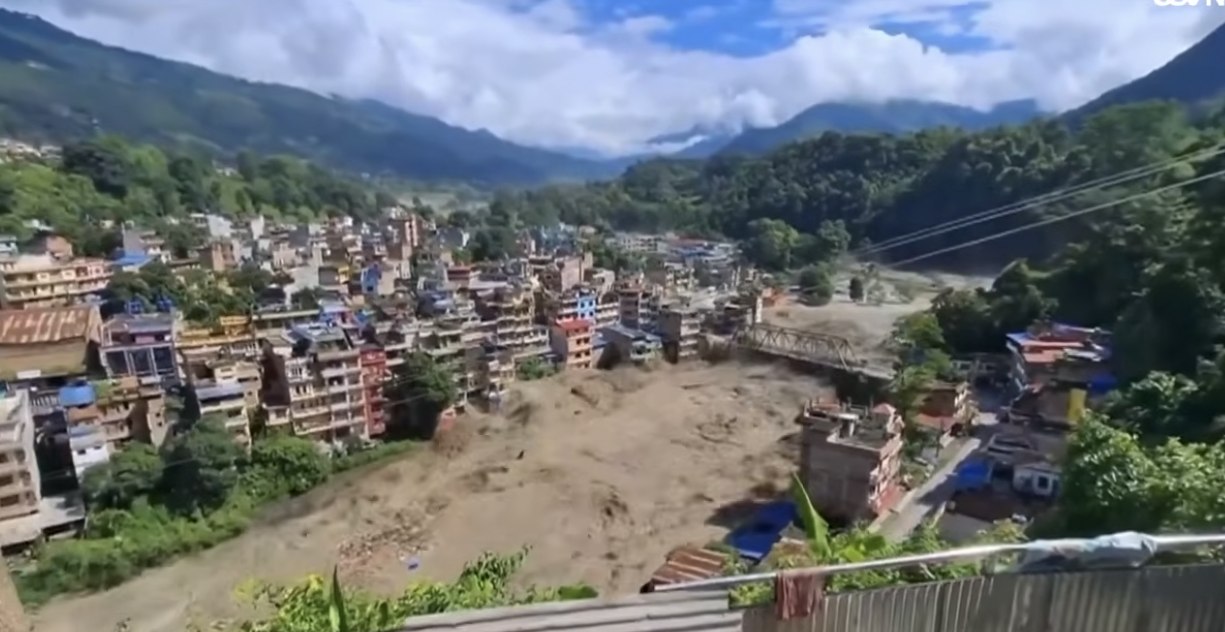
The flood struck Wednesday, sending a massive wall of water and debris crashing down mountain valleys as people scrambled to flee. Trucks were overturned, and houses, roads and power infrastructure were destroyed across the affected region in Nepal, while officials in Tibet warned of feared “major casualties” after a mudslide struck a border land crossing.
Early reports from Nepali officials initially suggested a magnitude-4.4 earthquake may have caused part of a glacier to collapse and trigger the flooding. But the U.S. Geological Survey later determined that what had been reported as an earthquake was in fact a seismic shock generated by the collapse of glacial rock and ice, followed by a debris flow. No actual earthquake had occurred.
An initial analysis of satellite imagery from Planet Labs indicated that a landslide of ice and rock triggered the debris-laden flood in the Lhende River, located roughly 20 kilometers, or about 12 miles, northeast of the Rasuwagadhi border crossing between Nepal and China, according to Nepal’s national disaster authority. Experts have pointed to the extreme topography of the Himalayas as a factor that compounds the risk of such catastrophic events.
Scale of the missing
Advertisement
Nepali police and tourism officials said almost 600 foreigners were among 826 people reported missing in Nepal alone. Among the unaccounted for were 177 people from India, 63 from the United States, 34 from Australia, 33 from Britain and 25 from Canada.
On the Tibet side of the border, Chinese state media reported that at least 558 people were missing, including at least 260 foreign nationals. Nepali police said 165 bodies had been recovered by late Wednesday, while Chinese state media reported three deaths on the Tibet side.
Many of the victims were believed to have been on pilgrimages to Kailash Mansarovar, a revered high-altitude site in Tibet considered sacred by Hindus, Buddhists and others.
Harrowing accounts from survivors
Advertisement
Survivors described the flood’s sudden and overwhelming force. Bibek Kumal, a laborer working downstream from the hard-hit Rasuwa district near Nepal’s Himalayan border with Tibet, said he began running as soon as he heard what sounded like an earthquake, only to see a wall of water thundering toward him. He said the torrent swept him downstream through mud and debris, and that he survived only by clinging to a mango tree. “Had there been no mango tree, I would have been washed away to death,” he said from his hospital bed.
Keshav Prasad Baral, a 68-year-old survivor being treated at a small hospital, described watching a huge surge of mud rise higher and higher as it approached. He said he tried to pull his wife to safety on a terrace, but she was swept away in the mud before a helicopter arrived to rescue him hours later. He said she remained missing, buried somewhere beneath the debris.
Rescue and relief efforts underway
Helicopters hovered over the disaster zone throughout the day Wednesday, ferrying survivors out of areas cut off by the flooding. In Tibet, officials mobilized nearly 800 emergency workers along with 150 vehicles, sniffer dogs and speed boats to assist search-and-rescue operations, China’s official Xinhua news agency reported.
Advertisement
The head of the International Federation of Red Cross and Red Crescent Societies, David Fisher, said entire villages and market areas had been wiped out by the disaster. United Nations Secretary-General António Guterres said U.N. teams and partner organizations were mobilizing supplies and personnel to support affected communities in Nepal. The U.S. government said it would provide $500,000 in emergency assistance.
Chinese President Xi Jinping said the most urgent priority was doing everything possible to locate and rescue those still missing.
Families searching for answers
In the hard-hit districts of Nuwakot and Dhading, families gathered outside a Nepali army training center that has served as the base for helicopter rescue operations, seeking any information about missing relatives. Police recorded the names of the missing just outside the barracks gate, working by mobile phone light after the area lost electricity due to damaged hydroelectric infrastructure.
Advertisement
The tour operator Himalayan Glacier said 47 people, including two children, were missing from one of its trekking groups in Nepal. Managing director Sanket Pandey said the group included 15 Australians, 10 Canadians, nine Nepalis, eight Americans, two Britons, two Singaporeans and one dual Russian-American citizen.
International reaction
Governments around the world responded to news of missing citizens. Australian Prime Minister Anthony Albanese said his thoughts were with families anxious about loved ones, acknowledging that obtaining reliable information about the status of the missing remained difficult given the scale of the disaster and the damage to local infrastructure.
With power out across large parts of the affected region and communication severely disrupted, authorities warned that both the death toll and the number of confirmed missing could continue to shift as rescue teams reach more remote areas. Search efforts were expected to continue in the days ahead, with international aid organizations and foreign governments coordinating additional support for what officials described as one of the deadliest glacial flood disasters to strike the Himalayan region in recent memory.
The service is expected to attract business travellers
11:09, 27 Aug 2026Updated 11:19, 27 Aug 2026
A Discover Airlines plane(Image: Bristol Airport)
Bristol Airport is launching a new route to the city of Frankfurt in Germany next year. Discover Airlines, part of Lufthansa Group, will be operating the twice weekly service from May.
The German airline will be offering flights on Mondays and Thursdays, and the route is expected to attract extra business travellers.
Advertisement
Bristol Airport said the new service would also offer “opportunities” for firms in the South West to connect with businesses in Germany.
Marco Götz, chief commercial officer at Discover Airlines said: “With Bristol, we’re adding our first destination in England to our portfolio.
“As we’re noticing a growing demand for destinations that combine culture, nature and outdoor experiences, Bristol is a perfect fit. The new Discover Airlines route is the only nonstop connection from Frankfurt and connects the South West of England with Germany during summer 2027, making travel to this region even more convenient.”
Kathryn Davis, chief executive of tourism body Visit West, welcomed the news. She said: “We know that there is already strong demand from German visitors to experience the best of Bristol, Bath and the region, and this will be a boost for our visitor economy.
Advertisement
“Germany is one of the largest markets for inbound tourism, and we look forward to working with Discover Airlines and Bristol Airport, as well as our local business community and trade partners, to ensure that this is a success.”
Rupert Lawrie, commercial director at Bristol Airport, said the transport hub had worked “closely” with Visit West to secure the route.
“This is fantastic news for both our business and leisure customers,” he said. “The new service will compliment increased capacity next year from Germany and Switzerland, enabling even more visitors into the region, which is something the airport is passionate about.”
Frankfurt is known as Germany’s ‘financial capital’ and is located near the world-famous Rhine Valley wine region, the Black Forest and thermal spas. The city’s airport is one of the biggest in Europe with a high-speed train connections to other major European cities.



























































You must be logged in to post a comment Login