
Business
What it can teach the wealthy about trusts


Jeanie Buss during the unveiling of a statue of former Lakers coach Pat Riley in Star Plaza in front of Crypto.com Arena in Los Angeles, Feb. 22, 2026.
Keith Birmingham | MediaNews Group | Pasadena Star-News | Getty Images
A version of this article first appeared in CNBC’s Inside Wealth newsletter with Robert Frank, a weekly guide to the high-net-worth investor and consumer. Sign up to receive future editions, straight to your inbox.
Jerry Buss structured his estate to keep the Los Angeles Lakers in the family after his death. But some of the safeguards meant to preserve that legacy have driven his children apart, according to trusts and estates attorneys.
Five of Buss’ six adult children want to sell the family’s remaining stake in the basketball team, valued by a separate recent transaction at $12.5 billion. Meanwhile, their sister Jeanie contends that her siblings do not have the legal authority to give up ownership and is opposing the sale, which would result in Jeanie Buss losing her position as governor of the Lakers.
The Buss stake in the franchise is owned by a family trust, which includes a “last man standing” clause, as described by sister Janie Buss to ESPN in 2017. That provision transfers a sibling’s equity upon their death to their surviving siblings rather than their own children, incentivizing the siblings to sell during their lifetime, Janie Buss told ESPN at the time.
Steven Fox, partner at Buchalter, said it’s common for parents passing down a business to want to limit the number of stakeholders. However, this type of clause is unusual, he said.
“I rarely draft that into estate plans, because just because one sibling has cancer and all of a sudden is going to die young, it’s not fair for their children to be divested,” he said. Fox, like the other attorneys who spoke to CNBC, has not seen the terms of the Buss family trust.
While few family businesses are like the Lakers, the broad strokes of the Buss family’s predicament are familiar, according to lawyers who spoke to CNBC. These succession conflicts are also likely to grow more common with the great wealth transfer underway and baby boomers passing on businesses to their children, said Sean Weissbart, partner at Blank Rome LLP.
Trusts and estates attorneys pointed to three steps that can make family business transitions smoother.
Use life insurance to compensate family members
The impulse behind the “last man standing” clause makes sense, Fox said. Without limits on inheriting equity, a family business can end up with dozens of shareholders. However, there are ways to avoid having too many cooks in the kitchen while compensating the next generation fairly, he said.
Fox and Weissbart each recommended using life insurance to essentially buy grandchildren’s equity. Typically, the trust would take out policies on the children of the patriarch or matriarch. After the child dies, their shares revert to their surviving siblings while the grandchildren receive cash from the life insurance payout.
If the death benefit isn’t sufficient to compensate the grandchildren, the trust can provide them with a secured note, placing a lien on the family business, according to Fox. The secured note can be paid out over time and paid in full if the business is sold.
Even before the business is sold, “there’s plenty of money for them to have a great lifestyle,” he said.
This approach can also be used a generation earlier to buy out children of the wealth creator who do not wish to be involved in the business. However, first-generation entrepreneurs are rarely able or willing to take out expensive life insurance policies while they are still relatively young, according to Fox.
Limit decision-making power
Jerry Buss divided the family’s controlling stake in the Lakers evenly among his six children, with each child receiving an equal vote. However, he designated Jeanie Buss to replace him as the team’s governor.
According to a letter written by Jeanie Buss’ lawyer, the trust requires two of Jeanie’s siblings and her co-trustees, Janie and Joey, to vote in a way that keeps her ownership above the 15% minimum for team governors.
Lawyers for Jeanie Buss and her siblings did not respond to requests for comment.
It’s common for parents to be torn between wanting to treat their children equally while acknowledging that one child is best-suited to run the business, Weissbart said. However, dividing decision-making power may not be in the children’s best interest, he added. He suggested allocating voting rights to one or two children who are best equipped to run the business while dividing the economic interest equally.
“Giving people the say over a multibillion-dollar business who don’t know how to actually manage it is detrimental to the business,” he said.
Weissbart and Fox both recommended placing the family business in a trust and naming only one child as trustee with the ability to make managerial decisions.
The shares are pooled into one so-called pot trust, and in the event of a sale, the proceeds are distributed to the individual siblings’ trusts, according to Fox. He said he sometimes adds an independent co-trustee such as an advisor from a bank or an advisory committee.
“It’s so much easier just to have one person dealing with it than to have to gain approvals from various children’s trusts or children themselves,” he said. “Siblings are difficult. We’re talking about a lot of bad blood.”
Still, Fox said most of his clients prefer a majority-rule approach, which he believes can worsen family ties.
“I always tell clients you’re going to destroy the relationship between your children. Once three of them gang up on one of them, the one that gets outvoted — and the business then gets sold — is going to harbor bad feelings the rest of their life against these three siblings,” he said.
Though Fox and Weissbart were largely in agreement, there isn’t widespread consensus.
George Taylor, partner at Brinkley Morgan, said instead of concentrating power with one sibling, he would recommend giving each child an equal say. Each sibling would be the trustee of an individual trust with equal shares of the business, and they could act through majority when selling.
“Obviously it’s more common than not that one child is left in control,” he said, “but this would be the ‘let’s get along, Kumbaya’ approach.”
Reconsider children’s involvement in the business
Perhaps the best way to keep a business in the family is to keep family out of managing it, according to Fox.
Keeping a family business through multiple generations is a steep challenge, he said. One of the families he works with has a fourth-generation billion-dollar company, according to Fox. He said their secret to success is that no one in the family is allowed to work for the company.
After the second generation of the family spent 10 years battling in court for control of the company, the third generation amended the shareholder agreement in the ’80s to keep family members out, he said.
“That doesn’t work for the Lakers, because there’s a lot of swag that goes along with running the Lakers. But it works for some businesses, and it’s worked perfectly for this family,” he said. “I’ve now done that with several clients.”
There’s no silver bullet for keeping children from taking family feuds to court, Fox said. While many trust documents have clauses requiring arbitration or disinheriting children who choose to sue, they are not necessarily enforceable, he said.
“I tell my clients you’re never going to stop your kids and grandkids from suing each other, because they didn’t earn this; it’s inherited,” he said. “You built it up. You took all the risk when you had nothing and were putting everything on your credit card. They don’t have that muscle memory.”


Unknown Executive
Good morning, everyone, in Europe. Good afternoon to those in Asia. Thank you for joining Jinhui Shipping and Transportation Limited Q2 and First Half 2026 financial results. Can everyone hear me? Sorry, there are other people joining, so I’ll accept…
I trust that you’ve all had a look at the financial results announcement, and you have a copy, and I’ve shared the presentation on the screen. So going through the highlights of current quarter. For Q2, we recorded USD 36 million for revenue, EBITDA of USD 17 million and a net profit for the quarter, USD 5 million. Basic earnings per share, USD 0.048 for Q2. For the first half of 2026, we recorded a revenue of USD 69 million, EBITDA of USD 34 million, a net profit of $10 million, basic earnings per share, 0.088 and a gearing ratio as of the end of June, 7%.
Compared to Q2 2025, Q2 2026 recorded a slight decrease. This should be a 9% decrease. This should be quite apparent because we — there’s a reduction in the number of ships we sold some secondhand ships. Net profit, $5.3 million in Q2 2026, which represents a 374% quarter-on-quarter increase. Average daily TCE stands in Q2 2026, USD 18,015 per day, which is a 30% increase compared to Q2 2025 number. For the first half, first half 2026 revenue compared to first half 2025 is a 13% drop. Again, this is due to the lower number of vessels in our fleet, given that we’ve sold some. Net profit, $9.6 million, 37% drop compared to the first half of 2025.
Average TCE in the first half 2026, USD 17,150 per day, a 30% increase compared



The family-run shop has been a fixture in Brislington, Bristol since the 1920s.

Raymond James raises Nvidia stock price target on strong outlook

Analysis-Meta’s social media settlement leaves its money machine unscathed

Sportradar expands partnership with Polymarket across 20 sports
Delivery Hero SE (DELHY) Q2 2026 Sales/ Trading Statement Call – Slideshow

Xos director Alice Yake sells $18,086 in shares

Quanta Services: Recent Selloff Creates Compelling Buy

OPINION: Big retailers’ struggles reflect the broader disquiet among investors and households.

Bitfinex Securities completes record $50M tokenized capital raise

Martha Stewart’s Zip-Up Jacket Is So Luxe — The Look

Crypto Is About To Get VERY Interesting (Final Warning)





-

 Fashion6 days ago
Weekend Open Thread: Madewell – Corporette.com
-

 Crypto World2 days ago
SpaceX stock could rise 75% to $240, JPMorgan says
-

 Business5 days ago
Musk’s Tesla, SpaceX Confirm $16.8 Billion ‘Terafab’ Chip Plant as World’s Largest Building in Texas
-

 Crypto World5 days ago
anatomy of crypto’s biggest liquidation event since 2021
-

 Crypto World3 days ago
A $30 Billion AI Fund Implodes, Now the SEC Is Investigating Wall Street’s Role
-

 Politics5 days ago
6 months on, Irish renters crushed by effects of government housing bill
-

 Crypto World1 day ago
Did Trump Just Move SpaceX Stock With One Truth Social Post?
-

 Business4 days ago
Mystery AI Model ‘Ox Alpha’ Draws Developers With Free Access as Chinese Lab Origins Remain Debated
-
 NewsBeat5 days ago
The ‘Lucky Dip Gang’ causing carnage for clicks: After five thugs were killed speeding in the wrong direction on a motorway, GUY ADAMS investigates a sick new trend… and why police aren’t even allowed to pursue them
-

 Business3 days ago
Moderna CEO warns China is pouring state money into mRNA technology
-

 Business7 days ago
Five Below: Kids Discount Retailer Reaps Rich Rewards
-
 Crypto World6 days ago
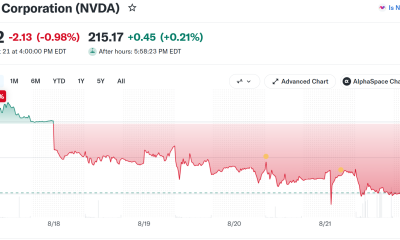
Nvidia Stock Suffers Longest Losing Streak Since 2022: Will Q2 Earnings End It?
-

 Business3 days ago
NVIDIA Stock Drops Nearly 2 Percent to $210 on Seventh Losing Day Ahead of Critical AI Earnings
-

 Sports4 days ago
Deshaun Watson fires back at Browns fans after being booed: ‘It’s a disrespectful thing’
-

 Business6 days ago
UK firms in critical financial distress rise 9% to 53,756
-

 Crypto World4 days ago
Google Gemini AI Predicts Ethereum Could Become the Trade Retail Misses in 2026
-

 Tech6 days ago
Unitree’s New Superman Robot Claims to Outjump and Outrun Every Human, Usain Bolt Included
-

 Tech6 days ago
Faster chip in a familiar form factor
-

 Crypto World6 days ago
SEC Regulation Crypto vs CLARITY Act: which framework wins
-

 Business5 days ago
Will Tesla Stock Be Higher or Lower a Year From Now? Here’s What Wall Street Analysts Are Saying
You must be logged in to post a comment Login