








Connect with us

Business

Rocket Lab Doesn’t Need Neutron To Justify This Quarter, But Does For What’s Next (RKLB)

Published

on

Rocket Lab Doesn't Need Neutron To Justify This Quarter, But Does For What's Next (RKLB)

This article was written by

Rick is a Wall Street Journal best-selling author and financial writer specializing in stocks and options trading. He’s recognized as a top 1% financial expert and blogger on TipRanks, and his work, in both written and video form, has appeared in Good Morning America, Forbes, Yahoo Finance, MSN, Business Insider, InvestorPlace, Benzinga, SoFi, Barchart, Thrive Global, and many more. Journalists and editors can find his verified credentials on MuckRack.His passion is business, and he works tirelessly to make complex investing ideas easy to understand, whether on his YouTube channel, in his books, or across his published work.Rick started his career young. In 2004, he founded a web marketing agency that was acquired in 2007. He and his partner then became pioneers in the telecom industry, offering a business phone service that worked from anywhere. The company grew rapidly through innovation and strategic acquisitions before being sold in 2014 for a seven-figure exit.Between 2009 and 2015, Rick served on the board of directors of GVCCU, where he gained inside experience in the mortgage and lending business.In 2018, he wrote The Financially Independent Millennial to share his story of reaching financial independence at age 35 despite not learning about money growing up. His books are written to be approachable and often highlight the lessons he wishes he could have told his younger self.Rick later co-authored Success Mindsets, which became a Wall Street Journal bestseller on November 13, 2021.When he’s not analyzing markets, Rick is an enthusiast of fast cars, technology, and good food.

Analyst’s Disclosure: I/we have no stock, option or similar derivative position in any of the companies mentioned, and no plans to initiate any such positions within the next 72 hours. I wrote this article myself, and it expresses my own opinions. I am not receiving compensation for it (other than from Seeking Alpha). I have no business relationship with any company whose stock is mentioned in this article.

Seeking Alpha’s Disclosure: Past performance is no guarantee of future results. No recommendation or advice is being given as to whether any investment is suitable for a particular investor. Any views or opinions expressed above may not reflect those of Seeking Alpha as a whole. Seeking Alpha is not a licensed securities dealer, broker or US investment adviser or investment bank. Our analysts are third party authors that include both professional investors and individual investors who may not be licensed or certified by any institute or regulatory body.

Advertisement
Continue Reading
Click to comment

You must be logged in to post a comment Login

Leave a Reply

Business

General Mills nixes ‘certified colors’ from all of its cereals in US

Published

on

General Mills nixes 'certified colors' from all of its cereals in US

Food-manufacturing giant General Mills announced that all of its U.S. cereal offerings are now created without “certified colors.”

The company said it intends to remove “certified colors,” which it notes are “also known as synthetic color additives,” from all of its U.S. products by the end of next year.

Advertisement

“With all U.S. cereals – including Lucky Charms and Trix – now free from certified colors, 90% of General Mills’ U.S. retail portfolio has completed the transition,” the food giant said in a statement Wednesday.

CHEERIOS MAKER SAYS COST OF LIVING, HOUSING EXPENSES CHANGING WAY CONSUMERS SPEND

Cereal boxes

Miami Beach, Florida, Bay Supermarket breakfast cereal aisle. (Jeffrey Greenberg/Universal Images Group via Getty Images / Getty Images)

“The company remains on track to remove certified colors from its full U.S. retail portfolio by the end of 2027, including fruit snacks and baking products,” the announcement noted.

General Mills previously tried removing artificial colors from Trix in the past but then ultimately chose to backpedal later and offer an option that included the popular vibrant colors again.

Advertisement

“As part of a commitment to remove artificial flavors and colors from artificial sources from all of its cereals by the end of 2017, General Mills is releasing its first wave of new cereal recipes, which includes Trix, Reese’s Puffs, Cocoa Puffs, Golden Grahams, Chocolate Cheerios, Frosted Cheerios and Fruity Cheerios. The family favorites are now available in the cereal aisle at local retailers nationwide and highlight no high fructose corn syrup and no artificial flavors and colors from artificial sources on the front of each box,” a 2016 press release noted.

GENERAL MILLS PULLS MORE THAN 735,000 PILLSBURY ROLLS FROM SHELVES OVER POSSIBLE GLASS CONTAMINATION

General Mills

Golden Valley, Minn. General Mills World Headquarters. General Mills, Inc., is an American multinational company. (Michael Siluk/UCG/Universal Images Group via Getty Images)

But then a 2017 General Mills post on X, formerly Twitter, declared, “Have you heard?! ‘Classic Trix’ colors are coming back to brighten up your breakfast bowl!”

“Our Trix fans have been calling us, e-mailing us and reaching out to us on social media asking if we would consider bringing back the original formulation of Trix cereal with its vibrant colors,” then-General Mills spokesperson Mike Siemienas noted, according to a 2017 Food Business News report. “As a result, we are launching ‘Classic Trix’ to fill these consumer requests.  We will continue to offer our current formulation of Trix with no artificial flavors and no colors from artificial sources, which has its own fan base, along with Classic Trix. So both products will be available for consumers. Consumers have differing food preferences, and we heard from many Trix fans that they missed the bright vibrant colors and the nostalgic taste of the classic Trix cereal.”

Advertisement

Boxes of Trix currently for sale on the Walmart and Amazon websites list “Natural and Artificial Flavor” on the ingredients list.

GENERAL MILLS LATEST US FOOD GIANT PULLING ARTIFICIAL DYES FROM PRODUCTS

Lucky Charms cereal box

Boxes of General Mills owned Lucky Charms cereal are stacked at a Costco Wholesale store on April 4, 2025, in San Diego, Calif. (Kevin Carter/Getty Images / Getty Images)

GET FOX BUSINESS ON THE GO BY CLICKING HERE

Betty Crocker and Pillsbury are some of the popular food brands within the company’s substantial portfolio.

Advertisement
Continue Reading

Business

Nvidia Stock Jumps On Bullish Quarterly Report, Outlook

Published

on

Nvidia Stock Jumps On Bullish Quarterly Report, Outlook

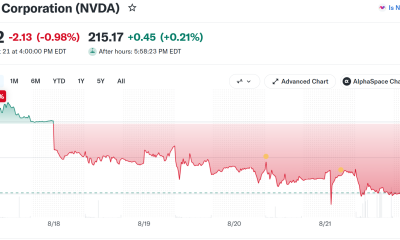
Nvidia (NVDA) reinvigorated the AI stock trade with its beat-and-raise earnings report and commentary about an inflection point in artificial intelligence. The AI chipmaker also gave an upbeat forecast for next year. The Santa Clara, Calif.-based company late Wednesday reported adjusted earnings of $2.22 a share on sales of $96.22 billion in its fiscal second quarter ended July 26. Analysts…

Copyright ©2026 Investor’s Business Daily, LLC. All rights reserved. 87990cbe856818d5eddac44c7b1cdeb8

Continue Reading

Business

Why is Rapid7 stock surging today?

Published

on


Why is Rapid7 stock surging today?

Continue Reading

Business

Earnings call transcript: TD Bank Group posts Q3 2026 beat on revenue, profit

Published

on


Earnings call transcript: TD Bank Group posts Q3 2026 beat on revenue, profit

Continue Reading

Business

Bitcoin Price ‘Powerful Setup’ Trips Rally Ahead Of IREN Earnings

Published

on

Bitcoin Price 'Powerful Setup' Trips Rally Ahead Of IREN Earnings

The price of bitcoin continued to trade around three-month highs near $80,000 Thursday morning, spurred by last week’s Treasury Department bond buyback plan and renewed regulatory agitation from the Trump administration. Bitcoin miner and high-performance computing infrastructure provider IREN reports earnings after the close. Crypto stocks swung higher early Thursday. The price of bitcoin on Thursday traded around $79,300, easing…

Copyright ©2026 Investor’s Business Daily, LLC. All rights reserved. 87990cbe856818d5eddac44c7b1cdeb8

Continue Reading

Business

Perth men charged over alleged cybercrime links

Published

on

Perth men charged over alleged cybercrime links

Two Perth men have been charged over their alleged involvement with a cybercriminal group linked to breaches of over 1000 organisations, including the European Commission.

Continue Reading

Business

Vertu CEO upbeat as profit expectations hiked amid growth in new and used car sales

Published

on

Business Live

Vertu has welcome a consultation on the Zero Emission Vehicle Mandate, but Mr Forrester has warned it is unlikely to go far enough

Mr Forrester says Government policies are distorting the car market.

Robert Forrester, chief executive of Vertu Motors(Image: supplied pic, free to use)

The boss of car retailer Vertu has talked of a strong start to the year following the firm’s second profits upgrade within three months.

Gateshead-based Vertu told investors to expect full year profits ahead of £26m as sales have increase across the national showroom operator’s new and used cars offer. CEO Robert Forrester said he believes the group – which runs 194 sales and aftersales sites in the UK – is growing its market share amid a significant marketing push that has included becoming the main shirt sponsor at Burnley FC and TV campaigns.

In a trading update for the five months to the end of July, Vertu reported a 4.6% rise in group revenues. Volume of new vehicles was up 8.7% while used sales were up 4.4.%. A rise in aftersales revenue has also helped grow group profits year-on-year. Bosses also said new vehicle order books for July-September were ahead of previous years.

Vertu has moved to open new outlets for Chinese brands in recent years and now runs 18 such sites, with the group’s first Omoda and Jaecoo sites launched in Burton last month. This month it opened its first Leapmotor outlets in Harrogate and Crewe, with work under way to bring a Geely forecourt to Teesside.

Advertisement

In Nottingham, Vertu has opened its first site for Renault Group-owned performance brand Alpine, alongside existing Renault and Dacia outlets. Closer to home, the group’s Morpeth-based Ford, Honda and BYD showroom has outgrown its current pitch and will expand into premises across the road. While in Hartlepool, £800,000 will be invested to create a major redevelopment of a dealership for BYD.

Mr Forrester said: “It’s our second profits upgrade in three months, which is good. We’ve had a strong start to the new financial year.

“I think the business is in a very strong position, operational we are in a good place. We’ve got lots of good initiatives that are adding value. And we’re making a lot of changes to the portfolio to reflect the changing nature of the sector – particularly the growth of the Chinese manufacturers – and everyone on the team has done a very, very good job.

“I don’t think it’s the easiest of sectors but we’re giving a good account of ourselves.”

Advertisement

Meanwhile, Vertu has welcomed the Government’s consultation on the controversial Zero Emission Vehicle (ZEV) Mandate, which has been criticised by the industry for pushing manufacturers to sell battery electric vehicles (BEV) ahead ahead of demand. Mr Forrester, who has been outspoken on the issue, said “something needed to happen” but pointed to concerns about the “almost prescriptive” nature of the consultation.

He said: “For example, the industry has been asked to consult on whether it wants a target for 2030 of 50% for BEVs, 60%, 70% or 80%. Well, to be honest its ‘none of the above’. When we get to vans, the lowest they’re proposing for 2030 is 40% – well the industry is currently on 9%.”

Mr Forrester added: “The manufacturers of new cars are making the cars far more affordable, actually. They’re trying to drive the new car market. It’s very difficult for them because of the ZEV Mandate and the electric targets – that’s make life very difficult for the manufacturers – but they are putting their best foot forward and there are some great offers out there.

“I think if you’ve got an older car that is starting to go wrong and you’re starting to click into big repair bills then actually it can make more sense to get a newer car or even a new car, or perhaps another used car with a warranty as well.”


Advertisement
Continue Reading

Business

American Airlines adds international routes on XLR planes

Published

on

American Airlines adds international routes on XLR planes

American Airlines A321XLR.

Courtesy: American Airlines

American Airlines announced Thursday it will add seven international routes to its 2027 schedule, with many of those on its Airbus A321XLR planes.

Advertisement

Here are the additions:

  • Charlotte, North Carolina, to Barcelona, Spain, starting May 27, on a Boeing 777-200ER.
  • Chicago O’Hare International Airport to Tokyo’s Narita International Airport, starting March 19, on a Boeing 787-9.
  • New York John F. Kennedy International Airport to Amsterdam, starting March 28, on an Airbus A321XLR.
  • New York JFK to Nice, France, starting May 6, on an Airbus A321XLR.
  • Philadelphia to Porto, Portugal, starting March 28, on an Airbus A321XLR.
  • Philadelphia to Reykjavik, Iceland, starting May 27, on an Airbus A321neo.
  • Philadelphia to Vienna, starting May 6, on an Airbus A321XLR.

The carrier is also adding a fourth daily flight between JFK and London Heathrow Airport, on a Boeing 787-9, starting March 28.

The Airbus XLR, which stands for extra long range, has the ability to go up to 4,700 nautical miles. The single-aisle planes are smaller than others in the airline’s fleet, like a Boeing 777 or Boeing 787 Dreamliner, which makes them cheaper to operate.

The airline rolled out a new interior and configuration with its inaugural XLR flight last year. It’s allocated more space to premium seats — which take up a fifth of the plane — than it has on its other aircraft.

American’s plan is to use the XLRs to focus on routes to smaller European cities from its Philadelphia hub or from New York City.

Advertisement

“It really opens up the menu for all these destinations that are just too small for a widebody,” American’s senior vice president of network and schedule planning, Brian Znotins, told CNBC last year.

The interior of American Airlines’ new Airbus A321XLR aircraft during a showcase event at John F. Kennedy International Airport in New York, U.S., December 11, 2025.

Rajesh Kumar Singh | Reuters

The airline said its Vienna route will extend through early January 2028 to draw tourists who are aiming to visit European Christmas markets. That follows a growing trend, as airlines have been adding more capacity in the shoulder seasons and even in the off-peak winter period as travelers opt to fly in the fall and other cooler, cheaper times of the year.

Advertisement

American’s announcement comes the same week that United Airlines unveiled its 2027 destinations. United is adding routes to less traditionally popular tourist destinations for U.S. travelers, spanning Ljubljana, Slovenia, to Okinawa, Japan.

United offers more international service than other U.S. airlines.

American has been trying to close a profit gap with rivals United and Delta Air Lines and said earlier this year that its flying is split about 80% domestic versus 20% international.

International flights often carry a high premium compared with domestic routes — and the planes serving them generally have more luxurious seats on board, which can be more profitable for airlines.

Advertisement
Choose CNBC as your preferred source on Google and never miss a moment from the most trusted name in business news.
Continue Reading

Business

Family offices making bullish bet on stocks, according to CNBC tracker

Published

on

Stock market gains mint new millionaires in 2025: UBS

The New York Stock Exchange on April 14, 2025.

View Press | Corbis News | Getty Images

A version of this article first appeared in CNBC’s Inside Wealth newsletter with Robert Frank, a weekly guide to the high-net-worth investor and consumer. Sign up to receive future editions, straight to your inbox.

Advertisement

Family offices boosted their stock holdings in the second quarter and trimmed their exposure to real estate and private market investments, according to the latest CNBC Family Office Portfolio Tracker.

Single family offices held 37% of their portfolios in stocks in the second quarter, up from 34% in the first quarter, according to the CNBC Portfolio Tracker powered by Addepar, the foundational data and artificial intelligence platform used by financial professionals globally.

The surge in family office stock holdings is the largest in several years and signals their continued bullishness on the AI trade and equities, despite fears of a bubble and highly concentrated market.

“I’d read it as family offices are more comfortable being more highly allocated to public equities,” said Addepar CEO Eric Poirier. “The increase in public equities was the biggest quarter-on-quarter shift that we’ve seen over the over the course of the last three four years.”

Advertisement

The CNBC Portfolio Tracker provides a real-time look into the portfolios of single family offices, the private investment arms of wealthy families. While most information on family office investments comes from surveys, Addepar’s data reflects the actual portfolios of hundreds of family offices — aggregated and anonymized — representing a total of more than $1.4 trillion in assets.

The rise in stocks in the second quarter was offset by a pullback in private markets and real estate. Family office holdings of private companies, real estate, private equity, venture capital and private credit dropped by 3 percentage points. They also drew down their cash piles by less than 1 percentage point in the quarter, suggesting a push to put more of their money to work.

While the 3 percentage point swing from alts to stocks is substantial for family offices, and challenges the notion that the richest investors prefer exotic alts over retail-friendly stocks, it was largely the result of market fluctuations rather than active buying and selling. The rally in stock markets in the second quarter — with the S&P 500 up about 15% during the quarter — powered their stock gains. The declines in private market valuations, led by troubles in private credit, brought down their allocations to alts.

Yet family offices are letting their stock allocations grow as a share of their portfolio, rather than rebalancing, suggesting a long-term bullish tilt to stocks. Poirer said the AI trade is likely driving much of the interest.

Advertisement

“The AI thematic bet is getting so much action and so much activity, and it’s being expressed in large part in public markets versus private markets,” he said.

The top five most commonly held stocks by family offices in the second quarter were Microsoft, owned by 77% of family offices, followed by Amazon and Alphabet (76%), Apple (70%) and Nvidia (69%).

In private markets, family office allocations to alternatives fell to 46% from 49% in the second quarter, the largest drop in years. Addepar said the decline was mainly driven by private credit funds marking down the values of their assets. Fully 18% of recent vintage private credit funds (vintages 2020 or later) have posted markdowns in net asset values, according to Addepar. That compares with an average of 9% in write-downs for private credit funds with vintages of 2016 or later through the first four years of the lifecycle.

Get Inside Wealth directly to your inbox

Real estate and venture capital funds also had markdowns, Poirier said.

Advertisement

“We’re not actually seeing changes in inflows or outflows,” Poirier said. “It’s more just where family offices are marking their private holdings.”

Family office holdings of fixed income held steady at 8%, hedge funds remain at 7% and “other alts,” which includes commodities and collectibles, held at 6%. Their largest investment segment after pubic equities was private companies, at 15% of their portfolios.

Looking ahead to the third quarter CNBC Family Office Portfolio Tracker, Poirier said the big themes to watch will be in interest rates and bonds.

“The rates environment, the fixed income world is very dynamic right now,” he said.

Advertisement
Choose CNBC as your preferred source on Google and never miss a moment from the most trusted name in business news.
Continue Reading

Business

What does the Meta settlement mean for the UK? Five things we learned

Published

on

A phone screen with the facebook and instagram logos on it. In the background is the meta logo.

The UK has its own measures in place to protect children online.

The Online Safety Act mainly put restrictions on what content young people can see online.

But the UK government has gone further than the US ban already.

Earlier this year, it announced an outright social media ban for under-16s, which will take effect in 2027.

Advertisement

Some other measures will apply to 16 and 17-year-olds, such as curfews and restrictions during certain hours of the day.

The US has to some extent followed the same path: Start by policing the content on the platforms, then move on to restricting access to social media.

But the core difference is children in the US will not be banned completely.

Instead, they will not have access to Facebook and Instagram overnight, have to follow time limits, and there will be prompts for children who use them for a long time.

Advertisement

Unlike in the UK, these are not put in by law, and will only apply to the two platforms so far (more on that below).

The UK government said it was “following developments closely” in the Meta settlement.

But now those safety features have been accepted by Meta in the US, other countries may start asking for them too.

“These tech platforms don’t usually do anything unless they are told to do it,” said Trevor Johnson, a former senior figure at Meta and TikTok, who spoke to Radio 4’s Today programme.

Advertisement

“But I do think the UK will feel empowered to at least ask for the same restrictions.”

Another former Meta director, Zvika Krieger, said Meta agreed to the changes because it saw “the writing on the wall”.

“They’re trying to demonstrate, ‘Oh, you don’t need to go and do a complete ban’,” he told 5 Live Breakfast.

“I think that they probably would roll out a lot of these features to the rest of the world as well.”

Advertisement
Continue Reading

Trending

Copyright © 2025