
Crypto World
Bitcoin Targets $81K After Nvidia Earnings Beat Lifts Risk Assets

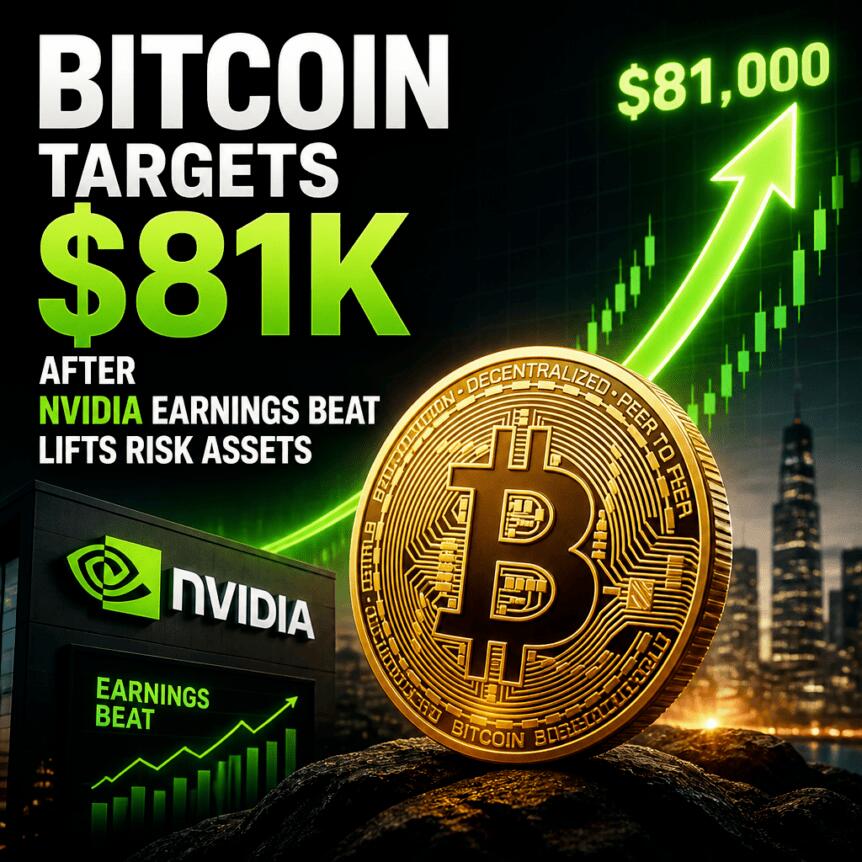
Bitcoin steadied above the psychological $80,000 level as a sharp rebound in US equities helped risk assets across markets. TradingView data showed BTC/USD pushing to a local high of $80,808 around the Wall Street open, with traders watching whether the latest move can hold as support.
The catalyst behind the broader bounce was Nvidia’s earnings surprise. Nvidia reported Q2 earnings of $96.2 billion—nearly $4 billion above expectations—sending its stock up more than 9% and lifting the Nasdaq Composite as investors rotated back into high-growth equities.
Key takeaways
- BTC reclaimed the $80,000 area after Nvidia’s earnings beat sparked a broader lift in US stocks and sentiment.
- Markets are focused on Fed chair Kevin Warsh’s Jackson Hole keynote on Friday amid uncertainty around inflation and the Fed reaction function.
- CoinGlass data showed crypto liquidations running around $417 million over 24 hours, suggesting pressure is easing as buyers absorb nearby sell liquidity.
- Analyst David Eng says the derivatives “liquidity wall” looks weaker ahead of August options expiry on Deribit, potentially improving the odds of a cleaner upside path if $82,000 breaks.
Nvidia lifts risk sentiment, Bitcoin follows
Nvidia’s upside surprise quickly spilled into crypto markets. After Wednesday trading, the company posted Q2 earnings of $96.2 billion—nearly $4 billion higher than expectations—prompting a major rally in its shares on Thursday. The stock surge translated into a wider market tailwind: the Nasdaq Composite was up about 1% at the time of writing, while Nvidia’s market capitalization increased by more than $400 billion.
That stock-market momentum mattered for Bitcoin in the near term because it reinforced the “risk-on” conditions that typically support higher-beta assets. TradingView charts reflected this with BTC/USD moving back toward and above $80,000 as bulls tried to defend the level early in Thursday’s session.
Commentary from trading resource The Kobeissi Letter on X highlighted the magnitude of the move, writing that Nvidia appeared on track for one of the biggest single-day market cap gains in stock history.
Jackson Hole focus returns as rates remain the swing factor
Even with crypto riding equity strength, attention is shifting quickly to monetary policy. Jackson Hole is already underway, and investors are bracing for Fed chair Kevin Warsh’s keynote speech on Friday.
The underlying reason is simple: Warsh’s comments could influence expectations for how quickly interest rates move—especially given the mix of inflation data and volatility in government bond yields referenced in coverage leading up to the event. According to CNBC, Kathy Bostjancic, chief US economist at Nationwide, said Warsh’s address is likely to be “extremely key” because long-term rates have risen and uncertainty remains about the inflation path and the Fed’s reaction function.
For Bitcoin traders, that matters because shifts in the interest-rate outlook often change how investors price duration risk, liquidity, and correlation across assets. When rates stabilize or expectations soften, conditions can become more supportive for crypto; when they reprice upward, momentum can fade quickly.
Sell-side liquidity appears to thin ahead of August options expiry
In crypto-specific flows, liquidation activity offered another clue. CoinGlass data showed liquidations edging higher to roughly $417 million over the prior 24 hours. The key nuance is how the market behaved: buyers were reportedly chipping away at an area of significant ask liquidity, helping Bitcoin hold firm rather than accelerating lower.
Earlier reporting cited a liquidity zone extending up to $86,000 that had been creating friction for additional upside. The current setup appears different in timing: with a major derivatives milestone approaching, that resistance may start to lose potency.
On the derivatives side, analyst David Eng described the prevailing “liquidity wall” as “weakening” ahead of Friday’s August options expiry on Deribit. The expiry cited in the report is $6.58 billion, corresponding to 81,700 BTC at the time referenced, with Eng suggesting that once Bitcoin clears $82,000, the path to higher levels (noted as $85,000+) could become “much cleaner.”
Options expiry events can increase volatility because market makers and traders rebalance positions when contracts settle. When open interest is concentrated around certain strikes, price often gravitates toward those levels as hedging and arbitrage dynamics intensify near the cutoff.
What traders should watch next
The near-term question for Bitcoin is whether it can consolidate above $80,000 and then challenge $82,000 with less friction than earlier in the week. If the liquidity pressure Eng flagged continues to dissipate into the August options expiry window, traders may see a more decisive move upward; if rates guidance from Warsh jolts markets the other way, the support narrative could be tested again quickly.

The company behind XRP has made another move geared toward Wall Street and beyond its cryptocurrency roots by launching a new institutional trading business with Ripple Prime.
The new initiative, announced earlier on Thursday, will allow hedge funds, asset managers, and other institutional clients to execute Total Return Swaps (TRS) across US-listed equities, indices, and digital assets.
Deeper Into Wall Street
The announcement shared by the company informed that the service is already live, and it aims to expand the firm’s presence in traditional financial markets less than a year after completing its $1.25 billion acquisition of prime broker Hidden Road.
Products within Delta One are derivatives designed to closely track the performance of an underlying asset or index. A TRS, for instance, allows an investor to receive the gains and income generated by an asset without necessarily owning it directly, in exchange for paying financing costs and absorbing losses.
Ripple Prime has expanded the scope of assets available on its platform as clients can now access equities alongside foreign exchange, fixed income, derivatives, and cryptocurrencies through a single counterparty relationship. The company said customers can also cross-margin exposures across those different assets around the clock, potentially reducing the amount of collateral institutions need to maintain separately.
Ripple Prime’s President, Noel Kimmel, said that these sorts of services are what institutional market participants are “asking for today, and we are proud to be the ones delivering it.”
Beyond Crypto
Ripple’s acquisition of Hidden Road (later renamed Ripple Prime) was initially announced in April 2025 and completed by the end of the year. It became the first crypto company to own and operate a global multi-asset prime broker, clearing over $3 trillion annually and serving more than 300 institutional customers.
As reported a few months back, Ripple Prime also received an investment-grade BBB rating from KBRA, with the agency pointing to its growth in clearing and intermediation across exchange-traded derivatives and fixed-income repo markets.
Earlier in August, Ripple Prime announced an upsized $275 million private placement of senior unsecured notes, following a $200 million debt facility secured from Neuberger Specialty Finance in May. The entity said it would use the fresh capital to support its continued expansion.
The post Ripple (XRP) Makes Major Wall Street Push With New Institutional Trading Business appeared first on CryptoPotato.


The changes aim to cut investor selling pressure and channel protocol revenue to ENA as Ethena looks to revive USDe growth.
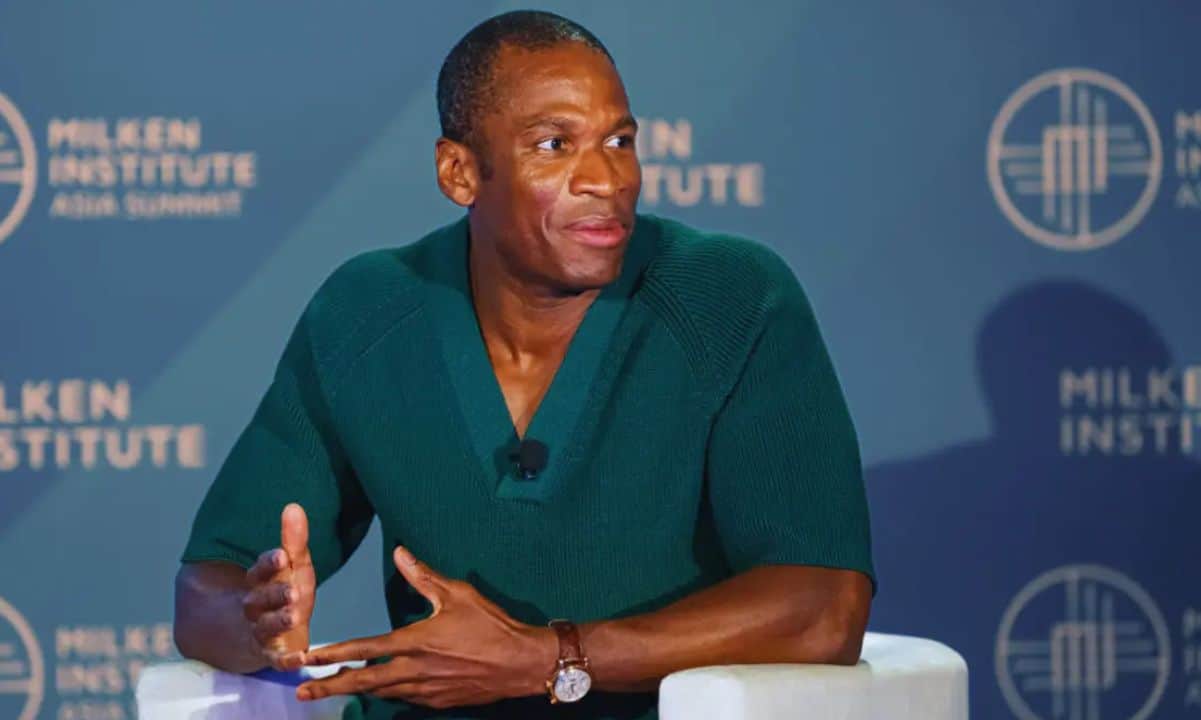
Arthur Hayes has expanded his thesis for Flop Labs, an AI payment project he announced recently, arguing that AI agents need a form of money that can be exchanged directly for computing power rather than relying on dollars, Bitcoin, or conventional payment rails.
The idea is simple on paper but ambitious in practice: if AI agents become major consumers of computing power, he believes their money should be directly redeemable for the resources they actually use.
A Case for a Compute-Based Currency
Flop Labs laid out Hayes’ latest argument in a six-part thread on August 27, starting with a basic problem: there is no efficient spot market for turning money into a known quantity of compute over a known period.
That is important because AI agents have different spending needs than people. “Agents don’t eat. They consume floating-point operations,” Flop Labs wrote, referring to the calculations required to run AI models.
The argument follows that an agent’s money should be useful for the thing the agent actually consumes. Hayes’ view, as presented by Flop Labs, is that the currency capable of converting into compute on demand at a fair price could become the money used by an agent economy.
He also questioned whether stablecoins and tokenized cards are suited to that role, given that those systems are designed around institutions and users that have people, legal entities, and physical-world needs behind them. An autonomous agent has none of those things.
The proposed Flop Network is designed around that distinction. GPU operators would provide inference and receive FLOP, while validators would check the work cryptographically. Miners would also post a stake that could be lost if they submit false results. Agents would then pay for compute using the same token they hold, with the network providing proof that the requested work was delivered.
Per the project’s tokenomics, which are still preliminary, the FLOP supply should hit about 17.2 billion by year 10 of its existence, with no venture capital allocation or presale. The Genesis airdrop is listed at 3.5 billion tokens, including 1.5 billion for miners, 1.2 billion for agents, 310 million for validators, and 790 million for reserves and incentives. There’s also a planned testnet in the works, which is expected to run for about 90 days, with the source code public.
Connecting AI Debt to a Crypto Liquidity Bet
The other part of the thread is more familiar to anyone who has followed Hayes’ AI criticism. He has spent months calling AI investment a bubble, but he said the excess sits in data center debt and unprofitable hyperscaler shares, not in agentic technology itself.
For that reason, the BitMEX co-founder expects AI spending to slow down next year, then contract, forcing bailouts bigger than those seen in 2008, which he believes will push new money toward crypto, potentially sending Bitcoin toward $1 million.
Still, real-world usage is lagging the pitch, with analyst Jamie Coutts recently finding that settlement volume on Coinbase’s x402 agent payment protocol had gone down 93% this year. While he called it a “reality check” for those building in the space, he expects volume to once again pick up in the fourth quarter.
The post This Is Why Arthur Hayes Thinks AI Agents Need Their Own Money appeared first on CryptoPotato.

“Among the people who did not donate,” he says, “16% had dementia listed on their death certificate. That certainly does not mean they had CTE, but it illustrates how unrealistic it is to assume that every non-donor was disease-free.”
Another part of the study looked at a larger time window—from 2008 to 2021—during which 1,712 former NFL players died. Of those, 338, including the 235 already analyzed, donated their brains to research, and of that group, 315 had CTE. That makes for a possible CTE prevalence of as high as 93.2%, though if the researchers once again made the conservative—if unrealistic—estimate that all of the unexamined brains were disease-free, the figure would drop to 18.4%.
What makes CTE particularly insidious is that it is a cumulative disease, one that builds up over a career’s-worth of hits that don’t begin when a player is tapped for the NFL, but can stretch back into college, high school, and even childhood play. In 2011, the NFL, mindful of the growing incidence of CTE, established its concussion protocol, sidelining players who take a hit and exhibit any signs of possible concussion, such as confusion, amnesia, ataxia—a lack of muscle control—or any loss of consciousness.

How does the body adapt to seasonal temperature changes?
Spending most of your time indoors in the air conditioning might slow the body’s changes, come summer. “But if we spend time outside exercising, or even just being physically active outdoors, we’ll adapt to those conditions,” Périard says.
When you go for a walk on a hot summer day, before you’ve adapted to the heat, both your skin temperature and your core temperature may go up. That sets off alarms in the body, announcing heat stress. “With that, we trigger lots of sweating, and we increase our skin blood flow,” says Périard. Sweat evaporates from the skin, cooling skin down, and blood sent to the surface of the body helps shed heat.
The volume of blood pumping through the body also goes up. More blood volume allows more heat to be shed and supports greater sweating without dehydration. There are also changes at the level of the cell, with some proteins’ production going up to protect normal functioning in greater heat. The process of reaching a fully adapted state might take a few weeks, although the precise details will depend on the situation.
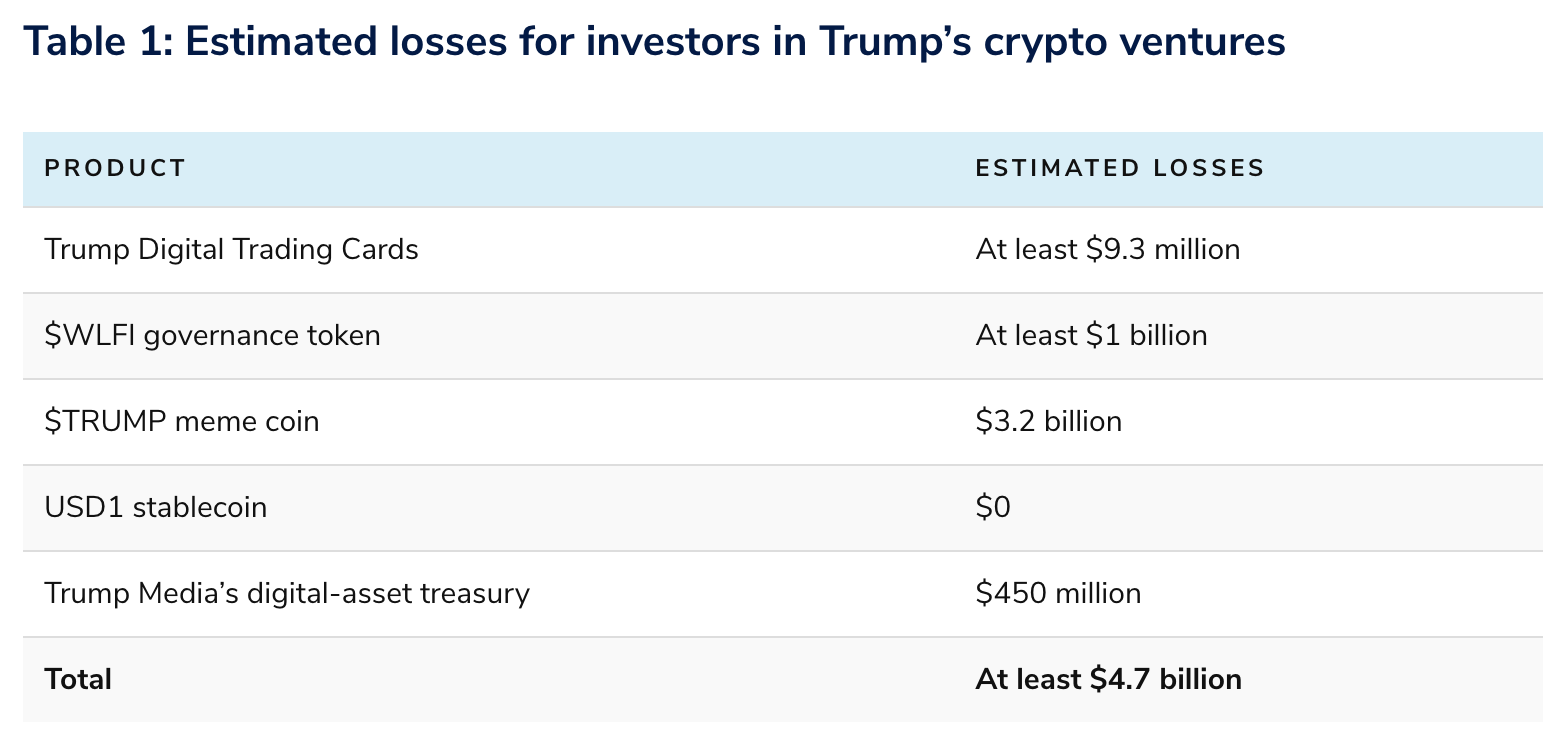
The nonprofit consumer advocacy organization Public Citizen reported that US President Donald Trump “left investors at least an estimated $4.7 billion underwater” since 2022 through his and his family’s digital asset ventures.
According to Public Citizen, investors lost billions of dollars through the Trump family World Liberty Financial governance token, the president’s nonfungible token (NFT) trading cards launched in 2022, his memecoin Official Trump (TRUMP) and Trump Media’s digital asset treasury.
The bulk of the estimated losses, according to the organization, came from investors in the TRUMP memecoin, with $3.2 billion lost, while buyers of World Liberty Financial‘s USD1 stablecoin “haven’t suffered major losses.” Public Citizen said that in the case of the memecoin, the losses represented “wealth transferred to a small group of early buyers rather than money that simply vanished.”
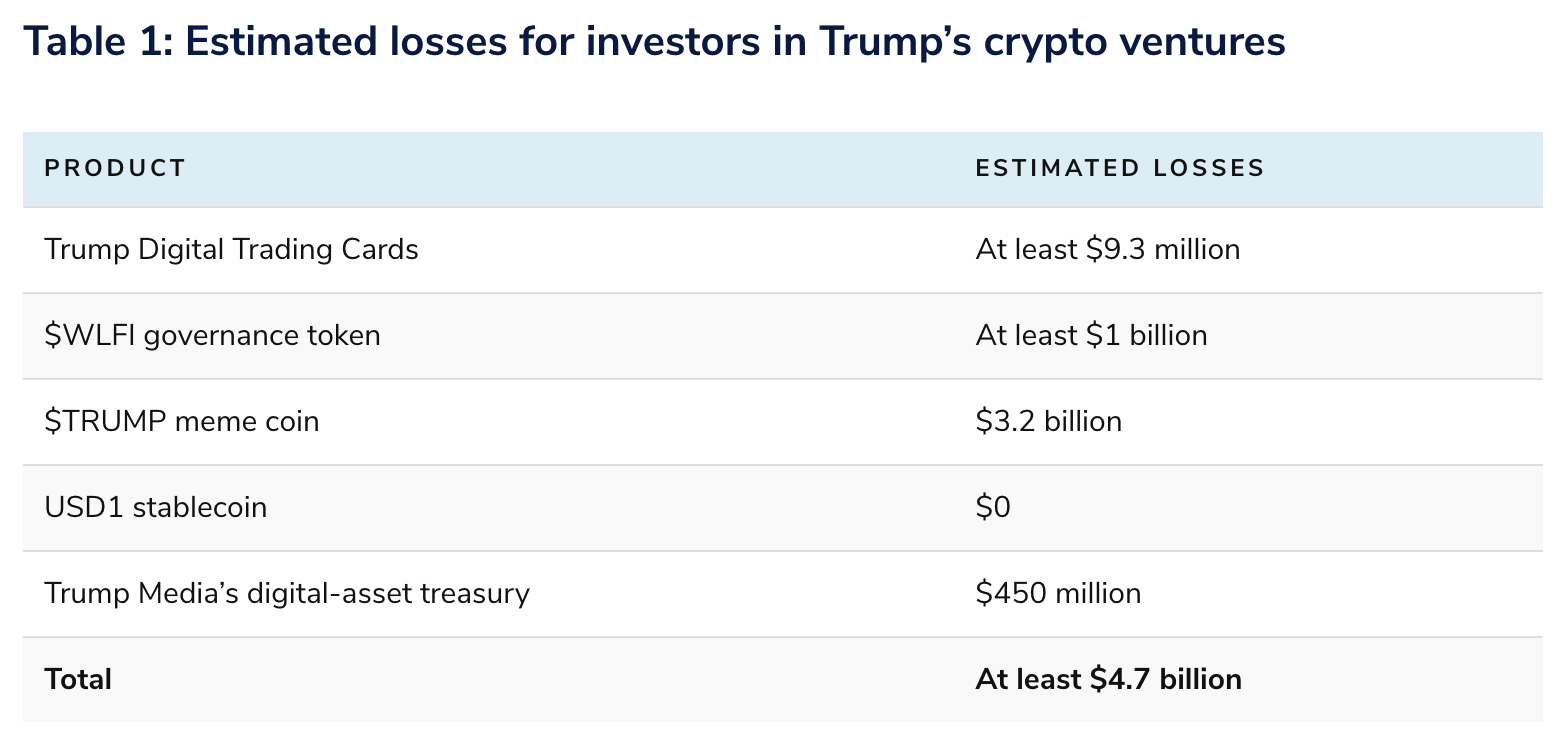
Estimated losses for investors in Donald Trump’s crypto ventures. Source: Public Citizen
According to Public Citizen, amid the $4.7 billion in investor losses, Trump earned $7.2 million from the NFT licensing fees and royalties, more than $600 million from World Liberty token sales and selling an equity stake, $635 million in licensing fees for his memecoin and $197 million in revenue from capital contributions to World Liberty. This did not reflect the stakes in companies and ventures he continues to hold. Some of the figures were included in the president’s 2025 disclosures, reporting $1.4 billion in earnings tied to crypto.
Related: Most Americans say the Trump family’s crypto investments are not ‘appropriate’: Poll
Cointelegraph reached out to the White House for comment but did not receive an immediate response. Spokesperson Anna Kelly has repeatedly said in response to questions on Trump’s crypto investments that there were “no conflicts of interest.”
Crypto bill still weeks away from potential vote
Amid the crypto ventures and more “potentially on the way” from Trump, the group renewed calls for ethics provisions in a cryptocurrency market structure bill, the Digital Asset Market Clarity (CLARITY) Act, claiming that “the president’s policy choices and personal portfolio cannot be separated” and any legislation should require a US president and his family to divest from projects in the industry.
Trump met with crypto company executives last week, calling for a “fair version” of the CLARITY Act to pass once the Senate returns to session next month. The bill is scheduled for a cloture vote on Sept. 15, which will require votes from at least 60 senators to advance.
Magazine: SEC’s proposed crypto rules probably won’t spark new ICO boom
Solana’s native token has posted an 8% increase over the past 24 hours, prompting analysts to make highly bullish bets for the near future.
At the same time, some remain cautious, projecting potential double-digit declines, while certain factors reinforce the pessimistic thesis.
SOL’s Bullish Targets
Just a few hours ago, the asset’s price briefly exceeded $105, marking the highest point since early February. Currently, it trades at around $104, which translates into a solid 42% pump on a monthly scale.
SOL’s strong performance appears to stem from a blend of bullish factors working together. The most obvious one is the broader market resurgence driven by monetary policy changes in the US, among other reasons. Another element is the rising institutional interest, with spot SOL ETFs registering seven consecutive green days: something last observed in May this year.

Next on the list is the return of some of the big players. Analytics platform Lookonchain revealed that a smart trader (who has been inactive in the past two years) has purchased almost 96,000 SOL for nearly $10 million. The analytics resource noted that the market participant has previously completed two Solana swing trades, buying low and selling high both times, ultimately making $4.95 million in total profit. Of course, this has led to speculation that the player might know something the rest of us don’t.
For his part, X user Sweep disclosed that a whale opened a $14.8 million long position in Solana, stating that the investor previously made $1.1 million trading the asset with a 100% win rate.
Many analysts applauded SOL’s revival, expecting further short-term gains. X user Daan Crypto Trades argued that everything “looks good” as long as the price remains above $98.
SKYLINE opined that it is only a matter of time before SOL rises beyond $150, whereas Fuel projected an eventual explosion to $1,000. It is important to note that the higher target seems a bit far-fetched, but yet again, nothing is impossible in crypto.
Going South?
Unlike the aforementioned bulls, Sweep outlined a rather cautious forecast. He thinks SOL could nosedive to $70, giving investors a chance to hop on the bandwagon at lower prices. “After that, Solana will go parabolic,” he added.
The asset’s exchange net flow backs the theory of a short-term decline. According to CoinGlass, investors have been moving aggressively from self-custody to centralized exchanges, which in turn boosts immediate selling pressure.

The post Solana (SOL) Reclaims $100: Is It Time for a Parabolic Rally? appeared first on CryptoPotato.
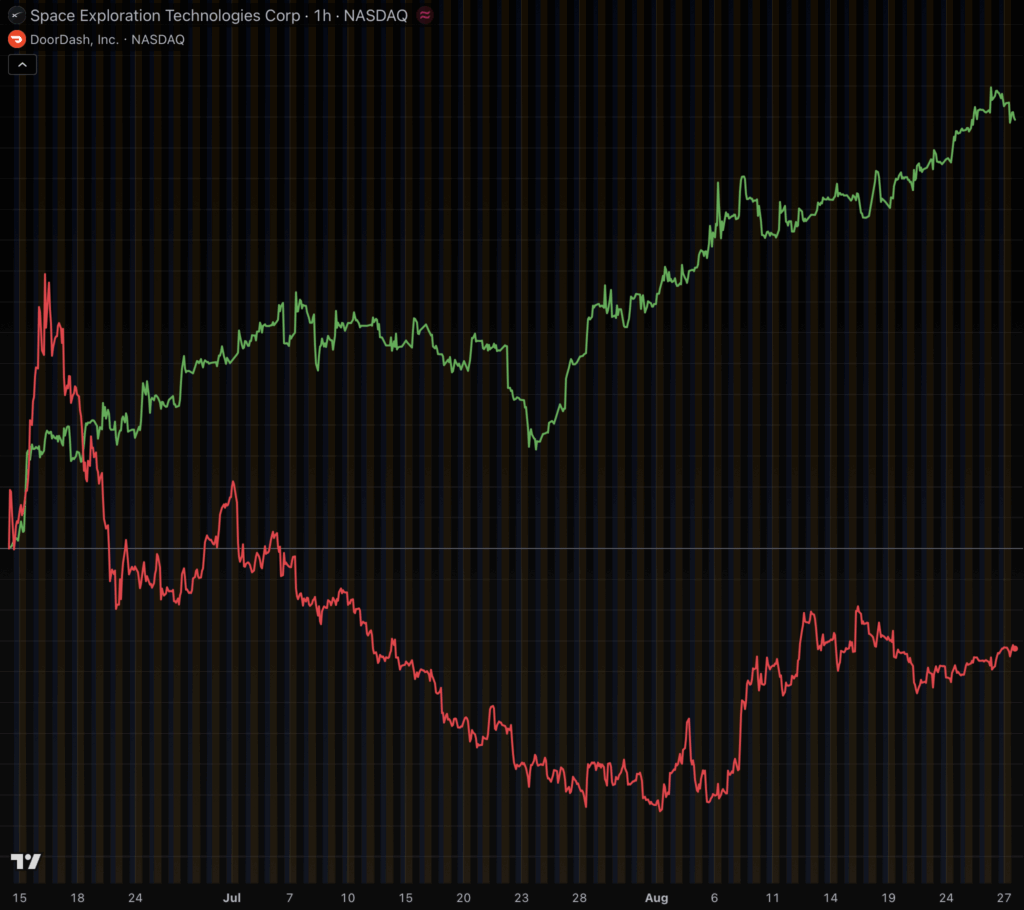
DoorDash has performed 48% better than SpaceX since Elon Musk’s rocketship company launched for public trading at $150 per share on June 12.
While SpaceX, which famously lost $1 trillion of market capitalization for its investors has crashed 6%, DoorDash has increased in value by 42%.
In fact, based on current stock prices, it would have been better to buy any number of restaurant stocks instead of SpaceX on the Nasdaq. Texas Roadhouse has performed 13% better, Flanigan’s has trounced by 35%, and Cracker Barrel has outperformed by 12%.
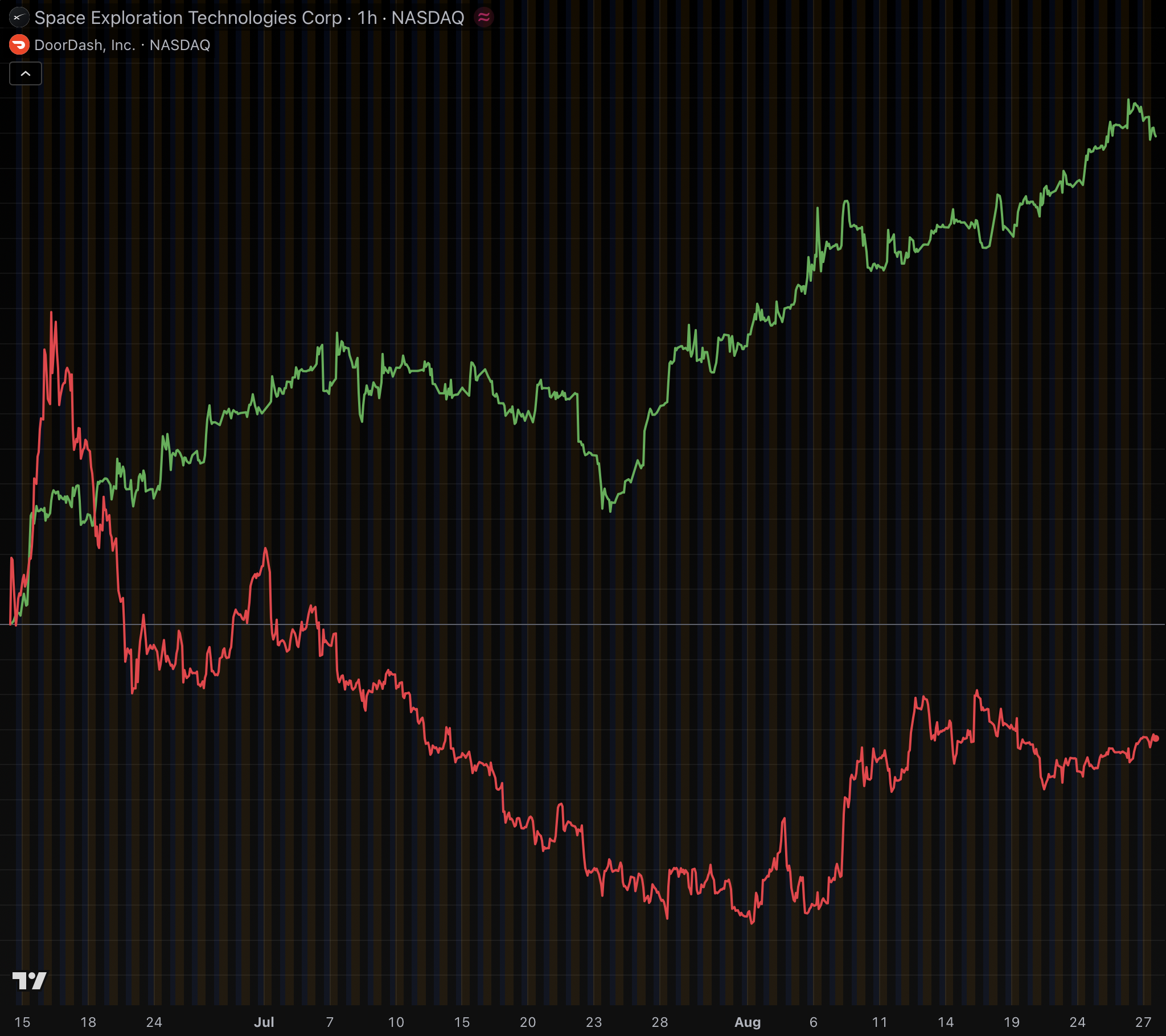
Measuring the drawdown from SpaceX’s peak is even more embarrassing.
Since June 16, SpaceX has declined 37%. It hit an intraday high of $225.64 that day, and performance has been down-only since.
DoorDash opened for trading at $155.24 per share on June 12, while SpaceX began trading at $150 — $15 higher than its formal IPO price.
Almost everyone has unrealized losses on SpaceX as a reward for patiently holding their IPO investment through today.
At this point, insiders who bought at the pre-Nasdaq open of $135 per share are the only shareholders who could possibly have an unrealized gain on a position held since SpaceX’s IPO.
Read more: SpaceX crashed too hard for insiders’ bonus unlock
Better earnings from DoorDash than SpaceX
Both companies reported quarterly results during this comparison period. Management asked investors to process entirely different numbers.
Earlier this month, DoorDash reported 970 million delivery orders for the quarter, $33.1 billion of marketplace gross order value, and a healthy $4.5 billion of revenue.
Orders still grew 17% and revenue grew 24% even after adjusting out a Deliveroo acquisition.
It also generated $944 million of operating cash flow and $742 million of free cash flow.
SpaceX filed its own quarterly results this month, revealing that while revenue reached $7.8 billion, the company lost $541 million. The company also disclosed $18.4 billion worth of capital expenditures.
As of this morning, $10,000 invested in DoorDash as of the June 12 open would be worth about $14,200. The same bet on SpaceX would be worth roughly $9,400.
Got a tip? Send us an email securely via Protos Leaks. For more informed news and investigations, follow us on X, Bluesky, and Google News, or subscribe to our YouTube channel.
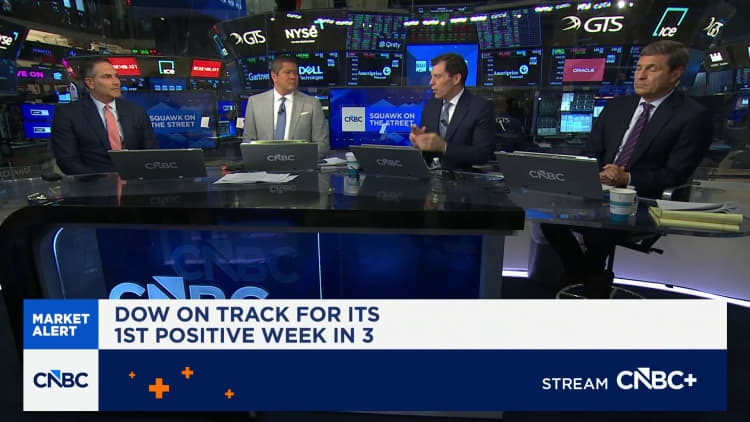
Federal Reserve Chair Kevin Warsh speaks during a news conference at Federal Reserve Headquarters on July 29, 2026 in Washington, DC.
Win Mcnamee | Getty Images
The Federal Reserve‘s cryptic chairman is set to deliver his much-awaited keynote address Friday in Jackson Hole, with markets trying to anticipate what, if anything, he will have to say on key matters affecting the economy and monetary policy.
Kevin Warsh will speak during the Fed’s annual symposium in Wyoming, an event this year that is titled “Financial Innovation: Implications for Payments and Policy.”
Prior Fed chairs have used the speech as an opportunity to discuss broad policy frameworks and intentions on where they see policy and interest rates headed, beyond the main focus of the conference.
But given his approach so far since taking the reins in May, a time during which Warsh has placed a far greater emphasis on market direction than cues from the Fed, it’s hard to know what to expect.
“People keep asking me what I’m expecting, and I’m not really expecting much of anything. I think it’s hard to predict what he’s going to say,” said Luke Tilley, chief economist at M&T Bank and Wilmington Trust Investment Advisors. “If I had to guess, I would say that he’s going to give a very high-level, broad look at the work of the task forces and how he thinks the Fed should operate, as opposed to a nuts-and-bolts assessment of the economy and expectations for policy.”

Warsh has set up five task forces aimed at taking what he calls a “first principles” look at Fed functions.
Among their tasks are an assessment of how policymakers view inflation, the balance sheet, the data points that influence decisions, communication strategies and communications.
On the final point, Warsh has taken a unique approach compared to his recent predecessors: Rather than seeking to steer reaction through carefully placed signals, he has preferred a more hands-off approach that lets markets interpret data and send signals to the Fed.
It’s a strategy that has met with mixed reviews so far and could generate adverse reaction.
Looking for more information
“I would appreciate some more detail on how he personally thinks inflation happens, or how he personally thinks monetary policy affects inflation, either in timing or through which channels,” Tilley said. “That doesn’t even have to address the reaction function. It’s just the basic plumbing of financial markets and monetary policy, because there are a lot of channels.”
With rising Treasury yields heavily in focus, that makes the stakes particularly high for Friday’s speech.
“We have the most unusual Jackson Hole monetary symposium in recent memory on deck because of Warsh’s unforced errors early in his tenure,” said Joseph Brusuelas, chief economist at RSM. “The market has now bid this up to be something that I think the Federal Reserve would rather it not be.”
There’s more at stake, though, than market reaction.
Coinciding with the rise in yields, Treasury Secretary Scott Bessent announced an initiative last week in which the department will double the size of its buybacks on off-the-run, or already issued, debt offerings. Treasury usually buys back $2 billion per weekly operation, but will “at least” double that when the next round begins Sept. 9.
While that’s a relatively small chunk of the massive U.S. debt load, the move still sets up a possibly uncomfortable scenario for Warsh. Market interventions from fiscal and monetary authorities seem to contradict Warsh’s stated intentions so far.
“We’re in a unique set of conditions here, where actions by the Treasury have undermined Warsh’s move. Therefore, the Fed chair is in between a rock and a hard place,” Brusuelas said.
Market impacts
One common complaint about Warsh thus far is his reluctance not only to provide so-called forward guidance on where he thinks the Fed is headed but also neglecting to delineate the “reaction function,” or the conditions that would warrant a move in either direction.
Failing to do so again could have significant market consequences, said Mark Cabana, head of U.S. rates strategy at Bank of America.
“In short, we expect Warsh to signal that he is prepared to raise rates again if inflation does not continue to moderate,” Cabana said in a client note earlier this week. “By contrast, if he uses the speech to focus solely on broader structural themes such as productivity or demographics, we worry markets could interpret the message as dovish.”
In such a case, Cabana said he would expect a sell-off in long-dated Treasurys that could send the 30-year yield to 5.5% or higher, which would be more than 0.3 percentage point from the current level to highs not seen since at least the early part of the 21st century.
Specificity, then, could be Warsh’s friend as he prepares to deliver the most important remarks of his tenure so far.
“Warsh is not going to be able to engage in cryptic discourse,” Brusuelas said. “He’s going to need to be a little bit more forthright and clear on what he means.”


Mastercard deepens its ties to the Ripple ecosystem right as XRP ETF flows show signs of life again. The token is still nowhere near its old highs, but the combination of institutional plumbing and fresh capital rotation is enough to put XRP back on trading desks’ watchlists this week.
The XRP Ledger Foundation confirmed Mastercard as a sponsor of the XRP Ledger Hackathon, a 36-hour event running October 24-25 ahead of Ripple Swell 2026 (October 27-29). The Foundation called the payments giant’s involvement “thrilled,” worthy news, framing the decade-old XRP network as “ideally suited for payment use cases.”
This announcement also follows Mastercard’s March move to enlist Ripple alongside Binance, PayPal, Circle, and others in a broader blockchain-payments partnership program.
Meanwhile, 21Shares has adjusted how its XRP ETF prices the underlying asset, a technical but telling shift arriving just as ETF inflows show renewed momentum after a rough patch.
Discover: The Best Crypto to Diversify Your Portfolio
Can XRP Price Hit $1.50 This Week?
XRP’s intraday range has spanned $1.38 to $1.46, with the current print at the $1.45 area sitting closer to the top of that band. Trading volume has picked up alongside the move, consistent with its August 2026 ETF activity, which saw $56.86 million in net inflows.
Not just ETFs, its trading volume sees the strongest showing since January. The $1.40 handle is now acting as immediate support, with resistance clustering in the mid-$1.40s near the recent high.

For XRP, a clean break above $1.46 opens room toward $1.60-plus, especially if the CLARITY Act clears its September 15 cloture vote and formalizes XRP’s status as a CFTC-regulated commodity. Consolidation between $1.30 and $1.46 could happen too while the market digests whale activity and ETF flow data.
The bear case sees XRP slip below $1.34 and risks a retest of the $1.00 psychological zone that held support in mid-August. Roughly 60% of supply reportedly sits underwater relative to the $1.48 realized price, an overhang worth watching before chasing strength here.
Trade XRP on Bybit and Get a Chance to Win Our $1,000 USDT Airdrop
Bitcoin Hyper Targets Early Mover Upside as Ripple Token Tests Key Levels
XRP holders riding this bounce have earned it; a move off $1.00 back toward $1.45 isn’t nothing. But at a roughly $90 billion market cap, doubling from here means finding another $90 billion in fresh capital, a heavier lift than most presale-stage assets face.
Standard Chartered’s cut of its 2026 target from $8 to $2.80 underscores how institutional expectations have already been recalibrated downward. That gap between JPMorgan’s original $8 billion inflow call and the roughly $1.5 billion actually delivered is exactly the kind of asymmetry that pushes capital toward earlier-stage bets.
Enter Bitcoin Hyper ($HYPER), a Bitcoin Layer 2 built with Solana Virtual Machine integration, pitched as faster than Solana itself while inheriting Bitcoin’s base-layer security.
The presale has raised $33 million to date at a token price of $0.01368, with a huge 35% APY staking rewards offered. Its Decentralized Canonical Bridge aims to solve Bitcoin’s long-standing programmability gap without sacrificing trust assumptions.
Research Bitcoin Hyper before the presale window closes.
Discover: The Best Token Presales
The post Ripple Gets Mastercard Boost as XRP ETF Makes Major Changes appeared first on Cryptonews.

Ashtrom Group Ltd. 2026 Q2 – Results – Earnings Call Presentation (OTCMKTS:ASHPF) 2026-08-27
Ripple (XRP) Makes Major Wall Street Push With New Institutional Trading Business

Rob Reiner’s Son Jake Gives 1st Interview Since Parent Deaths





-

 Fashion6 days ago
Weekend Open Thread: Madewell – Corporette.com
-

 Crypto World2 days ago
SpaceX stock could rise 75% to $240, JPMorgan says
-

 Business5 days ago
Musk’s Tesla, SpaceX Confirm $16.8 Billion ‘Terafab’ Chip Plant as World’s Largest Building in Texas
-

 Crypto World6 days ago
anatomy of crypto’s biggest liquidation event since 2021
-

 Crypto World3 days ago
A $30 Billion AI Fund Implodes, Now the SEC Is Investigating Wall Street’s Role
-

 Politics5 days ago
6 months on, Irish renters crushed by effects of government housing bill
-

 Crypto World2 days ago
Did Trump Just Move SpaceX Stock With One Truth Social Post?
-

 Business4 days ago
Mystery AI Model ‘Ox Alpha’ Draws Developers With Free Access as Chinese Lab Origins Remain Debated
-
 NewsBeat5 days ago
The ‘Lucky Dip Gang’ causing carnage for clicks: After five thugs were killed speeding in the wrong direction on a motorway, GUY ADAMS investigates a sick new trend… and why police aren’t even allowed to pursue them
-

 Business3 days ago
Moderna CEO warns China is pouring state money into mRNA technology
-

 Business3 days ago
NVIDIA Stock Drops Nearly 2 Percent to $210 on Seventh Losing Day Ahead of Critical AI Earnings
-
 Crypto World6 days ago
Nvidia Stock Suffers Longest Losing Streak Since 2022: Will Q2 Earnings End It?
-

 Business6 days ago
UK firms in critical financial distress rise 9% to 53,756
-

 Tech6 days ago
Unitree’s New Superman Robot Claims to Outjump and Outrun Every Human, Usain Bolt Included
-

 Sports5 days ago
Deshaun Watson fires back at Browns fans after being booed: ‘It’s a disrespectful thing’
-
 Crypto World4 days ago
Google Gemini AI Predicts Ethereum Could Become the Trade Retail Misses in 2026
-

 Tech6 days ago
Faster chip in a familiar form factor
-

 Crypto World7 days ago
SEC Regulation Crypto vs CLARITY Act: which framework wins
-

 Business6 days ago
Will Tesla Stock Be Higher or Lower a Year From Now? Here’s What Wall Street Analysts Are Saying
-

 Business4 days ago
Tesla Recalls Nearly 3 Million Cars in China Over Hidden Door Handles Linked to Multiple Deaths Amid New Ban
You must be logged in to post a comment Login