




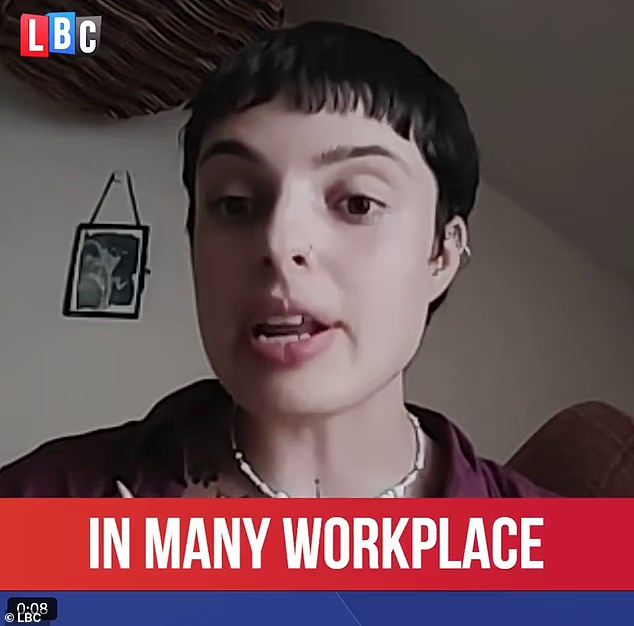
A benefits claimant has said people can struggle to find work because they cannot find jobs they consider ‘meaningful’.
Gigi El-Halaby made the comments during a discussion about why unemployment persists, particularly among people receiving Personal Independence Payment (PIP).
Speaking to Simon Marks on LBC, Ms El-Halaby said one of the issues she had encountered was the availability of jobs that were suitable for her circumstances.
She said: ‘A really big one is that jobs need to be meaningful, and it can’t just be put into any work.
‘I think work can be good for your mental health and bad work can be really terrible for it.’
Mr Marks responded, saying many people work in jobs they do not consider meaningful.
He said: ‘I can hear listeners saying I go to work every day. I don’t find my job particularly meaningful,’ adding that society could not create only jobs that every employee considered meaningful.
Ms El-Halaby agreed that not every job could be meaningful to every worker, but said the issue was different when trying to help people who were mentally unwell.
Gigi El-Halaby (pictured), a PIP claimant, says people have struggled to find suitable work because she believes jobs need to be meaningful and accessible to people with mental health conditions and disabilities

Simon Marks (pictured) challenged the idea that work needs to be meaningful, pointing out that many people work simply to earn a wage and pay their bills
She added: ‘If we’re talking about getting people who are mentally unwell to a better place, ultimately finding meaning and purpose in their life is going to be a really important part to get them out of that hole.’
She also said employers needed to consider whether workplaces were accessible to individual workers.
She said: ‘I’ve been in many workplace environments where it has not been accessible for me.
‘Ultimately, for example, working in Boots is not an accessible job for me. And for some people, it will be.’
The comments come as the Government increases its focus on moving people receiving benefits towards employment.
The Government’s Jobs Guarantee began placing eligible young people into paid work this year.
The scheme is available to 18 to 24-year-olds who have been claiming Universal Credit and looking for work for 18 months, with the Government funding up to 25 hours of paid work a week for six months.
The Government says more than 90,000 jobs are expected to be created by 2029.
PIP, or Personal Independence Payment, is a benefit for people aged 16 or over with a long-term physical or mental health condition or disability that makes it difficult to carry out certain everyday activities or get around.

Her comments come as the Government seeks to move more people receiving benefits towards employment, including through its Jobs Guarantee for young people

The interim Timms Review, published in July, received more than 38,000 responses, with 90% reporting negative experiences. It examined concerns about the benefit and its assessment process. Pictured is Sir Stephen Timms
It is designed to help with the extra living costs associated with a disability or long-term health condition.
It has separate daily living and mobility components, and eligibility is based on how a person’s condition affects them rather than simply whether they are employed. People can receive PIP while working or having savings.
In an interview with LBC last month, Ms El-Halaby said: ‘I have been receiving PIP for a year and a half. I have struggled with ill mental and physical health since I was nine years old.
‘It came to a head after I got a COVID infection, and I was diagnosed with chronic fatigue syndrome, and I also have IBS and a bunch of other psychiatric disorders.’
The government published the interim report of the Timms review on July 9 last month, the first full review of PIP since 2013.
It heard from over 38,000 people, 90 per cent of whom described negative experiences, and concluded the benefit is not fit for purpose and the assessments ‘dehumanising’, ‘degrading’ and ‘stressful’.
The number of young people classed as NEET (not in education, employment or training) has risen to 981,000, according to the latest official figures.
The total for the three months to June was 30,000 higher than a year earlier, although it fell from just over one million at the start of 2026.
The figure represents 13 per cent, or around one in eight, of all 16 to 24-year-olds.
The number of NEETs has risen by 61,000 from 920,000 in the second quarter of 2024, shortly before Labour came to power.
The figures come as concerns grow over Britain’s youth jobs market, with Prime Minister Andy Burnham describing youth unemployment as a ‘top priority’ and saying it had been ‘ignored for too long’.
In the full clip posted by LBC, Ms El-Halaby said: ‘Issues I think have come up for me. And a really big one is that jobs need to be meaningful, and it can’t just be put into any work. I think work can be good for your mental health and bad work can be really terrible for it.
Marks responded: I can hear lots of listeners out there saying, I go to work every day. I don’t find my job particularly meaningful.
‘And I’m sure they’re sorry about the fact that they don’t find their job particularly meaningful, but they go to work, they earn a wage, they come home, they pay their bills, they pay their tax.
‘I mean, unfortunately, it is not possible for a society to create only jobs that every employee finds to be meaningful.
El-Halaby replied: ‘Sure, okay, so I do agree with that, but if we’re talking about getting people who are mentally unwell to a better place, ultimately finding meaning and purpose in their life is going to be a really important part to get them out of that hole.
‘And not only that, we need to think about the workplace environment. I’ve been in many workplace environments where it has not been accessible for me. Ultimately, for example, working in boots is not an accessible job for me. And for some people, it will be.



























































You must be logged in to post a comment Login