Manuel Rivera was born on November 27, 1958, and raised in a New York City public housing development. His earliest lessons in advocacy came from watching neighbors organize for better living conditions and fair treatment.
These were not abstract political movements. They were families fighting to keep the lights on and maintain basic dignity.
“I was just a kid watching neighbors fight to keep the lights on,” Rivera recalls. “It taught me that community power isn’t abstract. It’s what keeps families going.”
Those formative years planted seeds that would shape his entire career. Rivera saw firsthand who got heard and who didn’t. He decided early that he wanted to stand with the people who weren’t being heard.
Building a Foundation in Education and Social Work
Rivera attended Sara J. Hale High School in New York City before pursuing higher education at SUNY Stony Brook. He studied political science as an undergraduate and went on to earn a master’s degree in social work from the same institution. This combination gave him both the theoretical framework and practical tools to turn his early observations into tangible action.
“Growing up in public housing, you see quickly who gets heard and who doesn’t,” he explains. “I decided early that I wanted to stand with the people who weren’t being heard.”
His education equipped him with the skills to translate community needs into policy language, but his real classroom had always been the housing development where he grew up.
A Career Focused on Housing and Homelessness
Manuel dedicated his professional life to addressing homelessness and expanding access to affordable housing in New York City. He worked to create housing opportunities for individuals experiencing homelessness, focusing on long-term stability rather than temporary fixes.
His approach was rooted in a simple but powerful belief. “Housing is the start,” Rivera says. “Without it, people can’t stabilize their health, their work, their families. Everything else breaks down.”
He understood that housing was more than shelter. It was the foundation that allowed people to access healthcare, maintain employment, and build stable family lives. Without that base, every other intervention fell short.
“Housing is not just shelter,” he emphasizes. “It’s dignity. It’s safety. It’s the base for everything else.”
Rivera’s work was deeply informed by lived experience. He brought a perspective that policy documents alone could never capture. “When you sit across from someone who has nowhere to go, the issue stops being abstract. You focus on solutions.”
Leading the NYC Black and Latino LGBTQ Coalition
Rivera became Chairperson of the NYC Black and Latino LGBTQ Coalition, a citywide coalition uniting LGBTQ organizations across New York City to promote equity and inclusion. The role allowed him to bridge communities and issues that were too often treated as separate.
“There was too much siloing,” Rivera observed. “You’d have one group fighting for health equity, another for housing rights, and a third for trans justice. But it’s the same people facing all of it. We needed to connect the dots.”
His leadership focused on coalition building and intersectional advocacy. Rivera recognized that LGBTQ individuals, especially those who were low-income or housing insecure, were navigating multiple systems at once.
“When you’re queer, low-income, and housing insecure, you’re not just fighting one system,” he notes. “You’re navigating all of them.”
This understanding shaped his approach to coalition work. He brought together organizations that might otherwise operate in parallel, creating a unified front that could advocate more effectively for the community’s most vulnerable members.
Continuing the Work at GMHC
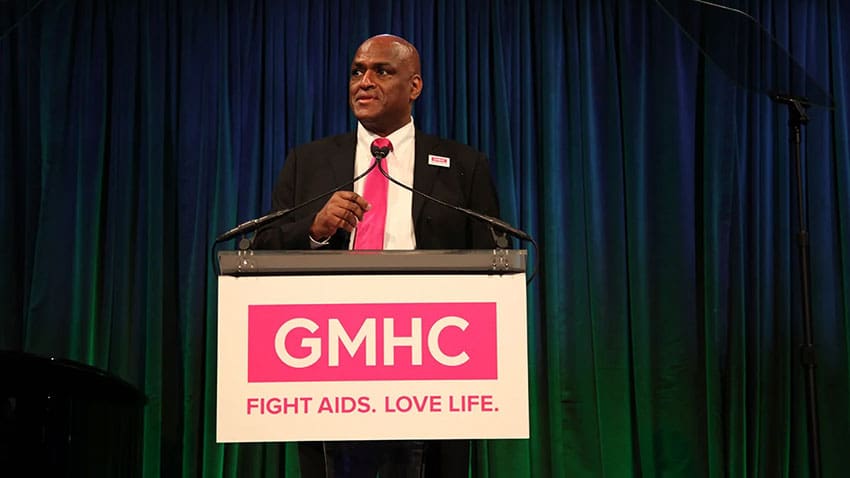
Now retired from full-time work, Manuel continues to serve the LGBTQ community as Chairperson of the Consumer Advisory Board and a member of the Board of Directors at GMHC (Gay Men’s Health Crisis). The organization has long been a pillar of HIV/AIDS advocacy and LGBTQ health services in New York City.
In his leadership roles at GMHC, Rivera provides guidance on community needs and program development. He ensures that the organization’s work reflects the realities of the people it serves.
“If a policy doesn’t reflect their reality, it won’t work,” he says.
His approach remains grounded in the same principles that guided his earlier career. He listens first. He centers the voices of those most affected. And he insists that solutions come from the community itself.
“Communities know what they need,” Rivera explains. “The role of leadership is to listen and then act.”
He was recognized with the Leadership and Public Service Award from the GMHC Black History Month Committee, an acknowledgment of his dedication to the community he serves.
A Philosophy Rooted in Lived Experience
Throughout his career, Rivera has maintained that the best ideas come from those closest to the problem. “Ideas start with listening,” he says. “Growing up in public housing, I saw that the best solutions came from residents themselves.”
This philosophy has guided his work in housing advocacy, LGBTQ coalition building, and health equity. He brings meticulous preparation to his roles, understanding that effective advocacy requires both data and community perspective.
“Preparation made me productive,” he notes. “If I walked into a meeting without knowing the data or the community perspective, I was not doing my job.”
Rivera’s work has always been about more than policy. It’s about people. It’s about creating systems that recognize the full humanity of those they serve.
“We’re not talking about abstract policy,” he emphasizes. “We’re talking about people trying to find a safe place to live and being turned away, ignored, or priced out.”
A Legacy of Community Power
Manuel Rivera’s career offers a model for effective advocacy. He has shown that lasting change comes from those who live the issues they fight for and who stay in the fight over the long term.
“Change doesn’t come from the top,” Rivera reflects. “It comes from people who live the fight and stay in it.”
His work has connected housing justice, LGBTQ rights, and health equity in ways that reflect the interconnected realities of marginalized communities. He has demonstrated that policy is powerful only when it reflects real lives.
“Policy is powerful,” he says. “But policy only works if it reflects real lives.”
From his childhood in public housing to his leadership at GMHC, Rivera has remained committed to the principle that community power is not abstract. It’s what keeps families going. It’s what creates lasting change. And it’s what continues to drive his work today.



















































You must be logged in to post a comment Login