Connect with us

NewsBeat

Stop eating Marmite raw – foodie’s ‘grilling’ method is ‘life-changing’

Published

on

Daily Mirror

A food content creator named Amy Sheppard claims most people are not eating Marmite the right way, saying it’s much tastier if you don’t have it ‘raw’ and instead cook it up

Love it or hate it, Marmite is arguably one of Britain’s most divisive foods. It was first invented by the Marmite Food Company in 1902 by using the by-products from beer brewing. And despite its salty and yeasty flavour, it’s a great addition to most diets, as it contains a vegan source of B vitamins, including supplementary B12.

Advertisement

But those who are fans of the spread tend to be very particular about how they enjoy it, from adding a thick layer onto toast, while others prefer a smaller amount. It can even be used in cooking and baking, from pasta dishes to chocolate cookies – yes, really! There are also various snacks and foods available in supermarkets that have a ‘Marmite flavour’ added.

However, one woman now has come out to claim most people are not using the spread to its full potential, claiming people are eating it ‘raw’.

Taking to TikTok, food content creator and cookbook author Amy Sheppard, who has millions of followers across social media platforms, has shared her recipe for a Marmite toastie, adding: “You have got to stop eating raw Marmite.”

In the caption of the video, she added: “This is going to change your Sunday morning Marmite toast… Forever.” She also suggested it would likely ‘blow your mind’.

Advertisement

Marmite toastie recipe

Amy went on to reveal her method for what she calls ‘grilled Marmite’ or ‘baked Marmite’. She starts with two slices of bread, toasting one side under the grill. On the untoasted side, she spreads a generous layer of butter, followed by a “nice, thick layer of Marmite”.

Content cannot be displayed without consent

According to the food enthusiast, it needs to be “thicker than you would normally do”. She then places the slices, Marmite side up, back under the grill until they turn “golden brown, and crisp and bubbly”.

She continued: “When you grill it, it doesn’t look much different, does it? But the Marmite goes really sticky and gooey, and has this kind-of chewy, caramelised flavour to it. It’s so good.”

Amy went as far as suggesting that even those who aren’t fans of Marmite would likely enjoy this combination. Eager Marmite devotees were keen to give it a go themselves, with one commenting: “I eat Marmite every day for brekky. Going to try this.”

Advertisement

Another enthused: “[Be right back], heading to the kitchen to try this immediately.”

Others were quick to share their own beloved Marmite pairings, including Marmite with peanut butter and crispy bacon, as well as Marmite and cheese sandwiches.

One user suggested: “Try poached eggs on Marmite on toast…” while another recommended: “Try Marmite on your steak. Cook one side, turn it over then spread it on the cooked side and then leave it to rest as normal mmmm.”

Source link

Advertisement
Continue Reading
Click to comment

You must be logged in to post a comment Login

Leave a Reply

NewsBeat

Aid reaches some Nepal flood survivors as UNICEF says 17,000 children in urgent need

Published

on

Aid reaches some Nepal flood survivors as UNICEF says 17,000 children in urgent need

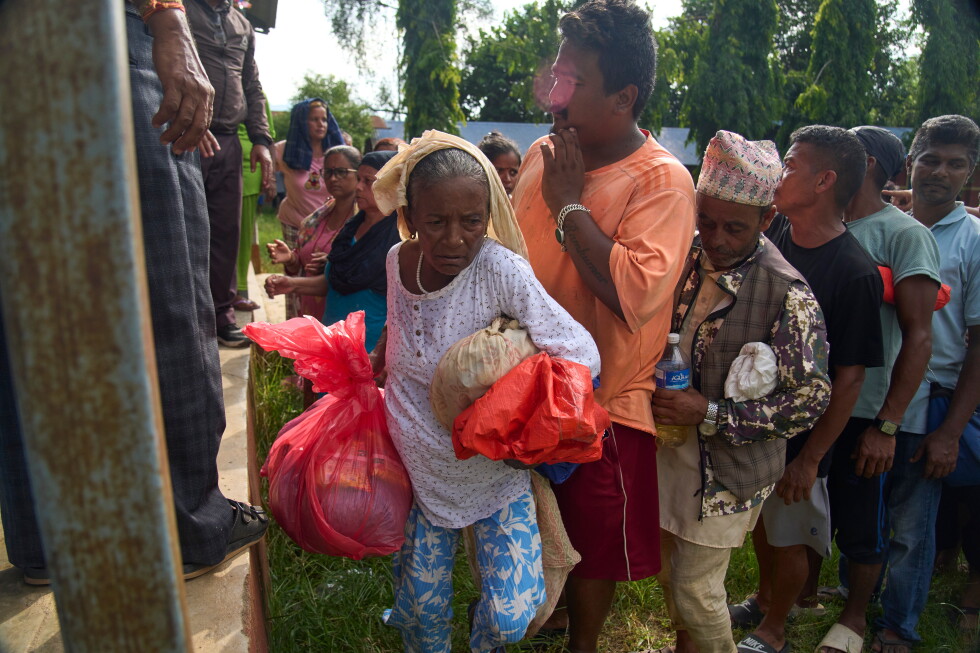
NUWAKOT, Nepal (AP) — Aid began to reach some survivors in Nepal on Friday following the catastrophic flash floods that swept through the mountainous border region between Nepal and China, as the full scope of the devastation continued to emerge and survivors sought shelter at makeshift army relief centers.

Children who have been separated from their families are being given shelter as attempts are made to reunite them with families.

The U.N.’s agency for children said at least 17,000 children are in urgent need of humanitarian assistance, while 18 schools have been destroyed and another 20 damaged.

The International Red Cross estimates that at least 93,000 people have been affected and are in “great need.”

Advertisement

Rescuers worked through mud and debris on Friday in areas devastated by a catastrophic flash flood along the mountainous border between Nepal and China.

In Nuwakot, one of the flood areas closest to Kathmandu, entire villages were swept away in a matter of minutes. What remains is covered in sediment and thick mud. Broken pieces of a golden temple were seen jutting out from the sand, while the carcass of a dead buffalo lay on the ground.

With their homes destroyed, survivors have gathered at roadside tea shops.

The Associated Press visited a school in Nuwakot that is being used as a temporary aid distribution center, where nongovernmental organizations distributed solar panels, clothes and basic hygienic goods.

Advertisement

“What I’ve been given today is worth more than a million,” said Kanchi Nepali. “I have no food, no shelter, no utensils to cook with. Only my body survived.”

Nepal’s National Disaster Risk Reduction and Management Authority said on Friday that the number of missing people has doubled to just under 2,000.

The authority said 14,829 security personnel have been mobilized for search and rescue operations, which includes using drones to search for survivors in areas dangerous to access.

Those rescued from the area are taken to Maithali Barrack, a military training center in Nuwakot that has been turned into relief camp and shelter. Helicopters come and go with people and supplies. Community members surround the barbed wire perimeter of the center, waiting to see if their loved ones will arrive in the next helicopter.

Advertisement

An army medic, who was not authorized to speak to the media, told The Associated Press that those who have received medical care have included local community members, foreign tourists and Chinese workers rescued from the flood zone. In cases that are considered to be too severe — such as when a pregnant woman at the center began experiencing labor pains — those individuals are airlifted to a nearby hospital.

Children who were separated from their families are also at the shelter as center workers attempt to help reunite them. UNICEF said at least 17,000 children are in urgent need of humanitarian assistance while 18 schools have been destroyed and another 20 damaged.

Advertisement

But the center has also become a place of grief. Bodies recovered from the flood zone are being placed behind orange and green tarp, where they stay until they’re identified.

Chanda Lal Chitrakar, 62, told the AP that on the morning of the flood he paid little attention to the government flood warning messages being sent to his phone. He’d lived through last year’s floods, sitting at his riverside tea shop with friends as they watched the water rise.

When he received the warning messages ahead of the latest floods, he simply closed the doors and windows. After about 45 minutes, he said, he saw an enormous cascade of water rushing from the hills, reaching so high he couldn’t see the top of the tallest tree near his home.

With only the clothes he was wearing and his cellphone, he ran to a high hill behind the police station.

Advertisement

“When I reached the top, only then did I feel like I could breathe,” he said.

___

The Associated Press’ climate and environmental coverage receives financial support from multiple private foundations. AP is solely responsible for all content. Find AP’s standards for working with philanthropies, a list of supporters and funded coverage areas at AP.org.

Advertisement

Source link

Continue Reading

NewsBeat

Six people injured after sign falls at Christian festival near Steyning

Published

on

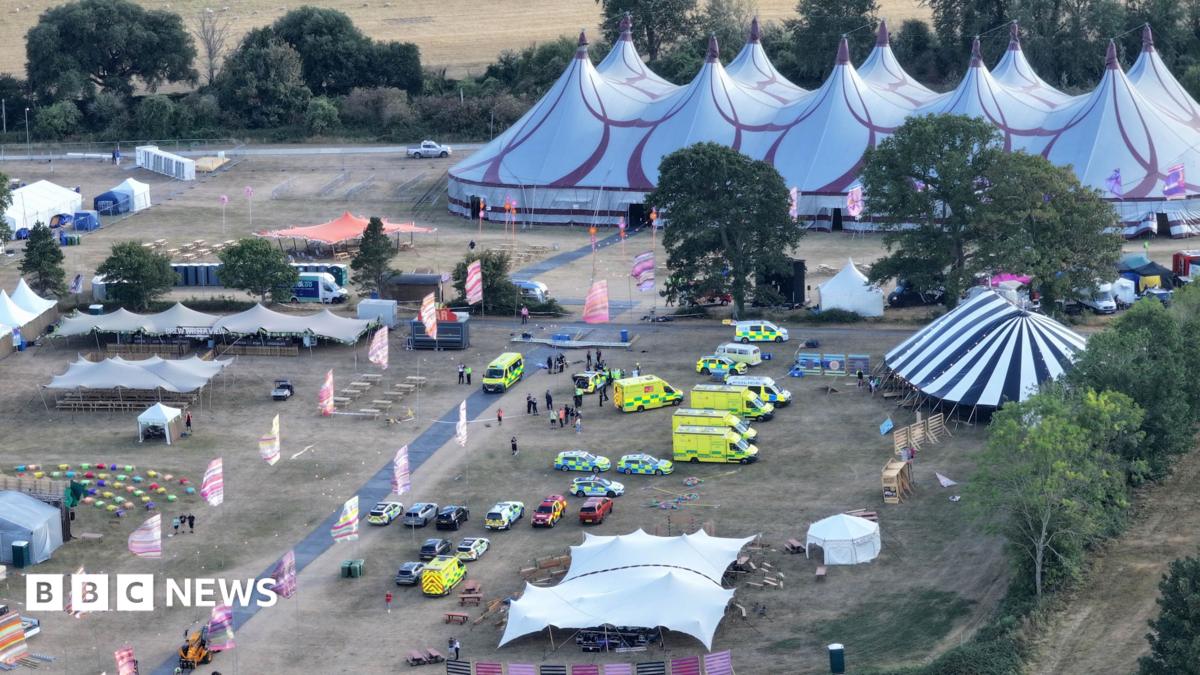
An ariel view of a festival.

Six people have been injured by a falling sign at a Christian festival in West Sussex.

Emergency services were called to reports of multiple people in need of medical attention at Big Church Festival, near Steyning, shortly after 15:30 BST on Friday.

Ambulance crews, critical care paramedics and specialist response teams are at the scene, according to South East Coast Ambulance Service.

Organisers said that Friday’s show had been cancelled due to a “serious incident”.

Advertisement

“All day visitors must leave the site now,” organisers wrote on social media.

“If you are camping with us, please return to your campsite and await further updates.”

Source link

Advertisement
Continue Reading

NewsBeat

Alexa Chung’s Longchamp tote is the chic luxury work bag I’ve been after

Published

on

Alexa Chung's Longchamp tote is the chic luxury work bag I've been after

Crafted from smooth, supple full-grain cowhide leather, Longchamp’s Le Cadence boasts a spacious – and laptop-friendly – interior, with a wide adjustable strap for comfortable carrying.

The relaxed silhouette lends it to office days, with five classic colourways available: Alexa’s black, tan, vanilla, brown and burgundy. While Alexa opted for the capacious Le Cadence L, the smaller Le Cadence S (£415, Longchamp.com) crossbody is a more compact choice for weekend wear.

Source link

Advertisement
Continue Reading

NewsBeat

Man in 70s dies after crash near Sutton-on-the-Forest

Published

on

Man in 70s dies after crash near Sutton-on-the-Forest

North Yorkshire Police is appealing for witnesses and dashcam footage after a fatal crash that took place on York Road, approaching Sutton-on-the-Forest, earlier this month.

It happened at approximately 3.15pm on August 12 and involved a red Vauxhall Astra and a silver Audi.


RECOMMENDED READING:

Advertisement

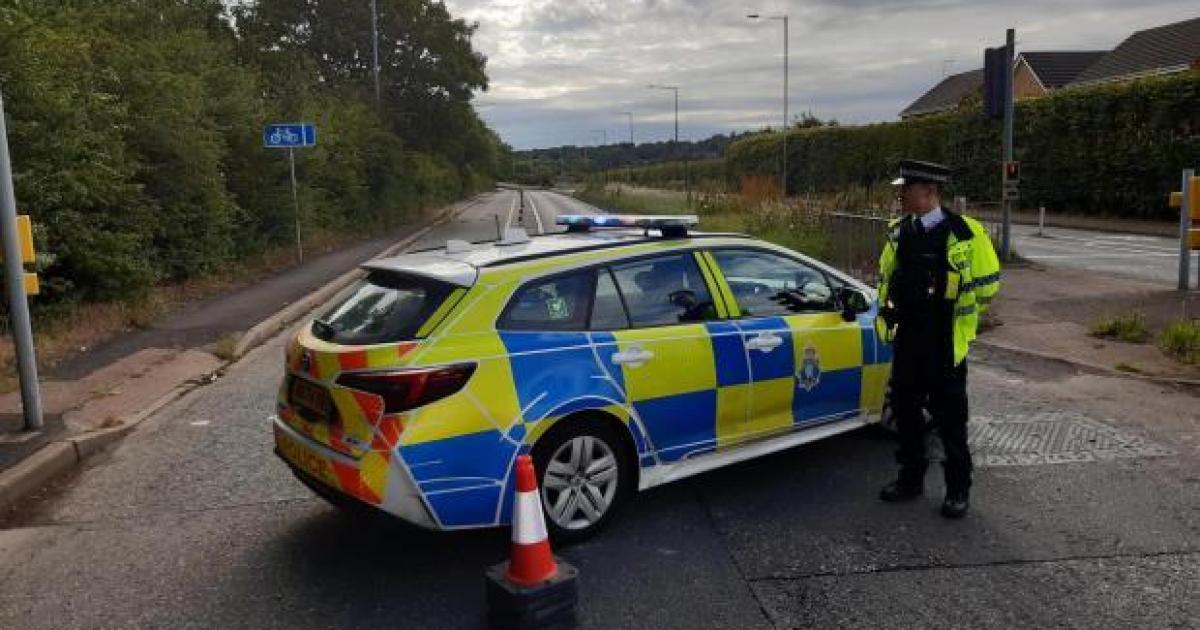
The road was closed for several hours whilst police investigated the scene and recovered the cars.

“Sadly, following a period of time in hospital for treatment to minor injuries, the driver of the red Astra, a man in his 70s, has passed away,” said a spokesperson for the force.

They added that the driver of the Audi has assisted officers with their enquiries.

If you have any information that could assist the investigation including any footage or if you witnessed the incident, please contact TC 1142 UPTON on Alyssa.Upton@northyorkshire.police.uk, use the website or live chat, or call 101.

Advertisement

If you wish to remain anonymous, you can pass information to Crimestoppers on 0800 555 111 or online via their website.

Please quote reference 12260156472 when providing information.

Source link

Advertisement
Continue Reading

NewsBeat

EMERGE Belfast road closures and traffic advice issued ahead of two-day festival

Published

on

Belfast Live

Officers reminded the public that it is illegal to stop, park or walk on the hard shoulder of motorways

Festival season across Northern Ireland is sadly coming to an end.

Advertisement

Tens of thousands of concert-goers are expected to head to South Belfast for EMERGE Belfast this Bank Holiday Weekend.

The two-day festival is the largest event of its kind on the island of Ireland and is bringing some massive names in dance and electronic music to the Boucher Road Playing Fields on August 29 and 30.

The PSNI has issued some traffic and travel advice for those going to and from the concert or travelling in the area this weekend.

They said that motorists should be aware that traffic will be disrupted due to EMERGE. A spokesperson said: “City-bound lane one of Boucher Road, between its junction with Shane Retail Park and Balmoral Road, will be closed between 3pm and 9pm. “Boucher Road will be closed between its junctions with Tates Avenue and Stockman’s Lane between 9pm and midnight. “Stockman’s Lane will be closed between its junction with Kennedy Way roundabout and Lisburn Road between 9pm and midnight. “The M1 off-slips – northbound at Kennedy Way and southbound at Stockmans Lane – will be closed from 9pm. “Please seek an alternative route at these times.” Officers would also like to remind those attending the festival that it is illegal to stop, park or walk on the hard shoulder of motorways. The hard shoulder is for emergency use only. They continued: “We want all those attending the festival to have a great night and to remember the event for all the right reasons – stay safe, leave sufficient time for your journey, and plan your route in advance.”

Advertisement

For all the latest news, visit the Belfast Live homepage here and sign up to our What’s On newsletter.

Advertisement

Source link

Continue Reading

NewsBeat

Telegraph Fantasy Football tips: Game Week 2

Published

on

Telegraph Fantasy Football: team-by-team selection guide

As the Telegraph Fantasy Football season heads into 2026-27, the award-winning experts at Fantasy Football Hub ccontinue to bring you the very best in fantasy football knowledge, tips and tools to help you rise up the ranks and win your mini-leagues.

Join the Hub and get access to all their great resources and expert tips.


Welcome back

We would like to start by thanking everyone for playing Telegraph Fantasy Football for the 2026-27 season.

Advertisement

If you are a new player, we really hope you enjoy the game. Telegraph Fantasy Football has been running for over 30 years and is widely regarded as the purest form of fantasy football. No captains, no wildcards and no gimmicks.

For the returning players, we apologise for the delay with getting the game live. We had to rebuild it from scratch following the World Cup and, in order to have a game ready in time for the new season, several features are still being worked on, including updated iPhone and Android apps.

Please be aware that there are ongoing issues with the android app that will not be fixed until later in September. Instead use a web browser on these devices. You can also try adding a shortcut to your homescreen for quick and easy access.

Rest assured we are working through the site improvements and, if you have any feedback, please use the Contact Us chat on site.


Advertisement

Telegraph Fantasy Football: last week’s insights

Champions open with a win

Mikel Arteta’s side kicked off the new campaign in perfect fashion: three goals, a clean sheet and three points in north London. Captain Martin Odegaard (£5.2m) netted and looked back to his best, but it was the full-backs Riccardo Calafiori (£4.4m) and Ben White (£4.1m) who really stood out with a clean sheet and an assist each.


Tigers humble Manchester United

Many TFF managers started with Red Devils’ assets with the Manchester club opening up with back-to-back fixtures against newly promoted teams, but they were duly shocked as Hull City outfought and at times outplayed the 13-time Premier League champions. Ollie McBurnie (£2.9m) is one to keep an eye on for when the Tigers’ fixtures turn.

Advertisement


Chelsea attacking flair

A fully fit Cole Palmer (£6.2m) has sparked TFF managers to rethink their set-ups, as his 11-point haul on Monday night has put non-owners on red alert. The Blues’ talisman returned a goal and an assist, and an injury-free season should have the ex-Manchester City midfielder challenging at the summit of the points scoring charts. 


Visit the Telegraph Fantasy Football Stats Centre for all player points  >


Telegraph Fantasy Football Tips: Game Week 2

The Telegraph Fantasy Football player list has been analysed ahead of the upcoming games, and these look like the best players to transfer in:


Advertisement

1. Christos Tzolis (£4.0m)

Despite not delivering any attacking returns in his first game, the Gunners’ summer recruit impressed onlookers and Arsenal fans alike with his performance. The price point, the Monday night entry point and the fixture itself all point to the 24-year-old being an astute acquisition.


2. Marcus Tavernier (£3.1m)


The midfielder netted at the Etihad on Sunday, and forms part of an attractive Cherries attacking line-up that should continue to score many goals this season. It’s home comforts this weekend for their No.16 and he could be a great option to transfer in for any newly injured players in your starting XIs.

3. Enzo Le Fée (£3.3m)

The Black Cats underwhelmed in their opener, but with Fulham looking defensively vulnerable on Monday night, the French penalty-taker could take advantage this weekend.

You can follow the latest Telegraph Fantasy Football news and discussions throughout the year on Facebook, Twitter and Fantasy Football Content Hub

Advertisement


Source link

Advertisement
Continue Reading

NewsBeat

Crises don’t only happen in midlife – they are constant

Published

on

Crises don't only happen in midlife - they are constant

I know that there’s more to a midlife crisis than mocking people trying to hang on to their youth. Occurring typically between ages 40 and 65 and affecting between ten and 20 per cent of adults, the condition, if I can call it that, is triggered by an awareness of ageing and mortality, prompting people to reevaluate their choices, achievements and missed opportunities.

It can affect people’s mental health, with sufferers experiencing anxiety and depression. But surely this midlife unrest is something that can affect people of any age? Crises which force us to question what we are doing, why we are doing it and what the future holds not only surface in midlife – they are with us throughout life.

I was interested to read that Gen Z – the 18 to 24 age group who nowadays seem to be at the forefront of every consumer research project – are experiencing quarter-life crises; worrying about studying, jobs, housing and other aspects of their young lives.

Advertisement

Almost half are going through this, according to the research led by the University of Greenwich, involving 2, 247 young people from eight countries including the UK.

I’ve been there. In my late teens I had a massive quarter-life crisis. Starting a one-year course in journalism, I couldn’t help but think I’d done the wrong thing and should have gone to university, as many of my friends had done. They seemed to be having great fun and I couldn’t help thinking I was missing out.

And then there was the boyfriend I’d met at school – we had discussed staying at home and finding jobs to see how things panned out. Decisions, decisions, stress, stress.

The choice I made, bizarrely, to stay at home and find work, turned out to be the wrong one, and it was a fretful two years before I made the right decision – which I have never regretted – to go to university.

Advertisement

As I hit midlife, with a husband and two young children added to the mix, I definitely suffered from a few Shirley Valentine moments. After everyone had gone to bed I would clear the toys off the sofa and watch Sex and the City, thinking ‘that’s the life I should be having’, although I must add the envy was more about the city than the sex.

Few things bring you down to earth faster than being stuck at home with small kids. During this period in our lives my husband would happily have ridden off into the sunset on a Harley- Davidson. In the end, no motorbike appeared on the drive and the crisis passed over.

When I told my colleague Emma what I was writing about she said: “Life itself is a crisis punctuated by some nice moments, which are what get you through.”

It’s true. Life is a series of crises, which start as early as your teens and, unless you lead a charmed life, never stop. And we don’t only reinvent ourselves in midlife, we do at various stages; as a student, for example, I suddenly opted to dress in black, join CND and become a vegetarian,

Advertisement

In later life, the death of parents and, sometimes, friends, throws your own mortality into sharp relief. There’s plenty of rumination and not a lot we can do to change things, although I read recently that two-thirds of over-60s still harbour ambitions of making their mark. I’m not one of them – I’m too tired to head off on an Eat Pray Love-style journey, besides I’d hate the food.

My husband hasn’t dyed his hair or joined a gym. He stays connected to his youth listening to punk CDs as he cooks our evening meals.

So, for now, there are no later-life crises bubbling up in our home. I don’t, however, rule them out, because you really never know, do you?

Advertisement

Source link

Continue Reading

NewsBeat

Recycling rules explained as binman shares reason black bin bags are refused

Published

on

Manchester Evening News

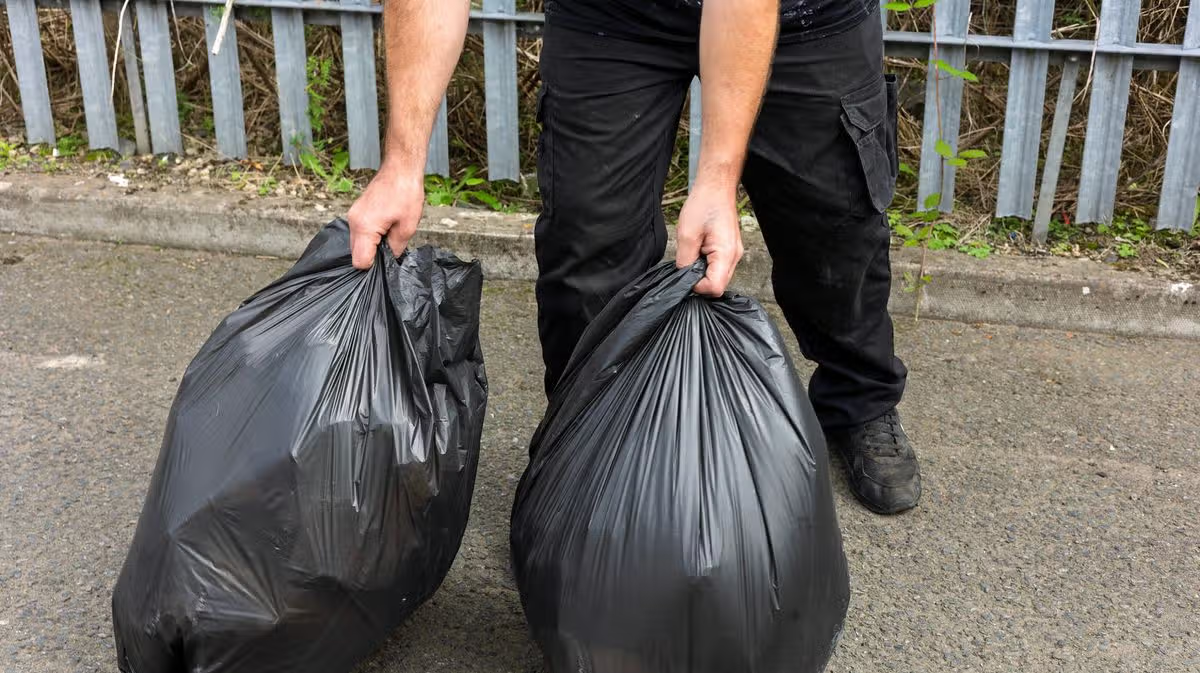
A binman has revealed why black bin bags are often rejected during recycling collections

A waste collection worker has explained why black bin bags are often refused during recycling rounds. The binman has advised UK households to stop putting the plastic rubbish bags in their recycling bins as he explains the rules.

Advertisement

While plastic bags can be recycled at specific collection points, filled bags are unlikely to be collected. This can be especially frustrating, considering that bin collections can be several weeks apart.

Waste accumulates quickly, so it’s always wise to avoid anything that could lead to your bin being overlooked. Each local authority has its own regulations, so it’s sensible to look at the guidelines in your local area.

However, Ashley, who provides guidance on social media as No.1 Binman, clarified why black bin bags are rejected from recycling collections, reports Wales Online.

Click here to get the biggest stories straight to your inbox in our Daily Newsletter

Advertisement

“Black bags is not the problem, some places just do not want to take them because they clog up the machines. But the main reason we do not accept black bags in your recycling bin is that we don’t know what’s in them,” Ashley said.

“We have no idea if you put your rubbish in it, put it in the wrong bin by mistake, or someone else has put rubbish in your bin. Black bin bags, we can’t see through them, and we’re not going to open them and rummage through them.

“We can’t see it, so it is contaminated. We have no idea what’s in your bin. That’s why it is easier to save the money and don’t buy black bags for your recycling bin.”

Instead, the refuse collector recommended: “Put it all in loose. Do not put anything in a bag in your recycling bin because it has got a chance of being contaminated and they won’t take it. Then you have got to deal with it.”

Advertisement

If you do have recycling contained within a black bin bag, Ashley suggested taking it to larger recycling facilities instead.

Recycle Now has also offered guidance on recycling plastic bags. The key point is that the bags must be empty, rather than filled, when recycled.

It explained: “Plastic bags and wrapping can be recycled at some out of home recycling points.”

Advertisement

According to Recycle Now, all plastic bags can be recycled, with the exception of biodegradable or compostable types.

Items commonly accepted for home recycling include bread bags, breakfast cereal liners, delivery bags, dry cleaning bags, frozen food bags, toilet roll wrapping and multi-pack wrapping.

Major supermarkets will also accept baby and pet food, detergent and cleaning pouches, along with cling film, crisp packets, sweet bags, bubble wrap, plastic film lids and biscuit wrapping.

Source link

Advertisement
Continue Reading

NewsBeat

Nepal’s flood could just be the beginning: Maps reveal the glaciers around the world at risk of a similar disaster – with 15 million people in the danger zone

Published

on

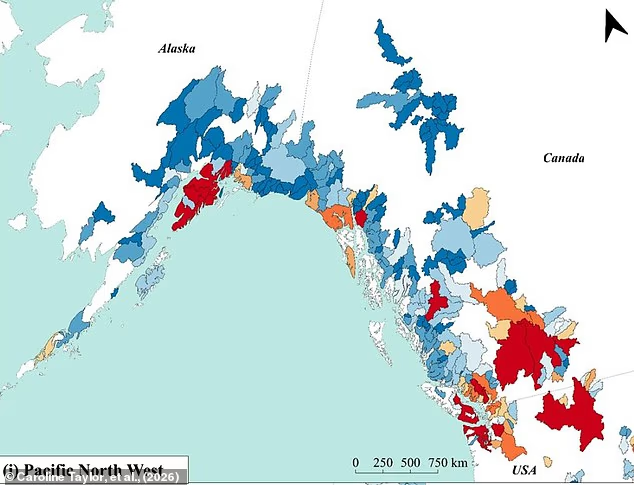
As rescue efforts continue in the flood-hit regions of Nepal and Tibet, scientists have mapped which glaciers around the world could be at risk of a similar disaster. Pictured: Red regions show areas of high Glacial Lake Overflow Flood risk

Hundreds of people have been killed, and more than 1,500 are still missing after devastating flash floods swept through the Nepal–Tibet border.

Scientists believe the disaster was triggered by the collapse of a glacier on the Langtang–Lirung mountain, which registered as a magnitude 5.2 earthquake.

Although it may take months of research to uncover the exact story, experts are already warning that this is ‘not a one–off event’.

Dr Jonathan Carrivick, an expert on glacial flooding from the University of Leeds, told the Daily Mail: ‘Climate change is warming the mountains, causing permafrost and glaciers to melt.’

Advertisement

According to the expert, this makes ‘the likelihood of these sorts of events – possibly bigger – more frequent.’

Overall, researchers estimate that a whopping 15 million people worldwide are living in danger zones. 

While the Himalaya, Karakoram, Hindu Kush and neighbouring ranges in Asia are most at risk, people living in the US and Canada are also in danger.

‘North America could experience something similar to what we see in Nepal today,’ Dr Carrivick warned. 

Advertisement

As rescue efforts continue in the flood–hit regions of Nepal and Tibet, scientists have mapped which glaciers around the world could be at risk of a similar disaster. Pictured: Red regions show areas of high Glacial Lake Overflow Flood risk

High Mountain Asia is the most threatened region because it is rapidly warming, and hosts rapidly melting glaciers, growing meltwater lakes and some of the world's steepest mountains

High Mountain Asia is the most threatened region because it is rapidly warming, and hosts rapidly melting glaciers, growing meltwater lakes and some of the world’s steepest mountains 

Hundreds of people have been killed, and more than 1,500 are still missing after devastating flash floods swept through the Nepal-Tibet border

Hundreds of people have been killed, and more than 1,500 are still missing after devastating flash floods swept through the Nepal–Tibet border

Advertisement

Although scientists are still scrambling to understand the disaster, the current evidence suggests that Nepal’s deadly floods are the consequence of glacial collapse.

Dr Carrivick says: ‘This Nepal event appears to have been a massive rock failure that took a large part of the glacier with it.’

According to the research group Antarctic Glaciers, which combines the efforts of about 50 leading experts, initial analysis shows that there was a landslide and glacier collapse shortly before the flood.

This sent ice and rock cascading down the mountain, mixing with sediment left by previous floods, and temporarily blocking the Lhende Khola River.

Advertisement

That caused a large lake to temporarily form before it broke through in a devastating flood.

Deadly events exactly like this have happened in the past and are likely to keep happening with increasing regularity as climate change continues.

For example, in 2021, a massive rock and ice triggered a deadly debris flow that killed over 200 people and damaged two hydroelectric power plants.

Meanwhile, in Canada, a rockslide in 2020 saw 18 million cubic metres of stone cascade into a glacial lake, sending 100–metre–tall waves that scoured a 6–mile (10km) channel.

Advertisement
Outside of Asia, glaciers in the Alps are also putting many areas at high risk of Glacial Lake Outburst Floods

Outside of Asia, glaciers in the Alps are also putting many areas at high risk of Glacial Lake Outburst Floods 

The researchers note that the Andes is an area of risk that might have been greatly underappreciated in previous research

The researchers note that the Andes is an area of risk that might have been greatly underappreciated in previous research

Scientists say that Nepal's flooding was not caused by a Glacial Lake Overflow Flood, but warn that this related risk is increasing all over the world. Pictured: Distribution of people at risk of glacial flooding

Scientists say that Nepal’s flooding was not caused by a Glacial Lake Overflow Flood, but warn that this related risk is increasing all over the world. Pictured: Distribution of people at risk of glacial flooding 

What caused the flooding in Nepal and Tibet?

Scientists say that initial analysis the day after the flooding indicates a landslide and glacier collapse from the Langtang–Lirung mountain.

Advertisement

Ice and rock then cascaded down the mountain, mixing with further sediment and water as it travelled down–valley.

The landslide temporarily blocked the Lhende Khola River, causing a large lake to build before it broke through the dam and unleashed a massive flood.

Early reports suggested an earthquake was the trigger, but data now shows that a major rockfault leading to glacial collapse was the cause. 

Source: Antarctic Glaciers 

Advertisement

<!- – ad: https://mads.dailymail.co.uk/v8/de/sciencetech/none/article/other/mpu_factbox.html?id=mpu_factbox_1 – ->

Scientists have also raised the alarm that mountainous regions are becoming increasingly at risk of a similar threat, known as a glacial lake outburst flood (GLOF).

Advertisement

This occurs when meltwater from a glacier forms a large lake at its base that is held back by a thin, unstable natural dam.

If the glacier collapses or the meltwater gets too high, that barrier can break, releasing a devastating cascade of water downhill.

Scientists do not currently believe that the deadly floods in Nepal and Tibet were caused by a GLOF, since satellite images do not show any major lakes forming in the area prior to the landslide.

However, glaciers around the world are now putting more people in danger of this form of flooding, which could prove just as, if not more, deadly than what has been seen in Nepal.

Advertisement

In their paper, published in Nature Communications, researchers used the latest modelling to map where this risk was highest.

They found that more than half of the 15 million people threatened by GLOFs live in just four countries: India, Pakistan, Peru, and China.

Populations in High Mountain Asia (HMA), which includes the Himalaya, Karakoram, Hindu Kush and neighbouring ranges, are most at risk.

Scientists currently believe that the floods were triggered by a rock slide that led to glacial collapse on the Langtang-Lirung mountain

Scientists currently believe that the floods were triggered by a rock slide that led to glacial collapse on the Langtang–Lirung mountain

Advertisement
Geological factors in the Himalayas lead to 'hazard cascades', chain reactions that release huge volumes of ice and water into populated areas - just like the recent disaster in Nepal

Geological factors in the Himalayas lead to ‘hazard cascades’, chain reactions that release huge volumes of ice and water into populated areas – just like the recent disaster in Nepal

The countries most at risk of Glacial Lake Outburst Flooding

  1. China
  2. Pakistan
  3. Peru
  4. Canada
  5. India
  6. USA
  7. Chile
  8. Italy
  9. Nepal
  10. Columbia

<!- – ad: https://mads.dailymail.co.uk/v8/de/sciencetech/none/article/other/mpu_factbox.html?id=mpu_factbox_2 – ->

Here, people are the most exposed on average and live closest to glacial lakes, with more than a million people living less than six miles (10km) from one.

This region is home to 62 per cent of all people exposed to GLOFs, with three million in India and two million in Pakistan.

Advertisement

Co–author Dr Matt Westoby, Associate Professor of Physical Geography at the University of Plymouth, told the Daily Mail: ‘High Mountain Asia is one of the fastest warming regions globally.

‘It hosts rapidly melting glaciers, growing meltwater lakes and some of the world’s steepest mountains.

‘As the climate warms, shrinking glaciers and thawing frozen ground can destabilise mountain slopes, increasing the risk of rockfalls, landslides and avalanches.’

Dr Westoby adds that these can cause ‘hazard cascades’, chain reactions that release huge volumes of ice and water into populated areas – just like the recent disaster in Nepal.

Advertisement

However, the researchers note that the Andes is an area of risk that might have been greatly underappreciated in previous research.

The number of glacial lakes in this region has increased by 93 per cent since 1990, compared with just 37 per cent in HMA.

Peru ranks as the third most dangerous country globally, and two of the world’s three most hazardous river basins are in the Andes: the Santa basin in Peru and the Beni basin in Bolivia.’

Co–author Professor Rachel Carr, a glaciologist from Newcastle University, told the Daily Mail: ‘It is important to note that it’s not just rural populations at risk: major cities draw their water from Andean glaciers,’ says Professor Carr.

Advertisement

But it isn’t just these highly exposed regions that are at risk, as the researchers show that North America, particularly the Pacific Northwest and Canada, and the Alps are threatened by GLOFs.

Even though there is debate over whether GLOFs are becoming more frequent, it is certain that they are becoming more dangerous.

This is because the downstream populations are growing, putting more people and critical infrastructure at risk.

Part of what makes this so dangerous is that experts cannot say exactly where or when the next devastating flood will strike.

Advertisement

Professor Carr says: ‘Usually, larger events are rarer and smaller events happen more frequently, but there is a random nature to them, especially when they are triggered by events such as landslides.

‘Thus it’s likely one of a similar scale [to Nepal] will occur in the future, but when and where is much harder to say.’

Source link

Advertisement
Continue Reading

NewsBeat

Bank Holiday weekend weather outlook for Northern Ireland

Published

on

Belfast Live

It’s the last Bank Holiday weekend before Christmas and September is just around the corner

It’s the last Bank Holiday weekend before Christmas and September is just around the corner – and the weather forecast is shaping up to be a bit unsettled.

Saturday looks wet and forecasters think only the very far north east of Scotland will entirely dodge the rainfall. The worst of the wet weather will hit the North West, Northern Ireland and north-west Scotland on Sunday.

“There is a chance we could see some quite windy weather through the bank holiday Monday, predominantly for more northern areas,” said Annie Shuttleworth, Met Office meteorologist.

Advertisement

“But I think it will likely be a relatively breezy day for the UK as a whole so that may affect plans if you are outside this weekend at a festival or in a tent. That is something to keep in mind.”

The change in conditions has come as a relief to many after an exceptionally dry, hot summer.

There’s plenty happening across Northern Ireland this weekend including five major ‘Last Saturday’ demonstrations, Belfast Mela at Botanic Gardens and Ireland’s biggest Electronic Music Festival at Boucher Road Playing Fields.

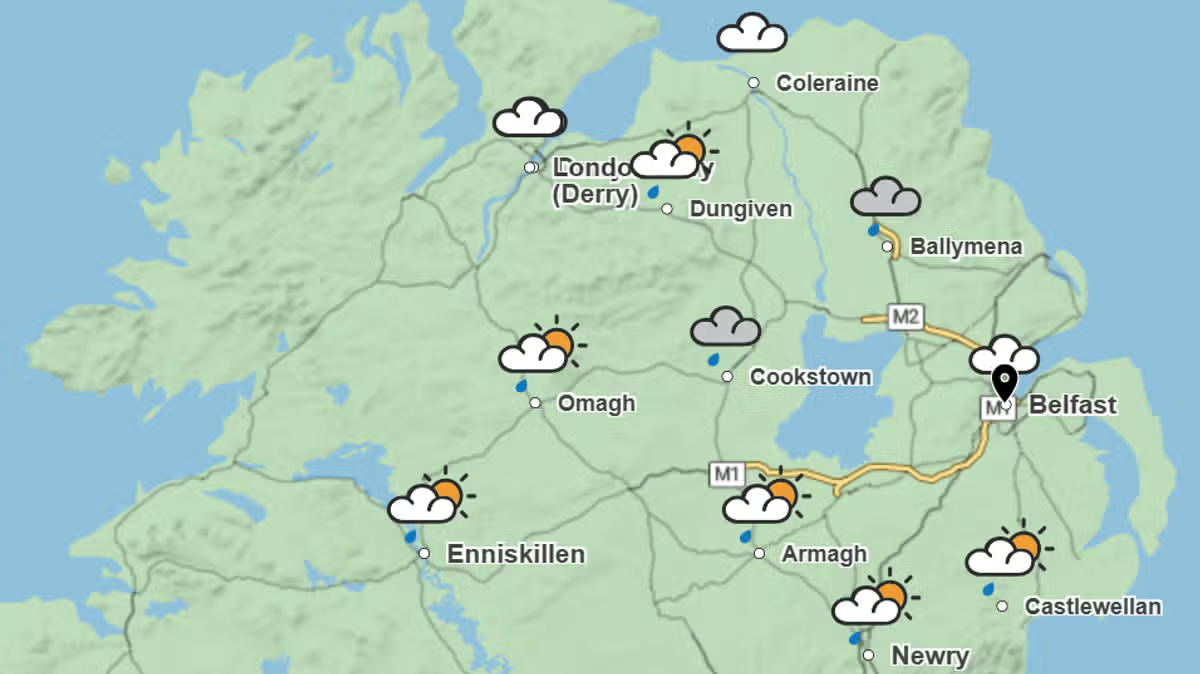
Whatever you have planned here’s the Met Office forecast for the next couple of days:

Advertisement

Saturday:

A mainly cloudy day with patchy rain spreading across the southeast, chance of one or two showers breaking out elsewhere. Maximum temperature 18°C.

Outlook for Sunday to Tuesday:

Rain or showers at times, perhaps heavy and thundery, but also occasional drier and brighter spells. Light or moderate winds, likely freshening on Monday and Tuesday.

UK long range weather forecast: Wednesday 2 September – Friday 11 September

Likely remaining unsettled with most areas seeing some showers or longer spells of rain at times, with the main focus for these across northern and western areas.

Potential for some strong and gusty winds at times. Some drier and more settled interludes could develop, perhaps becoming longer in duration across southern areas later in this period.

Advertisement

Temperatures are likely to be near average, although some short-lived warm or very warm spells are possible, especially in the south.

For all the latest news, visit the Belfast Live homepage here and sign up to our daily newsletter here.

Source link

Advertisement
Continue Reading

Trending

Copyright © 2025