
Crypto World
Solana vote to double disinflation passes by a hair in dramatic finish



Solana’s first network-wide vote went down to the wire, with a Kraken-linked validator switching sides before the disinflation proposal narrowly passed.



Circle, the issuer behind the USDC stablecoin, will be the latest sponsor for the Chelsea Football Club just months after the UK’s financial watchdog warned about “questionable sponsorship deals with unauthorized financial firms,” including crypto companies.
In a Friday announcement, Circle said its name and USDC would appear on jerseys for Chelsea FC players in the 2026/2027 season. The partnership deal between the football club and the digital asset company came about three months after the UK’s Financial Conduct Authority (FCA) said it had sent warning letters to clubs in the Premier League, potentially including Chelsea.
The letters concerned “unauthorized” companies, including crypto businesses, using sponsorship deals to target football fans, potentially breaching UK financial services laws.
“Millions of football fans trust their club’s badge,” said Lucy Castledine, the FCA’s director of consumer investments. “Clubs should not let unauthorised financial firms exploit that loyalty by putting potentially dodgy products in front of millions of fans.”
Circle UK Trading Limited, the company’s UK arm, has been listed as a company authorized under the FCA to provide certain financial services to residents since 2018. Stablecoins like USDC are also legal to use in the country, though lawmakers are working to establish a comprehensive regulatory framework for the digital assets.
Notably, although Circle said that USDC was “issued by certain regulated affiliates,” the stablecoin was “not issued or regulated under the laws of the United Kingdom.” Cointelegraph reached out to Circle and the FCA for comment but did not receive an immediate response.
Related: UK government reports 240 crypto millionaires in 2025
Crypto World
Bitcoin Loses Its Price Anchor After $6.4 Billion Options Expiry. Will the Fed Replace It?
Bitcoin options worth $6.4 billion settled Friday morning at $79,682, effectively removing the hedging flows that had held BTC near $80,000 all week.
Now that the pin is gone, what replaces it arrives in stages, starting with Kevin Warsh at 10 a.m. Eastern time.
What the $6.4 Billion Bitcoin Options Expiry Cleared
Approximately 81,700 contracts settled at 8 a.m. UTC on Deribit, with the official settlement price at $79,682.33. Calls at the $80,000 strike expired worthless, missing by just $318. Calls at $75,000 paid out.
Those two strikes held the most money in the batch. They also explain the week’s trading range.
When traders sell options, market makers hedge by trading the underlying asset. They sell BTC as price rises toward a heavy strike. They buy as it falls away.
That creates an invisible magnet, and Bitcoin sat inside it for three days, much as it did during previous large options expiries.
With today’s options expiry, the magnet switched off at 08:00 UTC on Deribit.
The Ceiling Moved to $82,000
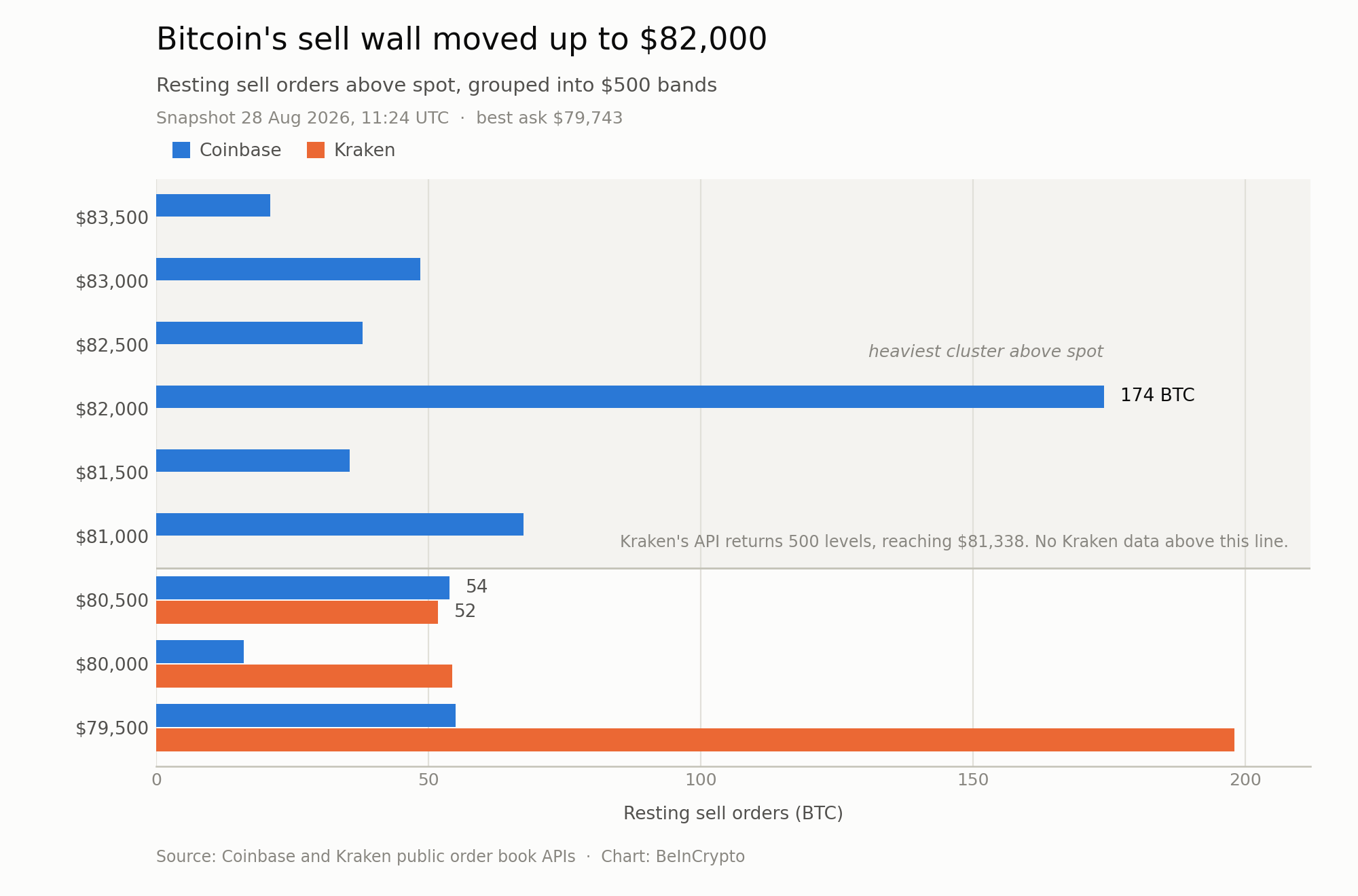
Analyst Ted Pillows flags a sell wall of roughly 1,052 BTC at $80,500 seen across four venues.
As of 11:24 a.m. UTC, only 101 BTC now rests at $80,500 on Kraken and Coinbase combined. The wall has largely gone.

The offers moved higher, such that at $82,000, the two exchanges hold 173 BTC, the largest cluster anywhere above spot.
Options data points to the same level. On the September 4 expiry, the $82,000 strike holds 5,931 contracts. That is 22% of everything open for that date, by far the heaviest concentration.

Therefore, two separate datasets now agree that the ceiling that mattered this week has shifted about $1,500 higher.
Why the Fed Matters More Than Usual This Year
Warsh delivers his first keynote as Federal Reserve chair on Friday morning. The theme of this year’s symposium is financial innovation, and the agenda names cryptocurrencies and stablecoins directly.
Considering crypto is not a side topic at the Fed’s biggest annual gathering this year, that is unusual. It is the subject.
“…cryptocurrencies, and stablecoins. This year’s symposium will explore how the rapid evolution of the payments system has implications for the future of currency, banking, monetary policy implementation, and global financial integration,” read an excerpt in the release.
The rate backdrop is also tense, because in July the Fed held its target range at 3.50% to 3.75%. Three officials dissented, and all three wanted a hike.
Beth Hammack, Neel Kashkari and Lorie Logan pushed for a quarter point increase. Traders now put roughly a one-in-three chance on a rise at the September 16 meeting.
Risk assets rarely price a hike well. Yet past Jackson Hole reactions have been mild. Across eight years, Bitcoin’s median move was about 1%.
The exception was 2022. Jerome Powell turned hawkish and BTC fell 6% in a day. Warsh has no record at this podium, and his long policy silence leaves economists guessing.
Frank Hepworth, chief executive of New Market Trading, urged calm on the expiry itself.
“expiry weeks always sound scarier than they are.”
The Next Anchor Is Already Forming
Bitcoin’s current spot price sat near $79,699 on Friday, up by 0.2% in the last 24 hours. The options market has stopped setting its boundaries.

The September 25 expiry already holds 155,393 contracts, roughly 40% of all open Bitcoin options on Deribit. It is nearly twice the size of the batch that just cleared.
It also settles nine days after the Fed decides. The heaviest strike sits at $70,000, and calls outnumber puts two to one. So the anchor has not disappeared. It has moved to a date that sits on the other side of the Fed.
The post Bitcoin Loses Its Price Anchor After $6.4 Billion Options Expiry. Will the Fed Replace It? appeared first on BeInCrypto.
Cardano’s native cryptocurrency was at the forefront of gains this time last week; however, in the past few days, it has lost momentum and given back part of its recent advance.
Despite the retreat, many analysts remain optimistic that a fresh uptrend is knocking at the door, while others argue that an ascent would depend on reclaiming a critical level.
‘Game On’ Under This Condition
As of this writing, ADA trades at around $0.21 (per CoinGecko), representing a 3% decline over the past 7 days and a 16% plunge from the local top of more than $0.25 seen less than a week ago.
Regardless of the slump, X user Jesse Olson recently opined that the asset still looks strong after its 4-hour chart has flipped bullish again. He noted that the price headed south and hit four out of four targets, found support, and wondered whether this means a new rally is about to begin.
Sssebi, who often touches on ADA, also chipped in. The analyst observed that the asset’s latest performance and suggested that a weekly close above the key line of around $0.21 would signal “game on.”
The asset’s Relative Strength Index (RSI) reinforces the bullish predictions. The ratio slipped to nearly 30, meaning that ADA is quite close to entering oversold territory, which is often a precursor to an incoming rally. The technical analysis tool measures the speed and magnitude of recent price changes and ranges from 0 to 100, where anything below 30 is considered a buying opportunity.

ADA’s latest exchange netflow should also be added to the list of optimistic factors. Over the past several days, outflows have exceeded inflows, signaling that some investors have abandoned centralized platforms and flocked to self-custody, thereby lowering immediate selling pressure.

Looking ‘Horrible?’
Contrary to the prevailing bullish stance, X user Rand Group made a rather pessimistic prediction. The analyst claimed that ADA has been lagging significantly behind the rest of the market and noted its rejection at $0.25. That said, they suggested it is currently looking “horrible.”
Some users commenting on the post reminded readers that ADA has been in much worse shape in recent years, yet it has managed to stage a solid comeback. Rand Group agreed, saying:
“Fair point, it’s surprised people before.”
The post ‘Game On’ for Cardano (ADA) Once It Crosses This Key Level: Analyst appeared first on CryptoPotato.

Justin Sun’s recent X post in which he accused a famous Chinese actress of reneging on a shady cash-for-eggs deal has caused waves in China — but perhaps not in the way that the crypto billionaire might have expected.
While for many in the English-speaking world, the most awkward and unsettling part of the story was Sun’s apparent treatment of and relationship with Jing Tian, what’s captured the public imagination in China is how much he’s relied on AI to make both his personal and business decisions.
Sun claims that he sought out Jing after a decades-long crush and paid her 30 million yuan to get her eggs.
However, he says that she subsequently demanded more money. At this point, he consulted Claude, which told him to call off the deal.
Now he’s suing her.
Read more: Is Justin Sun mixing HTX’s reserves with Poloniex?
Should Sun have used Chinese AI?
Sun’s also walking back the claims made in his story and is defending his use of AI.
In an interview with the Phoenix Network, Sun suggested that he’s using Claude “for business decisions worth tens of millions of dollars every day” and allowing it to perform “regular audits” of his companies.
It’s unclear if he implements these decisions without additional human input or offers the audits as factual without getting them double checked by a professional auditor.
At the end of the interview, Sun seemed to not know if publishing the story was a mistake or not, seemingly blaming Claude for telling him to cut off Jing.
Phoenix Network asked Sun if perhaps his personal life wouldn’t be getting meshed with his business affairs if he had used a Chinese AI instead.
The billionaire didn’t have an answer.

Read more: Justin Sun’s NFT marketplace managed just four sales last month
While Sun’s apparently doing everything he can to keep his name in the headlines, Jing has taken a different approach, denying Sun’s claims twice — once through her studio and once on her personal account.
Both denials have been brief and discussed settling the matter in court.
Got a tip? Send us an email securely via Protos Leaks. For more informed news and investigations, follow us on X, Bluesky, and Google News, or subscribe to our YouTube channel.

Crypto analyst Sykodelic says Bitcoin has now cleared roughly 80% of the technical conditions needed to confirm that its recent low is in, with the final answer likely to arrive in the next few days as the weekly and monthly candles close.
Whether BTC can close above $82,700 in that window will decide if the bottom has locked in for good or if there is still room for one more drop toward $75,000 first.
Where the Confirmation Case Stands
In a post on August 28, Sykodelic laid out which boxes have already been checked. For one, Bitcoin has reclaimed the $67,000 local structure level and the $74,400 higher-timeframe structure level.
It has also moved back above its daily 200 SMA and EMA, reclaimed its weekly 50 EMA, and pushed its daily RSI above 85, something the analyst says never happens during a bear-market bounce.
What is still missing is a weekly close above the 50 SMA at $82,000, a weekly close above the Supertrend line at $79,000, a higher low set above $82,700, and a monthly close above $76,463.
“Bitcoin has put in 80% of the data needed to confirm the low,” Sykodelic wrote. “However, for this low to be undeniable, we need to close above $82,700.”
The analyst mapped out two paths from here: a push back above $82,000 this week could send price toward $90,000 quickly, while chopping below the aforementioned $82,700 could mean there’s still one more leg down to around $75,000 to go before that level eventually gets taken out.
In another post, the analyst added that he’d seen another bottom signal. Short-term holder MVRV Bollinger Bands have entered an overheated zone for the first time since November 2024. He pointed out that similar readings appeared near the ends of the 2018 and 2022 bear markets and described the latest reading as the third-largest in nine years.
He also described the broader setup as healthy on multiple fronts, with funding rates having eased even as prices pushed higher, open interest cooling off and stabilizing instead of piling on leverage, and the Coinbase premium turning positive for the first time in three and a half months. Additionally, spot volume has stayed strong throughout.
How We Got Here
Bitcoin broke above $65,000 roughly two weeks ago, as CryptoPotato reported, then ran to $70,000 within hours and touched almost $80,000 by that Friday before slipping to $75,500 over the weekend.
It found buyers there, climbed past $81,000 for the first time since mid-May, dipped back under $78,000, and has since recovered to trade just under $79,000. At the time of writing, the primary crypto was up by slightly over 1% in 24 hours and more than 5% across seven days, per CoinGecko data. It was also up nearly 24% over 30 days, although it is still about 36% below its October 2025 all-time high.
If you are interested in learning more about the current market rally and a major Bitcoin protection development, check out the video below.
The post These Four Signals Could Confirm if Bitcoin’s Low Is Locked In: Analyst appeared first on CryptoPotato.

Bitcoin’s rather stable price moves over the past day or so were disrupted after Kevin Warsh finished his speech at Jackson Hole, as the asset slumped by a few grand in an hour.
Its move south dragged many altcoins with it, resulting in over $200 million in liquidated positions at one point, according to data from CoinGlass.
BREAKING: Bitcoin falls -$3,000 in 60 minutes as $200 million worth of levered longs are liquidated. pic.twitter.com/6FuQCUnzeu
— The Kobeissi Letter (@KobeissiLetter) August 28, 2026
The primary cryptocurrency traded at around $79,500 before the speech began, dipped to $78,500 during, and returned to its starting point after its completion. However, the market reacted in the following hour or so, as it mimicked Wall Street.
During his first speech at the helm of the US Federal Reserve, Warsh remained hawkish while the markets expected him to follow the example set by US Treasury Secretary Scott Bessent.
Instead, he reaffirmed the Fed’s 2% inflation target and called it “firm and fixed.” He believes the current figures of around 3.7% remain too high.
Although there was no official confirmation that the central bank would hike the rates at the upcoming FOMC meeting next month, the odds on prediction markets increased.
Aside from BTC, most other large-cap alts turned red as well. Ethereum lost the $2,500 level after a 3% decline, while BNB slumped below $700. XRP has lost the most value from this cohort of assets, dumping by 5% to under $1.40.
Further losses are evident from ADA, XLM, and BCH. Bitcoin Cash has plunged by almost 9% daily to under $250.
In the video below, we discussed the potential impact of the Warsh speech on the markets.
The post Bitcoin Suddenly Dumped by $3K as Liquidations Hit $200M Hourly: Is the Fed to Blame? appeared first on CryptoPotato.


Strategy’s two-week pause in Bitcoin sales has removed a three-month sentiment barrier after the company disposed of 6,948 BTC between late May and early August, according to Bitfinex analysts.
Summary
- Strategy reported no Bitcoin transactions for a second consecutive week.
- The company raised $2.01 billion by selling MSTR shares instead.
- Its 840,447 BTC are profitable with Bitcoin trading above the $75,385 average cost.
- Bitfinex said the earlier sales affected market sentiment more than Bitcoin’s available supply.
Bitfinex analysts said in an Aug. 28 report that Strategy’s 6,948 BTC in disposals were small compared with daily spot trading volume, but the company’s status as the largest corporate Bitcoin holder gave each weekly sale added weight among traders.
“The largest corporate holder is selling” became a recurring bearish argument between May and August, the analysts said. Although the sales did not create a large supply shock, each Monday filing left open the possibility that more coins could reach the market.
Strategy’s latest Form 8-K, covering Aug. 17 through Aug. 23, reported no Bitcoin purchases or sales. The filing was the second consecutive weekly disclosure with no change to the company’s 840,447 BTC balance.
With Bitcoin trading near $78,700, Strategy’s holdings have also moved above their average acquisition price of $75,385. The company paid about $63.36 billion for the position, including fees and expenses, placing its current value near $66 billion at the price cited by Bitfinex.
Strategy’s 6,948 BTC sales carried more symbolic weight
Strategy began selling Bitcoin in late May, ending a multiyear period during which its treasury had largely moved in one direction.
As crypto.news reported in June, the first transaction involved 32 BTC sold at an average price of $77,135. The disposal raised about $2.5 million and represented only 0.0038% of the company’s holdings at the time, but it was Strategy’s first reported Bitcoin sale since a tax-related transaction in December 2022.
Executive chairman Michael Saylor had prepared investors for the possibility during Strategy’s first-quarter earnings call. After the company reported a $12.54 billion net loss, driven mainly by unrealized losses on its Bitcoin holdings, Saylor said Strategy would “probably sell some Bitcoin to fund a dividend” and “inoculate the market.”
Larger disposals followed as Bitcoin remained under pressure during the summer. Strategy sold 3,588 BTC for approximately $216 million in early July to fund dividends tied to its preferred securities. It later sold 1,638 BTC for $104.73 million during the week ending Aug. 2, followed by another 1,690 BTC for $108.6 million through Aug. 9.
The company used the later proceeds for STRC dividends and repurchases. Its Aug. 10 filing showed that the entire $108.6 million generated from the 1,690 BTC sale went toward buying back roughly 1.15 million STRC shares.
By early August, the accumulated sales had reduced Strategy’s reserve to 840,447 BTC. Bitfinex calculated that all disposals from late May through early August totaled 6,948 BTC and generated about $432.5 million.
Against daily Bitcoin spot volume, the analysts described the amount as “a rounding error.” Market attention instead centered on whether preferred-stock obligations could turn Strategy into a recurring seller whenever its other funding channels weakened.
MSTR issuance has replaced Bitcoin as the funding source
Rather than sell more Bitcoin, Strategy raised about $2.01 billion in net proceeds by issuing approximately 18.26 million MSTR common shares between Aug. 17 and Aug. 23. The total was around six times the amount raised during the previous reporting week.
Strategy spent $136.4 million of the proceeds to repurchase about 1.43 million STRC shares below their $100 stated amount. Another $300 million went into its U.S. dollar reserve, increasing that balance from $4.8 billion to $5.1 billion.
The remaining $1.59 billion was deposited into a newly created cash account. Combined with the existing reserve, the two accounts held approximately $6.69 billion as of Aug. 23.
During the same period, Strategy bought no Bitcoin. The company has now raised roughly $2.35 billion through MSTR issuance across two weeks without directing any of the proceeds into BTC, according to the Bitfinex report.
Capital has instead gone toward preferred-stock repurchases, dividend coverage, and additional liquidity. Management designed the dollar reserve to cover payments on Strategy’s preferred shares and outstanding debt, reducing the need to sell Bitcoin when recurring cash obligations come due.
The latest allocation follows an earlier no-sale week in which Strategy raised $333.7 million through MSTR issuance. Of that amount, $149.1 million entered the dollar reserve, $132.2 million funded STRC repurchases, and $52.4 million covered STRC dividends.
Bitfinex said the pattern indicates that management currently prefers issuing common stock before disposing of additional Bitcoin. With the reserve now providing close to three years of payment coverage, the analysts viewed another BTC sale as less likely unless STRC suffers severe price pressure and other funding options become less attractive.
Strategy remains neutral rather than a Bitcoin buyer
The end of weekly sales has not yet restored Strategy’s former role as a steady source of Bitcoin demand.
Over the past two reporting periods, the company neither bought nor sold BTC, leaving its position unchanged at 840,447 coins. Bitfinex, therefore, described Strategy as neutral rather than an active buyer.
Bitcoin now competes with several uses for the capital raised through MSTR issuance. Strategy can direct the funds toward STRC repurchases, preferred dividends, debt payments, its dollar reserve, the new cash account, or additional Bitcoin purchases.
President and chief executive Phong Le has said the company expects to resume accumulation during 2026. In August, Le linked future purchases to STRC recovering toward its $100 stated amount, where Strategy could issue additional preferred shares on better terms.
“We’ll continue to build that. And yeah, when Stretch gets back to par, we’ll issue more. We’ll buy more Bitcoin,” Le said during an earlier interview.
Strategy has not provided a date or amount for its next purchase. Its filings show that supporting STRC and building cash have taken priority while the preferred stock remains below the level management wants to maintain.
Bitfinex also identified dilution as a remaining risk for MSTR holders. Issuing common shares when the stock trades at a reduced premium to the company’s Bitcoin value can weaken the Bitcoin-per-share measure that Strategy uses when discussing shareholder performance.
A renewed Bitcoin decline toward the low-$60,000 range could also tighten the company’s financing position, according to the analysts. During the summer sell-off, a weaker BTC price pushed Strategy’s holdings below cost while lower MSTR prices made common-share issuance more dilutive.
U.S. investors face exposure through MSTR and STRC
Strategy’s capital decisions directly affect U.S. investors because MSTR and STRC trade on Nasdaq, while the company reports its weekly Bitcoin and securities transactions through filings with the U.S. Securities and Exchange Commission.
MSTR investors gain indirect Bitcoin exposure through a public company, but their returns can differ from BTC’s performance because Strategy also issues common stock, pays preferred dividends, services debt and repurchases securities. Preferred shareholders rank ahead of common shareholders for dividend payments and certain claims.
The latest filing showed that Strategy sold MSTR at an average price of about $110 per share, up from approximately $96 during the previous week, according to Bitfinex. The higher price allowed the company to raise more cash per share while Bitcoin’s recovery placed its remaining treasury above its average acquisition cost.
STRC remains another factor in the company’s capital plan. Strategy designed the variable-rate perpetual preferred stock to trade near $100 and has maintained its annualized dividend rate at 12% for August while conducting regular repurchases below the stated amount.

Complicated father and son relationships
The “Whisper Man” and his latest victim both come from families with sad father-and-son relationships.
Frank Carter arguably targeted young boys because he was sexually abused by his own father and wanted to do the same to other children as revenge. He would specifically go after children who lived in difficult family situations. His son, Francis Jr., is following in Frank’s footsteps, trying to be like a father he never got to know. “He’s looking for his father’s approval,” says North.
Tom and his son clash because they are mourning Tom’s wife and Jake’s mother—who died after a long illness—in different ways. For a fresh start, Tom moves the family to a new house and a new school in New Jersey. Jake, on the other hand, is slower to move on, carrying around what he calls a “packet of special things,” filled with doodads and pictures that belonged to his mother. Tom is also frustrated that Jake prefers to play with an imaginary girl in a blue sweater rather than make real human friends, and they get into disagreements in the movie over that.

What to know about King Haakon VIII and his wife, Mette-Marit
As the only son of Harald and Sonja, Haakon somewhat broke with tradition in his younger years when he moved out of the country to attend the University of California, Berkeley, where he obtained a BA in political science in 1999.
Haakon wed Mette-Marit Tjessem Høiby in 2001, a non-royal and single mother of Marius Borg Høiby.
The couple welcomed their first child together, Ingrid Alexandra, in 2004 and had their son, Sverre Magnus, a year later.
Marius Borg Høiby, Mette-Marit’s eldest child, was found guilty of two counts of rape and was sentenced to four years in prison in June.
In recent years, Mette-Marit has suffered with poor health, after being diagnosed with a chronic lung disease—what the palace referred to as an “unusual variant of fibrosis”—in 2018.
In July, Mette-Marit shared a statement upon being discharged from hospital after undergoing a lung transplant. “It has given me the gift of life, and words fall short when I try to describe how grateful and humble I am for this,” she said of the surgery.
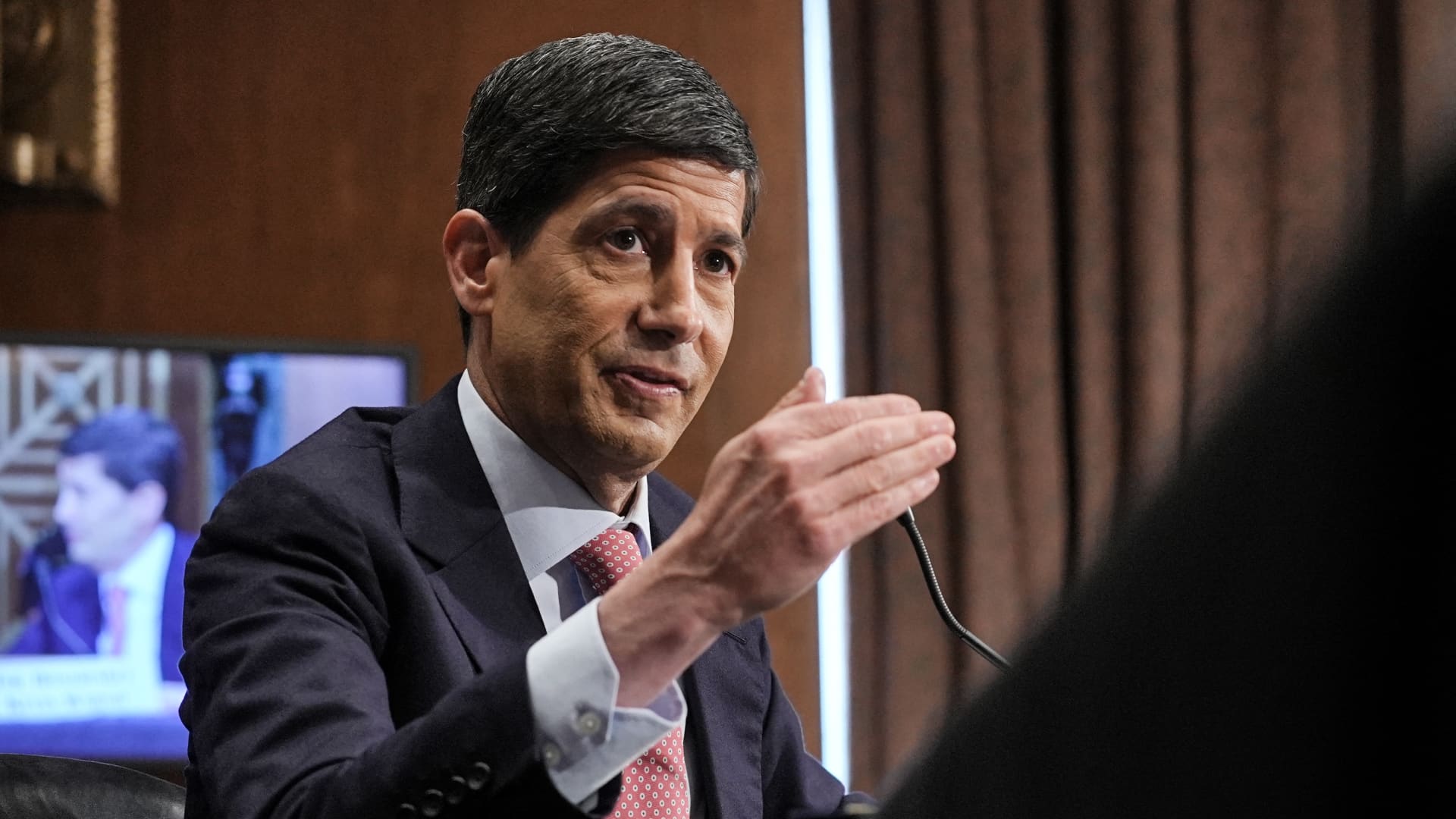
Federal Reserve Chairman Kevin Warsh testifies during a Senate banking committee hearing on Capitol Hill, in Washington, July 15, 2026.
Ken Cedeno | AFP | Getty Images
Kevin Warsh’s keynote speech at the central bank’s annual symposium in Jackson Hole, Wyo. has altered investors’ outlook for an interest rate hike in September after the Fed chairman said he was committed to fighting inflation.
Traders on prediction market platform Kalshi now believe there are 48% odds that the Fed will hike rates by 25 basis points. Before Warsh’s speech, odds that the central bank would maintain the status quo in September were nearly 70%. ‘
Traders of fed funds futures now see a nearly 56% chance of a quarter-point hike in September, per the CME’s FedWatch tool. And on Polymarket, speculators indicated 49% odds that the Fed raises rates.
After the Fed’s July meeting, investors were fairly certain of a rate hike in September, especially considering that three members of the Federal Open Market Committee disagreed with the majority’s decision to keep interest rates steady. Those three members, instead, argued rates needed to move higher in response to elevated inflation.
But odds for a rate hike in September declined in the past month after a weaker-than-expected employment report showed the U.S. lost jobs in July, and that inflation — while remaining above the Fed’s 2% target — cooled.
Warsh directly addressed those data reports in his Friday speech, but cautioned the central bank needed to see more. “While this summer’s [inflation] readings were better than expected,” he said, “they do not tell me that underlying trends have meaningfully improved,” Warsh said.
Addressing the situation more directly Warsh said, “We must be confident that underlying inflation is moving to our objective, clearly and at sufficient speed. Otherwise, we have work to do. That’s our job, our mandate and our charge to keep.”
In response, short-term yields rose, with the 2-year Treasury yield, which closely follows short-term rate decisions by the Fed, hitting its highest level since late July.
The Fed’s rate decision is Sept. 16.
Disclosure: CNBC and Kalshi have a commercial relationship that includes customer acquisition and a minority investment.

Marseille and Lyon to face Leverkusen in Europa League, Rennes take on Juventus

How Long Is A New Fire TV Stick Actually Supposed To Last?

Wanted suspect arrested after cops spot him wandering into Panda Express during their lunch break





-

 Crypto World3 days ago
SpaceX stock could rise 75% to $240, JPMorgan says
-

 Crypto World19 hours ago
Bitcoin’s 22% rally now needs real demand to outlast Treasury liquidity boost
-

 Business6 days ago
Musk’s Tesla, SpaceX Confirm $16.8 Billion ‘Terafab’ Chip Plant as World’s Largest Building in Texas
-

 Crypto World7 days ago
anatomy of crypto’s biggest liquidation event since 2021
-

 Crypto World4 days ago
A $30 Billion AI Fund Implodes, Now the SEC Is Investigating Wall Street’s Role
-

 Crypto World2 days ago
Warsh Jackson Hole keynote puts financial innovation first
-

 Politics6 days ago
6 months on, Irish renters crushed by effects of government housing bill
-

 Crypto World3 days ago
Did Trump Just Move SpaceX Stock With One Truth Social Post?
-

 Business18 hours ago
Salesforce Stock Soars 19% as Blowout Earnings and Agentforce AI Growth Silence Software Skeptics
-

 Business5 days ago
Mystery AI Model ‘Ox Alpha’ Draws Developers With Free Access as Chinese Lab Origins Remain Debated
-
 NewsBeat6 days ago
The ‘Lucky Dip Gang’ causing carnage for clicks: After five thugs were killed speeding in the wrong direction on a motorway, GUY ADAMS investigates a sick new trend… and why police aren’t even allowed to pursue them
-
 Crypto World7 days ago
Nvidia Stock Suffers Longest Losing Streak Since 2022: Will Q2 Earnings End It?
-

 Business2 days ago
Walmart takes aim at younger shoppers with new fashion brand
-

 Business4 days ago
Moderna CEO warns China is pouring state money into mRNA technology
-

 Business4 days ago
NVIDIA Stock Drops Nearly 2 Percent to $210 on Seventh Losing Day Ahead of Critical AI Earnings
-

 Business6 days ago
Will Tesla Stock Be Higher or Lower a Year From Now? Here’s What Wall Street Analysts Are Saying
-
 Crypto World5 days ago
$92 Billion Nvidia Earnings Could Make or Break the AI Trade
-

 Business3 days ago
Thailand’s Eastern Economic Corridor Capital City (EECiti): Key Developments and Investment Opportunities
-
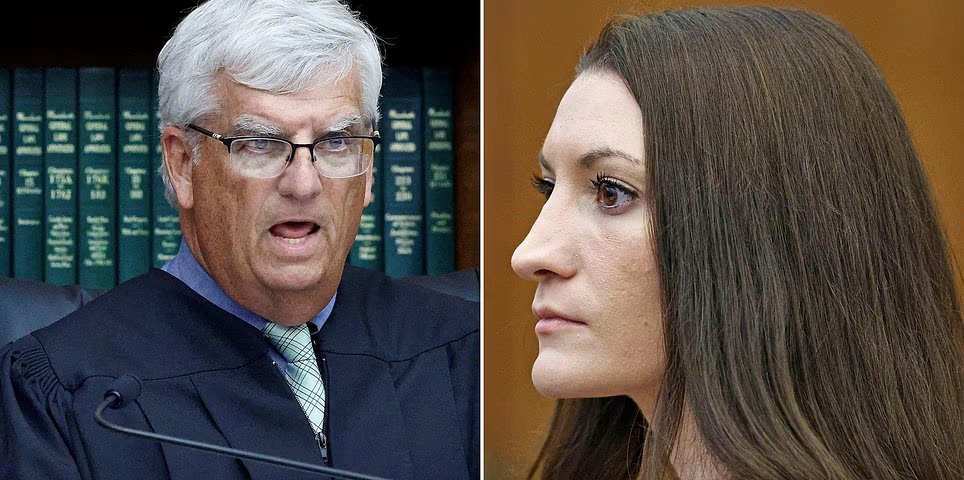 NewsBeat2 days ago
Lindsay Clancy jury braces for closing arguments as judge tells court: ‘You’ve heard all the evidence’ – Live updates
-

 Tech7 days ago
Unitree’s New Superman Robot Claims to Outjump and Outrun Every Human, Usain Bolt Included
You must be logged in to post a comment Login