After the introduction of this article, I promise readers they will get some good laughs. I’m just setting the stage.
Seeking Alpha is understandably cautious when it comes to articles involving any sort of litigation. We are, too. Legal proceedings can be complicated, and investors shouldn’t confuse our analysis with legal advice.
However, the litigation involving PennyMac Mortgage Investment Trust (PMT) and its preferred shares, PMT-A (PMT.PR.A) and PMT-B (PMT.PR.B) is important for investors to understand. There was a recent ruling on Aug. 19 by the Ninth Circuit that may make investors worry that preferred shareholders either lost or suffered a major setback. We wrote a PMT-B article on this case on Seeking Alpha back in 2024. For readers that aren’t aware of what’s going on, that article will help catch you up to speed.
Advertisement
PMT discussed this case in their 2025 annual report. Specifically, for those interested, it talks about the case on pages 27 and F-56. (Those are the page numbers on the actual page in the document found on the bottom of each page, not the page numbers of the PDF itself.)
The Ninth Circuit ruled that a fixed dividend rate isn’t automatically prohibited by the LIBOR Act. That’s the argument PMT won.
What the court didn’t decide is far more important in our view. The Ninth Circuit did not rule that PennyMac’s treatment of the preferred shares complied with the LIBOR Act. It did not rule that PennyMac correctly applied the contractual fallback provisions. The Ninth Circuit left several questions unresolved and sent the case back to the district court for further arguments.
The plaintiff lost an argument. In our view, it wasn’t the strongest argument available to shareholders in the first place. In fact, we believe the argument made by the plaintiff to the Ninth Circuit wasn’t good to begin with. Don’t believe me? You can watch the oral arguments on YouTube.
Advertisement
This article isn’t about predicting what a court will ultimately decide. It’s about separating what the Ninth Circuit actually decided from what it left undecided. We will examine the contractual language that may matter when the case returns to the district court.
PennyMac and the Tiny Ruling
On August 19th, the Ninth Circuit court ruled on the PennyMac case. The ruling looks really bad at a glance, and it had shares of PMT-A and PMT-B down over 1% in early trading. Then shares popped back up and were roughly flat on that day. I took a bit of time to read through the ruling and evaluate it against our projections.
The rulings here are not a huge blow because they only block what I would call “the weak argument.” Well, so much for keeping this section completely polite. The defense wrecked their argument harder than a piñata at batting practice.
Note: If you just watch Steven’s part, you’ll think he did a pretty mediocre job. It’s like watching a mediocre college team warm up. You’re not super impressed, but then you see the 3A JV team brick layups and argue with the refs (judges). Suddenly, mediocre looks pretty good.
Advertisement
We have extensively covered the case for members of The REIT Forum. We wanted to publish this article for Seeking Alpha readers to have a good understanding of what’s going on instead of reading some random headline.
The Weak Argument
The Ninth Circuit court was involved in this case to establish whether a fixed-rate dividend is an acceptable substitute under the LIBOR Act. Yes, it is. The dividend being fixed does not, by itself, make the entire “waterfall” (series of options for establishing the dividend rate) wrong.
That was just a poor place for the plaintiff to build their case. The last time I saw a foundation that bad, the termites were filing for relocation assistance.
The plaintiff’s lawyer probably wanted a ruling saying fixed rates don’t work because it would’ve put her in a great position for a case against Morgan Stanley (MS). Dilworth Paxson says they are investigating a case against Morgan Stanley. They are inviting those shareholders to contact them. Catherine Pratsinakis is listed as the contact:
Advertisement
Dilworthlaw
That makes the choice of argument make more sense. A ruling that fixed rates are categorically impermissible under the LIBOR Act could have implications well beyond PennyMac’s preferred shares.
Actions of the Ninth Circuit Court
The Ninth Circuit court thoroughly rejected:
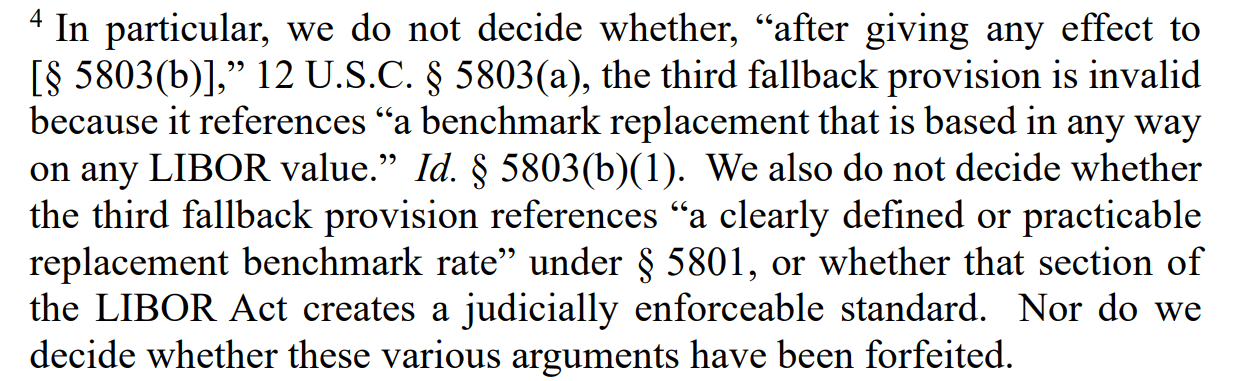
The Ninth Circuit court very explicitly did not rule on:
Advertisement
Whether PennyMac’s fixed dividend rate was acceptable.
Whether PennyMac violated the LIBOR Act.
Whether PennyMac’s fixed-rate dividend would be “a clearly defined or practicable benchmark rate”.
Whether various arguments on those topics have been forfeited.
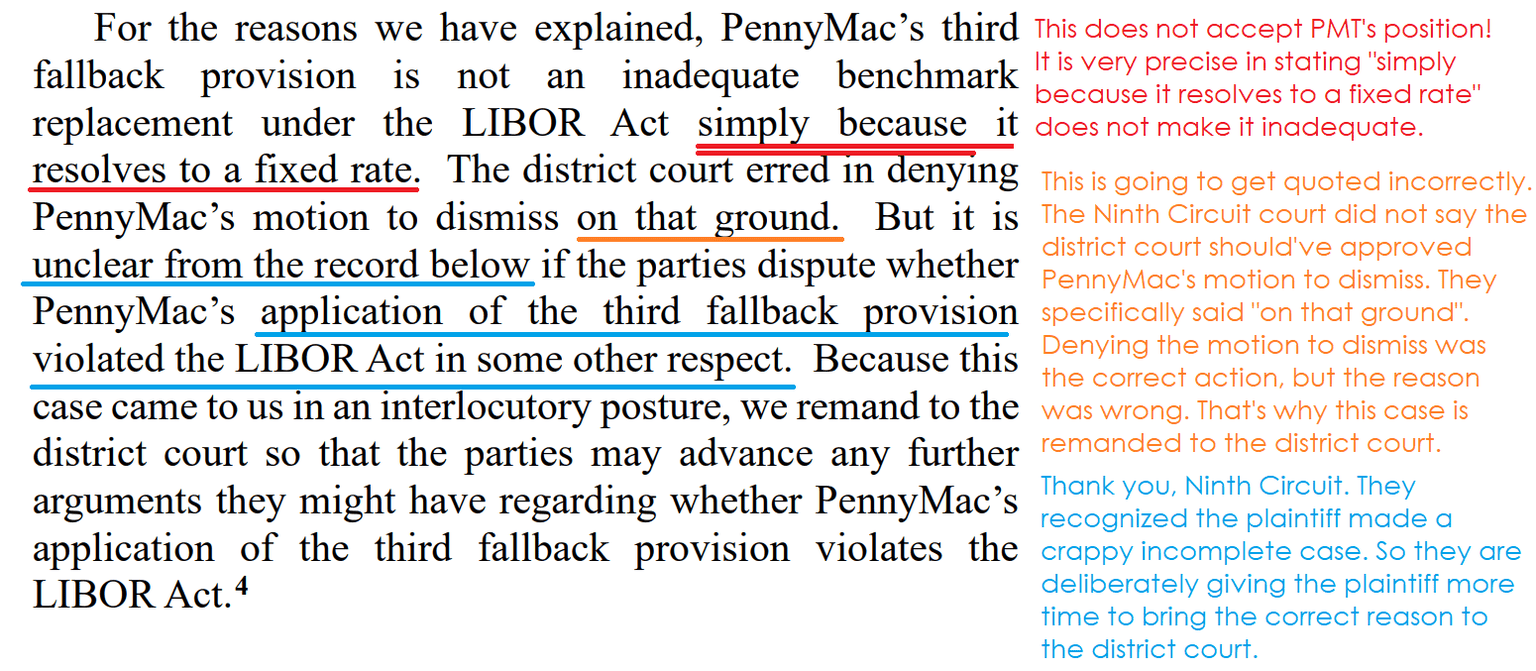
Ironically, all those very important things that the court is explicitly not ruling on were included as foot note 4 on page 24:
Ninth Circuit
Two Better Arguments
I suggested two arguments as viable alternatives.
Meeting of the Minds: This is a simple route in theory, and one of the judges was clearly considering it.
The Wording of the Contract: This is the stronger case. Reading the exact contract would go in the plaintiff’s favor.
Meeting of the Minds
A plaintiff could argue, “Reaching a fixed-rate dividend forever was not contemplated in the contract, and therefore the meeting of the minds did not exist.” That seems like a decent case because contracts are supposed to require a meeting of the minds. However, the Ninth Circuit ruled that the LIBOR Act intentionally allowed contracts to result in an outcome that was not intended when the contract was initially prepared. Consequently, this argument is out.
Advertisement
That’s okay. This was really plan B for the plaintiff and plan B for anyone trying to win. The difference is Plan A.
The Wording of the Contract—The Best Route Remains
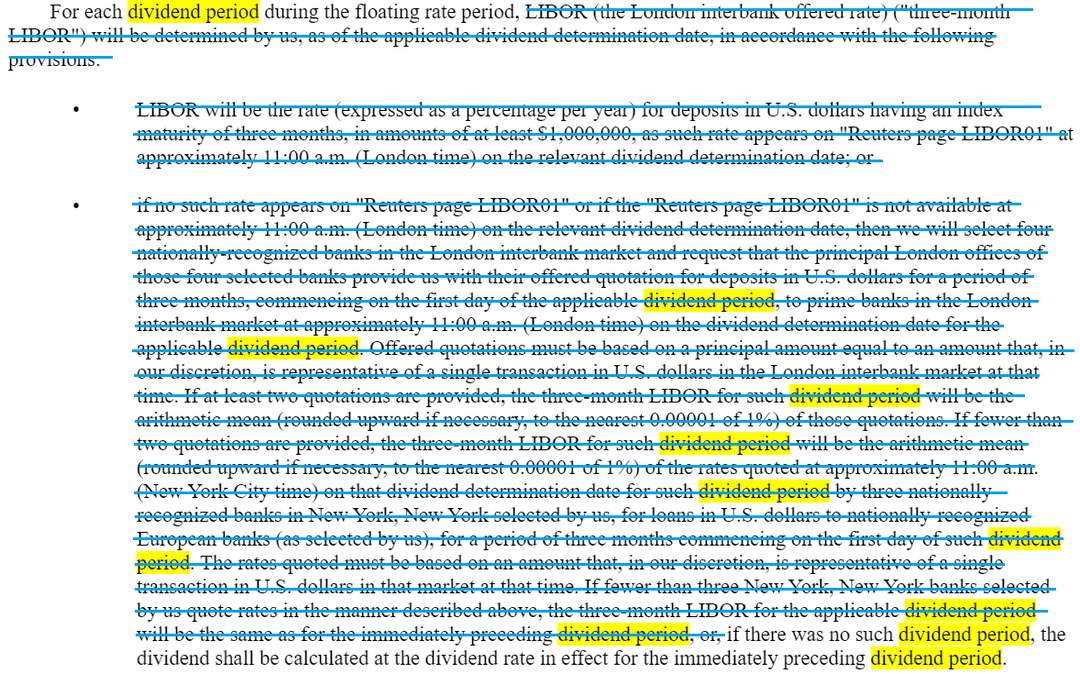
The waterfall is central to this case. It establishes how the dividend rate will be calculated. Under the LIBOR Act, several provisions had to be removed. I struck out the offending sections with blue lines:
Advertisement
SEC
That is a bit awkward to read, so I prepared another version where I deleted the parts that were struck out:
SEC
That’s actually very easy to read.
Advertisement
If we read those exact words, we have exactly one way to reach a dividend rate. The path can only be reached if the following clause is satisfied:
if there was no such dividend period
We’re going to touch on some terms briefly.
Sorry, we are entering the boring part. I guarantee it will pick up again.
Key Term—Dividend Period
A contract often defines the meanings of some terms. The definition it creates may not be intuitive. However, the fact that the definition is present in the contract makes it important.
“Dividend period” means the period from, and including, a dividend payment date to, but not including, the next succeeding dividend payment date, except for the initial dividend period, which will be the period from, and including, the date of original issuance of the Series B Preferred Shares to, but not including, September 15, 2017.
Key Term—Floating Rate Period
The term “Floating Rate Period” is a defined term, even though the definition is messy.
Any historical upward or downward trend in three-month LIBOR is not an indication that three-month LIBOR is more or less likely to increase or decrease at any time during the floating rate period (as defined herein), and you should not take the historical levels of three-month LIBOR as an indication of its future level.
Holders of Series B Preferred Shares will be entitled to receive, when, as and if authorized by our board of trustees and declared by us, out of funds legally available for the payment of dividends, cumulative cash dividends (i) from, and including, the date of original issuance to, but not including, June 15, 2024 (the “fixed rate period”), at a fixed rate equal to 8.00% per annum based on the $25.00 per share liquidation preference, or $2.00 per share; and (ii) from, and including, June 15, 2024 and thereafter (the “floating rate period”), at a floating rate equal to three-month LIBOR (as defined below) as calculated on each applicable dividend determination date (as defined below) plus a spread of 5.99% per annum based on the $25.00 per share liquidation preference.
That makes it very clear that the floating rate period is the period “from, and including, June 15, 2024 and thereafter”.
Putting It Together
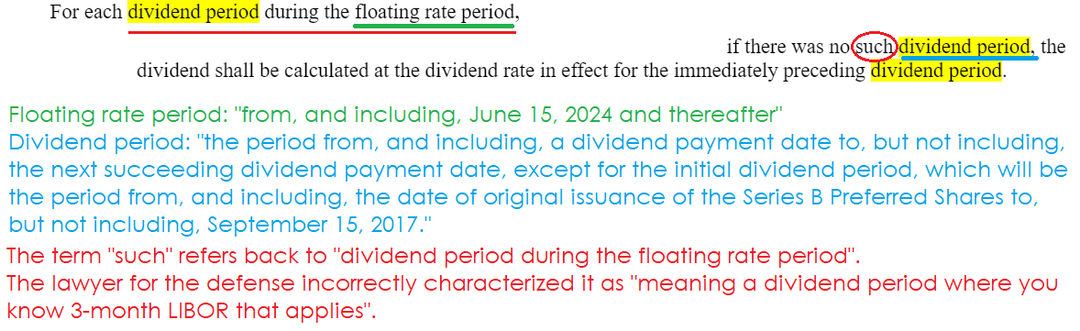
When we look at those terms, we reach the following:
SEC
Note: My text may seem sloppy in that final quote in red. I’m quoting the lawyer verbatim. The phrase “you know” and the “that” in the quote appeared to just be verbal filler. However, I try to include the exact words when possible.
Advertisement
Was There Such a Dividend Period?
Based on a literal reading of the plain text in the document after applying the LIBOR Act, we get an interpretation that is very favorable for the plaintiff.
The only phrase that “such dividend period” could be referring to is “each dividend period during the floating rate period.”
Based on that interpretation, you simply have to ask if such a dividend period existed. It is important to remember that the term “floating rate period” was already defined, and the definition of the floating rate period was based on time.
A “dividend period” does not become a “floating rate period” because the dividend floats. That would be getting causation backwards.
There is nothing in the contract to support the idea that the dividend floating creates a floating rate period.
Instead, the contract clearly indicates that it is the floating rate period that causes the dividend float.
The Defense Strategy
Steven Farina dominated the Ninth Circuit matchup because Catherine did not attack the wording. The judges told her to. They were very clear. They didn’t like her angle on the case and wanted her to go after the wording of the contract.
Advertisement
How do I know that? It’s in the video. I am giving you my impression from watching the actual case. In my opinion, the judges were clear.
Steven Farina tried to define “such dividend period” as meaning “a dividend period where you know 3-month LIBOR that applies.”
Note: I’m aware the grammar is awkward. That’s the problem with quoting someone from their live performance.
There would’ve been a viable way to reach that conclusion before the LIBOR Act.
Advertisement
We can build into his strategy by looking at the final sentence in full:
If fewer than three New York, New York banks selected by us quote rates in the manner described above, the three-month LIBOR for the applicable dividend period will be the same as for the immediately preceding dividend period, or, if there was no such dividend period, the dividend shall be calculated at the dividend rate in effect for the immediately preceding dividend period.
If you read that entire sentence, then you could plausibly reach the idea:
That’s a poorly constructed sentence, but maybe they meant to say that if there was no dividend period based on LIBOR.
Steven Farina picked that route and went hard on it. He didn’t highlight that it was poorly constructed. Instead, he focused on creating the impression that the phrase was about whether there was a dividend period based on LIBOR rather than about the actual definitions that were written in the contract.
That is very different from whether there was a “dividend period during the floating rate period”.
Advertisement
Why That Interpretation Doesn’t Work
Read this part again:
SEC
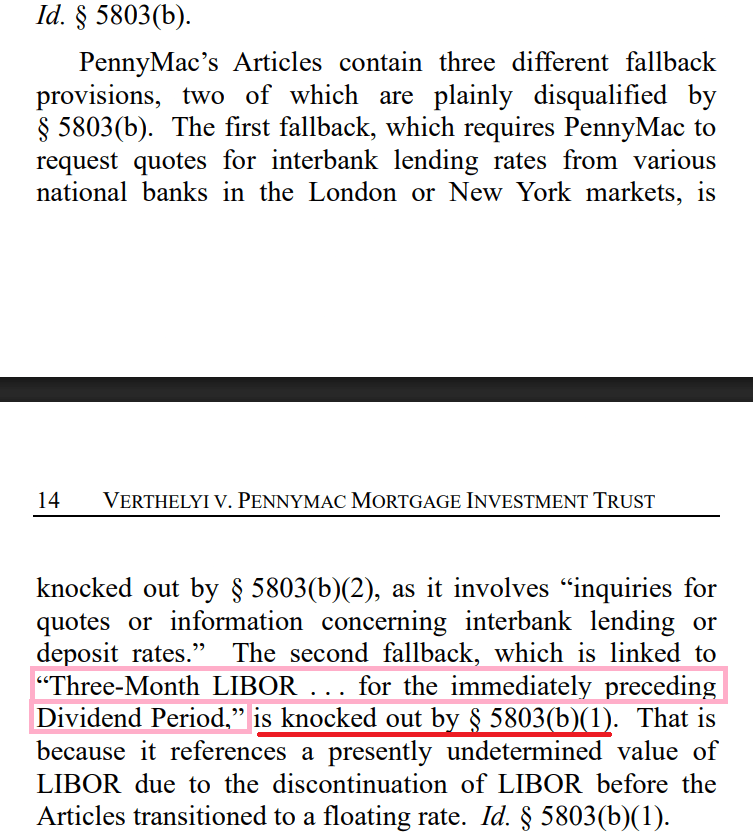
Per the LIBOR Act, the pink part “shall be disregarded as if not included in the fallback provisions.” If you remove the part in pink, then there is no viable method in the English language to conclude that “such dividend period” means a dividend period where 3-month LIBOR applies. That interpretation could only be reached by keeping that clause.
However, PennyMac did not argue to keep that clause. They knew the clause was gone. Everyone knows the clause is gone. Rather than try to keep the doomed clause, PMT’s lawyer let the clause go while trying to fold it into the definition of “such dividend period.”
Advertisement
The Ninth Circuit explicitly stated that the clause was gone:
Ninth Circuit
Questions the Plaintiff Needs to Ask
I’m writing out the questions. She can put this on a sticky note and read it. She can put it in any document she’s going to file. She could even rehearse it. I hear rehearsing can help people avoid looking like that performance in the YouTube video.
Here are the points I would make:
Advertisement
Given that the Ninth Circuit court explicitly stated that the second fallback was knocked out by §5803(b)(1), how can the second fallback provide the definition for the term “such dividend period” in the third fallback?
The second fallback was either removed or it was not. Since the Ninth Circuit court already ruled that it was removed, why don’t we read the contract that actually remains?
That’s rhetorical. I’m going to read the text that remains because it is the contract. This case is about the contract, so we should all be clear about exactly which words remain in the contract.
“For each dividend period during the floating rate period, if there was no such dividend period, the dividend shall be calculated at the dividend rate in effect for the immediately preceding dividend period.”
Have there been any dividend periods during the floating rate period? Let me check my calendar. The first one started on June 15, 2024 and ended on September 14, 2024. We should start counting. That’s one dividend period. Oh, look at that, we only needed to reach one. To respect the court’s time, I won’t manually count out each of the subsequent dividend periods. They started on the 15th of June, September, December, and March. We know that because it is the contract.
Is It Over?
The case isn’t over.
The closing assessment of the Ninth Circuit court was:
Because this case came to us in an interlocutory posture, we remand to the district court so that the parties may advance any further arguments they might have regarding whether PennyMac’s application of the third fallback provision violates the LIBOR Act.
The Defense Strategy
If I were Steven Farina, I would want to argue that the Ninth Circuit court already established that our fallback was viable. Keep in mind, that is not what the Ninth Circuit court said! It’s close, but it isn’t quite accurate. Okay, it’s the opposite of accurate. It’s about as far from reality as if Return to Silent Hill won Best Picture.
Remember that the Ninth Circuit court very specifically ruled that a fixed rate is not inherently incapable of being a benchmark rate.
Advertisement
The Ninth Circuit court did not:
Rule on the rest of the case.
Rule on whether PMT was correct about the third fallback being activated.
Rule on whether PMT’s fallback constitutes a “clearly defined or practicable replacement benchmark rate”.
But for PMT to get this case closed in their favor, they desperately want to pretend those things happened.
The Ninth Circuit Conclusion
This is exactly how they judges finished their assessment:
Ninth Circuit
Advertisement
Some people are going to read that section and come to the wrong conclusion. But I think it’s pretty clear. They decided not to end this case prematurely. They could’ve gone substantially further in PennyMac’s favor. They didn’t do that.
It appears to me that the Ninth Circuit court handled this pretty well.
What more could they do? Send someone down to coach Catherine Pratsinakis live? They gave her quite a few hints from the bench.
Remembering What The Plaintiff Said
When I was writing to subscribers about the oral arguments initially, I quoted another analyst who said they had spoken to her after the case. An anonymous source, but not anonymous to me. I believe they are credible.
Advertisement
This is what they said:
I just talked to the attorney yesterday. She said two of the judges said they were inclined to give them a narrow victory and the third judge didn’t say anything one way or the other.
At the time, I wrote:
I have very little confidence in her ability to read the room.
Clearly, her read of the room was roughly on par with a pair of frat boys showing up to a convent for singles’ night.
Conclusion
This case is still up in the air.
Advertisement
The Ninth Circuit court ruled very narrowly to create precedent that a fixed rate could be viable because it is a dividend rate and the LIBOR Act allows for a benchmark rate, interest rate, or dividend rate. That’s not a surprise. We knew those things because we read the law.
The question is whether the plaintiff’s lawyer can dust herself off and present the case that gives shareholders the strongest chance of winning. It shouldn’t be too hard. She can just print this article off and read part of it in court. If she does that, I would prefer she start with the part about the piñata.
Disclosure: I own shares of PMT-A and PMT-B. I’ve invested in them from time to time due to valuations and my research on this case. Currently I am long.
Hello, and welcome to the Special Meeting of Stockholders of Amaero Inc. Please note that today’s meeting is being recorded. It is now my pleasure to turn today’s meeting over to Mr. Hank Holland, Chairman and CEO of Amaero Inc. The floor is yours.
Hank Holland Executive Chairman & CEO
Advertisement
Thank you, Elizabeth. Good morning, ladies and gentlemen. My name is Hank Holland, and I’m the Chairman and CEO of Amaero Inc., and I will be chairing the meeting today. On behalf of all the directors, I’m pleased to welcome you to the company’s Special Meeting of Stockholders. Thank you all for joining us today.
I can confirm the special meeting of stockholders has been properly constituted, and it is now 11:00 a.m. on Friday in Sydney and 9:00 p.m. on Thursday in Chattanooga, Tennessee, and a quorum is present, I declare the Special Meeting of Stockholders open for business. The Notice of the Special Meeting of Stockholders and the accompanying proxy statement were made available to all members on the 7th of August 2026 and are taken to be read.
In attendance today is my fellow director, Robert Latta. Also in attendance today, we have Laura Newell from Source Governance and Ashley Rose from Norton Rose Fulbright Australia. Representatives from Computershare, our share registry provider, are also in attendance. Only the stockholder, CHESS Depositary Nominees Pty Limited, the depository nominee is entitled to vote at this meeting. Those persons holding CDIs as of Friday, July 31, 2026, at 9:00 a.m. U.S. Central Daylight Time, Saturday, August 1, 2026, at midnight Australian Eastern Standard Time, were entitled to instruct the depository nominee to vote at this meeting by following the instructions on the CDI voting instruction form and may not vote virtually at the special meeting. To
Eiffage SA (EFGSY) Q2 2026 Earnings Call August 26, 2026 11:40 AM EDT
Company Participants
Benoit de Ruffray – Chairman & CEO Christian Cassayre – Chief Financial Officer Camille Bonenfant-Jeanneney – Chairman of Motorway Concessions in France Ludovic Duplan – Chairman of Energy Systems Division Guillaume Sauvé
Advertisement
Conference Call Participants
Elodie Rall – JPMorgan Chase & Co, Research Division Jean-Claude Juncker Eric Lemarié – CIC CIB, Research Division Marc Ip Tat Kuen – Citigroup Inc., Research Division José Arroyas – Banco Santander, S.A., Research Division Cristian Nedelcu – UBS Investment Bank, Research Division Nicolas Mora – Morgan Stanley, Research Division
Presentation
Advertisement
Benoit de Ruffray Chairman & CEO
[Foreign Language] As said in February 2006 (sic) [ 2026 ], the group has a strategy, which is affirmed borne by the long-term trends, sovereignty of energy, development of new mobilities, necessary adaptation to the climate change facing extreme events that go on one after the other and extend on the whole European territory. Those trends will need investments, public as well as private remaining powerful drivers for growth in the medium and long term for our group.
Let’s move to the highlights of the first half year. It’s characterized by results and increasing outcome as expected. In the works, operational performance is solid and visibility remains very good with an order book again growth over year and progressing on all of the branches lines of business. In the concessions performance is impacted by the decrease of the motorway traffic of the LVs given the persistence of the oil price, which is high, direct consequence of the Middle East conflict. These results enable us to confirm the perspectives of the increase of activity and results for the group in 2006 (sic) [ 2026 ].
The construction line is back to growth. Commercial activity remained dynamic with some very beautiful operations. You can here see
The retailer cut its outlook for the second time this year and fired its chief growth officer after logging disappointing revenue and traffic in the second quarter. The lower guidance reflects the end of a multimillion-dollar partnership with Walmart, as well as a tepid response to the company’s experimental summer-themed products.



























































You must be logged in to post a comment Login