
Crypto World
Russia opens regulated crypto trading as new law takes effect



Russia’s first comprehensive legal framework for cryptocurrency trading, custody and cross-border settlements has taken effect on Sept. 1, opening regulated market access to retail and qualified investors under Bank of Russia supervision.
Summary
- Russia’s crypto law took effect Sept. 1, bringing trading, custody and cross border settlements under a regulated framework.
- Non qualified investors can buy up to 300,000 rubles of eligible cryptocurrencies annually through each intermediary after passing a suitability test.
- Qualified investors can trade cryptocurrencies without the same purchase limit, although testing requirements still apply.
- Bitcoin, Ether and USDT were among the cryptocurrencies proposed by the Bank of Russia for regulated trading.
- Crypto can be used for cross border settlements, while payments for ordinary goods and services inside Russia remain prohibited.
The Bank of Russia said the rules allow both investor groups to conduct cryptocurrency transactions through regulated intermediaries, while access levels depend on investor status and mandatory testing.
Non-qualified investors can buy up to 300,000 rubles worth of eligible cryptocurrencies each year through each intermediary, while qualified investors can trade without an amount limit.
Russia crypto law opens regulated trading from Sept. 1
President Vladimir Putin signed the legislation on Aug. 4 after the State Duma passed the framework in its second and third readings in July. The law covers cryptocurrency exchanges, digital depositories, brokers, management companies, organized trading platforms and other financial institutions involved in digital asset transactions.
As crypto.news previously reported, the framework keeps separate conditions for non-qualified and qualified investors. Retail investors without qualified status must complete a suitability test before purchasing cryptocurrencies and can access only assets that meet liquidity requirements set by the regulator.
Qualified investors must complete testing as well but can buy and sell any cryptocurrency without the same annual purchase ceiling.
The Bank of Russia has been developing the secondary rules needed to operate the market. Its criteria for cryptocurrencies available to non-qualified investors consider market capitalization, average daily trading volume and pricing history on foreign platforms, with an asset required to have at least five years of price history.
Bitcoin, Ether and Tether’s USDT were among the assets the regulator proposed for regulated trading in August. The final range available to retail investors will depend on the Bank of Russia’s eligibility requirements and the products offered by regulated intermediaries.
Russia changed its qualified investor rules shortly before the framework took effect. From Aug. 31, investors can gain qualified status by passing an approved domestic financial knowledge test and presenting an accepted Russian certificate.
The new qualification route includes certificates issued by the National Finance Association, Moscow Exchange and the National Association of Securities Market Participants. Existing qualification routes based on income, assets, relevant work experience, investing experience or education remain available.
Crypto exchanges and custodians enter a regulated system
The law creates dedicated roles for cryptocurrency exchanges and digital depositories, bringing trading and custody services under a formal regulatory structure.
Crypto exchanges will handle purchases and sales, while digital depositories will record rights to cryptocurrencies and other digital assets. Brokers and management companies can facilitate transactions, including through organized trading platforms.
Under rules outlined during the legislative process, cryptocurrency exchange providers must enter a special register, hold at least 15 million rubles in equity and become members of an approved financial-market self-regulatory organization.
The Bank of Russia will maintain registers of regulated market participants and has prepared operating requirements for exchanges, depositories and digital currency accounts. Exchanges can set trading procedures through their own rules and will be responsible for calculating market and weighted average prices for listed instruments.
Digital depositories face separate capital standards. Draft regulations published in July set minimum equity between 50 million and 250 million rubles depending on the services offered, including whether a depository works with open distributed ledgers or provides post-trade settlement services.
The draft operating standards cover record keeping, information about clients with access to the system, recorded assets and the opening and maintenance of digital accounts.
Market participants do not have to complete the entire licensing transition immediately. The Bank of Russia has provided a transition period until July 1, 2027, for affected businesses to obtain licenses and bring their operations into line with the new requirements.
Financial institutions have already started preparing services around the regulated structure. Sberbank plans to have cryptocurrency trading infrastructure and a digital depository ready by Dec. 1, with services expected to cover trading, custody, settlement and depository functions for eligible customers.
Its planned crypto trading infrastructure forms part of preparations by major Russian financial companies for the regulated market. Alfa-Bank has tested cryptocurrency trading through its Alfa-Investments brokerage application with a limited group of qualified investors, while other institutions have worked on custody infrastructure.
Cross-border crypto settlements receive a legal route
The framework keeps Russia’s prohibition on cryptocurrency payments for ordinary goods and services inside the country, meaning digital currencies do not become legal payment instruments for domestic commerce.
Foreign trade receives different treatment. Exporters and importers can use cryptocurrency for cross-border settlements without an amount limit under the new framework, according to the Bank of Russia.
Companies can conduct eligible transactions through intermediaries or directly using different cryptocurrency wallets and digital currencies. The rules formalize a route for cross-border crypto settlements after Russia had previously tested such transactions under an experimental legal regime.
The State Duma’s final approval of the framework in July covered trading, custody and foreign trade while maintaining restrictions on domestic cryptocurrency payments.
Russian residents can conduct cryptocurrency transactions abroad using foreign bank accounts. Crypto purchased domestically can be transferred overseas through regulated intermediaries, while cryptocurrency holdings recorded abroad must be reported to Russian tax authorities.
The law extends beyond purchases and foreign trade. Investors can exchange cryptocurrencies for securities and digital instruments issued under Russian law, while requirements applying to cryptocurrencies will cover foreign stablecoins as well.
During the bill’s passage, lawmakers removed a proposed requirement for cryptocurrency holders to disclose their wallet addresses. The revised version instead retained reporting requirements involving information such as balances and transaction volumes while introducing rules for certain transfers.
Some crypto rules will take effect later
Sept. 1 brings the core provisions into force, but several parts of the framework follow separate implementation schedules.
Rules involving certain transfer restrictions and the operation of nonresident digital depositories are scheduled to take effect on July 1, 2027. Technical provisions governing the issuance and circulation of digital financial assets, nominal holders and depositories are set to follow on Sept. 1, 2027.
The Bank of Russia has continued drafting secondary regulations while the main law moves into force. In August, the regulator proposed including cryptocurrencies in calculations used to measure the financial resilience of professional market participants.
Under the proposal, brokers, trustees, forex dealers and cryptocurrency exchange providers would be able to include only exchange-listed cryptocurrencies when calculating equity. Eligible crypto could account for no more than 25% of assets included in the calculation and would have to be registered with a crypto depository.
Russia is beginning another digital asset rollout on the same date. Major banks are required from Sept. 1 to give clients access to digital ruble transactions, while large retailers that meet the applicable revenue threshold must support payments using the central bank digital currency.
The digital ruble rollout will proceed in stages through 2028, when the remaining covered banks are scheduled to join the system.

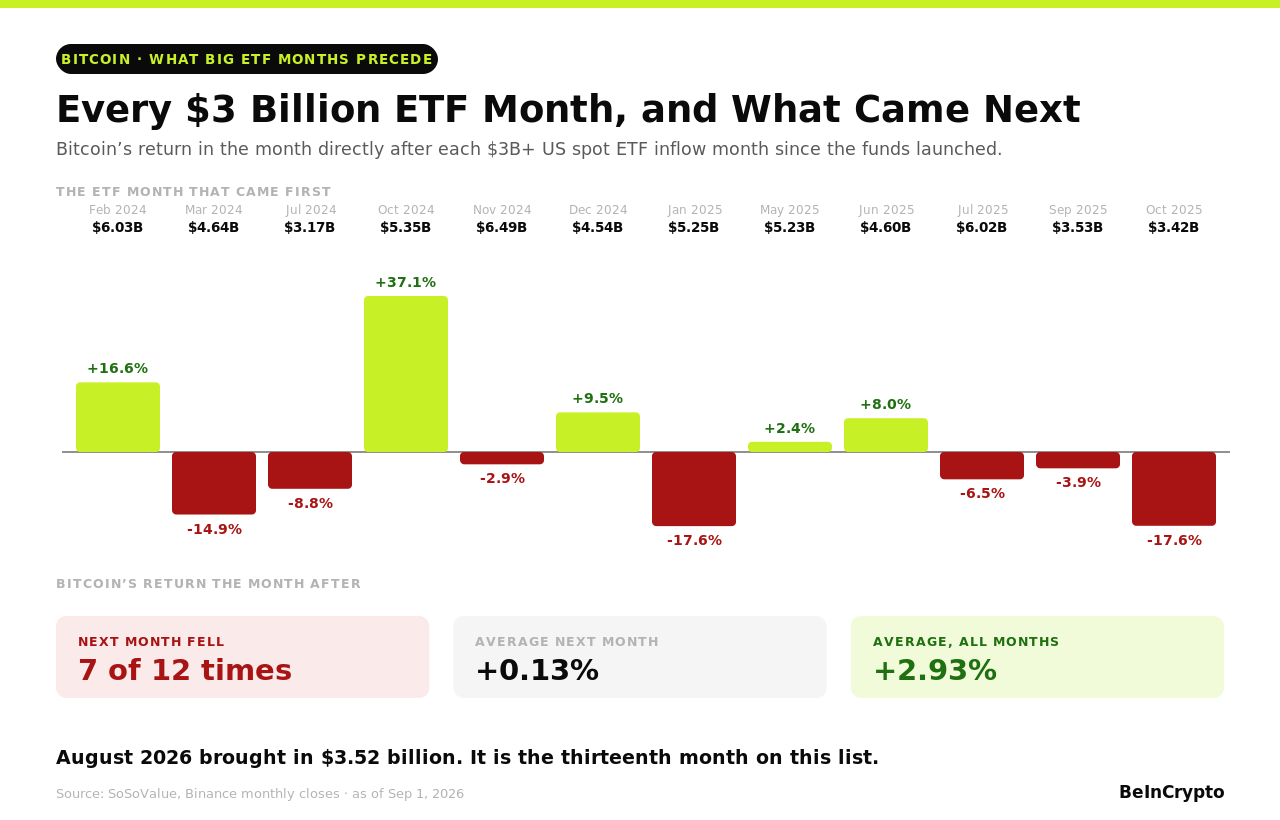
Bitcoin price rose 24.95% in August, and still trades 9.62% below where it started the year. The month was bought almost entirely by funds.
Everyone else was selling into it.
Why Did the Price Rise 25% in August?
US spot Bitcoin ETFs took in $3.52 billion during August, per SoSoValue data. Only five of 21 sessions saw money leave.
Want more token insights like this? Sign up for Editor Harsh Notariya’s Daily Crypto Newsletter here.
That single month outweighs everything before it. Across January to July, the same funds lost a net $5.30 billion. August did not just beat the year, it reversed it.

The problem is what months like this have preceded.
Will the Price Crash in September 2026?
Twelve months since these funds launched have drawn $3 billion or more. Bitcoin fell in the month straight after seven of them. The average return in those following months is 0.13%, against 2.93% for an average month.
Seasonality points the same way. Bitcoin has closed August green only two times since 2020 (before this year), and on both the occasions, September fell 7.30% and 7.96%.

One thing argues back. The last three Septembers all finished higher, so September’s reputation as Bitcoin’s worst month is out of date.
Who Was Selling While BTC Surged?
Hodler Net Position Change, which measures whether long-term holders are adding coins or releasing them, stayed negative for the whole rally. It turned red on August 2 and stayed there for four weeks.

Then it flipped. August 31 printed the first green bar since July, at 2,044 BTC.
Large wallets did the same thing and have not reversed it. Addresses holding more than BTC fell from 1,963 on July 31 to 1,908, a loss of 55 wallets during a 25% rally.

So the rally was funds buying what holders and whales were handing over. That matters, because it means the selling side was working through supply rather than reacting to bad news.
Are Big Traders Still Betting Big?
Their futures book says yes. Bitcoin’s positioning divergence score sits at 21.2, with top traders holding 111 points more long exposure than the average account.

The reading is specific to Bitcoin. XRP scores 2.7, meaning no meaningful gap between top-traders and everyone else.

That confidence is also the risk. Binance alone carries $3.00 billion in long liquidation leverage below the price against $1.80 billion in short leverage above it.

Therefore, a small BTC price drop could hurt the price prediction more going into September, as it might trigger a long flush.
Bitcoin Price Prediction: The Levels That Decide September
Bitcoin trades near $79,108. Everything rests on $77,057, the floor this range has held since the breakout, because losing it removes support all the way to $62,207.

Upside needs proof. A daily close above $82,656 opens $91,719, and only a move through that level would argue the bull phase is back, with $100,782 beyond it. Volume has to come with it, and buying volume only began recovering between August 29 and 31.
Analyst’s View: The pattern says funds buy late, and August’s money arrived after a 25% move in a year Bitcoin is still down. Against that, holders stopped selling on the final day of the month and the largest traders are positioned long. Which side wins in this Bitcoin price prediction war will be decided by the tussle between the historical bearishness and the current bullishness.
The post Bitcoin Price Prediction for September 2026: What Follows a $3.5 Billion ETF Month? appeared first on BeInCrypto.
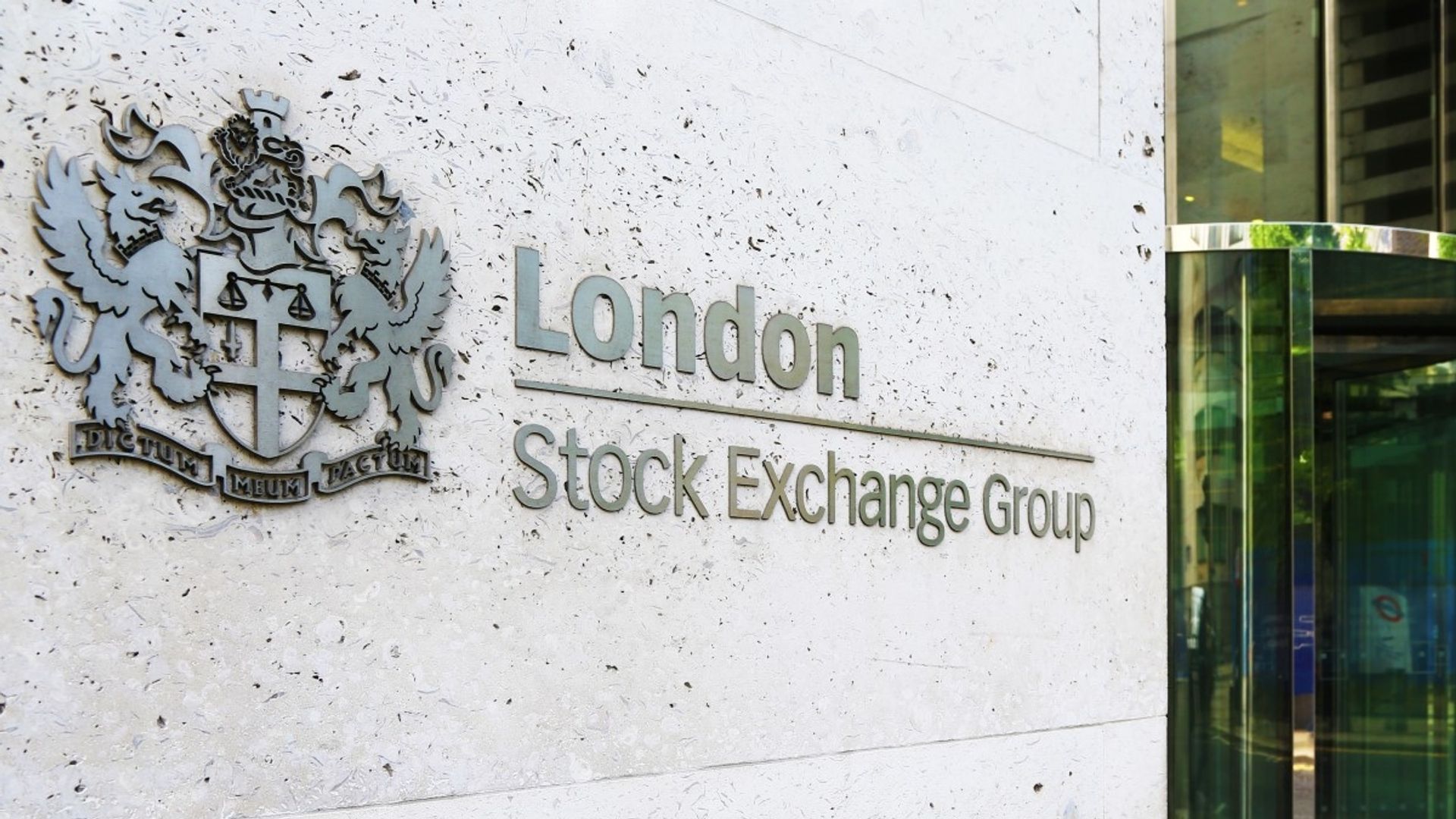
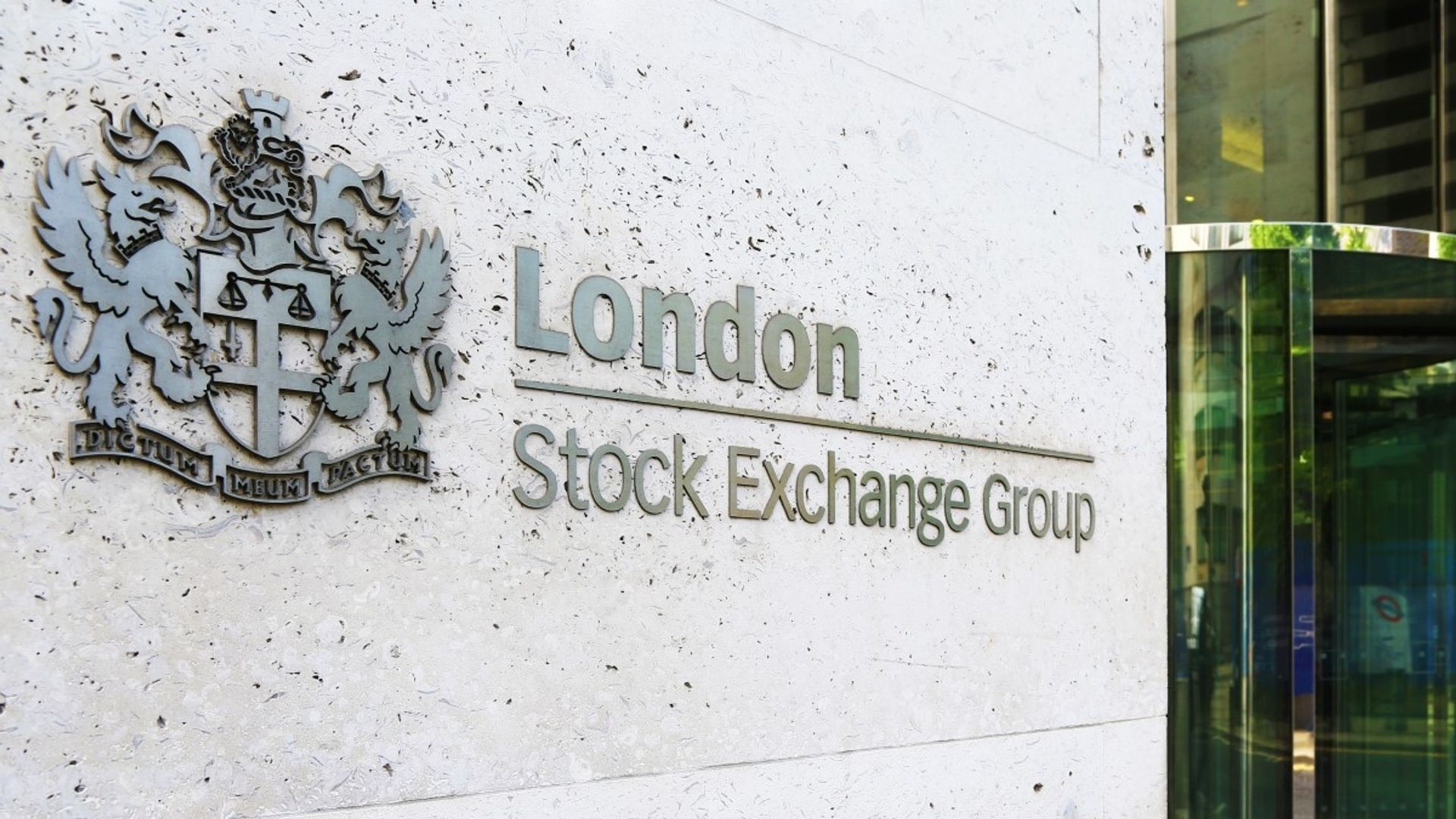
The LSE is working with Kraken owner Payward, the developer of the xStocks tokenized equities framework, to bring top U.K.-listed stocks onchain.
Crypto World
Frogbet Launches Crypto Casino With 70 In- House Original Games, Instant Withdrawals and a $10,000 Weekly Race

[PRESS RELEASE – Garabito, Costa Rica, September 1st, 2026]
Frogbet, a new cryptocurrency casino and sportsbook, has officially launched at frogbet.com, debuting a catalog of 70 original games developed entirely in-house alongside more than 7,000 titles from providers including Pragmatic Play, Hacksaw Gaming and BGaming.
Every Frogbet original is provably fair, allowing players to cryptographically verify the outcome of any bet at any time. The proprietary catalog spans in-house slots, eight blackjack variants, poker, and a full range of instant games including Mines, Dice, Plinko, Crash, Limbo and Keno — none of which areavailable on any other platform. According to the team, Frogbet’s proprietary slots are the first original games in the industry to ship with built-in bonus buys, letting players purchase direct entry into feature rounds.
The originals suite is built around a high-volume betting engine. Players can place up to 100,000 instant bets in a single click, with all rounds settled immediately, and a built-in strategy builder lets players define their own rules and automate their play hands-free.
“Original games are usually a side menu at crypto casinos — at Frogbet they are the product. We built all 70 games ourselves, made every one of them verifiable, and then built the tools serious players actually want: bonus buys on originals, six-figure batch betting, and a strategy builder. And when you win, the money is in your wallet in seconds, not days, ” said a Frogbet spokesperson.
Withdrawals are processed instantly, 24 hours a day, with payouts typically reaching players’ wallets within seconds of the request. The platform is fully crypto-native, supporting deposits and withdrawals in more than 50 cryptocurrencies including BTC, ETH, USDT and SOL, and pairs the casino with a complete sportsbook offering live in-play betting.
New players receive a 150% deposit match plus 100 free spins on their first deposit. Ongoing promotions at launch include a $10,000 Weekly Race, a $500 Daily Raffle and a Weekly Jackpot Lottery. Frogbet’s six-tier VIP program runs from Bronze to Elite with weekly cashback of up to 25%, and rakeback that accrues on every bet and can be claimed every 15 minutes.
Through the platform’sVIP Transfer program, players who hold VIP status at another casino can wager $500, share their current level with support via live chat, and be upgraded to the matching Frogbet tier instantly.
“The crypto gambling audience has become the most sophisticated betting audience in the world. They check the seeds, they hunt bonus buys, they automate strategies. Frogbet is built for exactly that player,” the spokesperson added.
Frogbet’s originals lobby, sportsbook and full game catalog are live now at frogbet.com.
About FrogbetZ
Frogbet is a crypto-native online casino and sportsbook offering 70 provably fair original games built in-house, more than 7,000 titles from leading providers, a full sports betting product, and instant cryptocurrency withdrawals, 24/7. Frogbet is intended for players aged 18 and over. Players are encouraged to gamble responsibly. Learn more at frogbet.com, or follow Frogbet on X at x.com/frogbetcom and on Telegram at t.me/frogbetcom.
The post Frogbet Launches Crypto Casino With 70 In- House Original Games, Instant Withdrawals and a $10,000 Weekly Race appeared first on CryptoPotato.

Can an iPhone comparison substitute for a business model? Coinbase CEO Brian Armstrong has argued that tokenized assets could reshape finance much as the iPhone enabled a new generation of technology companies. The comparison presents a platform thesis: blockchain-based assets could support businesses that are not yet apparent.
Armstrong made the case earlier in the week on X, comparing blockchain tokenization with the iPhone’s role in enabling companies such as Uber, TikTok, and Coinbase. He said tokenized assets could have a similar effect on financial markets and identified global access, better utility, and around-the-clock trading as immediate benefits.
Discover: The Best Token Presales
Why Tokenized Finance Is Part of the Growth Conversation
Tokenized assets are digital tokens created on a blockchain that represent ownership or rights to real-world physical or financial assets. Armstrong’s argument is that moving these assets onto blockchains could create a foundation for new finance companies, rather than simply reproducing existing markets in a different format.
— Coin Bureau (@coinbureau) August 25, 2026
 Japan officially moves to put its $8 TRILLION government bond market on blockchain.
The Financial Services Agency, Ministry of Finance, Bank of Japan, and the country's three megabanks are building a system for INSTANT 24/7 settlement of stocks and government bonds, per… pic.twitter.com/r3xZnqP4LR
Japan’s financial regulators and major financial institutions planned to study blockchain infrastructure for real-time settlement of stocks and bonds, with a strategy targeted by early 2027 and possible operations in the early 2030s. The proposal could tokenize bank deposits held at the Bank of Japan into digital currency for institutional blockchain settlement.
The Japanese effort is a multi-year regulatory and infrastructure process, not evidence of an imminent replacement for existing markets. Still, it shows that institutions and regulators are examining whether blockchain systems can support settlement for conventional financial assets.
Visit Coinbase Now For Stocks and Crypto Trading
Coinbase Strategy
Coinbase has been expanding beyond crypto into stocks, prediction markets, and other products as part of a broader effort to offer customers access to more than one type of tradable asset. That strategy is intended to diversify the company’s revenue streams and broaden its customer base, although its success remains uncertain.
For now, Coinbase’s stock offering is conventional rather than tokenized. The company has relied on Apex Fintech Solutions for backend operations, and the offering was initially available to a small group of users, with plans to expand it to all customers.
Armstrong has said Coinbase sees a longer-term role in connecting traditional finance and crypto, including helping tokenized equities gain traction. He has also said the more compelling form of tokenization would be an asset represented one-to-one on a blockchain, with the associated rights of that asset.

Discover: The Best Crypto to Diversify Your Portfolio
The Case Against Calling It a Growth Engine
The central limitation of the current thesis is straightforward: Armstrong’s public comments outline a direction for tokenized finance, but they do not provide Coinbase-specific measures of product adoption, transaction volume, or revenue from tokenized assets.
There is also a difference between a belief that assets will increasingly move onto blockchains and proof that a particular company will lead that transition.
Coinbase’s expansion into conventional stock trading may create a broader customer offering, but it does not establish demand for tokenized equities or show how quickly the necessary regulatory and market infrastructure will develop.

Regulatory timing remains especially important. Congress has been debating the Clarity Act, legislation aimed at creating a framework for integrating crypto into the broader financial system, but that process has faced disagreements involving the crypto industry and banking sector.
Armstrong has said that newer companies may be the first to issue stock natively on a blockchain, while predicting a broader transition over time. Those are expectations rather than completed market developments.
Trade Crypto on Bybit and Get a Chance to Win Our $1,000 USDT Airdrop
The post Coinbase Tokenization Bet Remains a Platform Hypothesis appeared first on Cryptonews.

Bitcoin’s August rally is facing a tougher test as fresh ETF demand meets growing expectations for tighter U.S. monetary policy. The cryptocurrency is holding above $77,100, but its next move may hinge on whether fresh liquidity can offset rising rate risks, according to Bitfinex Alpha.
This tension was evident in Bitcoin’s recent price action. Bitcoin closed above $80,000 on August 27 for the first time since May, ending at $80,256 after briefly reaching $81,500. It later fell to $76,857 after Federal Reserve Chair Kevin Warsh’s Jackson Hole remarks pushed markets to reassess the outlook for U.S. rates.
Bitcoin Holds Up Despite Rate Fears
The pullback came as markets raised the implied probability of a September rate increase from the mid-30% range to about 60%. Warsh also stressed the Federal Reserve’s 2% inflation target and suggested that monetary policy may not yet be restrictive enough.
Despite the shift in rate expectations, Bitcoin showed some resilience. It closed Friday only about 3% lower and remained above previous range highs through the weekend. Bitfinex identified $77,100 as an important volume-node support level after it helped define the cryptocurrency’s August breakout.
Continued ETF demand may have helped support that resilience. U.S. spot Bitcoin ETFs recorded $924.5 million in net inflows last week despite $202 million leaving the products on Friday. The funds had attracted $3.04 billion during the previous nine sessions, showing continued demand despite shifting expectations around U.S. monetary policy.
Beyond ETFs, stablecoin liquidity also remains relevant to the broader crypto market because it can provide capital for digital assets. However, the Bitfinex report points more directly to ETF demand as a key driver of Bitcoin’s current liquidity conditions.
Market Positioning Remains Stable
Bitcoin’s derivatives market has remained relatively controlled during the rally, according to the report. Perpetual futures open interest reached $55.6 billion, about 20% above the start of August, while funding rates and futures basis remained contained.
Meanwhile, on-chain data points to a shift in Bitcoin ownership. Wallets holding 1,000 to 10,000 BTC have reduced their balances by about 50,500 BTC since late June, while exchange and ETF custodial wallets have added roughly 59,100 BTC.
The post Bitcoin’s Rally Faces Fresh Test as Rate Fears Grow: Bitfinex appeared first on CryptoPotato.
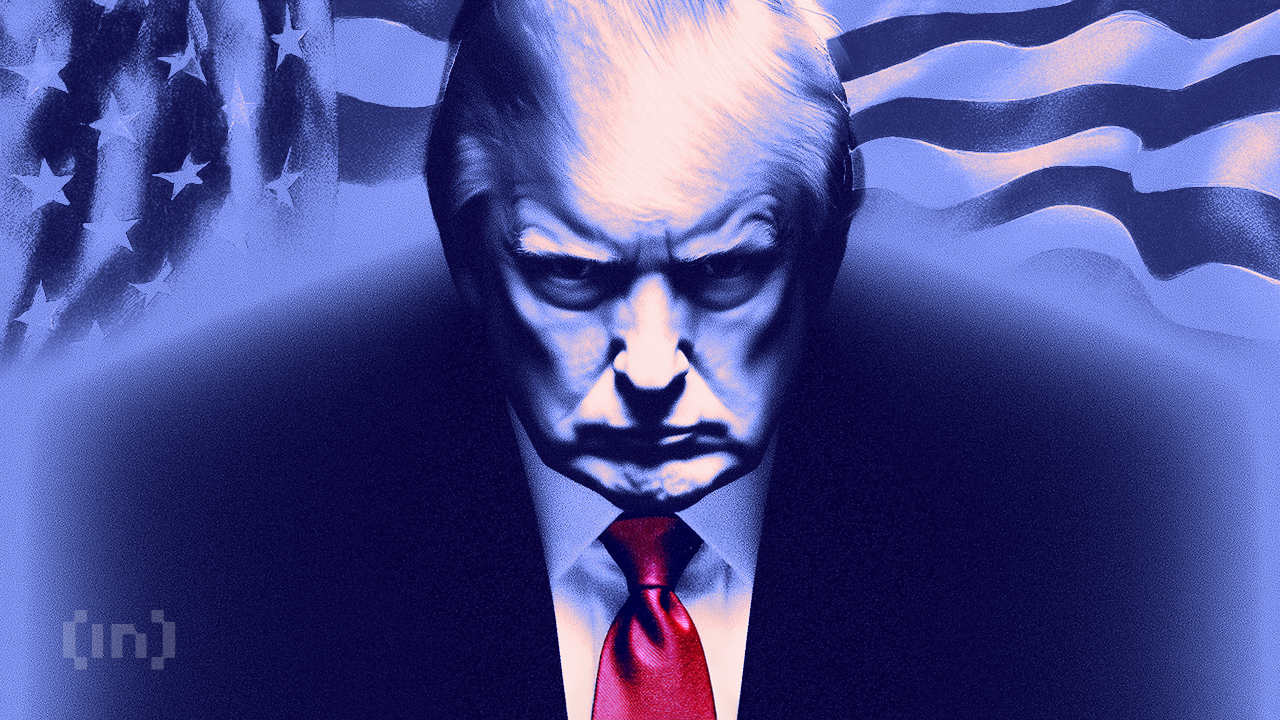

President Donald Trump told American communities to stop fighting data center projects. Writing on Truth Social on Monday, he warned that towns that reject them will end up backwards and poor.
Republicans now face rising voter anger over data center construction before November’s midterm elections.
Trump Calls Data Centers a Golden Goose
Trump framed the buildout as a national economic prize. Towns accepting the facilities gain jobs and lower taxes, he argued. Rival locations are waiting to absorb rejected projects.
Follow us on X to get the latest news as it happens
Meanwhile, artificial intelligence (AI) projects now face opposition in both Republican-run and Democratic-run areas. Residents cite higher electricity bills, water use, and strain on local grids.
Officials have answered with permit pauses and outright bans. Pennsylvania Governor Josh Shapiro tightened the review rules for large projects.
Texas Governor Greg Abbott paused new grid connections pending an audit. New York imposed a statewide hyperscale data freeze in July.
A Heatmap Pro review found that more than 500 counties and municipalities were restricting or blocking new facilities by late July. Trump framed that resistance as a gift to Beijing.
“The good news is that there are plenty of other places that want them. If we kill the Golden Goose, you will only have yourselves to blame. China could not be happier with this anti-Data Center movement. Actually, they can’t believe it is happening!” he said.
Sanders Rejects Trump’s Framing as GOP Nerves Grow
Sen. Bernie Sanders responded on X. The Vermont independent said opponents are defending their communities, not choosing poverty.
“No, Mr. President, the 75% of Americans who oppose data centers in their communities do not want to be ‘backwards and poor.’ They want a decent future for themselves, their kids and their communities… They have every right to be concerned,” he said.
The president’s own party has grown nervous. A private memo from the National Republican Senatorial Committee, obtained by Axios, warned that the campaign against data centers would spread far beyond Ohio unless voter perceptions changed quickly.
Sen. Jon Husted faces Democrat Sherrod Brown there. Brown has made opposition to data centers a central campaign theme.
“If he loses and data centers get the blame, politicians across the country will take notice — and they will not go near the next one…This has become a sleeper issue for the entire election cycle,” the memo reads.
Whether Trump’s jobs-and-taxes pitch lands will show if the White House can slow a movement that has already crossed party lines.
Subscribe to our YouTube channel to watch leaders and journalists provide expert insights
The post Trump Warns Towns Rejecting Data Centers Will End Up “Backwards and Poor” appeared first on BeInCrypto.
Crypto World
How Americans use FT Mining cloud mining to earn passive income in Bitcoin, Ethereum, and Dogecoin daily


As the regulatory framework for the U.S. cryptocurrency market gradually matures, an increasing number of investors are seeking compliant and efficient ways to acquire digital assets.
Thanks to its innovative business model and rigorous security standards, the FT mining cloud mining platform is emerging as the preferred choice for U.S. investors looking to obtain Bitcoin (BTC), Ethereum (ETH), and Dogecoin (DOGE) on a stable, daily basis.
New opportunities for compliant cloud mining in the U.S.
Assurance of compliant operations:
FT mining holds a license from the UK Financial Conduct Authority (FCA) and complies with financial service regulations across multiple U.S. states. The platform ensures the security of user funds through third-party custodial services and adheres to tax reporting requirements, providing a fully compliant mining environment for U.S. investors.
Enhanced security:
The platform utilizes top-tier security technologies from McAfee® and Cloudflare® to ensure your digital assets remain protected, wherever you are.
24/7 reliability:
With 100% uptime and round-the-clock technical support, the mobile app ensures uninterrupted mining.
Instant rewards:
New users receive an immediate $15 sign-up bonus and a $0.75 daily login bonus upon registration.
Diverse contract options:
Users can choose from a variety of mining plans—ranging from low-cost daily contracts to long-term investments—to suit different budgets and goals.
How to start your free mining journey with FT Mining
Step 1: Choose FT mining as your service provider:
FT mining offers a simple and transparent mining process. The platform provides daily returns on mining contracts and flexible payment options, making it accessible to everyone.
Step 2: Register an account:
Visit the official FT mining website at https://ftmining.com
Enter your email address to create an account, log in, and access your dashboard to start mining immediately.
Step 3: Purchase a mining contract:
FT mining offers a variety of contract options to suit different budgets and goals. Users can choose from the following:
Starter Contract: $100 — 2-day term — Total profit approx. $108
Stable Contract: $800 — 5-day term — Total profit approx. $852.80
Professional Contract: $5,000 — 20-day term — Total profit approx. $6,520
Premium Contract: $25,000 — 28-day term — Total profit approx. $38,300
Visit the official website for more contract details.
Once an order is completed, earnings are automatically credited to your account within 24 hours. Once your account balance reaches $100, you can withdraw funds to your personal wallet or reinvest them to generate further returns.
Success stories from U.S. investors
Michael, a tech professional from California, shares:
“I allocated a portion of my funds to FT mining’s multi-currency mining packages, and now I earn BTC, ETH, and DOGE consistently every day. This diversified approach allows me to maintain steady returns even in a volatile market.”
Sarah, a retired fund manager from New York, states:
“As a traditional finance professional, I place great importance on platform compliance and transparency. CryptoEasily provides daily earnings reports, and checking my returns every morning has become a habit. It is far easier than any side hustle I’ve done in the past.”
About FT mining
FT mining is a UK-licensed cloud cryptocurrency mining platform. Established in 2021 and headquartered in London, the company is dedicated to providing efficient and affordable cryptocurrency mining solutions by leveraging advanced hardware, intelligent algorithms, and cloud infrastructure. With over 10 million users across more than 180 countries and regions, FT mining delivers convenient and scalable cryptocurrency mining services to a global audience.
Visit the official FT mining website or download the official app today to experience free cloud mining services and start earning steady daily passive income with ease.
Official Website: https://ftmining.com
App Download: https://ftmining.com/xml/index.html#/app
Customer Service Email: [email protected]
Disclosure: This content is provided by a third party. Neither crypto.news nor the author of this article endorses any product mentioned on this page. Users should conduct their own research before taking any action related to the company.

The Microduck robot is set to come with a range of pre-installed actions, according to its developers HuggingFace and Pollen Robotics.
Pollen Robotics
BEIJING — A popular new programmable personal robot from a French-American company is powered by a chip from Shanghai-listed Rockchip which in turn uses British company ARM’s tech, reflecting how intertwined global tech supply chains remain.
The colorful “Microduck” robot from Hugging Face’s French subsidiary Pollen Robotics has sold more than 10,000 units since its launch on Thursday — earning over $4 million based on the $399 unit price. That’s quickly delayed delivery times for new orders past the initial promise of Christmas 2026.
The duck-shaped robots contain their own set of sensors, motors and on-device computing power from Rockchip’s RK3566. The chip incorporates technology licensed from British semiconductor company ARM, according to Rockchip.
The Chinese company is a “key vendor” for AI that operates on devices, rather than in the cloud, said Lian Jye Su, chief analyst at Omdia. He noted the company’s chips are commonly used for machine vision involving object detection and image recognition.
“While it has massive footprint, the company chips are not designed for complex edge AI devices as they lack the compute resources,” Su said. Such computing capabilities can allow smartphones, robots and other electronic devices to run generative AI tools securely without sharing data on the internet.
Rockchip last month reported a 40% year-on-year increase in operating revenue in the first half of the year to 2.88 billion yuan ($428 million), while net profit excluding one-time items surged by more than 60%.
The 1.76 pound (800g) Microduck is both an interactive consumer toy and a development platform. Using open-source software, it can supposedly learn from virtual simulations and goal-driven directions.
The product is the second robot from France-based startup Pollen Robotics, which was acquired by Hugging Face last year. The first robot by Hugging Face and Pollen Robotics, launched last spring, sold more than 10,000 units, Pollen Robotics said.
Just before Microduck’s release, The Information reported that Nvidia had agreed to buy Hugging Face for $12.9 billion. Neither company responded to a request for comment.
Hugging Face co-founder Thomas Wolf said in a social media post Monday that people were starting to monitor the Microduck supply chain, as the company sees a strong rush for orders.
Other companies are rolling out similar personal robots at premium-end consumer prices.
Startup Zeroth this summer launched a child-sized humanoid robot for 8,888 yuan that claims to offer similar virtual simulation learning capabilities. It lists 247 pre-orders on JD.com in China. The company plans to reveal its open source robotics system on Wednesday.
Meanwhile a Wall-E-type cameraman robot from Mondo Robotics has raised more than 80 times its initial goal of $50,000 on Kickstarter ahead of the Sept. 6 deadline. Early bird prices for the device, which resembles a GoPro on wheels, start at $549, with shipping scheduled to begin in October.
—CNBC’s April Roach and Kai Nicol-Schwarz contributed to this report.


Ripple unlocked 1 billion XRP on Sept. 1 through three transactions involving 500 million, 400 million and 100 million tokens.
Summary
- Ripple released one billion XRP through three escrow transactions on September 1, blockchain data showed.
- The releases comprised 500 million, 400 million, and 100 million XRP from Ripple-controlled escrow accounts.
- Approximately 31.28 billion XRP remained locked afterward, according to a tracker reading active on-ledger escrows.
- An escrow unlock makes XRP available to Ripple but does not prove any market sale.
- Ripple historically re-escrows unused tokens, but September’s returned amount was not yet independently confirmed publicly.
Blockchain monitoring account Whale Alert reported the transfers from Ripple-controlled escrow accounts.
The release formed part of Ripple’s programmed monthly XRP escrow schedule. It did not show that the company sold the tokens or transferred the entire amount to exchanges. The XRP became available to Ripple after the underlying time locks expired.
Ripple’s XRP unlock leaves 31.28B in escrow
Approximately 31.28 billion XRP remained inside active on-ledger escrow objects after the September release, according to an independent tracker that queries validated XRP Ledger data. The figure represented about 31.28% of XRP’s original 100 billion supply.
The tracker recorded approximately 32.28 billion XRP in escrow before the three September transactions. Completing escrow objects containing a combined 1 billion XRP reduced that balance to 31.28 billion.
This figure should still be attributed to the tracker rather than presented as a new company disclosure. Ripple had not published an updated official escrow balance at the time of reporting. Different data services can also show temporary discrepancies when they rely on cached figures instead of active ledger objects.
The remaining balance does not represent Ripple’s entire XRP position. Ripple also controls operational wallets containing previously released XRP. Those holdings are separate from tokens still restricted by active time-based escrow contracts.
The 1 billion XRP release was not a market sale
Ripple originally placed 55 billion XRP into escrow in December 2017. The company said the arrangement would make its supply schedule more predictable by allowing up to 1 billion XRP to become available each month.
The escrow restrictions operate through the XRP Ledger rather than through an informal company commitment. Ripple’s original explanation said ledger mechanics enforced each release date through consensus.
An EscrowFinish transaction delivers the locked XRP to its designated account once its release conditions are satisfied. It does not automatically send the tokens to an exchange, buyer or liquidity provider. The transaction therefore cannot establish how much XRP will ultimately reach the broader market.
The XRP Ledger’s technical documentation also distinguishes between creating, finishing and cancelling an escrow. A completed escrow removes the time restriction, but subsequent wallet activity determines the tokens’ eventual use.
That distinction matters because headlines describing a 1 billion XRP unlock can imply an immediate increase of the same size in tradable supply. In practice, Ripple has regularly returned unused tokens to new escrows with later release dates.
Re-escrow transactions will determine the net release
Ripple’s historical pattern has been to use part of each monthly release for operations, institutional transactions and other corporate purposes, while locking the unused portion again. The company said from the beginning that unused XRP would enter new escrows at the end of the existing release schedule.
As crypto.news previously explained in its guide to Ripple’s monthly XRP escrow process, the company has often returned between 600 million and 800 million XRP after monthly unlocks. The historical range does not confirm what Ripple will do with September’s tokens.
No independently verified re-escrow total for the September release was available when this report was prepared. New EscrowCreate transactions would provide on-chain evidence of how much XRP Ripple returned to time locks.
The net supply change can only be calculated after those transactions and any transfers from Ripple’s operational wallets are reviewed. Even XRP that remains outside escrow does not necessarily enter public trading markets immediately.
Ripple’s next scheduled XRP unlock arrives in October
The next monthly release window is scheduled for Oct. 1. Up to another 1 billion XRP could become available, although the exact structure will depend on the escrow objects reaching their programmed release dates.
Ripple cannot bring forward the release dates of XRP held in its existing time-based escrows. The ledger rejects attempts to finish an escrow before its specified date. This issue previously surfaced when an XRP ETF filing raised questions about Ripple’s escrow restrictions.
Future re-escrow transactions will also extend the schedule. When Ripple locks unused XRP again, the company generally places it behind the escrows already waiting in the release queue.
XRP traded near $1.39 around the reporting period and was higher over the preceding 24 hours. However, the scheduled unlock alone does not establish the reason for that movement. XRP prices also respond to broader crypto markets, liquidity, institutional activity and developments affecting Ripple or the XRP Ledger.
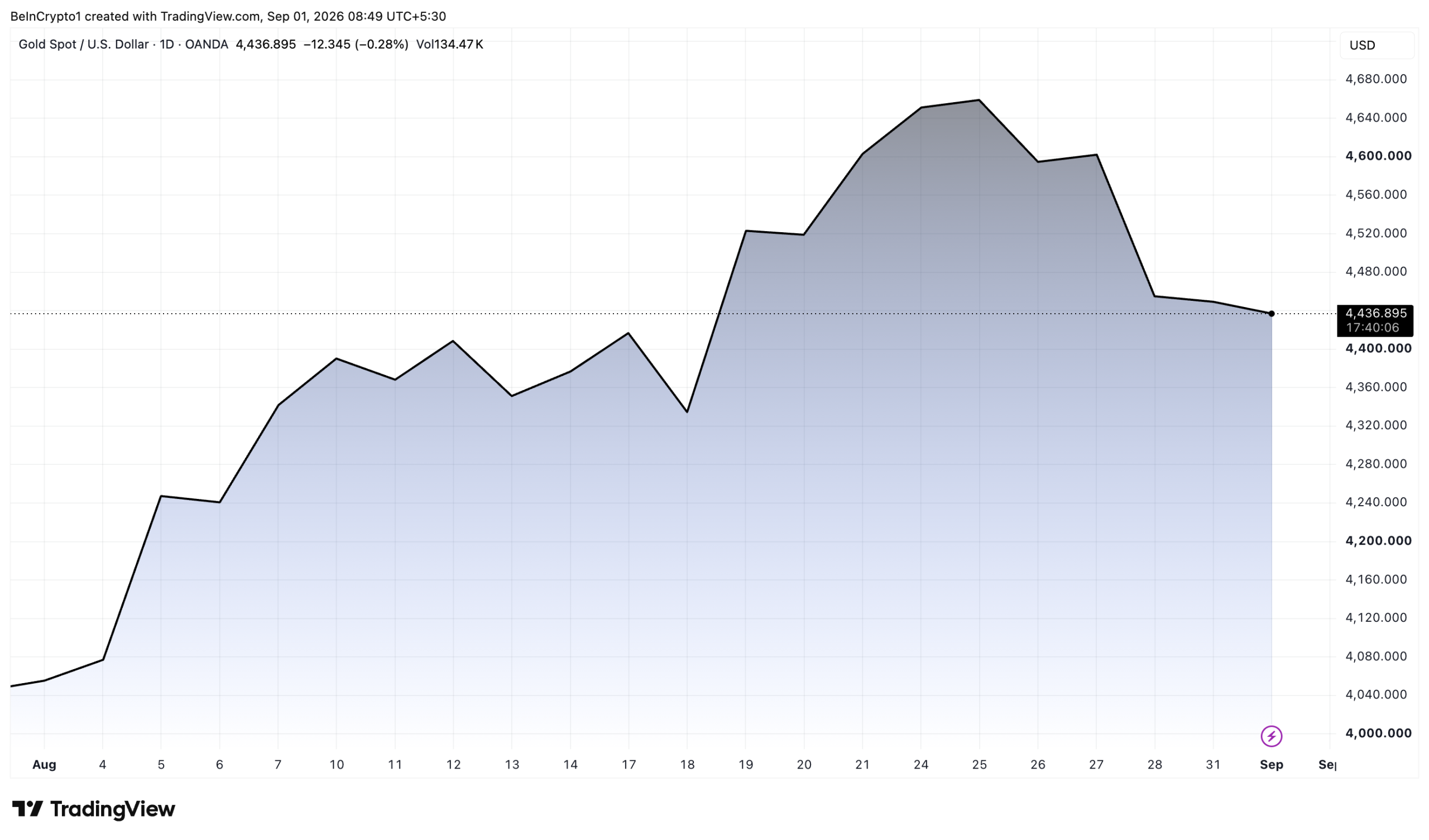
Gold has fallen 5.5% from the 4,697 three-month high it reached on August 25, trading near 4,436 at press time. Goldman Sachs still expects 4,900 by year-end.
The slide has pushed the metal under its 200-day moving average. Barchart said gold has now recorded multiple closes below the line, the first since early June.

Gold Rally Stalls at a Level Traders Watch Closely
The 200-day moving average tracks an asset’s average closing price over the previous 200 sessions. Gold now sits under that line, which stood near 4,529. The metal briefly traded below 4,400 on Monday, its weakest level since August 19.
Barchart noted that the SPDR Gold Shares fund entered a technical correction the last time gold logged multiple closes below the average. That precedent covers one prior episode, not a pattern.
Follow us on X to get the latest news as it happens
Renewed bets on a Federal Reserve rate hike have driven the latest leg down. Higher rates weigh on gold because the metal pays no yield.
Goldman Sachs and Fidelity Still Point Higher
Nonetheless, Goldman Sachs Research reaffirmed its 4,900 target for the end of 2026 in a note published August 28. From the press-time price, that implies roughly 10% upside.
The bank had cut that target by $500 in June as bets on 2026 rate cuts faded. The reduced figure still indicated gains, just smaller ones.
Senior commodities analyst Lina Thomas and Global Commodities Research co-head Daan Struyven anchored the call on official buying.
“We continue to see elevated central bank gold accumulation as a multi-year trend, as central banks diversify their reserves to hedge geopolitical and financial risks, consistent with recent survey evidence,” they wrote.
The bank expects central banks to buy an average of 50 tonnes per month in 2026, up from 17 tonnes before 2022.
Meanwhile, Fidelity’s analysis valued gold around 5,000 against the global M2 money supply, about 13% above the press-time price.
The near-term risk is one Goldman already named. It’s June note put gold at 4,400 by year-end if the Fed hikes, and the metal traded there on Monday. A sustained break would also test the debasement trade, which ties gold and Bitcoin (BTC) demand to currency erosion
Subscribe to our YouTube channel to watch leaders and journalists provide expert insights
The post Gold Drops 5.5% From 3-Month High but Goldman Sachs Still Sees 10% Upside appeared first on BeInCrypto.

Kasih Sayang yang Berubah Karena Uang

Emmerdale’s Charley Webb spends ‘romantic’ night with Sheridan Smith | Soaps

Tests of an alternative market





-

 Crypto World6 days ago
SpaceX stock could rise 75% to $240, JPMorgan says
-

 Fashion4 days ago
Weekend Open Thread: Maeve – Corporette.com
-

 Crypto World4 days ago
Bitcoin’s 22% rally now needs real demand to outlast Treasury liquidity boost
-

 Crypto World6 days ago
Warsh Jackson Hole keynote puts financial innovation first
-

 Business4 days ago
Salesforce Stock Soars 19% as Blowout Earnings and Agentforce AI Growth Silence Software Skeptics
-

 Crypto World5 days ago
Elon Musk Grok Bot Promise: We Will Make You Whole if AI Loses Your Money
-
 Crypto World6 days ago
Did Trump Just Move SpaceX Stock With One Truth Social Post?
-

 Business4 days ago
Apple Confirms September 9 Keynote and Reveals Its Full Pre-Order Schedule
-

 Business3 days ago
Onto Innovation Stock: AI’s Next Bottleneck Is Yield (NYSE:ONTO)
-
 NewsBeat6 days ago
Lindsay Clancy jury braces for closing arguments as judge tells court: ‘You’ve heard all the evidence’ – Live updates
-

 Business6 days ago
Walmart takes aim at younger shoppers with new fashion brand
-

 Crypto World3 days ago
Bitcoin price tests $82K resistance as Brandt stays long
-

 Business6 days ago
Thailand’s Eastern Economic Corridor Capital City (EECiti): Key Developments and Investment Opportunities
-

 Crypto World5 days ago
NVIDIA revenue hits $96.2B as AI demand doubles
-

 Business4 days ago
iPhone 18 Pro Pre-Orders Could Shift to Saturday as Apple Reportedly Avoids September 11 Anniversary
-

 NewsBeat6 days ago
Trump’s trade truce with China faces test with Iran effort
-
 Crypto World5 days ago
Nvidia Q2 Earnings Reveal $96.2 Billion Beat, So Why Is NVDA Falling?
-
 Tech5 days ago
Claude Cowork gets its own browser that doesn’t touch your tabs, bookmarks, or saved passwords
-
 Tech2 days ago
Hugging Face built a $4.5 billion empire on free AI models. Now Nvidia is buying it for $12.9 billion
-

 Crypto World4 days ago
Truflation calls for Fed rate cut after PCE forecast
You must be logged in to post a comment Login