When two-year-old Kole Pearson failed a series of routine newborn hearing tests, nothing could have prepared his parents for the deadly – and incurable – diagnosis their son would receive only months later.
Indeed, medics initially suspected Kole, from Ellesmere Port in Cheshire, to be autistic or have global developmental delay (GDD) after his mother, Beth Gordon, flagged his missed milestones and noted other symptoms like stimming and a floppy neck.
However, following a third failed hearing test, 33-year-old Ms Gordon recalled watching a TikTok video of a child with Sanfilippo syndrome – a rare, neurodegenerative disorder – and had a ‘motherly instinct’ her son fit the bill.
After flagging the possibility with Kole’s doctors, Ms Gordon was informed autism and Sanfilippo syndrome can present very similarly in the early phases of a child’s development – further raising her suspicions.
It was then, Ms Gordon said, she and her partner Daniel Pearson, 40, pushed for genetic testing to rule out – or confirm – their worst fears.
Following a series of tests, Kole received the life-altering – and devastating – diagnosis of Sanfilippo syndrome, also known as childhood dementia, in April of this year.
To make matters worse, doctors confirmed Kole’s variant of the condition is Type A – and there are zero treatment options available on the NHS.
Ms Gordon and Mr Pearson were simply told by medics to go home, and to ‘please love and make lots of memories’ with Kole in the limited time he has left.
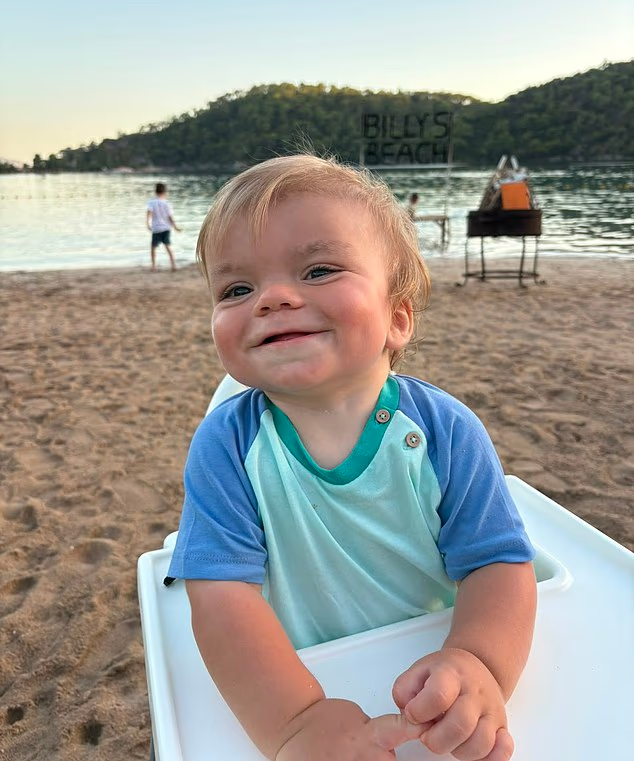
Two-year-old Kole Pearson was diagnosed with a rare and deadly variant of childhood dementia earlier this year
Kole’s mother, Beth Gordon, realised something was wrong after he failed a series of newborn hearing tests – something she had not experienced with her other children (Pictured: Kole with siblings Koby and Alya)
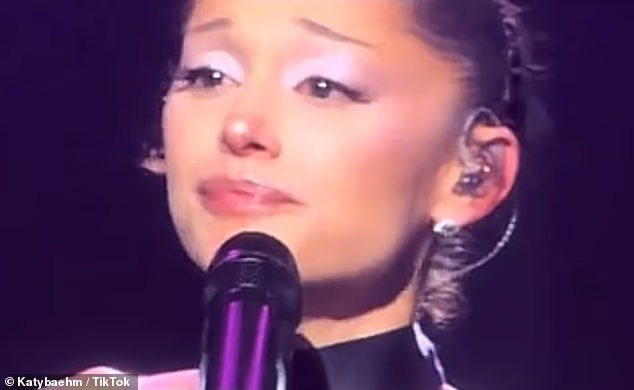
After Ms Gordon watched a TikTok video of a child with Sanfilippo syndrome, she realised Kole presented with similar symptoms
Yet despite such slim odds, Ms Gordon and Mr Pearson refused to accept it was the only option for their son – determined to enroll Kole in trial therapy only available in America hailed as ‘lifesaving’ for children with Sanfilippo syndrome.
The only catch is the steep price tag that comes with the treatment – with costs coming in at a mammoth £2million.
The family – which includes siblings Koby, 10, and Ayla, 8 – have now set up a GoFundMe campaign in hopes of raising the vital money, but have currently only raised just shy of £15,000 – a fraction of the money they so urgently need.
Ms Gordon spoke to the Daily Mail about how standard hearing tests turned into a nightmare for her young family – but how she will stop at no end to be successful in fundraising for Kole’s future.
She said: ‘Kole is the happiest little boy ever. People constantly comment on how happy and loveable he is. But I always had a motherly instinct something was not right with his health.
‘One of the first red flags was he did not react properly during reflex exam at six weeks old. He also failed a newborn hearing test.
‘He then failed two more hearing tests – we later learnt he has severe hearing loss in his left ear and mild to moderate hearing loss in his right.
‘It was always suspected he had global developmental delay, as a result. Then autism was put on the table.
Kole’s family are attempting to fundraise £2million for treatment that could become available in America – and save his life
Ms Gordon describes Kole as ‘the happiest little boy ever’ (Pictured here with siblings Koby and Ayla)
‘I did believe Kole could potentially be autistic – he was a flappy baby, very stimmy and very sensory seeking.
‘I now know autism and Sanfilippo present very similarly in young children – which is often why Sanfilippo can be misdiagnosed or not picked up on until the child is five or six years old.’
Ms Gordon, who is now a full-time carer for her son, described the penny finally dropping on what was wrong with Kole one night when scrolling on social media – following yet another failed hearing test.
She said: ‘After the hearing test, coincidentally I was scrolling on TikTok and came across a little girl in America that was identical to Kole – she had Sanfilippo syndrome.
‘I then googled the disorder and started crying – instinctively I knew Kole matched. I then rang my mum to tell her that I knew this condition is what Kole has.’
It was then Ms Gordon and Mr Pearson, a self-employed scaffolder, went to Kole’s paediatrician at the Countess of Chester Hospital in Cheshire, where Ms Gordon recalled asking for urgent genetic testing to confirm the potential diagnosis.
She said: ‘Kole’s doctors said Sanfilippo is so rare that it probably is not that – I was brushed off constantly, but I just had a gut feeling.
‘So, in April of this year, I went back to a different paediatrician at the hospital. I said, “Again, I think he has Sanfilippo syndrome,” and he was the first person that said, “I see it – but we are still waiting for the test results, which could take anything between six to 18 months to come back.”
Kole was initially believed to be autistic – with symptoms of the condition very similar to that of Sanfilippo syndrome in young children
‘Luckily, the results of Kole’s genetic testing were really quick.’
In April 2026, Kole’s family officially received the heartbreaking diagnosis he has Sanfilippo syndrome Type A – the more severe variant of the condition with a rapid decline rate.
The moment Kole was diagnosed – and the words spoken to her by attending medics – still haunt Ms Gordon to this day.
She said: ‘The night before we got the results, I just knew – you’ve got this awful feeling.
‘We went to the hospital the following morning, and the doctor said: “You are right, he has got Sanfilippo syndrome – Type A. It’s the most severe and the quickest progressing.”
‘We were told Kole’s condition was terminal, to please love him and make lots of memories. The NHS are very textbook – when they say it is terminal, it is terminal.
‘It was a mixed bag of emotions. I was devastated – but I want to fight on so no parent has to feel like I do, so no parent has to go into a hospital room and be told, “There is no cure, go home and love them.”
‘No family deserves that.’
The average life expectancy for affected children is usually mid-to-late teens. For those with Type A, such as Kole, life expectancy ranges from 11 years old to 19 years old on average
Following Kole’s diagnosis, Ms Gordon recalls being told by medics ‘there is no cure, go home and love him’
Sanfilippo syndrome, also known as Mucopolysaccharidosis type III, is a rare and terminal neurodegenerative disease, presenting in variants A, B, C and D.
Typically, affected children will develop to a certain point before regressing – causing them to lose all skills they have gained, begin experiencing movement disorders and having seizures.
Currently, there are no effective treatments for Sanfilippo syndrome available in Britain; however, clinical trials are available in the United States.
The average life expectancy for affected children is usually mid-to-late teens. For those with Type A, such as Kole, life expectancy ranges from 11 years old to 19 years old on average.
Ms Gordon, however, is determined this will not be the case for her son.
Alongside medics at the Royal Manchester Children’s Hospital – where Kole is now being monitored – they have discovered a revolutionary treatment for children afflicted with Sanfilippo, a gene therapy known as UX111.
UX111, developed in the United States, is an experimental therapy designed to work by fixing the root genetic cause of the condition, delivering healthy genes to the affected cells.
It is currently still awaiting food and drug administration (FDA) approval; however, a decision is expected within the next month.
Kole’s family have set up a fundraising campaign to raise the £2million needed to send the toddler to America to receive UX111 – a revolutionary treatment for sufferers of Sanfilippo syndrome
UX111 treatment could allow Kole to lead a normal life – with recipients of the treatment now reportedly playing football, reading and even running
If approved, the treatment would give Kole the best chance of leading a normal childhood – and potentially full adult life.
Ms Gordon said: ‘I can’t imagine my life without him – that is why I am so frantically and urgently fundraising for the potential treatment.
‘Children with Sanfilippo who have had the same therapy are now running, reading and playing football – it would completely change Kole’s whole prognosis.’
Kole’s family have since set up a GoFundMe campaign to raise the whopping £2million needed to send the toddler to America to receive UX111.
Ms Gordon said: ‘Two million pounds is such a massive amount of money, but if two million people all donated £1, that mountain my family have to climb wouldn’t feel so huge.
‘SFS doesn’t wait for anybody. We don’t have time to sit and wait and see what our government says and decides. It could take years and years for treatment approvals on the NHS, and by then it’s too late and Kole is regressing.
‘Our one goal is to get Kole over to America. He will have his treatment, and do you know what? He’ll live such a healthier, happier, longer life.’
A spokesperson for the Countess of Chester Hospital NHS Foundation Trust said: ‘We recognise how distressing it is for any family to receive a diagnosis of a serious condition, especially when it is life-limiting.
‘Our staff are focused on communicating difficult information with compassion, sensitivity and clarity, and they support patients and their families throughout diagnosis, care planning and ongoing care.
‘Patient confidentiality is paramount and so we will not comment on the care of an individual patient.’





















































You must be logged in to post a comment Login