

Connect with us

NewsBeat

Echo Comment on Andy Burnham’s first speech as PM in the Commons

Published

on

Echo Comment on Andy Burnham's first speech as PM in the Commons

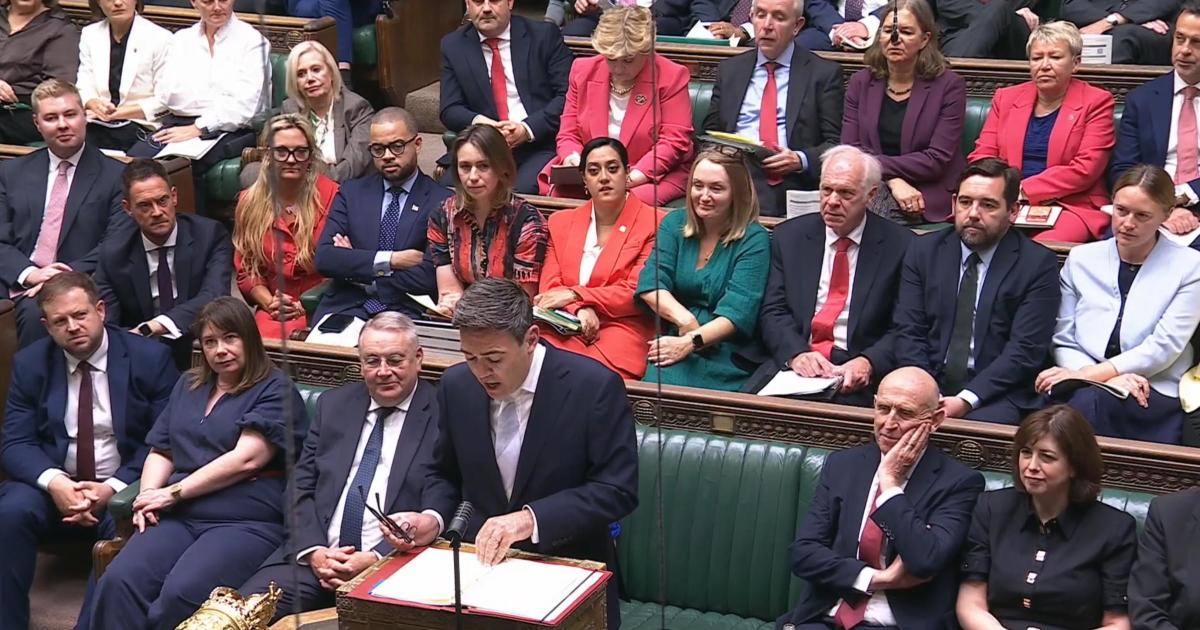
This afternoon, Andy Burnham made his first appearance in the House of Commons and immediately the difference to his predecessor was obvious: he was easily humoured and fluently human compared to the laboured lines and wooden legalese of his predecessor, Keir Starmer.

Mr Burnham put all of the catchphrases he has been honing over the summer into one attractive speech.

He talked of “problem solving over point scoring” and of how devolution would bring power back to local communities which over recent decades have become overlooked and powerless.

Advertisement

He promised high street revival and that there would be “positivity and possibility in every postcode in Britain”.

Much of it showed he is in touch with the British people and that he is desperate to sort out intractable problems like welfare spending and especially social care.

And the water industry – “a leaking monument” to private not public interest, he said – should prepare itself for a shower of change, as so many British people want.

But identifying the issues is only a small part of the battle.

Advertisement

As Kemi Badenoch said, he will be judged on his delivery.

And delivery will be difficult.

We’re high taxed and borrowing heavily, yet defence spending has to rise massively if we are, as he promised, to meet our international obligations.

This, and all the problems that weighed so heavily on Mr Starmer, are still there.

Advertisement

The vibes may be bouncing and the smile may be back on the government’s face, but that is only the start of the journey.

Source link

Advertisement
Continue Reading
Click to comment

You must be logged in to post a comment Login

Leave a Reply

NewsBeat

Swansea City to seal Monga move as Matos makes big Vipotnik transfer admission

Published

on

Wales Online

Two deals appear to have collapsed on deadline day – but a move for Monga is still on

Swansea City’s deadline day has taken a dramatic late twist, with two deals collapsing at the eleventh hour.

However, a move for Manchester City youngster Jeremy Monga is still expected to happen, and could be confirmed later tonight.

Ronald and Zeidane Inoussa had both looked set to leave the club today, but both moves have broken down.

Advertisement

The Swans had agreed a fee with Millwall believed to be in the region of £2m for Ronald, with Vitor Matos suggesting the move had fallen through due to a failure to agree personal terms.

JOIN US ON FACEBOOK! Follow Wales Online’s Swansea City FB page for more news and analysis

“Ronald, as far as I know, didn’t reach an agreement, so he’s part of the team,” he said.

Inoussa, meanwhile, had looked set to join Portsmouth on a season-long loan, but that move has also fallen by the wayside.

Advertisement

“I’m not really clear about what the situation was,” Matos added. “But yeah, staying as well. Happy to have him. He’s a wonderful kid.

“I don’t think he goes to Portsmouth, but I think he will stay.”

Meanwhile, it’s understood Swansea’s move for Monga is still set to go through.

Star striker Zan Vipotnik is still in the building, although Matos has suggested there is still a possibility he could go, with the window still open in Portugal, Saudi Arabia and Turkey among others.

Advertisement

Vipotnik was the subject of initial enquiries from Portuguese giants Benfica earlier in the summer, while rivals Sporting have also been touted as possible admirers.

“There are still some markets that are open,” Matos admitted. “So you never know what happens. But at the moment, like I said, he’s here and I’m really happy if he stays.

“We all love him. It’s not easy in terms of dealing with all the noise. Of course, but we are here to take care of him.”

Pressed on whether there might be a possibility he could still go, he added: “We hope he is here, but that is the hard part of the transfer window is that some markets are still open that are massive opportunities for players.”

Advertisement

*Follow all of our social channels to ensure you stay up to date with the latest Swans news. Sign up to our daily newsletter here and our WhatsApp channel here. Our Swansea City correspondent Tom Coleman is also on social media. He can be found on his X account here, on Instagram, on TikTok and on Facebook.

Source link

Advertisement
Continue Reading

NewsBeat

War has shifted how power works in Iran

Published

on

War has shifted how power works in Iran

When Washington unveiled its economic “D-Day” on August 19, the latest tightening of the financial siege and the blockade around Iran’s ports, it believed it was applying decisive leverage. But in Tehran the move was read as something else entirely – as confirmation that the US still prefers pressure to any settlement it might one day have to honour.

Across a political system that agrees on almost nothing, the interpretation was remarkably uniform. The economic stabilisers around the Iranian president, Masoud Pezeshkian, saw the US as reneging on a deal, while Ahmad Vahidi’s Islamic Revolutionary Guard Corps (IRGC) commanders saw their own warnings about American perfidy vindicated.

So whatever faith remained in Iran about US willingness to close a deal has thinned further. That erosion of trust now shapes what Tehran will and will not accept.

It is important to realise that Iran is making existential decisions about the survival strategy of the Islamic Republic itself. The old vocabulary of reformist against principlist – or moderate against hardliner – no longer reflects the real struggle inside the system.

Advertisement

The contest that matters runs between those who believe the Islamic Republic survives best by converting its wartime leverage into economic and diplomatic gains and those who believe survival depends instead on permanent confrontation. Both camps are loyal to the regime, and both argue in good faith about how to keep it alive. That makes the debate far harder to resolve.

It is also a debate with no single arbiter, because Iran today is best understood as a network state. Power runs through a decentralised structure that is horizontal in the way it is organised. The vertical hierarchy once associated with the former supreme leader Ali Khamenei has quietly dissolved.

His son Mojtaba Khamenei sits at the formal apex and shapes outcomes largely through appointments. He has installed Mohsen Rezaee, a founder member of the Islamic Revolutionary Guard Corps (IRGC), as his representative on the supreme national security council. He is also rebuilding the Bayt – the office of the supreme leader that has long been the system’s true centre of gravity – around loyalists such as his new chief of staff, Mahdi Khamoushi.

Yet Mojtaba rules as a balancer rather than a decider, careful never to let any one node or hub dominate the system. Beneath him, authority is spread across the nodes of the security establishment. Rezaee coordinates strategy from the council, while Vahidi commands the military muscle, from the missile force to the naval pressure in the Strait of Hormuz.

Advertisement

Parliamentary speaker, Mohammad Bagher Ghalibaf, brokers the relationship between parliament and the security men. Pezeshkian’s government shoulders the economy, and the foreign minister, Abbas Araghchi, handles the messages abroad. No single figure combines all of these functions in one pair of hands.

Iran’s shifting power balance

But this horizontal picture is shifting, because the war has centralised power even in a system built to disperse it. The longer the confrontation with Washington runs, the more the IRGC moves from being merely the strongest node toward becoming the effective decision-maker.

The IRGC still cannot run the economy, conduct diplomacy and preserve clerical legitimacy all at once. This is why it governs through that coalition rather than in place of it. But a prolonged state of war is exactly the condition under which that necessity begins to erode, because all decisions become related to the conflict and how best to prevail.

The current system in Iran and its position towards a negotiated deal out of the war exists on a spectrum. At one end stand the economic stabilisers around Pezeshkian and Araghchi. Their camp consider the prolonged stalemate untenable and want sanctions relief, the release of frozen assets, and an end to the blockade.

Advertisement
Iran’s parliamentary speaker, Mohammad Bagher Ghalibaf (centre) and foreign minister, Abbas Araghchi (left): different political factions but both aim at a negotiated settlement with the US.
Hamed Malekpour/Middle East Images/StringersHub/Sipa USA

Next come the pragmatic sovereigntists led by Ghalibaf and Rezaei – regime insiders who see diplomacy as the only way out, but not when it comes at the expense of strategic autonomy. Their camp will accept negotiation only from a position of strength and insist that the missile programme and the regional network of proxies stay off the table entirely.

Further along sit the security-first coercionists gathered around Vahidi and the IRGC, who view diplomacy as a tactical instrument at all times subordinate to military leverage.

At the far end are the ideological rejectionists of the Paydari Front and Saeed Jalili’s network. These fundamentalists regard any agreement with Washington as a form of surrender. They function less as a governing bloc than as a spoiler capable of raising the political cost of any deal.


A chance to talk

It is misleading to mistake Iranian dissent for dysfunction, when in truth it is neither. Here is a system arguing with itself about existential questions of statecraft. What is striking about the country now is not the depth of the disagreement but the extent to which the factions agree on the fundamentals.

Advertisement

The spectrum has, without ever announcing it, largely agreed that some form of negotiation is the way out of the crisis. The stabilisers want a deal to rescue the economy. The sovereigntists want one to bank the gains of the war. Even the IRGC appear to want a channel of its own, as recent reports about the Trump administration relaying messages via Iraqi Kurdistan directly to the IRGC leadership suggest.

The fight is therefore no longer about whether to bargain. It’s about the precise ways and means of improving Iran’s position before it commits to anything irreversible.

Washington needs to understand that Iran has already begun to make its choice. Every US economic D-Day that reaches once more for the escalation trap strengthens the rejectionists who insist that confrontation with the US and Israel is permanent. It weakens the factions that have, against considerable odds, talked the system toward the negotiating table.

By seeking to talk to the IRGC, Donald Trump has shown he understands he has a unique opportunity to get out of this self-inflicted quagmire. But he must not allow his ego to stand in the way of the mediators’ arduous efforts.

Advertisement

Source link

Continue Reading

NewsBeat

Weather maps show Scotland to plunge to 2C this month

Published

on

Daily Record

The Met Office predicted “unsettled” September conditions with rain and wind

Parts of Scotland could see temperatures drop to as low as 2C this month. ‘Unsettled’ conditions such as long rain spells and wind are predicted for September.

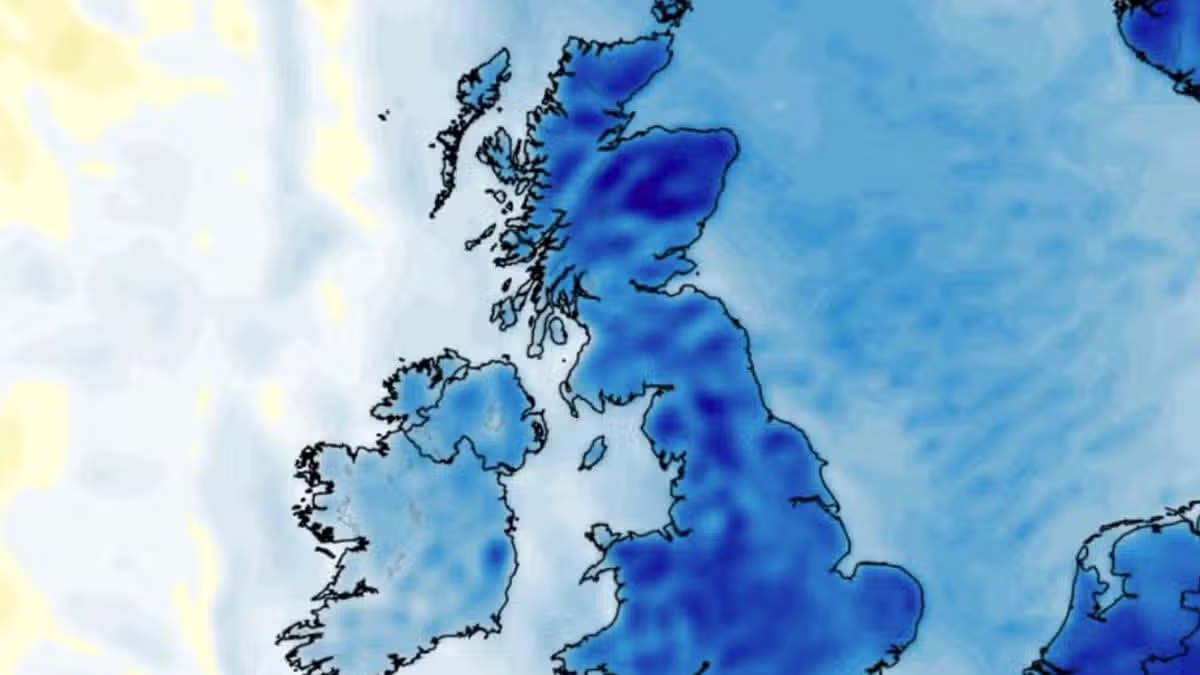
Temperatures look set to plunge from September 11, with the GFS weather model showing highs of just 11-12C around southern and eastern coasts at around midday.

Meanwhile 9C is coming in the Midlands and Northern Ireland, and lows of 2C on the cards in parts of Scotland. The Mirror reports by 6pm on September 11, the data shows highs of just 15C in the south-east – well below what is expected for this time of year – with afternoon temperatures remaining below 10C in Wales, northern England, Northern Ireland and Scotland.

Advertisement

Further cool conditions should follow on September 12, with temperatures dropping to just 1C in parts of northern England and Scotland. Every single county could see temperatures below 10C at midday, the data suggests.

The maps show temperatures peaking at just 13C in the south-east at around 6pm on September 12, with the Midlands reaching 11C, 12C in Northern Ireland and 10C in Scotland.

Similar conditions are expected on September 13 too, with the GFS model once again showing single-digit temperatures across the country at midday – with London at just 7C. Afternoon highs may reach just 14, with the warmest conditions expected in Northern Ireland and the south-west.

Temperature anomaly maps for this period show the UK shaded in areas of dark blue. This indicates that temperatures are expected to drop well below the seasonal average.

Advertisement

The Met Office anticipates “unsettled” conditions for the first half of September, with rain in northern and western regions and drier spells in the south and east.

The Met Office forecast for September 5 to 14 states: “An unsettled period is likely, with many places seeing showers or longer spells of rain at times. Rain is expected to be most frequent across northern and western areas, while the south and east are more likely to see longer, drier spells. There is also the potential for some strong and gusty winds, particularly in the northwest.”

The BBC forecast for September 7 to 13 says conditions should soon turn “cooler”, with “wet and windy or showery weather” on the cards.

It states: “Atlantic weather systems should continue to dominate conditions into the second week of September, with low pressure and frontal systems tracking near or across the UK, so further periods of wet and windy or showery weather look most likely.

Advertisement

“Short-lived drier and sunnier spells should occur in-between, especially in the southern and eastern UK where conditions may be less wet overall than the north and west.”

Ensure our latest stories always appear at the top of your Google Search by making us a Preferred Source. Click here to activate or add us as your Preferred Source in your Google search settings.

Source link

Advertisement
Continue Reading

NewsBeat

Major DWP changes hitting millions before the year is out

Published

on

Major DWP changes hitting millions before the year is out

Millions of people across the UK are set to be affected by changes to the benefits system and other support before the end of the year.

The changes include Winter Fuel Payments worth up to £300, a £150 energy bill discount for eligible households, a major expansion of free school meals and tougher new powers allowing the Department for Work and Pensions (DWP) to recover money it is owed.

Here are the key changes to know about:

Advertisement

Winter Fuel Payment worth up to £300

Older people could receive between £100 and £300 towards their heating costs this winter.

The payment is available to people who were born on or before June 27, 1960 and usually live in England, Wales or Northern Ireland. Those living in Scotland are not eligible for Winter Fuel Payment but may qualify for the separate Pension Age Winter Heating Payment.

Most eligible pensioners will receive the payment automatically.

Letters are due to be sent in October or November, with most payments expected to arrive in November or December 2026.

Advertisement

However, there is an important catch for higher-income pensioners.

If your total income is above £35,000, HMRC will recover the full Winter Fuel Payment through the tax system, unless you opt out this month.

Your partner’s income does not count towards the £35,000 threshold.

£150 Warm Home Discount

Millions of households could also get a £150 discount on their electricity bill through the Warm Home Discount scheme.

Advertisement

The scheme is due to reopen in October 2026 and the money is credited directly to the energy bill rather than being paid into your bank account.

In England and Wales, eligible households generally need to be with a participating energy supplier, receive a qualifying means-tested benefit and have the benefit recipient, their partner or legal representative named on the electricity bill.

Qualifying benefits include Universal Credit, Housing Benefit, income-related Employment and Support Allowance and Pension Credit.

The qualifying date for winter 2026 to 2027 was August 23, 2026, so households needed to meet the relevant conditions on that date for the automatic rebate.

Advertisement

Free school meals expanded

A major change has also arrived for families receiving Universal Credit in England.

From the start of the 2026/27 school year, all pupils in households receiving Universal Credit are eligible for free school meals.

Previously, Universal Credit households generally had to meet an annual household earnings threshold of £7,400.

The expansion means children in households receiving Universal Credit above that threshold can now qualify too.

Advertisement

The Government says more than three million children from Universal Credit families will benefit, with the expansion expected to cover more than half a million additional pupils.

The support could make a significant difference to family budgets, particularly as parents face the cost of school uniforms, childcare and other expenses at the start of the new term.

DWP can recover debts directly from bank accounts

The DWP now has sweeping new powers to recover certain benefit debts.

Under the Public Authorities (Fraud, Error and Recovery) Act 2025, the department can, as a last resort, recover money owed from a person’s bank account using a Direct Deduction Order.

Advertisement

The powers can apply to bank, building society and credit union accounts, and safeguards are in place to assess whether deductions are affordable. Joint accounts can also be considered, although the DWP says sole accounts must be considered first.

The new powers are aimed at people who owe money to the DWP and have failed to agree an appropriate repayment arrangement.

The department has said thousands of people with outstanding debts are being contacted and warned to get in touch.

Some benefit debtors could face a driving ban

The changes also mean persistent benefit debtors could ultimately face a driving ban.

Advertisement

Recommended reading:


The DWP can apply to a court to temporarily disqualify someone from holding a driving licence in the most serious cases where the person has the means to repay but has persistently failed to do so without good reason.

A driving ban can only be considered where at least £1,000 remains outstanding.

There are also protections for people who have an essential need for their licence, such as those whose work depends on driving or people with caring responsibilities.

Advertisement

Any ban is initially suspended while the person keeps to the agreed repayment terms.

The DWP has warned debtors to “get in touch and pay up, or face the consequences.”

Source link

Advertisement
Continue Reading

NewsBeat

Premier League clubs set new transfer spending record

Published

on

Split picture of Elliot Anderson, Enzo Fernandez and Morgan Rogers

This summer, 38% of deals involving a transfer fee have been from one Premier League club to another, which is an increase from last year, when the figure was 30%.

That then increases to 48% in instances where Premier League clubs have bought players from lower down the English football pyramid.

On top of that, the Premier League net spend remains over £1bn for this window – by far the most in Europe – despite many of the biggest sales this summer coming from the English league too. Bundesliga and Ligue 1 clubs have received more in transfer fees than they have spent.

Aside from French-based duo Barcola and Bouaddi, the majority of major signings made by Premier League clubs this month have been from rival clubs in the same division.

Advertisement

They include England team-mates Rogers and Anderson, while Newcastle sold Tonali to Spurs and Guimaraes to Arsenal.

Manchester United snapped up Baleba from Brighton after a 12-month chase to aid their midfield revamp, while Tottenham‘s recruitment of Fernandes and Savio is in the same category.

But why are English clubs buying each other’s players more than ever this summer instead of shopping abroad for the biggest deals?

One reason could be the temptation for players who are proven in the Premier League.

Advertisement

Many of last season’s big-money signings – with a good chunk of them coming from the Bundesliga – failed to meet expectations or justify their transfer fee.

There have also been deals this summer involving the same clubs, possibly with accounting in mind, with Chelsea and Villa selling players to each other.

And there is also a feeling that teams abroad increase the transfer fees they are asking for when English teams – with all their TV riches – show interest in their players.

Source link

Advertisement
Continue Reading

NewsBeat

M62 crash LIVE updates as all traffic held in Greater Manchester – latest updates

Published

on

Manchester Evening News

All traffic is being held on the M62 in Greater Manchester following a crash tonight (Tuesday, September 1).

The incident has taken place on the eastbound carriageway between J18 M66 J4 (Simister Island) and J19 A6046 Middleton Road (Heywood).

The crash was first reported at around 10.40pm.

Advertisement

Click here to get the biggest stories straight to your inbox in our Daily Newsletter

Inrix, the traffic data company, said: “All traffic being temporarily held due to accident on M62 Eastbound from J18 M66 J4 (Simister Island) to J19 A6046 Middleton Road (Heywood).”

This is an ongoing incident. We will bring you further updates as we get them on our dedicated live feed below.

Source link

Advertisement
Continue Reading

NewsBeat

Americans deliver stunning verdict on Trump’s renaming of Lake Ontario – as Canada trade war piles on misery ahead of the midterms

Published

on

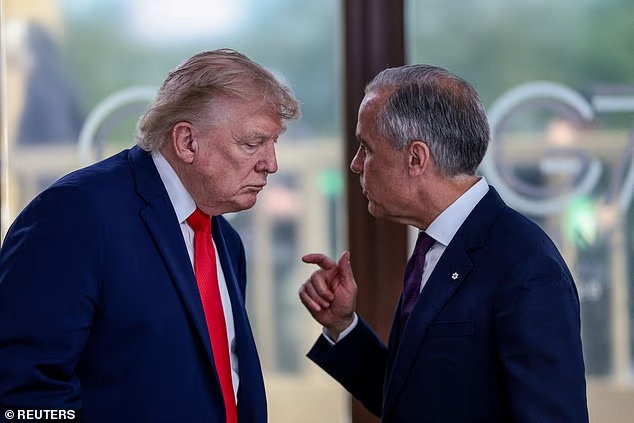
Voters have turned against Donald Trump's crusade against Canada, rejecting his rebranding of Lake Ontario as 'Lake America' by more than two to one. Trump is pictured speaking with Canadian Prime Minister Mark Carney at the G7 Summit earlier this summer

Advertisement

Voters have turned against Donald Trump‘s crusade against Canada, rejecting his rebranding of Lake Ontario as ‘Lake America’ by more than two to one.

A new Daily Mail/JL Partners poll finds only 20 percent of Americans support the name change, while 46 percent oppose it.

Even Americans who previously voted for Trump in 2024 only supported it by 33 percent, while 31 percent rejected the name change. 

Trump first floated the name last week after trade negotiations between the two countries collapsed. He declared that the US did not expect to be ‘doing much business with Ontario any longer.’

Advertisement

He followed through two days later with an executive order directing the federal government to use ‘Lake America.’

Soon after Washington slapped 50 percent tariffs on $20 billion in Canadian goods and Ottawa announced retaliatory levies of its own. 

A trade war to the north could also deepen Trump’s midterm headache as Republicans fight to protect their small congressional majorities. The Iran war has already pushed oil above $90 a barrel, and gas past $4 a gallon for most Americans. 

Just thirty-two percent of voters supported the new tariffs against Canada, with 36  percent opposing the levies. Thirty-seven percent blame US officials for the breakdown, compared with just 14 percent who fault Canada. However, 31 percent hold both sides equally responsible.

Advertisement

Advertisement

Voters have turned against Donald Trump’s crusade against Canada, rejecting his rebranding of Lake Ontario as ‘Lake America’ by more than two to one. Trump is pictured speaking with Canadian Prime Minister Mark Carney at the G7 Summit earlier this summer

Aerial view of the newly renamed Lake America which is shared by the US and Canada

Aerial view of the newly renamed Lake America which is shared by the US and Canada 

Yet one in four Americans, including 42 percent of Trump voters, would support closing the Canadian border entirely over the tariff feud.

Trump’s repeated talk of absorbing Canada as the 51st state also remains fringe, backed by 21 percent of Americans and 31 percent of his voters.

The poll was conducted between August 28-31 among 1,015 registered US voters online with a margin of error of 3.1 percent.

Advertisement

After Trump’s public spat with Canada, Ontario Premier Doug Ford warned last week that his province could cut off electricity to the US if Trump continues pressing the trade war.

Ford said Ontario powers 1.5 million American homes and businesses and warned Trump he had better have ‘a pack of batteries’ ready.

Ford also told Trump to ‘kiss my a**’ and that Canada should be ready to ‘throw everything in the kitchen sink’ at the US President.

A new Daily Mail/JL Partners poll finds only 20 percent of Americans support the name change, while 46 percent oppose it

A new Daily Mail/JL Partners poll finds only 20 percent of Americans support the name change, while 46 percent oppose it

Advertisement

Canada, the second-largest US trading partner, brings in about $880 billion in goods and services exchanged annually.

The northern US ally is deeply intertwined with auto, energy and manufacturing supply chains on both sides of the border.

A prolonged trade war could slow economic growth and raise prices for American consumers as manufacturers face higher costs for parts and materials.

Advertisement

Advertisement

Source link

Continue Reading

NewsBeat

Chelsea FC left furious as Monaco pull out of Lamine Camara deal at last minute

Published

on

Chelsea FC left furious as Monaco pull out of Lamine Camara deal at last minute

Then complications over Monaco’s sale of Folarin Balogun to Everton meant the French side were under pressure to sell before the French deadline and, following persistence from Chelsea’s recruitment team, the deal was revived and an agreement reached for Camara’s transfer for €55m (£47m).

Source link

Continue Reading

NewsBeat

Gripping murder trial reconstruction puts the jury system in the spotlight and receives four stars from CHRISTOPHER STEVENS

Published

on

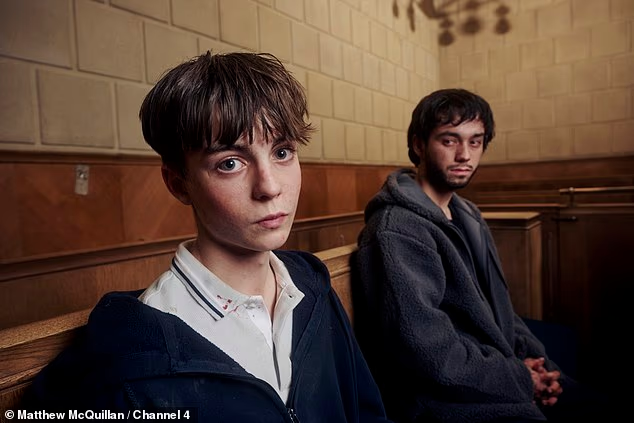
The Jury: 14 And On Trial For Murder uses actors to restage a court case involving two brothers, 22-year-old Luke and Daniel, 12 (14 when the case came to trial), who admitted killing their stepfather with a knife as he slept

Advertisement

The Jury: 14 And On Trial For Murder (Channel 4)

Rating: Four stars

Rating:

Jury service can be bad for your health. Up to half of jurors report symptoms of depression, dark intrusive thoughts, problems with sleeping and even traumatic stress after trials involving violence or sexual abuse.

Advertisement

Last year, a pilot scheme was launched to offer counselling to people affected by jury services. And after watching a reconstruction of one particularly shocking trial, it isn’t difficult to understand why some might need it.

The Jury: 14 And On Trial For Murder uses actors to restage a court case involving two brothers, 22-year-old Luke and Daniel, 12 (14 when the case came to trial), who admitted killing their stepfather with a knife as he slept.

Using a serrated kitchen knife, they hacked at his neck until he was almost decapitated.  

Though this was not real courtroom footage, the evidence shown to jurors appeared to be genuine, and included two gruesome photos of the corpse on the bloodsoaked sofa.

Advertisement

The Jury: 14 And On Trial For Murder uses actors to restage a court case involving two brothers, 22-year-old Luke and Daniel, 12 (14 when the case came to trial), who admitted killing their stepfather with a knife as he slept

Another picture showed the foul squalor of the family’s home, with refuse including a bag containing dirty nappies piled up on the kitchen units next to food.

The victim was Connor Fitzroy, who lived with the brothers’ mother Julie and their three younger children. Luke and Daniel were Julie’s sons from a former relationship, and Fitzroy bitterly resented the space they took up and the cost of feeding them.

Advertisement

Some of the jurors, who are not actors, made no attempt to hide their preconceptions. Signwriter Phill, 59, believed every crime merited punishment: ‘My values come from my parents. My mum used to give me a right old slap if I was naughty.’ 

Sociology student Christopher, 20, was adamant from the start that nobody is ‘born evil’. Upbringing and environment explained everything, he insisted.

That’s the drawback of this TV format: everyone taking part knows the cameras are watching and, rather than waiting to hear the evidence before reaching a decision, some were itching to deliver an immediate verdict.

Most of them were whispering in the jury box, showboating sotto voce, and surely that isn’t allowed. All 12 seemed to focus almost entirely on the younger of the brothers. That’s to be expected, and the title of the programme reflects that.

Advertisement

Narrator Indra Ove explained anyone over the age of ten can be held responsible for criminal actions, though one obvious point was omitted: while children under 18 will usually face trial in a juvenile court, murder cases are treated differently. These have to be heard in an adult court.

Condensing several days or weeks of evidence and cross-examinations into a couple of hours inevitably means much is left out. But what remained was gripping, and the twists in the story were well-paced.

At the midway point, it’s clear that Fitzroy, a hard drinker with convictions for battering his wife, is no loss to humanity. But can that excuse what amounted to butchery?

Advertisement

Advertisement

Source link

Continue Reading

NewsBeat

Justice Department seizes over $560,000 in cryptocurrency donations for Hamas

Published

on

Justice Department seizes over $560,000 in cryptocurrency donations for Hamas

WASHINGTON (AP) — The FBI has seized more than $560,000 in cryptocurrency donations intended for Hamas, the Justice Department said Tuesday in announcing a disruption of financing for the militant group.

In addition to seizing cryptocurrency meant to support Hamas’ military wing, the department said that it had taken control of website domains and communication platforms used for fundraising and recruitment, and had obtained information about thousands of people who had contacted Hamas with a goal of giving money to the group.

“My message to Hamas is clear: your networks are not secure, your crypto is vulnerable, and we will not stop until your ability to wage war is defeated,” Jeanine Pirro, the U.S. attorney for the District of Columbia, said in a video statement announcing the operation.

According to FBI affidavits filed in connection with the seizures, Hamas began testing virtual currency fundraising in or around early 2019 through its Qassam Brigades, or military wing, and solicited donations on its Telegram channel and also used direct online fundraising. Hamas officials bragged that the currency would be untraceable and their websites offered instructions for how to make anonymous donations, the affidavits say.

Advertisement

A major investigative break arrived last year when FBI officials identified a financing network soliciting donations to the Qassam Brigades via virtual currency and a confidential source located in the United States alerted law enforcement to a Telegram post asking for contributions to an email address associated with Hamas.

Brett Leatherman, an FBI assistant director in charge of its cyber division, said the bureau would “continue to use its authorities to intercept illicit funds and prevent terrorist organizations from exploiting digital networks to finance their operations.”

Hamas officials could not immediately be reached for comment.

Advertisement

Source link

Continue Reading

Trending

Copyright © 2025