Nvidia’s first official DLSS 5 benchmarks promise enormous frame rates, but the underlying render performance tells a very different story, with Neural Rendering looking exceptionally demanding.
Across IEEE, our strength lies not only in the excellence of our individual communities but also in our ability to bring them together around shared problems that demand interdisciplinary solutions. Our mission as a public charity—to advance technology for the benefit of humanity—is becoming an increasingly powerful differentiator. It is more than a statement of principle; it is a strategic advantage. When engineers and technologists serve with purpose and lead with heart, they strengthen the future of our profession and demonstrate why IEEE is uniquely positioned to lead at the intersection of technology and societal impact.
IEEE Humanitarian Technologies is a consortium of programs and initiatives—supported by a global network of volunteers and technical professionals—working together to apply technology to solve the world’s most pressing problems. These include Empower a Billion Lives, EPICSinIEEE, MOVE, IEEE REACH, IEEE SIGHT, IEEE Smart Village, and IEEE Tech4Good. These programs embody our mission in action. They are not simply charitable activities; they are strategic assets that help IEEE lead globally, innovate boldly, and remain essential to technical professionals at every stage of their careers. While deeply human in purpose, humanitarian technologies are fundamentally engineering challenges, demanding the full depth of engineering rigor and realized through disciplined, deeply technical work.
Cultivating Technical Leaders
IEEE Humanitarian Technologies sits at the intersection of engineering excellence, societal need, and global opportunity. Its programs allow our members to show the world that engineering and technology are forces for good, capable of addressing urgent challenges with precision, creativity, and compassion. These programs do more than inspire; they strengthen the technical ecosystem that underpins IEEE’s leadership.
Bringing together experts from power and energy, communications, computing, robotics, biomedical engineering, and many other domains to address real-world problems, these interdisciplinary intersections are where breakthroughs emerge. When engineers and technologists collaborate with the right humanitarian frameworks across sectors and cultures, they illuminate new constraints, design pathways, and opportunities that traditional project environments rarely reveal. This is how humanitarian technologies help shape the future of engineering itself.
Advertisement
These efforts also illustrate a broader opportunity for IEEE. By identifying critical challenges that can be addressed only through collaboration across disciplines, IEEE can mobilize the power of its global community toward solving problems around the world. In doing so, we strengthen both our impact on society and the value we provide to members, partners, and future generations.
These programs also build the leadership capacity our profession needs. Engineers working in humanitarian contexts learn to navigate ambiguity, engage diverse stakeholders, manage constraints, and design for environments where failure has real human consequences. They develop systems thinking, ethical reasoning, and cross‑cultural fluency—competencies increasingly essential in a world where technology and society are deeply intertwined. They also learn to transition from R&D to implementation by engineering the support, manufacturing, and delivery systems that make solutions viable in specific countries, all while balancing competing requirements. In doing so, humanitarian programs equip professionals with the capabilities that define modern technical practice.
Humanitarian technologies also help prepare the future technical workforce. Students and young professionals increasingly seek meaningful, high‑impact work. By engaging in purpose‑driven projects, they can discover their own capacity to grow, strengthen their technical skills, and become the leaders and problem‑solvers who will guide our profession forward.
Purpose Inspires Engagement
Our members feel this deeply. Engagement research shows that members increasingly cited “giving back to my profession and the world community” as a reason for joining the organization and renewing their membership. Those with higher membership grades identify “participation in humanitarian technology efforts” as one of the most satisfying experiences IEEE offers. These are not just data points; they are also signals of what our community values and what it expects IEEE to champion.
Advertisement
Younger generations amplify this even more. Millennials view IEEE through a global lens, prioritizing “humanitarian impact” and “large-scale collaboration.” One millennial member shared that teaching robotics to children in under-resourced communities transformed them into a deeply engaged member. Gen Z members emphasize inclusivity, environmental responsibility, and purpose-driven engineering, recommending that IEEE offer humanitarian-based challenges and competitions to increase engagement.
These findings reveal something powerful: Humanitarian programs are not only meaningful; they also are magnetic. They attract younger engineers, keep them engaged, and help them build a professional identity rooted in purpose and impact. They also create loyalty and develop the leadership pipeline IEEE needs for the decades ahead.
These programs also strengthen our brand. Members across segments describe IEEE as an organization that works hard to make real changes in the world. That perception is not just flattering, it is strategic. It positions IEEE as a global leader in responsible innovation that can be trusted to guide technology for the public good, catalyzing innovation that benefits society at scale.
As we look ahead, IEEE has an opportunity to become the world’s leading convening force for developing interdisciplinary technology solutions to solve humanity’s most important challenges. Our future relevance will be defined not only by the technologies we advance but also by the problems we choose to help solve.
Smart home device maker Wyze wants to end notification fatigue by turning security footage into something more akin to an Instagram feed.
The Kirkland, Wash.-based company launched “Wyze Stories,” a new AI-powered feature that stitches together clip sequences from multiple cameras into a single, chronological event.
Instead of firing off separate alerts as a visitor moves from the driveway to the front porch, the system uses multi-camera grouping and event importance filtering to deliver a unified highlight reel alongside a descriptive, text-based summary.
“Honestly, the number one thing people complain about with security cameras is getting blown up with notifications,” Dave Crosby, co-founder and chief marketing officer at Wyze, said in a news release Tuesday. “Instead of digging through a mess of clips, you just tap through daily stories like your house is your favorite social feed.”
Advertisement
An illustration shows how Wyze AI combines video feeds from multiple cameras—such as a driveway, front window, and front door—into a single, summarized event notification. (Wyze Graphic)
Within the app, stories are indicated by glowing green-and-purple rings on the home tab, allowing users to tap through footage, hold to pause, or watch events at double speed. The feature also uses AI to generate instant written summaries of detected activity — such as noting when a delivery driver leaves a box at the door — and automatically highlights high-importance events while suppressing repetitive, minor alerts.
The new feature is available as part of Wyze’s top-tier “Cam Unlimited Pro” subscription, which costs $19.99 a month and includes features like cross-camera grouping, 24/7 emergency dispatch, and 60 days of cloud storage.
Wyze Stories works across most of the company’s hardware lineup, with the exception of older legacy models like the original Wyze Cam, Doorbell v1, and Outdoor v1 and v2.
Founded in 2017 by a trio of former Amazon employees, Wyze originally launched with a $20 smart camera before expanding into a broader lineup of sensors, lighting, and home security systems. The company raised $110 million in 2021 and ranks No. 20 on the GeekWire 200 index of top Pacific Northwest startups.
John Ternus has officially taken over as Apple CEO after 15 years under Tim Cook, stepping up from his role as senior vice president of hardware engineering. A 25-year Apple veteran who helped oversee products including AirPods, Apple Watch, Vision Pro, Apple silicon, and the new MacBook Neo, Ternus now inherits the challenge of pushing Apple forward in AI while Cook stays on as executive chairman. TechCrunch reports: Ternus has worked at Apple for nearly half of his life — now 51 years old, he has been with the company for 25 years. He joined Apple’s product design team in 2001 as only his second job out of college (his first was at a small maker of virtual-reality devices called Virtual Research Systems). By 2013, Ternus was a VP of hardware engineering and was promoted to the SVP role in 2021. […] Ternus previously reported to Cook, who he considers a mentor, and led all of hardware engineering at Apple. That’s a pretty big deal for a company that’s known for ubiquitous hardware like the iPhone and the MacBook. […] Ternus’ earliest project at Apple involved scrutinizing parts for the Apple Cinema Display, an early desktop monitor. “At some point in my first year, I found myself at a supplier facility. I was far away from home. Well past midnight, I was using a magnifying glass to count the number of grooves on the head of a screw … and I was arguing with the supplier because these parts had 35 grooves. They were supposed to have 25,” Ternus recalled in his commencement speech. “I distinctly remember stepping back for a minute and thinking, ‘What the hell am I doing? Is this normal?’”
As Ternus climbed the corporate ladder, his responsibilities grew. He may no longer spend as much time analyzing screws, but he still seems to take pride in getting the little details right. In a recent interview, when Ternus was asked about his favorite memory of Steve Jobs, he mentioned the former Apple co-founder’s attention to craftsmanship. “[Jobs] was moving a piece of furniture, a chest of drawers, and pulled it away from the wall and looked at the back and was just reflecting on, you know, that the carpenter who made it had made it beautiful,” Ternus said. “It finished the back as beautifully as the rest of it, even though nobody was going to see it, right? And I think about that all the time because I think that perfectly exemplifies what we do here.”
From there, he went on to lead the hardware development behind products across the Apple ecosystem, overseeing launches like AirPods, Apple Watch, and the Vision Pro. He also had a hand in major technical upgrades at Apple, like Apple’s transition from Intel chips to its own proprietary Apple silicon. Most recently, Ternus was involved in the production of the MacBook Neo, Apple’s new, more affordable laptop model that lowers costs through some clever trade-offs in hardware design, like using an iPhone chip to power the device. “We never want to ship junk. We want to ship great products that have that Apple experience, that Apple quality. To do that with the Neo required building something completely new from the ground up … leveraging both the technologies we’d been developing like Apple silicon, but also the kind of expertise that we’ve developed over many, many years of building Macs, and building phones, and building iPads, and all of these things,” Ternus told Tom’s Guide.
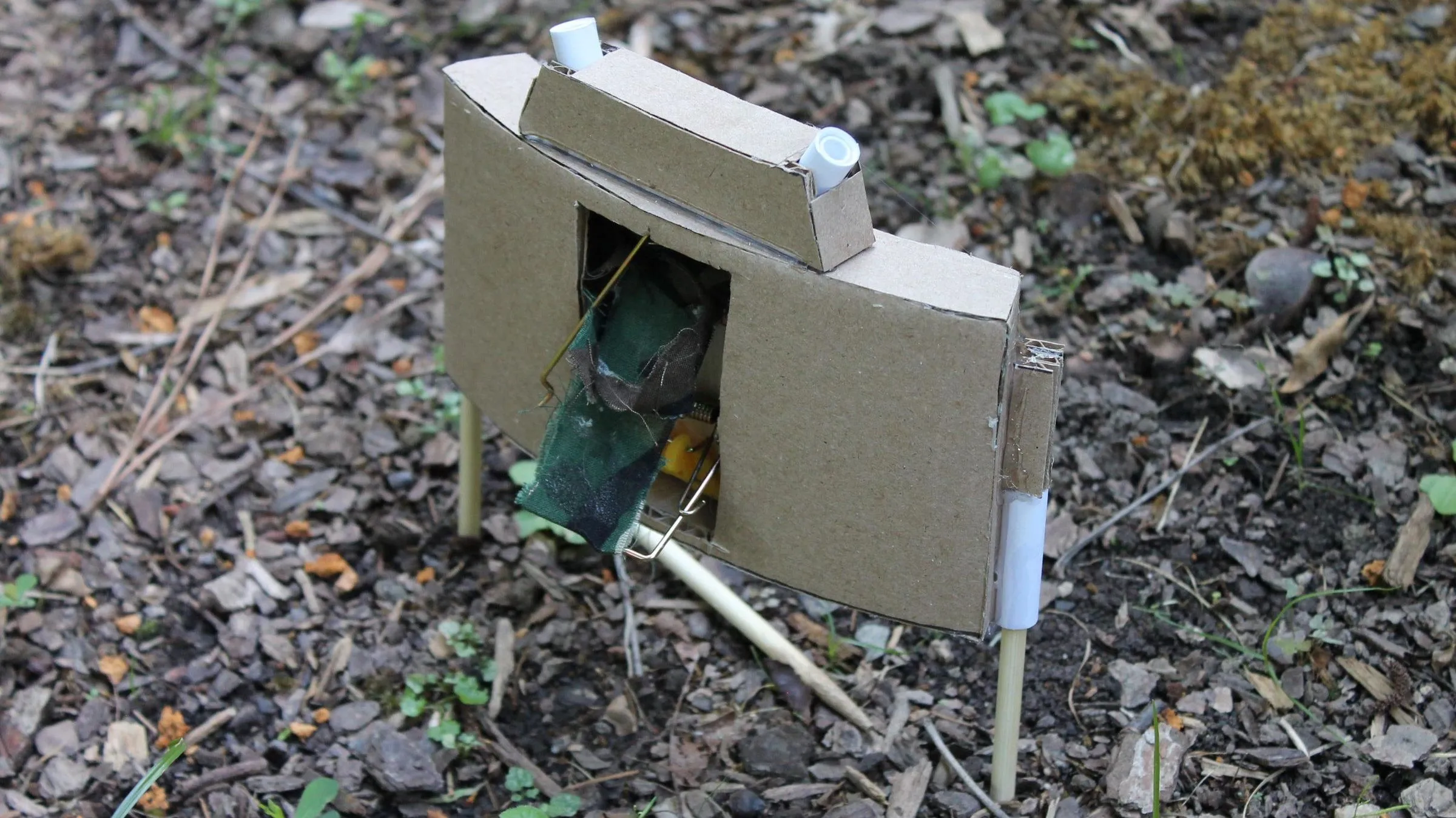
The Claymore mine is a rather fearsome weapon of war, using explosives to blast a cone of shrapnel towards advancing enemies. It’s not really something you should try and build at home. An airsoft version, though, is altogether more appropriate. [RegiBlackwood] has developed a simple way to build exactly that.
It’s a cheap and cheerful build, with the claymore housing itself built out of cardboard. Wooden dowels are used to stake it into the ground, just like the real thing. In the center of the housing sits a regular old mouse trap. Only, it’s been modified to hold a sling carrying a payload of BBs. The trap is also tweaked to make its spring more powerful, and to enable it to be triggered with the tug of a tripwire. When triggered, the mousetrap fires and hurls the sling forth, spewing a rain of BBs from the front of the device—ideally quelling the advance on your position.
Built properly, it’s a fun piece of airsoft hardware that could really change the dynamics of your regular game. If you’re looking to do point defence, you might also consider building yourself some automated turrets as well…
Unauthenticated intruders can mint admin tokens, and exposed servers are already being hit
Security researchers reported that someone is exploiting CVE-2026-82329, a critical JFrog Artifactory authentication-bypass bug, just days after the vendor patched the 9.8-rated flaw. And we don’t know if that someone is human.
Advertisement
Artifactory is a widely used tool for managing software artifacts, packages, binaries, and AI models. It’s also popular with AI agents that go rogue and need to communicate with each other while remaining undetected by their human babysitters.
JFrog disclosed CVE-2026-82329 on Friday, and by Tuesday, attackers had already begun exploiting internet-exposed systems, according to exposure-management biz watchTowr’s threat-intel team, which reported “attackers minting themselves admin tokens.”
In addition to creating new administrative credentials, watchTowr’s honeypot network caught miscreants “enumerating users, groups, credential sets and federated access topologies,” Yordan Ganchev, principal threat intelligence specialist at watchTowr, told The Register.
Advertisement
“Right now, we’re observing exploitation from a small number of IP addresses from varying geographies exploiting multiple of our honeypots,” Ganchev said. “Broad-scale scanning and mass exploitation has not been observed, but that is unlikely to stay the case for long.”
Ganchev urged organizations running vulnerable versions to “urgently patch” internet-exposed systems, and treat them as being potentially compromised – so inspect audit logs, rotate credentials, and investigate connected systems for any unusual changes or backdoor implants.
“When attackers gain admin level access to a central software supply chain system, they can do what every engineering team does best – build, ship and distribute software fast,” he said. “From there, they could tamper with build pipelines, move laterally into production systems and potentially push malicious changes downstream to customers.”
JFrog did not immediately respond to The Register’s inquiries. We will update this story when we receive any response. ®
A garage door opener is the type of convenience that’s easy to take for granted until it stops working properly. One way to guard against unexpected garage door opener failure is to familiarize yourself with the expected lifespan of such devices. Although numerous factors, such as how often you use it, can influence the lifespan of these machines, they typically should last between 15 and 20 years on average. Look into replacement options if yours is nearing 15 years or more of age. You should also be on the lookout for common signs indicating a garage door opener is dying and needs to be replaced.
Be aware that not all the problems affecting garage doors and garage door openers necessarily require investing in a full replacement. In many cases, it’s wise to assess the situation, perhaps with the help of a professional, to determine if a simple repair job would fix the issue. However, in some instances, even if it’s technically possible to repair a broken garage door opener, it might be more financially prudent in the long run to simply invest in a new model that’s unlikely to break down in the near future.
Advertisement
Inconsistent operation
GagoDesign/Shutterstock
Naturally, if your garage door opener doesn’t open the garage door reliably, that’s a sign of a problem. Even if it works some of the time, the fact that it’s not doing its job consistently is a red flag. That said, it’s also a bad sign if the garage door opens or closes on its own.
Any type of inconsistent or unexpected functioning could indicate some part of the garage door opener is malfunctioning. Unless you’re genuinely an expert in garage door opener repair, you should hire a professional to thoroughly inspect the system. Fixing it may only require swapping out an old component for a new one. Sometimes, if a garage door won’t open at all, installing a new battery is all that’s necessary.
If the issue is more widespread, affecting multiple components due to factors like age, you might be better off replacing the system entirely. Remember, in terms of long run expenses, staying on top of repairs and upkeep for an aging garage door opener system could be costlier than installing a replacement.
Advertisement
Strange noises or movements
Yuliya Taba/Getty Images
Even if your garage door opener is technically working, you should nevertheless pay attention to how smoothly it appears to be functioning. You might notice that the garage opens more slowly than it once did. Or, it could move in a jerky manner. Both of these could be signs of garage door opener trouble.
Similarly, listen to any sounds your garage door makes when the opener is in operation. Strange noises when the garage door is opening or closing could be a sign that something is wrong with the motor or another component.
Advertisement
Again, it’s possible that the cause of the problem is something that can be repaired without a full garage door opener replacement. However, these warning signs often arise when garage door opener systems are fairly old and reaching the end of their lifespans. Thus, if you want to avoid having to address more issues in the near future, your best bet may be to schedule replacement service.
Advertisement
The garage door doesn’t close completely
Marvin Samuel Tolentino Pineda/Getty Images
This is another form of inconsistent performance that can be very frustrating to encounter. When you trigger the garage door to close, you might notice that sometimes, it only closes slightly. Rather than close fully, it may reverse course and start to open again.
This can happen for various reasons. Often, a problem with the sensor or the motor is to blame. You might be lucky and discover that the sensors are merely detecting debris or other obstructions and interpreting them as signs that a person or animal is in the way. Clearing away the obstruction can fix the problem immediately. However, if the sensor is malfunctioning, you might have to replace the opener.
A similar problem can occur if the garage door doesn’t close all the way. If it closes somewhat, but doesn’t necessarily reverse course, it might indicate a problem with the tracks or rollers. Again, someone with professional experience or knowledge can help you better determine whether this is the type of problem that requires basic repairs or a full garage door opener replacement.
Advertisement
Your garage door opener relies on old tech
Seanpavonephoto/Getty Images
A garage door opener could theoretically work perfectly fine. Still, you might decide it’s time to replace yours simply because you want to upgrade to something that leverages newer tech to offer enhanced performance. For example, maybe you’ve studied the pros and cons of smart garage door openers and concluded that you’re ready to make the switch. This is a perfectly valid reason to schedule replacement service.
No matter what, it’s critical to keep in mind that garage door openers are complex machines. They can also be dangerous, particularly when they’re not working properly. Don’t attempt the DIY approach to diagnosing or addressing any garage door opener problems if you lack the necessary training and experience. Instead, if you notice any signs that your garage door opener is no longer working properly, get in touch with a professional who can take a closer look. In the meantime, you can also begin exploring options for replacing your current opener with something that not only works, but uses the latest innovations to deliver an exceptional experience.
X-Bow received nearly $11 million under a new interceptor development contract
The new interceptor system targets a cost below $750,000 per launch
Patriot missiles currently cost roughly one-fifth more than this new target
The Pentagon has awarded X-Bow Systems almost $11 million to develop a lower-cost interceptor system under a missile defense program.
The project falls under the Missile Defense Agency’s Rapid Response Small Launcher Technology program and seeks to create a weapon that could cost below $750,000 per launch.
That figure amounts to roughly one-fifth the cost of a Patriot missile, the current top-tier standard for air defense systems.
Latest Videos FromTechRadar
Advertisement
X-Bow develops a new interceptor approach
The Missile Defense Agency selected X-Bow through its Low-Cost Interceptor program, which focuses on developing affordable systems against advanced aerial threats.
The company will use the funding to continue propulsion work and prepare a prototype for a planned flight demonstration.
X-Bow produces its solid rocket motors and propellant internally, allowing the company to control more parts of its manufacturing process.
The agreement requires the firm to deliver a prototype system by late 2027, although that stage will not represent a fully operational weapon.
Are you a pro? Subscribe to our newsletter
Sign up to the TechRadar Pro newsletter to get all the top news, opinion, features and guidance your business needs to succeed!
Advertisement
The Pentagon has faced pressure because existing interceptor systems remain expensive and difficult to produce quickly.
The war in Iran revealed a major setback as the U.S. is now left with about 250 THAAD rounds and less than 1,000 Patriot interceptors.
Patriot replacement rounds cost around $3.9 million each, while manufacturing takes years and depends on a small number of established suppliers.
“The contract will aim to address the critical need to expand the SRM industrial base, which is currently reliant on a duopoly of two primary manufacturers,” said the US Department of Defense in its contract announcement.
X-Bow said its production methods could help create affordable weapons while increasing manufacturing speed for military requirements.
“America can’t out-produce today’s threats with yesterday’s supplier base,” said Jason Hundley, founder and CEO of X-Bow Systems.
The company is examining ways to reduce costs across interceptor components, including propulsion systems and other expensive sections.
Advertisement
Other nations explore cheaper missile defense systems
The search for lower-cost interceptors has expanded beyond the United States as allies face similar concerns.
Ukraine and European partners have started developing alternative approaches that could reduce reliance on existing expensive missile defense weapons.
One European effort called Freyja has been linked with an interceptor costing around $700,000 per round.
Advertisement
Lockheed Martin has also introduced the PAC-3 ACE missile concept, which the company says could lower costs compared with current Patriot versions.
The US Air Force previously requested proposals for a counter-air missile that could cost below $500,000.
That effort reflected wider interest in producing larger numbers of affordable weapons for future defense requirements.
The X-Bow project remains in an early development stage because testing and evaluation are still required before deployment.
Advertisement
Military officials will need to confirm whether the system can achieve lower costs while meeting operational standards.
“We’re taking a look at propulsion, we’re taking a look at all the expensive parts of an interceptor to look for opportunities to drive down every bit of cost,” said Lt. Gen. Heath Collins, director of the Missile Defense Agency.
The program shows the Pentagon is exploring alternatives as demand for missile defense grows worldwide.
However, the outcome will depend on whether new production methods can deliver affordable systems without reducing expected performance levels.
Anthropic wants AI agents to control programmable machines through common software rules
Model Hardware Standard (MHS) can connect microscopes, robotic arms, and liquid handling equipment
MHS allows different laboratory devices to communicate through standardized software drivers
Anthropic opened a preview of its Model Hardware Standard (MHS), designed to let AI agents control programmable machines through shared rules.
The proposed system is intended for laboratories, factories, and workplaces where different instruments must work together without custom software links.
MHS uses software drivers that translate between computer systems and individual machines, allowing equipment with different interfaces to communicate consistently.
Latest Videos FromTechRadar
Advertisement
A common system for physical machines
Its drivers rely on basic commands for reading measurements or changing settings, giving agents a method for controlling connected equipment.
The system records machine details that might otherwise remain inside manuals or depend on knowledge held by experienced laboratory staff.
Users can enter such information through natural language, after which MHS creates reference material describing capabilities, adjustments and safety restrictions.
Agents can then discover compatible equipment across networks without requiring separate software bridges for every machine they need to operate.
Are you a pro? Subscribe to our newsletter
Sign up to the TechRadar Pro newsletter to get all the top news, opinion, features and guidance your business needs to succeed!
Advertisement
The standard supports microscopes, liquid handlers, robotic arms and other equipment that offers some form of programmable interface for agents.
The company claims integration that once required weeks or months could instead take hours or minutes when equipment supports MHS.
According to Anthropic, Claude was tested with physical experiments, including laser alignment supported by camera-based observation during early physical trials.
The model successfully adjusted the laser, checked the image, and repeated the process while assessing each change carefully.
The design also lets agents combine commands from several devices, creating automated sequences for work that might otherwise require coordination.
Physical limits remain a concern
Anthropic said Claude interacts with experiments and hardware in an “exploratory manner, much as a scientist would,” during physical testing.
Advertisement
That model can then coordinate several instruments through one interface, rather than requiring separate control software for every connected device.
The company has shared MHS with manufacturers and research groups working across biotechnology, robotics and quantum computing fields.
Anthropic intends the preview to help establish safety checks before the standard becomes available widely to developers and equipment makers.
Amazon Web Services, Automata, Danaher, Doosan Robotics, MBF Bioscience, QIAGEN, Tecan and Universal Robots are among the early participants now.
Advertisement
Anthropic acknowledges that AI agents still require expert supervision because language models have clear limits when reasoning about physical equipment.
MHS cannot currently support equipment lacking a programmable interface, leaving some laboratory and industrial machines outside its current technical scope.
Anthropic says it plans to work with manufacturers to add drivers while expanding compatibility with more devices and robotics platforms.
The preview will also support new safety tests and practical rules for deploying AI agents around physical equipment.
Advertisement
The company says its eventual open-source release will include findings from these tests alongside detailed guidance for safer implementation.
The project therefore remains experimental, with practical limits still depending heavily on hardware design, software access and human oversight.
Phishing actors are abusing the legitimate Faronics Deploy endpoint-management platform to gain remote administrative control over victim computers and install the ScreenConnect remote support software.
In activity observed between July 21 and August 20, Faronics-themed lures reached more than 457 endpoints via emails disguised as invoices, tax documents, or other business files.
Faronics Deploy is a cloud-based endpoint management platform that allows IT administrators to remotely enroll and manage computers, deploy software, and execute scripts.
Researchers at managed detection and response company (MDR) Huntress say that the embedded malicious links lead to a website that profiles potential targets and guides them through a malicious download flow.
Advertisement
If the website is reached from an analysis environment, a decoy routine is activated, such as displaying an error message.
Huntress explains that a potential victim is prompted to download and launch a legitimate, signed Faronics Deploy installer that is disguised as an Adobe document, a reader app, or a plugin update.
Fake Adobe download page Source: Huntress
When the victim runs the Faronics installer, often named ‘Adobe.exe,’ their computer is enrolled in a Faronics deployment controlled by the attackers.
The threat actor then uses Faronics’ remote-deployment functionality to execute PowerShell scripts on the enrolled computer without further user interaction.
These scripts download additional tools from the attacker’s infrastructure or external locations, including GitHub, eventually installing another legitimate remote access tool, ConnectWise ScreenConnect.
Advertisement
“The delivery method varies between scripts, with observed examples using curl or mshta to retrieve additional content, while others invoke msiexec to install payloads hosted on attacker-controlled infrastructure,” Huntress says.
“These scripts are subsequently used to install ScreenConnect, establishing an additional remote access mechanism on the compromised endpoint.”
ScreenConnect gives attackers an additional remote-access channel independent of Faronics, providing hands-on remote control better suited to interactive access while also serving as redundancy if the malicious Faronics deployment is identified and terminated, or if defenders remove its agent.
Huntress notified Faronics of its findings on August 5, and the vendor confirmed the observed malicious activity, countering it by implementing additional anti-abuse measures.
Advertisement
Moreover, Faronics has contacted victimized organizations to notify them about potential compromise.
According to Huntress, the malicious activity dropped significantly starting August 21, indicating that Faronics’ actions worked.
Huntress recommends that administrators check the “C:\ProgramData\Faronics\Logs\” location for a ScriptRunner.log file, which may preserve remotely executed script names and download URLs.
The company says that the ck parameter in Faronics configuration requests is also an indicator, as it identifies the associated customer deployment and can help identify compromised endpoints or malicious accounts.
Advertisement
Administrators should also look for ScreenConnect installations where it is not normally deployed.
Overall prevention scores can hide what happens after initial access. Once attackers are using valid credentials, prevention drops sharply.
The Blue Report 2026 measures defenses technique by technique across 338 million simulations run in customer production environments.


































































You must be logged in to post a comment Login