
Crypto World
Kalshi Hands First Lifetime Ban to Republican Over Insider Bets

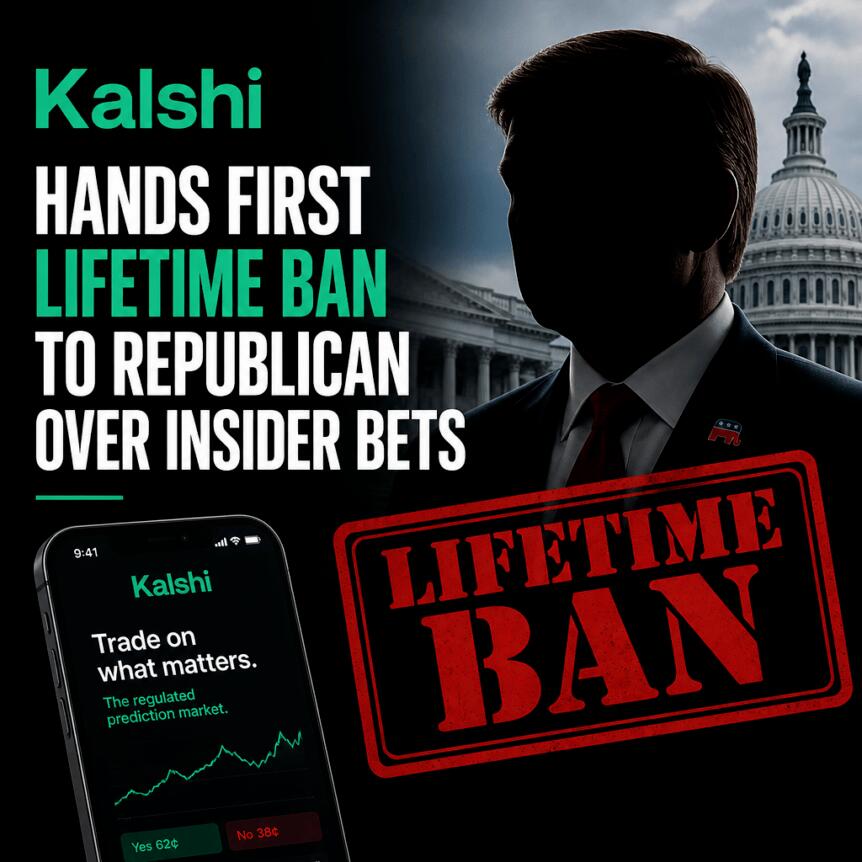
Prediction market platform Kalshi says it has permanently barred two US political candidates from trading on its event contracts after compliance investigations found activity that Kalshi described as violating rules against insider influence. The actions follow a broader wave of scrutiny directed at prediction markets, including investigations tied to potential manipulation of politically sensitive markets.
In separate settlement notices announced Friday, Kalshi’s compliance team reported that it imposed a lifetime suspension and a $71,356 penalty on former Republican congressman George Santos, while Laurie Buckhout—also a Republican candidate—received a three-year trading suspension plus a $2,590 penalty. Both cases relate to contracts that Kalshi says could be influenced by the candidates’ own actions.
Key takeaways
- Kalshi reports it permanently suspended George Santos from trading on its prediction market platform and imposed a $71,356 penalty.
- Kalshi reports it suspended Laurie Buckhout for three years and imposed a $2,590 penalty.
- Both actions were tied to Kalshi findings that each person traded in markets connected to events in which they had decision-making influence, which Kalshi says its rules prohibit.
- The disciplinary steps come as prediction markets remain in the crosshairs of US state and federal regulators debating jurisdiction and market-manipulation risk.
- As of Tuesday, Kalshi still listed election-related event contracts tied to Buckhout’s North Carolina race.
Why Kalshi took action
Kalshi framed both settlements around a core compliance principle: its market rules prohibit trading by anyone who can influence the outcome of the underlying event tied to a contract. In the platform’s rules, Kalshi states that if a trader is a decision maker—or has any direct or indirect influence, “no matter the scale and importance of the influence”—on the outcome of an underlying event, the trader is prohibited from entering trades on markets for those contracts.
According to Kalshi’s disclosures, Buckhout violated this restriction by trading around event contracts connected to her own political race. Kalshi said Buckhout announced her candidacy in North Carolina’s 1st congressional district and that she was subsequently added as an option for a contract tied to the outcome of the congressional election.
For Santos, Kalshi said its investigation found he engaged in trading activity in certain markets related to his attendance at the State of the Union address in February 2026—again, a scenario Kalshi characterized as falling under its prohibition on trading when the trader can influence the underlying event.
Penalties, suspensions, and what Kalshi said about cooperation
Kalshi’s compliance department reported the settlements in two documents published with its regulatory notices. For Santos, Kalshi said the disciplinary action took the form of a permanent suspension from trading on Kalshi markets, accompanied by a $71,356 penalty. For Buckhout, Kalshi reported a three-year suspension and a $2,590 penalty.
Kalshi’s notices also included differing language about cooperation. In Buckhout’s case, Kalshi stated that she “cooperated with the inquiry” and agreed to the three-year trading ban and penalty. In Santos’ case, Kalshi did not similarly state that he cooperated with its investigation, leaving an important procedural detail unaddressed in the company’s public notice.
These measures are notable because they represent one of the first lifetime bans Kalshi has imposed since the platform’s launch in 2021, according to the article’s framing. For participants who trade on event contracts, the message from Kalshi’s compliance team is that the company intends to treat “influence” broadly—especially when the underlying event is tied to a person’s public role or political activity.
Prediction markets face escalating political and regulatory scrutiny
The Kalshi actions arrive at a moment when prediction market platforms are under intensified review from both state and federal lawmakers. The underlying concern is not simply whether markets are speculative, but whether certain contracts are vulnerable to manipulation when insiders can affect outcomes.
Earlier this year, the issue was highlighted by federal action involving Kalshi-tied event contracts. According to the article, President Donald Trump’s teleprompter operator, Gabriel Perez, was fined $172,000 by US regulators after trading event contracts on Kalshi related to Trump’s speeches. That case underscores how regulatory attention can focus on politically linked markets—particularly where traders may have privileged access or ability to impact the event that drives settlement.
More broadly, Kalshi and other prediction market platforms—including Polymarket—have faced lawsuits brought by individual state gaming authorities alleging that the platforms facilitate illegal betting on sporting events. At the same time, the chair of the US Commodity Futures Trading Commission (CFTC), Michael Selig, has argued that the CFTC has “exclusive jurisdiction” over prediction markets and has said the agency will take legal action against states that challenge that position.
Last month, the CFTC invoked emergency authority in response to New York’s attempt to block Kalshi from offering contracts tied to sports, elections, and other events, according to the cited coverage. This ongoing jurisdictional dispute is part of the larger fight over how US regulators classify prediction markets and who has the authority to regulate them.
Where the candidates stand after the settlement
Kalshi’s sanctions are tied to trading behavior, but they also intersect with ongoing political campaigns. The notices indicate Buckhout remains a Republican candidate for North Carolina’s 1st congressional district in the 2026 midterm elections, while Santos was previously expelled from Congress in December 2023 amid fraud allegations.
After Kalshi’s settlement was announced, Santos said on X that Kalshi was an “unserious company.” Buckhout, according to reported comments, characterized her actions as a “dumb mistake.” While those reactions provide political context, what matters for traders and users is Kalshi’s clear enforcement of its own rules against trading while influencing underlying event outcomes.
Importantly for market participants, Kalshi still lists event contracts tied to the outcome of Buckhout’s North Carolina race. As of Tuesday, the platform reportedly showed Democratic incumbent Don Davis at a 63% chance versus Buckhout at 41%—meaning the settlement does not appear to have removed the election market itself, only restricted Buckhout’s trading access.
Readers should watch how Kalshi continues to handle conflicts of interest in politically linked contracts, and whether regulators—especially the CFTC—treat these enforcement actions as evidence that prediction markets need stronger compliance guardrails or as support for the company’s broader regulatory stance. The next signals to monitor are additional disciplinary notices and any new court activity that could reshape how prediction markets are governed in the US.

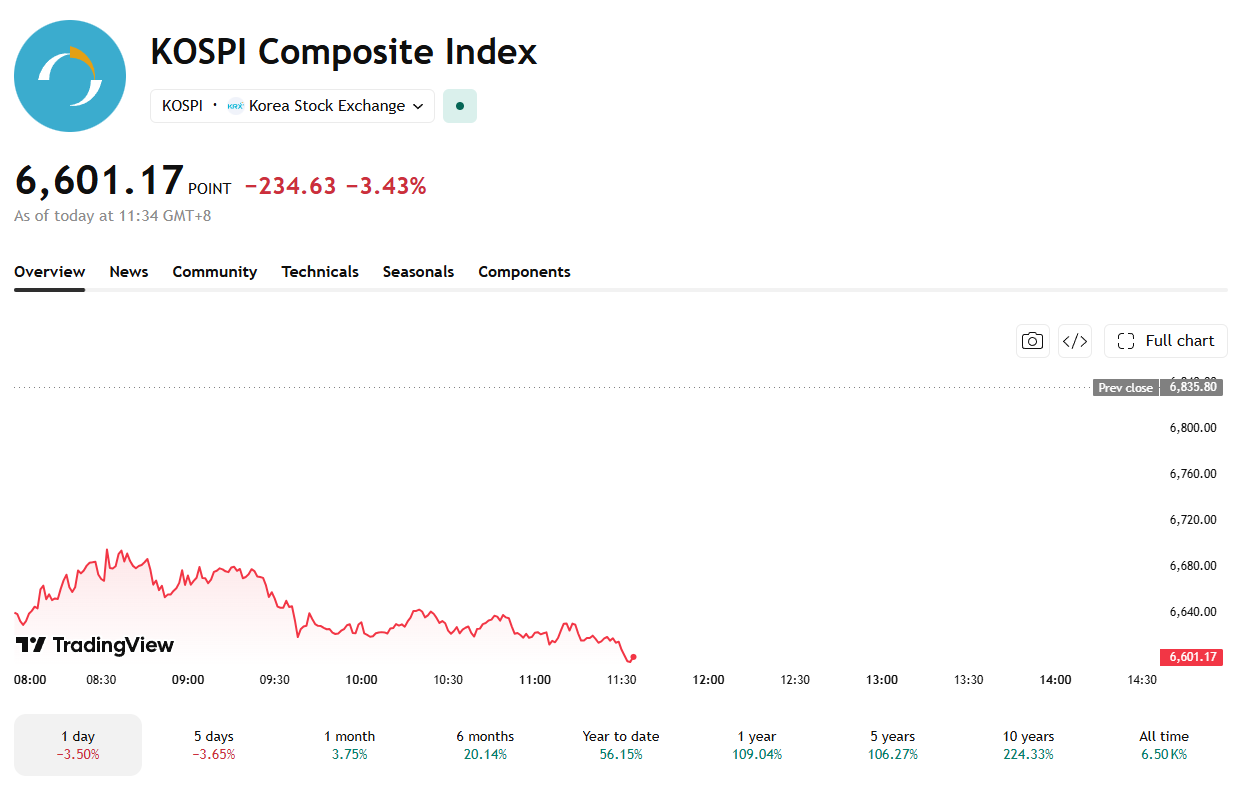
Asian equities sank in Wednesday’s trading as renewed US airstrikes on Iran pushed oil prices higher and triggered a global bond selloff that spilled into the region.
The MSCI Asia-Pacific Index, a broad gauge of stocks outside Japan, fell 1.5%, while South Korea’s KOSPI dropped more than 3% and the Nikkei 225 slid 2.6%.
Oil Jumps as Bond Yields Hit Multi-Year Highs
Brent crude rose 1.3% to $95.91 a barrel Wednesday. The gains extended a rally that began after the United States launched fresh airstrikes on Iran on Tuesday. The attack briefly pushed oil to a five-week high.

The strikes renewed fears over disruptions to the Strait of Hormuz.
“The threat of further disruptions to the Strait of Hormuz has brought about renewed anxiety over inflation, driving a selloff in stocks across most major markets and a rout in global bond markets,” Westpac analysts wrote.
DBS analysts added that if the bond rout does not stabilize, policymakers may need more aggressive measures to cap yields.
The US 10-year Treasury yield hit an intraday high of 4.8122%, its highest level in almost three years. Japan’s 5-year government bond yield climbed to 2.295%, a record.
Most Markets are Taking a Hit
Meanwhile, crypto assets slipped alongside broader risk sentiment. Bitcoin fell to $77,000, and Ether dropped to $2,410.73, based on the latest BeInCrypto data.
Rising bond yields have already been rattling Asian tech and chip stocks in recent weeks. Wednesday’s move extended that pressure into a broader equity selloff.
However, Wall Street stocks also fell overnight as rising bond yields weighed on equities. The S&P 500 slipped 0.7% and the Nasdaq Composite fell 1%.
Traders now see a 67% chance the Federal Reserve raises rates at its two-day meeting ending September 16. That is up from a 39.6% chance a week earlier, according to the CME Group’s FedWatch tool. The tool estimates rate-hike odds from futures pricing.
With yields still climbing and a Fed decision two weeks away, markets face a volatile stretch. Wednesday’s selloff shows how directly the widening Iran conflict is now moving oil, Wall Street, and Bitcoin.
The post KOSPI Sinks 3% as Iran Strikes Push Oil to 5-Week High appeared first on BeInCrypto.
Crypto World
Bitcoin withstands $90 oil and rising yields while gold slides. A firm dollar is the catch


BTC trades choppy as $90 oil and rising bond yields weigh on stocks and gold.


Two Thai businessmen sued Tether on Aug. 31 in the U.S. District Court for the Southern District of New York, challenging the issuer’s authority to freeze approximately 42.4 million USDT before authorities secured a seizure warrant.
Summary
- Tether faces a New York lawsuit over 42.4 million USDT frozen after an HSI request.
- Plaintiffs allege no warrant or court order existed when Tether blacklisted their ten Ethereum addresses.
- A February seizure warrant directed Tether to burn USDT and reissue tokens into government custody.
- Prosecutors separately said over 61 million USDT was traced to wallets linked with investment fraud.
- Plaintiffs seek declaratory relief, an injunction, damages, reserve income disgorgement, and punitive damages from Tether.
Nutthawat Rukthammachalern and Natthawat Kasamvilas allege in their complaint that Tether blacklisted ten Ethereum addresses containing precisely 42,417,785.62 USDT on Oct. 30, 2025. The allegations have not been adjudicated, and Tether had not filed a public response as of Sept. 2.
Tether allegedly acted before obtaining legal process
The plaintiffs claim Tether acted after receiving an informal request from a Homeland Security Investigations agent. They contend no warrant, court order, subpoena or other formal legal process authorized the initial freeze.
Kasamvilas discovered the restriction after attempting a transaction, according to the filing. When he contacted Tether, the company allegedly referred him to an HSI agent’s email address without explaining its legal basis for blocking the funds.
The complaint says Tether used the addBlackList function within its Ethereum smart contract. This prevents tokens at designated addresses from moving. Another function, destroyBlackFunds, allows Tether to burn blacklisted USDT.
The plaintiffs say they acquired the tokens through secondary-market business transactions and had no direct customer relationship with Tether. They argue that possessing technical control over the smart contract does not automatically give Tether legal authority over tokens held by third parties.
A later warrant targeted tokens linked to alleged fraud
On Feb. 19, 2026, a magistrate judge in the Eastern District of North Carolina issued seizure warrant 5:26-MJ-1267-JG. According to the New York complaint, the warrant described a process under which Tether would burn USDT at the identified addresses, mint an equivalent amount and transfer the replacement tokens to a government-controlled wallet.
Five days later, federal prosecutors announced the seizure of more than $61 million in USDT. Investigators alleged that the targeted wallets received proceeds from cryptocurrency investment scams commonly called pig-butchering schemes.
HSI reportedly opened the investigation after receiving a victim’s tip. Investigators traced funds through multiple wallets that authorities said were used to obscure the money’s source, ownership and connection to fake trading platforms.
The Justice Department thanked Tether for assisting with the asset transfer. Tether separately confirmed its involvement in the broader $61 million operation.
However, the new complaint says the plaintiffs’ specific 42.4 million USDT remained frozen when the case was filed. It seeks to prevent Tether from burning those tokens. The available records therefore do not establish that the disputed tokens had already been transferred to the government wallet.
Tether lawsuit tests stablecoin issuers’ freezing powers
The plaintiffs do not merely challenge the government’s tracing allegations. Their case focuses on whether a private stablecoin issuer may restrict secondary-market tokens after an informal law-enforcement request and before receiving judicial authorization.
They also argue the February warrant could not retroactively validate Tether’s October action. The complaint further disputes whether a seizure warrant permits burning the named property and replacing it with newly minted tokens before a final forfeiture judgment.
The claims include conversion, trespass to chattels, unjust enrichment and requests for declaratory and injunctive relief. The businessmen want Tether ordered to remove the blacklist, pay damages if the tokens are destroyed and surrender income allegedly earned from reserves supporting the frozen USDT.
Tether’s law-enforcement powers operate at a considerable scale. As crypto.news previously reported, the company froze $514 million across 370 addresses during one 30-day period in 2026. Its 2025 blacklist covered 4,163 Ethereum and Tron addresses, according to BlockSec data cited in that report.
The next procedural step will be service of the complaint and Tether’s response. The court could also consider an early injunction request if the plaintiffs seek immediate protection against burning or reissuing the disputed tokens.
Separately, the plaintiffs told the New York court that they filed an application in North Carolina on July 31 seeking the return of the USDT. Neither proceeding has produced a judgment on ownership, forfeiture or Tether’s liability.

A consortium of 21 major financial institutions says it will form a dedicated company to develop and issue regulated stablecoins, signaling another push by traditional banks and asset managers toward dollar-denominated digital money.
The group, announced Tuesday, includes Bank of America, Goldman Sachs, Citi, Deutsche Bank, UBS, Santander, MUFG and Fidelity Investments. The consortium’s stated goal is to launch a US dollar stablecoin in the first half of 2027, contingent on forming the company and satisfying other conditions.
Key takeaways
- The consortium’s planned launch of a US dollar stablecoin is targeted for the first half of 2027, subject to corporate formation and other requirements.
- After the initial dollar product, the group intends to expand into other G7-denominated stablecoins, with a euro coin identified as the next priority.
- The stablecoin design is positioned for compliance with the US GENIUS Act and, where applicable, the EU’s MiCA framework.
- The membership has more than doubled since an earlier October initiative involving 10 banks exploring a reserve-backed model.
- Broader institutional momentum is building across regions, including examples from Singapore’s regulatory discussions and multiple launches by established firms.
A wider coalition builds toward regulated stablecoins
According to the consortium’s announcement, the new venture is expected to address wholesale, institutional and retail use cases. Proposed applications include cross-border payments and digital asset settlement—areas where stablecoins can potentially reduce friction compared with legacy settlement workflows.
The group also emphasized regulatory alignment. Its initiative is intended to comply with both the US GENIUS Act and the European Union’s Markets in Crypto-Assets Regulation (MiCA), where applicable. That matters for market participants because stablecoin issuance, distribution, and reserve management typically face heightened scrutiny once products move from pilots into mainstream financial rails.
In addition, the consortium says it plans to broaden beyond a single denomination. After the dollar release, it sees a euro stablecoin as the next major step—an approach that reflects both currency demand and the regulatory expectations different regions may impose.
From a 10-bank probe to 21 institutions
The initiative expands on an earlier effort announced last October. At the time, an initial group of 10 banks said they were exploring a 1:1 reserve-backed form of digital money available on public blockchains. By Tuesday, the consortium’s membership had more than doubled, bringing together institutions spanning North America, Europe, East Asia, the Middle East and Africa.
That expansion suggests the stablecoin conversation has shifted from individual exploration to coordinated planning—often a prerequisite for building shared standards, clarifying reserve and issuance mechanics, and navigating cross-border legal requirements.
While the consortium has not detailed issuance mechanics in the announcement excerpt provided, its stated timeline and compliance framing indicate it expects regulatory conditions to be central to execution rather than an afterthought.
Why GENIUS and MiCA matter for adoption
Stablecoin adoption has accelerated in recent years, and the consortium explicitly ties its strategy to clearer regulatory pathways. In the US, the GENIUS Act is referenced as a key driver for how a compliant stablecoin could be issued and used. In the EU, MiCA provides a framework that has influenced how market players structure offerings and disclosures.
For investors and builders, the practical difference between “stablecoin growth” and “regulated stablecoin issuance” is significant. Regulatory clarity can influence bank participation, custodial relationships, settlement partnerships, and the willingness of traditional payment networks to integrate stablecoin rails.
Even outside Europe and the US, regulators are actively shaping the boundaries. According to a separate Tuesday announcement from Singapore, the city-state is considering allowing jointly issued cross-border stablecoins into its regulatory regime, revisiting an earlier decision to restrict the framework to domestic issuance. That kind of evolution can be important for consortia, because cross-border stablecoin models often require coordination between jurisdictions.
Institutional momentum already shows the market’s pull
The consortium’s plan arrives amid broader signs of mainstream engagement. Earlier in 2025, a Fireblocks survey of 295 executives found that 90% of respondents were using or planning to use stablecoins. That kind of adoption intent can help explain why large financial firms are now looking beyond experimentation and toward structured issuance strategies.
Developments across the industry also illustrate how quickly participation has broadened. Societe Generale’s crypto subsidiary has issued euro- and dollar-denominated stablecoins, while Fidelity has launched its US dollar-pegged FIDD stablecoin. Meanwhile, Standard Chartered has backed a Hong Kong dollar stablecoin venture. These examples suggest that while the consortium targets a future launch, parts of the market have already moved into live offerings and distribution experiments.
There is also a competitive element to this landscape. As major firms test stablecoin use cases—from custody and settlement to payments—regulators and counterparties gain real-world evidence for how products should operate. In that context, the consortium’s emphasis on compliance with GENIUS and MiCA reads as both a risk-management decision and a roadmap for scaling.
What to watch next
For now, the key unknown is execution: the consortium’s ability to finalize corporate structure, meet regulatory requirements, and define reserve and issuance arrangements at launch will determine whether a first-half-2027 dollar stablecoin becomes a practical on-ramp for institutions—or remains a high-level plan. Investors and market participants should track how the group formalizes governance, how regulators interpret stablecoin rules in each jurisdiction, and whether euro expansion timelines follow quickly after the initial US dollar rollout.


Core says the incident is contained and its planned forward upgrade will not roll back the network or reverse previously confirmed transactions.
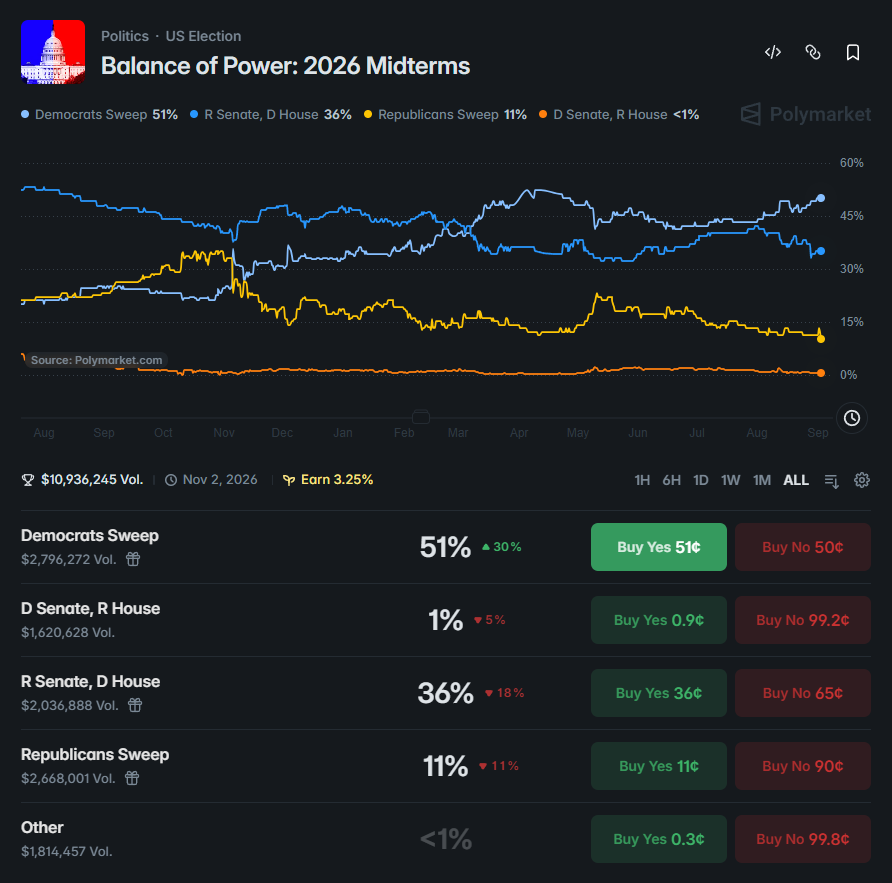
Cryptocurrency-based prediction platform Polymarket now gives Democrats better-than-even odds of sweeping both chambers of Congress in November. Trump’s approval ratings are sliding, and gas prices just hit a fresh record.
The odds have moved fast. A Democratic sweep sat at just 26% a year ago and 45% one month ago.
Democrats Gain Ground as Trump’s Support Slides
Polymarket’s 2026 midterms market, called Balance of Power, puts the odds of a Democratic sweep at 51%. The House looks decided, with Democrats holding 89% odds. The Senate is closer, with Democrats at 51%.

Republicans currently control both chambers of Congress. Elections are set for Nov. 3.
Trump’s Approval Rating Drops for A Number of Reasons
The shift tracks Trump’s sliding approval. Some surveys put his support as low as 32% to 34%.
A Financial Times and FocalData poll found most Americans say their finances have worsened under Trump. A majority of independents agreed.
A separate Reuters and Ipsos poll found Democrats now edge out Republicans on the economy. Voters split 37% to 36% in the Democrats’ favor, ending nearly a decade of Republican advantage on the issue.
Rising gas prices are adding to the pressure. The national average hit a record $4.056 a gallon in August.
That breaks the previous high of $3.940, set in 2022. The conflict with Iran keeps energy markets on edge.
Trump has defended the price spikes as a necessary cost of pushing Iran toward denuclearization. He said he would never apologize because he did the right thing.
Trump has also moved to court Venezuelan oil supply. He met with industry executives this week to try to cool prices.
Election Day is two months away. The question now is whether Republicans can reverse the slide, or whether Polymarket’s odds keep drifting toward a Democratic sweep.
The post Crypto Bettors Give Democrats 51% Odds to Sweep the Midterms appeared first on BeInCrypto.
Goldman Sachs, Jane Street Group, and Millennium Management were the three largest reported holders of spot XRP ETFs in second-quarter 13F filings, according to Bloomberg Intelligence data shared by James Seyffart on August 31.
The filings show that institutional exposure has grown alongside a sharp increase in XRP ETF inflows, even as the Ripple token itself has pulled back from its August highs.
Advisors Dominate XRP ETF Holdings
Bloomberg’s compilation puts Goldman Sachs well ahead of other reported holders, with $87.4 million in ETF exposure representing 84 million XRP. Jane Street followed with just under 16 million XRP, worth $16.6 million, while Millennium Management held 15.5 million tokens valued at about $16.2 million.
Intesa Sanpaolo ranked fourth with $14.4 million in exposure, followed by Marex UK Holdings at $8.1 million. Citadel Advisors also appeared in the filing data, although its XRP exposure fell by $645,000. But SIG Holdings recorded a much larger reduction, with its reported XRP exposure down by roughly $4.6 million.
Across the identified holders, total exposure reached $183.5 million, representing about 176.4 million XRP. Bloomberg also grouped the holders by category and found investment advisors far ahead of the other groups, with $120.9 million in exposure. Hedge fund managers accounted for $25.1 million, brokerages for $17.9 million, and banks for $14.8 million.
ETF Demand Rises While XRP Price Cools
The numbers come as demand for spot XRP ETFs has picked up, with the funds attracting $110.5 million during the week ending August 28, their strongest five-day inflow since the first week of December 2025, when they drew in more than $230 million. SoSoValue data shows another $5.6 million entered the products on August 31, taking cumulative net inflows to about $1.67 billion, with total net assets reaching roughly $1.45 billion.
Meanwhile, the token itself was trading near $1.40 at the time of writing, having hit a multi-month high of $1.70 last week. Although that price represents a nearly 9% dip over seven days, it is still 28% higher than where it was a month ago and almost 40% up from its level two weeks ago. That said, XRP’s value is still nearly half of what it was this time last year, and it is stuck approximately 62% below its all-time high of $3.65 recorded in July 2025.
Traders are now watching the $1.35 to $1.38 zone closely, since a break below could open the door to more downside, while analyst Ali Martinez fingered $1.60 as the next major resistance level were XRP to attempt another recovery.
The post These Wall Street Giants Are the Biggest Holders of Spot XRP ETFs appeared first on CryptoPotato.


Donald Trump Jr. is deepening his ties to Polymarket through a new $300 million investment from 1789 Capital, his venture firm. He also holds a paid advisory role, and equity, at rival Kalshi, giving him a stake in whichever platform wins.
1789 Capital is contributing $300 million to Polymarket’s $1 billion round, valuing the platform at $21 billion. Trump Jr. separately holds a Kalshi stake, granted in 2025 and worth $300,000 at the time, before Kalshi’s valuation climbed to $22 billion.
Advisor to Both Sides
Trump Jr. became a paid strategic advisor to Kalshi in January 2025. He joined Polymarket’s advisory board seven months later, alongside 1789 Capital’s initial investment in the platform.
The arrangement gives the president’s son financial or advisory ties to the two largest prediction market platforms in the country. Both compete for the same users and the same regulatory outcomes.
Front Office Sports flagged the dual role at the time, noting that advising two direct rivals raises its own conflict-of-interest questions. Kalshi has told CNBC that Trump Jr.’s advisory work concerns marketing strategy, not regulatory matters.
A Direct Line to Regulators
The New York Times reported that Trump Jr. privately urged Republican attorneys general to stop pursuing prediction markets. The remarks came in March, at a closed-door gathering in New Orleans. He argued that traditional gambling companies were driving the pushback to protect their own market position. The Times cited people familiar with the matter.
The Commodity Futures Trading Commission has sued nine states this year to block state regulation of prediction markets. Eight of those states have Democratic attorneys general. Arizona has gone further than most, filing criminal charges against Kalshi in March over unlicensed gambling.
Trump Jr.’s dual advisory roles sit inside that fight. Any state loss for Kalshi or Polymarket touches a business he is tied to twice over.
President Trump has separately backed the industry. He called prediction markets a new class of financial product in May. He also argued that the CFTC’s authority over them should stay intact. His son’s financial interests in both leading platforms now sit atop that same policy debate.
The post Trump Jr. Now Profits From Both Sides of the US Kalshi, Polymarket Rivalry appeared first on BeInCrypto.


Pantera Capital founder Dan Morehead calls the US Treasury’s expanded bond buyback plan a bluff that backfired. He ties Bitcoin’s 26% August rally directly to it.
Speaking on Bloomberg Crypto, Morehead argued investors saw through Treasury Secretary Scott Bessent’s move almost immediately.
The Buyback That Backfired
On August 19, Bessent doubled the Treasury’s bond buybacks to ease borrowing costs. The program lets the government repurchase its own debt to influence bond yields. The cap rose to at least $4 billion per operation.
Morehead said the increase looked tiny against the $2 trillion in bonds the Treasury must sell every year. Highlighting the gap, he argued, only exposed the depth of the debt problem rather than solving it.
“It backfired because everyone could see they are off by three orders of magnitude.”
Dan Morehead, Pantera Capital founder, Bloomberg
Bitcoin’s Best August Since 2021
Bitcoin climbed 26% in August, its strongest month since November 2025. It marked the first net positive August since 2021, briefly topping $81,000. BTC traded near $77,258 at press time, per BeInCrypto data.
Fed Chair Kevin Warsh struck a different tone at Jackson Hole. He argued stronger growth could lift rates and reduce the appeal of yield-free assets like bitcoin. Both gold and Bitcoin retreated after the speech, giving Morehead’s bullish debt thesis its clearest pushback yet.
Morehead called crypto a macro trade that benefits whenever governments keep expanding debt. He pointed to Pantera’s call that Bitcoin would peak at $117,542 on August 10, 2025, a forecast that held. He argued the same four-year cycle model now points to another leg higher once this pullback ends.
Bitcoin peaking on the exact day Pantera called years earlier means the current pullback fits the same script, according to Morehead. He said the pattern has held for the 13 years his fund has tracked it.
Morehead expects a new upswing to begin near the end of this year, followed by another two to three year run.
The post Pantera's Dan Morehead Calls Bessent's Bond Buyback a ‘Bluff' That Backfired appeared first on BeInCrypto.


A two-month-old Layer 2 built by a stock brokerage is now processing more daily decentralized exchange volume than chains that have existed for years, and the market is only beginning to pay attention.
Summary
- Robinhood Chain recorded roughly $945 million in daily decentralized exchange volume on Aug. 25, 2026, a new all-time high for the network and nearly double its previous record of $563 million set on July 8.
- The chain, which launched its public mainnet on July 1, has processed more than $47 billion in cumulative DEX volume in under two months, placing it fifth among all chains by 30-day volume at $15 billion.
- Uniswap serves as the dominant trading venue on the chain, and cumulative tokenized stock volume through Uniswap surpassed $1 billion by Aug. 21.
- Total value locked on Robinhood Chain surged from $4 million in June to roughly $1.4 billion by late August, a trajectory that no Ethereum Layer 2 has matched at this stage of its lifecycle.
- The 90-day gas subsidy that covers transaction fees through the end of September 2026 raises a central question: whether volume holds once users start paying for their own trades.
How Robinhood built a top-five chain in 56 days
Robinhood Chain is an Ethereum Layer 2 built on Arbitrum Orbit, the chains-as-a-service framework that runs on the Nitro stack. It settles directly to Ethereum and uses Ethereum blobs for data availability. Block times run at 100 milliseconds, faster than Arbitrum One at 250 milliseconds and Monad at 300 milliseconds. The gas token is ETH.
The mainnet went live on July 1 at Robinhood’s “The World is Flat” keynote at the Old Royal Naval College in London. Within eight days, Uniswap swap volume on the chain had reached $500 million. By July 11, the chain was processing 7.6 million daily transactions and had recorded $3.1 billion in DEX volume in its first week alone.
By the end of July, Robinhood Chain had topped Ethereum in 24-hour application revenue. It had briefly surpassed Base in daily active users, logging 324,000 wallets against Base’s 275,000 on July 21. And it had placed itself in the top five chains globally by 30-day DEX volume, sitting behind Solana, BNB Chain, Ethereum, and Base with roughly $15 billion in monthly throughput.
For context, Arbitrum One’s 30-day DEX volume during the same period was roughly one-quarter of that figure. Robinhood Chain, using the same underlying technology, was running four times the volume of the chain it forked from.
The volume breakdown: what is actually trading
The Aug. 25 record was not driven by a single asset class. Three distinct categories of activity converged on the same day.
The first was memecoin speculation. Pons, a token launched through the chain’s launchpad ecosystem, accounted for roughly half of all DEX volume at its peak. CASHCAT, Robinhood Chain’s first breakout memecoin, had previously hit a $156 million market cap before Pons overtook it in late July. On Aug. 30, Pons alone contributed $445 million of the chain’s $874.8 million in volume that day, demonstrating the degree to which a single venue can dominate chain-level metrics.
The second was tokenized equities. Robinhood launched Stock Tokens as a flagship product at mainnet, offering ERC-20 representations of stocks like NVIDIA, Apple, GameStop, and SpaceX that trade around the clock in more than 120 countries. These tokens give holders economic exposure to the underlying stock rather than legal ownership of shares. By Aug. 21, cumulative tokenized stock volume through Uniswap had surpassed $1 billion. A tokenized Nasdaq-100 tracker called QQQB drove 288 percent of July’s tokenized equity volume, suggesting heavy concentration in index products.
The third was leveraged derivatives. Arcus launched pTokens on Aug. 25, wrapping leveraged perpetual accounts into transferable ERC-20 tokens including pBTC3x and pHOOD3x. The platform also began accepting tokenized stock collateral at a 50 percent loan-to-value ratio, creating a direct bridge between equity exposure and leveraged crypto trading that has no equivalent on any other chain.
The timing of the Aug. 25 spike also mattered. Bitcoin had rallied sharply since Aug. 17 on what Bloomberg called a record $2.7 billion wave of short liquidations, the largest since records began in 2021. A White House crypto meeting and a U.S. Treasury move to double long-dated bond buybacks added fuel. Bitcoin reached near $81,500 and Ether gained nearly 29 percent in a single week. That macro tailwind lifted activity across every chain, but Robinhood Chain captured a disproportionate share because its zero-fee environment made it the path of least resistance for traders looking to rotate quickly between assets.
The stablecoin layer underneath the trading activity tells its own story. Stablecoin market capitalization on Robinhood Chain reached $640 million by late August, with USDe from Ethena accounting for the bulk of inflows. Robinhood Earn, a decentralized lending product launched alongside the mainnet, offers an estimated 7 percent yield on USDG, the stablecoin developed in partnership with Paxos. The yield product serves as an anchor for capital that might otherwise leave the chain between trading sessions, giving the ecosystem a retention mechanism that pure trading chains typically lack.
The infrastructure advantage Robinhood brought to the table
Most Layer 2 networks launch with a technical thesis and then spend months or years trying to attract users. Robinhood reversed the sequence. The company brought 27 million funded brokerage accounts, an existing mobile wallet, a compliance infrastructure built over a decade of regulatory engagement, and a brand that, whatever crypto natives think of it, is synonymous with retail trading for an entire generation of investors.
CEO Vlad Tenev framed the ambition in a recent interview: “Crypto is becoming the infrastructure that powers financial markets.” On Aug. 7, he described Robinhood Chain as the fastest-growing chain in history, noting that it reached 100 million cumulative transactions faster than any other network. Bitmine Chairman Tom Lee separately called the launch “one of the biggest crypto success stories” of 2026.
The revenue model also differs from most Layer 2 networks. Under the Arbitrum Expansion Program, 8 percent of chain revenue goes to a treasury controlled by governance token holders and 2 percent funds a developer guild. Robinhood keeps the rest. In July alone, the chain generated roughly $3.6 million in transaction fees, making it the top revenue-producing Layer 2 across the entire Ethereum ecosystem at 38 percent of the estimated $6.3 million in total L2 fees collected that month.
The company’s Q2 2026 earnings, reported on July 29, showed total revenue of $1.31 billion, beating Wall Street estimates. Net income rose 48 percent year over year to $573 million. Robinhood is not a startup hoping its chain will subsidize losses. It is a profitable company with a stock trading above $100 that can afford to invest in chain infrastructure without needing the chain itself to be immediately profitable.
The gas subsidy question
The single most important variable in Robinhood Chain’s near-term trajectory is the 90-day gas fee subsidy that covers all transaction costs through the Robinhood Wallet. The promotional period, which began at mainnet launch on July 1, runs through approximately Sept. 29, 2026.
In mid-August, Robinhood reduced the subsidy threshold from $5 per transaction to $0.50, a 90 percent cut that suggests the company is already tapering the benefit rather than cutting it off all at once. The move signals a gradual transition rather than a cliff.
But the subsidy has clearly inflated activity metrics. When transactions cost nothing, the friction that normally separates casual browsing from actual trading disappears. The 16,000 new tokens created daily at peak memecoin activity in July were possible in part because launching a token was free. The 5.5 million daily transactions on Aug. 25 included activity that would not have occurred at even minimal gas costs.
The precedent from other chains is mixed. Base launched with heavily subsidized gas and retained strong activity after costs normalized, in part because Coinbase’s distribution kept funneling users to the network. Blast, by contrast, saw activity crater after its incentive programs wound down. The question for Robinhood Chain is whether the brokerage’s 27 million accounts provide a durable demand floor that subsidies merely accelerated, or whether the subsidy itself created demand that will not survive its removal.
There is a middle scenario that the binary framing obscures. Volume could fall significantly from the Aug. 25 peak and still leave Robinhood Chain as a top-ten chain by DEX activity. A 60 percent drop from $945 million would still produce roughly $380 million in daily volume, which would place it ahead of most Layer 2 networks even without subsidies. The relevant question is not whether volume declines after the subsidy ends, because it almost certainly will, but whether the floor is high enough to sustain the ecosystem’s economic model.
The corporate chain land grab
Robinhood Chain did not launch into a vacuum. It entered a market where every major financial technology company appears to be building its own chain. Coinbase has Base. Stripe acquired Bridge and is building payment infrastructure on it. Circle launched a new standard for stablecoin interoperability. Robinhood followed with its own Arbitrum-based rollup.
The pattern is clear: consumer fintech companies have concluded that owning the execution layer is more valuable than renting space on someone else’s chain. The economics are straightforward. A chain operator captures sequencer revenue, controls the fee schedule, and can subsidize specific types of activity to drive adoption. A tenant on another chain pays whatever fees the market demands and has no control over the user experience at the infrastructure level.
The comparison to Base is instructive. Base launched in August 2023 and has had three years to build its ecosystem. Its total value locked stands at roughly $5.47 billion as of late August 2026, compared to Robinhood Chain’s roughly $1.4 billion. Base processes more daily transactions on average. But Robinhood Chain closed the gap on several metrics in weeks rather than years, briefly surpassing Base in daily active users and consistently ranking within striking distance on DEX volume.
The difference is maturity versus momentum. Base has accumulated three years of liquidity, developer tooling, and protocol deployments. Robinhood Chain has a brokerage with 27 million accounts and a product, tokenized equities, that no other chain offers at the same scale.
The DEX-to-CEX ratio and what it means
Robinhood Chain’s volume spike arrived during a broader structural shift in crypto trading. In July 2026, decentralized exchanges handled spot volume equal to 24.14 percent of centralized exchange volume, the highest ratio since The Block began tracking the metric in 2019. The ratio has roughly tripled in under three years, rising from below 10 percent for most of 2024 to its current level.
The irony is that the shift is being driven in part by centralized companies. Robinhood, a centralized brokerage, is routing volume through a decentralized exchange layer. Coinbase, a centralized exchange, is doing the same through Base. The line between centralized and decentralized finance is blurring in ways that do not fit neatly into the narratives that either side prefers.
For Robinhood specifically, the chain creates a flywheel that its centralized app cannot replicate. Stock Tokens traded on Uniswap generate fees that flow back to the Robinhood Chain ecosystem. Users who start with tokenized equities discover memecoin trading, lending protocols, and leveraged products. The chain becomes a surface area for financial experimentation that a regulated brokerage app cannot legally offer through its primary interface.
This is the strategic logic that the market has largely missed. Robinhood Chain is not a marketing exercise. It is a mechanism for Robinhood to offer products and services that its regulated brokerage cannot provide directly, while still capturing economic value from the activity.
The concentration risk
The bull case for Robinhood Chain is compelling, but the data also reveals structural vulnerabilities that the headline volume numbers obscure.
On Aug. 30, a single protocol, Pons, generated 51 percent of the chain’s $874.8 million in daily volume. When one venue does half of all throughput, the chain’s activity metrics become a proxy for that venue’s performance rather than a measure of ecosystem health. If Pons loses momentum, the chain’s volume numbers could drop by half overnight without any change to the underlying infrastructure.
The tokenized equity market, while growing, remains concentrated as well. QQQB, a single Nasdaq-100 tracker, drove the majority of July’s tokenized stock volume. A dozen stocks clear at least $500,000 in daily volume, but the breadth of adoption is still narrow relative to the potential market.
Total value locked tells a similar story. Robinhood Chain’s TVL has surged to $1.4 billion, but this remains roughly one-quarter of Base’s $5.47 billion. The chain’s TVL-to-volume ratio is unusually high, meaning it generates more trading activity per dollar locked than most chains. That can be read as capital efficiency or as evidence that volume is being amplified by zero-cost transactions and speculative turnover rather than deep, sticky liquidity.
Stock Tokens also remain unavailable to U.S. residents, which excludes the majority of Robinhood’s 27 million funded accounts from the chain’s flagship product. The addressable market for tokenized equities is currently limited to users outside the United States, a significant constraint on growth.
The reflexive fee structure on Pons adds another layer of fragility. Eighty percent of the protocol’s fees fund automated token buybacks and burns. By Aug. 29, 29 percent of the original one billion token supply had been retired. That mechanism creates a self-reinforcing loop in rising markets: higher volume generates more fees, which fund more burns, which reduce supply, which pushes prices higher, which attracts more volume. In falling markets, the same loop works in reverse. Volume drops, burns slow, the supply compression narrative weakens, and traders move to the next opportunity. Chains built on reflexive tokenomics tend to experience sharp drawdowns when sentiment shifts.
What Robinhood Chain means for Ethereum
Robinhood Chain settles to Ethereum. Every transaction on the chain ultimately posts data to the Ethereum mainnet through blobs. This means that Robinhood Chain’s activity, all $47 billion of it, contributes to Ethereum’s security budget and reinforces the network’s role as a settlement layer.
For Ethereum, the emergence of corporate-backed Layer 2 networks is a double-edged development. On one side, chains like Robinhood and Base bring millions of users into the Ethereum ecosystem who would never interact with the mainnet directly. They generate blob fees, consume blockspace, and create economic gravity around ETH as a gas token.
On the other side, these chains capture most of the value at the execution layer. Robinhood keeps the bulk of sequencer revenue, sharing only 10 percent with the Arbitrum ecosystem. The users on Robinhood Chain may never know or care that Ethereum exists underneath. The settlement layer becomes invisible infrastructure, essential but unrewarded relative to the activity it supports.
This dynamic is already visible in the fee data. Robinhood Chain surpassed both Ethereum and Base in 24-hour application revenue on Aug. 31, recording $2.66 million. The chain built on Ethereum is generating more application-level revenue than Ethereum itself on certain days.
The tension between Layer 2 growth and Layer 1 value capture is not unique to Robinhood Chain, but the scale makes it unusually visible. Ethereum’s blob fee revenue from all Layer 2 networks remains a small fraction of what those networks generate in sequencer revenue. The argument that Layer 2 activity is inherently good for Ethereum depends on the assumption that demand for blob space will eventually drive meaningful fee revenue back to the mainnet. At current utilization levels, that assumption remains unproven. Robinhood Chain’s success makes the question more urgent without answering it.
The September test
The gas subsidy expires at the end of September. Between now and then, several developments will clarify whether Robinhood Chain’s trajectory is sustainable.
Arcus is expanding its leveraged product suite, adding new pToken pairs and increasing collateral types. If leveraged trading generates durable volume independent of the gas subsidy, it would suggest that the chain has found a product-market fit that goes beyond free transactions.
The DTCC is scheduled to launch tokenized securities infrastructure in October, which could either validate or undermine Robinhood’s first-mover advantage in tokenized equities. If institutional players enter the market with competing infrastructure, the value proposition of Stock Tokens may shift.
And Robinhood itself will face a decision about whether to extend, modify, or eliminate the gas subsidy. The company’s financial position gives it the flexibility to continue subsidizing transactions if it believes the long-term economics justify the cost. With $573 million in quarterly net income, a few million dollars in gas subsidies is a rounding error on the income statement.
What to watch
What is Robinhood Chain?
Robinhood Chain is an Ethereum Layer 2 blockchain built on Arbitrum Orbit technology. It launched its public mainnet on July 1, 2026, and uses ETH as its native gas token. The chain settles directly to Ethereum and features 100-millisecond block times. Its flagship products include tokenized Stock Tokens, decentralized exchange trading through Uniswap, and lending through protocols like Morpho.
How much DEX volume does Robinhood Chain process?
On Aug. 25, 2026, Robinhood Chain recorded roughly $945 million in daily decentralized exchange volume, a new all-time high. The chain has processed more than $47 billion in cumulative DEX volume since launching on July 1. Its 30-day volume of approximately $15 billion places it fifth among all blockchain networks, behind Solana, BNB Chain, Ethereum, and Base.
What are Stock Tokens on Robinhood Chain?
Stock Tokens are ERC-20 tokens that track the price of publicly traded equities like NVIDIA, Apple, GameStop, and SpaceX. They give holders economic exposure to the underlying stock rather than legal ownership of shares. Stock Tokens trade around the clock in more than 120 countries through decentralized exchanges like Uniswap on Robinhood Chain. They are currently unavailable to U.S. residents.
Is there a Robinhood Chain token?
No. Robinhood has not issued a native governance or utility token for Robinhood Chain. The network uses ETH for gas fees. While several community-created tokens like CASHCAT and PONS trade on the chain, none of these are officially affiliated with Robinhood.
How does Robinhood Chain compare to Base?
Base, built by Coinbase, launched in August 2023 and has roughly $5.47 billion in total value locked compared to Robinhood Chain’s $1.4 billion. Base processes more daily transactions on average and has a more mature ecosystem of developer tools and protocols. However, Robinhood Chain closed the gap on several metrics within weeks, briefly surpassing Base in daily active users and ranking within striking distance on daily DEX volume.
What is the gas subsidy on Robinhood Chain?
Robinhood covers transaction fees for users trading through the Robinhood Wallet on Robinhood Chain. This 90-day promotional period began at mainnet launch on July 1 and runs through approximately Sept. 29, 2026. In mid-August, Robinhood reduced the subsidy threshold from $5 to $0.50 per transaction, signaling a gradual taper rather than an abrupt cutoff.
Who can use Robinhood Chain?
Robinhood Chain is a permissionless Ethereum Layer 2, meaning anyone with a compatible wallet can interact with it. However, the tokenized Stock Tokens product is available in more than 120 countries but is not available to U.S. residents. Other DeFi products on the chain, including decentralized exchange trading and lending, are accessible to users globally through wallets like Robinhood Wallet, MetaMask, and others.
How does Robinhood make money from the chain?
Robinhood captures sequencer revenue from transactions processed on the chain. Under the Arbitrum Expansion Program, 8 percent of chain revenue goes to a treasury controlled by Arbitrum governance token holders and 2 percent funds a developer guild. Robinhood retains the remaining 90 percent. In July 2026, the chain generated roughly $3.6 million in transaction fees, making it the top revenue-producing Layer 2 in the Ethereum ecosystem.
Disclaimer: This article is for informational purposes only and does not constitute financial advice. Always do your own research before making investment decisions. Information is accurate as of Aug. 31, 2026.

KOSPI Sinks 3% as Iran Strikes Push Oil to 5-Week High

Amid ‘very long meetings’ and running chess world, has Viswanathan Anand lost ‘hunger’ to win? | Exclusive | Chess News

Are All TVs At Risk From Burn-In? Here’s How To Avoid The Problem Altogether





-

 Fashion4 days ago
Weekend Open Thread: Maeve – Corporette.com
-

 Crypto World5 days ago
Bitcoin’s 22% rally now needs real demand to outlast Treasury liquidity boost
-

 Crypto World7 days ago
Warsh Jackson Hole keynote puts financial innovation first
-

 Business5 days ago
Apple Confirms September 9 Keynote and Reveals Its Full Pre-Order Schedule
-

 Crypto World6 days ago
Elon Musk Grok Bot Promise: We Will Make You Whole if AI Loses Your Money
-

 Business5 days ago
Salesforce Stock Soars 19% as Blowout Earnings and Agentforce AI Growth Silence Software Skeptics
-

 Business4 days ago
Onto Innovation Stock: AI’s Next Bottleneck Is Yield (NYSE:ONTO)
-
 NewsBeat6 days ago
Lindsay Clancy jury braces for closing arguments as judge tells court: ‘You’ve heard all the evidence’ – Live updates
-

 Business7 days ago
Walmart takes aim at younger shoppers with new fashion brand
-

 Crypto World6 days ago
NVIDIA revenue hits $96.2B as AI demand doubles
-

 Crypto World4 days ago
Bitcoin price tests $82K resistance as Brandt stays long
-

 Crypto World7 days ago
Kraken hit by 12,000 HTX-linked dust transfers
-

 Business5 days ago
iPhone 18 Pro Pre-Orders Could Shift to Saturday as Apple Reportedly Avoids September 11 Anniversary
-

 Crypto World6 days ago
Nvidia Q2 Earnings Reveal $96.2 Billion Beat, So Why Is NVDA Falling?
-
 Tech3 days ago
Hugging Face built a $4.5 billion empire on free AI models. Now Nvidia is buying it for $12.9 billion
-

 Tech6 days ago
Claude Cowork gets its own browser that doesn’t touch your tabs, bookmarks, or saved passwords
-

 Crypto World5 days ago
Truflation calls for Fed rate cut after PCE forecast
-

 Tech4 days ago
PaperCut releases second emergency patch for exploited flaws
-

 News Videos3 days ago
Charlie Munger on Robinhood: No one should believe that Robinhood’s trades are free
-

 Sports7 days ago
SV 07 Elversberg 2026/27 season preview: Transfers, pre-season, predicted lineup & predictions
You must be logged in to post a comment Login