
Crypto World
Core DAO plans emergency hard fork after validators drew excess rewards



Core says the incident is contained and its planned forward upgrade will not roll back the network or reverse previously confirmed transactions.



Palo Alto Networks CEO Nikesh Arora said companies must build an entirely new security stack for the roughly $5 trillion of capital spending on AI infrastructure he expects over the next five years.
Arora spoke on CNBC’s Mad Money on Tuesday, after the cybersecurity firm posted fiscal fourth quarter results that beat Wall Street estimates.
Arora Breaks Down the Math Behind $1 Trillion of Cybersecurity Debt
The executive said AI is forcing companies to modernize roughly $1 trillion of aging cybersecurity infrastructure that cannot handle attacks moving at machine speed.
“There’s approximately $1 trillion of global cybersecurity debt that must be modernized to defend against automated threats because they operate instantaneously,” he stated during the earnings call.
He reached that figure through simple arithmetic. Security equipment lasts about seven years, and annual spending runs $200 billion to $300 billion.
“You’re going to see $5 trillion of capex spend in the next five years with people building AI data centers and having tons and tons of agents running around. You also have to build a net new security stack for that,” he said.
Arora highlighted the launch of Anthropic’s Mythos model earlier this year as a major shift in the cybersecurity space. The model’s ability to identify and exploit software vulnerabilities pushed companies to take cybersecurity more seriously.
Follow us on X to get the latest news as it happens
Results Back Up the Argument
That shift in urgency is already showing up in the company’s numbers. Quarterly revenue reached $3.41 billion, up 34% year over year, against analyst estimates of $3.35 billion. Adjusted earnings came in at $1.02 per share, four cents above expectations.
Next-generation Security annual recurring revenue hit $9.10 billion, a 63% increase. Remaining performance obligations rose 34% to $21.2 billion.
The company guided to $14.10 billion to $14.20 billion in revenue for fiscal 2027, ahead of the $13.79 billion forecast from analysts.
Subscribe to our YouTube channel to watch leaders and journalists provide expert insights
The post Palo Alto CEO Says $5 Trillion AI Buildout Needs New Security Stack appeared first on BeInCrypto.
Bank of America, Citi, Goldman Sachs and 18 other financial institutions committed on Sept. 1 to establish a stablecoin company during the second half of 2026, subject to closing conditions.
Summary
- Twenty-one financial institutions committed to establish a stablecoin company during the second half of 2026.
- The consortium targets a dollar stablecoin launch during 2027’s first half, subject to closing conditions.
- Additional G7 currency stablecoins may follow, with a euro-denominated product identified as the initial priority.
- The planned token would support wholesale, institutional and retail payments alongside digital asset settlement services.
- The venture intends to meet applicable GENIUS Act and MiCA requirements before beginning global operations.
The unnamed venture plans to issue a U.S. dollar-denominated stablecoin during the first half of 2027. The group said it may later introduce tokens linked to other G7 currencies, with a euro stablecoin named as its first expansion priority.
The institutions intend to use the token across wholesale, institutional and retail markets. Proposed uses include cross-border payments and settlement for digital asset transactions.
The announcement remains a development plan rather than a completed launch. The group has not disclosed the company’s name, token name, blockchain networks, reserve custodian, governance structure or final redemption terms.
Stablecoin group spans four continents
The consortium comprises banks, asset managers and other financial institutions based across North America, Europe, East Asia, the Middle East and Africa.
Its North American participants are Bank of America, Capital One, Citi, Fidelity Investments, Goldman Sachs, PNC Financial Services, Scotiabank, TD Bank Group, Wells Fargo and WisdomTree.
European members include Banco Santander, BBVA, Commerzbank, Crédit Agricole, Deutsche Bank, Lloyds Banking Group, Rabobank and UBS. MUFG Bank represents East Asia, while Sirius International Holding and Standard Bank represent the Middle East and Africa, respectively.
The group said the project would combine the participants’ distribution networks with bank compliance, governance and risk-management systems. Those are company claims about the planned product, which has not yet entered the market.
MUFG confirmed its participation through a separate release dated Sept. 2. BBVA also published the consortium announcement through its corporate news service. No later disclosure had named the operating company or assigned specific roles to individual members.
USD stablecoin plan grew from a 10-bank study
The project follows an October 2025 announcement in which 10 banks said they were studying a 1:1 reserve-backed form of digital money available on public blockchains.
The latest announcement expands that initial group to 21 institutions and moves the project from exploration toward establishing a dedicated company.
However, the consortium has not yet identified which public blockchains it will support. It has also not disclosed whether users will be able to hold and transfer tokens directly or whether access will depend on participating banks and approved service providers.
The product’s proposed user base is also broad. Wholesale use could include transfers between banks or large companies. Institutional uses could involve settlement for tokenized securities and other digital assets. Retail applications could include payments, although the consortium has not released a consumer distribution plan.
The planned token would enter a market currently led by established issuers such as Tether and Circle. The banks may compete through their existing customer relationships, compliance systems and access to payment infrastructure. Those potential advantages remain untested until the venture publishes its operating model and launches the token.
Traditional banks are also considering separate approaches. JPMorgan has held early discussions about a possible stablecoin, although the bank said it had no active launch plan and would assess customer demand and regulation, as crypto.news reported.
GENIUS Act rules remain unfinished before launch
The consortium said the dollar stablecoin “intends” to comply with the U.S. GENIUS Act where applicable. President Donald Trump signed the legislation on July 18, 2025, creating a federal framework for payment stablecoin issuers.
The law establishes licensing and supervision requirements. It also calls for stablecoins to be backed one-to-one by eligible liquid reserves, provides redemption protections and requires regular reserve disclosures. Issuers cannot pay interest or yield solely for holding a covered payment stablecoin.
Several implementing regulations were still unfinished after federal agencies missed a July 18, 2026 rulemaking deadline. The Office of the Comptroller of the Currency has proposed reporting requirements that include confidential weekly reports and quarterly financial submissions for issuers under its authority.
The OCC is targeting November 2026 for final rules, as crypto.news reported. The statute’s timing could place the federal framework into effect around the period when the bank consortium is preparing its 2027 launch.
That schedule gives the venture time to incorporate final reserve, capital, redemption, custody and compliance requirements into the product. It also leaves uncertainty because several details may change before regulators complete their work.
The Treasury Department is separately developing rules for state regulatory recognition and foreign stablecoin issuers. In related coverage, Treasury requested public feedback on licensing standards and the interaction between federal and state supervision.
A euro token would face MiCA requirements
The consortium also said it “intends” to comply with the European Union’s Markets in Crypto-Assets regulation when applicable. MiCA already provides a regulatory structure for stablecoins offered in the bloc.
A token pegged to one official currency, such as the euro, generally falls within MiCA’s electronic money token category. Issuers face authorization, reserve, disclosure and redemption requirements, with additional supervision possible if a token reaches regulatory importance thresholds.
The consortium did not say which legal entity would issue its planned euro token or where that issuer would be licensed. Those choices will determine the relevant supervisory authority and the obligations assigned to participating institutions.
Operating across the U.S. and European Union will also require coordination between regulators. The Financial Stability Board recommends comprehensive supervision and cross-border information sharing for global stablecoin arrangements because their functions can span banking, payments and securities markets.
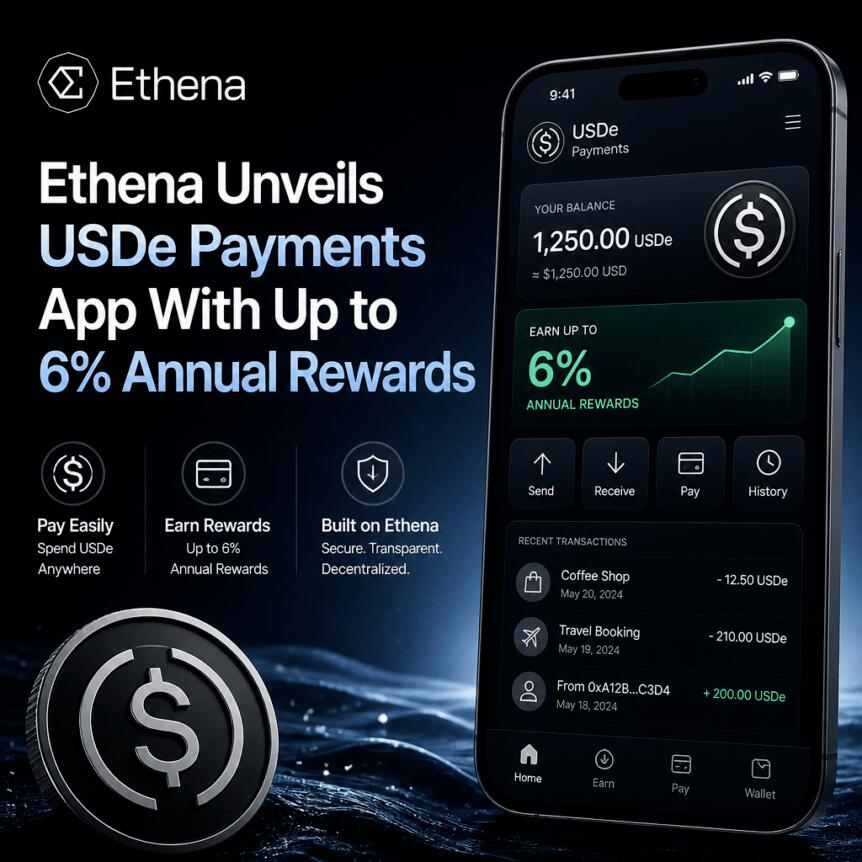
Ethena has moved beyond synthetic-dollar trading with the launch of Ethena Pay, a crypto-native “global money app” designed to make its USDe stablecoin usable for everyday payments, savings, and cross-border transfers.
Announced in a Tuesday post on X, the self-custodial app is built around holding USDe in a dollar-denominated balance, earning up to 6% annualized rewards, and spending via a payment card. Ethena says fiat access is supported through onboarding tools that convert deposits into USDe.
Key takeaways
- Ethena Pay turns USDe into a wallet-based balance for payments, savings, and transfers, with up to 6% annualized rewards for eligible users.
- In the beta, Ethena will begin with 400 users, expanding access weekly across 48 countries.
- Avalanche is listed as the exclusive settlement layer for payments and transfers.
- The app supports moving money using IBAN details and local-currency rails, but is not initially available in the US, EU, Canada, Taiwan, or South Korea.
- USDe’s market has continued to scale: DefiLlama data cited by Ethena’s report puts USDe at roughly $4.1 billion market cap, while ENA is up sharply in recent weeks.
Ethena Pay: a USDe-focused wallet for spending and transfers
Ethena positions its new product as a “money app” rather than a pure trading interface. According to the Tuesday announcement, users can deposit fiat or crypto, after which funds are converted into USDe (USDe) to create a dollar-denominated balance inside the app.
The product is also designed for external transfers. Ethena says users will be able to use IBAN details to move funds between bank accounts and settle into local currencies. For payment execution, Ethena Pay includes a payment card flow that allows users to spend their USDe balance, while also offering fiat onramps to fund the wallet.
Ethena further notes that MoonPay-owned Iron supplies backend infrastructure for the service.
Where the beta starts—and where it doesn’t
The rollout is structured as a limited beta across broad regions, including Latin America, the Caribbean, Africa, and parts of Asia. Ethena said the beta spans 48 countries, but access is initially restricted to 400 users, with availability expanding weekly.
There’s also a clear geography boundary for regulatory or operational reasons. Ethena Pay is not initially available in the United States, the European Union, Canada, Taiwan, or South Korea. Ethena indicated it expects to expand into those markets during the beta, subject to regulatory approval.
For investors and users watching stablecoin “real use” narratives, the staged launch matters: it suggests Ethena is testing both product mechanics (on/off ramps, card spend, transfer rails) and compliance constraints in select regions first, rather than attempting a full global release immediately.
Why the settlement choice matters: Avalanche for transfers
A key technical detail in the announcement is settlement. Ethena says Avalanche will serve as the exclusive settlement layer for Ethena Pay’s payments and transfers.
This matters because the user experience of a payments product depends not just on custody and user interfaces, but also on how value is processed behind the scenes—especially for cross-border activity. By naming a single settlement layer, Ethena is effectively narrowing one major variable for the beta: how transfers are finalized and coordinated as transactions scale.
As Ethena expands the app in waves, traders and ecosystem builders will likely watch whether the payment and transfer flows remain consistent in speed and reliability across regions, and whether the company adds settlement options later or keeps Avalanche exclusively for the broader rollout.
USDe and ENA: growth backdrop for the payments push
USDe is the synthetic dollar that underpins Ethena Pay. Ethena describes it as an Ethereum-based protocol designed to keep its value close to $1 without relying on traditional banking infrastructure.
According to the information provided, USDe maintains its peg using crypto collateral and hedging strategies, including derivatives positions. Ethena’s announcement cites DefiLlama data indicating USDe has reached a market capitalization of about $4.1 billion, which it characterizes as making it the sixth-largest stablecoin by market cap.
Ethena also operates ENA, its governance token. The same coverage notes ENA’s market capitalization at roughly $1.5 billion, and says the token has rallied about 68% over the past month, though it remains below earlier highs.
Separately, the Ethena Foundation proposed on Friday directing 95% of the net revenue it receives from Ethena’s core businesses toward ENA buybacks, conditional on USDe’s circulating supply reaching $7.5 billion. Following that proposal, Ethena’s reporting states ENA rose more than 10% and then added 27% over the week.
On the market data side, the article cites CoinGecko for ENA trading information, including a reference trading price around $0.16 on Tuesday. It also references trading volume of about $595 million over the past 24 hours, up 16% from the previous day.
What to watch next
With Ethena Pay moving into a limited, multi-country beta, the key question is whether the app can translate USDe’s stablecoin mechanics into dependable payments and transfer experiences at scale. As access expands weekly and Ethena seeks regulatory approval for additional regions, users and market observers should watch for improvements in coverage, any changes to settlement approach, and how USDe adoption in real-world rails affects demand for both USDe and ENA.


ARK Invest and Glassnode published a joint study on Sept. 1 that found three entities could cross the measured block-production thresholds for both Bitcoin and Ethereum, while Solana required 19.
Summary
- Bitcoin reaches its 51% hash-rate threshold through three mining pools, according to the joint report.
- Ethereum requires three staking entities to exceed 33%, although pooled delegation complicates direct control assumptions.
- Solana’s Nakamoto coefficient is 19, but nearly all measured infrastructure operates inside commercial data centers.
- Bitcoin’s infrastructure is comparatively dispersed, with 63% of measured nodes operating anonymously through Tor networks.
- Ethereum hosts roughly 49% of execution-layer nodes in clouds, including 20% through Amazon Web Services.
The 32-page report, titled The Decentralization Spectrum: Design Tradeoffs in Digital Assets, compares the networks across ownership, exit fluidity, verification costs, critical resilience, reconstruction costs and infrastructure distribution.
The findings do not mean three companies control Bitcoin or Ethereum. The metric counts mining pools and staking platforms as entities, even when the underlying hardware, stake or node operators belong to separate participants who may withdraw or redirect their resources.
Bitcoin’s three-pool threshold does not equal ownership
The report applied a 51% hash-rate threshold to Bitcoin. Foundry USA represented 27.27% of the measured hash rate, followed by AntPool at 17.06% and F2Pool at 16.96%. Together, the three pools exceeded 61%.
This produced a Nakamoto coefficient of three, defined as the minimum number of measured entities needed to cross a network’s critical production threshold. ViaBTC controlled another 9.50%, while SpiderPool represented 5.82%.
Mining pools coordinate block construction and distribute rewards, but they do not necessarily own the machines producing their hash rate. Independent miners connect to pools to receive steadier income and can redirect their computing power elsewhere.
That mobility limits how closely pool concentration can be equated with permanent control. The report estimated a Bitcoin miner could switch a 1% hash-rate position in approximately 29 seconds. A coordinated attack or censorship attempt could prompt participants to leave the responsible pools.
Pools still influence transaction inclusion and ordering because they usually provide the block templates miners use. Pool concentration therefore represents an operational risk, even if it overstates the concentration of underlying mining ownership.
The issue is not new. Earlier crypto.news reporting found that two mining pools produced a majority of sampled Bitcoin blocks in late 2022. Pool shares have changed since then, but production continues to be concentrated among several large coordinators.
Ethereum crosses a lower threshold through pooled stake
ARK and Glassnode applied a 33% stake threshold to Ethereum because participants controlling one-third of staked ETH can disrupt finality. This differs from Bitcoin’s 51% majority threshold, so the two coefficients do not describe identical powers.
Lido represented 23.04% of staked ETH in the report’s July data. Binance controlled 8.88%, and Kraken held 6.91%. Those three entities collectively represented approximately 38.8%, taking Ethereum above the selected threshold.
Lido is not a single validator. It distributes stake among multiple node operators, although those operators participate through a common protocol and governance framework. The report therefore treats Lido as shared infrastructure that aggregates economic weight rather than one machine or company directly controlling every validator.
Ethereum’s exit mechanics also restrict validator mobility. The report estimated that exiting a 1% position would take around 14.6 days under current conditions and as long as 55.6 days under heavy congestion. That is much slower than redirecting Bitcoin hash rate.
Client diversity provides another layer of resilience. The study placed Geth’s execution-client share at 34.88%, followed by Nethermind at 26.96% and Reth at 18.98%. Lighthouse represented 54.16% of consensus clients.
Different clients independently implement Ethereum’s rules, reducing the portion of the network exposed to one software defect. The relationship between Ethereum nodes and their software clients means validator concentration alone cannot describe the network’s full failure risk.
Solana’s 19-validator result comes with infrastructure costs
Solana recorded the highest Nakamoto coefficient for the selected block-production threshold. The report found that 19 validators were needed to control more than 33% of delegated stake.
Figment was the largest individual validator at 3.78%, followed by Helius at 3.69%, Jupiter at 2.91%, Binance Staking at 2.81% and Ledger by Figment at 2.16%. The remaining 84.65% was spread across other validators.
One passage in the report says Solana requires 20 entities, but its chart, comparison table and published Glassnode summary all report a coefficient of 19. The table also says the figure increased from 18 in March 2026.
Solana’s validator distribution performed well on this particular measure, but its physical infrastructure was more concentrated. Approximately 100% of the infrastructure measured by the researchers operated in commercial data centers. About 68% was in Europe, while 21% was in North America.
TeraSwitch hosted 30.23% of measured stake, and the top two hosting companies served around 35.7%. Common infrastructure can create correlated failures even when the validator set contains many separate operators.
That risk became visible in August when 102 of 699 Solana validators stopped voting during a TeraSwitch routing problem. Solana continued processing transactions, but the episode showed how one infrastructure failure can affect multiple otherwise independent validators.
The report used Solana geographic data from November 2024, while most Bitcoin and Ethereum infrastructure data came from July 2026. That timing difference limits direct comparisons and leaves room for Solana’s distribution to have changed.
Bitcoin leads infrastructure resilience and auditability
Bitcoin had the least expensive verification requirements in the study. The researchers estimated hardware for a full node at $289, compared with $730 for Ethereum and $21,478 for a Solana RPC node or validator-class configuration.
Its measured full-chain storage requirement was 753 gigabytes. Ethereum required approximately two terabytes for a full archive setup, while reconstructing Solana’s history was estimated at 480 terabytes because historical data is commonly offloaded to external providers.
Bitcoin also had the most distributed hosting profile. Only 16% of measured infrastructure operated in data centers, while 63% of nodes used Tor. Another 15% was residential or self-hosted.
Ethereum placed approximately 49% of execution-layer nodes in cloud environments and 45% in self-hosted settings. AWS alone hosted around 20%, while the top two providers accounted for approximately 27%.
Solana’s higher hardware and bandwidth demands reflect its focus on throughput. The tradeoff is that fewer ordinary users can independently recreate or verify the full network history using consumer equipment.
No single score settles blockchain decentralization
The report ultimately ranked Bitcoin as the most decentralized of the three networks overall, followed by Ethereum and Solana. Bitcoin led in ownership distribution, auditability and geographic resilience.
Ethereum generally occupied the middle across the six dimensions. Solana scored strongly for its critical resilience threshold and validator participation but ranked lower for ownership distribution, verification accessibility and infrastructure diversity.
The methodology remains sensitive to how entities are grouped. Exchanges can hold tokens for many customers, mining pools aggregate independent miners, and staking protocols coordinate multiple operators. Wallet-size bands can likewise combine custodial assets belonging to thousands of users.
The comparison is therefore more useful as a map of separate concentration risks than as a definitive ranking. A network may distribute block production broadly while relying heavily on several hosting companies, software clients or governance organizations.
Future editions could improve comparability by using synchronized data dates, separating pools from underlying resource owners and distinguishing censorship thresholds from thresholds capable of rewriting finalized history.
FAQs
Do three entities control Bitcoin?
No. Three measured mining pools exceeded 51% of hash rate, but independent miners supply much of that computing power and can change pools.
Can three Ethereum platforms rewrite the blockchain?
The report’s three-entity figure concerns the 33% stake threshold associated with disrupting finality. It does not represent the stronger two-thirds threshold needed for other consensus actions.
Why does Solana score 19?
The 19 figure is the minimum number of validators whose combined delegated stake exceeds the report’s 33% threshold.
Which blockchain did the report rank as most decentralized?
Bitcoin ranked highest overall due to its accessible verification, dispersed ownership and comparatively resilient geographic infrastructure.
Hyperliquid Strategies expanded its equity financing facility with Chardan Capital Markets from $1 billion to $2.5 billion on Sept. 1, according to a new U.S. Securities and Exchange Commission filing.
Summary
- Hyperliquid Strategies expanded its Chardan equity facility from $1 billion to $2.5 billion in capacity.
- The facility permits periodic share sales but does not guarantee the company raises $2.5 billion.
- Proceeds may fund general corporate purposes, including potential HYPE purchases, subject to discretion and conditions.
- A 42,641,847-share exchange cap applies to certain below-$12.02 sales after the first $1 billion raised.
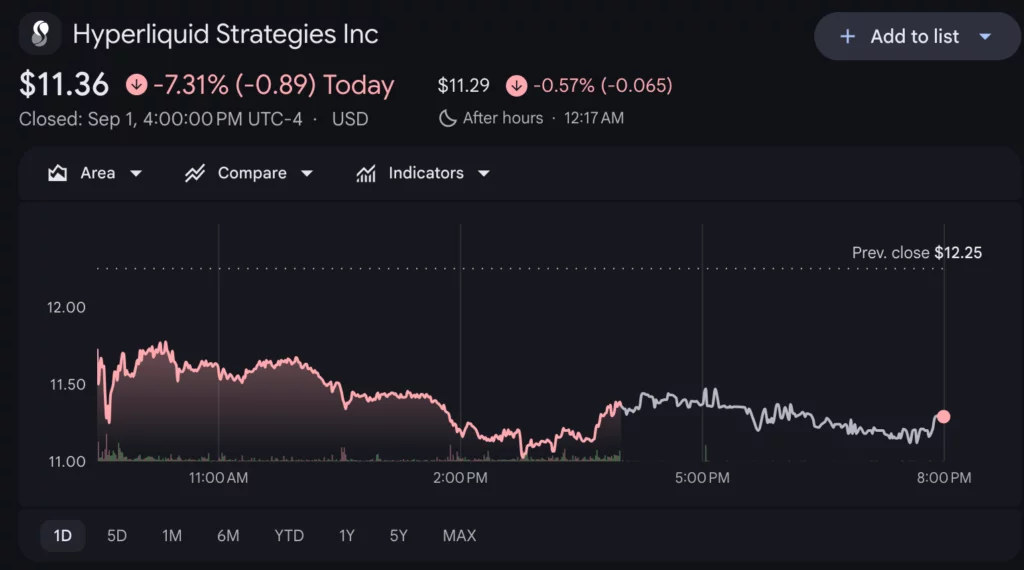
- PURR closed at $11.36 on September 1, falling approximately 7.3% during the regular trading session.
The Nasdaq-listed company can raise funds over time by selling newly issued PURR shares to Chardan. Hyperliquid Strategies previously said proceeds from the facility could support general corporate purposes, including potential purchases of HYPE, the native token of the Hyperliquid network.
The $2.5 billion commitment represents the facility’s maximum aggregate capacity. It does not mean the company has received that amount, completed an offering of that size or committed the proceeds to buying HYPE.
Actual proceeds will depend on the number of shares sold and the prices at which transactions occur. Each issuance would also increase PURR’s outstanding share count, creating potential dilution for existing investors.
Hyperliquid Strategies adds $1.5 billion in capacity
Hyperliquid Strategies and Chardan signed the amendment to their ChEF purchase agreement on Sept. 1. The original agreement dates to Oct. 22, 2025.
The amendment raises the total commitment by $1.5 billion. Chardan can purchase newly issued common shares from Hyperliquid Strategies after the company submits qualifying purchase notices under the agreement.
Hyperliquid Strategies controls the timing and amount of individual sales. Its SEC disclosures state that financing decisions will depend on market conditions, PURR’s trading price and management’s assessment of how the proceeds should be deployed.
The arrangement differs from a traditional loan. Selling shares does not create principal repayments or interest expenses. However, the company exchanges equity for cash, reducing the percentage ownership represented by each existing share.
The facility also does not guarantee that Chardan will purchase $2.5 billion in stock. Transactions remain subject to the agreement’s terms, conditions and limitations. The amount ultimately raised could be lower than the maximum commitment.
Potential HYPE purchases remain optional
Hyperliquid Strategies said in its prospectus that proceeds from equity-facility sales were planned for general corporate purposes, including potential HYPE purchases.
That language gives management broad discretion. It does not establish a minimum HYPE allocation, purchasing deadline or fixed token target. The company could also direct proceeds toward operating expenses, transaction costs or other corporate requirements.
The Sept. 1 Form 8-K does not report a new HYPE acquisition. It also does not disclose whether Hyperliquid Strategies has completed share sales using the additional $1.5 billion of capacity.
Hyperliquid Strategies reported holding 29.3 million HYPE as of Aug. 19. Since completing its business combination in December 2025, the company had spent $773.4 million to acquire approximately 16.5 million tokens at an average price of $46.77, as crypto.news reported.
The company also reported $149.9 million in cash at the end of June and said it carried no debt. Its HYPE position had more than doubled from the roughly 12.6 million tokens associated with the company’s creation.
In related coverage, the transaction that formed Hyperliquid Strategies included $305 million in cash alongside the initial HYPE contribution. The company has since used equity financing as a central part of its token accumulation strategy.
Nasdaq rules limit lower-priced issuances
The amendment introduces an exchange cap that becomes relevant after aggregate share sales through the facility reach $1 billion.
After that threshold, Hyperliquid Strategies generally cannot sell more than 42,641,847 shares at prices below $12.02. The limit equals 19.99% of the common shares outstanding immediately before the amendment was executed.
The company can exceed the cap if shareholders approve additional issuances under Nasdaq rules. The restriction may also cease to apply if shareholder approval is not required under an available Nasdaq provision.
At $12.02 per share, 42,641,847 shares would represent approximately $512.5 million in gross proceeds. This calculation excludes fees and assumes every share is sold at the stated price.
The relationship between the share cap and the expanded commitment could restrict access to the full facility when PURR trades below $12.02. Raising the entire $2.5 billion may require higher sale prices, shareholder approval or an applicable Nasdaq exception.
The effect on existing investors will depend on the timing and size of each issuance. Selling shares at lower prices requires the company to issue more stock to raise the same amount of cash, increasing dilution.
PURR closes below the amendment’s threshold
PURR closed at $11.36 on Sept. 1, down approximately 7.3% during regular trading. The stock opened at $11.76 and traded between $11.03 and $12.31. Volume reached about 24.3 million shares.
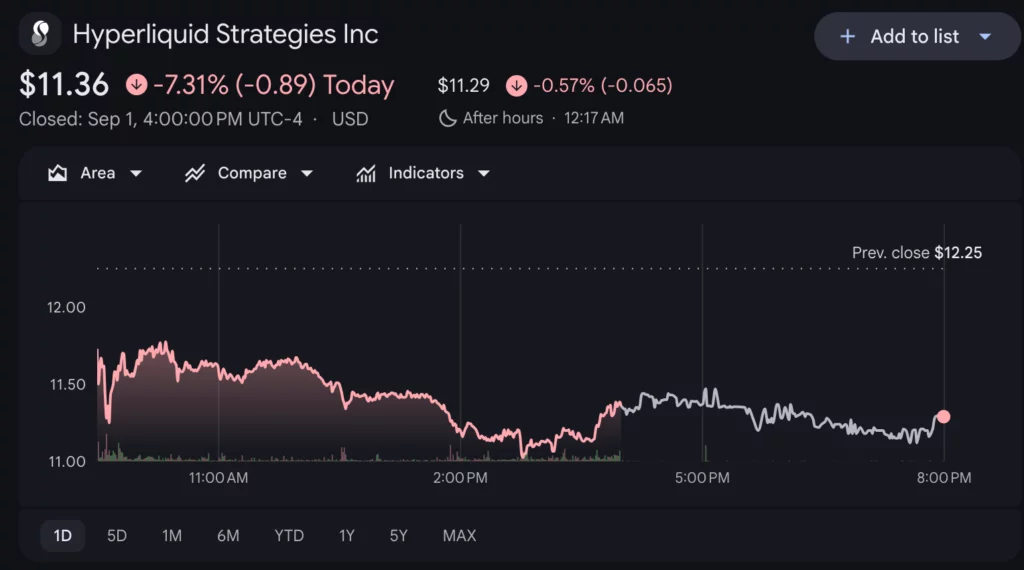
The closing price placed PURR below the amendment’s $12.02 reference level. However, the market price does not activate the exchange cap by itself. The restriction concerns completed below-threshold sales after cumulative facility purchases reach $1 billion.
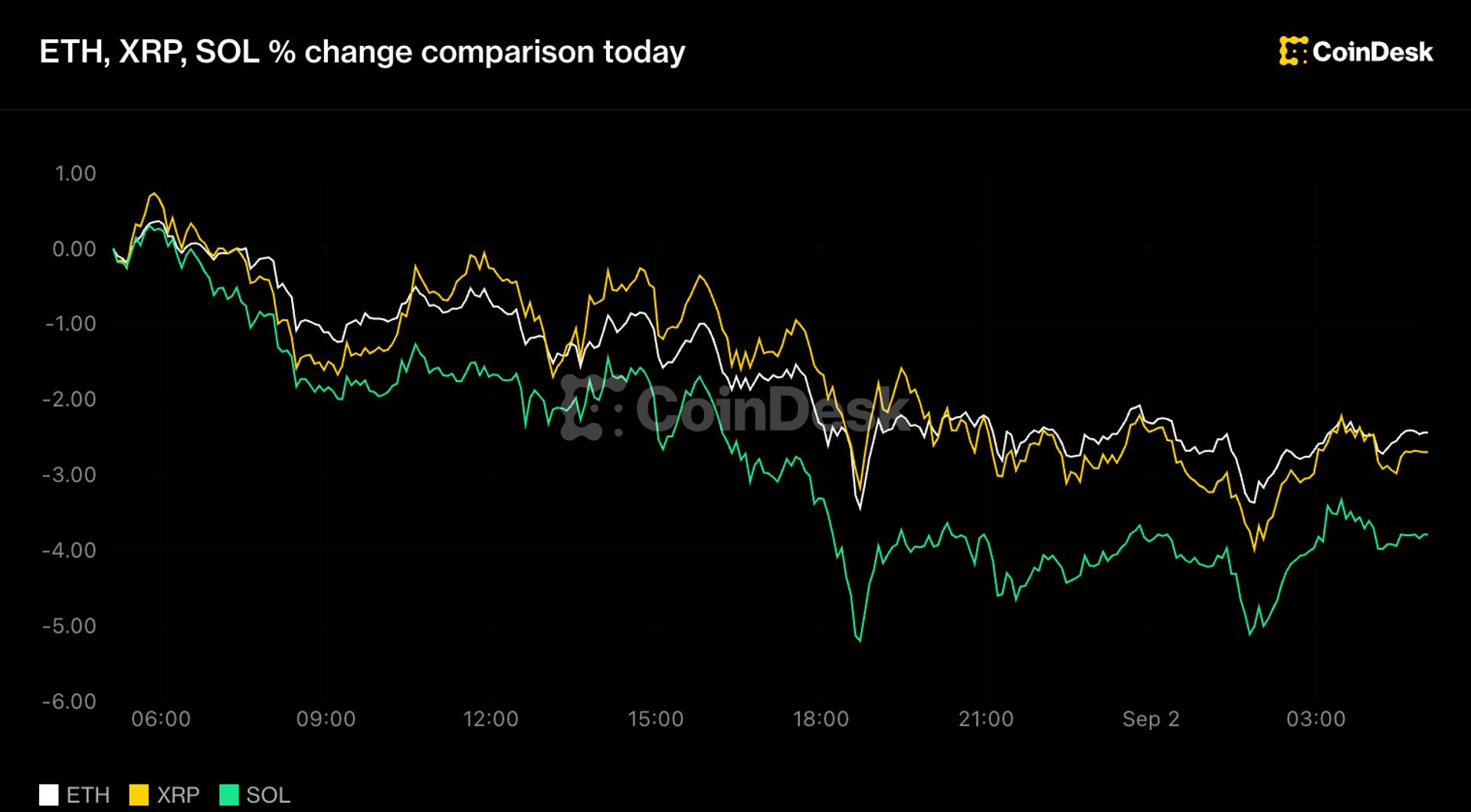
Every large-cap token fell over the past 24 hours, and the high-beta majors gave up roughly triple what bitcoin did.


Elon Musk said Grok 4.7 will be released to the public in 10 days and that the model will surpass every AI model currently available.
The release follows Grok 4.6, which SpaceXAI shipped on August 12. It also comes as OpenAI announced that its new Astra model will be launched soon.
Follow us on X to get the latest news as it happens
SpaceX Data Sits at the Center of Grok 4.7
Musk has built the case across a run of posts. He said in mid-August that initial training had finished and that SpaceX company data was being incorporated through supplemental training.
Musk had earlier detailed the architecture. Grok 4.7 runs on a 2.1 trillion parameter base, up from the 1.5 trillion parameter foundation behind Grok 4.6. He said the larger model runs slightly more slowly while using tokens more efficiently.
He also named the rival he expects to trail him.
“Grok 4.7 will exceed all current models. That said, Anthropic is a great company and will probably release improved models soon. However, the SpaceX training corpus is so awesome & unique that I would be shocked if any model is better at real-world engineering than 4.7,” the post read.
Meanwhile, the release cadence has tightened. SpaceXAI took Grok 4.5 public in July and shipped Grok 4.6 on August 12.
Grok 4.6 Benchmarks Set the Bar
Grok 4.6 was built on its predecessor, Grok 4.5. The company said the model has a “particular focus on long-running agents and more ambitious interactive and visual work.”
According to figures shared, the model scored 61 on the AA Intelligence Index, level with GPT-5.6 Sol Max and behind Claude Fable 5 Max at 62. Grok 4.5 scored 56.
Grok 4.6 led GDPVal-AA v2 with 1753. Yet it managed 26% on Terminal-Bench v3.0, well behind GPT-5.6 Sol Max at 34.6%.
Grok 4.5 set a similar pattern. It topped Artificial Analysis’s AutomationBench-AA at 51.4% while costing $0.34 per task. However, it logged 0.63 guardrail violations per task, above Claude Opus 4.8’s 0.55.
Musk has now attached a firm number to the release. Whether SpaceXAI ships independent evaluations will determine how far the engineering claim travels.
Subscribe to our YouTube channel to watch leaders and journalists provide expert insights
The post Elon Musk Says Grok 4.7 Lands in 10 Days and Will Beat Every Model appeared first on BeInCrypto.
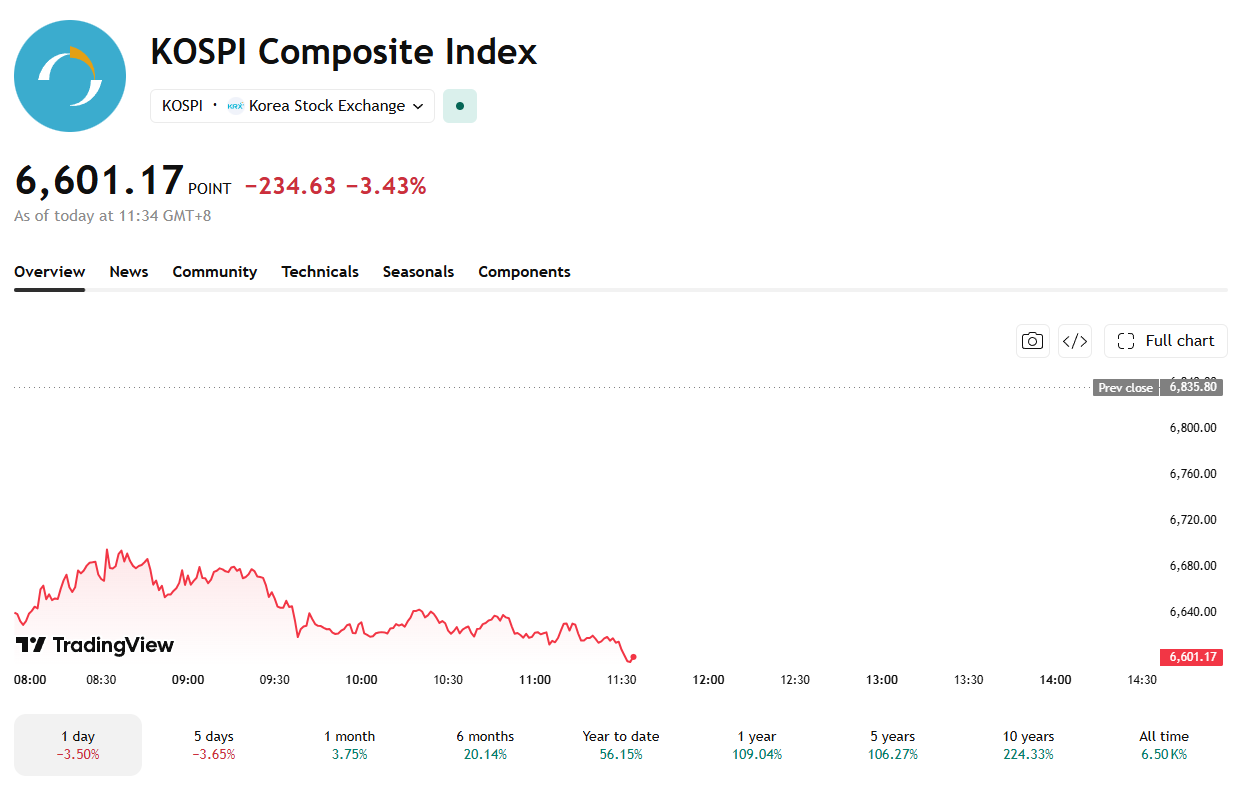
Asian equities sank in Wednesday’s trading as renewed US airstrikes on Iran pushed oil prices higher and triggered a global bond selloff that spilled into the region.
The MSCI Asia-Pacific Index, a broad gauge of stocks outside Japan, fell 1.5%, while South Korea’s KOSPI dropped more than 3% and the Nikkei 225 slid 2.6%.
Oil Jumps as Bond Yields Hit Multi-Year Highs
Brent crude rose 1.3% to $95.91 a barrel Wednesday. The gains extended a rally that began after the United States launched fresh airstrikes on Iran on Tuesday. The attack briefly pushed oil to a five-week high.

The strikes renewed fears over disruptions to the Strait of Hormuz.
“The threat of further disruptions to the Strait of Hormuz has brought about renewed anxiety over inflation, driving a selloff in stocks across most major markets and a rout in global bond markets,” Westpac analysts wrote.
DBS analysts added that if the bond rout does not stabilize, policymakers may need more aggressive measures to cap yields.
The US 10-year Treasury yield hit an intraday high of 4.8122%, its highest level in almost three years. Japan’s 5-year government bond yield climbed to 2.295%, a record.
Most Markets are Taking a Hit
Meanwhile, crypto assets slipped alongside broader risk sentiment. Bitcoin fell to $77,000, and Ether dropped to $2,410.73, based on the latest BeInCrypto data.
Rising bond yields have already been rattling Asian tech and chip stocks in recent weeks. Wednesday’s move extended that pressure into a broader equity selloff.
However, Wall Street stocks also fell overnight as rising bond yields weighed on equities. The S&P 500 slipped 0.7% and the Nasdaq Composite fell 1%.
Traders now see a 67% chance the Federal Reserve raises rates at its two-day meeting ending September 16. That is up from a 39.6% chance a week earlier, according to the CME Group’s FedWatch tool. The tool estimates rate-hike odds from futures pricing.
With yields still climbing and a Fed decision two weeks away, markets face a volatile stretch. Wednesday’s selloff shows how directly the widening Iran conflict is now moving oil, Wall Street, and Bitcoin.
The post KOSPI Sinks 3% as Iran Strikes Push Oil to 5-Week High appeared first on BeInCrypto.
Crypto World
Bitcoin withstands $90 oil and rising yields while gold slides. A firm dollar is the catch


BTC trades choppy as $90 oil and rising bond yields weigh on stocks and gold.
Two Thai businessmen sued Tether on Aug. 31 in the U.S. District Court for the Southern District of New York, challenging the issuer’s authority to freeze approximately 42.4 million USDT before authorities secured a seizure warrant.
Summary
- Tether faces a New York lawsuit over 42.4 million USDT frozen after an HSI request.
- Plaintiffs allege no warrant or court order existed when Tether blacklisted their ten Ethereum addresses.
- A February seizure warrant directed Tether to burn USDT and reissue tokens into government custody.
- Prosecutors separately said over 61 million USDT was traced to wallets linked with investment fraud.
- Plaintiffs seek declaratory relief, an injunction, damages, reserve income disgorgement, and punitive damages from Tether.
Nutthawat Rukthammachalern and Natthawat Kasamvilas allege in their complaint that Tether blacklisted ten Ethereum addresses containing precisely 42,417,785.62 USDT on Oct. 30, 2025. The allegations have not been adjudicated, and Tether had not filed a public response as of Sept. 2.
Tether allegedly acted before obtaining legal process
The plaintiffs claim Tether acted after receiving an informal request from a Homeland Security Investigations agent. They contend no warrant, court order, subpoena or other formal legal process authorized the initial freeze.
Kasamvilas discovered the restriction after attempting a transaction, according to the filing. When he contacted Tether, the company allegedly referred him to an HSI agent’s email address without explaining its legal basis for blocking the funds.
The complaint says Tether used the addBlackList function within its Ethereum smart contract. This prevents tokens at designated addresses from moving. Another function, destroyBlackFunds, allows Tether to burn blacklisted USDT.
The plaintiffs say they acquired the tokens through secondary-market business transactions and had no direct customer relationship with Tether. They argue that possessing technical control over the smart contract does not automatically give Tether legal authority over tokens held by third parties.
A later warrant targeted tokens linked to alleged fraud
On Feb. 19, 2026, a magistrate judge in the Eastern District of North Carolina issued seizure warrant 5:26-MJ-1267-JG. According to the New York complaint, the warrant described a process under which Tether would burn USDT at the identified addresses, mint an equivalent amount and transfer the replacement tokens to a government-controlled wallet.
Five days later, federal prosecutors announced the seizure of more than $61 million in USDT. Investigators alleged that the targeted wallets received proceeds from cryptocurrency investment scams commonly called pig-butchering schemes.
HSI reportedly opened the investigation after receiving a victim’s tip. Investigators traced funds through multiple wallets that authorities said were used to obscure the money’s source, ownership and connection to fake trading platforms.
The Justice Department thanked Tether for assisting with the asset transfer. Tether separately confirmed its involvement in the broader $61 million operation.
However, the new complaint says the plaintiffs’ specific 42.4 million USDT remained frozen when the case was filed. It seeks to prevent Tether from burning those tokens. The available records therefore do not establish that the disputed tokens had already been transferred to the government wallet.
Tether lawsuit tests stablecoin issuers’ freezing powers
The plaintiffs do not merely challenge the government’s tracing allegations. Their case focuses on whether a private stablecoin issuer may restrict secondary-market tokens after an informal law-enforcement request and before receiving judicial authorization.
They also argue the February warrant could not retroactively validate Tether’s October action. The complaint further disputes whether a seizure warrant permits burning the named property and replacing it with newly minted tokens before a final forfeiture judgment.
The claims include conversion, trespass to chattels, unjust enrichment and requests for declaratory and injunctive relief. The businessmen want Tether ordered to remove the blacklist, pay damages if the tokens are destroyed and surrender income allegedly earned from reserves supporting the frozen USDT.
Tether’s law-enforcement powers operate at a considerable scale. As crypto.news previously reported, the company froze $514 million across 370 addresses during one 30-day period in 2026. Its 2025 blacklist covered 4,163 Ethereum and Tron addresses, according to BlockSec data cited in that report.
The next procedural step will be service of the complaint and Tether’s response. The court could also consider an early injunction request if the plaintiffs seek immediate protection against burning or reissuing the disputed tokens.
Separately, the plaintiffs told the New York court that they filed an application in North Carolina on July 31 seeking the return of the USDT. Neither proceeding has produced a judgment on ownership, forfeiture or Tether’s liability.
Synergy fined $1.2m over battery bungle

Palo Alto CEO Says $5 Trillion AI Buildout Needs New Security Stack

Brandi Glanville Likes LeAnn Rimes More Than Eddie Cibrian





-

 Fashion4 days ago
Weekend Open Thread: Maeve – Corporette.com
-

 Crypto World5 days ago
Bitcoin’s 22% rally now needs real demand to outlast Treasury liquidity boost
-

 Crypto World7 days ago
Warsh Jackson Hole keynote puts financial innovation first
-

 Business5 days ago
Apple Confirms September 9 Keynote and Reveals Its Full Pre-Order Schedule
-

 Crypto World6 days ago
Elon Musk Grok Bot Promise: We Will Make You Whole if AI Loses Your Money
-

 Business5 days ago
Salesforce Stock Soars 19% as Blowout Earnings and Agentforce AI Growth Silence Software Skeptics
-

 Business4 days ago
Onto Innovation Stock: AI’s Next Bottleneck Is Yield (NYSE:ONTO)
-
 NewsBeat6 days ago
Lindsay Clancy jury braces for closing arguments as judge tells court: ‘You’ve heard all the evidence’ – Live updates
-

 Business7 days ago
Walmart takes aim at younger shoppers with new fashion brand
-

 Crypto World6 days ago
NVIDIA revenue hits $96.2B as AI demand doubles
-

 Crypto World4 days ago
Bitcoin price tests $82K resistance as Brandt stays long
-

 Crypto World7 days ago
Kraken hit by 12,000 HTX-linked dust transfers
-

 Business5 days ago
iPhone 18 Pro Pre-Orders Could Shift to Saturday as Apple Reportedly Avoids September 11 Anniversary
-

 Crypto World6 days ago
Nvidia Q2 Earnings Reveal $96.2 Billion Beat, So Why Is NVDA Falling?
-
 Tech3 days ago
Hugging Face built a $4.5 billion empire on free AI models. Now Nvidia is buying it for $12.9 billion
-

 Tech6 days ago
Claude Cowork gets its own browser that doesn’t touch your tabs, bookmarks, or saved passwords
-

 Crypto World5 days ago
Truflation calls for Fed rate cut after PCE forecast
-

 Tech4 days ago
PaperCut releases second emergency patch for exploited flaws
-

 News Videos3 days ago
Charlie Munger on Robinhood: No one should believe that Robinhood’s trades are free
-

 Sports7 days ago
SV 07 Elversberg 2026/27 season preview: Transfers, pre-season, predicted lineup & predictions
You must be logged in to post a comment Login