
Crypto World
B HODL Stock Surges 67% in a Month on MicroStrategy Bitcoin Playbook

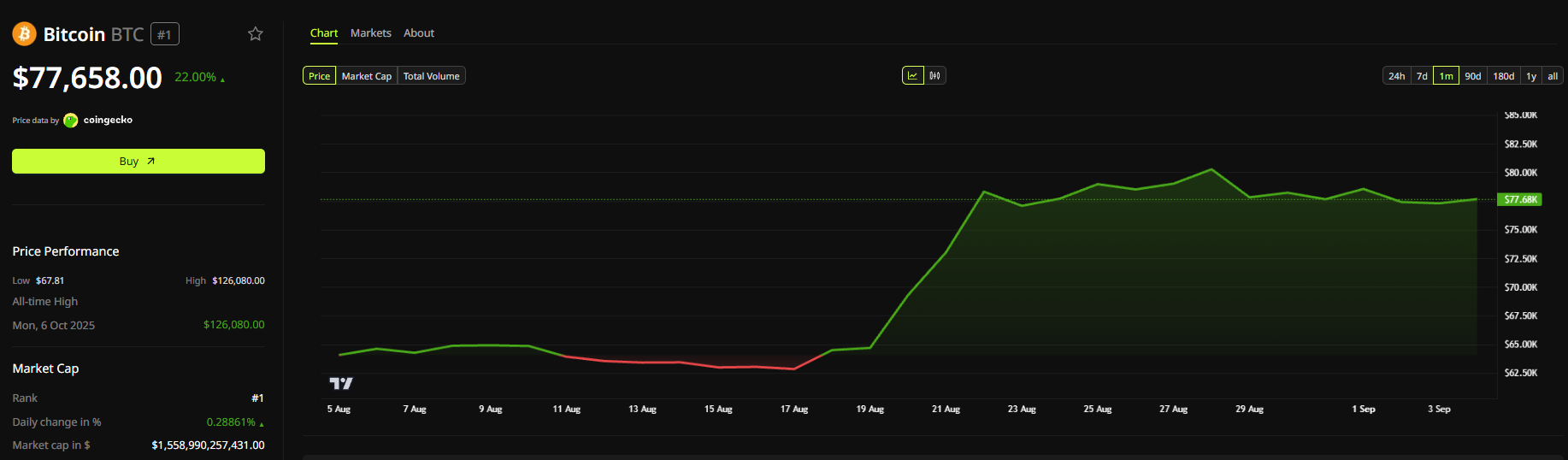
B HODL stock has climbed 67% in a month. It announced buying 1 BTC on Thursday, lifting its treasury to 167.487 BTC.
The company trades on the Aquis Stock Exchange, a small London venue for growth companies. It part-funded the purchase by completing its second at-the-market (ATM) equity programme, with its Capital Deployment Programme covering the rest.
B HODL Stock Climbs While the Bitcoin Cost Basis Stays Underwater
The company paid £57,680, or about $77,772, for the coin. Its average cost sits near $110,129 per Bitcoin, so the treasury stays roughly 29% under water.
Bitcoin (BTC) traded near $77,658 on Thursday, up 0.3% on the day. The coin has gained 22% in a month, so B HODL stock tripled that pace.
Sats per share climbed to 120.16 from 117.77 at the end of April. That number matters because dilution only pays when each share ends up holding more Bitcoin.
An ATM programme drip-feeds small share tranches into the open market, and MicroStrategy pioneered the tool. B HODL raised about £48,300, or roughly $65,000, selling 600,000 shares at an average 8.06 pence. The Capital Deployment Programme made up the difference.
The scale differs wildly from MicroStrategy’s billion-dollar raises, yet the mechanism is identical. Several peers cannot sell equity at all, because their stock trades below Bitcoin they already own.

Adam Back Endorses the MicroStrategy Model
Adam Back, the Blockstream chief executive, endorsed the approach.
He also backs European treasury vehicles directly, funding a Capital B raise worth €7.6 million on Wednesday.
The rally, however, arrived before the news. HODL closed Wednesday at 8.84p, up 4% on the day, after an 11.11% jump on Tuesday.

MicroStrategy still sets the benchmark. Michael Saylor said his firm holds more reserve capital than every S&P 500 financial except Berkshire Hathaway, pointing to 845,050 Bitcoin.
That claim rests on a metric MicroStrategy designed itself, however, and MSTR slipped 2.1% on Wednesday.
Analysts called treasury stocks a textbook bubble chart in June, and market net asset value (mNAV) pressure has persisted since.
B HODL, however, keeps clearing that bar. ATM 2 delivered roughly 135 sats for each new share, comfortably above the 120.16 average.
Issuing above that line leaves holders owning more Bitcoin per share, not less. ATM 3 opens on about September 8 with the same test attached.
The post B HODL Stock Surges 67% in a Month on MicroStrategy Bitcoin Playbook appeared first on BeInCrypto.

Crypto World
BeInCrypto to Launch Its Legal & Regulatory Expert Council at the United Nations, Partnering with GBA's Future of Money, Governance, and the Law


BeInCrypto is officially partnering with the Government Blockchain Association (GBA) for their flagship summit, The Future of Money, Governance, and the Law (FoMGL) taking place September 29 to October 2, 2026 across Washington, D.C.and New York.
The partnership will mark the launch of BeInCrypto’s Legal & Regulatory Expert Council, with the council making its public debut during the event’s New York programme at the United Nations Headquarters (pending final room confirmation).
Intersection of Policy, Capital and Technology
The three-day GBA programme will move from Capitol Hill discussions with U.S. policymakers to a full-day summit at the National Press Club focusing on the impact of AI, blockchain and quantum on financial services, including digital assets, tokenization, and regulatory frameworks.That evening features cryptopoly, gala reception in a historic georgian mansion where the guests receive movie money and cryptocurrency themed cards to buy, trade and sell to win generous crypto themed prizes. The event is followed by the Future of Money, Governance & the Law FinTech Summit in New York.
Confirmed speakers include Dino Cataldo Dell’Accio (UN Joint Staff Pension Fund), Jarod Koopman (U.S. Treasury / IRS), Landon Zinda (SEC Crypto Task Force), Thomas Puschnik (World Bank), Lauren Belive (Ripple), Corey Then (Circle), Robin Cook (Coinbase), Dr. Scott Stornetta (blockchain co-inventor), Charles Hoskinson (Cardano), Markus Veith (Grant Thornton), and Christopher Bramwell (Utah State Government) amongst many others.
The GBA has members in over 500 government offices around the world in over 50 working groups that has established the Blockchain Maturity Model (BMM), a framework for assessing the maturity, integrity and trustworthiness of blockchain solutions, and showcased by the Blockchain Assurance & Standardization Dynamic Coalition recognized by the United Nations Internet Governance Forum (IGF). The IGF is convened by the UN Secretary-General as a global forum for dialogue on internet governance. The GBA connects public-sector requirements with private-sector expertise across a range of blockchain and emerging-technology issues.
BeInCrypto’s Legal & Regulatory Council Launch
The Legal & Regulatory Expert Council unites senior practitioners working across crypto and digital-asset regulation, compliance, tax, financial data, AML and sanctions, and institutional adoption.
Its focus is on the issues around how digital asset businesses operate across markets, including the right jurisdiction, navigating new regulatory frameworks and understanding the implications of tax, market structure, privacy and cross-border compliance.
The council will bring these perspectives to the global policy conversation at FoMGL, where BeInCrypto’s Global Head of News, Brian McGleenon, will moderate a panel on the state of global crypto regulation. Panel details and council members joining him on stage will be announced ahead of the event.
Both legs of the summit are open to the BeInCrypto community. The New York programme at the United Nations Headquarters (pending final room confirmation) is free to attend. For Washington, D.C., readers can use the code BEINCRYPTO20 at checkout for 20% off tickets. You can secure your spot here.
BeInCrypto is part of the BeInNews Academy Ltd, an independent media group covering the convergence of finance and digital assets. We help professionals act with confidence in a complex and fast-changing industry through our newsroom, Expert Councils, Research Division, the Institutional 100 Awards, and event activations.
The post BeInCrypto to Launch Its Legal & Regulatory Expert Council at the United Nations, Partnering with GBA's Future of Money, Governance, and the Law appeared first on BeInCrypto.


Ukraine has dismantled a network of fake crypto investment platforms that allegedly drained wallets belonging to people in more than 20 countries, with investigators identifying 62 victims so far.
Summary
- Ukraine dismantled fake crypto investment platforms that targeted victims across more than 20 countries.
- Investigators have identified 62 victims, while the network reportedly handled up to $1 million a month at its peak.
- Victims were shown fake investment gains before a wallet drainer stole their crypto when they tried to withdraw funds.
- Police conducted 34 searches and seized more than 100 computers, over 100 phones and 15 vehicles.
The National Police of Ukraine said investigators from its Main Investigation Department worked with the Security Service of Ukraine and the Office of the Prosecutor General to uncover the operation, which maintained several offices in Kyiv and the surrounding region.
Поліцейські припинили діяльність мережі фейкових інвестиційних платформ, через які шахраї викрадали криптовалюту у громадян понад 20 країн
Наразі поліцейські встановили 62 потерпілих. 🔗 Деталі: https://t.co/e4OZtqg0gB pic.twitter.com/QblK1EWXi8
— Національна поліція України (@NPU_GOV_UA) September 1, 2026
More than 46 Ukrainians were recruited into the network, while authorities are still identifying other participants, victims and the total amount stolen.
Fake crypto investment platforms targeted more than 20 countries
Investigators said the group created websites designed to look like legitimate investment platforms and used them to offer supposedly profitable cryptocurrency projects.
The Security Service said the scheme began with advertising distributed through Telegram, where potential customers were offered opportunities to invest in crypto projects. Users who registered were instructed to connect a cryptocurrency wallet and transfer funds to the platform.
Behind the websites, developers maintained the infrastructure and worked to keep the platforms accessible when attempts were made to block them. Other members of the group staffed offices, communicated with customers and provided security for the operation.
Once funds were deposited, employees manually simulated investment activity. Customers could see account balances rising inside their dashboards, although investigators said the displayed trading activity was fabricated.
A 25-year-old IT specialist organized the network, according to the Security Service. At its peak, the operation had monthly turnover of up to $1 million.
Authorities have so far identified 62 victims from more than 20 countries. They included citizens of Germany, Poland, Lithuania, Latvia, Spain, France, the UK, Canada and Israel.
The number could rise as investigators continue examining information recovered from the network’s infrastructure and determining how many people transferred cryptocurrency through its websites.
Wallet drainer activated during withdrawal attempts
The alleged theft entered another stage when customers attempted to withdraw their funds.
Operators blocked withdrawal requests and told victims that another verification procedure was required before their money could be released. Users were instructed to connect their primary cryptocurrency wallet and approve a small test transaction to demonstrate that the platform was functioning.
Investigators said the websites contained a wallet drainer that used the authorization to transfer assets from a connected wallet to addresses controlled by the group. After the cryptocurrency had been moved, the victim lost access to the investment platform.
The method relied on the same type of malicious authorization used in wallet drainer attacks, where users can unknowingly give an attacker-controlled contract permission to move their tokens. As crypto.news previously reported in July, approval phishing can involve token approvals, permit signatures and other authorizations that allow assets to be transferred without an attacker obtaining the wallet owner’s private key.
A similar technique surfaced in August when a Hyperliquid user lost roughly 550,000 USDC after interacting with a fraudulent website promoted through a Google advertisement. Security firm Salus later connected the fake Hyperliquid website to infrastructure associated with the Inferno drainer ecosystem.
Salus said that operation included malicious scripts, approval-command generation, automated draining, cross-chain withdrawals and tools for consolidating stolen funds. The Ukrainian case used a different investment pitch, but investigators similarly said victims were induced to authorize a transaction before assets were removed from their wallets.
The fake platforms collected more than cryptocurrency. Registration and verification procedures gathered victims’ passport information, phone numbers, email addresses, account logins, passwords and photographs, according to Ukrainian authorities.
Netherlands servers held records of victims and stolen crypto
Investigators traced server equipment used by the network to the Netherlands and obtained access to a database stored there.
The records contained information about victims, including cryptocurrency wallet addresses and the amounts allegedly stolen from individual users. Authorities said the servers held internal correspondence between members of the group and records describing how the fraudulent platforms operated.
Access to the database helped investigators trace the network across several countries and identify people who had interacted with the websites.
The international element follows several law enforcement operations targeting online investment fraud and crypto-linked social engineering schemes. INTERPOL said in August that Operation Jackal IV resulted in 58 arrests and identified 263 suspects after authorities in 22 countries targeted investment scams, romance fraud and related money laundering networks.
South African authorities seized $2.67 million during that operation and blocked 257 bank accounts, while Romanian police arrested 11 suspects in an investment scheme associated with an estimated €143 million, according to INTERPOL.
A larger INTERPOL crackdown reported in July produced 5,811 arrests across 97 countries and territories. Operation First Light intercepted $293 million in illicit assets, blocked more than 31,000 bank accounts and identified over 142,000 victims while targeting investment fraud, romance scams, impersonation and other forms of social engineering.
Investigators in that operation uncovered crypto laundering activity that used several digital assets and cross-chain swaps. INTERPOL said one wallet linked to a Thai investigation had processed more than $122.5 million over a 10-month period.
Approval phishing has drawn separate enforcement attention. A UK-led operation involving authorities in the United States and Canada froze more than $12 million in suspected scam proceeds earlier this year and identified more than 20,000 potential victims.
The operation focused on schemes in which victims were persuaded to sign malicious blockchain authorizations that gave scammers permission to move cryptocurrency from their wallets.
Police seized more than 200 computers and phones
Ukrainian officers carried out 34 searches at homes, offices and vehicles across Kyiv and the surrounding region as part of the investigation.
More than 100 computers and other pieces of computer equipment were seized along with over 100 mobile phones, 79 SIM cards and a GSM gateway. Police recovered cash and records connected with the operation, while 15 vehicles were taken during the searches.
Some cars and real estate used by members of the network had been registered in the names of suspects’ wives and other relatives, investigators said. The alleged organizer traveled with armed guards.
The criminal proceedings are being conducted under Part 5 of Article 190 of Ukraine’s Criminal Code, which covers fraud. Authorities have not disclosed a final loss figure because they are continuing to identify suspected members of the network and additional victims.
Ukraine has separately been developing procedures for handling cryptocurrency recovered through criminal cases. Authorities transferred more than $8.3 million in seized USDT to a state-managed wallet in June, the first time confiscated cryptocurrency had been placed under direct state management.
The Royal United Services Institute has estimated that stronger rules for tracing, seizing and managing illicit cryptocurrency could help Ukraine recover at least $10 billion in stolen funds and lost tax revenue.
Police said investigators are continuing to identify everyone involved in the fake investment network, locate further victims and determine the total value of cryptocurrency stolen through the platforms.


Hyperliquid opened its HIP-4 outcome-market infrastructure to outside venues on Aug. 29, and daily trading volume nearly tripled within three days, according to research published Sept. 3.
Summary
- Hyperliquid opened HIP-4 deployment August 29, and reported daily outcome volume tripled within three days.
- Two outside venues each posted 500,000 HYPE bonds to deploy markets using approved templates independently.
- Outcome captured 85% of reported volume while offering traders a $1 million active rebate program.
- Hyperliquid validators publish settlement prices every three seconds, according to the research collective’s analysis publicly.
- U.S. availability would require regulatory authorization, while sports contracts could face additional federal scrutiny requirements.
Daily volume increased from an August average of approximately $545,000 to $1.97 million on Aug. 31, the Hyperliquid Research Collective reported. The trailing daily figure subsequently reached approximately $2.75 million.
Two outside venues, Outcome and Skew, posted 500,000 HYPE bonds and began deploying markets through seven templates approved by Hyperliquid validators. However, the early volume was heavily concentrated in Outcome and supported by trading incentives.
The rollout makes market deployment permissionless at the protocol level. It does not automatically authorize HIP-4 operators to serve U.S. customers or offer every category of event contract.
Hyperliquid HIP-4 opens deployment to outside venues
HIP-4 supports fully collateralized outcome contracts that settle within a fixed range, usually zero or one. Prices can represent the market’s assessment of whether a specified event will occur.
Unlike perpetual futures, these contracts do not use leverage, funding payments or liquidations. Traders must provide the full collateral required for their positions.
As crypto.news previously explained, HIP-4 introduced outcome contracts alongside Hyperliquid’s builder-deployed perpetual markets. The first HIP-4 products reached mainnet in May but remained controlled by validators and selected operators.
The Aug. 29 upgrade opened deployment to outside builders. Each operator must bond 500,000 HYPE for at least six months. The bond can be slashed if validators determine that a deployer created an invalid market, settled it incorrectly or failed to complete settlement within the permitted period.
Permissionless deployment also remains limited by templates. Validators approve standard market formats and their permitted language. Builders can then launch markets that follow those specifications without seeking separate approval for every contract.
This design separates market creation from template governance. Outside operators gain control over individual listings, while validators retain influence over the categories and settlement structures that the protocol supports.
Incentives drove most of the early volume
Outcome accounted for approximately 85% of reported HIP-4 volume after third-party deployment opened. Skew produced roughly 1%, leaving the remaining activity with existing validator-deployed markets.
Outcome introduced a $1 million rebate campaign that paid users approximately one cent for every dollar traded, according to the research. The incentive means the initial increase should not be treated entirely as evidence of lasting demand.
Rebate programs can encourage participants to trade more frequently or execute transactions that would be less attractive without rewards. The reported volume remains genuine trading activity, but its durability will become clearer after incentives decline or expire.
The concentration also creates an early test for HIP-4’s permissionless model. Two operators have posted bonds, yet one venue controls most of the new activity. More deployers, market templates and liquidity sources would be needed to establish a broader competitive market.
Hyperliquid previously announced plans for permissionless HIP-4 deployment in July. At the time, crypto.news reported that outside builders would need substantial HYPE stakes and could face slashing.
The current 500,000 HYPE requirement provides an economic penalty for misconduct. However, its dollar value also creates a high entry barrier. Only operators controlling or borrowing large HYPE positions can deploy markets directly.
No verified market data showed that the permissionless rollout alone caused a distinct change in HYPE’s price. Wider crypto-market conditions and other activity on Hyperliquid also affect the token.
Shared settlement connects outcomes with perpetuals
HIP-4 contracts settle using prices published by Hyperliquid validators every three seconds, according to the collective. The outcome positions use the same account environment supporting Hyperliquid’s perpetual markets.
This architecture can allow a trader to hedge a binary outcome with a perpetual contract referencing the same mark price. Because both positions use the same underlying price source, the hedge avoids differences created when separate venues use different indexes or settlement times.
For example, a contract paying one dollar if Bitcoin closes above a specified level could be paired with a Bitcoin perpetual position. Both instruments would respond to a common Hyperliquid mark rather than independent external references.
The arrangement does not remove every risk. Traders still face liquidity, execution and settlement risks. Validators also play a central role in publishing the prices used for settlement.
The collective argued that neither Kalshi nor Polymarket can offer an identical hedge because their event contracts do not share Hyperliquid’s perpetual account and mark-price system. That comparison concerns technical market structure, not liquidity quality, regulatory protection or overall platform risk.
Kalshi operates as a regulated U.S. designated contract market. Polymarket has used blockchain settlement and external resolution systems. Hyperliquid instead places matching, collateral and validator-directed settlement within its own network.
That tighter structure may reduce basis differences between instruments. It also concentrates operational dependencies within Hyperliquid’s validator and trading systems.
U.S. access remains a separate challenge
None of the current HIP-4 templates reportedly covers sports, elections or other categories commonly associated with federal event-contract disputes. Existing listings instead focus on prices, economic figures and other objectively measurable results.
Avoiding sports does not by itself make the markets lawful for U.S. customers. A platform offering commodity derivatives to U.S. persons generally requires an appropriate regulatory framework, regardless of whether its software permits permissionless deployment.
The Commodity Exchange Act allows registered entities to submit new contracts to the Commodity Futures Trading Commission. Federal law also allows the CFTC to review event contracts involving gaming, terrorism, assassination, war, unlawful activity or similar subjects considered contrary to the public interest.
Current CFTC rules establish a review process for contracts involving those categories. The regulator can request a trading suspension during a 90-day review before approving or rejecting a contract.
Sports would therefore add another legal question. The research collective found that sports accounted for 91% of HIP-4’s largest historical trading session. Opening third-party sports markets could increase demand, but it could also trigger scrutiny under the gaming provision.
The collective described regulatory “permission” as the remaining constraint, but no regulator has confirmed that registration alone would authorize every HIP-4 structure or market category.
The legal status could also depend on who operates the interface, controls market parameters, receives fees and makes the platform available to U.S. users. A protocol’s decentralized architecture does not settle those questions automatically.
What happens next for HIP-4
The clearest test will be whether volume remains above its August average after Outcome’s rebate campaign ends. Activity will also need to spread beyond a single operator to demonstrate that permissionless deployment has produced durable competition.
Additional builders may enter after posting the required HYPE bonds. Hyperliquid validators could approve more templates, expanding the range of economic, crypto and financial outcomes available for deployment.
U.S. access would require a separate compliance path. Any operator seeking American users would need to determine whether its contracts require CFTC registration, submission or other authorization.
Sports markets would face an added review question because federal law specifically identifies gaming as an event-contract category that may be examined under the public-interest standard.
FAQs
What is Hyperliquid HIP-4?
HIP-4 is Hyperliquid’s framework for fully collateralized outcome contracts. The contracts commonly settle at zero or one based on a predetermined result.
When did permissionless HIP-4 deployment begin?
Hyperliquid enabled outside HIP-4 deployment on Aug. 29, 2026. Builders must use validator-approved templates and post a 500,000 HYPE bond.
Why did HIP-4 volume triple?
Outcome generated most of the increase after launching third-party markets. Its $1 million rebate program also rewarded users according to their trading volume.
Can U.S. customers legally trade HIP-4 markets?
Permissionless protocol deployment does not establish lawful U.S. access. Operators may require CFTC registration or authorization, depending on their products and activities.
Why could sports markets face greater scrutiny?
The Commodity Exchange Act allows the CFTC to review certain event contracts involving gaming under a public-interest standard.
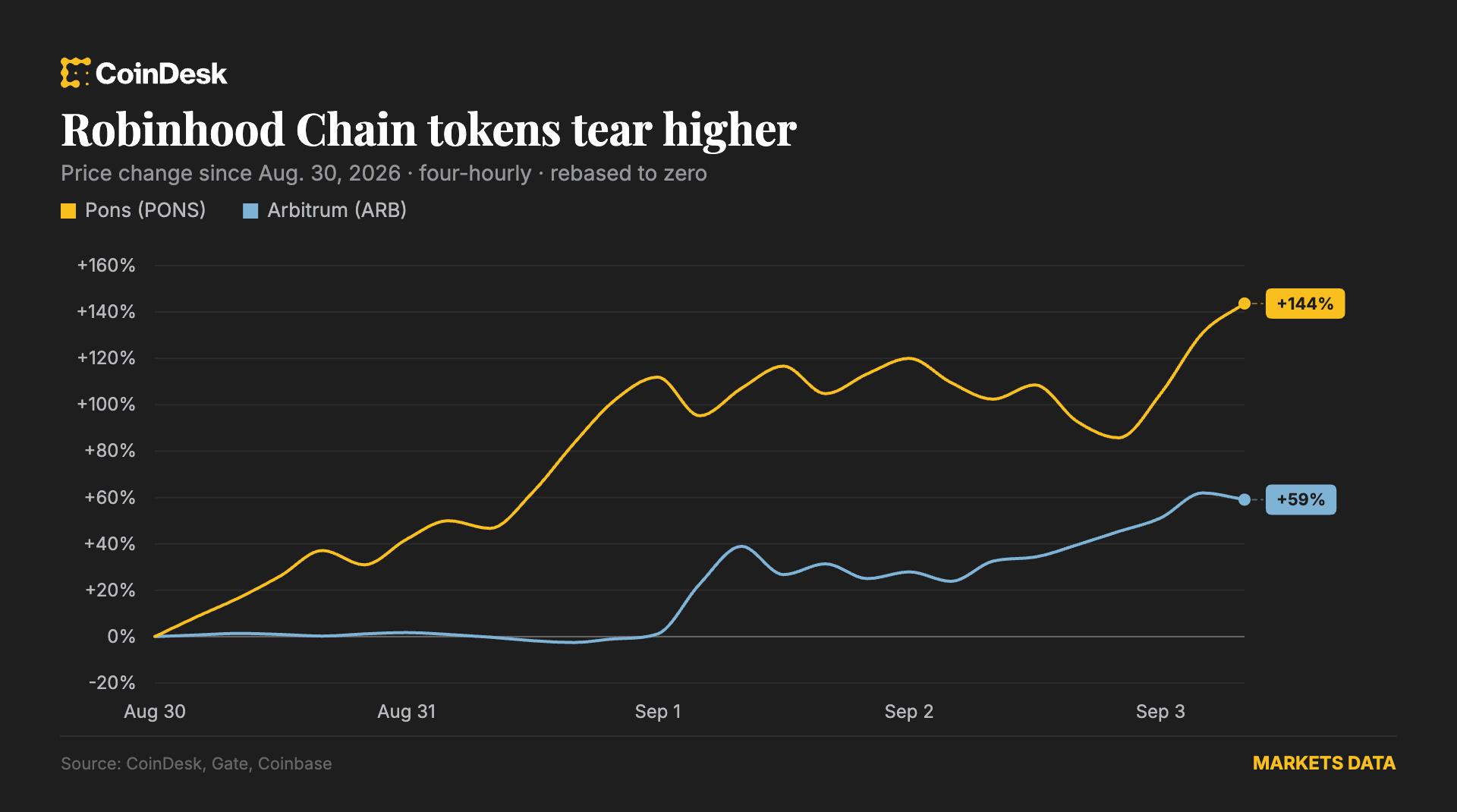
BTC rose 0.76% since midnight as a softer dollar lifted equities and metals alongside crypto, while ARB and PONS pushed higher for a third session.

Bitcoin was trading almost flat at $77,700 as crypto traders awaited Friday’s U.S. jobs report. The data could influence expectations for the Federal Reserve’s next major move. Ethereum was also holding near $2,400.
The market was in a wait-and-see mode ahead of the employment release. Bitcoin’s limited move and Ethereum’s similarly quiet trading reflected a period of caution as traders looked for a clearer signal from the U.S. data.
Friday’s report could either reinforce or alter the market’s view of the policy outlook. For crypto traders, that makes the release a key focus while Bitcoin remains near its current level.
Discover: The Best Token Presales
Why Crypto ETF Demand Matters
The flat price action comes alongside signs of resilience in Bitcoin holdings. About 68% of all Bitcoin in circulation is currently in profit despite global uncertainty. That measure indicates that a substantial share of the supply is above its purchase price.
At the same time, demand for Bitcoin ETFs has become less consistent after strong inflows in August. The pattern hints that large investors have been less active lately, even as Bitcoin has held near $77,700.

Avinash Shekhar, the CEO of Indian Crypto Exchange, has urged a cautious approach to Bitcoin accumulation. He said investors may benefit from seeking confirmation instead of chasing sudden price moves, and suggested gradual accumulation at defined levels while watching trading volumes and Bitcoin’s ability to sustain higher levels.
The combination of profitable Bitcoin supply and less consistent ETF demand describes a market with signs of resilience but without the same steady demand seen during the August inflow period.
Trade Bitcoin on Bybit and Get a Chance to Win Our $1,000 USDT Airdrop
Bitcoin near $77,700: the snapshot, and its limits
The available snapshot as of September 3 shows Bitcoin near $77,700 and down 0.1%, Ethereum near $2,400, roughly 68% of Bitcoin supply in profit, and ETF demand becoming less consistent after August’s strong inflows. Markets also see a 64% chance of a Fed rate hike.
The supplied information does not identify confirmed support or resistance levels, moving-average signals, or a specific breakout threshold. The available evidence instead points to a market waiting for the jobs report and its possible effect on expectations for the Fed.
Friday’s Bureau of Labor Statistics release could shift expectations around the Fed’s next move. That possibility is why traders are focused on the report while Bitcoin remains near $77,700.
Geopolitical tensions add risk alongside possible Fed rate hikes. The supplied evidence says that any price breakout could set the next trend for crypto, while the market’s current position remains one of caution ahead of the jobs data.
Visit Kraken and Trade Crypto Today
Discover: The Best Crypto to Diversify Your Portfolio
The post Bitcoin Waits for Jobs Data as ETF Demand Cools appeared first on Cryptonews.


Standard Chartered said it is the first major global bank to offer institutional access to spot Bitcoin and Ether trading in the UAE region.
The trending altcoin PONS, which saw the light of day earlier this summer, hit a new all-time high and just entered the prestigious club of the 100 largest cryptocurrencies by market capitalization.
Here’s what triggered its additional rally and some of the most interesting predictions for the near future.
PONS Keeps Pumping
The cryptocurrency market has a habit of spewing tokens that stun industry participants with rapid price increases. The latest example is PONS, which is closely connected to Robinhood Chain and began trading in mid-July.
Over the past two weeks, its valuation has skyrocketed by nearly 1,300% and is now hovering at a record high of around $0.55 (per CMC). PONS’s market capitalization is approximately $395 million, making it the 98th-largest cryptocurrency.

The most recent jump was likely triggered by Binance, which added the token to its Binance Alpha section. The platform serves as an early-stage discovery hub, featuring emerging cryptocurrencies before they potentially receive official backing.
The impressive performance has caught the attention of numerous industry participants. X user Crypto Tony, for instance, claimed that PONS “will no doubt” hit the $1 billion market-cap milestone “soon.”
Meanwhile, some traders and investors have already tried their luck with the token, but not all have been successful. As CryptoPotato reported, an anonymous person purchased nearly 8 million PONS roughly a month ago for about $443,000. Shortly after, the token pulled back, and the investor decided to minimize the damage by selling their entire position, incurring a $308,000 loss. This turned out to be an emotional and irrational move since the stash is currently worth over $4 million.
Surpassing the Leaders on This Front
Besides being a standout performer today (September 3), PONS is also the number-one trending cryptocurrency (according to CoinGecko). It has dwarfed popular altcoins like Arbitrum (ARB), Uniswap (UNI), Hyperliquid (HYPE), and others, while the heavyweights Bitcoin (BTC) and Ethereum (ETH) have not even made the top 10 list.

The post Viral Altcoin Enters Crypto’s Top 100 Club Following Support From Binance: Details appeared first on CryptoPotato.
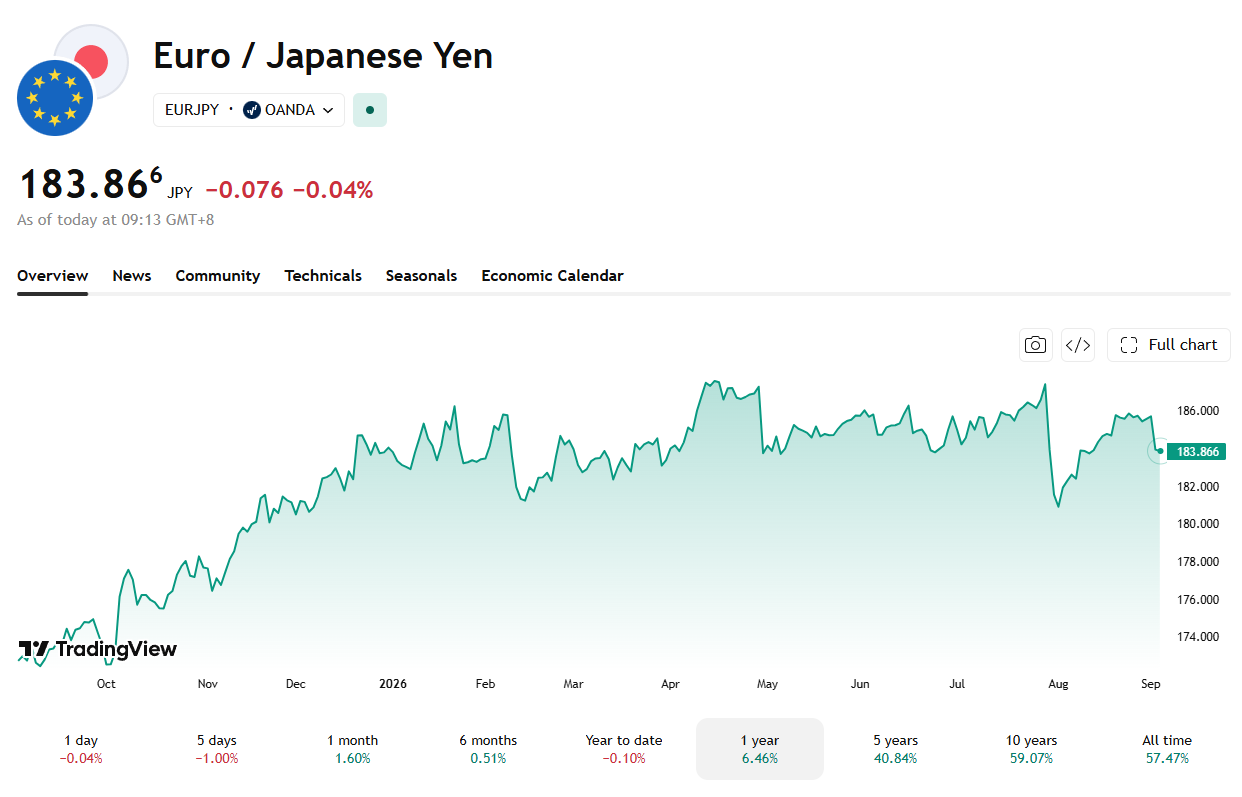
Arthur Hayes says a falling EUR/JPY could unlock a fresh wave of crypto liquidity. He argues the currency move signals more dollar printing at the Federal Reserve.
The Maelstrom chief investment officer forecasts EUR/JPY falling from about 185 to below 140 by June 2027. He links the move to US Treasury Secretary Scott Bessent’s currency strategy.
Why EUR/JPY Is Hayes’ Crypto Liquidity Gauge
In July, the New York Fed sold euros to help fund Japan’s yen rescue. It used the Treasury’s Exchange Stabilization Fund (ESF) rather than dollars.
Hayes argues that reallocation previews a bigger pattern. Allies get dollar liquidity without an official expansion of the Fed’s balance sheet.

Senator Elizabeth Warren has already asked Bessent to justify the ESF’s use. He has not disclosed the full amount spent.
Hayes also points to the Fed’s growing use of repo market purchases to backstop Treasury demand. Similar repo dynamics underpin a separate BeInCrypto analysis tying Bessent’s buyback program to a $224,000 Bitcoin math.
Maelstrom, his family office, holds Bitcoin (BTC) as a structural long regardless of short-term swings.
A Political Trigger in France
Hayes’ EUR/JPY call rests partly on France. He argues, in his latest newsletter, the country’s widening bond yields and fragile banks could force the Banque de France into unofficial stimulus. That would come ahead of France’s 2027 presidential election.
That scenario is Hayes’ own framework, not a confirmed policy shift. No French or European Central Bank official has signaled such a move.
He also cites a widening gap between French and German bond yields. He says it is near its widest level since the 2011 euro crisis.
Still, Hayes says any strain on French lenders could reduce their role in short-term funding markets. He argues that gap would pull the Fed deeper into repo purchases to keep Treasury markets functioning.
He calls a weaker EUR/JPY the fastest early warning that liquidity is accelerating.
Whether the euro cooperates on Hayes’ timeline remains unverified and speculative. If EUR/JPY keeps falling through next year’s French elections, that alone could be the tell.
Crypto traders may end up watching a currency pair, not ETF flows, for their next liquidity cue.
The post Arthur Hayes Says EUR/JPY Drop Could Fuel Crypto Liquidity Surge appeared first on BeInCrypto.


The third-wave Coldcard exploiter moved about 10% of stolen funds through THORChain as researchers traced the assets to a new Ethereum address.
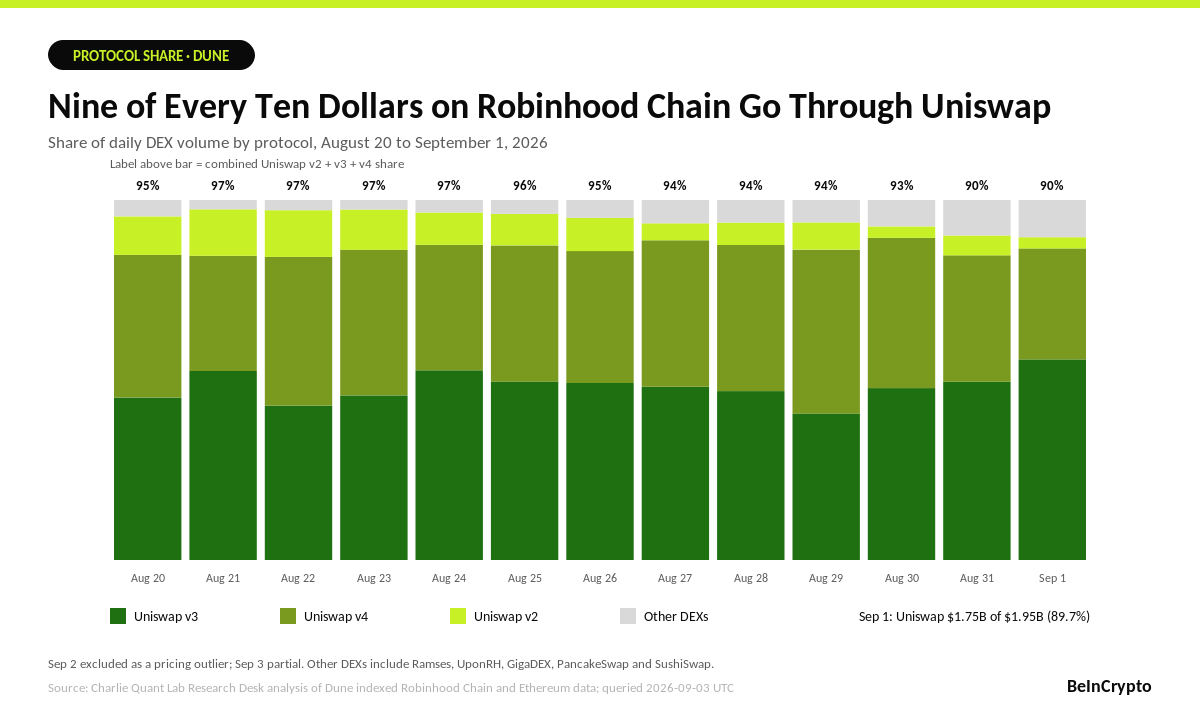
Uniswap price has doubled since August 14, and the money comes from an unexpected place. Robinhood Chain, the network Robinhood launched on Arbitrum in July, now generates two thirds of everything Uniswap earns.
The original Robin Hood took from the rich and gave to the poor. This one takes from the chain it was built on and pays a protocol that has found it hard to keep its revenue.
Robinhood’s Record Month Ran on Uniswap
Robinhood Chain traded $17.99 billion in August, 26% more than July, per DefiLlama’s Robinhood Chain data, and September 1 was its biggest single day yet.
Almost all of it was Uniswap. On September 1, $1.75 billion of the chain’s $1.95 billion passed through Uniswap pools, per Dune, so nearly every new dollar on the chain is a new dollar of Uniswap fees.

The number of traders barely changed. Wallets rose 22% since August 1 while volume rose 7.9 times, so each is trading about six times more.

Existing users are putting more money to work, and since Uniswap earns a percentage of each trade, that deepening interest is worth more to it than a rush of new wallets.
So who collects those fees?
Taking From Arbitrum, Paying Uniswap?
Not the chain’s landlord. Robinhood Chain is an Arbitrum Orbit chain, meaning Robinhood built it with Arbitrum’s technology and in return hands Arbitrum 10% of the chain’s net revenue, which came to $1.32 million in 30 days.
Uniswap, the exchange where the trading happens, collected $78.73 million in trading fees there over the same period. That is 60 times Arbitrum’s share, and 66% of everything Uniswap earned across 47 chains. Arbitrum gets paid for lending the technology. Uniswap gets paid every time someone trades.

The DeFi protocol also earns more per dollar there, charging 0.465% of each dollar traded on Robinhood Chain against 0.214% globally, because Robinhood swaps land in higher fee tiers. In the two highest Uniswap v4 tiers, they paid 84 and 351 basis points against 45 and 241 on Ethereum, per Dune indexed data.

Those tiers are where tokenized stocks trade, and their share of volume rose from under 0.1% in mid August to 4.1% on September 1. More volume at a higher rate means more fees.
The Weakness Robinhood Is Fixing
More fees matter because keeping them is where Uniswap falls short. Of $119.3 million in 30-day fees, only $9.45 million, or 7.9%, reached UNI holders through the burn approved last December. Aerodrome, the largest exchange on Base, passes 70% to holders. GMGN, a Solana meme coin trading app, passes 82%.

Robinhood does not raise that 7.9%. It raises the fee total the 7.9% is taken from. Robinhood Chain’s volume grew 26% in August, and Uniswap charges double its usual rate there. Therefore, every dollar traded on the chain produces more Uniswap fee than a dollar traded elsewhere.
A fixed 7.9% of a larger fee total means more money spent buying and burning UNI, and fewer UNI left in circulation.

That is the revenue story whale wallets bought with 257,777 UNI as September opened, and the price was already moving on it.
Uniswap Price Action: A Flag After a 100% Pole
Uniswap trades at $5.73, down 2.1% day-on-day, after a 100% run from $3.16 on August 14 to $6.38. The pullback looks like a bull flag, which usually resolves upward.

Volume agrees. Buying rose into the peak, and selling has stayed below August 24 levels since.
A daily close above $6.20 confirms the flag and opens $7.06, 23% higher. Below $5.67 the flag fails, and a break under $4.35 erases the setup.

Analyst’s View: Robinhood did not set out to rescue Uniswap, but the money says it has. While Robinhood’s volume keeps climbing, UNI has a revenue story it never had before. The chart says the market is still deciding whether to believe it.
The post Uniswap (UNI) Price Surges 100%, and One Chain Playing ‘Robin Hood' Explains Why appeared first on BeInCrypto.

5 golf driver headcovers with big personality

ICE Finalizes Stun Glove Purchase, Claims There’s No Other Way To Handle ‘Violent’ Migrants

Inox Wind shares rise 2% after bagging Rs 755 crore turnkey order from Indian Oil





-

 Fashion6 days ago
Weekend Open Thread: Maeve – Corporette.com
-

 Crypto World6 days ago
Bitcoin’s 22% rally now needs real demand to outlast Treasury liquidity boost
-

 Business6 days ago
Apple Confirms September 9 Keynote and Reveals Its Full Pre-Order Schedule
-

 Business6 days ago
Salesforce Stock Soars 19% as Blowout Earnings and Agentforce AI Growth Silence Software Skeptics
-

 Crypto World11 hours ago
CLARITY Act could advance within weeks, Atkins says
-

 Business5 days ago
Onto Innovation Stock: AI’s Next Bottleneck Is Yield (NYSE:ONTO)
-

 Crypto World5 days ago
Bitcoin price tests $82K resistance as Brandt stays long
-
 Tech5 days ago
Hugging Face built a $4.5 billion empire on free AI models. Now Nvidia is buying it for $12.9 billion
-

 Business6 days ago
iPhone 18 Pro Pre-Orders Could Shift to Saturday as Apple Reportedly Avoids September 11 Anniversary
-

 Crypto World6 days ago
Truflation calls for Fed rate cut after PCE forecast
-

 News Videos4 days ago
Charlie Munger on Robinhood: No one should believe that Robinhood’s trades are free
-

 Tech5 days ago
PaperCut releases second emergency patch for exploited flaws
-

 Tech6 days ago
The fix for the AI agent that hijacked a company’s DNS: it can propose the change, but it can’t approve it
-
 Entertainment6 days ago
‘Adults’ Creators Break Down Season 2’s Most Shocking Moments and Tease a Potential Season 3
-

 Crypto World1 day ago
Elon Musk Says Grok 4.7 Lands in 10 Days and Will Beat Every Model
-

 Tech4 days ago
Tamagotchi Ring Takes the 30-Year Digital Pet and Places it on Your Finger
-

 Tech4 days ago
As the influencer economy drives retail sales, Seattle startup raises $22M to play matchmaker
-
 NewsBeat4 days ago
Trump posts AI video of ‘Lake America’ being protected by an army of bequiffed ‘Donald Ducks’
-
 Crypto World1 day ago
Bitcoin slips below $77.5K as macro pressure offsets ETF inflows
-
 Entertainment3 days ago
Taylor Swift Reportedly ‘Frustrated’ With Travis Kelce After ‘Short’ Honeymoon
You must be logged in to post a comment Login