Ukraine has dismantled a network of fake crypto investment platforms that allegedly drained wallets belonging to people in more than 20 countries, with investigators identifying 62 victims so far.
Summary
Ukraine dismantled fake crypto investment platforms that targeted victims across more than 20 countries.
Investigators have identified 62 victims, while the network reportedly handled up to $1 million a month at its peak.
Victims were shown fake investment gains before a wallet drainer stole their crypto when they tried to withdraw funds.
Police conducted 34 searches and seized more than 100 computers, over 100 phones and 15 vehicles.
The National Police of Ukraine said investigators from its Main Investigation Department worked with the Security Service of Ukraine and the Office of the Prosecutor General to uncover the operation, which maintained several offices in Kyiv and the surrounding region.
Поліцейські припинили діяльність мережі фейкових інвестиційних платформ, через які шахраї викрадали криптовалюту у громадян понад 20 країн
More than 46 Ukrainians were recruited into the network, while authorities are still identifying other participants, victims and the total amount stolen.
Advertisement
Fake crypto investment platforms targeted more than 20 countries
Investigators said the group created websites designed to look like legitimate investment platforms and used them to offer supposedly profitable cryptocurrency projects.
The Security Service said the scheme began with advertising distributed through Telegram, where potential customers were offered opportunities to invest in crypto projects. Users who registered were instructed to connect a cryptocurrency wallet and transfer funds to the platform.
Behind the websites, developers maintained the infrastructure and worked to keep the platforms accessible when attempts were made to block them. Other members of the group staffed offices, communicated with customers and provided security for the operation.
Once funds were deposited, employees manually simulated investment activity. Customers could see account balances rising inside their dashboards, although investigators said the displayed trading activity was fabricated.
Advertisement
A 25-year-old IT specialist organized the network, according to the Security Service. At its peak, the operation had monthly turnover of up to $1 million.
Authorities have so far identified 62 victims from more than 20 countries. They included citizens of Germany, Poland, Lithuania, Latvia, Spain, France, the UK, Canada and Israel.
The number could rise as investigators continue examining information recovered from the network’s infrastructure and determining how many people transferred cryptocurrency through its websites.
Advertisement
Wallet drainer activated during withdrawal attempts
The alleged theft entered another stage when customers attempted to withdraw their funds.
Operators blocked withdrawal requests and told victims that another verification procedure was required before their money could be released. Users were instructed to connect their primary cryptocurrency wallet and approve a small test transaction to demonstrate that the platform was functioning.
Investigators said the websites contained a wallet drainer that used the authorization to transfer assets from a connected wallet to addresses controlled by the group. After the cryptocurrency had been moved, the victim lost access to the investment platform.
The method relied on the same type of malicious authorization used in wallet drainer attacks, where users can unknowingly give an attacker-controlled contract permission to move their tokens. As crypto.news previously reported in July, approval phishing can involve token approvals, permit signatures and other authorizations that allow assets to be transferred without an attacker obtaining the wallet owner’s private key.
Advertisement
A similar technique surfaced in August when a Hyperliquid user lost roughly 550,000 USDC after interacting with a fraudulent website promoted through a Google advertisement. Security firm Salus later connected the fake Hyperliquid website to infrastructure associated with the Inferno drainer ecosystem.
Salus said that operation included malicious scripts, approval-command generation, automated draining, cross-chain withdrawals and tools for consolidating stolen funds. The Ukrainian case used a different investment pitch, but investigators similarly said victims were induced to authorize a transaction before assets were removed from their wallets.
The fake platforms collected more than cryptocurrency. Registration and verification procedures gathered victims’ passport information, phone numbers, email addresses, account logins, passwords and photographs, according to Ukrainian authorities.
Netherlands servers held records of victims and stolen crypto
Investigators traced server equipment used by the network to the Netherlands and obtained access to a database stored there.
Advertisement
The records contained information about victims, including cryptocurrency wallet addresses and the amounts allegedly stolen from individual users. Authorities said the servers held internal correspondence between members of the group and records describing how the fraudulent platforms operated.
Access to the database helped investigators trace the network across several countries and identify people who had interacted with the websites.
The international element follows several law enforcement operations targeting online investment fraud and crypto-linked social engineering schemes. INTERPOL said in August that Operation Jackal IV resulted in 58 arrests and identified 263 suspects after authorities in 22 countries targeted investment scams, romance fraud and related money laundering networks.
South African authorities seized $2.67 million during that operation and blocked 257 bank accounts, while Romanian police arrested 11 suspects in an investment scheme associated with an estimated €143 million, according to INTERPOL.
Advertisement
A larger INTERPOL crackdown reported in July produced 5,811 arrests across 97 countries and territories. Operation First Light intercepted $293 million in illicit assets, blocked more than 31,000 bank accounts and identified over 142,000 victims while targeting investment fraud, romance scams, impersonation and other forms of social engineering.
Investigators in that operation uncovered crypto laundering activity that used several digital assets and cross-chain swaps. INTERPOL said one wallet linked to a Thai investigation had processed more than $122.5 million over a 10-month period.
Approval phishing has drawn separate enforcement attention. A UK-led operation involving authorities in the United States and Canada froze more than $12 million in suspected scam proceeds earlier this year and identified more than 20,000 potential victims.
The operation focused on schemes in which victims were persuaded to sign malicious blockchain authorizations that gave scammers permission to move cryptocurrency from their wallets.
Advertisement
Police seized more than 200 computers and phones
Ukrainian officers carried out 34 searches at homes, offices and vehicles across Kyiv and the surrounding region as part of the investigation.
More than 100 computers and other pieces of computer equipment were seized along with over 100 mobile phones, 79 SIM cards and a GSM gateway. Police recovered cash and records connected with the operation, while 15 vehicles were taken during the searches.
Some cars and real estate used by members of the network had been registered in the names of suspects’ wives and other relatives, investigators said. The alleged organizer traveled with armed guards.
The criminal proceedings are being conducted under Part 5 of Article 190 of Ukraine’s Criminal Code, which covers fraud. Authorities have not disclosed a final loss figure because they are continuing to identify suspected members of the network and additional victims.
Advertisement
Ukraine has separately been developing procedures for handling cryptocurrency recovered through criminal cases. Authorities transferred more than $8.3 million in seized USDT to a state-managed wallet in June, the first time confiscated cryptocurrency had been placed under direct state management.
The Royal United Services Institute has estimated that stronger rules for tracing, seizing and managing illicit cryptocurrency could help Ukraine recover at least $10 billion in stolen funds and lost tax revenue.
Police said investigators are continuing to identify everyone involved in the fake investment network, locate further victims and determine the total value of cryptocurrency stolen through the platforms.
Jim Cramer expects a huge move in Snowflake stock after a blowout quarter. Broadcom earned a far more cautious verdict.
The CNBC host weighed in after both companies reported. Snowflake and Broadcom both cleared estimates, yet only one drew unqualified praise in the artificial intelligence (AI) trade.
Jim Cramer Snowflake Verdict Follows a Blowout Quarter
Snowflake reported product revenue of $1.49 billion for its fiscal second quarter, up 37% from a year earlier. Adjusted earnings hit $0.62 per share.
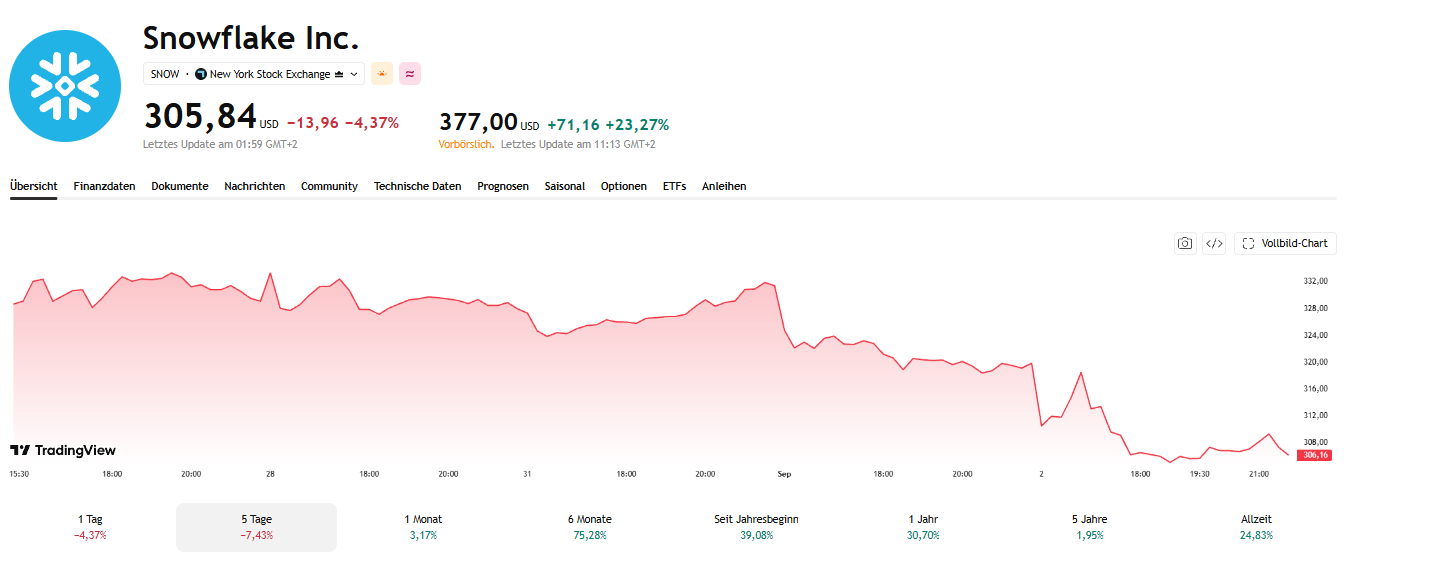
Management lifted full-year product revenue guidance to $6.07 billion. Shares jumped 23.27% to $377.00 in pre-market trading from Wednesday’s $305.84 close.
Advertisement
The stock had slid 7.4% over the five sessions into the report.
Cramer flagged the valuation in the same breath as the beat. He called it the cleanest way for hesitant enterprises to buy compute on demand.
So Snowflake remains the best way for the uncertain to get compute but Broadcom tells a story of an explosion of business coming. Snowflake will have a huge move…. Broadcom? More nuanced…
Broadcom Triples AI Revenue Yet Wall Street Hesitates
Broadcom delivered $16.7 billion in AI semiconductor revenue, a 221% jump. Total revenue rose 86% to $29.6 billion, and adjusted earnings reached $3.32 per share.
Chief Executive Hock Tan guided fourth-quarter AI sales to $21.7 billion. He has secured a supply to roughly double AI revenue to about $115 billion in fiscal 2027.
Tan flagged a path toward $230 billion in fiscal 2028. Investors still balked.
Cramer welcomed the raises, then hedged.
Hock giving you some nice raises for next year and the year after. That’s what we have been looking for. Maybe i am too hopeful… Small position for the trust…
Total fourth-quarter guidance of $34.8 billion landed just under consensus. The stock slipped 2.58% to $357.76 in pre-market trading, extending a 4.5% monthly decline.
Broadcom (AVGO) one-month chart. Source: TradingView
“The memories are so vivid,” says Lomonaco, who helped start a fund for the families of his staff and who has gone on to run several successful restaurants in the city. “A generation has grown up since then, but it still seems like yesterday to me.”
A 25th anniversary marks a swath of time that can be illuminating because, to someone who is younger than 30, it feels like an eternity. Or a lifetime, which to someone who actually is 25, it is. But to someone who is over 50, as I am, it feels like a chapter. A long one, perhaps. But, still, a part of something else.
9/11 is a hinge of time that separates generations. It shouldn’t be surprising—but it always is—when I ask young folks about 9/11, and they just can’t get their hearts around it. It’s something that they learned about in class or saw on YouTube. They don’t feel it like I do. Like we do.
Those of us who are moved by this anniversary—no matter how close we were to the actual tragedy—should find some way to talk about it. “We have an obligation,” Lomonaco says. “When we talk about the people who died, we’re acknowledging the significance of their lives.”
Over the course of her long and influential life, Gloria Steinem went from being described in the pages of TIME as “one of the best dates to take to a New York party these days” and “smashing looking Gucci liberal” to being lauded as a “feminist icon.” If nothing else, the shift in the tone of her coverage in the magazine provides a window into the change in attitudes toward women that she helped engineer over the course of her 92-year life, which ended on Sept. 2.
Let’s add one more description to the list: durable dynamo. Steinem never outlived her ability to be relevant, inspiring several generations of women to organize and strive to be given the same opportunities as men. She never stopped blazing a trail for those who faced a particularly dense thicket and she never thought small. “I believe that things are a circle, not a hierarchy,” she said to TIME in 2011. “The kind of society we are striving toward is one in which things are linked not ranked. And one in which we understand that the women’s movement and the anti racist movement and the gay movement and the environmentalist movement, they’re all linked.”
Steinem was born on March 25, 1934, to a homemaker mother and a father with, she later said, only two points of pride: “He never wore a hat, and he never had a job. He was always going to make a movie, or cut a record, or start a new hotel, or come up with a new orange drink.” She didn’t spend a full year in school until she was 12, when her parents split and she ended up living with her mother, whose mental health was in a dire state, in East Toledo, Ohio. At 16, she was sent to live with an aunt in Washington. Before that, she says, “I’d never lived any place to invite anybody home to. I thought that people always ate out of refrigerators.”
After graduating from Smith College in 1956, she spent two years in India on a fellowship (and also to get out of an engagement), then came home to work in Cambridge, Mass., for a group encouraging American students to attend Communist youth festivals abroad. It was later revealed to be CIA-funded, but Steinem was unfussed, saying she “was happy to use the Establishment’s money against the Establishment.”
In 1963, she famously published a first-person account of her glamour-free month undercover as a Playboy Bunny in Show magazine. It was her big break, and it also threatened to be her curse, since at first she almost exclusively got offered assignments along the same lines. This was the period when TIME thought it important to note an appearance in which she wore “a Luis Estevez creation that consisted of five widely spaced bands of chinchilla held together by transparent black net. In between was supposed to be little more than a bare bodkin.”
Advertisement
She later got hired at the fledgling New York magazine, where in 1968 her first story was about Vietnamese leader Ho Chi Minh’s stint as a New York City waiter and laundryman. As she steadily found her journalistic feet, she began to find her calling: to use her charm, wit and platform to promote equality. Steinem understood the fear that these ideas stirred up in people. “Women don’t want to exchange places with men,” she wrote in an essay for TIME in 1970, shortly after the magazine identified her as “a trim, undeniably female, blonde-streaked brunette who has been described as ‘the thinking man’s Jean Shrimpton.’ ” She went on to add: “But we do want to change the economic system to one more based on merit. In Women’s Lib Utopia, there will be free access to good jobs—and decent pay for the bad ones women have been performing all along, including housework.”
Inevitably, her activism moved beyond writing to organizing. In 1971, along with Shirley Chisholm, Bella Abzug, Betty Friedan and several others, she convened the National Women’s Political Caucus to try to get more women into government offices. Shortly after that she co-founded Ms. magazine, which she described as “a how-to magazine; not how to make jelly but how to seize control of your life.” TIME’s writers, by this time calling her “feminism’s superstar,” finally began to acknowledge her impact. A story about the 1972 Democratic convention—titled, alas, “Eve’s Operatives”—opened with: “Gazing around the convention through her blue-tinted glasses, Gloria Steinem pronounced with satisfaction: ‘We’ve changed the population here. It almost looks like the country. What she meant was that women are 52% of the nation’s population, and last week close to 40% of the convention delegates were women—a dramatic jump over their 13% representation at the 1968 Democratic Convention.”
There was a still way to go, however—both for women and for TIME. “Decorative as the women were in their bell-bottom trousers, miniskirts, jeans and hot pants,” the magazine went on to say, “they were not there to be on display but to seek power. Except for a couple of setbacks, they got enough to satisfy and even surprise them.” After the crushing loss of Democratic Presidential Candidate George McGovern to Richard Nixon, Steinem’s political campaigning took a backseat to her advocacy work. The 1977 women’s conference, which she has called “the most important event that nobody knows about,” remained one of her proudest achievements, even as it sparked a conservative backlash and perhaps the founding of the religious right.
As the decades passed, Steinem’s activism grew to encompass more than women’s equality. She campaigned on behalf of native people, was arrested while protesting apartheid, publicly opposed the first Gulf War, advocated for disarmament in Korea, spoke against child abuse, female genital mutilation and pornography, and was an early supporter of LGB rights. (It took her a little longer to endorse the transgender movement.) Her advocacy was always couched in pragmatism and compassion. She pointed out that the pedestal women were put on was “as much a prison as any small, confined space” and called her 2019 memoir The Truth Will Set You Free, But First It Will Piss You Off! Writing, her first calling, remained one of her great loves—”the only thing that, when I do it, I don’t feel I should be doing something else.” She published books throughout her career, many of which, including her first memoir, 1983’s Outrageous Acts and Everyday Rebellions, were bestsellers, and she had another one due out this fall. (She often joked that she wished her books didn’t get republished so much because it would mean they were no longer relevant.)
Advertisement
By the ’90s, Steinem had scored a TIME cover, albeit one about a pushback against feminism, after her book about female self esteem—Revolution From Within—was a bestseller. “As she tours shopping malls, Steinem is being mobbed by crowds that, according to one bookstore owner, exceed those of Oliver North and Vanna White, the backlash icons of American manhood and womanhood,” Nancy Gibbs wrote. As well as writing her own books, Steinem contributed to countless others, appeared in more than 120 films, help produce several documentaries and inspired the 2019 Off Broadway play, Gloria: A Life. She cast her gaze domestically, locally, nationally and globally, founding Equality Now, which aimed to elevate and protect the rights of girls and women internationally.
Somewhere around the turn of the century, the times—and TIME— caught up with Steinem; her ideas became mainstream and her words and activities were covered with the kind of reverence reserved for icons. In 2013, President Barack Obama awarded her the Presidential Medal of Freedom. Half a century after writing her Women’s Lib Utopia essay for TIME, she annotated it, warning that women had made many advances but that the “time of greatest danger comes after a victory, and that’s where we are now.” (She also noted that she found out later that she had been paid less than the men who wrote for the same issue.)
Through it all she kept one of her less acknowledged gifts intact: her sense of humor. She did not come up with the classic feminist saying that women need men like a fish needs a bicycle, but she popularized it. She was always threatening to get a back tattoo for her 70th birthday. So frequently was she asked about her beauty secret that she came up with the perfect reply: “Revolution,” she would say. “It keeps you young.”
In 2011, TIME asked what she would do if she only had two years to live. “It seems to me one of the uses of age is to help you know what you want to do and keep from wasting time,” she said. “And I have this unfortunate notion that I’m immortal, which doesn’t cause you to plan very well. I think it would be mainly about writing and seeing friends, my chosen family. And writing what I believe. And maybe living with elephants. I do still want to live with elephants.”
Ethereum price is trading around $2,390, but the chart is starting to look tired. ETH has shed 3%-6% over the past week, and the bounce that carried it above $2,400 last week is losing steam fast. What’s not showing up in the number? A quieter shift in derivatives positioning that suggests traders are hedging, not accumulating.
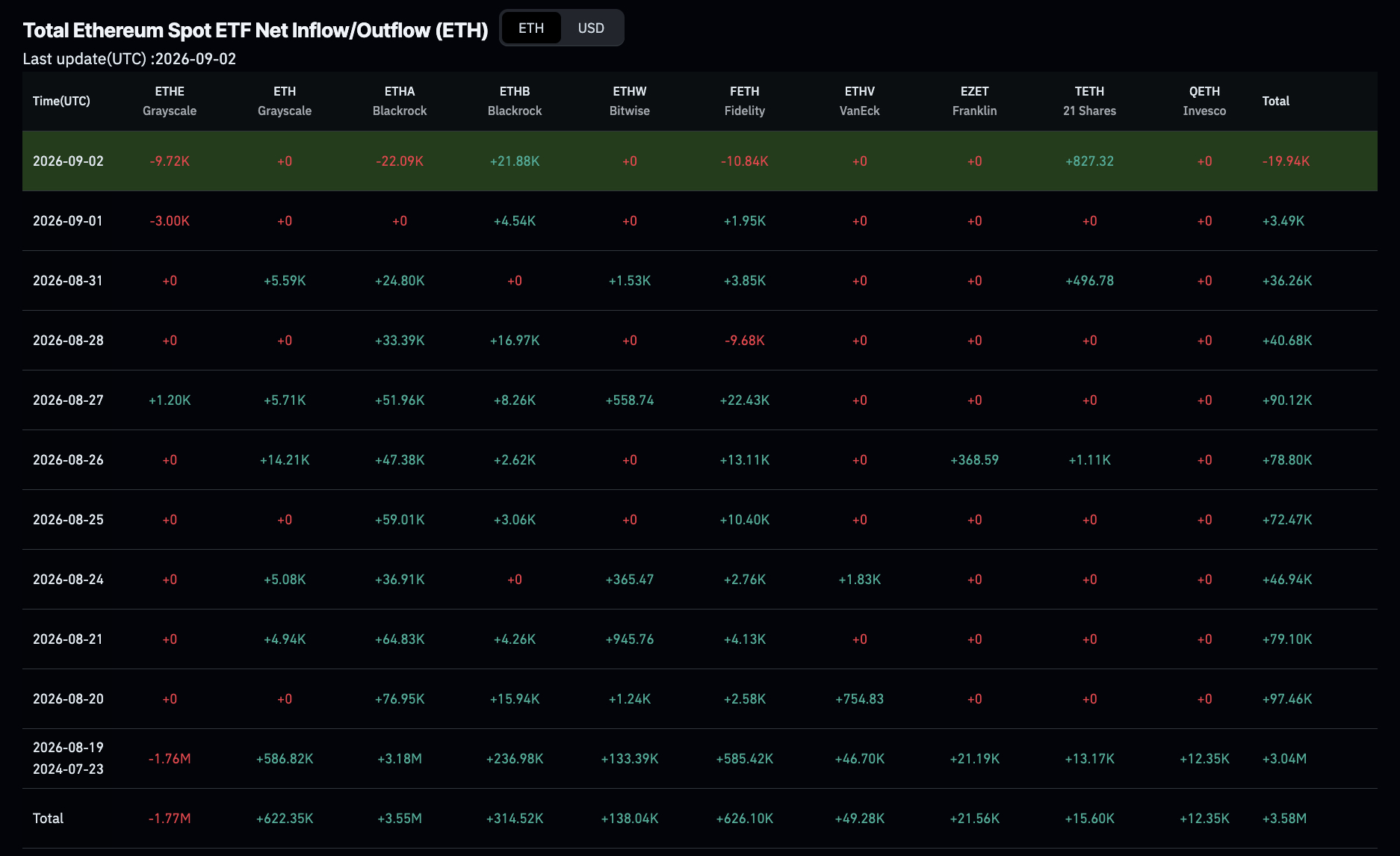
Spot Ethereum ETFs logged inflows for a 12th consecutive session before turning red yesterday, even as Bitcoin ETFs bled outflows, a gap that would normally read bullish for ETH. Institutional buyers keep showing up, yet the spot price refuses to follow.
Ethereum ETF Flows, Coinglass
A Bybit market note flagged ETH as “consolidating at high levels” while facing “increased downward pressure” from liquidity spillover and leverage unwinds, a dynamic that often precedes a liquidation cascade rather than a clean breakout.
Macro conditions aren’t helping. Rate-cut odds have been getting repriced hard this week, and that kind of shift tends to hit risk assets like ETH before it hits anything else.
ETH’s $2,400 zone is the line in the sand right now. Bybit’s own data flags a breach below that level as a potential accelerant for further downside, and our technical mapping shows a support ladder underneath at $2,290, then $2,210, then $2,160, with $2,550 standing as the key resistance overhead.
Bull case: ETH reclaims $2,438.85 (the 0.618 Fibonacci retracement) and pushes toward $2,550, opening a path to $2,800 if momentum returns.
Bitcoin Hyper Targets Early Mover Upside as Ethereum Tests Key Levels
Advertisement
Selling pressure like this is exactly why long-term ETH holders start eyeing the exits, or start looking for asymmetric bets elsewhere.
When a $290 billion asset struggles to hold $2,400, the marginal upside on adding more ETH at these levels looks thin. That’s pushing capital toward earlier-stage infrastructure plays with room to actually multiply.
Bitcoin Hyper ($HYPER) is building the first Bitcoin Layer 2 with full SVM integration, aiming to process transactions faster than Solana while settling back to Bitcoin’s base layer for security.
The presale has raised $33 million at a current token price of $0.0136856, with staking rewards live at a high 60% APY for early participants. Its Decentralized Canonical Bridge lets BTC move into the L2 without a custodial middleman, a real fix for Bitcoin’s programmability gap.
Gloria Steinem, the feminist activist who inspired a generation of women and fought for gender equality, has died at age 92.
Her foundation announced the news in a social media post Thursday morning, sharing that Steinem had “passed away peacefully” at her home in New York City the day before, surrounded by her loved ones.
“Gloria’s greatest gift was her ability to listen to others, to make others feel seen and heard. Her words, actions, and example gave people permission to be their truest selves. Gloria lived true to her independent spirit, always with curiosity and a great sense of humor,” the statement read.
“Gloria loved the tradition of lighting signal fires on hills to light the way to the other side of the mountain. Lighting your own candle for Gloria makes you part of this global and celestial community circle.”
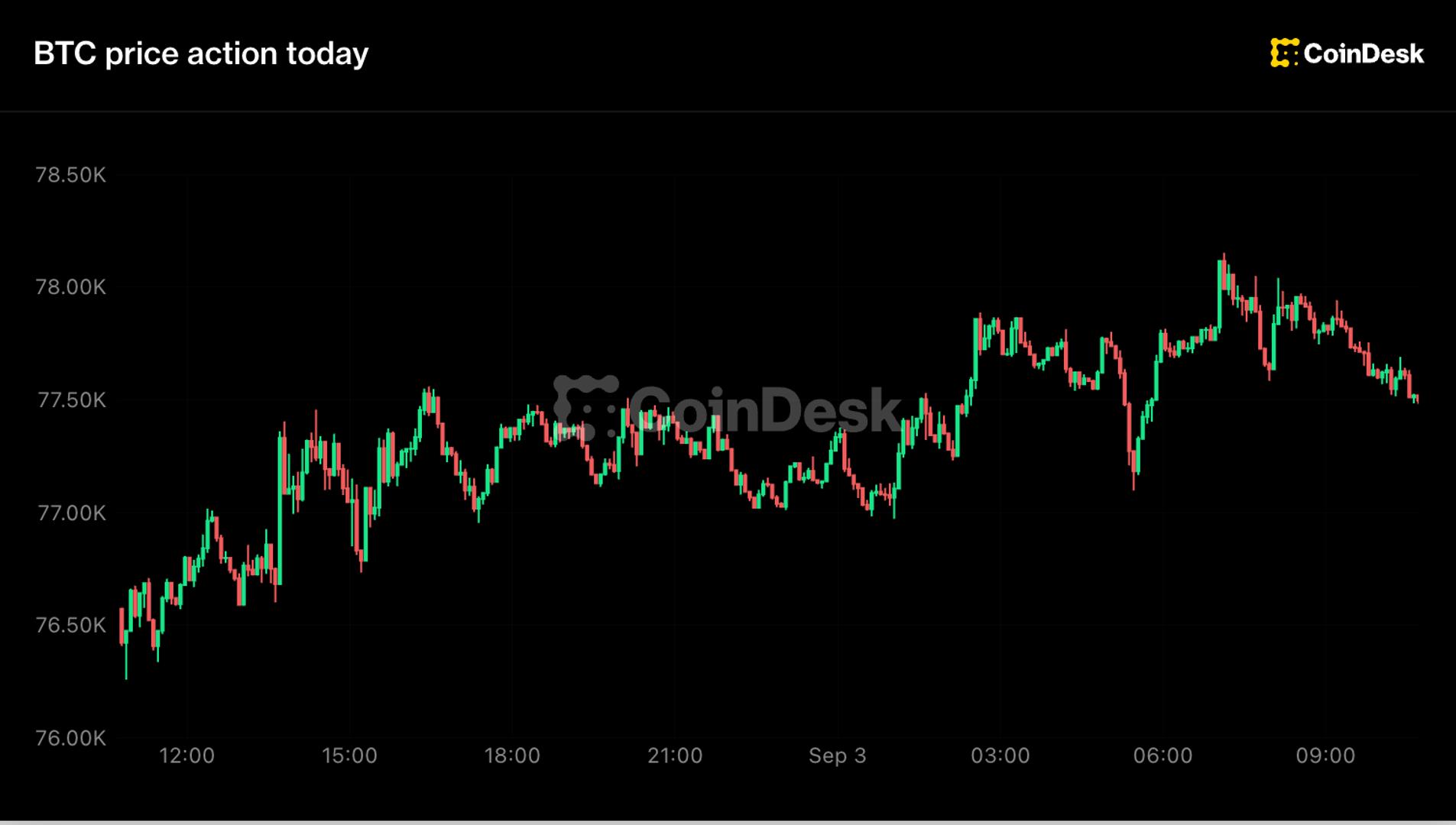
Bitcoin is back above $77,500 with every major green on the day, though the week still reads red. Global investors are carrying their lowest currency protection on U.S. assets in a decade.
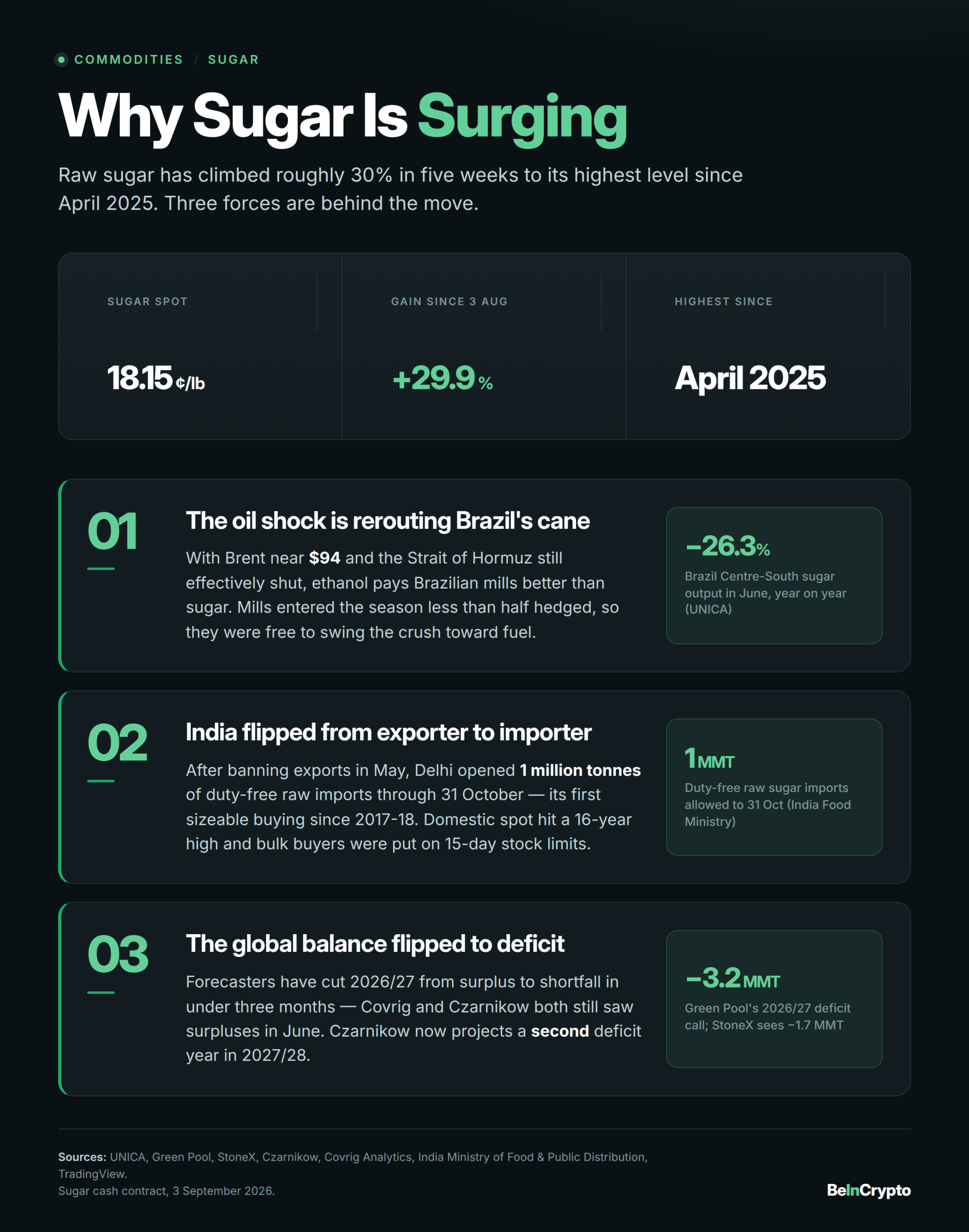
Brazilian mills have switched cane away from sugar and into ethanol. Brent crude near $94 a barrel makes fuel the better payer, and the Hormuz closure keeps energy costs high. Mills entered the season less than half-hedged, so they moved quickly. Center-South sugar output fell 26.3% year over year in June, according to UNICA.
Advertisement
India has meanwhile turned buyer. New Delhi banned exports in May, then allowed 1 million tonnes of duty-free raw imports through Oct. 31. That is its first sizeable purchase since the 2017-18 season. Domestic prices hit a 16-year high, and the government capped bulk buyers at 15 days of stock.
Forecasters have also flipped the global balance. Green Pool projects a 3.2 million tonne deficit for 2026/27, while StoneX sees 1.7 million tonnes. Covrig Analytics and Czarnikow both expected surpluses in June.
Czarnikow now forecasts a second shortfall in 2027/28. A strong El Niño adds risk to Indian and Thai cane, a threat Goldman flagged in June.
Three drivers behind the sugar price rally / Source: BeInCrypto
Sugar Price Technical Analysis Eyes 19.48 Cents
The weekly chart tracks a retracement of the slide from 23.38 cents. Sugar broke above the 0.236 Fibonacci level at 15.58 cents in August, turning that band into potential support.
Price now sits at the 0.5 retracement at 18.28 cents. Thursday’s candle tagged 18.58 cents before easing back, so resistance has held on the first attempt.
Advertisement
A weekly close above 18.28 cents would expose the 0.618 retracement at 19.48 cents. That level coincides with the declining 200-week moving average, which reinforces it as resistance. The 0.786 level at 21.20 cents sits above.
Sugar weekly chart / Source: Tradingview
On the downside, the 0.382 retracement at 17.08 cents offers first support. A deeper correction would retest 15.58 cents.
Volume has risen sharply over the past three weeks, which suggests conviction behind the breakout. The weekly RSI also sits at its highest reading since April 2023. Momentum, therefore, favors the commodities bulls for now.
Managed money held 207,100 net long contracts in late August, a two-year high, after sitting net short in May. However, crowded positioning could sharpen any reversal.
State fairs might also be the last best venue we have where people compete for the love of their passions. At the Creative Arts building this year, I walked by display cases with hundreds of cookies, scones, and bars from kitchens across the state. Tiny flags glued to toothpicks poked out from atop the winners.
Next, I stopped by the horticulture building to see our neighbor’s prize-winning floral arrangements; she grows flowers all summer to show them at the fair. And over at the livestock barns, I watched farmers carefully parade their perfectly groomed sheep in a circle around a judge who was picking winners. I asked one of the contestants what they would get if they won.
“A trophy, a ribbon, and about 28 bucks,” she said, adding with a smile, “If you’re getting into sheep for the money, it’s not worth it.”
In a time when almost every level of competition is heavily commercialized, from youth sports to the NIL era to the professionalization of everything, it’s refreshing to see people competing solely for the pride of putting their work on display. And thankfully, there’s nothing controversial about a flower, a cookie, or a beautiful animal—they’re things everyone can enjoy.























































You must be logged in to post a comment Login