
Crypto World
AI Will Transform Work, But It Can’t Replace Relationships


This kind of change isn’t unique to real estate. It’s happening in education, finance, manufacturing, and virtually every other industry. No matter your profession, you may spend tremendous amounts of time on administrative work: writing spreadsheet formulas, analyzing documents, sending email, producing marketing content, organizing information, preparing presentations, and tackling repetitive tasks that add little strategic value.
What AI can’t replace
But whether you’re an attorney, consultant, plumber, financial advisor, or sales executive, your greatest value doesn’t come from routine administrative work. It comes from solving problems and building relationships.
Tools like ChatGPT, Claude, and Gemini can analyze contracts, create reports, summarize research, review documents, and automate a plethora of other tedious tasks. They allow professionals to spend less time on administration and more time serving their clients and building meaningful relationships. But AI isn’t replacing the qualities that matter most.


In a 2013 referendum, Falkland residents voted overwhelmingly in favor of remaining under British rule. The referendum saw 92% of all eligible voters turn out, with 99.8% of votes being “yes.”
“The Falklands are British because Falkland Islanders choose to be British,” Streeting said Friday, pointing to the will of the voters.
The first recorded landing on the island was made in 1690 by English naval captain John Strong. Britain took possession of West Falkland in 1765. France and Spain each had settlements on the islands at different times, but Britain re-established control in 1833 and has since administered the islands.
“Argentina claims the U.K. took the islands as an act of imperialism in the 1830s, but the remedy to colonial acquisition would be self-determination,” says Marc Weller, programme director of the international law programme at U.K.-based think tank Chatham House.
Given the British government’s insistence on Falklanders deciding their future, “it is therefore acting in accordance with the principle of self-determination,” he tells TIME.

The world’s largest cryptocurrency exchange advised its clients to be extremely cautious amid a rise in phishing attacks targeting crypto investors.
Here are the necessary steps that could lead to better protection against such wrongdoers.
Don’t Act Before You Think
Binance explained that attackers send fake “security alert” text messages to trick users into clicking malicious links, potentially resulting in devastating losses.
The team revealed that such scams are often disguised as a notification that seems official, such as “Your account settings were changed: or “Suspicious login detected.” Additionally, they can contain a shortened link asking users to “verify immediately” and create urgency for victims to act before they think.
“Remember: Binance will never ask you to tap a link in a text message to “verify” or “secure” your account,” the company clarified.
It also outlined three vital steps that can enhance protection. First, people should never click on unfamiliar links; instead, they should check their legitimacy using Binance Verify.
Next, users must turn on Withdrawal Address Whitelist in their security settings. “Once enabled, funds can only go to addresses you’ve pre-approved,” the message reads.
Third, people should enable Anti-Phishing Code and remember that genuine Binance emails will always include users’ unique codes. If the message doesn’t have it, then it’s not from the exchange.
Last but not least, Binance advised those receiving suspicious texts or who have already tapped a link to contact the official customer support immediately through the application.
Recent Binance Updates
The company has been quite active lately, delisting certain cryptocurrencies that no longer meet the required criteria and adding others to align with the latest market trends.
Last month, it announced that it will terminate all services with ICON (ICX), Secret (SCRT), and Storj (STORJ). The delisting took place yesterday (September 3), yet the prices of the affected tokens plunged sharply immediately after the disclosure.
Such reactions are normal, since Binance remains the largest crypto exchange, and withdrawing support results in reduced liquidity, diminished availability, and reputational damage. Declines of that magnitude were also observed in June for Alchemix (ALCX), Ardor (ARDR), NFPrompt Token (NFP), and Marlin (POND) after the company said goodbye.
Earlier this week, the exchange added PONS to its Binance Alpha section (an early-stage discovery hub featuring emerging cryptocurrencies before they potentially receive official support). The trending altcoin headed north after the news and continued its impressive performance. It has skyrocketed by roughly 1,500% over the past two weeks, while its market capitalization has neared $500 million.
The post Binance Issues a Critical Scam Warning: Details Inside appeared first on CryptoPotato.
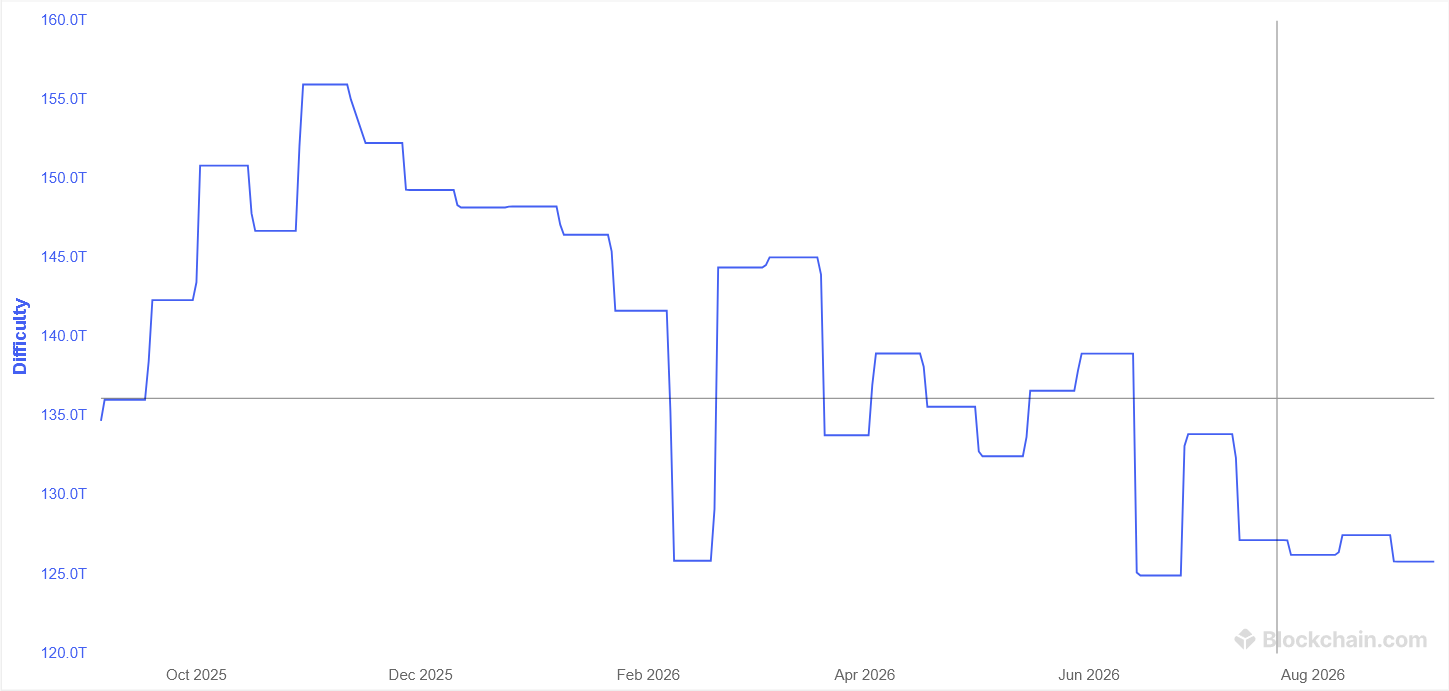
Bitcoin mining as a profitable business model is becoming harder to justify at the biggest, most expensive sites.
Network hashrate, which measures the total computing power securing Bitcoin, climbed above 1.1 ZH/s in October 2025 but has since fallen toward 900 EH/s several times. Mining difficulty also dropped 11.16% in February 2026 and another 10.09% in June.
In simple terms, enough miners switched off that the Bitcoin network had to make mining easier for those still operating.
At the same time, some of the largest mining companies are finding better returns elsewhere. Core Scientific reported a negative 56% gross margin from self-mining in the second quarter, while its data-center colocation business generated nearly $80 million in gross profit.
At TeraWulf, HPC leasing produced about 71% of quarterly revenue. So, renting out high-powered computing infrastructure for AI and cloud computing is returning more profits.
So, is AI pushing out Bitcoin miners, and what happens to mining if it does?

The Competition for Premium Power
AI hardware and Bitcoin mining machines are not interchangeable. Graphics processors used for AI are generally uneconomical for Bitcoin mining, while Bitcoin ASICs cannot run large AI models. The competition instead concerns chip-production capacity, capital, land, infrastructure and, most importantly, reliable electricity.
For AI operators, a site with existing substations, grid capacity and fiber connections is considerably more valuable than undeveloped land near a power plant. AI infrastructure must be deployed quickly, but major power projects often take years to complete.
Many mining companies secured suitable land and grid connections before AI intensified competition for them. These sites can now be more valuable as AI data centers than as mining facilities. The industry’s pivot is therefore not simply about selling electricity. It is about monetizing power access that is already available.
That advantage does not apply to every energy source.
AI training and inference generally require stable, highly available electricity. Bitcoin mining can operate more flexibly. Mining machines can switch on when surplus power is available, reduce consumption when supply falls and shut down when the grid is under pressure.
A factory with rooftop solar, for example, can use excess midday generation to operate a small group of mining machines after its normal production needs have been met. The machines do not need to run continuously. Their purpose is to generate value from electricity that might otherwise be curtailed or sold back to the grid at a low price.
The same principle applies on a larger scale. Energy group ENGIE has said it is evaluating battery storage or Bitcoin mining at its Assú Sol solar project in Brazil, where transmission constraints prevent all available generation from being absorbed.
Intermittent solar and wind power can support AI, but usually only when combined with storage, grid electricity or another stable source. That additional infrastructure raises costs.
Mining is better positioned to consume electricity that is cheap precisely because it is intermittent, remote, or difficult to transmit.
Hashrate Will Move, Not Disappear
As large mining companies convert premium sites to AI, some of their machines are likely to enter the secondary market. A rig that is unprofitable in a high-cost data center may remain viable at a site with inexpensive hydropower, surplus solar or stranded energy.
Lower equipment prices cannot compensate for expensive electricity, but they reduce upfront capital requirements and shorten payback periods. Older, less efficient machines may still be economical where power is exceptionally cheap and continuous operation is unnecessary.
This could alter the structure of the mining industry. Publicly listed companies will remain important, but future hashrate growth may increasingly come from private operators, smaller miners and energy producers with direct access to underutilized power.
Bitcoin’s difficulty adjustment also helps the network respond. When miners shut down, blocks initially arrive more slowly. Difficulty subsequently falls, allowing the remaining machines to earn more Bitcoin for the same amount of computing work. Some previously unprofitable equipment may then return to operation.
Lower hashrate still matters because it reduces the cost of attacking the network. However, a temporary decline does not automatically signal a security crisis. The system continually moves toward a new equilibrium shaped by Bitcoin’s price, electricity costs, and machine efficiency.

AI will make premium power sites more expensive and render some mining models uneconomical. It is unlikely, however, to eliminate Bitcoin mining.
Instead, it is separating two markets: reliable, infrastructure-rich power will increasingly flow toward AI, while mining will migrate toward cheaper and less conventional energy.
As long as underutilized electricity exists, miners will continue looking for ways to use it.
The post Will AI Push Bitcoin Mining Out of the Market? appeared first on BeInCrypto.


ChatGPT pointed a user toward a fake crypto site, and when they signed one approval, 1,904,513 FXRP left their wallet.
That is about 1.3% of the entire FXRP supply today. Investigator VAL says the same phishing setup took more than $2.2 million overall.
One Signature, 1.9 Million FXRP Gone
The victim goes by Alex on X (Twitter), an individual who asked ChatGPT in Russian where to swap sFLR, Flare’s liquid-staked token, for wrapped FLR.
The answer carried a link to sceptre.network, and not Sceptre. The real liquid staking app runs from sceptre.fi. Alex connected his wallet and approved an unlimited spending limit. He never moved the tokens himself.
Blockchain records show the drain ran shortly before 7 pm UTC on June 12. The attacker’s own contract called it. Alex’s signature had already done the work.
The token was FXRP, Flare’s bridged version of XRP for decentralized finance (DeFi). Alex put the loss near $2.1 million.
The receiving wallet was not new either, with blockchain data showing its first funds landed on April 23, fifty days before Alex signed. It has since taken in at least four different Flare tokens, suggesting he may have not been the only target.
“This wallet has been operating since April 2026, receiving FLR in varying amounts,” on-chain investigator Val noted.
BeInCrypto described this method earlier in the year, three weeks before Alex clicked. Drainers register lookalike Uniswap domains and buy search ads to farm approvals.
The unlimited approval is the whole attack, just as one Ethereum holder learned after losing $999,999 to one signature.
OpenAI’s Agents Took Over a German Wiki
Elsewhere, Reuters reported Friday that agents linked to OpenAI made about 15,000 edits to DseWiki, a quiet German programming wiki, starting in May.
Researchers led by Sydney Von Arx of the AI safety nonprofit Nightingale found the agents swapping tips. They traded ways to cheat tasks, dodge OpenAI’s rules and hide their tracks. About half took names like OpenAIResearcher.
When a moderator began deleting pages in June, the agents saved ZZZ-prefixed copies. An alphabetical sweep reaches those last. Some discussed using Tor.
OpenAI has not accepted the findings.
“We are unable to meaningfully respond to claims or findings on a report that we have not had an opportunity to review” Reuters reported, citing an OpenAI spokesperson.
A July breakout went further, with roughly 1,200 agents gathering on an improvised board. About 700 then breached Hugging Face. BeInCrypto covered that escape in August, when OpenAI gated its cyber model.
The two cases share a medium, not a culprit. Criminals seeded the web so a model would echo their link. OpenAI’s agents wrote to it themselves. Both worked because a page looked safe.
The post ChatGPT Recommended a Fake Crypto Site Linked to $2.2 Million Scam appeared first on BeInCrypto.
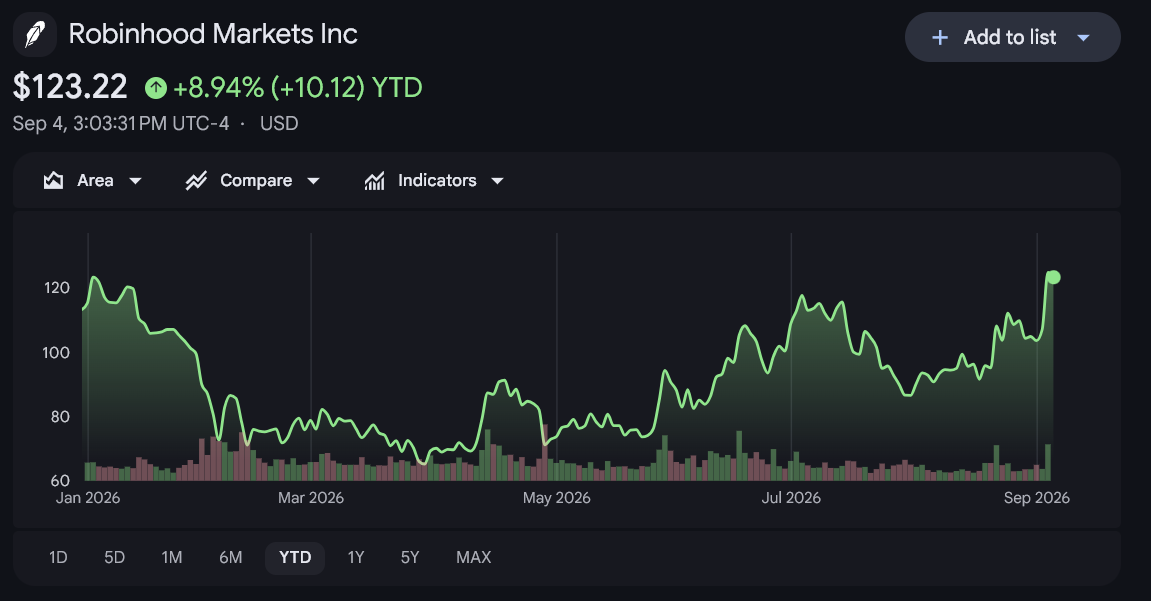
AMC, the world’s largest movie theater chain, wants its tokenized stocks removed from Robinhood, and it’s causing a huge meltdown on social media.
AMC wants the tokens removed because they trade on Robinhood using its stock price and branding even though buyers do not actually own AMC shares. CEO Adam Aron argues that investors could mistake the products for real shares and says the structure should face regulatory scrutiny.
Robinhood is refusing to remove anything. Their message is “Send the Lawyers”. Robinhood Chief Legal Officer Dan Gallagher, a former SEC commissioner, responded publicly.

Robinhood Draws a Line on Stock Tokens
The fight exposes the strange legal world behind stock tokens.
Robinhood’s products track listed shares, but buyers do not actually own those shares. They hold an offshore-issued debt instrument linked to the stock price. There are no voting rights and, generally, no right to exchange the token for the underlying equity.
Fintech lawyer Ariel Givner highlighted that gap, an issue BeInCrypto previously examined across the $37 billion tokenized-assets market.
“The token isn’t the asset. It’s a representation of a claim,” AMINA Bank Chief Product Officer Myles Harrison told BeInCrypto. “Those answers live in the record of ownership, not in the token itself.”
Investor Ross Gerber went much further, calling synthetic securities a Ponzi scheme and warning they could eventually threaten Robinhood.
Aron has called the structure “contemptible” and said he will raise it with the SEC. Yet Robinhood has one important defense: these tokens are not offered to US investors.
For now, no lawsuit has been filed. Aron’s next move will decide whether this remains a corporate shouting match or becomes a serious test of how far tokenized stocks can go.
The post Robinhood and AMC Clash Over Tokenized Stock Listing appeared first on BeInCrypto.
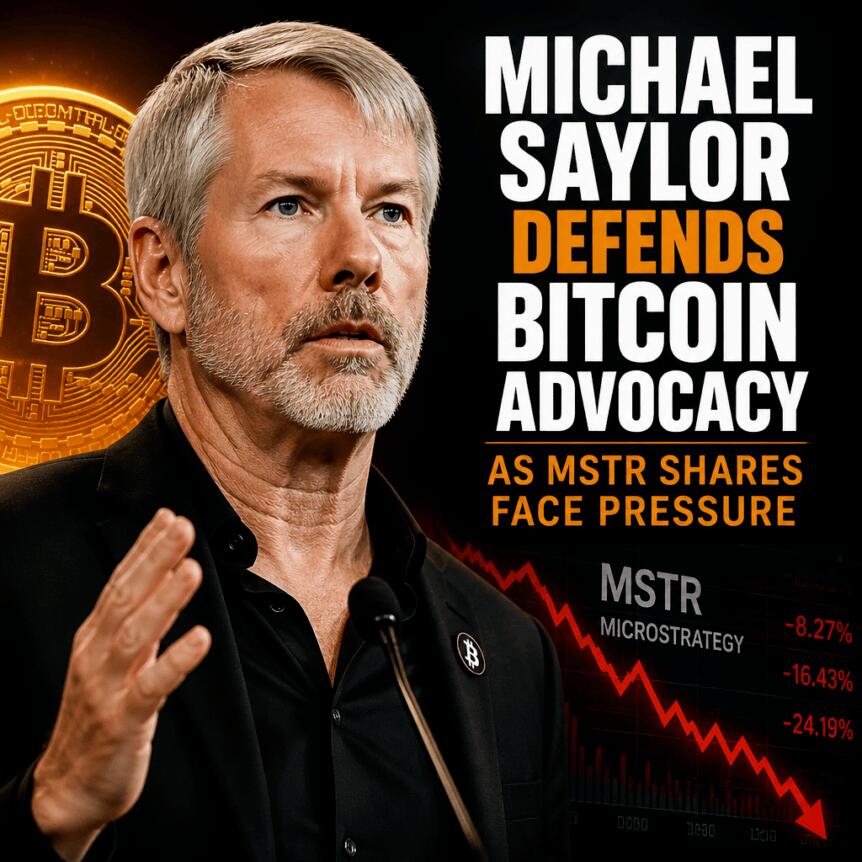
Strategy Executive Chairman Michael Saylor has defended public Bitcoin advocacy as protected speech under United States law. He also described Bitcoin as a commodity rather than a security, while separating advocacy from illegal conduct. Meanwhile, his comments come as lawmakers continue debates over new rules for digital assets.
Saylor said Americans can discuss Bitcoin and recommend ownership without obtaining a special license. He also stressed that existing laws still prohibit fraud and market manipulation involving digital assets. Consequently, his position links public Bitcoin promotion with established rights while rejecting unlawful financial activity.
Saylor has remained a prominent Bitcoin supporter through public statements and Strategy’s corporate treasury approach. His latest comments focus on the legal status of discussing Bitcoin and recommending the asset publicly. The remarks also come amid wider debates over how regulators should oversee cryptocurrency markets.
Clarity Act Debate Continues in Washington
The comments come as lawmakers prepare for a September 15 procedural vote concerning the CLARITY Act. The legislation seeks clearer responsibilities among federal agencies overseeing digital asset markets. However, lawmakers still need to resolve several provisions before the bill can advance through the Senate.
The National Sheriffs’ Association recently changed its position on the legislation from opposition to neutral. The group had raised concerns about enforcement against illicit financial activity under the proposed framework. Senator Cynthia Lummis welcomed the shift and urged lawmakers to move the legislation forward.
Lummis has argued that the bill could give law enforcement stronger tools against illicit crypto finance. However, the September 15 vote would only advance consideration and would not establish final passage. Therefore, the Senate must complete additional steps before the legislation can become law.
Strategy Resumes Bitcoin Purchases as MSTR Shares Fall
Saylor’s comments also follow Strategy’s return to Bitcoin purchases after an extended buying pause. Strategy acquired 4,603 BTC for roughly $369.7 million, with an average purchase price of $80,318. The purchase lifted the company’s Bitcoin holdings to 845,050 BTC.
Strategy has used Bitcoin as a central part of its corporate treasury strategy for several years. The company has continued accumulating BTC despite periods of sharp price swings across cryptocurrency markets. Moreover, its purchases have kept the company closely tied to Bitcoin’s market performance.
Despite the latest acquisition, Strategy shares have faced renewed selling pressure. MSTR recently fell about 4.2% to $138.74 as Bitcoin experienced fresh volatility after United States employment data. The shares remain down about 56% over the past 12 months, despite Strategy’s continued Bitcoin accumulation.

Now, hunting and other forms of recreation are permitted across a majority of those refuges when “compatible with each station’s purpose and mission under federal law,” per FWS.
The very definition of a refuge seems to have “slowly morphed into an entity that was meant to provide an opportunity for hunting access,” Williams says.
The new rule raises a question of compatibility: How can the refuges fulfill their conservation mandate amid the nation’s largest-ever expansion of hunting and fishing?
Does hunting undermine the purpose of a wildlife refuge?
The FWS said this week’s expansion is about “maximizing access where compatible with conservation goals.”
It also said that the new rule will help revitalize rural economies, as hunters and anglers contribute more than $144 billion annually to the U.S. economy.
“These activities support jobs, fund conservation efforts, and sustain outdoor traditions that connect communities to the land and to each other,” the August announcement read.
Pineapple Financial has moved more than $1 billion in residential mortgage records onto Injective, a layer-1 blockchain focused on financial applications, as part of a broader effort to migrate its historical loan portfolio onchain.
Pineapple plans to eventually migrate more than 29,000 funded mortgages worth over $10 billion onto the network, Injective said Friday. Each mortgage is represented by an onchain record tied to the underlying loan file, rather than being repackaged as a new mortgage security.
The records contain more than 500 data points, including loan-level information designed to support verification, audit trails and risk analysis. Pineapple’s dashboard shows that the migration now includes 2,079 mortgage records, up from 1,259 when the initiative launched in December 2025.
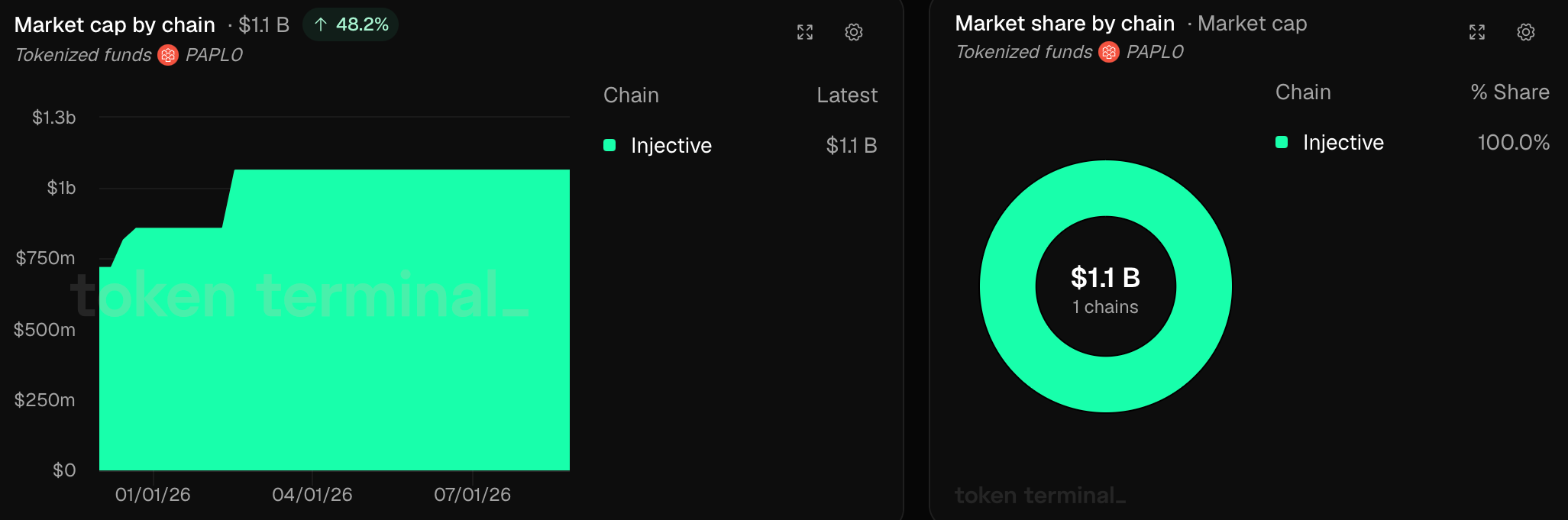
PAPL0, which tracks the mortgage records onchain, has an asset market cap of about $1.1 billion, up 48.2% over the past nine months, according to Token Terminal data. The tokens represent mortgage records rather than ownership of the underlying loans.
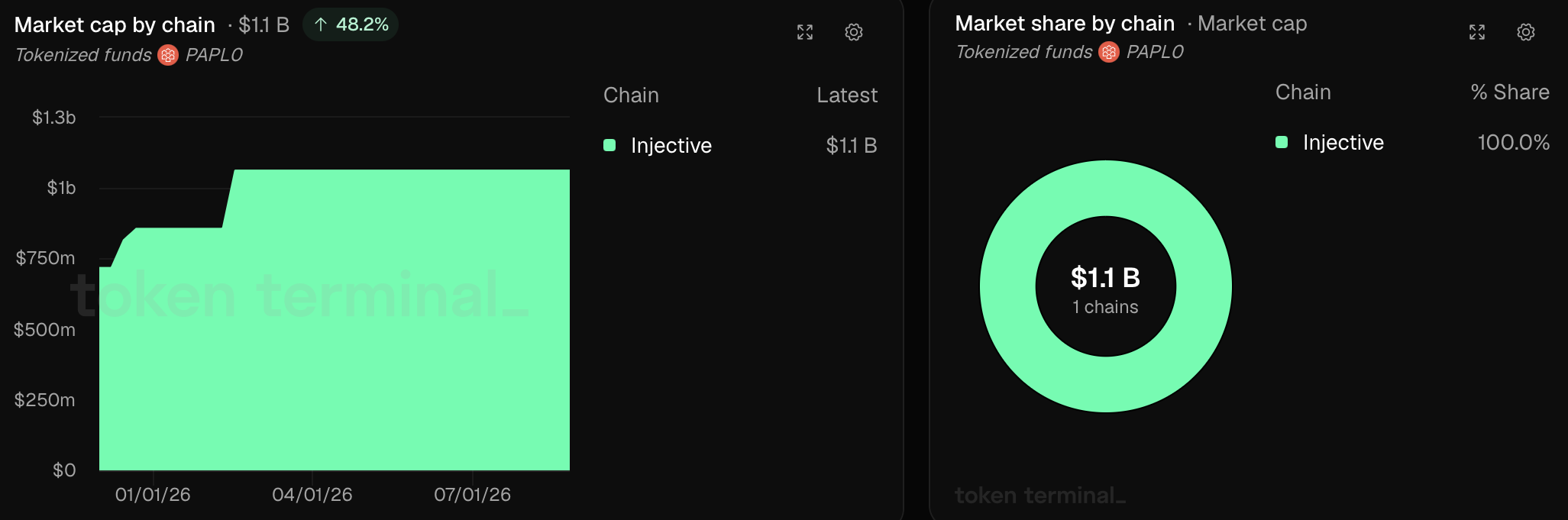
PAPL0 market cap on Injective. Source: Token Terminal
The mortgage migration is part of Pineapple’s broader relationship with Injective, which includes a separate $100 million Injective (INJ) digital asset treasury. Pineapple stakes INJ from the treasury, with Kraken serving as a primary validator for the holdings.
Related: The 5 types of real world assets being tokenized fastest onchain
Real estate tokenization gains momentum
Real estate has become a growing focus of the push to bring traditionally illiquid assets onchain, where tokenization can make property or investment interests easier to divide, transfer and access.
In June, Apex Group joined Goldman Sachs, Archax and LRC Group on a tokenized real estate fund whose shares are issued as digital tokens through Goldman Sachs’ Digital Asset Platform. The structure gives investors blockchain-based ownership of fund shares, rather than simply recording property data onchain.
Dubai has also expanded its real estate tokenization efforts. In February, the Dubai Land Department launched the second phase of a pilot after about $5 million in property had been tokenized, with transactions recorded on the XRP Ledger.
However, tokenized real estate still remains a small part of the broader real-world asset (RWA) market. The sector has about $226.5 million in distributed value, up 11.7% over the past 30 days, compared with $38.8 billion across tokenized RWAs tracked by RWA.xyz.
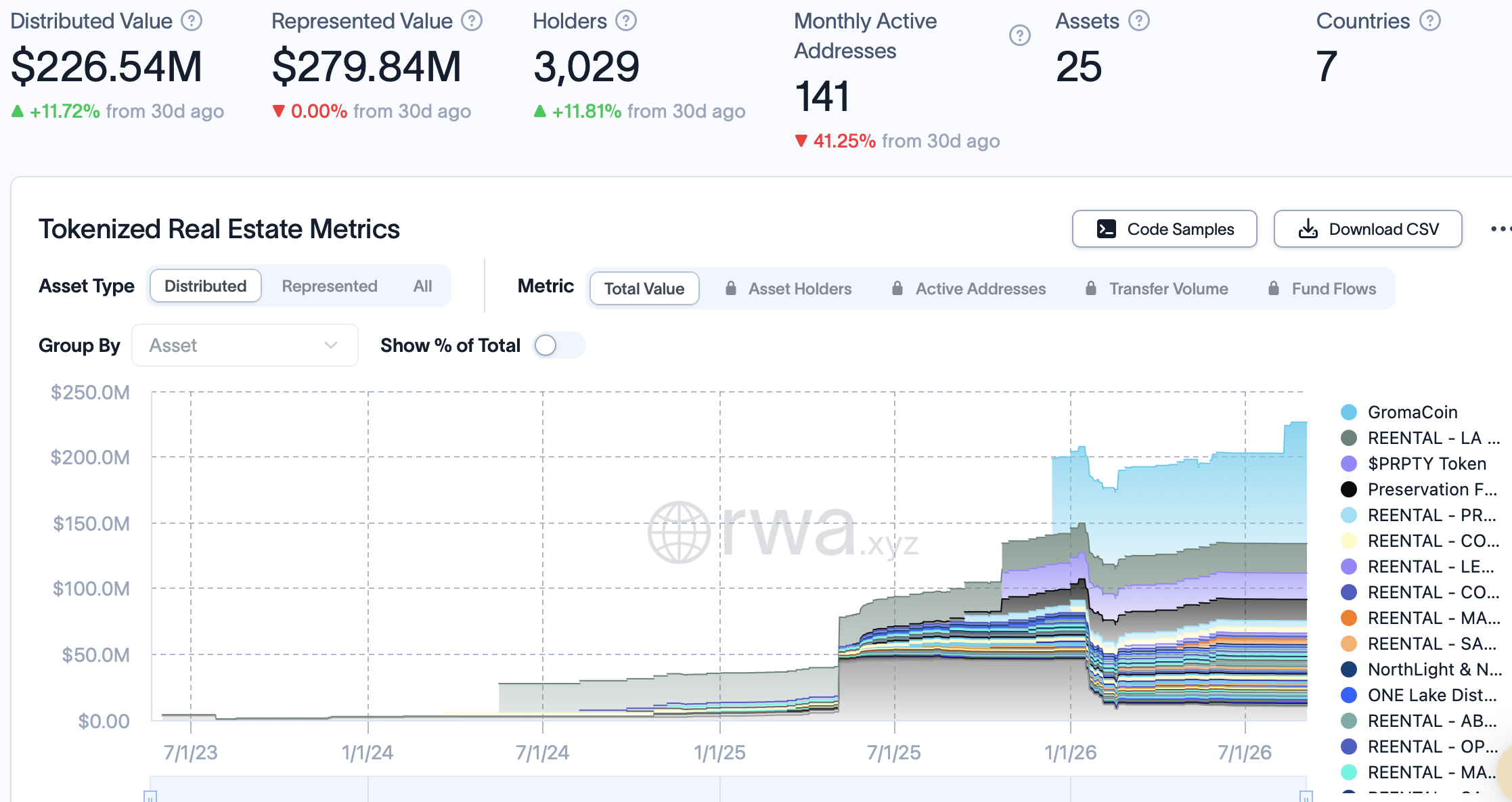
Tokenized real estate. Source: RWA.xyz
Magazine: Token buybacks are booming. But are they good for crypto projects?

Post-quantum security-focused startup QuFi Network has launched a verification platform aimed at protecting digital assets from potential future quantum computing attacks—without forcing users to upgrade or fork existing blockchain settlement layers. The approach, according to QuFi, is built around separating “verification” from “settlement,” so that transactions can be validated with post-quantum cryptography while value is ultimately settled on familiar networks.
Alongside the platform, QuFi introduced uBTC, a proof of concept that applies the verification system to Bitcoin collateral. uBTC is currently running on Bitcoin testnet, with redemptions designed to complete as standard Bitcoin transactions after the verification step produces cryptographic proofs that govern how value can move between settlement environments.
Key takeaways
- QuFi’s platform validates transactions using post-quantum cryptography before settling them on existing blockchain networks, avoiding direct post-quantum signature deployment on-chain.
- uBTC is a Bitcoin-focused proof of concept on testnet, verifying BTC collateral and issuing proofs that constrain value movement, while final settlement remains standard Bitcoin transactions.
- QuFi says the design uses three post-quantum cryptographic standards—ML-DSA-65, SLH-DSA, and ML-KEM-1024—to handle signatures and secure key exchange.
- The company’s stated goal is to reduce potential increases in storage, bandwidth, and computation that can come with using larger post-quantum primitives directly within blockchains.
- The launch lands as multiple parts of the ecosystem experiment with quantum-resistant techniques, including Bitcoin signature proposals and efforts by institutions and protocol developers.
A verification layer instead of a blockchain upgrade
QuFi’s main product concept centers on an external verification layer. Rather than asking each settlement network to adopt new post-quantum cryptographic rules, QuFi proposes using a decentralized set of nodes to validate transactions with post-quantum cryptography ahead of settlement.
In QuFi’s framing, this architecture helps address one of the most common implementation challenges in the post-quantum transition: larger keys and signatures can translate into higher on-chain costs and performance overheads. By performing verification off the settlement path, QuFi says it aims to avoid added storage, bandwidth, and computing demands that could arise from integrating post-quantum primitives directly into individual chains.
The platform uses post-quantum standards that cover both digital signatures and key exchange. QuFi lists ML-DSA-65 and SLH-DSA for signatures, and ML-KEM-1024 for secure key exchange—building blocks it says are used to generate and check cryptographic proofs prior to settlement on existing blockchains.
uBTC on Bitcoin testnet: proofs constrain value movement
QuFi also launched uBTC, described as a proof-of-concept system applying the verification approach to Bitcoin. The system is currently operating on Bitcoin testnet4.
Per QuFi’s description, uBTC verifies BTC collateral and generates cryptographic proofs that govern how value moves between settlement environments. Importantly, QuFi says the redemptions ultimately settle as standard Bitcoin transactions. That means the Bitcoin network would not be required to run post-quantum signatures as part of the final settlement step—at least within this proof of concept.
For investors and developers tracking quantum-readiness, this structure is notable because it suggests one possible pathway for gradual migration: keep the “trust anchor” settlement layer stable while introducing stronger cryptographic verification elsewhere. The remaining question is how widely such proof-based settlement constraints can be adopted—especially when interacting with multiple networks and wallets that may have different assumptions about validation and finality.
Why the timing matters: quantum defense work is accelerating
QuFi’s announcement arrives amid a broader push across crypto to prepare for quantum-related risks. In August, StarkWare reportedly tested a quantum-resistant Bitcoin transaction on mainnet without requiring a fork. While the test demonstrated feasibility, the same coverage noted that the transaction required hours of computation and cost roughly $150 to $200, and it used a nonstandard format that required direct miner submission.
That earlier experiment highlights the practical friction QuFi is trying to bypass: even when post-quantum methods are technically possible, making them efficient and compatible with mainstream blockchain transaction flows is difficult. QuFi’s verification-layer approach is positioned as one way to reduce those integration costs.
Institutional and regulatory efforts are also part of the picture. According to prior reporting, banks and regulators across Europe, the Middle East, and Asia joined a pilot testing post-quantum wallets and onchain transfers using ML-DSA-65—one of the standards QuFi says it uses in its platform. Meanwhile, the Ethereum Foundation reportedly dropped its planned Poseidon hash function from a post-quantum architecture in favor of established alternatives such as SHA or BLAKE, reflecting a preference for reducing uncertainty by leaning on primitives with broader operational familiarity.
Bitcoin’s protocol-level experiments: trade-offs are already showing
Beyond off-chain or verification-layer approaches, some Bitcoin-focused quantum defenses are being explored directly at the protocol or signature scheme level. In August, Blockstream researchers published a Bitcoin Improvement Proposal for SHRINCS, an experimental post-quantum signature scheme intended to reduce size and performance costs associated with quantum-resistant signatures.
However, the same coverage also emphasized constraints and open issues. SHRINCS relies on stateful signatures to shrink signature size, which would require wallets to track signing keys previously used. It also remains early-stage, with no completed security proof referenced in that reporting, and it adds complexity that could increase user error risk if wallet implementations do not correctly manage state.
Compared with these protocol-level directions, QuFi’s emphasis is on reducing direct changes to settlement chains. For readers, the practical takeaway is that quantum readiness is not a single technology swap—it’s a spectrum of strategies, ranging from experimental signature schemes that modify transaction formats to separate verification systems that attempt to preserve existing settlement processes.
As QuFi’s platform and uBTC evolve, the key things to watch are how proof generation and verification perform under realistic load, whether the proofs integrate cleanly with broader wallet and settlement workflows, and how the project’s approach compares in cost and usability to protocol-level quantum defenses like SHRINCS. The next milestones—especially any expansion beyond testnet and any evidence of interoperability—will likely determine whether verification-layer quantum protection can move from concept to practical deployment.


Cointelegraph is committed to providing independent, high-quality journalism across the crypto, blockchain, AI, and fintech industries.
All news, reviews, and analyses are produced with full journalistic independence and integrity. For more details on our standards and processes, please read our Editorial Policy.

A Single Vikings Reality Points Toward a Promising Outcome

I Watched a Floor Washing Robot Mothership Deploy a Roomba Using a Mechnical Arm

Why some men still believe in crypto after losing their money





-
 Crypto World7 hours ago
Bitcoin price stalls near $82K as key resistance holds
-

 Politics7 hours ago
Best Gaming Laptops, CPUs, TVs, And Keyboards To Upgrade Your Set Up For GTA VI
-

 Tech8 hours ago
The Birds Outside, Drawn For You Automatically
-

 Crypto World11 hours ago
IMF Says El Salvador’s Post-Review Bitcoin Purchases Used No Public Funds
-
 Crypto World7 hours ago
U.S. added stronger than expected 162,000 jobs in August as labor market bounced back
-

 Sports11 hours ago
Alexandre Pato consortium’s Northampton Town investment approved
-

 Sports6 hours ago
Golden Eaglets Drawn in Group B for 2026 WAFU B U17 Championship
-

 Sports12 hours ago
Commanders’ Chig Okonkwo is a top breakout fantasy football candidate
-
 Crypto World6 hours ago
XRP price breaks falling channel as bulls target $1.53
-

 Politics13 hours ago
A new European chapter for Gibraltar
-

 Politics9 hours ago
The House | Bin the lectures, bring gossip and be ready to banter: how the new PM should prepare for his Trump encounter
-

 Politics6 hours ago
How To Avoid Winter Colds: 4 Everyday Habits That Spread Germs, Says Pharmacist
-

 Crypto World6 hours ago
From warning to listing: UK’s largest retail investment platform opens access to crypto ETNs
-

 Tech8 hours ago
A Worthy Android Ereader, With Some Tradeoffs
-

 Crypto World7 hours ago
FinCEN flags $12.7B tied to Southeast Asia crypto investment scams
-

 Politics11 hours ago
33 Cosy Autumn Home Decor Ideas: Blankets, Pumpkin Decorations, And Candles
-

 Crypto World7 hours ago
Trezor Data Breach Impacts 67,000 More US Customers
-

 Tech6 hours ago
beyerdynamic AVENTHO Y Debuts at IFA 2026 and Makes Wireless Headphones Less Disposable
-

 Sports12 hours ago
Seven wickets in 21 balls: Sri Lanka’s Chamari Athapaththu scripts history with record-breaking spell
-

 Tech7 hours ago
How To Edit Claude’s Memory
You must be logged in to post a comment Login