
Crypto World
Bitcoin Price Analysis: The Good and the Bad for BTC After Latest $82.4K Rejection

Bitcoin remains locked in a post-breakout consolidation phase, but the latest rejection from the upper end of the structure shows that buyers are still struggling to generate sustained momentum above $80K. The broader trend remains constructive, although the current range leaves BTC vulnerable to further liquidity-driven swings before its next directional move.
Bitcoin Price Analysis: The Daily Chart
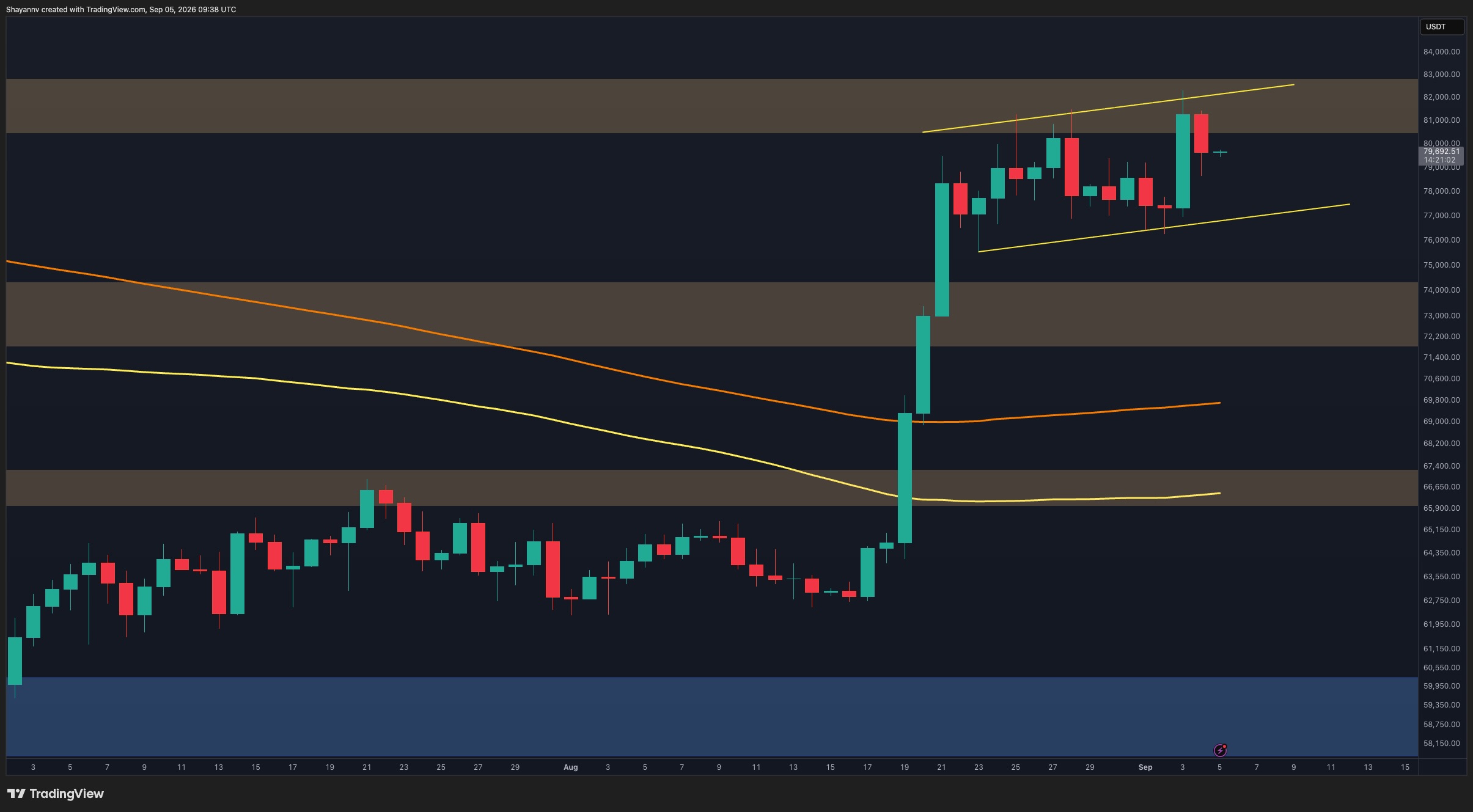
Bitcoin’s daily structure remains significantly stronger than it was before the August breakout. The asset is holding well above the former $72K-$74.5K resistance zone and both moving averages, preserving the broader bullish shift despite the recent loss of momentum.
However, BTC has repeatedly encountered selling pressure inside the $80.5K-$82.5K resistance zone. The latest attempt briefly pushed toward $82K before being rejected, sending the price back below $80K. This inability to establish acceptance above the resistance area suggests that supply remains active at higher prices.
At the same time, the asset continues to trade within a gradually ascending channel. Its lower boundary currently sits around the $76K-$77K region, making this the most important nearby structural support. As long as BTC remains above this area, the ongoing price action can still be interpreted as consolidation following the sharp rally rather than a confirmed bearish reversal.
A decisive breakout above the $80.5K-$82.5K zone would strengthen the continuation scenario. Conversely, losing the channel support around $76K-$77K could trigger a more substantial correction, with the former $72K-$74.5K breakout zone becoming the next major area of interest.
BTC/USDT 4-Hour Chart
The 4-hour chart highlights the market’s current indecision more clearly. BTC rallied from the lower boundary of the ascending structure near $76.5K-$77K and quickly tested the $81K-$82K area, only for sellers to reject the move once again.
Price subsequently dropped toward $79.5K and has entered a tight short-term consolidation. This creates a notable contrast between the rising channel structure and the repeated failures near its upper boundary. Buyers are still defending higher lows, but they have yet to demonstrate enough momentum to convert the $80.5K-$82.5K supply area into support.
The $76.5K-$77.5K region therefore remains crucial. Another test of this zone could determine whether the ascending structure survives. A strong reaction would keep a renewed push toward $81K-$82K in play, whereas a breakdown would indicate that the consolidation is transitioning into a deeper corrective phase.

Sentiment Analysis
The one-week BTC liquidation heatmap shows substantial liquidity on both sides of the current price, which supports the possibility of continued choppy trading and liquidity sweeps.
Above the market, notable liquidation concentrations appear around $81K-$82K and extend toward approximately $84K. These clusters could attract price if buyers regain momentum.
However, the downside liquidity is particularly relevant following the latest rejection. A broad and comparatively dense concentration is visible below the market, especially around the $76K-$78K region. This aligns closely with the lower boundary of the ascending technical structure.
As a result, a downside liquidity sweep toward $76K-$78K remains a plausible near-term scenario before another recovery attempt. Such a move would not automatically invalidate the broader bullish setup, but a sustained breakdown beneath this region would increase the probability of a deeper retracement toward the $72K-$74.5K support zone.

The post Bitcoin Price Analysis: The Good and the Bad for BTC After Latest $82.4K Rejection appeared first on CryptoPotato.


Trump attempts to revive stalled Ukraine-Russia peace talks
Trump has repeatedly stated that ending the Russia-Ukraine war is a major priority of his Administration, but the reality of that aim has proven difficult.
In August 2025, the U.S. President met his Russian counterpart in Anchorage, Alaska, to pursue a ceasefire agreement. The talks proved unsuccessful, and Trump left empty-handed.
In October 2025, Trump and Putin planned to meet in Budapest in hopes of furthering peace talks. But the summit was canceled just a few days after the summit was announced after Russia indicated that its hard-line stance on the war had not shifted.
“It just didn’t feel right to me,” Trump said at the time. “It didn’t feel like we were going to get to the place we have to get. So I canceled it.”
Strain between Trump and Zelensky also impeded progress. In February 2025, Oval Office talks collapsed within minutes when the U.S. President accused Zelensky of being “ungrateful” for U.S. aid and refusing to agree to a ceasefire without security assurances. In the 18 months since, however, that tension has largely dissipated, with Trump saying at this year’s NATO summit that the two had “actually developed a good relationship.”
CryptoQuant data shows that bitcoin investors started realizing major profits after the explosive August rally, disposing of roughly 110,000 BTC in just a few weeks.
Such highly concentrated profit-taking developments have historically been followed by substantial price correction for the underlying asset, the analysts warned. Moreover, several demand indicators have weakened, which could add to the selling pressure.
110K BTC Profit Taken
The major run that began on August 19 at prices of under $65,000 drove the leading cryptocurrency to almost $80,000 in just two days. According to CQ’s latest weekly report, holders realized net profits of 23,000 BTC on that day alone (August 21), which became the largest single-day profit realization this year.
The asset indeed dipped in the following days as it felt almost inevitable after such a gigantic jump, but went on the offensive once again in the following week or so. It rocketed past $82,000 on Friday before it was rejected following the US jobs report, and now sits below $80,000.
The report described the major profit-taking as a classic characteristic of a bullish cooldown, but warned that if they continue at such a rapid pace, the asset’s price could be primed for another correction. Historical occurrences have shown that BTC tends to dump hard after a major rally if investors are not convinced about its potential.
“It is a hallmark of a bullish cooldown: bullish because it happens into strength, cautionary because concentrated realization can cap near-term upside,” reads the report.

Cooling Demand
CryptoQuant outlined another reason why BTC could be primed for a more profound correction, even though it already slipped from $82,400 to $79,600. Its apparent spot demand briefly expanded by 43,000 units, marking its fastest growth pace of the year. However, that metric has lost its momentum and is now back in contraction.
US investors’ demand has weakened as well. The most used metric for this, the Coinbase Premium, measuring the price difference between the asset on the leading US exchange and other trading platforms, has returned to slightly negative territory at -0.05.
The analysts said similar periods of soft US spot demand have capped the cryptocurrency’s rallies three other times this year alone.
Nevertheless, the short-term picture does not necessarily mean that BTC’s run is over and that it will return to a bearish phase. The Bull Score currently stands at 70, which is above the 60 threshold historically associated with sustainable bull markets.
” This keeps the broader picture constructive: Bitcoin remains in the early phase of a new bull market even as short-term momentum cools. The “official” bull market begins once price closes above its 365-day moving average,” they added, outlining that this key MA is located at around $83,000 – the level that stopped BTC in May.
The post Bitcoin Holders Just Cashed Out 110,000 BTC in Profits: Is a Bigger Price Drop Coming? appeared first on CryptoPotato.


Buying pressure in Binance-paired currencies correlates with local currency depreciation as market makers balance positions.

Chainlink’s LINK token has climbed nearly 50% over the past month, with the latest rally pushing its price above $12 as partnerships with financial institutions and U.S. government entities strengthens the market’s focus on the network’s role in traditional finance.
LINK gained about 8% in 24 hours on September 4, bringing its market capitalization to roughly $9 billion and placing it among the largest crypto assets by market value. The move has coincided with a broader crypto recovery but has also been supported by several developments involving Chainlink’s infrastructure.
Key Takeaways
- LINK has gained nearly 50% in one month and recently moved above $12.
- Chainlink partnered with Bottomline, which serves more than 600 banks and processes over $16 trillion in annual payments.
- The U.S. Department of Commerce is using Chainlink infrastructure to bring selected economic data onchain.
- Wyoming has expanded its use of Chainlink for its state-issued stablecoin, while Standard Chartered sees LINK reaching $200 by 2030.
Chainlink Expands Its Connection To Banking Infrastructure
On September 3, when Chainlink announced a strategic partnership with Bottomline, a major provider of payment technology used by hundreds of banks, the news added momentum.
Bottomline’s platforms reportedly process more than $16 trillion in payments each year and serve over 600 banks.
Through the agreement, Chainlink will provide an interoperability layer designed to connect existing payment systems with both public and private blockchains.
Notably, the integration is intended to allow financial institutions to use ISO 20022 messages to interact with blockchain-based payment infrastructure without having to build separate connections for individual networks.
The development adds to Chainlink’s growing involvement in financial infrastructure as banks and other institutions explore blockchain-based settlement and tokenized assets.
“Bottomline moves more than $16 trillion in payments annually across its platforms. Through the partnership, Chainlink is providing the secure interop and orchestration layer connecting Bottomline’s existing payment infrastructure to public and private blockchains.” Chainlink tweeted.
U.S. Government Data Moves Toward The Blockchain
Chainlink has also gained exposure to a U.S. government initiative. On September 1, the project announced that the Department of Commerce would use its infrastructure to make selected economic data available onchain.
The data includes real gross domestic product, the personal consumption expenditures price index and actual final sales to domestic private domestic buyers.
The initiative could allow blockchain applications connected to Chainlink’s infrastructure to access updated government economic data, creating another potential use case for decentralized data delivery.
Wyoming Deepens Chainlink Stablecoin Integration

Fidelity Digital Assets has cautioned that Bitcoin’s strong August performance does not necessarily mean the cryptocurrency’s broader bear market has ended. While the latest rally has improved market conditions, the firm said investors should still consider the possibility of another market bottom later this year.
Bitcoin posted its strongest monthly gain since late 2024 during August, while Ethereum and other major cryptocurrencies also recorded substantial advances. The move has led some investors to argue that the market may have already established a bottom.
Key Takeaways
- Fidelity said Bitcoin’s bear market may not be over despite its strong August recovery.
- The four-year cycle model places potential attention on November 2026, although Fidelity stressed that the pattern is not a reliable timing tool.
- Bitcoin gained more than 25% during the third week of August, while Ethereum and Solana rose 34.1% and 28%, respectively.
- Growing stablecoin activity, real-world asset adoption, institutional participation, and regulatory developments could support a broader recovery.
Four-Year Cycle Keeps November in Focus
Fidelity’s latest digital asset outlook points to Bitcoin’s historical market cycles as one reason investors remain cautious.
Bitcoin’s previous major bear market bottom occurred in November 2022. If the roughly four-year pattern were to repeat, another potential bottom could emerge around November 2026.
However, Fidelity emphasized that investors should not treat the cycle as a precise forecasting model. Bitcoin’s historical cycles have not consistently lasted exactly four years, meaning the market could have already bottomed in July or could experience another decline later in the year.
Chris Kuiper, vice president of research at Fidelity Digital Assets, said the broader significance of the cycle may be connected to how cryptocurrency adoption develops.
“The more important point for investors is that adoption of digital assets has happened in waves, which can perpetuate cycles. In light of this, having a long-term perspective and holding period is what has historically been the most beneficial for investors.” He noted.
August Rally Provides Evidence of a Possible Shift
Fidelity also identified several developments that could support the argument that the market is moving away from its bearish phase.
Bitcoin spent much of the third quarter in relatively subdued trading before volatility increased sharply in late August. During the third week alone, Bitcoin rose more than 25%, while Ethereum gained 34.1% and Solana advanced 28%.
According to Fidelity, previous Bitcoin bear markets have sometimes ended after a period of subdued volatility followed by a sharp expansion in price activity.
Kuiper said the period from June through mid-August showed signs that selling pressure had weakened and that several digital assets were trading toward the lower end of their historical valuation ranges.
The subsequent price expansion therefore represents one factor that could indicate the market is approaching a turning point. Fidelity, however, stopped short of treating the rally as confirmation of a new bull market.
Esewhere, crypto analyst Darkfost described Bitcoin as being at a “tipping point between a genuine bullish recovery and a continuation of the correction.”
According to the analyst, futures activity is currently helping drive market movements while spot demand has declined. Darkfost said speculation can produce short-term price movements, but sustained momentum would require stronger spot buying to develop alongside derivatives activity.
“The balance remains and still leans towards buyers. But the question is, what type of buyers are driving the market? Speculation can trigger movement, but for momentum to become sustainable, spot demand must synchronize,” the analyst noted.
Regulation and Institutional Demand Remain Important
Fidelity identified regulatory progress, institutional adoption, monetary policy, and new cryptocurrency use cases as potential factors that could influence the next phase of the market.
In the United States, attention remains focused on the CLARITY Act, which seeks to establish clearer regulatory responsibilities for digital assets. The legislation has passed the House and remains under consideration in the Senate.
The SEC has also proposed a new regulatory framework that could provide exemptions from securities registration requirements for certain early-stage crypto asset offerings. The proposal remains subject to public comment.
What to Watch Next
Bitcoin’s August recovery has improved the market’s outlook, but Fidelity’s assessment suggests that investors should not assume the bear market is definitively over.
The next phase will depend on whether higher prices are supported by sustained adoption, institutional participation, and spot market demand rather than short-term volatility alone.
For now, November remains a date watched by investors following the four-year cycle thesis, while Fidelity continues to stress that historical patterns should not be used as a precise method for timing Bitcoin’s market bottom.
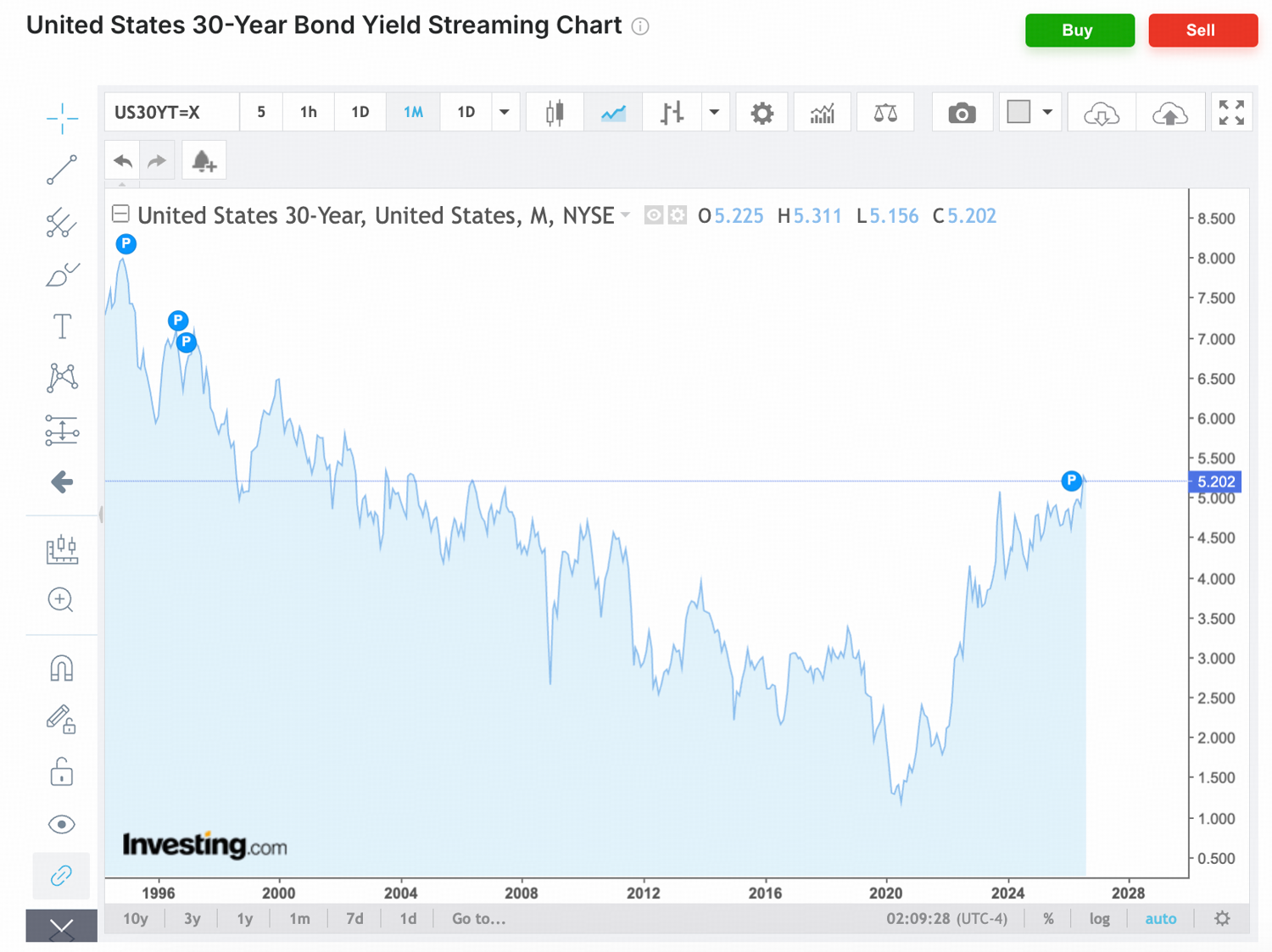
US federal debt has crossed $40 trillion. The government is still running a deficit close to 6% of GDP. Long-term borrowing costs remain high. Yet Bitcoin is trading near $80,000, roughly 37% below its record high from last year.
That creates an awkward question for one of Bitcoin’s oldest macro narratives. If rising debt and weaker fiat money are supposed to make scarce assets more valuable, why has Bitcoin spent much of 2026 falling?
Analysts at BloFin argue that it’s about how the debasement trade is changing. Its latest report finds that the trade has entered a “second phase.” Investors are now watching government attempts to control borrowing costs as closely as money creation itself.
The Trade Broke Before It Came Back
The debasement trade rests on a simple idea. Large fiscal deficits eventually create pressure for easier monetary policy because governments cannot allow borrowing costs to rise forever.
Investors then move toward scarce assets such as gold and Bitcoin.
That thesis weakened in early 2026. Bitcoin fell below $62,000, while gold and silver also dropped sharply from their highs.
BloFin links much of that unwind to the nomination of Kevin Warsh as Federal Reserve chair. Markets viewed Warsh as less likely to use aggressive balance-sheet expansion to absorb fiscal pressure.
The trade depends heavily on expectations. Investors still saw huge deficits, but the path toward easier monetary policy looked less certain.
Then the Bond Market Started Making Noise
The picture changed in August. On August 18, the 30-year US Treasury yield reached its highest level since 2007.
One day later, the Treasury said it would at least double the maximum size of liquidity-support buybacks in some 10-to-30-year bonds, from $2 billion to at least $4 billion per operation.

Bitcoin rose about 25% in August. Gold gained around 15%.
The timing is actually critical. Expanding buybacks immediately after a surge in long-term yields suggested policymakers may be becoming less willing to tolerate higher borrowing costs.

Treasury Buybacks Are Not QE
The Treasury cannot print money. It has to fund buybacks through cash, tax receipts, or new borrowing. That makes the mechanism very different from Federal Reserve quantitative easing.
Under QE, the Fed creates reserves and buys government debt. Treasury buybacks mostly change the composition of government liabilities.
Still, BloFin argues that markets may care more about the direction of policy than the immediate liquidity effect. As the research puts it: “Treasury buybacks are not QE.”
If investors believe rising long-term yields will repeatedly trigger intervention, they may begin pricing an informal limit on borrowing costs.
That is where financial repression enters the story.
Bitcoin Still Has a Real-Yield Problem
The current data shows why the debasement trade remains incomplete.
US public debt is around 101% of GDP, while the 2026 deficit is projected near $1.9 trillion. M2 has also returned to growth.
At the same time, 10-year real Treasury yields remain around 2.4%.
That is a major obstacle for Bitcoin. Investors can still earn a strong inflation-adjusted return from government bonds without taking crypto risk.
It also helps explain why Bitcoin’s 2026 price action still resembles a traditional crypto cycle.
Bitcoin peaked roughly 534 days after the April 2024 halving, close to the timing of the 2017 and 2021 cycle highs. It then fell by more than half before recovering.
The old four-year cycle still works.
The Next Test Is Whether Policy Starts Bending
BloFin’s thesis becomes much stronger if real yields start falling while fiscal pressure remains high.
That could happen if long-term borrowing costs keep creating stress and policy responses become larger. A more aggressive version would involve the Fed eventually stepping in.
History offers a clear precedent. From 1942 to 1951, the Fed capped long-term Treasury yields at 2.5%, helping the government finance wartime debt while inflation later pushed real bond returns deeply negative.

Bitcoin does not need that exact scenario to benefit. It needs investors to believe governments will increasingly protect the debt market from its own borrowing costs.
For now, Bitcoin is caught between a traditional crypto cycle that explains much of its 2026 weakness and a worsening fiscal backdrop that is starting to push scarce assets higher again.
The debasement trade has not failed. The bigger question is whether August marked the point when it became harder to ignore.
The post US Debt Hit $40 Trillion. So Where Is Bitcoin’s Debasement Trade? appeared first on BeInCrypto.
Binance Coin is among the top performers in the past 24 hours in the altcoin space, surging by over 6% and further extending its lead above XRP in terms of market cap placement.
This impressive rally on a rather dull Saturday after the Friday market rejection came following some positive news from Kalshi and the overall growth of the BNB Chain.
BNB Pops
The native token of the broader Binance ecosystem traded at $725 yesterday amid the market-wide revival that drove BTC to $82,400. However, the subsequent retracement prompted by the strong US jobs report pushed it south to $710. The asset found solid support there and exploded out of the gate, surging to $770 minutes ago for the first time since early February.

This Saturday’s rally is quite unexpected since most of the market is still in the red following yesterday’s bad news for risk-on assets. As such, the reason for BNB’s defiance is likely coming from outside factors, such as Kalshi’s move to launch perpetual futures contracts for the asset in the US, regulated by the Commodity and Futures Trading Commission.
Leverage is capped at around 4.5x for eligible US traders and comes after the platform added support for other altcoins such as ADA, AAVE, WLD, and VVV. Kalshi also supports BNB Smart Chain (BSC) integrations for managing deposits and withdrawals on international accounts.
BNB Chain Growth
The other probable reason comes from a Grayscale report cited by Wu Blockchain. As explained, BNB Chain is among the most widely used networks for trading tokenized equities.
The paper reveals that the weekly spot volume peaked at almost $3 billion in August, while only 5% of the market is currently deployed in on-chain finance. Robinhood Chain leads the pack, followed by BNB Chain and Solana.
Grayscale explained that further US regulatory clarity could “expand tokenized stocks from global, around-the-clock trading products into productive on-chain financial assets.”
Grayscale: Tokenized Equity Weekly Spot Volume Nears $3B, Only 5% Used in Onchain Finance
Grayscale said tokenized equity trading reached record highs in August, with weekly spot volume peaking near $3 billion, while only about 5% of the market is currently deployed in onchain… pic.twitter.com/ZcVA72DYTX
— Wu Blockchain (@WuBlockchain) September 4, 2026
The post BNB Hits 7-Month High After Major Kalshi Move and Explosive Chain Growth appeared first on CryptoPotato.
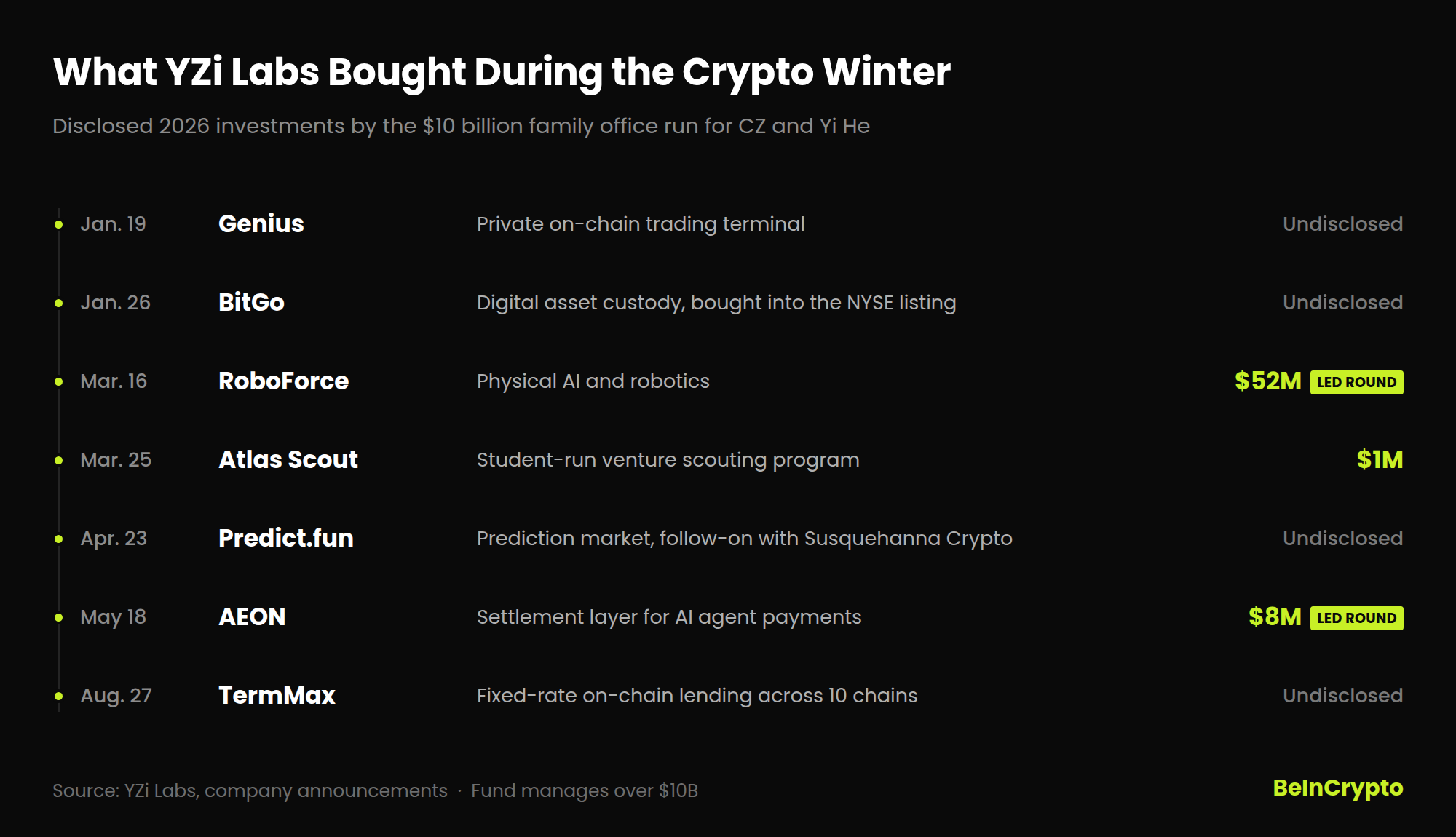
Changpeng Zhao expects the bets YZi Labs made over the past few months to become its best performers. The Binance founder credits the timing, because the firm invested while crypto prices sat near their lows.
His optimism is directly tied to the deployment of his private billions. In fact, YZi Labs is the family office that manages his personal wealth.
Why CZ Thinks His Firm’s Timing Works
His comment sat on top of a summary of an August 28 book club session in Hong Kong. Zhao told the audience that money rushing into artificial intelligence (AI) is filtering out short-term crypto teams.
He has also argued that AI money rotating back into digital assets is already underway.
The winter framing has support. Bitcoin had fallen 47% from its peak by early June, a slide that fueled a coldest crypto winter debate. Prices have since clawed back ground, yet they remain far under the October high.
What YZi Labs Has Backed This Year
YZi Labs runs more than $10 billion for Zhao and Binance co-founder Yi He. It grew out of Binance Labs, the exchange’s former venture arm, and now invests independently. Its 2026 deals stretch well past crypto, into robotics, AI payments, and custody.

The biggest disclosed check went to robotics. YZi Labs led a $52 million round in RoboForce in March, a company building physical AI systems. It also bought into digital asset custodian BitGo before the January NYSE listing.
Smaller bets followed. In April, the firm added to its position in prediction market Predict.fun alongside Susquehanna Crypto. It then led an $8 million pre-seed round for the payments protocol AEON in May, and it backed the fixed-rate lender TermMax in August.
Zhao published no returns data, however. The claim therefore stays untested. Meanwhile, YZi Labs spent much of the year fighting for control of BNB treasury firm CEA Industries. A director resigned in March, and both sides reached a settlement in June.
Bitcoin’s next leg will decide whether the timing looks smart. Zhao has separately said that a $1 million bitcoin could arrive sooner than most expect. Current Bitcoin price levels leave him a long way from that mark.
The post CZ Says These 7 Crypto Investments from YZi Labs Will Perform Best appeared first on BeInCrypto.
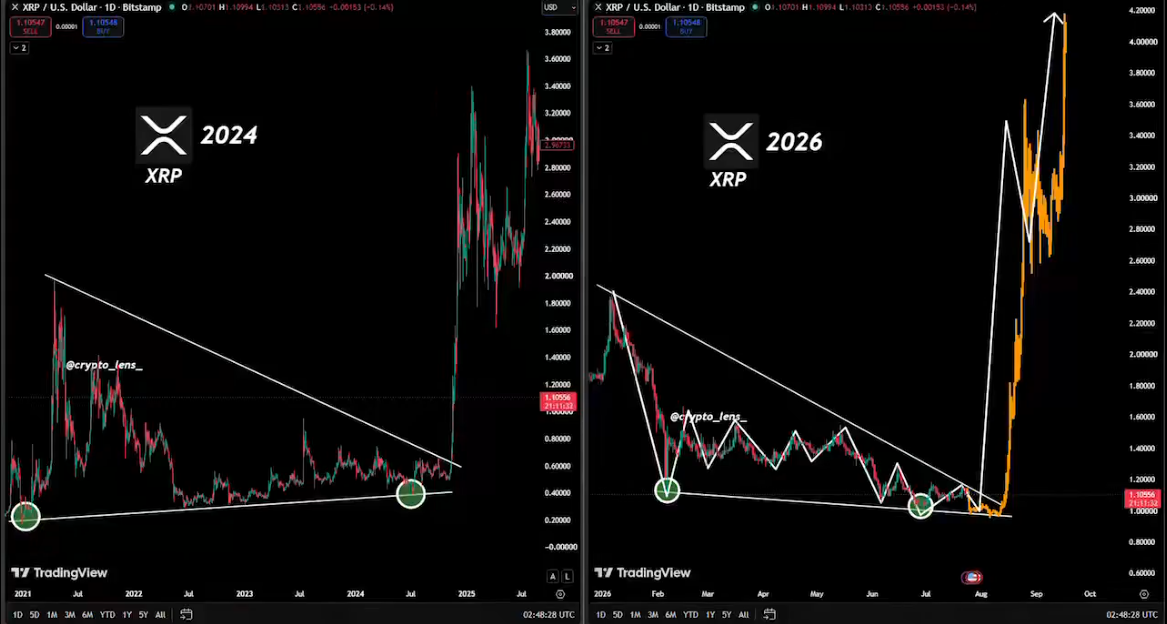
XRP is drawing renewed attention as its chart structure closely mirrors a formation seen in 2024, just before a sharp upward move.
Analysts tracking the altcoin note that the current setup echoes the sequence that preceded that earlier 650% advance.
Why This XRP Setup Looks Familiar to Chart Watchers
At the time of writing, XRP trades near $1.40, up roughly 35% in a month. The token sits well below its 2025 peak near $3.65 but has rebounded from levels below $1.00 earlier this summer.
One technical view, shared by analysts, highlights that XRP has repeated the same pattern observed in 2024 immediately ahead of that rally. The token is outlining a sequence progressing from the $1.10 to $1.00 zone through successive targets at $1.30, $1.90, $2.80 and $3.40.
The analysis frames this as a potential roadmap rather than a guarantee.
Follow us on X to get the latest news as it happens.

Additional bullish projections draw on Fibonacci levels. One analysis, from trader CW8900, notes that a recent correction bottomed near the 0.5 retracement and that price has since cleared the 0.618 level, with the next extension target cited near $2.13 at the 1.618 Fibonacci level.
The On-Chain Data and the Skeptics
Supporting data from on-chain metrics adds important context:
- Spot trading volume for XRP reached a six-month high in August 2026, with Binance alone recording more than $7.26 billion, while Upbit and Bithumb also showed elevated activity.
- Roughly 500 million XRP left Binance during the same period, pushing monthly average reserves on the exchange down to levels last seen in early 2024.

Analysts interpret the outflow as a longer-term positive signal, consistent with accumulation in self-custody or demand for spot ETF products launched in late 2025.
The dynamic is viewed as more relevant over extended horizons than for immediate price action.
Not every outlook agrees, however. A more cautious reading from other analysts describes XRP as remaining inside a corrective pullback within the $1.10 to $1.38 support zone. In this view:
- The latest bounce still appears as a three-wave structure.
- No confirmed low has been established yet.
- The current recovery looks more like an incomplete recovery than the start of a sustained advance.
Subscribe to our YouTube channel to watch leaders and journalists provide expert insights.

The combination of a repeating technical pattern, elevated spot volume, declining exchange reserves, and mixed short-term structures creates a genuinely contested setup.
Historical pattern recognition can highlight possibilities, yet market conditions, broader crypto sentiment, and macroeconomic factors continue to shape actual outcomes.
Whether the 2024-style sequence reappears will depend on sustained buying interest and XRP’s ability to hold key levels in the weeks ahead.
The post XRP Price Shows the Same Pattern That Sparked a 650% Rally appeared first on BeInCrypto.
Crypto World
Cardano Founder Warns Trump-Linked Crypto Executives May Come Under Scrutiny After Midterms

Cardano founder Charles Hoskinson has warned that crypto executives closely associated with the Trump administration could face greater political scrutiny if Democrats make significant gains in the 2026 U.S. midterm elections.
Hoskinson made the comments after being questioned over his absence from a recent White House meeting attended by several prominent figures from the cryptocurrency industry. The gathering focused on digital asset policy and efforts to advance U.S. crypto legislation, including the CLARITY Act.
Key Takeaways
- Charles Hoskinson warned that some crypto executives could face investigations if Democrats gain power after the 2026 midterms.
- His comments followed criticism that the Cardano founder was not included in a recent White House crypto gathering.
- Ripple CEO Brad Garlinghouse and other major industry figures attended the meeting with Trump administration officials.
- President Donald Trump has continued to position the U.S. as a global center for financial innovation while his administration has moved to reverse policies that the crypto industry viewed as restrictive.
Hoskinson Responds to Criticism Over White House Absence
The controversy began after a user commented that Hoskinson appeared to have been left out of the White House gathering.
The comment followed a September 3 post from CFTC Chairman Mike Selig, who shared photographs from the meeting and highlighted the administration’s efforts to develop the digital asset industry in the United States.
Notably, the gathering brought together several prominent figures from the crypto and financial sectors, including Ripple CEO Brad Garlinghouse, Coinbase CEO Brian Armstrong, Robinhood CEO Vlad Tenev, Kraken co-CEO Arjun Sethi, Gemini co-founders Tyler and Cameron Winklevoss, and Chainlink co-founder Sergey Nazarov.
Hoskinson responded with a warning about what could happen if political control changes after the midterms.
“I’ll sit this one out and pick up the pieces after the Republicans get destroyed in the Midterms and half the people in that picture are being investigated by the newly empowered Democrats”
Crypto’s Relationship With Trump Remains Politically Significant
Hoskinson’s comments come as the cryptocurrency industry has developed a significantly closer relationship with the Trump administration.
Trump has repeatedly pledged to make the United States a leading destination for financial and digital asset innovation. His administration has also pursued policies intended to move away from what the industry viewed as aggressive regulatory pressure under the previous administration.
One notable area has been the administration’s response to Operation Choke Point 2.0, a term widely used by crypto companies and industry advocates to describe alleged efforts by financial regulators to discourage banks from providing services to digital asset businesses.
The Trump administration has positioned itself as opposing such restrictions and has said it wants to ensure financial institutions do not improperly deny access to banking services based on lawful business activities.
That policy direction has helped strengthen ties between Washington and major crypto companies.
Hoskinson Remains Critical of the CLARITY Act
Meanwhile, despite the industry’s closer relationship with the administration, Hoskinson has remained critical of parts of the Republican-led approach to crypto legislation.
The Cardano founder has repeatedly expressed concerns about the CLARITY Act and the political divisions surrounding digital asset regulation. He has argued that crypto should not become identified exclusively with one political party.
That concern is particularly relevant as several of the industry’s most recognizable executives have become increasingly visible alongside Republican officials.
Hoskinson has previously argued that political association could create problems for the broader industry if control of Congress changes.
Trump Continues to Promote Financial Innovation
The political divide comes as Trump continues to promote the United States as a hub for financial innovation.
In May, the White House announced measures aimed at strengthening the financial system while also emphasizing America’s role in financial innovation. The administration said its policies were intended to preserve U.S. leadership in emerging financial technologies.
The White House has also sought to reverse regulatory approaches that crypto advocates described as hostile to the industry, including policies associated with

finance #watch

Juicehaus opens as studio and shop in Bishopthorpe Road

Lululemon: Even As A Bear I Am Surprised How Fast Fundamentals Are Collapsing





-
 Crypto World1 day ago
Bitcoin price stalls near $82K as key resistance holds
-

 Politics1 day ago
Best Gaming Laptops, CPUs, TVs, And Keyboards To Upgrade Your Set Up For GTA VI
-

 Tech1 day ago
The Birds Outside, Drawn For You Automatically
-

 Crypto World1 day ago
IMF Says El Salvador’s Post-Review Bitcoin Purchases Used No Public Funds
-
 Crypto World1 day ago
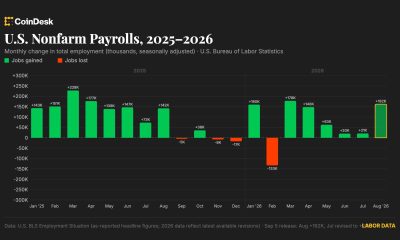
U.S. added stronger than expected 162,000 jobs in August as labor market bounced back
-

 Sports1 day ago
Alexandre Pato consortium’s Northampton Town investment approved
-

 Fashion23 hours ago
Weekend Open Thread: Beyond Yoga
-

 Sports1 day ago
Golden Eaglets Drawn in Group B for 2026 WAFU B U17 Championship
-

 Sports1 day ago
Commanders’ Chig Okonkwo is a top breakout fantasy football candidate
-
 Crypto World1 day ago
XRP price breaks falling channel as bulls target $1.53
-

 Politics1 day ago
A new European chapter for Gibraltar
-

 Politics1 day ago
The House | Bin the lectures, bring gossip and be ready to banter: how the new PM should prepare for his Trump encounter
-

 Politics1 day ago
How To Avoid Winter Colds: 4 Everyday Habits That Spread Germs, Says Pharmacist
-

 Crypto World1 day ago
From warning to listing: UK’s largest retail investment platform opens access to crypto ETNs
-

 Tech1 day ago
A Worthy Android Ereader, With Some Tradeoffs
-

 Crypto World1 day ago
FinCEN flags $12.7B tied to Southeast Asia crypto investment scams
-

 Crypto World1 day ago
Trezor Data Breach Impacts 67,000 More US Customers
-

 Politics1 day ago
33 Cosy Autumn Home Decor Ideas: Blankets, Pumpkin Decorations, And Candles
-

 Sports1 day ago
Seven wickets in 21 balls: Sri Lanka’s Chamari Athapaththu scripts history with record-breaking spell
-

 Tech1 day ago
How To Edit Claude’s Memory
You must be logged in to post a comment Login