



The senior Reform official didn’t pull his punches. ‘The point of this conference was to show the country we were ready for office. That we had a plan for our first 100 days. And we’ve blown it.’
Twelve months ago, when Nigel Farage and his party arrived in Birmingham for their first major gathering since the General Election, the prospect of securing power was an ambitious but realistic goal. Keir Starmer’s premiership was already imploding. The Tories were flatlining, with speculation rife Kemi Badenoch was set to be ousted as leader and replaced by Robert Jenrick.
The polls showed Reform UK on 30 per cent, ten points ahead of Labour, 14 ahead of the Conservatives, and on course for an outright majority.
So this year’s conference was – at Nigel Farage’s own insistence – supposed to be a defining moment. The point at which he and his allies transitioned from being scrappy political insurgents to supplanting the Tories as the effective Opposition to Labour, and showing the nation they were the viable alternative government in waiting.
But his colleague is right. They have indeed blown it.
Over the past 72 hours the political agenda has been dominated by Channel 4’s ‘sting operation’ which saw two of Farage’s most senior aides suspended from the party for allegedly discussing improper donations. But in a sense, that represents a side issue. What the 2026 Reform conference has highlighted is the way that over the last 12 months the party has not merely stalled, but regressed.
Yes, there is a greater degree of professionalism about their operation, as anyone walking around the impressive array of corporate stalls dotting the National Exhibition Centre could attest.
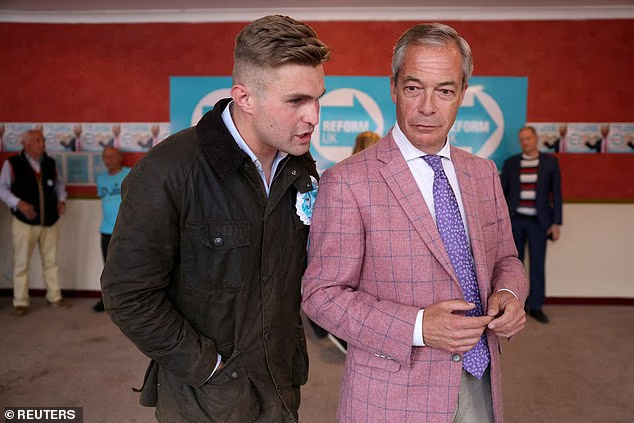
Ex-aide Dan Jukes, seen with Nigel Farage ahead of the 2024 general election, will no longer advise the Reform UK leader
There was also some evidence of policy development, with the unfeasible proposal of unilaterally dumping small-boat migrants back on French beaches seemingly replaced by a tentative returns agreement secured with French prime ministerial candidate Jordan Bardella. And the long queues to enter the conference hall showed the energy and enthusiasm of the Reform faithful remain undimmed.
But this was merely papering over the cracks. Cracks that are now turning into gaping fissures.
‘There’s a serious divide between the Tory defectors and Reform traditionalists,’ one party source admitted to me yesterday.
‘The Tories think we have to start to broaden our appeal, detoxify the brand and stop trying to simply appeal to our base.
‘But traditionalists are obsessed with trying to outflank Restore, pushing everything through the prism of migration and fighting a culture war.’
There are also major splits forming within Nigel Farage’s inner circle. In the wake of the Channel 4 exposé, the departure of senior aides Dan Jukes and James Orr was seen by many as a body-blow to the party. But some senior Reform insiders are openly celebrating their demise.
‘Jukes was a liability,’ another Reform official claimed. ‘He was leading Nigel astray.
‘This gives an opportunity to get things back on track.’
Another insider stated: ‘It’s damaged us, but it gives us the chance to push through the changes that are needed at the top of the party. What Nigel needs is a proper chief of staff, not a bunch of courtiers.’
This in-fighting is music to the ears of Reform’s political opponents. One senior Tory official pointed to the ongoing blood-letting and dysfunctionality, and drew a direct contrast with the way Kemi Badenoch last week reshuffled her own top team.
‘You look at how we managed it. A number of senior people were moved and replaced with fresh talent. There were no rows. No tantrums. We’ve had our problems, but we’re now looking like a serious alternative government. They look like a rabble.’
One thing that was notable was that as Reform’s showpiece conference turned into a bin-fire, there was no attempt by Kemi Badenoch or Andy Burnham to leverage or exploit their obvious discomfort. Which is part of a deliberate strategy.
Badenoch has taken the decision that from now on Reform will effectively be ignored.
‘We think the battle lines are clear now,’ one senior aide explained. ‘It’s us as traditional Conservatives versus Burnham and his old-school Labour socialism. That’s the choice facing the country. That’s where our focus is.
‘Reform are too busy looking inward and fighting among themselves.’
Meanwhile, the latest incumbent in No10 views Reform as representing less of a threat and more of a political opportunity.
‘Obviously Reform are splitting the Right, and that’s a big help to us,’ one Burnham ally revealed, ‘but Andy is going to adopt a different approach to them.
‘Keir basically said, “I’m going to destroy Farage and everything he represents”. Andy’s approach is going to be to reach out to Reform voters and say, “I get it. I understand why you’re angry. I don’t think you’re a bunch of ignorant bigots. Let me see if I can help sort some of this.’

French prime ministerial candidate Jordan Bardella, the leader of the National Rally party, with Nigel Farage at the Reform UK conference. The pair have agreed a tentative returns deal over small-boat migrants
In the bars of Birmingham, in the wake of Nigel Farage’s strangely lacklustre speech, the view of the travelling press pack was that this had indeed been a defining moment.
‘There’s no way they recover from this,’ one veteran Reform observer stated, echoing the prevailing consensus. His view was reinforced by a Reform MP. ‘Power isn’t a realistic prospect,’ they conceded. ‘Our strategy now has to be to try to shore up our existing support and see if we can leapfrog the Tories and become the new Opposition.’
That view is almost certainly overly pessimistic. Whatever happens, Reform will continue to exert influence over British politics. There is a small but significant proportion of the electorate who no longer trust the two main traditional parties, and see Farage and his allies as the only remaining hope for their broken nation.
But another truth has emerged from Birmingham. This was supposed to be the conference where Reform demonstrated they are ready for government.
And they are palpably not. They are too fractured internally. The bulk of their policy prescriptions – from Robert Jenrick’s ambitious assertion he would manage to cut public spending by £80 billion a year in his first five years in the Treasury, through their flip-flopping over the two-child benefit cap, to their proposal to effectively penalise pensioners and single mothers in the allocation of social housing – are neither practical nor electorally viable.
The ongoing scandals surrounding their finances expose a recklessness towards important regulations safeguarding our public governance, and an increasingly arrogant belief the rules do not apply to them.
Kemi Badenoch’s aide is correct. This weekend the choice facing Britain became clear. Kemi’s traditional conservatism. Or Andy Burnham’s old-school socialism.
However effective Nigel Farage has been at identifying the problems facing the country, Reform are simply not currently a viable alternative government.
And based on what I just witnessed in Birmingham, it may be many, many years until they are.
– READ MORE: Robert Jenrick vows to cut taxes for millions… and says he’ll quit if pledge isn’t met in the first 100 days
– READ MORE: Nigel Farage says ‘bad period’ is over for Reform as family urges him to quit as he faces barrage of questions over donations to his party




















































You must be logged in to post a comment Login