

Bestselling author Tony Parsons initially didn’t want a pet dog, as he explained in yesterday’s Daily Mail. But here he reveals their growing friendship during Covid, and the relentless positivity of man’s best friend in times of crisis…
When Sophocles said that the sexual urge is like being chained to a maniac, he was probably thinking about Stan.
As he approached young manhood, a kind of insanity came over our boy. Without prior warning he would throw himself into rush-hour traffic if he caught the scent of some hot young Goldendoodle promenading on the other side of the street.
He was a gentle, sweet, loving lad – but when it came to sex, he was an animal. In fact, he would run away from everyone who ever loved him for even the faintest hint of sex, the vague promise of sex, a whiff of sex, the mere rumour of sex.
He clearly saw himself as the Don Juan of dogs, the Casanova of the canine world, a four-legged Leonardo DiCaprio always ready to spring into action at the sight of a bitch on Hampstead Heath.
There were dogs we knew who had been neutered – or ‘done’ – in order to ease this unstoppable urge, but there were also dogs we knew who were not done. My wife Yuriko and daughter Jasmine were in favour of getting Stan done. They believed he would have a happier, easier existence. I crossed my legs, a lot less certain.
We learned that for those dogs that carried on ‘intact’, the animal sex drive was always there. The intact dogs were also far more prone to seek to establish dominance over other dogs, and to have other dogs trying to establish dominance over them.
So they may have escaped neutering but were never free from their instincts. Sex and fighting, basically. For the dog that remained intact, life would always be like a pub in Essex at chucking-out time.
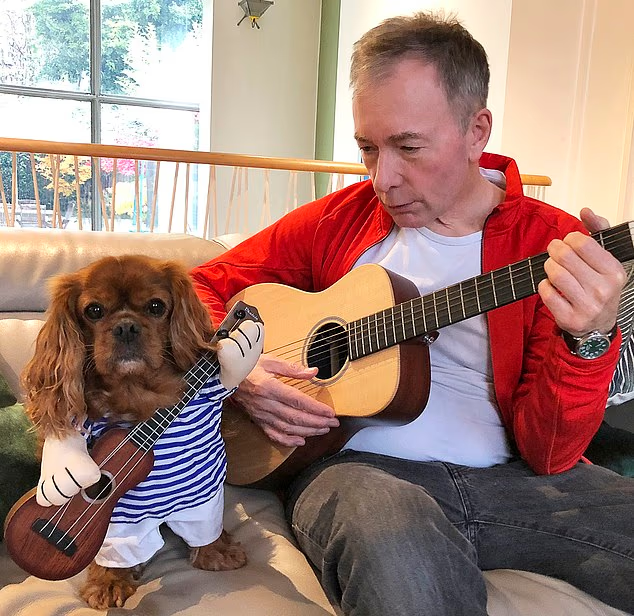
‘Nobody will ever love you like a dog. Nobody will ever be as consistently happy to see you as a dog. Nobody will ever make you laugh like a dog. Nobody will ever make you so glad to be alive’, writes Tony Parson, seen with Stan dressed up
When we talked to vets, it became clear they too were divided on the issue. Many – I was surprised and heartened to see – leaned towards not getting a male dog neutered. At least, those were the male vets.
The greatest pro was that neutering would give Stan a happier, safer, less troubled life. And the greatest con was that neutering meant removing his testicles.
The guilt of that would not leave me alone and even today, all these years later, I can still feel it gnawing away at me.
But whatever we decided, timing was key. Neutering should not happen too soon – not until the dog is well past puberty – but equally there is no point in doing it too late because then part of the dog will always believe it’s closing time at that imaginary boozer in Basildon.
As Stan slept at my feet while I worked, and as he padded across the floor to greet me when I came home, I could not pretend to myself that having him neutered felt like an act of care, let alone love. It felt like betrayal.
But after much agonising I accepted that the sex urge did not seem to bring Stan much happiness. The reality was that the intact Stan was not loving the single life. Stan’s insatiable hunger for sex was Hugh Hefner-like. Compulsive, driven, unstoppable. Midnight at the Playboy Mansion.
In short, Stan’s sex drive tormented him.
We knew something had to be done. And what had to be done was Stan.
When I went to pick him up after his procedure at the vet, Stan was so happy to see me. Because dogs don’t stop loving you, even when you don’t deserve to be loved. And so, ignoring Kipling, we happily give our dogs our hearts to tear.
‘Let’s go home,’ I told him. Stan thought that was a grand idea.
And I thought – nobody will ever love you like a dog. Nobody will ever be as consistently happy to see you as a dog. Nobody will ever make you so glad to be alive.
My friend Fred has a different way of encapsulating a dog’s unconditional love: ‘If I locked my wife and my dog in the boot of my car,’ he’d say, ‘and then came back four hours later, only one of them would be pleased to see me.’
I thought Stan and I could not get closer. But in March 2020, life closed down. And we did. Because – unlike everything else during the pandemic – dogs could not be cancelled.
In lockdown, they all became the one thing that could inoculate us against the all-pervading debilitating loneliness.
Over that time Stan never felt more like my best friend – truly, my best friend. Since he had strolled into our family, I had always spent more time with him than I did with anyone else. Your dog always seems to like you more than anyone else does.
But now, separated from friends, family, work colleagues and normal life, I had never needed him more. It was hard to be down for long when Stan was always so happy to be alive. It was hard to feel sorry for yourself when Stan would gaze up at you with those huge eyes as if you were the greatest thing in the world.
The only down side was a sort of heightened separation anxiety. There was now a clinging need to keep each other within view, an increasing terror of being apart, and a low whimpering sound that could be heard when we found ourselves on different floors of the house.
And that was just me.
The weekend had always been the time for our longer walks, but now every new day was like the weekend and began on Hampstead Heath. Before I even spoke to my wife and daughter, I was having conversations with my dog as we roamed every corner.
Stan and I had long ago worked out that, if we timed it right, we could arrive on Hampstead Heath just as the sun was rising. Our favourite walk was through the big field above Hampstead ponds, because it was the best place to find white moths dancing around the wildflowers. Leaping like a salmon to try to catch them was Stan’s favourite pastime.

Stan seen celebrating Christmas with Tony, Yuriko and Jasmine in a family photo

During the Covid lockdowns, Tony and Stan would go for long sunrise walks on Hampstead Heath in north London
And as Stan jumped for the white moths, the day would be breaking, sunlight pouring through the trees and burnishing the bathing ponds, and so the sunrise always found me smiling. It was a good way to start a day. The best way to start the day.
I had seen a few sunrises before, but not like this, and not like these. Watching the sunrise with Stan was not the same as seeing the sunrise after you had stayed up all night with wild Irish rock band Thin Lizzy in Philadelphia.
Stan got me out of indoors and into the world, and without me even thinking about it he immersed me deep into nature in a way that I only vaguely remembered from my childhood.
We both became fitter than we had been before Covid struck, suggesting that dogs should be prescribed on the NHS. Dogs are the best personal trainers in the world. Walking a dog is never optional, and it is never dependent on the weather, and – unlike a gym – you can’t find a good excuse to skip it. Not even for a global health epidemic. There was no way I would have been jumping out of bed at the crack of dawn during lockdown if not for Stan.
I hadn’t always been fit. As a young music journalist I had lived a recklessly unhealthy lifestyle. The first time I went on the road with a band – accompanying Thin Lizzy on a brisk rampage through the Midlands – I had sat at breakfast with frontman Phil Lynott in the Holiday Inn, Leicester, with a bottle of vodka between us, as Phil explained that because of the demands of touring we needed to drink lots of orange juice with our breakfast vodka. ‘You will need your vitamin C,’ Phil said wisely.
That sort of life was fun right up until the moment that it wasn’t. You changed your ways, or you died. Phil Lynott – a beautiful man, a proud black Irishman, a hardcore party animal and one of the sweetest souls I ever met – was gone at 36.
In the darkest days of Covid, when we wondered when and if it would ever end, Stan was my mood-enhancing drug. Whatever my frame of mind, Stan lifted it. His relentlessly positive attitude was inspirational.
Because of course, having their owners Working From Home – and the world closing down – was what every dog dreamed of, whatever their age. They simply loved having their owners home all day.
There are around ten million dogs in the UK and, before Covid, the worst thing in the life of most of them was being left home alone. Lockdown changed everything. There was suddenly so much we could not do, but we could love our dogs, and we could walk into wild nature with them, and we could get even closer to them, and we could rely on them even more than we did before. The dogs didn’t mind a bit.
In our house, like many houses, lockdown was toughest on our child. But Stan, for his part, just loved having Jasmine. Even when lockdown had dragged on for weeks, then months, and then years, Stan would trot up to Jasmine with his tail slapping like a windscreen wiper, smiling with those huge eyes.
Jasmine!
What are YOU doing here in the middle of a school day?
And isn’t this a moment of magic?
At a time when real loss was all around, Stan showed us the joy in simple pleasures, the small mercies and the counting of blessings. He was good at it. He had a genius for looking on the bright side. Stan guided us through loneliness, anxiety and fear.
Even at the end of the worst of days, there he was offering affection, comfort and love. And there was nothing remotely remarkable about our family. In millions of homes all over the city, and the country, and the planet, the bright, unbreakable hopefulness of dogs was the light that shone in the darkness, the light that would never go out.
We filled our locked-down days with each other, me and my dog, a happy gang of two. Before morning had broken, Stan and I would be out on Hampstead Heath, embarking on our daily marathon yomp. Then we would come home and I would work until the early afternoon. It was never difficult to start writing because I always followed Ernest Hemingway’s old maxim – ‘Leave some water in the well’. Meaning: you already know where you are going to begin when you sit down.
It was the second-best advice about the writing life that I ever heard. The very best advice about the writing life came from my old man. ‘Keep earning,’ my dad told me.
In 2015 I’d finally finished the book that had drained our savings, the book that was meant to revive my fortunes. Everything that I had hoped – and prayed – would happen, happened. Sick with nerves, I gave the book to my agent. He sold it within 24 hours. Called The Murder Bag, it was my first in what became a crime series featuring DC Max Wolfe. It went to number one on the Sunday Times bestseller list. A contract for more books was signed. The great gamble with my family’s life savings had paid off.
Since then, Stan had done plenty of books with me, around one a year, and although neither of us was counting, we had to be approaching double digits in both books and dog years.
This veteran of the writing life knew the drill, curling up in his favourite one-click-on- Amazon £20 dog basket as if there was no place in the universe he would rather be until the day’s work was done.
And when the work was over, every afternoon, just when our energy levels were starting to dip, it became our habit to retire for a Stan-sized siesta. Stan was ten years old now. If he had been human, he would have been applying for his free bus pass.
Many pandemic months went by without us seeing the people and places we loved. But dog time remained, and dog time expanded, and dog time became the true heart of every day.
As restrictions were placed on our life, we lifted restrictions on Stan. His favourite snack – rabbit droppings – was now permitted on the Heath. Good for him, Yuriko and I agreed. Nutritious. Disgusting, undoubtedly, but nutritious. A little of what you fancy does you good, my mother always said. Although Mum probably wasn’t thinking about rabbit droppings.
With all the usual landmarks of our lives removed, it felt like the world was standing still. But that was an illusion. The seasons were passing, the world was turning, and Stan and I were both getting older. Watching the sun rise on Hampstead Heath and napping became part of our day. Just like grumpy old men – trust me on this – dogs love routine.

‘The first time I went on the road with a band – accompanying Thin Lizzy – I had sat at breakfast with frontman Phil Lynott (pictured) in the Holiday Inn, Leicester, with a bottle of vodka between us,’ writes Tony

‘When the work was over, every afternoon, just when our energy levels were starting to dip, it became our habit to retire for a Stan-sized siesta’
After many years, and prolonged diplomatic negotiations, Stan’s long march to sharing my pillow at night was coming to its happy and always inevitable conclusion. There was an en suite bathroom next to the bedroom and, after nestling by the bed in his favourite basket after lights out, Stan would stir, rise and pad into the bathroom and settle down in the shower stall for the night.
And there he would stay, contentedly snoring, until emerging before dawn to stand by the side of the bed and stare at me. ‘It’s not time yet,’ I would tell him, words I knew he understood. ‘Soon.’
Then he would either return to his basket or, more likely, he would just stand there staring at me in the darkness until I finally gave in and hoisted him up, placing him on top of the bed.
Behind him now were all those years of not being allowed upstairs, and then not being allowed in the bedroom, and then not being allowed on and even inside the bed. The old restrictions had all fallen like dominoes. Now Stan would take a voyage around my duvet at dawn as though he had been doing it for years, and then either rest his head (or butt) on the pillow next to mine or, if the night was cool, crawl under the blankets.
Yuriko moved into her own bedroom, joking – or maybe not! – that she could stand the sound of me or Stan snoring, but not both. Stan and I missed her.
As lockdown eased and the world opened up again, I began to notice there was something amiss with Stan that I could not put my finger on. Sometimes I would be standing right next to him on the Heath and he would lose sight of me. And then I would see him visibly panic, before dashing off at top speed to look for me, with me chasing behind him, shouting his name. And he would not respond. His hearing or vision – or possibly both – seemed not to be working as they should.
Then there were his old favourites, the white moths. I always went looking for them as soon as the good weather came, because I knew that Stan loved hunting for them more than he loved anything in the world – apart from stuffing his face, of course. But that summer when I found the white moths for him, Stan stared at them and then back at me – politely bewildered.
Sorry, what am I meant to do now?
And there were times, on our walks, when I would look back at him and feel he was struggling to keep up the pace. It was as if he did not enjoy the walks as he once had – as though he was doing it for me.
One early spring evening, Stan was panting as we walked home. ‘What’s wrong, old boy?’ He shot me a look. But I was not worried. I had seen him fighting for his breath before. In the end the panting always eased. Always.
We knew Stan sometimes overheated and Yuriko had bought multiple gadgets for cooling him down. Doggy ice packs, chilling mats and cooling bandanas. Later that evening, the panting stopped. Because Stan always bounced back! That is what our brave boy did.
So I was not worried because, on that first day of spring, I did not dream for one moment that our time together was running out.
© Tony Parsons, 2026
Adapted from Man & Dog: A Love Story by Tony Parsons (DK Red, £20), to be published September 10. © Tony Parsons 2026. To order a copy for £18 (offer valid to 20/09/26; UK P&P free on orders over £25) go to www.mailshop.co.uk/books or call 020 3176 2937.


























































You must be logged in to post a comment Login