Connect with us

Tech

Printing Micron-Scale Benchies With Resin And Turmeric

Published

on

Resin 3D printing has opened up a whole new scale of resolution for hackers, but the technology can go still finer; commercial micro-SLA and two-photon polymerization printers can print items with sub-micron feature sizes, but the machines are well out of reach for hackers. There’s more than one way to get such high resolution, though, as [Diffraction Limited] demonstrated with his micron-scale resin printer.

The printer builds on [Diffraction Limited]’s previous micro-manipulator and fiber-coupled laser. The micro-manipulator holds the end of the optical fiber just in front of the build plate, which is coated with resin. A 405-nm laser shines through the fiber, curing the resin in a narrow cone in front of the fiber’s core, which the micro-manipulator can trace in a pattern to build up objects, much like an FDM printer. Since the fiber’s inner core is only three microns across, the cured resin shears cleanly away from it when the fiber moves. Since the principle is so similar to an FDM printer, a standard slicer could be used to generate the tool paths.

Early testing proved that the principle worked, but the resin wasn’t absorbent enough for very high resolutions; UV light passed through previously cured resin too easily, limiting the minimum layer height. A UV-absorbent dye dissolved in the resin solves this by limiting the light’s penetration depth. [Diffraction Limited] found that curcumin, the natural dye responsible for turmeric’s bright yellow colour, worked well for this; as an added bonus, alcohol easily extracts it from turmeric powder. This solved the resolution issues well enough for [Diffraction Limited] to print a series of Benchies 150 µm long, a Stanford bunny dwarfed by a human hair, and a few other microscopic pieces. Conveniently, the curcumin dye leaves the printed objects slightly fluorescent under UV light, making them easier to pick up under a microscope.

Advertisement

For a slightly different approach to FDM-inspired microscopic 3D printing, check out necroprinting. For the absolute limits of 3D printing, check out the world’s smallest Benchy.

Advertisement

Source link

Continue Reading
Click to comment

You must be logged in to post a comment Login

Leave a Reply

Tech

Time lords prepare to kick leap seconds into the next millennium

Published

on

OFFBEAT

Risk of an unprecedented negative adjustment prompts plan to let UTC drift by as much as an hour

The prospect of a negative leap second – combined with decades of irritation over leap seconds generally – looks set to inspire a bit of global procrastination among international timekeepers.

Advertisement

Next month, the General Conference on Weights and Measures is set to vote on effectively calling time on leap seconds. A draft resolution [PDF] would make Coordinated Universal Time (UTC) continuous from May 20, 2027, and allow the difference between UTC and UT1, a measure of time based on Earth’s rotation, to reach as much as one hour.

Leap seconds keep UTC, which is based on atomic clocks, within 0.9 seconds of time determined by the slightly wobbly rotation of our home planet. Since the system was introduced in 1972, 27 leap seconds have been added to UTC.

The urgency comes partly from a slight increase in Earth’s rotational speed in recent years, raising the possibility of an adjustment never attempted before: a negative leap second. Experts convened by international timekeeping bodies estimated a 30 percent probability that one would be needed by 2035.

Many computer systems were designed on the assumption that a leap second would always be added rather than removed, explained Setnam Shemar, principal scientist at the UK’s National Physical Laboratory (NPL).

Advertisement

“Most digital architectures and network time servers are hardcoded under the assumption that leap seconds are strictly additive. Losing a second could trigger severe disruption across critical national infrastructure, including telecommunications, electricity grids, and satellite navigation systems,” he said.

The risks posed by a negative leap second – and leap seconds generally – are behind the proposal to let UTC diverge from rotational time by as much as an hour, which is due to be put to a vote in October.

Shemar said the proposal would remove the need for further leap-second adjustments for many years.

“This would remove the risks entirely for a very long time. Next month’s resolution is likely to pass since it will be based on the outcome of a majority vote of the national delegates from many different countries, and most of them have been keen to end leap seconds for several years due to the risks posed to national infrastructure.”

Advertisement

UTC would be unlikely to diverge from rotational time by a full hour for at least a thousand years, Shemar said.

If humankind lasts that long, it might be the least of our worries. ®

Source link

Advertisement
Continue Reading

Tech

Console makers say buyers are owed nothing from their tariff refunds

Published

on

Sony, Microsoft and Nintendo have all moved to dismiss class actions arguing they should pass US tariff refunds back to console buyers, saying customers paid advertised prices and got working consoles. European buyers absorbed the same increases but there is no European tariff refund, because there was no European tariff.

Sony, Microsoft and Nintendo are all arguing in American courts that they should not have to pass tariff refunds back to the people who bought their consoles, Business Insider reported.

Sony’s lawyers told a court on Monday that buyers “suffered no cognizable injury because they voluntarily paid the advertised prices for the consoles and received exactly what they paid for“. They also said the plaintiffs had not plausibly alleged that tariffs caused the increases.

Microsoft put it more bluntly. “He paid for it, he received it, and he continues to use it,” its filing said of the plaintiff.

Advertisement

Nintendo moved first, in July, after the US Supreme Court ruled the tariffs illegal and forced the government to refund companies. It says the plaintiffs do not dispute that its pricing adjustments were lawful.

The money is real. Sony expects about 80 billion yen, roughly $510M, across the group, Nintendo has recorded a $300M refund, and Microsoft has not said. The same three companies warned Washington about console tariffs back in 2019.

Walmart and Costco have said they intend to pass savings back to shoppers, which is what makes the console makers’ position conspicuous.

European buyers paid the increases too, and have nothing to argue about at all.

Advertisement

Sony raised PS5 prices across Europe, the UK and Australia in April 2025, citing a challenging economic environment with high inflation and exchange-rate swings. None of those markets was paying American tariffs.

Xbox followed, with the Series X going up by 200 euros in Europe. Nintendo raised Switch 2 prices in May.

There is no European tariff refund, because there was no European tariff. The pot the American plaintiffs are fighting over simply does not exist on this side.

Europe does now have collective redress. The Representative Actions Directive has applied since June 2023 and lets designated bodies seek remedies including reimbursement of the price paid.

Advertisement

It needs an infringement of consumer law to bite. Raising prices and citing inflation is not one, however irritating it looked at the time.

So American buyers are at least arguing over money that exists, and console makers have settled before. European buyers paid the same increases, got the same explanation, and never had a fund to argue about.

Source link

Advertisement
Continue Reading

Tech

Feliks Audio EOS Tube Amp Powers Both Headphones and Speakers For $14K

Published

on

Personal audio has officially reached the point where $13,786 (€11,999) can be described as comparatively sensible.

I am aware of how ridiculous that sentence sounds.

But after watching Audio-Technica ask $108,000 for its NARUKAMI HPA-KG NARU headphone amplifier and matching ATH-AWKG headphones, Feliks Audio’s new flagship EOS starts looking almost fiscally responsible.

For the price of the NARUKAMI system, you could buy the EOS, a very serious pair of headphones, suitable high-efficiency loudspeakers and put a luxury SUV in the driveway with the money left over. Personal audio may have lost the plot somewhere along the way.

Advertisement

We first saw the Feliks Audio EOS in prototype form at HIGH END Vienna 2026, but the Polish manufacturer has finally published a proper product page and a substantially more complete set of production specifications.

And there is a lot more going on here than another expensive 300B headphone amplifier.

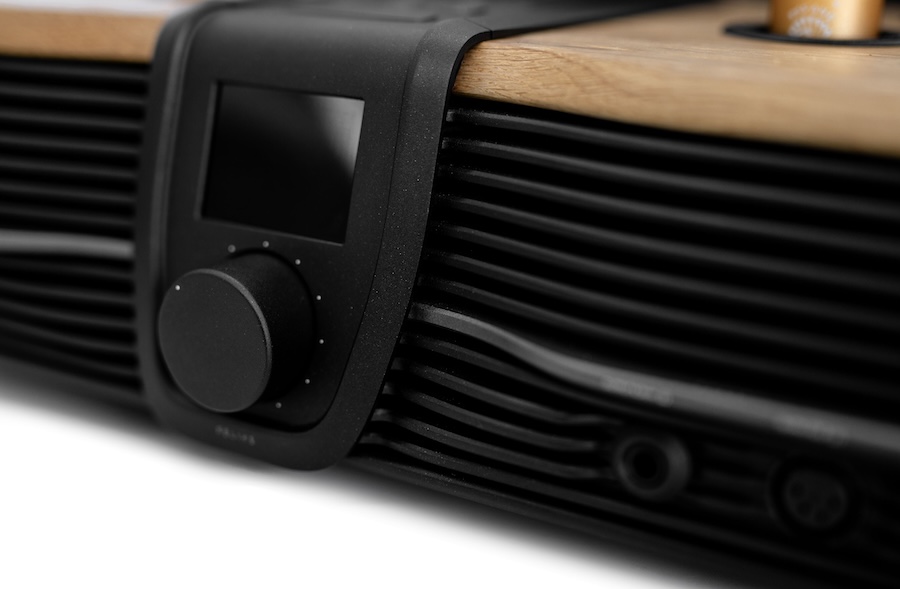
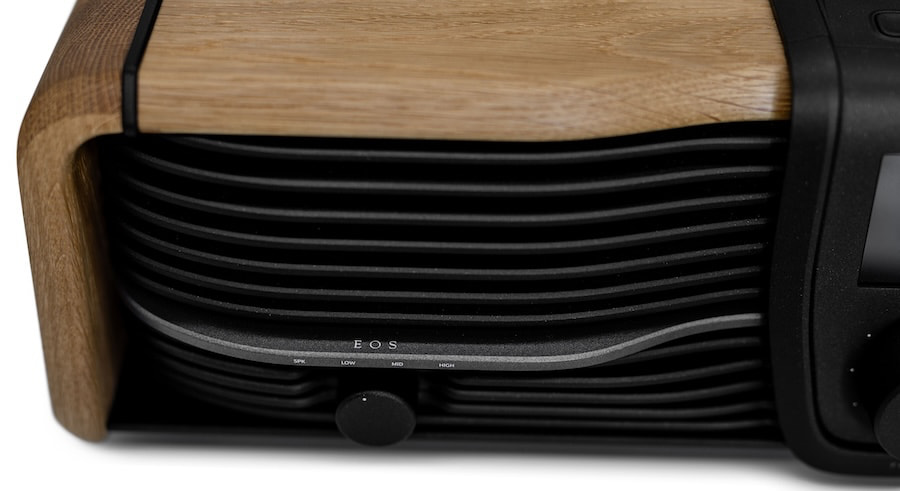
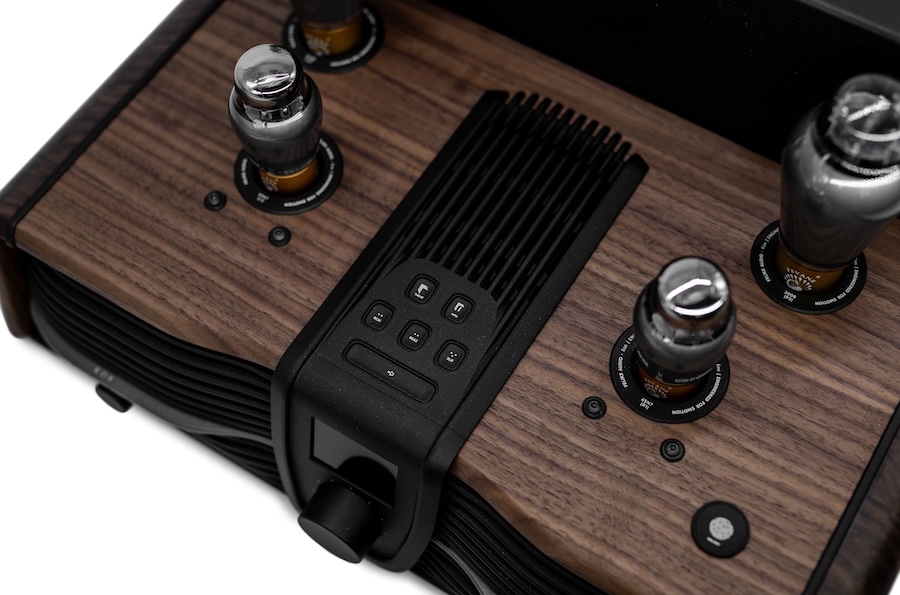
The EOS is designed to drive headphones, IEMs and loudspeakers from the same chassis, while also functioning as a balanced or single-ended preamplifier. Feliks rates headphone output as high as 8 watts and speaker output at up to 6 watts, adds a display that monitors the health of the amplifier and its tubes, and wraps everything inside a 57-pound chassis available in Oak or American Walnut.

Welcome to summit-fi in 2026. Apparently $1,000 headphone amplifiers are now the appetizer.

Advertisement
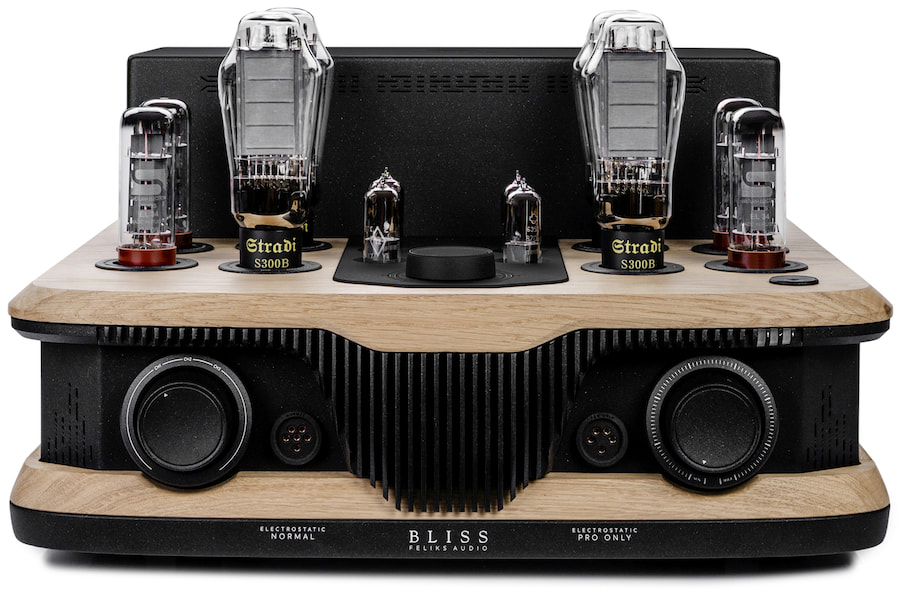
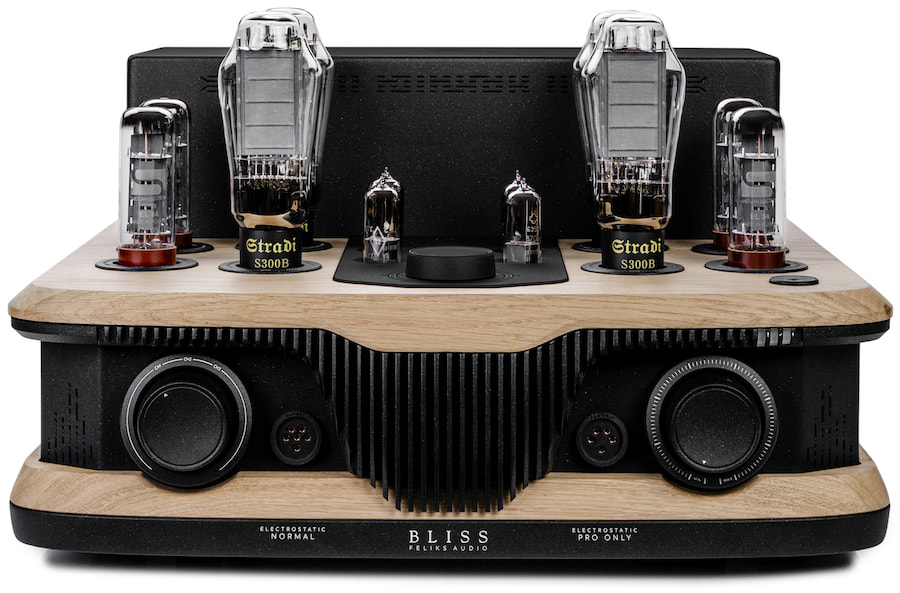
feliks-bliss-tube-amp-oak-front
Feliks Audio BLISS (oak)

From Prototype to Production

The EOS sits above the Envy family as Feliks Audio’s flagship amplifier for conventional dynamic and planar magnetic headphones. The $22,800 Feliks Audio BLISS, which we heard at CanJam NYC 2026, remains the company’s statement product for electrostatic headphones. 

Feliks has been building tube amplifiers since 1998, and the EOS brings its headphone and traditional two-channel experience together in one product. Two 300B power tubes are paired with two CV181/6SN7 driver tubes, a combination already familiar to anyone who has spent time with the company’s Envy models. 

What has changed is the scope.

Advertisement. Scroll to continue reading.
Advertisement

The EOS is not merely a headphone amplifier with preamp outputs that can eventually lead to a pair of loudspeakers. There are dedicated speaker outputs, and Feliks has finally put numbers behind them.

For headphones, the company specifies 5 watts at 1% THD, rising to a maximum of 8 watts at 5% THD. For loudspeakers, the figures are 4 watts at 1% THD and 6 watts at 5% THD. 

There is an important qualification.

Feliks does not specify the load impedance used for either power rating. We therefore cannot tell you that the EOS produces 5 watts into 32 ohms, 8 watts into 16 ohms or 6 watts into an 8-ohm loudspeaker because the manufacturer has not published that information.

Advertisement
feliks-audio-eos-tube-amp-walnut-angle
Feliks Audio EOS (walnut)

From IEMs to Speakers?

Power is only half the story because Feliks is also claiming the EOS will work with headphones and IEMs with impedances as low as 10 ohms.

That is potentially more interesting than the headline wattage.

Large 300B amplifiers and sensitive IEMs do not always make particularly happy roommates; background noise and excessive gain can quickly turn an expensive system into an equally expensive collection of hiss.

Feliks says the EOS delivers the lowest distortion and widest frequency range of any amplifier it has produced, along with sufficiently low output impedance for sensitive headphones and IEMs. The company has not, however, published the actual headphone output impedance, frequency-response limits, SNR or noise-floor measurement. 

Advertisement
feliks-audio-eos-tube-amp-oak-display

A Tube Amp With a Check Engine Light

One of the more practical EOS additions is the front display.

It shows input, output and gain settings along with a VU meter, but Feliks has also turned it into a diagnostic interface. Owners can view operating voltages, internal temperature and tube-health information, and run a diagnostic check from the front panel. 

There is also a remote control with motorized volume adjustment, input switching and gain control. Switching between headphones and loudspeakers does not require disconnecting either load.

Considering what good 300B tubes cost these days, knowing what is happening inside the amplifier before something expensive starts glowing the wrong shade of orange is not a frivolous feature.

Advertisement
Advertisement. Scroll to continue reading.

The EOS is still unapologetically old-school amplification, but Feliks has clearly decided that owning tubes in 2026 does not require living like it is 1956.

feliks-audio-eos-tube-amp-oak-left-front

Feliks Audio EOS Specifications

Specification Feliks Audio EOS
Amplifier Type Tube amplifier
Power Tubes 2 x 300B
Driver Tubes 2 x CV181 / 6SN7
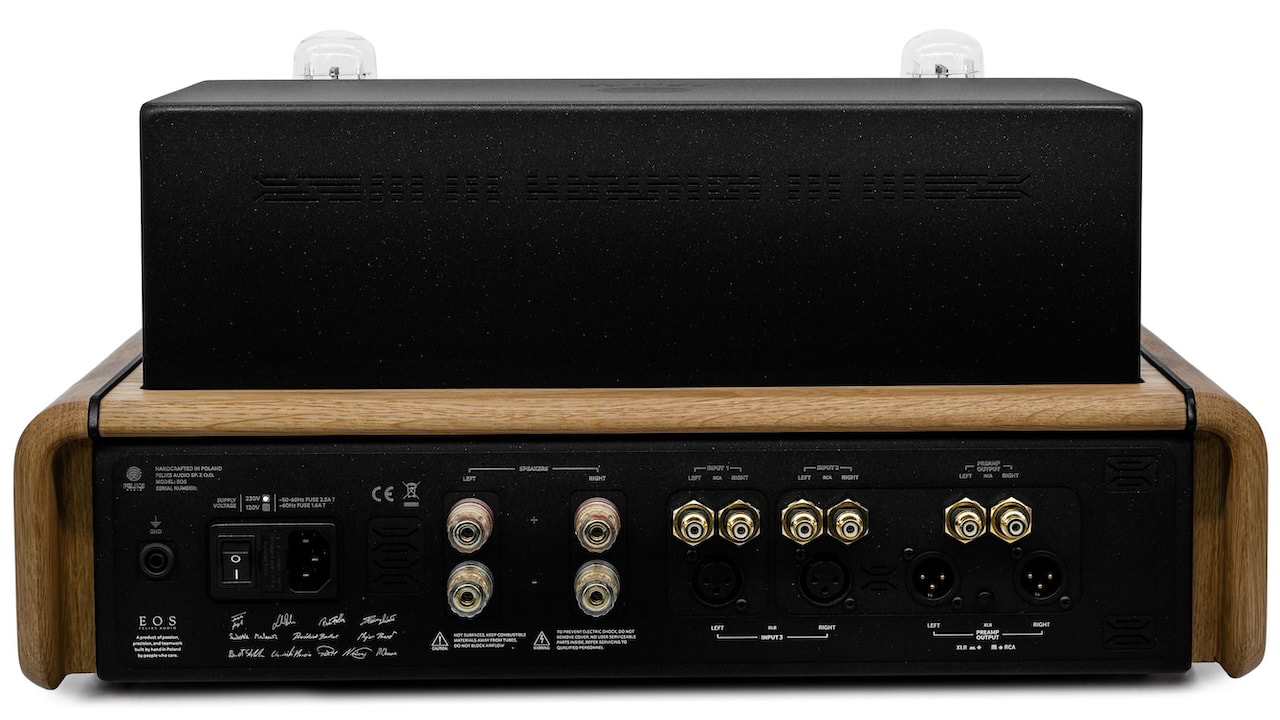
RCA Inputs 2 pairs
XLR Inputs 1 balanced pair
Input Sensitivity 1V RMS
RCA Input Impedance 43kΩ
XLR Input Impedance 41kΩ
RCA Preamp Outputs 1 pair
XLR Preamp Outputs 1 balanced pair
Headphone Outputs 6.3mm, 4-pin XLR
Headphone Power 5W at 1% THD; 8W maximum at 5% THD
Speaker Power 4W at 1% THD; 6W maximum at 5% THD
Minimum Supported Headphone/IEM Impedance 10 ohms, manufacturer claim
Preamp Output Impedance 1.4 ohms at 1kHz
AC Versions 115V or 230V, 50/60Hz
Dimensions 47 x 47 x 29.5cm
Weight 26kg / approximately 57.3 lbs
Finishes Oak, American Walnut
Remote Control Included
Display VU meter, operating information and diagnostics
MSRP $13,786 (€11,999)
Availability End of September 2026
feliks-audio-eos-tube-amp-rear-oak
Felix Audio EOS (rear)

The EOS Has Some Expensive Company

Audio-Technica NARUKAMI HPA-KG NARU — $108,000

This is where the EOS suddenly becomes the Aldi weekly special.

Audio-Technica’s extraordinary HPA-KG NARU uses four Takatsuki 300B tubes in a fully balanced tube architecture with rare kurogaki woodwork, custom transformers and matching ATH-AWKG NARU headphones included for the $108,000 asking price. We have heard the system on multiple occasions, including CanJam NYC and AXPONA, and there is nothing remotely ordinary about its construction or presentation. 

Audio-Technica also publishes considerably more detailed measurements than Feliks currently does. The NARUKAMI delivers a specified maximum 1.6 watts into 32 ohms, 1.3 watts into 150 ohms and 1 watt into 600 ohms, although those figures are measured at 10% THD. Its official specification sheet also provides frequency response, noise, channel separation and gain figures. 

Advertisement

Do not interpret that as evidence that the EOS is automatically more powerful in real-world use. Feliks has not identified the load used for its ratings, and the distortion conditions are different.

What can be compared without qualification is functionality and price.

The Audio-Technica is a headphone amplifier and preamplifier. The Feliks can also drive loudspeakers directly.

The Who called that a “bargain.”

Advertisement

Almost. Probably a good time to check in with my therapist.

MASS-Kobo Model 491 — $20,000

The MASS-Kobo Model 491, which impressed us at CanJam London 2026, occupies far more comparable financial territory at $20,000.

Its fully balanced solid-state design uses independent left and right power supplies and delivers at least 3.5 watts per channel into 32 ohms through its balanced outputs. It is a purpose-built reference headphone amplifier, however, rather than the headphone amp, preamp and speaker amplifier combination offered by the EOS. 

That makes the Feliks proposition unusual even within this rarefied part of the market.

Advertisement
Advertisement. Scroll to continue reading.
feliks-audio-eos-tube-amp-walnut-top

The Bottom Line

It would be very easy to spend the entire conclusion mocking the idea of a nearly $14,000 headphone amplifier.

Personal audio has certainly earned some of that. Five-figure headphones, $20,000 amplifiers and $108,000 systems have moved the goalposts so far that the goalposts are now somewhere outside the stadium and on the banks of the Lublinica River.

But the Feliks Audio EOS is harder to dismiss than another exercise in summit-fi excess.

This is a 300B amplifier designed to handle IEMs, dynamic headphones, demanding planar magnetics and actual loudspeakers, with balanced and single-ended preamp functionality, remote operation and onboard diagnostics. In the right system, it could replace several very expensive boxes.

Advertisement

Feliks still needs to publish the measurements missing from its specification sheet, particularly power by load impedance, headphone output impedance, frequency response and noise performance. At this price level, “trust us” should not be considered a technical specification.

Still, look across the room at Audio-Technica’s $108,000 NARUKAMI and something deeply troubling happens.

The $13,786 Feliks Audio EOS starts looking like value.

Oy vey iz mir.

Advertisement

Source link

Continue Reading

Tech

AI has a safety problem nobody is ready for

Published

on

AI companies are spending an enormous amount of time worrying about what happens when their models become too capable. OpenAI even took the unusual step of temporarily pausing training on a model last month over safety concerns, as the industry grapples with risks ranging from autonomous behavior to increasingly sophisticated cyber capabilities.

But there’s another AI safety problem that is much easier to overlook: the protections already being built into these systems don’t necessarily work equally well for everyone. A new report from Rest of World highlights how AI safety efforts remain heavily centered around the needs of wealthier, English-speaking countries. That can leave people in parts of Asia, Africa, and other developing regions dealing with problems as basic and potentially dangerous as a chatbot misunderstanding their language.

AI safety can look very different outside Silicon Valley

Many of the biggest AI companies have extensive trust and safety teams, but the standards used to evaluate models are largely shaped in high-income countries. Researchers argue this creates blind spots when the same models are deployed in places with different languages, infrastructure, laws, and cultural expectations. Healthcare provides a particularly worrying example. Research into natural-language AI systems used in Africa has uncovered translation errors involving medical terminology. In Tigrinya, for example, machine translation has confused smallpox with syphilis and even translated “intravenous antibiotics” as “intravenous insecticides.”

The problem goes beyond translation. Research has also found that AI models can hallucinate more frequently in languages with relatively little training data. Safety guardrails that reliably catch harmful requests in English may also perform worse or be easier to bypass in those languages. That matters as people increasingly turn to chatbots for health information and other important decisions. It effectively creates a new AI divide: two people can use the same product and receive very different levels of protection simply because they speak different languages.

AI adoption isn’t waiting for safety to catch up

The timing makes this especially important because enthusiasm for AI is growing rapidly across many of these markets. China offers perhaps the clearest example. We’ve already seen AI adoption spread far beyond tech companies, with everything from schools to local governments embracing the technology. It has even reached Beijing dumpling shops, where one business began giving customers AI tokens and built AI-powered tools for managing queues. That enthusiasm isn’t necessarily a problem. But researchers warn that safety infrastructure needs to expand just as quickly.

Advertisement

Governments are beginning to respond. AI safety has featured in international initiatives including the Bletchley Declaration and this year’s India AI summit, while China has also proposed mechanisms to manage AI risks in developing nations. The larger challenge is making sure “AI safety” doesn’t only mean preventing a futuristic model from escaping its boundaries or launching a cyberattack. For millions of people already using these tools, safety can be much simpler: making sure a chatbot understands their language, recognizes when something is urgent, and doesn’t confidently give them dangerously wrong information. As AI spreads into everyday life, those problems are no longer edge cases. They’re part of what making AI safe actually means.

Source link

Continue Reading

Tech

GPU shipments surged 12% despite weaker PC demand and higher memory costs

Published

on

The takeaway: Discrete graphics processor shipments rose in the second quarter, defying a seasonal slowdown in the PC market and higher component costs tied to memory shortages. The increase is notable because the second quarter is typically slower than the first. It also comes as memory shortages have raised costs for PC makers and consumers, particularly for systems with high-end graphics hardware.appol

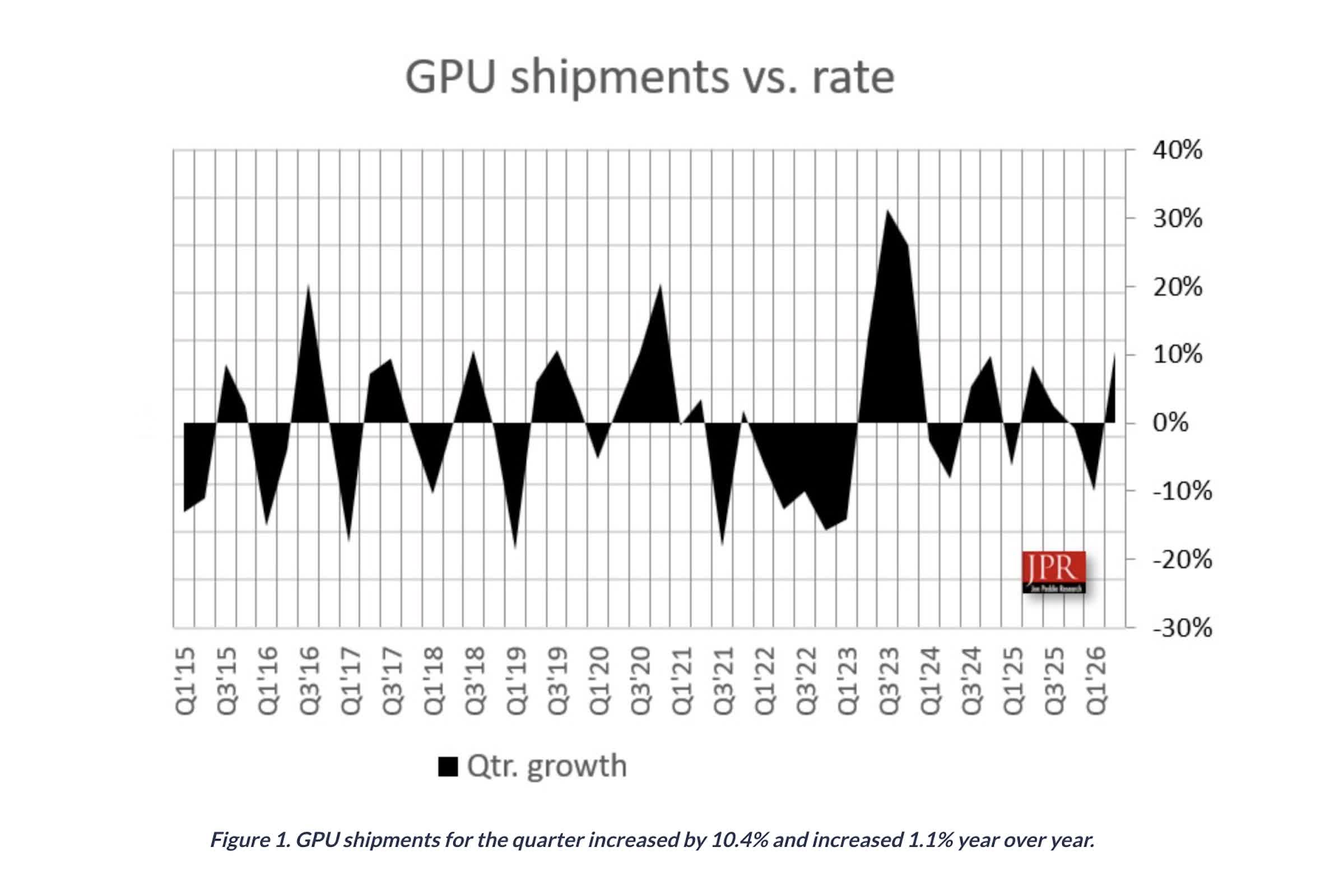
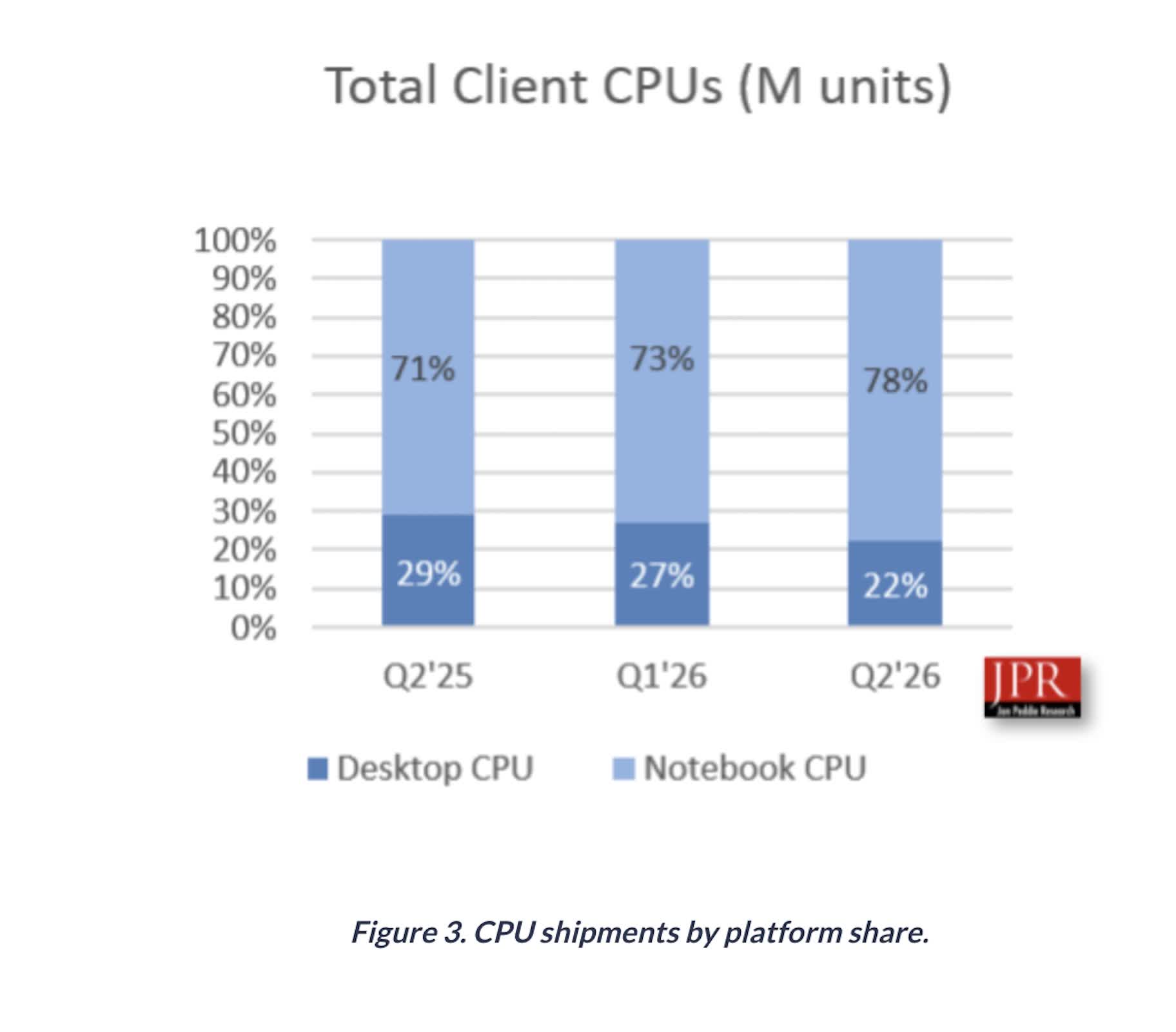
Standalone GPU shipments climbed 12.2% from the first quarter and 14.1% from a year earlier, according to Jon Peddie Research. The increase came as the broader client CPU market declined 1.1% year over year and desktop PC demand weakened.

Total consumer PC GPU shipments, including integrated graphics and discrete processors, reached 75.5 million units in the second quarter of 2026. That was up 10.4% from the previous quarter and 1.1% from the same period last year, JPR said.

Notebooks drove most of the growth. GPU shipments for laptops rose 16.8% quarter over quarter, while desktop GPU shipments fell 4%. The pattern matched the client CPU market, where mobile processor shipments increased while desktop CPU shipments dropped sharply from the first quarter.

Advertisement

JPR did not provide a unit total for discrete GPUs. Based on the company’s reported attachment rates, Nvidia’s market position and other shipment data, AMD, Intel, and Nvidia appear to have shipped about 20 million standalone GPUs during the quarter.

The research firm’s figures do not show what drove the increase. It is unclear how much came from desktop graphics card sales, gaming notebooks, or other PC designs that include discrete GPUs. Still, the results suggest that demand for PCs with dedicated graphics held up better than demand for desktop systems overall.

Intel remained the largest supplier in the overall consumer PC GPU market thanks to the integrated graphics in its CPUs. Team Blue had a 56% share in the second quarter, according to JPR. Nvidia ranked second with 23%.

AMD held 21% of the consumer GPU market, up from 14% a year earlier. The gain was tied to increased shipments of its consumer CPUs, which include integrated Radeon graphics. It does not necessarily indicate a similar gain in AMD’s standalone graphics card business.

Advertisement

More details should arrive later this month when JPR publishes its full desktop add-in-board report. It will provide market-share data for AMD, Intel, and Nvidia and should offer a clearer view of how the three companies performed in the discrete desktop GPU market.

Source link

Advertisement
Continue Reading

Tech

Apple may launch a home security camera system in 2027

Published

on

Summarizing existing rumors about Apple launching an AI home security camera, a new report says it will be announced in 2027 alongside a monitoring service.

Apple has not had the best luck so far with security devices, having effectively abandoned HomeKit Secure Routers after few vendors supported it. But it was one of several signs that Apple was aiming at the home with secure devices, and there have long been rumors of a full security system.

Now Bloomberg claims to have more details, and a projected launch date. It includes the home security system in a list of products slated for 2027, alongside iPad and MacBook Neo refreshes.

The as-yet unnamed security system is, unsurprisingly, said to be privacy-centric. It’s said to center on AI monitoring the feed from cameras rather than actual video being recorded.

Advertisement

Presumably video recording would cut in if that AI system detects something such as movement within sight of the camera. But the report says only that this will be one element of a home security system that includes a unspecified monitoring service.

Apple has long been planning this

Given that Apple has already added the ability to view feeds from compatible security cameras on Apple TV 4K, little of the report is surprising. At present that Apple TV 4K also effectively acts as a hub for such a system, and of course Apple is also expected to shortly launch a whole home hub.

The point about using AI monitoring instead of video recording is newer, though. It means capturing frames, possibly on the camera itself, and analyzing them on device.

Instead of saving raw video, the camera need only send metadata such as a timestamped record of when someone was spotted. It uses less bandwidth, and it can also be quicker from the moment movement is detected to when an alert is sounded.

Advertisement

It’s previously been reported that Apple would introduce a home security camera before the end of 2026. For at least two years, it’s been believed that Apple was also working on a related video doorbell.

Apple will face competition from many existing devices, but it will also doubtlessly have the advantage that its security camera will fit into its whole ecosystem. Most recently, Anker launched its MindBase smart home system includes some similar features, but no release date or price has been announced.

Source link

Advertisement
Continue Reading

Tech

Last two counterfeiting defendants sentenced

Published

on

A woman is robbed after visiting the Apple Store; a fake NFL swindler used apps and FaceTime calls, and an AirTag signal led to the rescue of 20 cats, all in this week’s Apple Crime Blotter.

The latest in an occasional AppleInsider series, looking at the world of Apple-related crime.

Two sentenced to prison for “fake iPhones” scheme

Two of the Chinese nationals who carried out the nine-year scheme to return counterfeit Apple products imported from China to Apple Stores throughout California have been sentenced to prison.

According to The Orange County Register, Wenhui Huang, described as the group’s ringleader, was sentenced to six years and six months in federal prison. Yang Song, described as the second-in-command, received just under five years.

Advertisement

The two were also ordered to pay $16.2 million and 16.9 million, respectively, in restitution.

Both men had pleaded guilty in 2025 and are the last of the six defendants to receive sentences.

Woman robbed after Apple Store visit

A woman who purchased a MacBook and other products from an Apple Store in Houston was robbed soon afterward, after two suspects followed her.

KTRK reports the incident, took place at the Memorial City Mall in late August. The 51-year-old woman was putting her items in her car when a suspect ran up and took a bag.

Advertisement

Surveillance video showed the suspect getting into a GMC Arcadia, and then Flock cameras caught the vehicle at a cell phone repair store. A subsequent traffic stop led to the arrest of two suspects.

Police arrested both suspects and charged them with robbery, and they recovered the stolen items.

Three arrested for stealing iPads from Target

Elsewhere in the Houston area, three suspects were arrested for stealing nearly $14,000 in iPads from a Target in Sugar Land, Texas.

According to KTRK, the three suspects, one of whom was a minor, were caught on store surveillance breaking a display case, taking items, and placing them in a garbage bag before leaving.

Advertisement

Police caught the suspects as they entered a car on their way out, and one attempted to flee on foot but was later caught. The group, the report said, is suspected of involvement in other thefts in the area.

Swindler who impersonated an NFL player used FaceTime calls, apps as part of scheme, prosecutors say

In the high-profile case of a man who impersonated a San Francisco 49ers player and real estate investor in order to swindle women, the man and his accomplice often used three-way FaceTime calls to show off bogus financial gains, federal prosecutors allege.

According to the Justice Department, 35-year-old Daejon Labrayae Love would meet women on dating apps and use fictitious investments to defraud them. Meanwhile 18-year-old Taylor Jamie Chan would pose as his “financial advisor.”

Advertisement

Love also, per prosecutors, “used phone applications to create fictitious bank and investment accounts and balances which Love showed victims to legitimize the scheme.”

The scheme lasted four years, until authorities arrested the two on August 24. They were charged in federal court with conspiracy to commit wire fraud and wire fraud.

AirTag signal leads to stolen truck, 20 cats

A truck was stolen in Tacoma, Wash., in August, containing unusual cargo: Twenty cats. However, the truck contained an AirTag, which led police to the vehicle and the felines.

KIRO reports police followed the signal and discovered the man and woman still in the car, and they were arrested. The female suspect had been attempting to feed the cats with food and water, but they still appeared emaciated and had been exposed to ringworm, police told KIRO.

Advertisement

The cats were taken to a shelter.

“The female [owner of the truck] had mentioned her cats were in the car,” Pierce County Sheriff’s Detective Josh Mills told the radio station. “The deputies asked her, ‘Well, how many cats?’ And she said she wasn’t actually very sure.”

AirTag catches a carjacker in Cleveland

A Cleveland man has been arrested after he allegedly carjacked a woman at a gas station, and an AirTag in the car helped catch him. He’s now been charged in federal court with carjacking and using a gun during a violent crime.

Cleveland.com explains the 24-year-old man admitted that he carried out the carjacking of the 67-year-old woman, and wrote a letter of apology that he asked the FBI to deliver to her.

Advertisement

AirPods help to solve a car theft

When an idling car was stolen outside a Georgia school in mid-August, the crime was soon solved thanks to AirPods left behind in the car and video from a nearby Tesla.

According to Fox 5 Atlanta, a woman had left the car idling outside while bringing her son to school. This gave the thief the opportunity to get in the car and drive away.

The woman’s AirPods, however, allowed police to track the car’s location to a local subdivision, where they found the car abandoned. They discovered that the man had been dropping items, including the AirPods and the victim’s wallet.

The Tesla video had clearly captured the original theft, leading to the man’s arrest.

Advertisement

The man had claimed that he had permission to “borrow” the vehicle, but police didn’t appear to buy that explanation.

Two arrested for stealing MacBook, cars and other items from home of couple that died in Africa

A man and woman were arrested in late August and charged with stealing several items, including luxury cars and a MacBook, from the home of a couple that had been killed the week before in a helicopter crash in Kenya.

According to NBC Miami, the stolen items included a Range Rover and Porsche Taycan, a MacBook, “personal and business documents, jewelry, electronics and artwork.”

They were caught, the report said, after the MacBook and a spare key for the Range Rover were tracked to an address in Hialeah, where some of the stolen items were found. Both were arrested.

Advertisement

The man and woman were charged with burglary of an unoccupied dwelling, grand theft of a vehicle, and grand theft.

The male of the couple, a prosecutor said, had prior convictions for burglarizing homes, money laundering, and dealing in stolen property. While his attorney produced a document alleging that the victims had granted him authorization to use their vehicles, both detectives and a friend of the victims said in court that they believed the document was fraudulent.

UPS employee accused of stealing Apple Watch

A UPS package handler in Florida has been charged with grand theft after trying to steal nearly $2,600 worth of electronics, including phones and an Apple Watch Series 11, from a UPS facility.

CBS 12 reports that, after a tip that the man was hiding stolen items under a yellow tote, supervisors found the packages there. The man typically handled heavier packages and not smaller ones, which drew suspicions, the report said.

Advertisement

A man from New York was arrested in California for what police described as his part in a mobile identity fraud operation.

According to KRON, police say the 30-year-old man came to a Verizon Store in San Mateo, accessed a customer’s Verizon account and used it to “place an unauthorized order for two Apple iPhones.”

After fleeing the store in a U-Haul van, the man was apprehended by police, who used a drone to track him down.

A search of the van, the San Mateo Police Department said, discovered “numerous fictitious identification cards, blank identification cards, an ID card printer, bank cards not belonging to Simemorales, and numerous boxes of unopened iPhones.”

Advertisement

He was charged with identity theft, forgery, and possessing a document-making device with the intent to defraud.

Source link

Advertisement
Continue Reading

Tech

Seattle Times and Newsday are the latest publications to sue OpenAI and Microsoft

Published

on

Two more news organizations are suing OpenAI and Microsoft over the supposed use of their journalism to train AI.

A lawsuit filed by The Seattle Times and Newsday argued that with the advent of AI, the journalism industry could become “broken beyond repair.” The lawsuit described generative AI as “a snake eating its own tail” that could “destroy the very organizations” that produce the content it’s trained on.

“AI products like ChatGPT and CoPilot are touted as producers of content, but in fact they are rapacious consumers, devouring human-authored content and delivering back to the world copies and derivative imitations of that same original content they consumed to achieve their commercial objectives,” the lawsuit said.

Back in 2023, The New York Times sued OpenAI and its partner/investor Microsoft over alleged copyright infringement; other publications have followed suit as the case continued. The Seattle Times’ lawsuit is particularly notable because Microsoft and OpenAI have funded some of the organization’s journalism projects and fellowships.

Advertisement

A Microsoft spokesperson told GeekWire that the company is “surprised by the lawsuit” but is “always happy to sit down and explore solutions to this type of dispute.”

Source link

Continue Reading

Tech

FSF is Now on Bluesky – But Won't Advocate Signing Up Due to Nonfree JavaScript

Published

on

The Free Software Foundation (FSF) is now on Bluesky, they announced this week. But “We can’t advocate that you sign up for a Bluesky account like we do with Mastodon or PeerTube since signing up for Bluesky means loading the registration page’s nonfree JavaScript…”

While federated, Bluesky is generally not considered part of the “fediverse” network of social media services like Mastodon and PeerTube, as it uses its own AT protocol rather than ActivityPub… Hosting your own Bluesky “Personal Data Server (PDS)” and relay is technically possible, but generally far more difficult and resource-intensive than spinning up an instance of Mastodon, let alone any of the lighter-weight ActivityPub servers like Akkoma or Starling.

Much of the Bluesky codebase is freely licensed. This allows users to run, copy, modify, and share large parts of the codebase. However, Bluesky’s web client still serves nonfree JavaScript to users, just like its registration page. (Since our script was written for us specifically, we have not extensively vetted all available clients.)

Why did we sign up? Simply put, we have to continue to reach people where they are. Bluesky is a decent choice for us that evades many of the issues of other, more problematic networks… We accepted running Bluesky’s nonfree JavaScript a single time if it meant being able to reach people who have never heard of software freedom.

Advertisement

The FSF’s blog post advises supporters “If you’re on social media, follow the FSF on Bluesky and on Mastodon today.”

Slashdot also has an account on Blueky.

Read more of this story at Slashdot.

Advertisement

Source link

Continue Reading

Tech

Apple iTunes Still Exists, But Not The Way It Used To

Published

on

You can still buy music from the iTunes Store, believe it or not.

It’s been just over a quarter of a century since Steve Jobs announced the release of iTunes, and it’s still treading water today, in a drastically diminished state. For the Apple faithful, iTunes holds legendary status as the once-predominant digital storefront for organizing and playing music files. At the peak of iTunes’ heyday, it held roughly 63% of the US paid digital download market. Ironically, the emergence of subscription services (Apple Music, Spotify, etc.) kick-started iTunes’ fall from grace. It certainly didn’t help that iTunes slowly grew into a severely bloated, overly complicated amalgamation of necessary tools buried in a tab-heavy interface.

iTunes didn’t necessarily disappear so much as scatter, with various remnants dispersing into separate apps. Music went to the Music app, movies to Apple TV, and podcasts to Apple Podcasts. More importantly, device syncing no longer takes place within the twisted webwork of pre-Mojave iTunes. If you connect an iPad or iPhone to your Mac to back up or restore, the process takes place in Finder, not iTunes.

The original iTunes was designed to manage a personal media collection, a task it was very good at. In time, it became Apple’s behemoth hub for apps, backups, movies, podcasts, books and everything else you can imagine within the Apple ecosystem. Though it’s now fragmented, iTunes is still hanging on in a few ancillary ways.

Advertisement

Your old iTunes library and purchases are still there

You don’t need a separate iTunes account to access old purchases. Your Apple Account (formerly Apple ID) is tied to all of your purchased music, films, TV seasons, audiobooks and other content. As iTunes accounts became Apple IDs, which later became Apple Accounts, your library remained the same across that timeline, as long as you remember your login credentials.

For Apple users, the Music app is the closest successor to classic iTunes. It can play and organize purchased tracks, DRM-free files, ripped CDs and other music you’ve imported over the years. An Apple Music subscription is not required to keep listening to files you already own. An Apple Music subscription adds a streaming catalog and cloud-library features, but it is separate from purchasing music or keeping local MP3, AAC and ALAC files.

Advertisement

Apple still offers iTunes for Windows, and you can even use it for media if you haven’t installed Apple’s newer Windows apps. Once you install Apple Music or Apple TV on a PC, those apps take over music, movies and TV shows. The Apple Devices app handles syncing and devices, while good old iTunes remains the place to go for audiobooks and free podcasts.

Where iTunes is still useful now

Despite its drastic regression, iTunes is still a thing. It’s just no longer a universal command center for Apple media and device control. Windows users can download the traditional iTunes app, manage compatible media and access the iTunes Store, kind of like old times. However, iPhone and iPad users have an iTunes Store app now. This app, unlike the Music App, is the go-to option for purchasing music, movies, and TV shows if you prefer owning downloads over paying for a monthly subscription. Mac users can still purchase music from the iTunes Store through the Music app; TV and movie purchases now live in the TV app.

Purchased albums in 2026 can sit in your Music library right alongside files ripped from CDs back in 2004. No Apple subscription is necessary for downloading your purchases for easier listening while you’re on the road or off-grid. When it comes to device management, iTunes is just legacy software these days, assuming you’re running any macOS versions post-Mojave. The Finder app handles device management in terms of wired syncing, backups, restores and software updates. The Apple Devices app on Windows serves the same purpose. The iTunes name has survived because most people still associate it with Apple’s storefront and personal libraries, but the original application is all but gone, with a few exceptions.

Advertisement

Source link

Advertisement
Continue Reading

Trending

Copyright © 2025