The remarkable discoveries were made during work to upgrade the A1 between Leeming Bar and Barton, which eventually transformed the road into the A1(M).
As construction work progressed, teams of archaeologists were given an opportunity to investigate land surrounding the route between North Yorkshire and County Durham.
What they found at Scotch Corner changed understanding of the Roman occupation of northern England.
![]()
Archaeologists discovered the remains of a major settlement which Historic England says pre-dated Roman settlements at York and Carlisle by around ten years.
The settlement was also enormous by the standards of Roman northern England.
It stretched for around 1.4km from north to south – roughly equivalent to placing 13 football pitches end-to-end.
Evidence suggests it was occupied for a relatively short period, perhaps only 20 to 30 years, before activity shifted further south towards Catterick.
![]() NEW TREASURES: A Samian cup and decorated bowl found at the Scotch Corner Roman site during the roadworks. Picture courtesy of Northern Archaeological Associates
NEW TREASURES: A Samian cup and decorated bowl found at the Scotch Corner Roman site during the roadworks. Picture courtesy of Northern Archaeological Associates
But during that time, the people living at Scotch Corner appear to have had access to remarkable wealth and goods arriving from across the Roman world.
Among the most extraordinary finds was a small figure of a toga-clad actor carved from amber.
The object is believed to have been made in Italy during the first century AD and Historic England said nothing like it had previously been found in Britain.
A similar example had been discovered at Pompeii.
Its presence in North Yorkshire suggested the settlement’s inhabitants had connections stretching hundreds of miles across the Roman Empire.
It was far from the only unusual discovery.
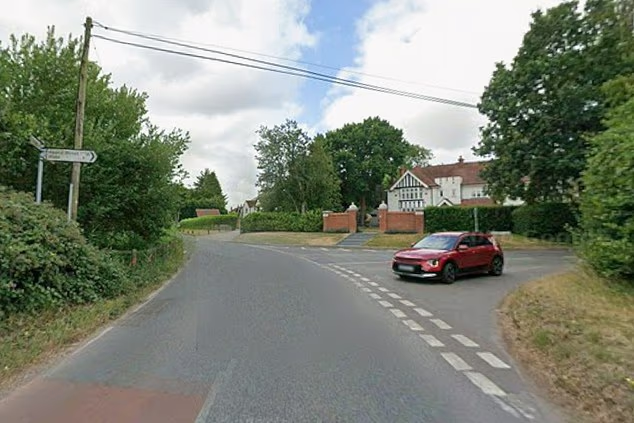
![]() Roadworks on the A1(M) at Scotch Corner
Roadworks on the A1(M) at Scotch Corner
Archaeologists also found evidence of workshops where gold, silver and copper coins were being produced.
Historic England described the workshops as the most northerly example of coin production then known anywhere in Europe.
Brooches, gaming counters and other high-status objects were among the thousands of finds recovered during archaeological work associated with the road scheme.
The discoveries indicated Scotch Corner was not simply a collection of homes beside an ancient road.
Instead, it appears to have been an important industrial and trading settlement sitting at a strategically significant junction.
![]() An old road sign for Scotch Corner
An old road sign for Scotch Corner
That should perhaps sound familiar to modern motorists.
Scotch Corner remains one of the North’s most important crossroads today.
The A1(M) carries drivers north towards County Durham, Newcastle and Scotland or south towards Yorkshire, while the A66 heads west across the Pennines towards Cumbria and the M6.
Nearly 2,000 years ago, major routes were already converging in the same area.
Dere Street, one of the principal Roman roads running north through Britain, passed nearby, while another route headed west towards Bowes, Brough and eventually Carlisle.
The modern road scheme which uncovered the remains was the £380m upgrade of the A1 between Leeming and Barton.
Excavations began in 2014, with around 60 archaeologists involved in investigating sites along the route.
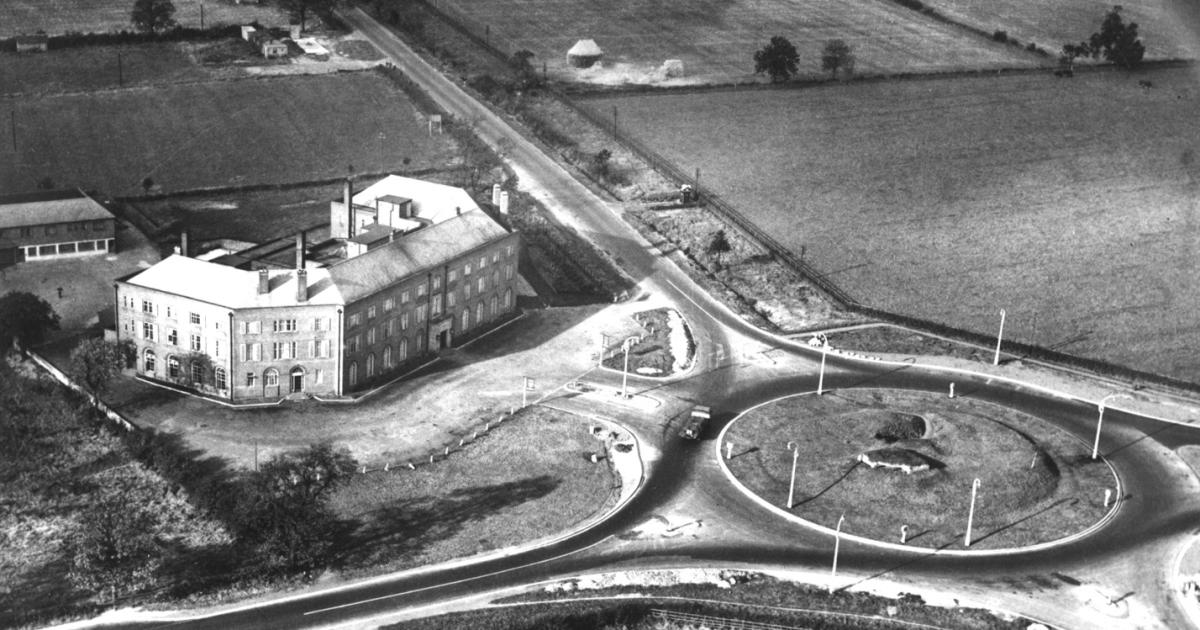
![]() FIRST PUB: The Three Tuns at Scotch Corner, complete with stone mounting steps, which was demolished in 1939 so that the Roman road could be widened
FIRST PUB: The Three Tuns at Scotch Corner, complete with stone mounting steps, which was demolished in 1939 so that the Roman road could be widened
The wider project uncovered thousands of objects from several periods of history, including well-preserved Roman shoes and keys around Catterick.
Archaeological evidence around Catterick has long shown it developed into an important Roman centre known as Cataractonium, with a fort guarding the River Swale crossing and a substantial civilian settlement alongside Dere Street.
But the discoveries at Scotch Corner suggested an important centre had existed further north even earlier.
Historic England said its existence meant Roman expansion into northern England may have happened around a decade earlier than previously believed.
The settlement appears eventually to have declined as Roman activity moved northwards and Catterick grew into a major administrative and economic centre.
Dr Jonathan Shipley, who worked on the archaeological programme, later said the discoveries showed that Scotch Corner had been the site of a much older junction long before the modern road network appeared.
Evidence from the area also included activity dating to the Iron Age and indications of interaction between local communities and the arriving Roman world.
Today there is little from the motorway itself to suggest just how much history was discovered beneath and alongside it.
Drivers still approach Scotch Corner to decide whether to continue north or turn west.
But archaeological work has shown people were travelling, trading and meeting at almost the same strategic location around two millennia before the A1(M) existed.


































































You must be logged in to post a comment Login