
Business
UK recruiters see first rise in permanent role hiring since 2022




Calamos Investments is a diversified global investment firm offering innovative investment strategies including U.S. growth equity, global equity, convertible, multi-asset and alternatives. The firm offers strategies through separately managed portfolios, mutual funds, closed-end funds, private funds, an exchange traded fund and UCITS funds. Clients include major corporations, pension funds, endowments, foundations and individuals, as well as the financial advisors and consultants who serve them. Headquartered in the Chicago metropolitan area, the firm also has offices in London, New York and San Francisco. For more information, please visit www.calamos.com.

Thinkhubstudio/iStock via Getty Images

August was a good month in financial markets, with the S&P 500 up around 2.7%. The market leaders came from the commodity complex, with gold and bitcoin (not sure how this should be classified) being the two top performers. High up as well was GSG (GSG), an ETF tracking the broad commodities market, with a roughly 50% weight in the energy complex. Stocks also had a good month, led by emerging markets ex-China (EMXC), which represents a bounceback of the semiconductor-heavy Korean and Taiwanese markets after their massive rally and subsequent correction. Tech did well in the U.S. as well, with NASDAQ up 4%. Finally, the non-AI complex held its own, with low volatility (USMV) and value (VTV) stocks doing well.
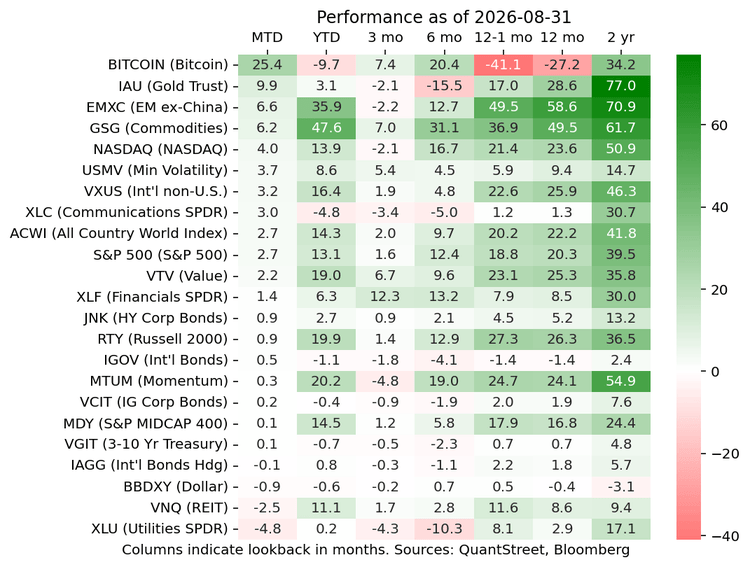
The market’s consternation was focused on the long-end of the Treasury curve, as well as on government debt markets globally. A lot of the concern centers around large and growing government debt loads, and though the US experience is not particularly anomalous across either level or rate of change of government debt to GDP (see below), the dollar bore the brunt of investor concerns. The rate-sensitive parts of the stock market, utilities and REITs, were the worst-performing sectors in the month.
QuantStreet’s performance remains strong. We track the returns of several strategies, and you can see those numbers here. More detailed analysis of our performance relative to benchmarks is available via our strategy-level tearsheets. Please reach out at hello@quantstreetcapital. com if you would like to see these.
Interest rates
Since the start of the year, longer-term interest rates have increased around the globe. U.S. 10-year rates (GT10) are about 50 basis points higher than they were at the start of the year. UK (GUKG10) and Japanese (GJGB10) 10-year rates have increased even more. Even Germany, a stalwart of fiscal conservatism, has seen its 10-year rates rise so far this year.

The rate increases have been associated with ominous-sounding news headlines, like this recent one warning that Treasury secretary “Scott Bessent Has a $40 Trillion Problem as Interest Rates Are Closing in on a Multi-Decade High”. The Treasury’s recent intervention in the long-end of the yield has not as of yet achieved the desired results of calming investor fears, with the FT warning that “Scott Bessent’s intervention to prop up the market failed to soothe investor jitters.” Even CNN, not usually known for its front-page economics coverage, has weighed in with “The war is raising the price of money. That’s a problem for the global economy.” Sentiment surrounding interest rates remains tense.
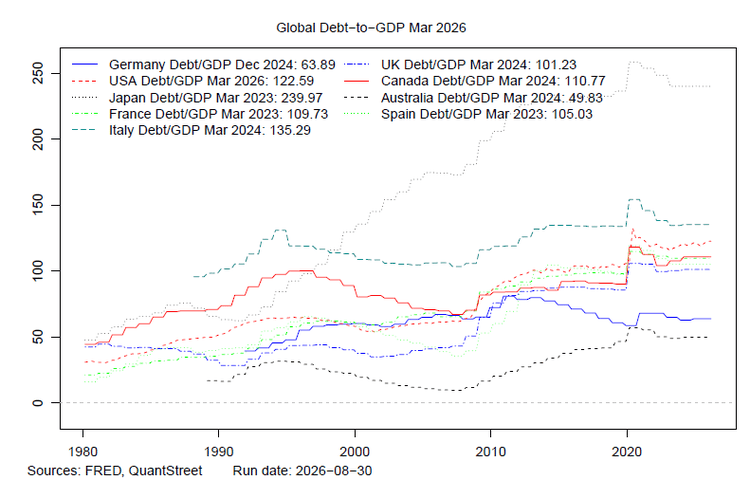
Importantly, the U.S. is hardly the only country with debt and spending issues. The next chart plots the government debt-to-GDP levels across several developed economies. The U.S. is not the worst of the bunch. Our general debt trajectory has mirrored that of other developed countries.
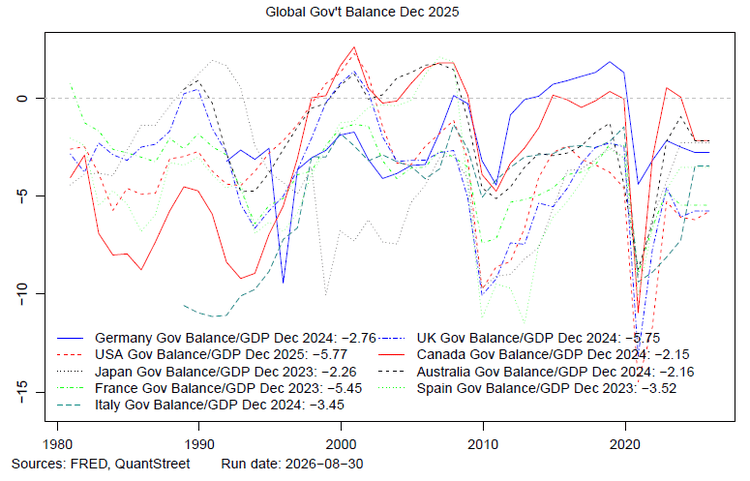
The same is true about our fiscal deficits. The next chart shows that the U.S. budget deficit of roughly 5.8% (as of the end of 2025), while in the bottom rung of peer economies, has followed a very similar pattern to the budget deficits of other countries. Excessive government spending is a global problem and the sell-off seen across government bonds is really a global issue.
Theories
There are many theories out there for what’s been happening with long-term interest rates. One is that the higher level of short- and long-dated interest rates simply reflects market expectations for higher future growth; indeed, the currently elevated stock price-to-earnings ratios suggest that the market expects rapid economic and earnings growth. Much of the AI data center build out is being financed with debt, again in anticipation of high future growth, and this additional supply is leading to increased interest rates to induce investors to invest.
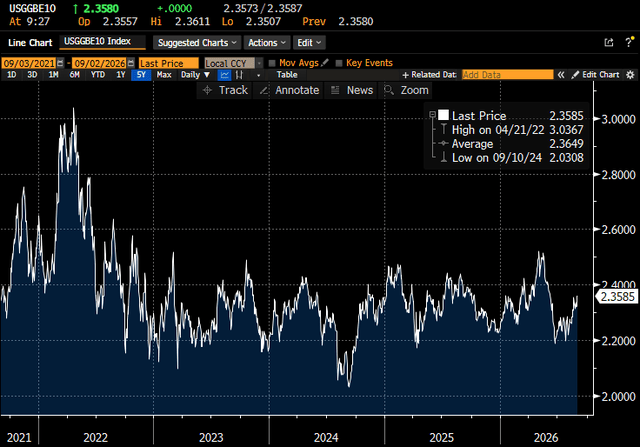
Supporting this view, inflation breakevens–the difference between 10-year nominal and real interest rates–are well-contained. Outside of inflation risk premium considerations, this suggests that market participants believe the Fed is in control of inflation expectations.
The long-end of the yield curve contains two components. One is the market’s expectation about future short-term interest rates. The other is the term premium investors demand to hold Treasuries relative to shorter-dated and less price sensitive securities. According to a recent piece by Apollo’s Torsten Slok, the 10-year Treasury term premium has remained stable over the last 12 months, suggesting that the increase in 10-year rates reflects investor expectations about higher future short-term rates (and growth), and not an additional risk premium due to fiscal concerns. Though another recent piece from Stanford’s Hanno Lustig questions this interpretation, arguing that the term premium has, indeed, increased when looked at over the last several years.
Hanno Lustig also shows that the Treasury convenience yield, which is the difference in yields between highly rated corporate bonds and Treasuries, has largely disappeared over the past few years, suggesting that the specialness of Treasuries is diminishing relative to comparable high-quality non-Treasury bonds. It’s hard to attribute the recent disappearance of the Treasury convenience yield to anything other than investor concerns about lending money long-term to the U.S. government.
Consistent with this theme is a recent FT article about European countries repatriating their gold reserves back to Europe. According to the FT, this is out of a fear that an “unreliable American government under President Donald Trump may otherwise seize them amid growing transatlantic tensions.” If this is where people’s minds are at, it is no surprise that Treasuries are also losing their appeal as an impregnable store of value.
Our own take is that multiple factors are at work. First, higher rates undoubtedly reflect elevated growth expectations. The AI boom is for real, and whether or not all of the current investment proves justified, the investment will get made for the next few years, which will pressure bond yields as a large supply of new bonds comes to market. Second, it is unlikely that inflation concerns are behind the selloff, especially in light of inflation breakevens remaining well anchored. Third, while current fiscal deficits combined with growing government debt loads and increasing interest rates are almost certainly not sustainable in the long-term, a short-term, bond-vigilante driven Treasury selloff also seems unlikely. (The level of credit default swaps which track U.S. government debt is not elevated and the level of U.S. national wealth, however one might measure the latter, is surely much higher than our annual GDP, suggesting that the U.S. debt-to-national wealth ratio is far lower than our roughly 120% debt-to-GDP.)
Keep in mind, these are our current views based on the information available to us, and our analysis of this highly complex topic may well prove incorrect as economic and market conditions evolve.
(As usual, John Cochrane of the Hoover Institution also has an interesting take on things, which you can read about here. Cochrane discusses many potential reasons for the increase in yields, without taking a stand on which reason is the most probable.)
Portfolio positioning
Looking to the month ahead, we continue our attempt to find exposures that are not directly AI-related: as AI adoption increases, our view is that the non-AI parts of the economy stand to benefit, and this is exactly the types of companies that represent the value and low-volatility parts of the market. We maintain slightly conservative positioning by reducing the allowed tail risk limits at each of our portfolio risk levels (the latter determined using portfolio realized volatility). Across all of our portfolios outside of the one targeting 100% stock-level risk, these tightened tail risk limits led to an increase in our short-term Treasury exposure and a decrease in our S&P 500 exposure. We are not turning bearish, but perhaps are turning slightly more cautious as a lot of good news has already been priced in.
On the Treasury front, we admit that 10-year rates in the 4.8% range and 30-year rates in the 5.25% range are beginning to look appealing. Despite that we maintain our model allocation discipline and stick with low duration exposures until our model return forecasts for and the return trends of longer-dated bonds become more attractive. (The caveat is that these are just model forecasts, and future returns on longer-dated bonds may be much more attractive than our models suggest.)
In addition, we exited the commodities position we initiated at the start of last month. Our model still likes a commodities allocation as trend, model forecast, and diversification all point in the same direction. However, as we regularly warn, the model could always be wrong, especially if there is salient information the model does not have access to. And with regard to that, we were struck by a Bloomberg article which quoted Secretary Bessent as saying he believes the Strait of Hormuz may become a “worthless piece of water” in a couple of years as oil shipments bypass the Strait. Add to that evidence that more ships continue to pass through the Strait, and it raises the possibility that the war in Iran will continue, while the global oil market will remain well supplied. We do not want to get stuck in an oil-heavy position in such a scenario, and so we exit the trade.
Editor’s Note: The summary bullets for this article were chosen by Seeking Alpha editors.

Commonly called alternative investment funds (AIFs), these local fund houses, which have emerged as significant sources of risk capital, made a strong appeal at a meeting about a fortnight ago with senior officials of the Securities and Exchange Board of India (SEBI), Reserve Bank of India (RBI) and ministry of finance, two persons familiar with the discussions told ET.
At stake is the future of the fast-growing AIF industry which has been pooling in money for over a decade from local and offshore investors to bankroll unlisted firms, startups and expanding businesses.

Their concern and the urgent plea requesting a status quo on regulations, stems from the draft FEMA (Foreign Investment) Rules 2026. The draft, released by RBI on July 21, 2026, gives regulators the scope to change the parameters that qualify an AIF as ‘foreign controlled’. Currently, an AIF with almost all offshore investors is regarded as a domestic entity if its sponsor and investment manager are Indian owned and controlled.
As SEBI and RBI had expressed before, such a rule opens the door to regulatory arbitrage: a foreign investor barred from ownership or control in sensitive industries puts money in an AIF (backed by Indian sponsor and manager) to indirectly acquire equity stake in companies operating in sectors having foreign direct investment (FDI) restrictions.

After the draft July guidelines, AIFs fear that a relook at the ‘foreign ownership and control’ definition to curb such indirect ownership would mean that even AIFs with Indian managers and sponsors would be considered as foreign entities if majority of the fund corpus is contributed by foreign investors. Once categorised as foreign entities, such AIFs would run into investment restrictions and formalities applicable to foreign direct investors.
With non-residents accounting for 40% of AIF investments, the draft rules have rattled the industry, as ET had reported on August 11.”At the meeting, the AIF lobby tried to put across the point that the India story can be best sold by Indian managers. They are best positioned to canvass for capital from various markets — a strategy that has worked in the last 10 years. The industry said that if the government intends to liberalise foreign investments, such a change could slow down inflows,” said a person who attended the meeting.
In fact, AIFs have even asked for a carve out in the existing regulation so that funds whose sponsors and managers are owned and controlled by listed Indian financial institutions should be treated as domestic AIFs even if more than 50% equity of these institutions is with foreign persons. “Private banks and NBFCs are regulated and registered with RBI. As long as they are listed, AIFs backed by them should be considered domestic. AIFs have asked for simplification of rules related to ultimate beneficial ownership,” said a source.
The regulatory and ministry officials neither raised the issue of regulatory arbitrage nor reacted to the points made by AIF industry officials whose views on the draft norms were sought. The concerns over regulatory arbitrage was first captured in a note placed before SEBI board in May 2024. Besides AIFs’ ‘indirect ownership from downstream investment’, it said, “..there is scope that the investments could flow from our land border sharing countries through AIFs in companies beyond the permissible limit for automatic route under FDI policy, undermining the spirit of Press Note 3 notification and the steps taken by Government of India in this regard.”

SMHX: Top Holdings Are Expanding The Market, Not Competing

Australia’s Ingenia rejects $1.4 bln Warburg Pincus buyout bid

UK finance minister Healey seeks growth through decentralising power

Workers would be able to divert a portion of their superannuation to help pay for their rent or mortgage under a One Nation proposal.

VGP SA (VGPBF) Analyst/Investor Day – Slideshow

SCHV: Schwab's Large-Cap Value ETF Is Having A Moment


I’ve been contributing to Seeking Alpha and other investment websites since 2011, with a general (though far from rigid) focus on value over growth. I got my Series 7 and 63 back in 1999, and watched the dot-com bubble peak and then burst in real time at a small, tech-focused retail brokerage in NYC. Now co-host of The Atlantic Current podcast, with twice-weekly cross-border conversations on politics, finance, and culture.
Analyst’s Disclosure: I/we have a beneficial long position in the shares of FSLR either through stock ownership, options, or other derivatives. I wrote this article myself, and it expresses my own opinions. I am not receiving compensation for it (other than from Seeking Alpha). I have no business relationship with any company whose stock is mentioned in this article.
Seeking Alpha’s Disclosure: Past performance is no guarantee of future results. No recommendation or advice is being given as to whether any investment is suitable for a particular investor. Any views or opinions expressed above may not reflect those of Seeking Alpha as a whole. Seeking Alpha is not a licensed securities dealer, broker or US investment adviser or investment bank. Our analysts are third party authors that include both professional investors and individual investors who may not be licensed or certified by any institute or regulatory body.

Robert Downey Jr.’s Forgotten Supernatural Horror Thriller Is Officially Back on Streaming

Welsh region partners with National Wealth Fund to ‘accelerate major growth’

Calamos Convertible Opportunities And Income Fund Q2 2026 Commentary





-

 Fashion2 days ago
Weekend Open Thread: Beyond Yoga
-
 Crypto World2 days ago
Bitcoin price stalls near $82K as key resistance holds
-

 Politics2 days ago
Best Gaming Laptops, CPUs, TVs, And Keyboards To Upgrade Your Set Up For GTA VI
-

 Tech3 days ago
The Birds Outside, Drawn For You Automatically
-

 Crypto World3 days ago
IMF Says El Salvador’s Post-Review Bitcoin Purchases Used No Public Funds
-
 Crypto World2 days ago
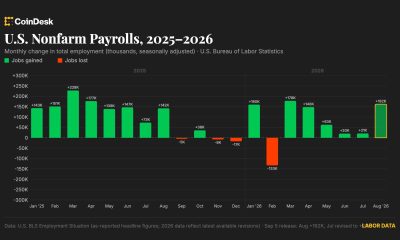
U.S. added stronger than expected 162,000 jobs in August as labor market bounced back
-

 Sports3 days ago
Alexandre Pato consortium’s Northampton Town investment approved
-

 Sports3 days ago
Commanders’ Chig Okonkwo is a top breakout fantasy football candidate
-

 Sports2 days ago
Golden Eaglets Drawn in Group B for 2026 WAFU B U17 Championship
-
 Crypto World2 days ago
XRP price breaks falling channel as bulls target $1.53
-

 Politics3 days ago
A new European chapter for Gibraltar
-

 Politics2 days ago
How To Avoid Winter Colds: 4 Everyday Habits That Spread Germs, Says Pharmacist
-

 Politics3 days ago
The House | Bin the lectures, bring gossip and be ready to banter: how the new PM should prepare for his Trump encounter
-

 Crypto World2 days ago
From warning to listing: UK’s largest retail investment platform opens access to crypto ETNs
-

 Crypto World2 days ago
FinCEN flags $12.7B tied to Southeast Asia crypto investment scams
-

 Tech3 days ago
A Worthy Android Ereader, With Some Tradeoffs
-

 Politics3 days ago
33 Cosy Autumn Home Decor Ideas: Blankets, Pumpkin Decorations, And Candles
-

 Tech2 days ago
How To Edit Claude’s Memory
-

 Crypto World2 days ago
Trezor Data Breach Impacts 67,000 More US Customers
-

 Tech2 days ago
beyerdynamic AVENTHO Y Debuts at IFA 2026 and Makes Wireless Headphones Less Disposable
You must be logged in to post a comment Login