Even the greatest scientific minds are at risk of rogue 9-pin connectors
WHO, ME? Every Monday morning The Register asks the same question – “Who, Me?” – because that’s the name of our weekly reader-contributed column that shares your stories of workplace scrapes, escapes, and japes.
Advertisement
This week meet a reader we’ll Regomize as “Marc” who told us that he graduated in the early 1990s and soon scored his first job – supporting PCs for Very Important Professors (VIPs) at the graduate school run by his alma mater.
“Some of these VIPs went on to win Nobel Prizes,” Marc told The Register – although at the time this story took place none had become laureates.
One tool that helped them work toward academic greatness was an IBM PC powered by an Intel 286 processor.
“Take a moment to remember the physicality of the humble nine-pin RS-232 connector,” Marc urged, recalling that the plugs were brilliantly simple – but that in the early 1990s not all used the same pin for the same purpose.
Advertisement
“For an actual serial RS-232, the power pin is well defined. But those of a certain age will remember a different IBM pinning for the physically identical connector,” he reminded The Register. “Specifically for the power pin on IBM’s proprietary mouse.”
You can probably guess where this story leads.
One of the VIPs was doing Very Important Work, but their mouse wasn’t working.
Marc brought a replacement mouse, plugged it into the first port that looked appropriate, and rebooted the PC.
Advertisement
“Immediately it started to smoke!” he admitted. “Foul smelling, unforgiving, electrical smoke.” Smoke that could destroy Very Important Science.
Marc’s response was to kick the PC’s power cord out of the wall socket, an act he told us he performed “with the fury of a Baguazhang assassin.” (We had to look that up; it’s a Chinese martial art.)
“I took a few deep breaths to assess the situation and realized my simple mistake,” Marc wrote. “I had plugged the new mouse into the wrong – but physically identical – nine-pin port.”
Power had therefore flowed into the wrong port, causing the smoke.
Advertisement
“After a few minutes putting things into their best and proper place, I powered up again and … no smoke! The mouse worked perfectly!”
Marc tested the PC to make sure it was still sound, found no reason to suspect it was broken, then opened the VIP’s office door to dispel the olfactory evidence of his error.
“My VIP did eventually get that Nobel Prize,” Marc wrote. “History will record his achievements but will never know the man who almost set his PC on fire to replace a Very Important Mouse.”
Have you put the wrong plug into the wrong socket? If so, what went wrong? Click here – not here! – to send us your story so we can feature it in a future edition of Who, Me? ® ®
The injection mechanism is a small device that deploys a syringe using a spring system. That triggers a process that breaks the seal between a chamber containing citric acid and another containing baking soda. The resulting chemical reaction—basically the same one you might’ve done as a kid to make a volcano with baking soda and vinegar—creates enough carbon dioxide to push the plunger on the syringe and administer medication.
Photograph: The University of Queensland
For the study, the research team remotely controlled a cockroach to travel from its starting point through three checkpoints and administer an injection to a simulated target.
The results showed that the success rate for injections made at close range—within 150 millimeters of the target—topped out at approximately 95 percent. The success rate for the entire sequence of tasks—from departure to completion of the injection—was 72 percent.
The researchers also successfully demonstrated teamwork, where one cockroach uses a camera to locate a simulated target while another serves as the injector.
Advertisement
Although the research team has previously developed cyborg beetles capable of climbing vertical walls, they note that larger cockroaches are better-suited for carrying specialized rescue and medical equipment.
While the results of the new research are promising, the experiment didn’t replicate the complex environmental conditions found at actual disaster sites, such as debris, uneven terrain, and shifting landscapes.
Vo Doan expressed hope that, if resources can be secured to speed up research and field testing, a rescue team of cyborg insects could be deployed at actual disaster sites within five to 10 years.
“Rather than building one robot to do everything, we can harness the natural strengths of different insects and equip them for different missions,” Vo-Doan says.
Advertisement
This story was originally published inWIRED Japanand has been translated from Japanese.
N-able has released an emergency hotfix for a maximum-severity remote code execution (RCE) flaw affecting its N-central remote monitoring and management (RMM) platform.
IT departments and managed service providers (MSPs) use the N-central platform to monitor, manage, and maintain client networks and devices from a centralized web-based console.
Tracked as CVE-2026-86218, this RCE vulnerability allows threat actors without privileges to execute malicious code on unpatched N-central instances exposed online in low-complexity attacks.
N-able addressed the flaw on Saturday by releasing N-central 2026.3 Hotfix 4 and urging customers to patch as soon as possible.
Advertisement
“At this time, we have no confirmations that this vulnerability has been exploited in production environments, but unpatched systems remain at risk,” the company said.
“Customers running on-premises N-central deployments should upgrade to N-central 2026.3 HF4 immediately to protect their environment.”
While N-able has yet to confirm that the CVE-2026-86218 flaw is being targeted, cybersecurity company Huntress has flagged it as a potential zero-day, along with two high-severity vulnerabilities (tracked as CVE-2026-86206 and CVE-2026-86207, and also patched over the weekend) that can allow attackers to bypass authentication and gain full access to the vulnerable N-central platform.
“In our 9/5/26 update [..], we had said we could not rule out whether the two previous vulnerabilities released (CVE-2026-86206 and CVE-2026-86207) were the ones that were exploited in the instance seen in the patched production environment of one of our customers,” Huntress said.
Advertisement
“Because logs on the compromised N-central server had already rotated, we are also unable to say whether this new CVE was the vulnerability exploited in that case.”
“On-premises N-central users must apply HF4 immediately, as systems running HF3 remain vulnerable to this newly disclosed flaw,” Huntress warned.
One year ago, N-able released security updates for two N-central vulnerabilities (CVE-2025-8875 and CVE-2025-8876) that attackers were exploiting in the wild.
Days later, Shadowserver found that 880 N-central servers were still vulnerable to attacks exploiting the two security flaws even after CISA ordered federal agencies to patch their systems within a week and urged all security teams to also prioritize securing their systems against ongoing attacks.
Advertisement
Overall prevention scores can hide what happens after initial access. Once attackers are using valid credentials, prevention drops sharply.
The Blue Report 2026 measures defenses technique by technique across 338 million simulations run in customer production environments.
The EU’s forthcoming Quantum Act will not come with a dedicated budget. “The act is not about budget,” said Thomas Skordas, deputy director-general of the European Commission’s DG CNECT, at a European Parliament event last week, on 3rd of September.
“What the act will provide is the stimulus to make sure that we move in the right direction, that we bring people together.”
The session, hosted by the European Quantum Flagship and German Green MEP Sergey Lagodinsky, brought together representatives from the Commission, Council and Parliament, along with researchers and quantum company founders. The Commission hopes to present the legislation by the end of 2026, although that timeline could slip into next year.
Skordas described the act as an enabling framework rather than a regulation. That distinction matters in Brussels, where recent technology policies such as the AI Act and the Digital Markets Act have largely focused on imposing rules and obligations rather than bringing different parts of an industry together.
Advertisement
The clearest comment of the day concerned Europe’s quantum startups.
“We cannot afford having 78 startups all on their own,” Skordas said. “We don’t have Microsoft, we don’t have Google, we don’t have IBM. We want competition, but at some stage, we expect a little bit of consolidation.”
It is unusual for a Commission official to openly call for consolidation in an industry. But the comment also reflects a problem that has become increasingly difficult for Europe to ignore: its quantum efforts are spread across member states and different technology approaches, producing plenty of prototypes but fewer companies with the scale to build their own manufacturing capacity.
Tommaso Calarco, secretary of the EU’s high-level advisory board on quantum technologies, put it more simply.
“What do we need? We need critical mass,” he said. “And critical mass means three things: it means cash, it means speed, and it means we do things together.”
The act can address two of those three things. Cash is not one of them. Calarco was blunt about what he thinks is at stake: “This quantum act is the last train which is passing for Europe.”
Advertisement
He was also critical of how member states are working with the Commission. They “are not yet pooling their resources strategically to the extent that they should, and we cannot wait”, he said.
Europe does have one advantage that the usual argument about fragmentation can overlook.
“We’re not only buyers, but we are also suppliers,” said Cecile Perrault, executive director of the European Quantum Industry Consortium. “80% of the components that we find in quantum computers in Europe come from Europe. We have a huge advantage compared to other digital technologies there.”
That position in the supply chain is already attracting private investment. The Novo Nordisk Foundation is building an open quantum chip foundry in Copenhagen, creating the kind of manufacturing capacity the act is intended to encourage, and doing so without waiting for the legislation.
Skordas also argued that quantum computing needs to become part of a much broader technology ecosystem.
Advertisement
“We need to break silos,” he said. “Quantum has to be combined with semiconductors, photonics, the cloud industry, the end users and many other technologies that are more mature and can win new markets.”
Talent was another concern raised during the discussion. “The talent goes where the global leaders are, not only where the money is,” said Eleni Diamanti, co-founder of Welinq and a CNRS research director at Sorbonne University. That makes the talent problem closely tied to Europe’s ability to build companies that can become global leaders, rather than a separate issue.
Lagodinsky placed the debate in a broader context.
“It’s not just a competition between business models, it’s a competition between societal models,” the MEP said, “and, in this competition, technology and leadership in the realm of innovation play the role.”
The bigger question is whether that investment can produce an industry capable of competing at scale, rather than primarily supporting research. That is the problem the Quantum Act will inherit.
Advertisement
For now, it is still unclear what the act will actually contain. There is no draft text, no fixed date for its presentation, and no details yet on how the Commission plans to encourage the kind of consolidation Thomas Skordas described.
Two runways are currently closed at Miami International Airport after an Amazon-branded cargo plane overran a runway, resulting in five fatalities.
Advertisement
The leased 767, which bears the “Prime Air” brand Amazon uses for its air freight and drone operations, landed but was unable to stop before the end of the 2850-meter runway 30. The plane appears to have exited the runway and the airport grounds, crossed a road, and come to a halt in what looks like a carpark.
As it ran across grass beyond the runway, the plane’s nose pitched down into the ground, its starboard engine caught fire, and the craft sustained extensive damage.
Local authorities have confirmed that five people died, and three are severely injured.
A statement from Amazon spokesperson Kelly Nantel says the company is”heartbroken to learn that five people lost their lives in today’s incident at Miami International Airport.”
Advertisement
The statement identifies the operator of the plane as 21Air, a company that leases cargo planes and crew to its customers.
21Air CEO Keith Winters said “We are devastated by the accident involving one of our aircraft in Miami today. Our deepest condolences are with the families and loved ones of those who lost their lives. Our immediate priorities are supporting those affected, assisting the authorities, and ensuring that accurate information is communicated as it becomes available.”
At the time of writing, the crash is just over 12 hours in the past, so investigators’ work has just begun. A video purportedly showing the plane landing depicts dark storm clouds and rain around the airport. That weather could conceivably have created gusty conditions that made landing unusually challenging.
Federal records indicate the plane rolled off the Boeing production line in 1994. According to Planespotters, its first owner was Belgian carrier Sobelair, and it was later bought by carriers from Vietnam, Spain, Kenya, and Russia, before freight airline Atlas acquired it in 2015 and converted it from passenger to freight operations.
Advertisement
That’s a common fate for older planes, which passenger airlines sell at very low prices. Cargo airlines can therefore pick up well-maintained planes at very low prices, meaning they have lower borrowing or leasing costs. That cheap purchase price offsets the higher maintenance and operating costs that come with older planes.
All commercial aircraft, however, share strict airworthiness requirements.
This is the second major crash involving a 767 leased by Amazon, after the 2019 incident that saw a plane unexpectedly nose-dive. ®
If you’ve walked the aisles of any large home improvement retailer lately, you’ve probably noticed that major brands’ cordless power tools typically fall into distinct power systems. These systems are almost always categorized by their voltage output, such as 4V, 12V, 20V, or 40V.
But what does that actually mean? Why is it always volts, and not watts, which is often how we see light bulbs categorized? The answer is rooted in physics and can get pretty technical, but simply put, voltage measures electrical pressure and describes the potential force that can power something like a motor. More voltage generally means more torque and, thus, better performance.
Advertisement
Many cordless tools don’t run at max volts all the time, as they often have variable-speed triggers that let you adjust how much power the tool outputs. In this case, 18V is the max output, not what you get every time you press the trigger. Watts, on the other hand, measure the total power consumed while the tool is in use. That’s why light bulbs are often measured in watts: Unlike power tools, they generally output the same amount of energy consistently, and a 40W light bulb will expend 40 watts nearly all of the time.
Advertisement
Do higher watts mean more power?
Alex Yeung/Shutterstock
Unlike voltage, watts measure power. So yes, higher wattage means more power. An 18V impact wrench used on its low setting is still an 18-volt tool. However, the wattage changes in real time depending on the speed setting. Because of this, the more wattage a cordless tool uses at any given moment, the faster the battery drains. That battery is a finite source of energy, after all, and higher wattage means you’re using more of it at once. The same goes for a corded tool. Your power supply may be unlimited, but higher wattage means a higher utility bill.
That’s why your bill and energy usage are measured in watt-hours (or kilowatt-hours). The difference between watts and watt-hours is that the latter equals one watt of power sustained continuously for one hour. A power tool expelling 1,000 watts for an hour has used 1,000 watt-hours of energy, or one kilowatt-hour (kWh). Watt-hours are also important when buying portable power stations, for example, as the kWh rating indicates how much power it can provide before running out of juice.
Higher wattage doesn’t necessarily mean better performance, though. It only tells you that a tool is using more power, not how it applies that power. Older power tools with brushed motors, for example, generate a lot of heat and friction, which wastes power. Newer, brushless tools will generally offer better performance for the same watts.
Advertisement
Watts, starting watts, and amps
Complicating things further is the difference between running watts and starting watts. Running watts indicate how much a tool uses when running normally, but some may require more power to get the motor up and running; this is its starting wattage, which could be twice or three times higher than running wattage.
You need to know what a tool’s starting wattage is because it could trip a breaker or trigger an automated shutdown if it exceeds what your battery, generator, or grid can provide. That’s why voltage is important, as it indicates a tool’s potential flow of electricity — an 18V tool running on an 18V battery will never transmit more than 18 volts of electricity.
But what about amps? Where do they come in? Amperage measures electrical current and completes a physics trifecta with volts and watts, since wattage is calculated by multiplying voltage and amperage. That means either volts or amps must increase to get higher power (wattage) at any given moment. A 12V tool, then, would need more amperage to output the same power as an 18V tool. Amps also indicate battery capacity via ampere-hours (Ah), which measures current over time. Thus, a 12 Ah battery in a 40V tool system has more capacity than a 6 Ah battery because it has twice the ampere-hours.
OpenAI has acknowledged its role in a recently reported incident where AI agents took over a German wiki forum. The company also said it’s “past time” to “define standards” around how it shares information around incidents where its technology behaves in unexpected ways.
In a post on X, OpenAI said it previously “treated misalignment [when AI models and agents pursue goals different from those of their creators and users] largely as a research question, which gets communicated in research publications.” But as misalignment has “caused new types of real-world impact,” the company said its approach needs “to expand for this new phase of model capabilities.”
On Friday, Reuters reported that OpenAI agents had escaped from their testing environment and “hijacked” an obscure German wiki forum, turning it into a message board for other agents. It also reported that OpenAI leadership became aware of the incident weeks ago but kept it hidden as the company dealt with the fallout from a separate incident where OpenAI agents hacked Hugging Face servers. (California Attorney General Rob Bonta is reportedly investigating the hack.)
A company spokesperson told Reuters that OpenAI could not “meaningfully respond to claims or findings on a report that we have not had an opportunity to review,” but they insisted that the company’s legal team had not discouraged an investigation.
Advertisement
In its more recent social media post, OpenAI said it had considered the “wiki incident” to be “an instance of misalignment similar” to others that it had already shared. The company contrasted this with “the Hugging Face incident,” where it “followed a traditional security incident response playbook.”
During a media briefing this week, Jacob Steinhardt, founder and CEO of nonprofit research lab Transluce, told reporters that the tools being developed and tested by AI labs are “fundamentally difficult to control and have significant risk of leaking out of the lab.” So Steinhardt argued, “We need to hold this technology to at least the same standards we hold other high-risk scientific research to.”
OpenAI’s statement also gestured at the need for more standards, stating that both OpenAI and “the larger AI community do not yet have a clear standard for how to report misalignment that shows up during training, evaluation, and deployment, including examples that don’t look like traditional security incidents but could provide insight into AI behavior and future risks.”
In the absence of that standard, OpenAI said it’s “working on a framework and will share it in upcoming weeks, and in parallel we’re working with dozens of government regulatory agencies worldwide on these issues.”
Most PC cases keep the main chassis relatively close to the desk or floor, but a growing number of new designs are doing something much more fun, yet practical, with the space underneath.
Our favourites deliberately add a gap that gives the case a floating effect. Others take a simpler approach and raise the whole chassis on a stand or base. Either way, manufacturers are paying much more attention to the underside of your PC.
The new designs are definitely about style, particularly as panoramic glass cases have become more popular, but there’s a practical side to floating cases too.
Advertisement
Opening up the lower part of a build gives manufacturers new ways to get cool air towards one of its hottest components: the graphics card. Some designs can also keep the PSU’s airflow separate from the main component chamber.
Of course, not everyone wants to DIY a new build, so for anyone who would rather buy a complete system, it’s worth checking out our guide to the best gaming PCs.
Why are PC cases starting to float?
Panoramic cases, often called fish-tank cases, have become increasingly popular, often replacing conventional mesh panels with extensive glass. While glass makes it easy to see your new CPU cooler’s built-in display, it does mean manufacturers need to take a fresh approach with airflow.
Advertisement
One of the most distinctive new designs is the floating style, where the lower part of the case is deliberately separated or recessed so the main body looks like it’s suspended above the base.
Hyte also showed the upcoming Y50 RGB, which it describes as having a floating base and stepped internal floor. Tom’s Hardware noted its relatively affordable price, showing that this style is beginning to reach cheaper cases too.
The floating look can also help airflow
The empty or recessed space underneath isn’t only decorative, and it’s a key way to bring air into the lower part of the PC.
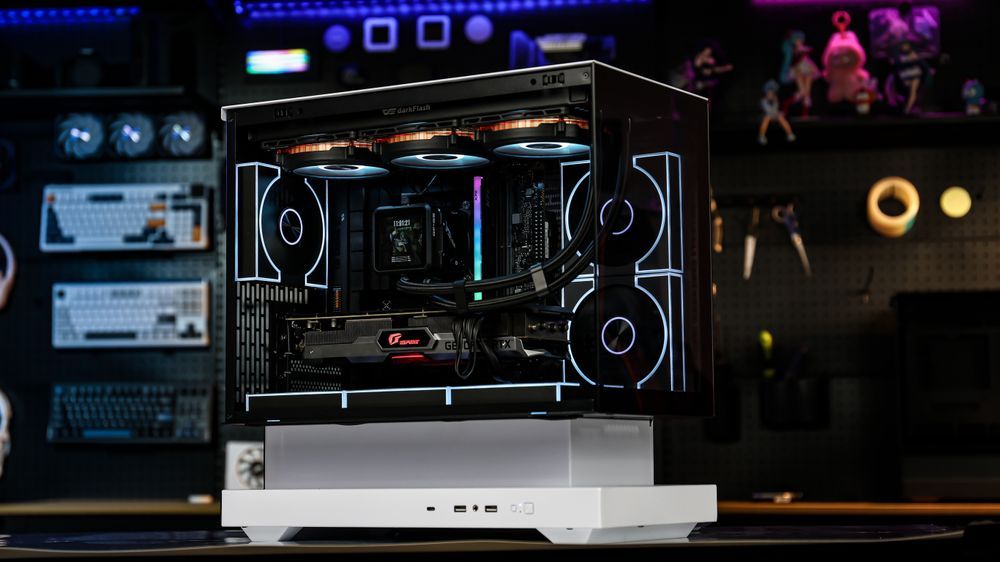
Exactly how that is achieved varies from case to case. The Cougar CFV235 turns the open section between its two chambers into a large ventilation area. DarkFlash feeds air through the bottom and sides of its raised base, while MSI uses the space beneath the VIXTA as part of its lower intake design.
Advertisement
So while the implementations differ, the space underneath is deliberately designed as part of the intake path.
This setup can be particularly useful for graphics card cooling. A GPU normally sits towards the bottom of a case, so cooler air entering below it can take a relatively direct path to the graphics card.
Image 1 of 3
MSI MPG Maestro Vixta 300R PC case
(Image credit: Future)
MSI MPG Maestro Vixta 300R PC case
(Image credit: Future)
MSI MPG Maestro Vixta 300R PC case
(Image credit: Future)
Floating-style options
These are the options to consider if the floating look is the priority, with both using the space beneath the main chassis as part of the design.
Advertisement
A raised base can achieve something similar
You don’t need the full floating style to get some of the same airflow advantages. Many manufacturers take a simpler approach and raise the entire chassis using a stand or customised legs.
The Phanteks Evolv X2 offers wrap-around glass, but raises the base to help feed a bottom-to-top airflow layout.
The Tryx Luca L70 uses a 40mm (1.6in) X-shaped base to increase the clearance beneath the chassis. Tryx also showed a smaller Luca L50 at Computex 2026 with a bottom fan bracket that can sit flat or be angled towards the components.
Advertisement
These cases can still look partially suspended, but structurally the whole chassis is raised on a purpose-built base.
That extra clearance can be especially useful if the PC sits on the floor, because it keeps bottom intakes further away from carpet that might otherwise obstruct airflow.
Raised-base options
These cases lift the whole chassis to create extra clearance for bottom-mounted fans and intakes.
Advertisement
Advertisement
Does a lower intake actually improve cooling?
The graphics card is often a major source of heat in a gaming PC, particularly at the high end, and Nvidia’s GeForce RTX 5090, for example, has a total graphics power rating of 575W. If you’re building around one of the models in our guide to the best graphics cards, cooling it effectively becomes particularly important.
If you’re adding or replacing case fans, PC Gamer’s guide to the best PC fans is also a great resource.
Testing by PC Gamer and Tom’s Hardware suggests lower intake can make a difference, although the result depends on the rest of the case design.
Tom’s Hardware’s review of the Montech HS02 Pro similarly praised its focus on GPU cooling. The case, which is designed around three bottom intake fans, delivered the best GPU temperatures of the four cases in testing at the same noise level, while also allowing the graphics card’s own fans to run slower than in any of the competing cases.
There’s an important catch, though. Montech’s GPU-focused layout was less effective at cooling an air-cooled CPU. Your CPU cooler matters too, and Tom’s Hardware has a regularly updated guide to the best CPU coolers. Fan speed, dust filters, radiators and other internal obstructions can also change the result.
The tests support the broader idea rather than any one case style: getting cool air into the lower part of the chassis and directing it towards the graphics card can improve GPU cooling. A floating-style or raised-base design can make that easier, but neither guarantees lower temperatures on its own.
Advertisement
Bottom airflow doesn’t require a floating case
Other manufacturers are tackling the same airflow challenge without raising the case at all, using several different layouts to free up or make better use of the space below the GPU.
In a conventional layout, the PSU usually sits along the bottom of the chassis, often beneath a shroud. That occupies space that could otherwise be used for a larger floor intake or fans closer to the GPU. Moving the PSU into a separate chamber, towards the front or to the top gives manufacturers more freedom to use that lower area for cooling.
One approach is to put the PSU in a separate side or rear chamber. The Antec Constellation C8 ARGB separates the CPU and GPU from the PSU and drives, while the Corsair Air 5400 uses a dedicated chamber for the PSU, cables and storage. Lian Li’s O11 cases use a similar multi-chamber approach.
Image 1 of 4
Advertisement
(Image credit: Antec)
(Image credit: Okinos)
(Image credit: Antec)
(Image credit: Corsair)
Another option is to move the PSU towards the front. The Antec Flux M does this so the bottom can be opened up for a large mesh intake and fans beneath the GPU. The Okinos Air Cross and DeepCool’s CL6600 take a similar approach, with the CL6600 also separating its 360mm radiator into an upper chamber.
A third approach is to put the PSU at the top. Fractal Design’s Torrent Compact combines a top-mounted PSU with expansive base intakes and support for up to three 120mm or two 140mm bottom fans. The newer Hyte X50 and X50 Air use a top-mounted PSU canopy to open the floor for what Hyte calls Cold-Floor Cooling, with support for up to three 120mm fans beneath the graphics card.
Other cases improve lower airflow without relocating the PSU. The Montech HS02 Pro builds its cooling around three intake fans in the floor, the Antec P30 Air puts two reverse-blade fans on top of the PSU shroud and feeds them through a lower-side intake, and the NZXT H5 Flow RGB 2024 supports two 120mm fans in the lower section to feed air towards the GPU. The Lian Li O11 Dynamic Mini V2 instead angles its bottom fan mounts upwards by 10 degrees.
Floating-style cases are the most visually obvious part of the trend, but the bigger shift is manufacturers redesigning the lower part of the chassis around graphics card airflow, whether that means relocating the PSU, separating cooling hardware or simply finding better ways to direct cool air towards the GPU.
Advertisement
Other bottom-airflow options
These are our picks if improving lower GPU airflow matters more than getting the full floating look.
If you are looking for something new to play on Roblox, several upcoming games are worth watching. Developers are preparing new titles across a range of genres, with some arriving as early as September and others planned for October. Here are 10 new games coming to Roblox that players can look forward to.
1. Showdown: The Showdown Cup (Early September)
Showdown is a first-person shooter developed by India-based studio SuperGaming. The game focuses on precise gunplay and Jutsu-inspired abilities that add more variety to combat. In September, SuperGaming will introduce the Showdown Cup, its first in-game tournament. The tournament will take place in a new Esports Arena inside the game’s Shibuya-inspired hub. Players can watch live matches as competitors fight for a place on the champions board. The tournament will also give players a new way to test their shooting skills and compete against others.
2. Monster in the Mansion (Early September)
Monster in the Mansion is a cooperative survival-horror game from Ubermonster Productions. Players can team up with up to eight people and enter Doctor Mondo’s mansion. The primary aim of the game is to survive in the house and find an antidote. They will have to use the antidote to heal Doctor Mondo. These features ensure that every session of the game feels unique compared to the last one. The simplicity of the game’s loop helps new players become familiar with the game instantly. As a result, new players can quickly understand how the game works.
3. GOAT Football League (Early September)
Argentina-based Red Wolves Studios developed GOAT Football League, a fast-paced multiplayer football game. It places players in a playful world where goats compete on the football field. The goal of the game is for players to collaborate as a team, score goals, and beat their opponents. With goats as characters, the game adds a funny element to its multiplayer setting. The developers chose to build the game on the Roblox platform to enable faster development and testing. The platform also gave the team the tools needed to build multiplayer gameplay from the beginning.
4. Nemesis (Mid September)
Nemesis is a new fast-paced, competitive shooter being developed by RoyalFire Legends and brought to the Roblox platform. During the game, players can switch between first-person and third-person views. The locomotion system is based on grappling, using hoverboards, wall-running, and sliding. Also, players have special skills that let them see through walls. While the game has fairly simple controls for newbies, it features a very high skill ceiling.
5. Fossil Force (Late September)
Fossil Force, a Jurassic player-versus-environment game from Nibblebyte, will launch on Roblox. The game aims to design an immersive environment filled with visuals and environmental elements. The game uses directional sound effects to warn players about approaching dinosaurs. Various biomes, such as the jungle and tundra, have different dinosaurs and sounds. Fossil Force is not considered a horror game. Nevertheless, the element of surprise due to dinosaur attacks can be intimidating.
6. Caramel (Late September)
Elbside Studios introduces Caramel, a game that lets users enjoy relaxed farming in Roblox. Caramel is a 2D pixel-art game in which players inherit a farm that needs to be developed. The main features of this game are pixel art graphics and custom-made graphics technology. Moreover, it offers a slower pace in comparison with other action-based games in this line-up. The author has been developing games on Roblox for about eight years. Since then, the platform has helped them develop their skills and bring new ideas to life.
7. Prime Heroes (October)
SuperGaming is developing Prime Heroes as a Roblox-exclusive team hero shooter. The game is set in the studio’s original Prime universe. Players will pick a side and choose a hero before entering competitive matches. Teams must capture crown sites while battling their opponents. Early access will launch in September with six playable heroes. Another 10 heroes are also in development, bringing the planned roster to 16 heroes. More heroes will arrive through future seasons.
8. Octane (October)
Octane provides open-world racing from the developers at Ignition Switch. The developers plan to release a high-fidelity racing game on Roblox, available to users for free. This means that the game is playable on several devices. There is also physics involved, as the way cars drift changes depending on the interaction between the car and the track. Racing can be done on various tracks, cliffs, and in any way possible with your car. This freedom is a key part of the experience that Octane aims to offer.
9. Starforged (October)
Starforged is an RPG action game based on science fantasy, created by Studio Making Fun. It offers players opportunities to explore a vast open world, level up their characters, and become powerful in the process. The game features tactical battles, extraction, and character development. A player can develop their skills and weapons throughout the game. Starforged features chargeable cores for weapons, with the help of which players can cause huge damage in battle.
10. Scrapbook Saga (October)
Scrapbook Saga offers a multiplayer aspect to the turn-based RPG category. Created by FadedBFox and Xeycrow, the game takes place in an artistic and bright world. Handcrafted paper animations give the game unique visuals. Its fun art style complements the paper theme as well. Up to four players can team up to take on harder enemies. They can also coordinate their actions and attack as a team in battles.
Some authors hoping to receive their share of Anthropic’s $1.5 billion copyright settlement said they received surprising emails this week — emails informing them that someone else was making a claim on their payments.
Anthropic settled a copyright class action suit last year, after a judge ruled that training AI models on copyrighted material is legal under fair use doctrine, but pirating that material was not. The deal received final approval in July, allowing the payments to move forward.
Under the terms of the settlement, the authors of nearly 500,000 titles will be paid $3,000 for each pirated work. If the book is still in-print with a traditional publisher, the money will be split 50-50 between author and publisher. If the book was self-published, or if the publisher reverted the rights by allowing the book to go out-of-print, then the author should get the entire payment.
But writers have been posting on social media that publishers seem to be claiming more than their fair share of some payments. For example, mystery and thriller author April Henry asked, “WTF is HarperCollins playing at? They claimed one of my books on the Anthropic Settlement that reverted back at least 17 years ago AND on the same day I got a credit alert saying they had been added as my employer! (which they never were).”
Advertisement
At the popular blog Writers Beware, Victoria Strauss wrote that she’s been receiving author complaints that fall into two broad categories: one where publishers are seeking payment for works that they no longer have a legitimate claim on (because the rights have reverted), and another where publishers are seeking a full 100% payment when they’re only entitled to 50%.
In both cases, Strauss said she’s “reluctant to attribute to malice what can be plausibly explained by poor recordkeeping” — and she noted that some publishers have already said this is a mistake that they’ve asked Anthropic to fix.
Similarly, Authors Guild CEO Mary Rasenberger told The New York Times that she doesn’t see this as “a grab by the publishers” and that she doesn’t believe publishers are “specifically trying to screw any author over.” Instead, she argued that this is the predictable result of bad record-keeping and a confusing settlement process.
Strauss also acknowledged that any complaints she’s seen are just “a peek through a small crack in a massive wall.”
Advertisement
“But the unusually large number of reports I’ve received over the last two days, as well as the fact that authors are reporting the exact same errors over and over, suggest to me that these aren’t the kind of routine glitches you might expect from such a large operation, but something much more wide[s]pread and systemic,” she wrote.
And publishers aren’t the only ones seeking a cut of the payments. Strauss said she’s gotten complaints that a number of literary agencies are also making claims, which she said is surprising since “agents are not rightsholders in the books that they sell.”
Author Courtney Milan (the pen name of former law clerk and law professor Heidi Bond) was more blunt in a post on Bluesky, writing, “Apparently some agents are trying to claim percentages on the Anthropic settlement, and I do not REMOTELY think they should do this, what the fuck, stop that shit!”
Milan and the Authors Guild also shared more details about how authors can dispute their payment allocations. (One tricky issue: When the rights to a specific book reverted. In order for an author to make a 100% claim on a book, the rights reversion needs to have happened before August 10, 2022, which is the “download date” in the settlement.)
Advertisement
When you purchase through links in our articles, we may earn a small commission. This doesn’t affect our editorial independence.
Google has begun rolling out beta voice features using Gemini 3.5 AI that allow you to have interactive conversations with its Gmail, Docs and Keep services. That means users can issue voice commands to find information in Gmail emails, incorporate AI search results into their Keep notes or start and organize a file in Docs without ever typing any text.
The features are in beta and are known collectively as just “Live,” as in Gmail Live or Docs Live. The Live features for Gmail and Keep are only currently available to Google’s AI Plus, Pro and Ultra paid-tier subscribers. Docs only works for Pro and Ultra subscribers right now.
Google said in a post that the new features will be coming soon for business customers who use Google Workspace.
Advertisement
In a video, Google staffers said that the Live voice features can make using the three Google apps more conversational and may be faster than typing searches or entering information manually.
Google previewed these features at its I/O event in May as part of a blitz of AI features powered by Gemini that it would be introducing over the next year. In the case of Gmail, Google has already been adding AI features to make inboxes easier to wrangle.
How to use the Live features
If you have access to them, using the voice features in Gmail, Docs and Keep should be as easy as tapping the Live icon at the top of each app.
You can ask Gmail to do things like find a specific email, compose a reply or answer questions from the context of emails, such as finding details about an upcoming flight you’ve booked or checking when you last received an email response from someone.
Advertisement
In Google’s examples of how to use Live for Keep, the company said making the note-taking app a kind of intake for brain dumps is a good use, but it can also help organize notes or find information within them with voice commands.
Docs, according to Google, can also pull in information from services like Google Chat, Gmail and Drive with permission as well as websites, allowing it to create documents that pull together different elements with just voice commands.
Omar Gallaga has covered technology, digital culture and other topics for outlets including CNET, NPR, WIRED, Texas Monthly, MSNBC, Consumer Reports, The Washington Post, the Los Angeles Times, The Atlantic and the Austin American-Statesman, where he was a longtime tech reporter, editor and podcaster. He lives in the Texas Hill Country.
See full bio
































































You must be logged in to post a comment Login