Good afternoon since it is almost 12:00 afternoon, not morning. It’s not a very good morning in Johannesburg. I don’t think we like presenting results unless the sun is shining. But welcome to everybody who’s taken the trouble to come and join us at the JSE today. Thank you and also to everybody online.
These are our results for the 30th of June 2026. We’ve got a pretty normal presentation. Key features and results history, I think I’ll cover. Justin will talk to you about some of the more detailed group financial numbers, and then we’ll go into the performance and prospects and then take questions. It’s certainly a tale of 2 halves. The first semester was much stronger. Second was much more challenging. Certainly, from February onwards, steep price increases in energy — and certainly, quarter 4 of the second semester was particularly challenging from a sales point of view where we saw a market slowdown with respect to anxieties with our wholesale and distribution channel.
So revenue only increasing by 1.4%, some leverage, 4.4% at the operating profit level, but strong protection of the margins across the portfolio, and we’ll go into some of that in more detail. Pretty tough semester, particularly the second semester with creamer, but still a very, very strong results, but a lot more competitive than the prior year.
Tesla Tells Cybercab Riders to Talk to Grok for Climate, YouTube, Music and Destination Changes
AUSTIN, Texas — Tesla’s official Robotaxi account said riders can run a Cybercab cabin by talking to Grok, amplifying a passenger video that showed climate, video and music changing without a finger on the screen.
“Talk to Grok to control your Cybercab,” the @robotaxi account posted on Sept. 6, quoting Owen Sparks, who had written: “Cybercab has some pretty in-depth Grok integration, so for many actions, you never have to touch the screen. You can just use natural language to control the climate, YouTube, Music, and it will even send a notification to your phone so you can easily edit your destination.”
The post did not list a software version, a city-by-city rollout or a claim that every Austin Cybercab already behaves that way. It did put Tesla’s own stamp on a feature that matters in a car with no steering wheel and no pedals: if no one is driving, the cabin has to work like a lounge, not a cockpit.
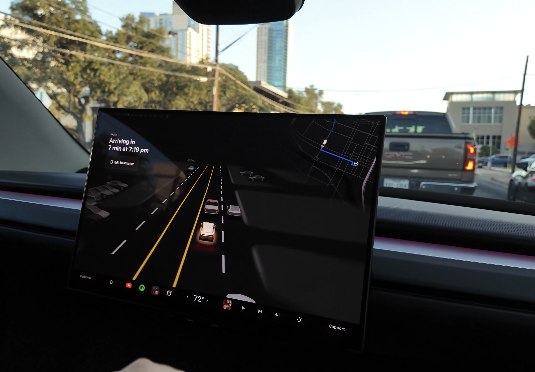
Sparks’s clip, about three and a half minutes long, shows the production two-seater moving through Austin traffic while a large landscape display handles the trip. The visualization puts the Cybercab on a digital roadway with other vehicles. On-screen copy tracks an arrival window measured in minutes. A Grok chip sits in the interface. The rider opens YouTube and Apple Music, adjusts climate settings labeled low, medium and high, and later holds a phone showing an “Edit Dropoff” card for the Courtyard by Marriott Austin Downtown Convention Center, with a fare near $26. Buttons visible on the bar include Pull Over and Support.
Voice control is not a new Tesla idea. It is new as the public pitch for this body style. In Tesla’s 2026 Summer Update notes the company wrote that Grok “can now make phone calls, search and play music, adjust climate, open the glovebox, and answer questions about your Tesla.” Tesla also said the summer release uses “Grok Think Fast 2.0.” In privately owned cars with the right infotainment hardware, testers have described chained commands — climate, wipers, seat heaters — in one spoken sentence. Cybercab applies that stack to a cabin where there is no driver to reach a stalk or a wheel.
The destination piece is the one that crosses from entertainment into the trip itself. Sparks said Grok can push a notification to the rider’s phone so the drop-off can be edited there. The video shows the phone card, not the car rewriting the route from the cabin screen alone. That split is practical. Tesla’s robotaxi service is geofenced. Changing an address mid-ride is a billing and routing event as much as a voice trick. The phone remains the booking tool. Grok becomes the hands-free remote for comfort and media.
Musk has sketched a deeper layer that the Robotaxi post does not claim is live. Asked in June about talking to Grok “like we can with an Uber driver,” he wrote that “this functionality will be there in about 3 months or so.” He said Tesla would eventually have “fully integrated voice control commands that can control the vehicle,” but that it was “just a bit too early for that.” Three months from late June lands near this launch window. The official Cybercab line still describes cabin control — climate, YouTube, music, a phone ping for the pin — not “turn right here” as a spoken override of the driving stack.
That distinction matters to regulators and to riders. A voice that lowers the temperature is an amenity. A voice that changes lanes on command is a driving control. Cybercab’s Rider Guide still centers the in-cabin screen for trip functions and a stop or pull-over control that brings the car to a safe stop and connects the passenger to support. Tesla has also said riders will be able to plug in a PlayStation or Xbox and has teased theater, music, gaming and later Starlink connectivity. A reply under the Robotaxi post asked for TIDAL HiFi and Spotify Lossless because the car has “Starlink onboard + great sound system.” Tesla did not answer in that thread.
Advertisement
The commercial context is still small. Paid Cybercab trips are Austin-only. Tesla’s Model Y robotaxis run in additional Texas and Florida markets. The company has not posted a Cybercab expansion calendar or a consumer MSRP. Musk has previously said the car should cost under $30,000 and that Tesla would sell units to customers, not only operate them. The September event did not confirm either number. Ashok Elluswamy, Tesla’s head of AI software, posted last month that “the streets won’t be the same anymore.” Asked whether Cybercabs would flood Austin, Musk replied, “Yes.” Forty-five registered cars and a voice demo are not a flood.
They are, however, a consistent software strategy. Tesla wants the same assistant in a Model Y glovebox command and in a robotaxi that has no glovebox driver. Grok already lives in Tesla cars as a chatbot with a “Hey Grok” wake word. The summer notes extended it into calls and climate. Cybercab is the first vehicle where talking to that assistant is not a convenience for a person who is also steering. It is the intended way to live in the cabin for the length of a $26 downtown hop.
What Tesla has not published is a reliability rate for those spoken commands in the robotaxi fleet, or whether every public Cybercab in Austin is on the same Grok build Sparks filmed. Community tests of the summer update in regular Teslas found mixed hit rates on long command lists. A robotaxi ride is shorter and the command set Sparks named is smaller: temperature, YouTube, music, a destination edit on the phone. That is an easier demo than “drive like my usual Uber.”
The company that posted “Talk to Grok to control your Cybercab” is the same company asking riders to trust a car with no wheel. The sentence is marketing. It is also an accurate description of the cabin Tesla showed: a screen that can stay dark while a voice changes the climate, a phone that still owns the pin, and a two-seat car that keeps moving through Austin whether anyone touches glass or not.
Harbor Capital is an asset manager focused on curating an intentionally select suite of active ETFs that they believe have the potential to produce compelling, risk-adjusted returns within a portfolio. Note: This account is not managed or monitored by Harbor Capital, and any messages sent via Seeking Alpha will not receive a response. For inquiries or communication, please use Harbor Capital’s official channels.
NEW YORK — Gmail users across the United States reported blank inboxes, stalled logins and messages that would not send on Labor Day, even as Google’s public Workspace dashboard listed no incident.
DownDetector said complaints about Gmail rose above typical levels beginning at 11:01 a.m. Eastern time on Monday, Sept. 7. The tracker posted its standard alert — “User reports indicate problems with Gmail since 11:01 AM EDT. How is it affecting you? #GmailDown” — a few minutes before a similar warning for Google as a whole. Those posts measure a surge in people saying the same product failed. They are not a company admission.
Independent checkers split the difference. Down For Everyone Or Just Me logged several short Gmail events on Monday, including stretches it timed at roughly 32 to 43 minutes, with users tagging send-mail and receive-mail failures into the late afternoon Eastern. UptimeRobot said probes to gmail.com completed without errors. IsDown, which watches Google’s official status page, said Gmail was “working normally” when it last checked. The Google Workspace Status Dashboard displayed “No incidents” in updates through Monday afternoon Coordinated Universal Time, with Gmail marked available.
That mismatch is the story. Gmail is not a single website. It is a web app, iOS and Android apps, IMAP and POP connections, Workspace tenants for schools and companies, and sign-in that also unlocks Calendar, Drive and Meet. A regional DNS problem, an authentication hiccup or a path that fails on one internet provider can look like “Gmail is down” in a kitchen in San Diego while Google’s global monitors still reach the front door.
Advertisement
Comments posted on DownDetector described exactly that kind of patchy failure. A user in San Diego wrote, “No gmail, no maps, no calendar.” Another in the same city, on AT&T Wi-Fi around 2 a.m. Monday, said the “GMail suite not loading, webpage slow.” In California’s Central Valley, a poster said they could not load Gmail or YouTube around 3 a.m. while “everything else is running fine.” In Sugar Land, Texas, a user said Google had been down “all day” and that “only workaround is to turn on VPN.” Others reported the inverse: turning on a VPN made Gmail load. One Windows user said the Google app launcher returned, “Can’t seem to load the app launcher right now.”
Those are first-person reports, not a root-cause finding. Several of them mention AT&T. DownDetector also posted a separate AT&T alert early Monday. A provider-side problem can impersonate a Gmail outage because the mailbox never gets a chance to answer.
Google had not, by late Monday in the United States, published a named Gmail outage explaining the holiday reports. The company has been more specific in other recent disruptions. In June, after Gemini inside Workspace failed, Google wrote that “the issue was triggered by a performance issue in our backend database which impacted the retrieval of Gemini App tools catalog.” That statement belongs to a different product and a different month. It is useful only as a reminder that Google will sometimes describe a backend fault after users have already spent a workday refreshing.
Advertisement
Gmail’s scale makes even a short, uneven stall expensive. Google has said the service has more than 1.8 billion users. A holiday Monday is when travel plans, school schedules, small-business invoices and family threads all sit in the same inbox. If the web client fails but a desktop mail app still downloads messages over IMAP, the store is probably healthy and the front end is not. If every device on one household connection fails and a phone on cellular works, the fault may be the home network. If a VPN fixes it, routing or DNS is a better suspect than a wiped mailbox.
Support desks will keep reciting the same checks because they still isolate the problem. Open Google’s Workspace status page before social media. Try an incognito window. Try basic HTML Gmail. Switch from the app to the mobile site. Test a different network. Confirm the account is not over its storage quota. Look at whether Calendar and Drive fail at the same moment, which often points to sign-in rather than mail delivery.
None of that converts a DownDetector spike into a historic blackout. The tracker itself says it flags an incident when reports jump well above the usual volume for that hour. A holiday can produce more people poking the same app at the same time. It can also hide a real, regional failure that never crosses Google’s internal line for a public incident.
What can be said on the record is limited and enough. On Labor Day 2026, enough people could not load, send or receive Gmail that DownDetector raised an alert at 11:01 a.m. Eastern. Similar complaints had already run through Sunday morning. Google’s Workspace dashboard did not match that noise with a posted outage. Users from California to Texas described blank pages, dead apps and VPNs that suddenly made mail appear. Until Google names a cause — or the charts fall back to baseline and stay there — the accurate description is an unconfirmed, uneven disruption of one of the internet’s default inboxes, reported by the people who could not open it.
I’m a Ukraine-based seasoned investor, who firsthand experienced what’s it like to live in an environment full of systemic geopolitical shocks when the war came to my home country. Despite this, I managed to build an all-weather portfolio that has been able to thrive in volatile markets. My goal is to help investors find event-driven geopolitical ideas that can generate strong returns during periods of economic and political uncertainty.
Analyst’s Disclosure: I/we have no stock, option or similar derivative position in any of the companies mentioned, and no plans to initiate any such positions within the next 72 hours. I wrote this article myself, and it expresses my own opinions. I am not receiving compensation for it (other than from Seeking Alpha). I have no business relationship with any company whose stock is mentioned in this article.
Bohdan Kucheriavyi is not a financial/investment advisor, broker, or dealer. He’s solely sharing personal experience and opinion; therefore, all strategies, tips, suggestions, and recommendations shared are solely for informational purposes. There are risks associated with investing in securities. Investing in stocks, bonds, options, exchange-traded funds, mutual funds, and money market funds involves the risk of loss. Loss of principal is possible. Some high-risk investments may use leverage, which will accentuate gains & losses. Foreign investing involves special risks, including greater volatility and political, economic, and currency risks and differences in accounting methods. A security’s or a firm’s past investment performance is not a guarantee or predictor of future investment performance.
Advertisement
Seeking Alpha’s Disclosure: Past performance is no guarantee of future results. No recommendation or advice is being given as to whether any investment is suitable for a particular investor. Any views or opinions expressed above may not reflect those of Seeking Alpha as a whole. Seeking Alpha is not a licensed securities dealer, broker or US investment adviser or investment bank. Our analysts are third party authors that include both professional investors and individual investors who may not be licensed or certified by any institute or regulatory body.
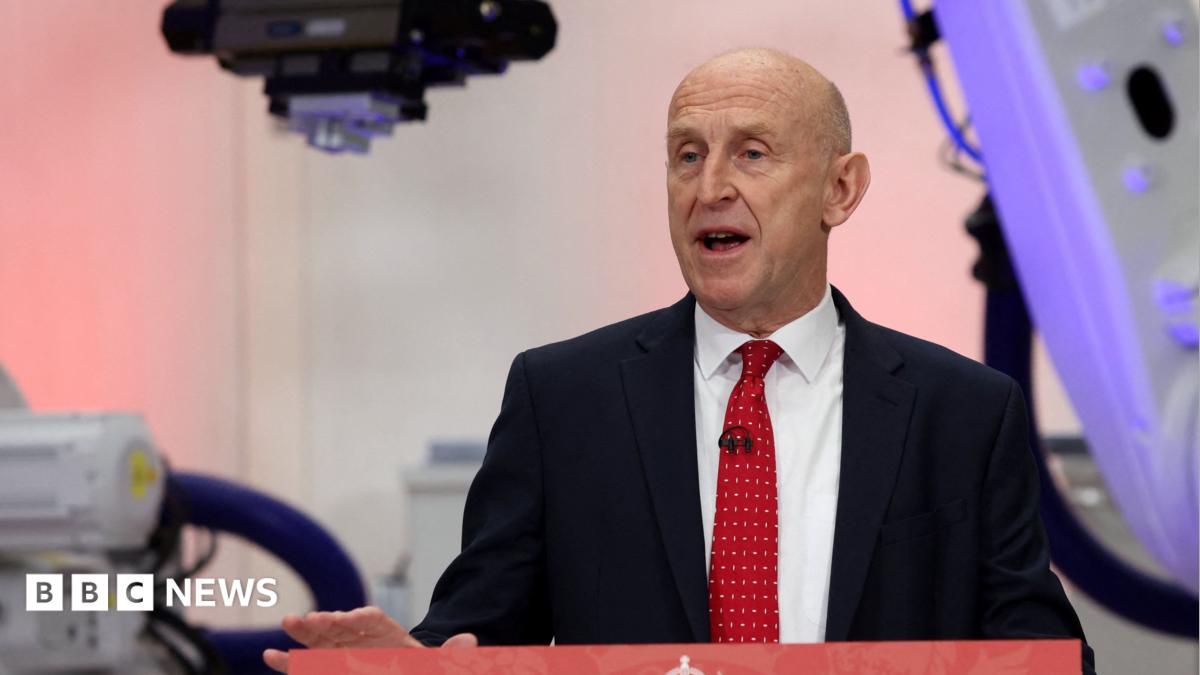
The chancellor may have thought about shifting the venue of his first major speech this morning.
It was an absolute and total coincidence that he chose to make it in the Coventry Manufacturing and Technology Centre (MTC), just a few minute’s drive from the city’s totemic HQ of Jaguar Land Rover (JLR).
In the event, no one was pulling punches. The 4,000 office-based job losses at JLR were confirmed as John Healey answered questions a few miles away.
Healey chose to lean into it as an example of the global turbulence against which the UK needs more resilience.
Advertisement
The difference between this chancellor and his predecessor was he also feels that stressing fiscal discipline should instil confidence in consumers, businesses and investors, and not sap it away amid rolling fears of tax hikes.
So the prime minister and his chancellor have been engaged in a conscious attempt to boost the economic vibes – “a new story”, as he called it.
In his speech, and in a BBC interview afterwards, this was clear. There are some positive underlying signs from consumer, business and recruiter confidence measures that indicate this message has been heard, although the hot weather and World Cup have also been factors.
The Downing Street duo are trying to maintain this precious commodity of confidence and the promotion of economic animal spirits that have been suppressed by years of political and economic chaos.
Advertisement
“Borrowing costs are too high,” Healey acknowledged at the start of his speech. The global rise in bond yields is like a boa constrictor squeezing the Budget maths, slowly and relentlessly, occasionally loosening its grip, but never actually slithering away entirely.
It raises some reasonable questions therefore about how to balance reining in borrowing with protecting mildly better confidence?
The speech did not seem to me to prepare the ground – a “pitch roll” – for significant tax rises, as I heard at the equivalent Budget “scene setters” for the past two years.
“Am I right?” I asked the chancellor on this point. A pause as he sought precisely the right word formulation. “I won’t comment. I can’t comment. No chancellor can ahead of a Budget I will take and announce on October 28th”.
Advertisement
OK, what about the advice from one of the PM’s favourite economists Lord O’Neill that the rise in borrowing rates is a golden opportunity to scrap the triple lock?
This lock guarantees the state pension rising each year in line with either inflation, wage increases or 2.5% – whichever is the highest – but some have argued it is unaffordable.
“The prime minister has said, like I have, that we must bring down welfare costs, but we are also responding to the extreme pressure that is there in wider markets,” Healey said.
Neither answer was a denial, but nor were they any type of confirmation. Like a stubborn batsman, the chancellor is going to stay at the crease, giving little away, in his case, about next month’s Budget.
The city’s business improvement district has launched a five-year strategy to transform the city’s Christmas lighting
08:57, 07 Sep 2026Updated 09:05, 07 Sep 2026
Christmas lights in Bath(Image: Bath BID)
New plans aimed at transforming how Bath celebrates Christmas every year have been unveiled. The Bath Business Improvement District (BID) has launched an ambitious five-year strategy to improve its festive lighting and encourage more visitors to the historic city.
Under the plans, the Bath BID will grow its collection of Christmas lights with the help of Wellington-based lighting and immersive experiences firm The Festive Lighting Company.
Advertisement
Working on a theme of ‘Understated Elegance’, the new lighting will bring out “the best of Bath’s stunning architecture”, according to Bath BID chief executive Allison Herbert.
She said: “We have launched a new five-year programme of Christmas lighting starting this year. Bath is famous for its fabulous world class Christmas market, and this year, we want to add more reasons to visit the city.”
Jonathan Bradford, director of the Festive Lighting Company, added: “We’re incredibly proud to be part of the team behind Bath’s Christmas lighting for the next five years. There’s nowhere quite like Bath and helping to add a touch of sparkle to the architecture is exactly the kind of work we love.”
Bath BID is also bringing a giant sculpture trail to the city for Christmas this year. The trail – named ‘Walking with the Snowman’ – will feature 12 larger-than-life representations of Raymond Briggs’ famous Snowman, with families encouraged to find all 12 across the city centre between November 19 and January 31.
Advertisement
The trail ties in with Victoria Art Gallery’s ‘The World of The Snowman’ exhibition, which is running from November 20 to February 28 next year.
There will also be a screening of ‘The Snowman’ accompanied by a live orchestra by the Bath Philharmonia on December 19 at The Forum Bath. And visitors will get the chance to meet the Snowman on November 19 and 21 in collaboration with Rainbow Productions.
Bath BID is encouraging businesses across the city to join the festive activities through window displays, events or their own Snowman-themed exhibitions.
A spokesperson for the BID said: “A huge thank you goes to the businesses helping bring the ‘Walking with the Snowman’ Trail to life: Bath Abbey, Victoria Art Gallery, Thermae Bath Spa, Wylde Jewellers, SouthGate Bath, The Apex City of Bath, Visit West, and the Fudge Factory.”
Advertisement
Nicholas Wylde, owner of Wylde Jewellers, added: “This is the third year running that we’ve been proud to sponsor a Bath BID trail, and it never gets old. Bath has given so much to us as a business, and trails like ‘Walking with the Snowman’ are a wonderful way to give something back to the city and the families who visit it.”
CHICAGO — Gunnar Sigge, PhD, associate professor and head of the Department of Food Science at Stellenbosch University in South Africa, has been named president of the Institute of Food Technologists (IFT). He succeeds Peggy Poole, PhD, who completed her one-year term as president.
Jeffrey Varcoe, PhD, senior vice president, science and technical excellence at The J.M. Smucker Co., takes over as president-elect and will begin his term as IFT president starting on Sept. 1, 2027.
Sigge has been an active volunteer at IFT for many years, and an active leader in the South African Association for Food Science and Technology (SAAFoST) since 1997.
“We are facing incredibly complex and interconnected challenges across the global food system, and no one discipline, sector, or part of the world can address them alone,” Sigge said. “What excites me about taking on this role is the opportunity to build on IFT’s unique ability to connect people and perspectives from across the global food science community. There is so much we can learn from one another, and I believe IFT has an important role to play in creating those connections, equipping food science professionals with the knowledge and resources they need, and bringing credible science to the conversations shaping the future of food.”
Advertisement
Sigge was a member of the IFT board of directors from 2021-24. He also served on the Annual Meeting Scientific Program Advisory Panel (AMSPAP), Divisions Champions Team, the Inclusive Systems Review Task Team, as well as the International Division leadership team.
In South Africa, he has been involved with several other scientific organizations, including the International Water Association (IWA), the Institute of Packaging South Africa (IPSA), the Water Institute of South Africa (WISA), and the South African Society for Dairy Technology (SASDT). His research interests include food processing, food processing wastewater treatment, sustainable water-use in the food industry, food safety, and novel disinfection systems for food and irrigation water. He was also integral to the establishment of Stellenbosch University’s master’s program in food and nutrition security.
Sigge received bachelor’s, master’s and doctoral degrees in food science from Stellenbosch University. Since 2009, he has been chair of the Department of Food Science where he has mentored and guided some of South Africa’s top food science students, including Jana Schreuder, Institute of Food Technologists Student Association (IFTSA) immediate past president.
“Gunnar brings a valuable global perspective, deep scientific expertise, and a strong understanding of the opportunities ahead for IFT and the food science community,” said Christie Tarantino-Dean, chief executive officer of the IFT. “Our board plays an important role in shaping IFT’s strategic direction, and we are fortunate to have leaders who are deeply committed to our mission and generous with their time and expertise. I look forward to partnering with Gunnar and the board as we continue to strengthen IFT and position the organization for the future.”
Advertisement
Varcoe has been involved in many professional and community-oriented organizations, including the American Frozen Food Institute, Mitchell Hamline School of Law’s Food Law & Policy Institute Advisory Committee, Advisory Council for the University of Minnesota’s Department of Food Science and Nutrition, Southwest Minnesota Workforce Council, and the Canby (Minnesota) High School Blue & Gold Foundation.
Prior to joining J.M. Smucker, he spent 21 years at Schwan’s Co. where he held a variety of technical leadership roles, including vice president of food safety and quality, vice president of manufacturing technical services, director of research and development, director of food safety and microbiology, and manager of food safety.
“IFT and the people within this community have given a great deal to me throughout my career,” Varcoe said. “Some of my earliest connections to IFT came through mentors who showed me the value of being part of this community, and that has stayed with me. Serving as president-elect is an opportunity to give back to a profession that has given so much to me and to bring the perspective I’ve gained over 25 years in food manufacturing to help IFT continue to evolve and serve its members.”
Varcoe received his bachelor’s and master’s degrees in biology from Missouri State University and Minnesota State University, Mankato, respectively. He received his doctorate in food science from the University of Minnesota.















































You must be logged in to post a comment Login