
Crypto World
XRP Sits at $1.40: Nobody Wants to Sell, Nobody Wants to Buy

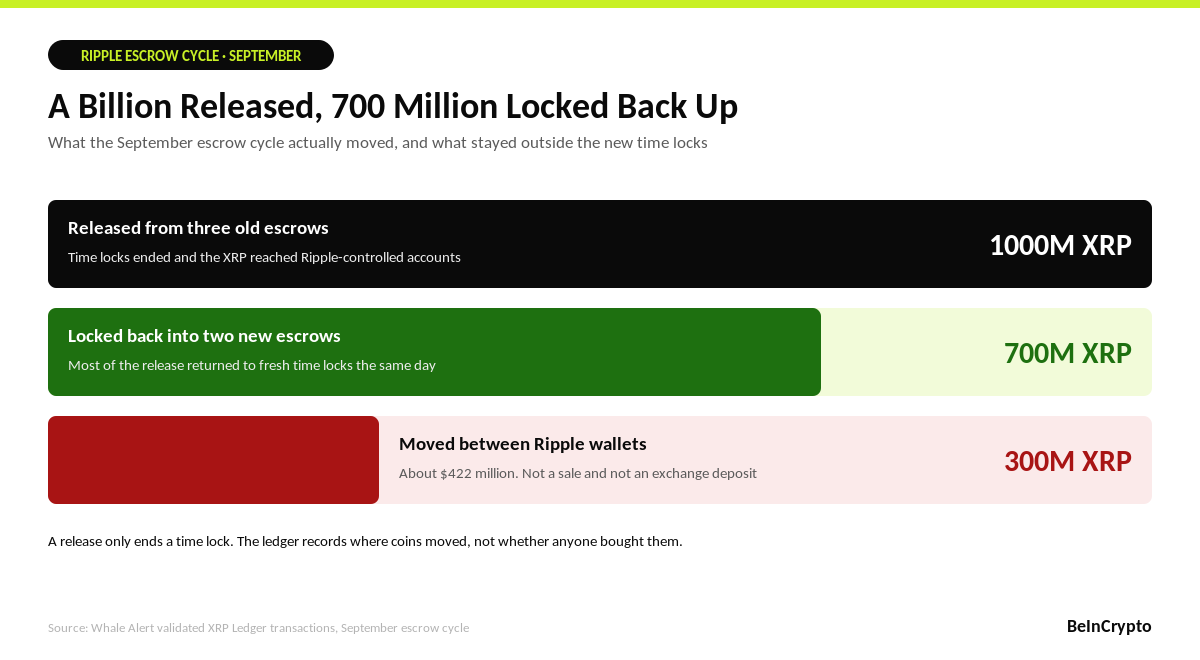
Ripple released 1 billion XRP from escrow at the start of September, and by the end of the day, only 300 million sat outside new time locks.
XRP price still holds near $1.40. The headline sounded bearish. The ledger says less happened than it looked.
Ripple Released a Billion, Then Re-Locked 700 Million
Three old escrows ended, releasing 500 million, 400 million, and 100 million XRP. Hours later, two new escrows took 500 million and 200 million back.

That leaves 300 million XRP, worth about $422 million, outside those locks. It moved between Ripple-labelled wallets, so the monthly release is not a sale or an exchange deposit. But it matters anyway.
It still matters because the market could not take it. Buy orders sitting close to the current price add up to $108.2 million, so those 300 million coins are worth almost four times what buyers are ready to absorb.

The market held only because nobody tested it.
Older Coins Stopped Moving. So Did the Volume.
So the coins are still there. The question is who is willing to move them, and the answer is almost nobody.
XRP’s 1-2 year holding band rose from 17.3% of supply in late August to about 18.2% now. Therefore, the oldest supply is refusing to move, and despite the pullback since August 22, those holders have not sold into it.

That stillness cuts both ways. Daily volume (all traders) has fallen every session since the August 22 burst, down to about 27.6 million XRP. So the interest seems very ‘long-term-holder-specific’.

Meanwhile, the chart is close to a golden cross, the point where the 20-day exponential moving average, an average of closing prices that leans on the most recent days, climbs above the slower 200-day line. The fast line sits at $1.3516 against $1.3540, close enough to cross on any decent day. Crossovers built on falling volume are the ones that fail.
XRP Led the Rally, Then Stopped Leading
Fading volume shows up as lost leadership. Over 21 sessions, XRP gained 42.4% against 27.0% for Bitcoin and 33.8% for Ethereum.

Over the last 14 days, it was the weakest of 20 large coins against that pair, trailing by 5.7%.

Futures repeat the pattern. Count the accounts and big traders look confident, 2.86 betting on a rise for every one betting on a fall, against 2.46 for ordinary traders.

Weigh those bets by money, and it flips. By size, the ratio drops to 2.09, below the crowd’s count. Most large accounts sit on the bullish side without putting much behind it, and their shorts are the bigger trades.

XRP is one of four majors where that gap runs negative.
XRP Price Levels That Decide It
All of it comes down to one line. XRP trades at $1.4079, above both averages, which keeps the recovery alive. Confirmation sits at $1.4785, about 5% up, the level that has capped every rebound since late August.
Clearing it opens $1.5832, then the $1.6678 to $1.7038 area around the August peak, a 21% move from here. A daily close below $1.3092 breaks the setup.

Analyst’s View: Nobody is selling XRP, and nobody is buying it either. A price only climbs when someone shows up willing to pay more, and right now that person is missing.
The post XRP Sits at $1.40: Nobody Wants to Sell, Nobody Wants to Buy appeared first on BeInCrypto.

The Philippines’ central bank has proposed freezing new payment-system operator registrations for 12 months while imposing tighter controls on payment arrangements involving virtual asset service providers (VASPs).
Under a draft circular, the Bangko Sentral ng Pilipinas (BSP) said it would suspend acceptance and processing of applications for operators of payment systems (OPS) to conduct a “holistic review” of its taxonomy and licensing framework.
Applications submitted before the suspension could continue to be evaluated, but the BSP would not approve or deny any until the pause ends. Entities would be barred from starting activities that require OPS registration unless the regulator authorizes them otherwise.
The proposal would require BSP-supervised institutions offering merchant acquisition services to handle regulated VASPs through direct merchant arrangements. Those relationships would be subject to enhanced due diligence and monitoring, transaction and settlement limits and other risk-based controls.
The requirement covers virtual asset firms that must be licensed, registered or authorized by the BSP, the Philippine Securities and Exchange Commission, or another authority. VASPs are listed alongside gambling businesses, gaming providers, adult-oriented businesses and money service businesses.
The draft would take effect 15 days after publication if finalized, and the BSP is currently accepting feedback.
Cointelegraph reached out to the BSP for more information but did not receive a response before publication.
Related: Philippines SEC flags dYdX, six crypto platforms as unauthorized

Vitalik Buterin has rejected a warning that artificial intelligence could cause Bitcoin to lose half its value by weakening assumptions about the network’s security.
In reply to crypto commentator Liron Shapira, Buterin said the chance of AI actually breaking Bitcoin’s hashing or proof-of-work is “tiny,” while arguing that the harder issue would be moving the network through a security upgrade.
Buterin Sees the Bigger Risk in the Transition
Shapira posted that he had “50% confidence” BTC would crash 50% or more within two years because AI could undermine what people had imagined were Bitcoin’s security guarantees.
Buterin took the other side. He said he is optimistic about cybersecurity over the long run and sees the main risk as managing the transition itself, not a cryptographic failure, arguing Bitcoin should handle network-layer problems, the kind fixed by upgrading clients or mining pools, without needing broad social consensus.
“I expect BTC to handle at least any issues that do not require social consensus well (upgrading clients, mining pools, etc to deal with network-layer hacks is in this category) (and I think the probability of actual breaks on hashes or PoW is tiny),” he wrote.
Shapira came back later with a smaller number. “I’ve updated down to 40%,” he posted, crediting Buterin and a commentator named Eliezer for the shift.
Vista Labs pushed the debate toward coordination, arguing that AI would not need to break SHA-256 if it could shorten the period between finding a vulnerability and exploiting it to less than the time a decentralized network needs to agree on an upgrade.
“Does upgrade latency become the real security constraint?” the account asked.
However, analyst Crypto Patel framed Bitcoin’s strength as its capacity to adapt once new threats appear rather than any promise that it will never face one.
Recent Attacks Show Where AI Can Matter
The concern is not entirely theoretical. As CryptoPotato reported in August, Bitcoin swap service Boltz suspended operations after AI-assisted attacks. The five-person team said automated probing had increased before attacks accelerated, leaving it without the resources to keep operating safely.
Furthermore, a recent security campaign found 4,962 software issues across 390 Bitcoin-related open-source projects in about 30 hours. The tally included 85 critical and 635 high-severity findings.
Another report published on August 10 found that Kimsuky, a North Korea-linked threat actor, had set up local AI environments and collected software for AI execution and automated agents. According to investigators, the group appeared to be preparing AI for malware development, data analysis, and attack techniques.
But replying to Buterin, crypto trader Hazenlee argued that stronger generative AI could make Bitcoin’s scarcity more relevant, given that AI can create content and new tokens cheaply, but cannot simply create ownership of existing BTC or force a decentralized network to accept a false history.
The post Could AI Cut Bitcoin’s Value in Half? Vitalik Buterin Says the Odds Are ‘Tiny’ appeared first on CryptoPotato.
Flare has recorded a roughly 34% increase in staked FLR since July, taking the total to 21.5 billion tokens as its revised economic model cuts inflation and ties more network activity to token burns and protocol revenue.
Summary
- Flare staking increased from about 16 billion to 21.5 billion FLR after the July upgrade.
- FIP.16 reduced annual FLR inflation from 5% to 3% and lowered its issuance ceiling.
- Transaction-fee burns have risen to more than 10 times their level before the network upgrade.
- FIRE has collected $31,438 from four revenue sources since it started operating in May.
Flare staking has increased to 21.5 billion FLR
DefiLlama Research reported on Sept. 4 that Flare’s tokenomics changes are producing measurable onchain results four months after the network approved FIP.16.
Staked FLR rose from approximately 16 billion in July to 21.5 billion, an increase of about 34%. The portion of all staked or delegated FLR held in staking climbed from roughly 32% in April to 46% by late August, with much of the increase occurring within weeks of the July 14 network upgrade.
Under FIP.16, FLR locked on Flare’s P-chain carries five times the signing weight of wrapped FLR delegated on its C-chain. Delegated tokens remain liquid and can be withdrawn at any time, while P-chain staking requires holders to lock their capital with a validator.
Signing weight determines how much influence infrastructure providers have when producing blocks and operating Flare’s native data systems. Providers run the Flare Time Series Oracle, which supplies price feeds, and the Flare Data Connector, which verifies information from other blockchains and Web2 services.
Before FIP.16, different Flare protocols calculated voting weight in different ways. The revised system applies one calculation across FTSO anchor feeds, FDC, and block-latency feeds, with locked stake receiving the fivefold weighting.
Flare’s official governance proposal said the change was designed to put more influence behind committed capital and make the network’s core services equally costly to attack.
At the same time, the July upgrade raised the maximum stake per validator from 200 million to 300 million FLR. It also introduced a network-wide minimum delegation fee of 20%, replacing the previous minimum of zero.
Flare said the fee floor should prevent providers from competing through unsustainably low charges. Infrastructure providers must operate validators, collect data, maintain independent systems, and participate in governance, according to the proposal.
Flare tokenomics changes cut inflation and raise burns
Annual FLR inflation fell from 5% to 3% on May 14, cutting the headline rate by 40%. The annual issuance ceiling also declined from 5 billion to 3 billion FLR.
With an inflatable supply of about 87 billion tokens, the 3% rate produces a gross yearly issuance of roughly 2.6 billion FLR, according to DefiLlama Research. Actual issuance may decrease over time because FIP.16 also changed, which balances count toward the calculation.
Permanently burned FLR, tokens held by the Flare Income Reinvestment Entity, and unearned rewards placed in certain penalty pools are excluded from the inflation base. As those balances increase, the amount subject to the 3% calculation becomes smaller.
Transaction burns accelerated after Flare implemented its Granite upgrade on July 14. Official network release notes show that the minimum C-chain base fee increased from 25 gwei to 500 gwei.
All FLR paid as base transaction fees are permanently destroyed. Flare had burned 15.6 million FLR through transaction fees in 2026 by the time DefiLlama published its report, with more than 40% of the total burned following the July upgrade.
Consequently, the current burn pace sits at more than 10 times its pre-upgrade baseline. Usage determines the amount destroyed because every transaction removes FLR without requiring a new vote or a treasury decision.
Higher gas settings have not made simple transfers expensive in dollar terms. DefiLlama estimated that a basic transfer costs around 0.064 FLR, although transactions involving smart contracts may consume more gas.
Activity feeding the burn mechanism has also expanded through Flare’s FAssets system. In May, an FAssets v1.3 upgrade allowed users to mint FXRP from centralized exchanges such as Binance and Kraken through an XRP Ledger destination tag. FLR rose 14% on the day the upgrade went live, crypto.news reported at the time.
FIRE has started collecting network revenue
FIP.16 created FIRE as a governed entity responsible for receiving revenue generated by Flare’s protocols. Its primary mandate permits the entity to reduce FLR supply through token burns and open-market purchases.
Secondary uses include supporting asset issuers, application yields, liquidity programs and the Flare Foundation’s network operations. Flare initially administers the entity through its foundation.
Four income sources are already active. FIRE receives all FAssets minting fees, 90% of FDC request fees, 10% of FAssets redemption fees, and FLR paid for FXRP destination-tag registrations.
Since collections began in May, FIRE has received assets worth $31,438, according to the DefiLlama report. FAssets minting provided $18,248 across 7,708 mints, making it the largest source.
FDC request fees contributed another $12,676 after collections from that service began on Aug. 18. Destination-tag registrations added $505, while FAssets redemption fees supplied $9.
Two sources pay FIRE in FLR, and two pay in FXRP. As a result, the pool’s reported dollar value changes with token prices as well as the volume of protocol activity.
FDC activity supports several services behind those revenue streams. Flare uses the connector to verify payments and events outside its network, including XRP Ledger transactions involved in creating FXRP.
A July update simplified FXRP access by allowing users to mint the asset and enter selected vaults with one XRP Ledger signature. At the time, FXRP deployed in DeFi had increased from 82 million in February to 144 million, while users had created nearly 24,000 Flare Smart Accounts.
FIRE’s current receipts remain small compared with approximately 2.6 billion FLR in estimated gross annual issuance. Flare’s model therefore still relies mainly on reduced inflation and transaction burns rather than on enough protocol income to offset token creation.
Planned income from Flare Smart Accounts, Confidential Compute, and protocol-level maximal extractable value has yet to enter FIRE. Flare said its MEV system would capture value from permitted activities such as liquidations, atomic arbitrage, cross-chain arbitrage, and just-in-time liquidity.
According to Flare’s April explanation of FIP.16, its DeFi ecosystem processed more than 660,000 transactions involving cyclic-arbitrage structures and over 1,000 liquidation events during the first quarter of 2026. The company said the amount that FIRE could collect from MEV would depend on the volume and type of DeFi transactions processed by the network.
FXRP activity connects Flare with U.S.-regulated RLUSD
FAssets give tokens from networks without smart-contract support a usable form on Flare. FXRP represents XRP within that system, allowing holders to place the asset in lending markets, liquidity pools, vaults, and other decentralized applications.
Flare said in April that more than 150 million FXRP was in circulation, with about 85% deployed across DeFi. At that point, the network had more than $160 million in total value locked under DefiLlama’s standard calculation and over 880,000 active addresses.
Part of that activity now reaches Ethereum. In August, FXRP received approval as collateral in Sentora’s RLUSD Main vault on Morpho, allowing holders to borrow Ripple’s dollar-backed stablecoin without selling their XRP exposure.
The RLUSD lending market provides a relevant U.S. connection because Ripple received approval for the stablecoin from the New York Department of Financial Services in December 2024. Sentora reviewed FXRP’s liquidity, price behavior, oracle design and liquidation mechanics before accepting it as collateral.
Morpho uses isolated lending markets, limiting problems with one collateral asset to its specific pool rather than exposing every market in the protocol. Borrowers must deposit more FXRP than the value of RLUSD they receive, and liquidations depend on enough FXRP liquidity being available to repay lenders.
FIRE may move to joint community governance after its first year. Initiating the change requires support from holders representing at least 50% of Flare’s total inflatable FLR supply, after which the network would elect four representatives from infrastructure providers operating across Flare and Songbird.
Crypto World
XRPPower launches its global AI trading system, offering free access to XRP and BTC holders with up to $5,000 daily

Disclosure: This content is provided by a third party. Neither crypto.news nor the author of this article endorses any product mentioned on this page. Users should conduct their own research before taking any action related to the company.
With the continuous integration of artificial intelligence and digital asset technology, XRPPower has officially launched its intelligent automated trading system, providing global users with a more intelligent and automated digital asset service experience.
Summary
- XRPPower launched an automated AI trading system for XRP and BTC holders worldwide.
- The platform supports XRP, BTC, ETH, and USDT under its current service rules.
- Yield contracts start at $1,000, while new users receive a claimed $21 registration bonus.
- XRPPower advertises returns of up to $5,000 daily, depending on the selected plan.
This system combines AI-powered intelligent data analysis, automated trading strategies, and systematic management to help users reduce the need for continuous manual operations. Users holding XRP or BTC can register for free and learn about the relevant intelligent trading functions, choosing a service plan that suits their needs based on the platform’s published rules and conditions.
XRPPower aims to lower the barrier to entry for intelligent digital asset services through AI technology, allowing more users to easily understand automated trading models. The platform mentions daily profit opportunities of up to $5,000, with actual profits depending on the specific plan.
How do new users get started with XRPPower?
01|Quick account creation
Register an XRPPower account with your email address. After completing basic information settings, you can access the platform to learn about the intelligent system and related digital services.
02|Explore intelligent services
After logging in, view the platform’s service content, operating cycle, participation conditions, and related rules. Thoroughly understand these details before making a selection based on your individual needs.
03 | Select supported digital assets
The platform supports digital assets such as XRP, BTC, ETH, and USDT according to current service rules. Please confirm the currency, network, and specific service requirements before operation.
04 | Self-management of account
Users can apply to withdraw available funds or use funds for yield contracts offered by the platform, depending on their own circumstances.
Popular yield contracts for new users
Investment amount: $1000, investment period: 7 days, daily yield: $13.2, principal refund at maturity: $1000
Investment amount: $5000, investment period: 15 days, daily yield: $70.5, principal refund at maturity: $5000
Click to view all contract yields
How to achieve long-term returns with zero investment
New users receive a $21 bonus upon registration, which can be used to purchase daily contracts, earning $0.6 per day.
Additional referral rewards
Log in to your account using your referral code or request link to invite friends and family to join the XRPPower platform and earn permanent rewards of 3% + 2%.
Example description:
(A) User A refers User B to make an additional investment; if B invests $10,000, A will receive a 3% ($300) reward.
(B) User B refers User C to make an additional investment; if C invests $10,000, B will receive a 3% ($300) reward, while A will receive a 2% ($200) second-level referral reward.
XRPPower intelligent technology system: Integrating AI, security, and professional management concepts
As digital services continue to evolve, users are increasingly valuing platform security, system stability, operational efficiency, and information transparency. XRPPower continuously optimizes its technical architecture and operational processes, combining AI intelligent technology, automated management, and security mechanisms to create a clearer and more convenient digital service experience for users.

Multi-layered security mechanisms enhance account protection
XRPPower has perfected its security system across multiple levels, including accounts, data, and networks. It employs SSL/TLS encryption, two-factor authentication (2FA), cold and hot wallet management, multi-signature, and access control, continuously reducing potential risks.
Internally, XRPPower continuously monitors the risk management, internal control, and information security concepts of international professional auditing and consulting firms, and references the practices of professional institutions such as PwC in related fields to optimize its own management processes and risk control system.
AI intelligent system improves operational efficiency
XRPPower applies AI data analysis and automation technology to platform operations. Through an intelligent system, it analyzes and monitors relevant data, account activities, and system status, helping to improve anomaly detection capabilities and overall operational efficiency.
Simultaneously, it combines DDoS protection, WAF (Web Application Firewall), and network security measures to continuously strengthen the protection capabilities of digital infrastructure.
Transparent display makes services easier for users
The platform continuously optimizes page design and account functions, providing a clearer display of service cycles, participation conditions, rule descriptions, and account records.
Users can log in to their accounts to view relevant data and historical records and make informed choices based on their needs after fully understanding the service content and associated risks.
AI and automation: Driving digital service upgrades
Artificial intelligence is constantly changing the way services are delivered in the digital asset industry. XRPPower will continue to advance the integration of AI intelligent analysis, automated management, and digital services, continuously improving the platform’s overall service capabilities through technological iteration and process optimization.
In the future, XRPPower will continue to upgrade its technology around security, efficiency, transparency, and intelligence, providing users with a more convenient and clear digital service experience.
Learn more: https://xrppower.com/
Email: [email protected]
Disclosure: This content is provided by a third party. Neither crypto.news nor the author of this article endorses any product mentioned on this page. Users should conduct their own research before taking any action related to the company.
French Bitcoin treasury company Capital B has acquired 376 Bitcoin (BTC) for 25.3 million euros ($29.5 million), bringing its total holdings to 3,521 BTC.
The purchase was funded after Capital B completed roughly 30.1 million euros ($35 million) in capital raises, including a private placement backed by investors Adam Back and TOBAM, according to a Monday announcement.
The company bought the Bitcoin at an average price of 67,182 euros apiece, with Swissquote Bank Europe executing the purchase and Taurus providing custody.
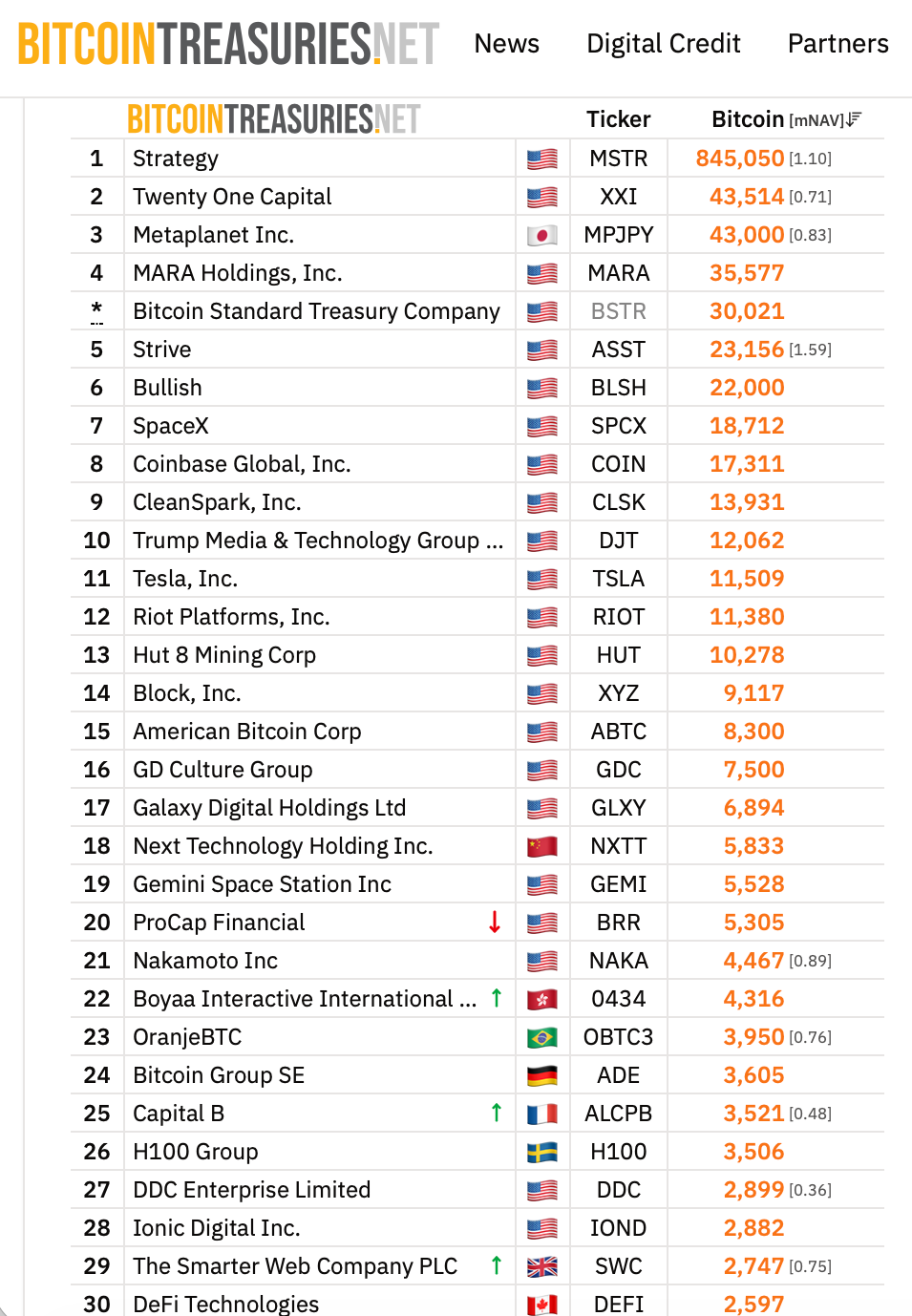
Capital B has spent a total of 309.4 million euros acquiring its Bitcoin treasury, at an average cost of 87,878 euros per BTC. The purchase moved the company to 25th among publicly traded companies by Bitcoin holdings, according to BitcoinTreasuries.net.
The latest acquisition was Capital B’s largest since September 2025, when it purchased 551 BTC for 54.7 million euros. The company also holds 61 BTC for operational purposes, which it keeps separate from its treasury reserve and excludes from its Bitcoin-related performance metrics.
Related: Satoshi-era Bitcoin wakes after 16 years of dormancy as 600 BTC moves
Top BTC treasury firms continue accumulating
While companies including K Wave Media and Sequans Communications have moved to unwind their Bitcoin treasuries, others are continuing to accumulate.
Japan-based Metaplanet acquired 2,823 BTC during the second quarter for about $222 million, bringing its holdings to 43,000 BTC. The company paid an average of roughly $78,850 per Bitcoin during the quarter and now ranks as the third-largest publicly traded corporate Bitcoin holder, behind Michael Saylor’s Strategy and Twenty One Capital, according to BitcoinTreasuries.net.
In August, Sweden-based H100 Group more than tripled its Bitcoin holdings after acquiring Norwegian companies holding 2,455 BTC. The all-share deal lifted H100’s treasury to 3,506 BTC, making it Europe’s second-largest publicly traded corporate Bitcoin holder at the time. Capital B’s latest purchase puts it 15 BTC ahead of H100, though both remain behind Germany’s Bitcoin Group SE with 3,605 BTC.
Strategy, the world’s largest corporate Bitcoin holder, also resumed buying in August after a two-month pause, acquiring 4,603 BTC for $370 million. The purchase brought its holdings to 845,050 BTC, acquired for a combined $63.3 billion.
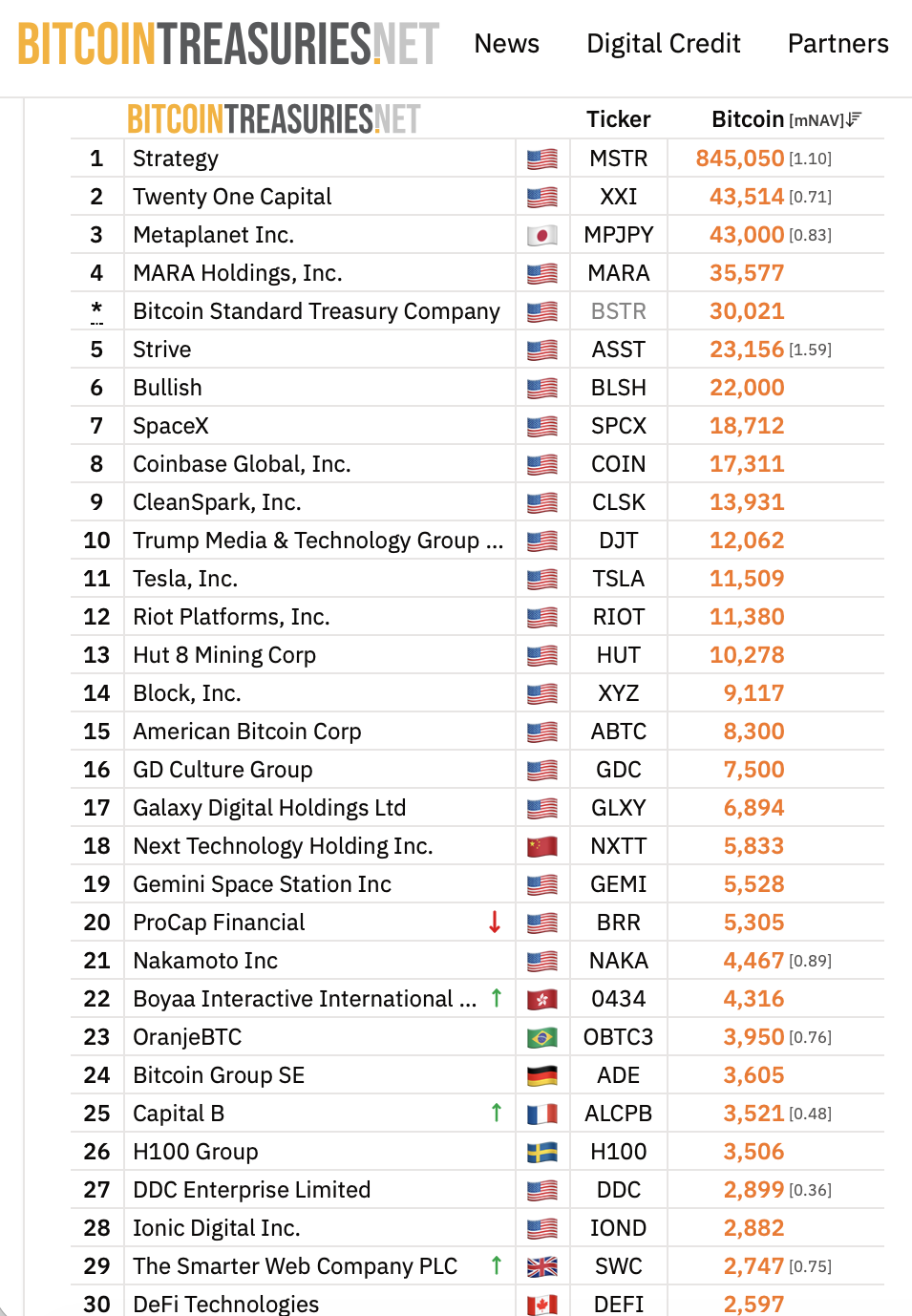
Top 30 Bitcoin treasury companies. Source: BitcoinTreasuries.NET
Magazine: ‘White hats’ take 4000 BTC from Liquid, ETFs see best inflows of 2026: Hodler’s Digest
Crypto World
The cryptocurrency bull market is back, UE Crypto performs strongly; BTC holders invest in UE Crypto cloud mining to earn $2,700 a day
Disclosure: This content is provided by a third party. Neither crypto.news nor the author of this article endorses any product mentioned on this page. Users should conduct their own research before taking any action related to the company.
As Bitcoin prices continue to fluctuate, investors are increasingly concerned about short-term market risks, and more and more BTC holders are beginning to explore cloud mining and other digital asset methods to generate daily income of up to $2,700.
Summary
- UE Crypto offers cloud mining contracts for BTC, LTC, and other major cryptocurrencies.
- The platform advertises daily returns of up to $2,700 without users operating mining hardware.
- UE Crypto claims to use renewable energy, encrypted infrastructure, insurance, and annual security audits.
- Bitcoin’s rebound above $80,000 provides the market backdrop for the company’s cloud mining services.
Unlike highly volatile futures trading and approaches that rely solely on asset price appreciation, the UE Crypto cloud mining platform provides a more convenient and intuitive way to participate in digital assets. Users do not need to purchase expensive mining hardware or handle complex equipment deployment, technical maintenance, or daily operations themselves. They only need to participate in digital asset mining according to their selected mining contract and receive corresponding potential returns in accordance with the terms of the contract.
As of Sep. 7, 2026, Bitcoin has recently staged a strong rebound, moving back above the $80,000 level and briefly breaking through $81,000. The rise was mainly driven by continued inflows into spot Bitcoin ETFs, recovering institutional demand, and improving market sentiment.
The funding picture has also remained strong. U.S. spot Bitcoin ETFs recorded approximately $987 million in net inflows for the week ending Sep. 4, maintaining net inflows for three consecutive weeks and indicating that institutional investors’ demand for Bitcoin allocation is continuing to recover.
Entering September, market attention will continue to focus on ETF fund flows, Federal Reserve policy expectations, macroeconomic data, and overall market liquidity. If continued ETF inflows push BTC through key resistance levels, Bitcoin’s upside potential could expand further, although short-term performance may still be affected by the macroeconomic environment and market volatility.
As the BTC bull market approaches, UE Crypto has entered an unprecedented opportunity
The recent recovery in the cryptocurrency market has attracted widespread attention, with many investors interpreting this phenomenon as a response to the current economic uncertainty. However, for professionals in the blockchain industry, this round of market volatility has created unique opportunities.
Mr. Ian Raymond HUGHES, Chairman and CEO of UE Crypto, stated: “After U.S. President Trump proposed the visionary concept of a strategic cryptocurrency reserve, our company decisively made the strategic decision to hold all cryptocurrencies. This reflects our firm belief in cryptocurrencies as core assets in the digital economy era.”
“We firmly believe that cryptocurrencies such as Bitcoin will become key assets in the strategic reserve systems of countries around the world. With the rapid development of the digital economy, cryptocurrencies not only represent the future direction of the financial system, but will also become an important engine driving global economic transformation.”
To learn more about our strategic positioning, please visit UE Crypto.
As a leading cloud mining service provider in the industry, UE Crypto has observed that periodic market corrections often create strategic positioning opportunities for long-term investors. The company recommends that investors consider adopting a “buy-the-dip” strategy, using professional mining services to continuously accumulate digital assets during relatively weak market conditions, thereby positioning themselves in advance for a potential rebound in value. This long-term value investment strategy has been proven in previous market cycles to effectively enhance the potential for investment returns.
Advantages of UE Crypto
✅ No investment in mining machines required | Simply sign a contract
✅ Supports deposits and withdrawals in multiple major cryptocurrencies, including XRP, BTC, ETH, USDT, BNB, ADA, USDC, DOGE, LTC, and SOL
✅ No hidden fees | 100% transparent income
✅ Advanced eco-friendly cloud mining technology
UE Crypto: built on security; in terms of security and compliance, the platform states that it has implemented the following protective measures:
- Annual financial and security audits conducted by PwC;
- Digital asset custody insurance provided by Lloyd’s;
- Enterprise-level security solutions from Cloudflare and McAfee®;
- Bank-grade data encryption and professional security infrastructure provide multiple layers of protection for users’ assets and accounts.
In the field of digital currency mining, security and trust are the issues users care about most. UE Crypto has always placed the security of user assets and data first. Through multi-layer encryption technology, a real-name risk control system, and compliant operations, the platform aims to build a transparent and reliable investment environment. We understand that only by providing every user with peace of mind can long-term mutual benefits and win-win outcomes be achieved.
At the same time, UE Crypto actively promotes the concept of green mining. All partner mining farms are powered by renewable energy sources such as wind and photovoltaic power, reducing carbon emissions at the source. We firmly believe that the growth of computing power should not come at the expense of the environment. Through a clean-energy infrastructure, we can not only ensure mining efficiency but also contribute to global carbon neutrality goals, making every unit of income generated for investors more sustainable in value.
Popular UE crypto contracts:
BTC (Supercomputing System Contract): Investment amount: $1,000; investment period: 10 days; daily income: $13.10; principal returned at maturity: $1,000 + $131 in income
LTC (Algorithm-Driven System Contract): Investment amount: $5,000; investment period: 25 days; daily income: $72; principal returned at maturity: $5,000 + $1,800 in income
BTC (Quantitative Intelligent System Contract): Investment amount: $10,000; investment period: 34 days; daily income: $158; principal returned at maturity: $10,000 + $5,372 in income
To view more stable-income contracts, please visit the official website: https://uecrypto.com/
About UE Crypto
UE Crypto is a professional cloud mining service provider committed to making cryptocurrency mining more convenient and efficient through innovative remote mining solutions. We have established a deep partnership with Bitmain, a leading Bitcoin mining hardware manufacturer, and combine advanced cloud computing technology with powerful mining infrastructure to provide users with stable and reliable mining services.
Whether you are interested in Bitcoin, Dogecoin, XRP, or other popular cryptocurrencies, our platform provides a variety of cloud mining solutions to meet the investment needs of different users. With UE Crypto, you can easily participate in cryptocurrency mining without worrying about hardware maintenance or high electricity costs.
For more information, please visit the official website and download the application.
Disclosure: This content is provided by a third party. Neither crypto.news nor the author of this article endorses any product mentioned on this page. Users should conduct their own research before taking any action related to the company.
Hunter Biden is turning his laptop into a crypto token called LAPTOP, set to launch Wednesday on Base, a blockchain built by Coinbase.
The Wall Street Journal reported the plan, which takes aim at President Donald Trump. Nearly a third of the coins go to the founders, Hunter Biden among them.
Follow us on X to get the latest news as it happens
Why the Coin Is Called LAPTOP
The laptop is real, and a court has said so. Hunter Biden left it at a repair shop in Wilmington, Delaware, in 2018. Its contents spread online before the 2020 election and fed years of attacks on his overseas business deals.
In 2024, federal prosecutors used the same machine against him. An FBI agent testified that the serial number matched Apple’s records. His lawyers argued the data was altered. The judge admitted it anyway.
The coin arrives late, seeing as Joe Biden left office in January 2025, and the Trump family got there first. BeInCrypto reported that Barron Trump’s crypto fortune reached about $150 million by late 2025.
Biden has been warming to crypto in public. In recent posts on X he called decentralized digital currencies the inevitable future. He also weighed into the fight between World Liberty Financial, the Trump family venture, and the entrepreneur Justin Sun.
The launch lands inside a weeks-long media run. Biden, 56, has been on podcasts, news shows and his own Substack, at times beside right-wing hosts.
Who Actually Gets the Coins
The 20% aimed at TRUMP losers is not only for them. It goes out in two batches, the Journal reported:
- Wallets of people who lost money on TRUMP get a share.
- Subscribers to Biden’s Substack and a mailing list curated by his friend Andrew Callaghan, a video journalist.
That makes the airdrop a payout to his own audience as much as a rescue for Trump’s buyers.
The final 20% is broader than charity too. It also covers liquidity for exchange partners and market makers. Some goes to the foundation behind the token, which pays its legal and accounting bills.
The 30% Burn Is a Long Shot
Supply is 1 billion tokens. Founders hold 30%, locked for six months and fully vested in two years. Two blocks of 20% cover the airdrops and the token’s own costs.
The burn is the pitch, as up to 30% of supply can be destroyed, but only if 30 set events land the right way. Three of the named ones are hard.
- One is a Democratic win in 2028.
- Another is a new record for Bitcoin (BTC), which trades near $78,780 against a peak of $126,080 set last October. That is a 60% climb from here.
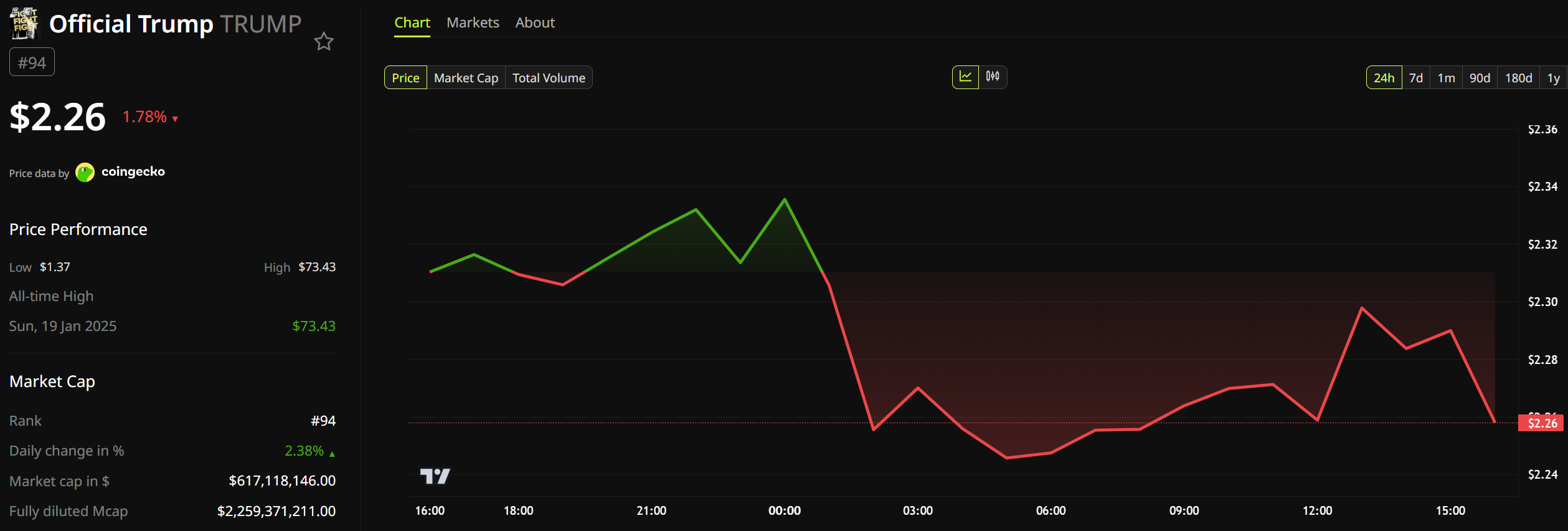
- The third is steeper than it sounds. LAPTOP has to beat TRUMP on fully diluted value, and TRUMP’s sits near $2.26 billion.

LAPTOP would need roughly 3.7 times TRUMP’s current market value, or about $2.26 a coin.
TRUMP is the warning, seeing as it trades near $2.26, about 97% below its January 2025 peak of $73.43. The Journal put its top market value at close to $15 billion, against roughly $617 million now.
BeInCrypto found every Trump-endorsed token now trades roughly 60% below its pre-endorsement price.
The Rule That Would Not Cover Him
Trump’s crypto income is on the record. His latest financial disclosures showed $1.4 billion from his meme coin and crypto deals last year, the Journal reported.
Congress has tried to draw a line. The Clarity Act would set one rulebook for digital assets. It has stalled partly over wording that would stop officials and their families from profiting from crypto.
That wording would not reach Hunter Biden. His father left office in January 2025.
No contract address is public yet, and scammers have run this play before. In February 2025, a hacked World Liberty Financial account pushed a fake BARRON meme coin.
It kept trading even after the scam was exposed. Until Hunter Biden or his team posts an address, treat every LAPTOP you see as fake.
The post Hunter Biden's Laptop Becomes a Meme Coin Wednesday. TRUMP Is Down 97% appeared first on BeInCrypto.
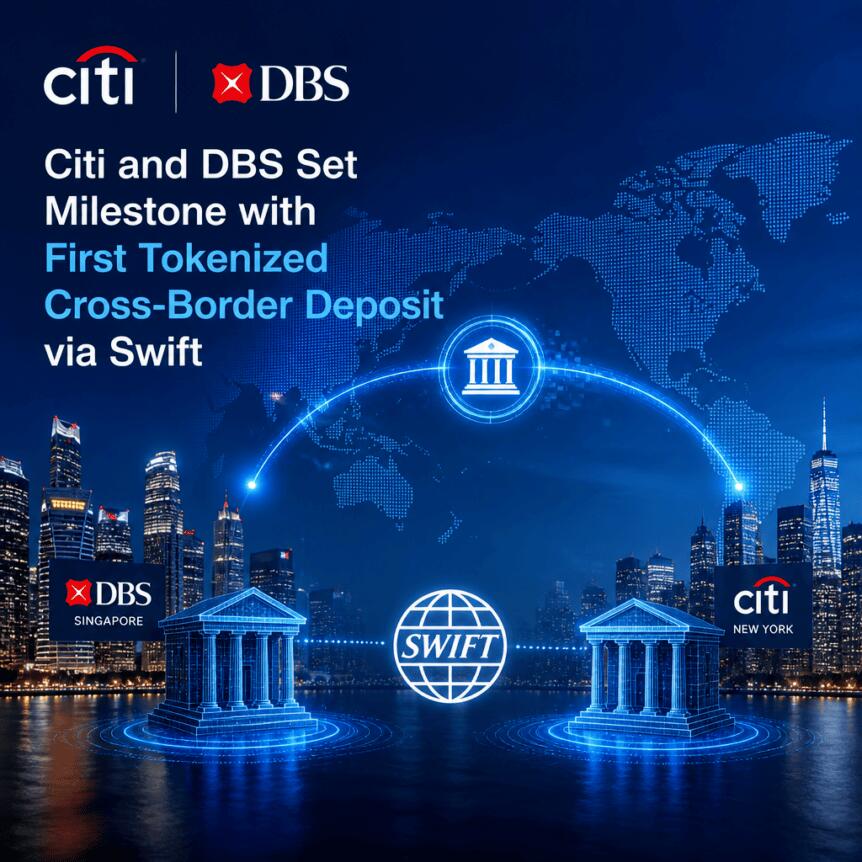
DBS and Citi have completed the first tokenized cross-border payment between Singapore and the United States over a blockchain-based settlement rail, marking a concrete step in banks’ shift from traditional transfer timelines toward near-instant processing.
The transaction was executed on Saturday using tokenized deposits via the Swift Digital Ledger, according to DBS, which said the deposit was finalized in minutes—an improvement over the “as long as two business days” timeline typical of conventional cross-border transfers. DBS made the announcement on Monday.
Key takeaways
- DBS and Citi completed a Singapore-to-US cross-border payment using tokenized deposits on the Swift Digital Ledger.
- DBS said the deposit was settled in minutes, contrasting with traditional cross-border transfers that can take up to two business days.
- The experiment highlights how major banks are testing blockchain rails while still operating within banking deposit structures.
- Swift’s blockchain ledger work is moving from pilots toward broader operational use, following earlier live demonstrations.
Tokenized deposits on Swift’s digital ledger go live
DBS described the weekend transfer as a landmark milestone for cross-border payments, not only because it used the Swift Digital Ledger, but also because it relied on tokenized deposits rather than switching to a fully crypto-native model.
Under this approach, banks can represent deposit value as tokens while keeping the transaction rooted in regulated banking balance sheets. DBS framed the speed of finalization as a key differentiator: settling within minutes rather than waiting through banking-day cutoffs and correspondent processes that often slow down international payments.
A shift from pilots to operational momentum
This development sits within a longer sequence of Swift blockchain efforts. In August, Standard Chartered and HSBC became the first banks to complete a live tokenized cross-border transaction using Swift’s blockchain ledger—showing that the concept could work outside a closed test environment.
Earlier, Swift said its blockchain-based ledger was ready for initial use and that it was preparing to pilot tokenized cross-border payments with 17 major banks. The pilot group included Citi, DBS, HSBC, BNP Paribas, UBS, ANZ, and Standard Chartered, as noted in reporting on Swift’s preparations.
With DBS and Citi now completing the Singapore-US leg using the ledger, the focus appears to be moving from feasibility and interbank coordination toward repeatable processing that can be integrated into existing banking workflows.
Why keeping deposits “inside” banking matters
While blockchain rails are often discussed in the context of digital assets, the direction implied by DBS’s framing is different: tokenization here is being used to streamline settlement while preserving familiar deposit mechanics.
That matters for multiple reasons. First, it can reduce friction for counterparties that are more comfortable with the compliance and operational controls already embedded in deposit-based systems. Second, it provides a path to faster settlement without necessarily requiring participants to hold or transfer tokens as their primary payment method for everyday banking.
In other words, these transactions suggest a hybrid model: blockchain for settlement efficiency, traditional deposits for value custody and regulated banking integration.
Plans for broader tokenized deposit networks
The weekend result also fits into plans for future deposit token infrastructure in the United States. In June, The Wall Street Journal reported that Citi and other large US banks plan to launch a separate tokenized deposit network in the first half of 2027, operated by The Clearing House. The WSJ report cites David Watson, CEO of the bank-owned payments operator, in connection with the initiative.
Separately, DBS and JPMorgan have also outlined longer-term work. In November 2025, Cointelegraph reported that the two banks revealed plans to develop a blockchain-based tokenization framework aimed at enabling onchain transfers between their respective deposit token ecosystems and potentially setting an industry standard for cross-bank payments.
Taken together, these efforts point toward an emerging competitive and collaborative landscape: banks testing tokenized rails in production while simultaneously planning next-generation network designs that could expand interoperability beyond individual bilateral relationships.
Looking ahead, market participants will likely watch whether speed improvements translate into consistent, scalable settlement performance across more corridors, and whether Swift-led ledger usage broadens beyond early pairs like DBS-Citi—especially as parallel tokenized deposit network plans move from announcements toward delivery.
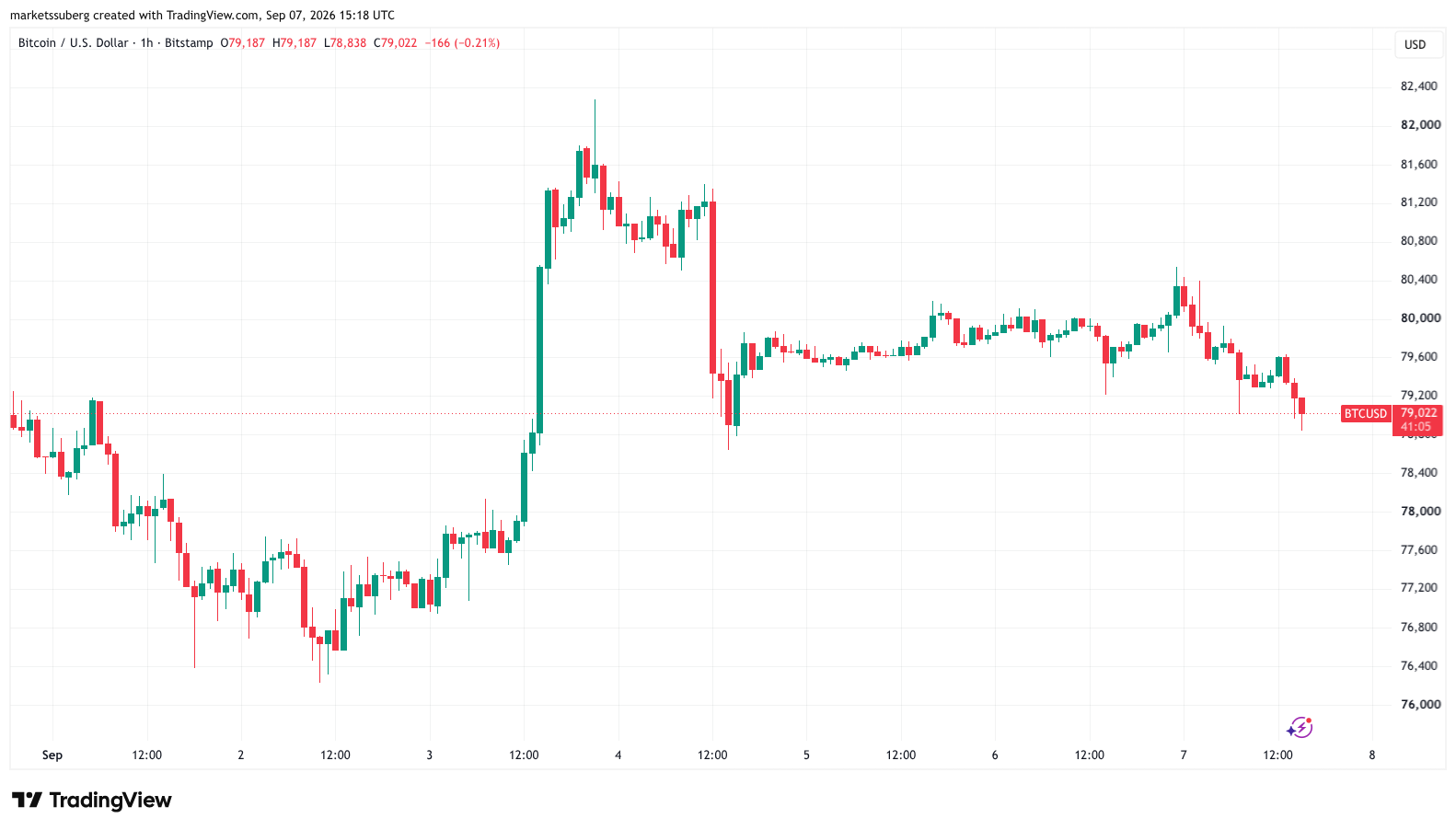
Bitcoin (BTC) drifted lower on Monday as a low-liquidity environment erased the weekend’s gains above $80,000.
Key points:
- Bitcoin dips 2% below $80,000 after its highest weekly close since the start of May.
- Traders are in wait-and-see mode ahead of the week’s key volatility catalyst in the form of US inflation data.
- Analysis praises Bitcoin’s “resilience” as a narrow range holds since mid-August.
Bitcoin needs US inflation catalyst: Analysis
Data from TradingView showed BTC/USD down nearly 2% on the day at the time of writing. This price action comes after its first weekly close above $80,000 since early May.
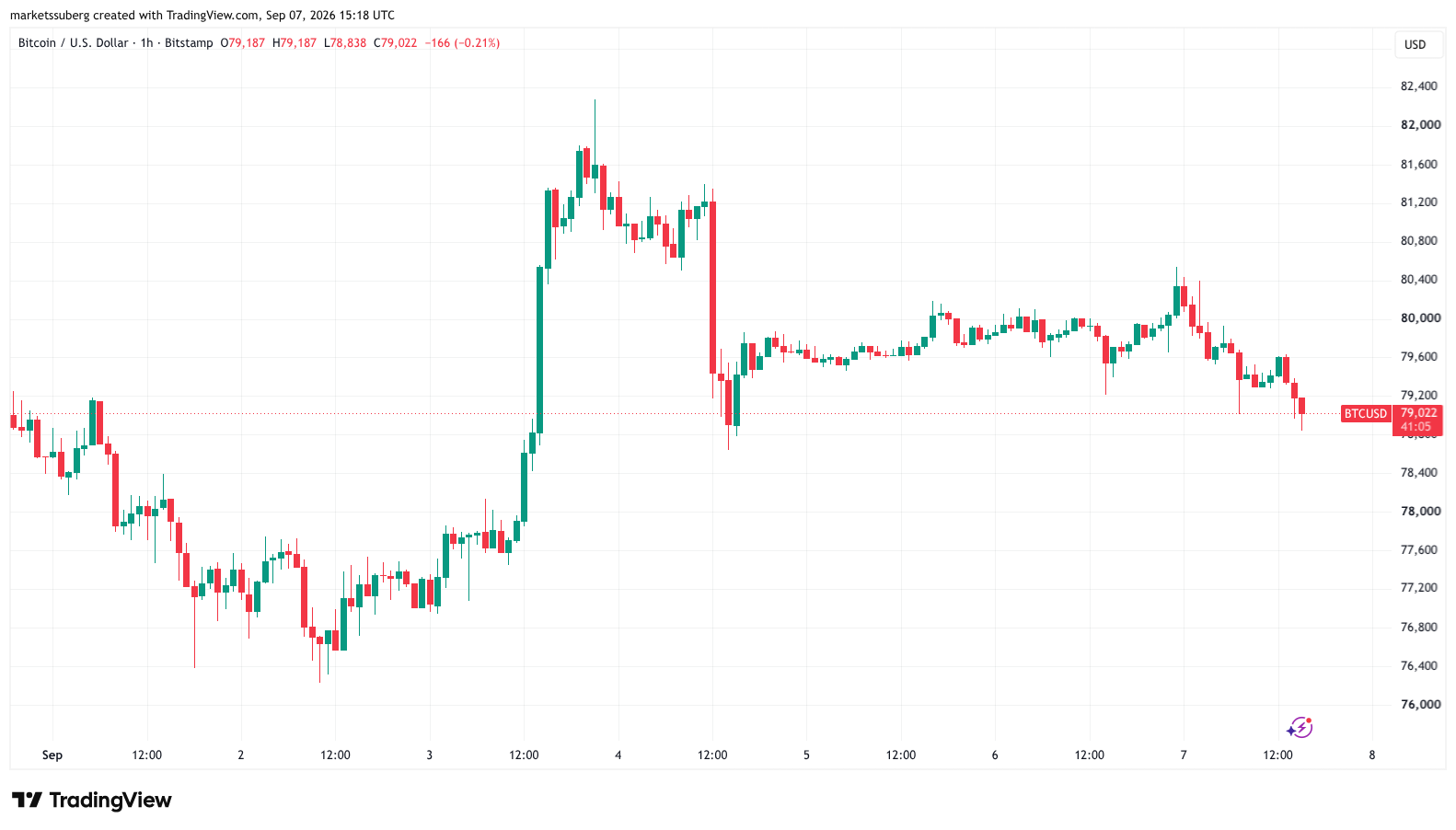
BTC/USD one-hour chart. Source: Cointelegraph/TradingView
With US markets closed for the Labor Day holiday, thinner order books increased the chances of sudden moves to target liquidity both above and below the spot price. Data from CoinGlass showed liquidations evenly split between long and short positions over the past 24 hours, with the cross-crypto total at $178 million.
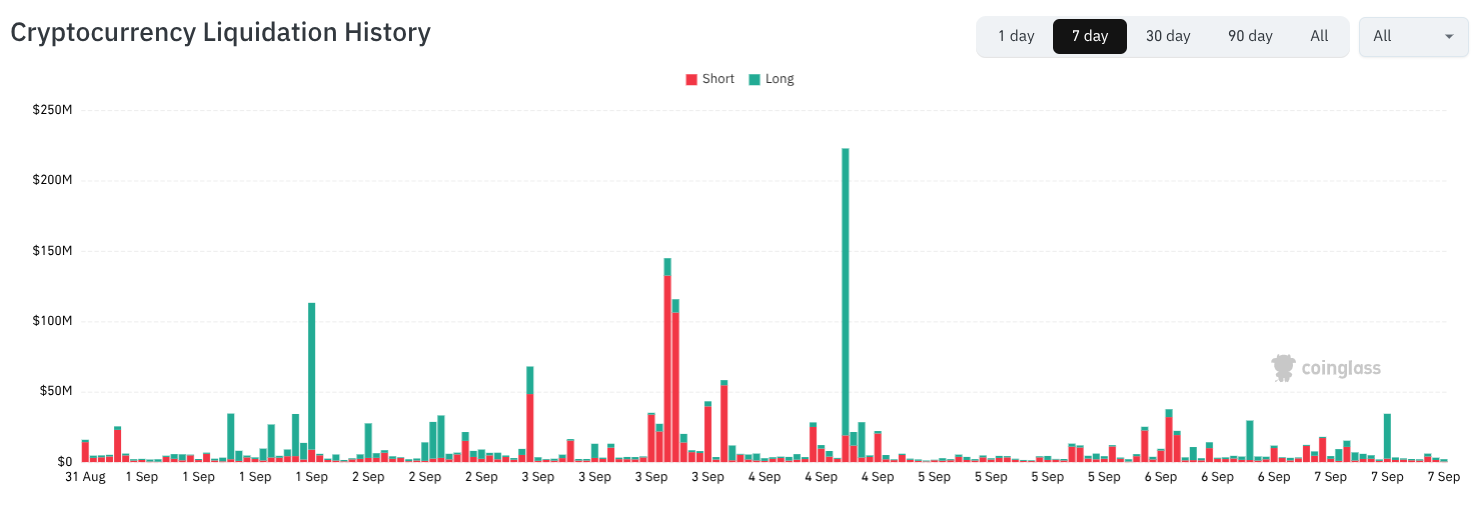
Crypto liquidation history (screenshot). Source: CoinGlass
Liquidity thickened over the course of Monday, with concentrations at $80,500 and $78,800 providing nearby short-term targets.
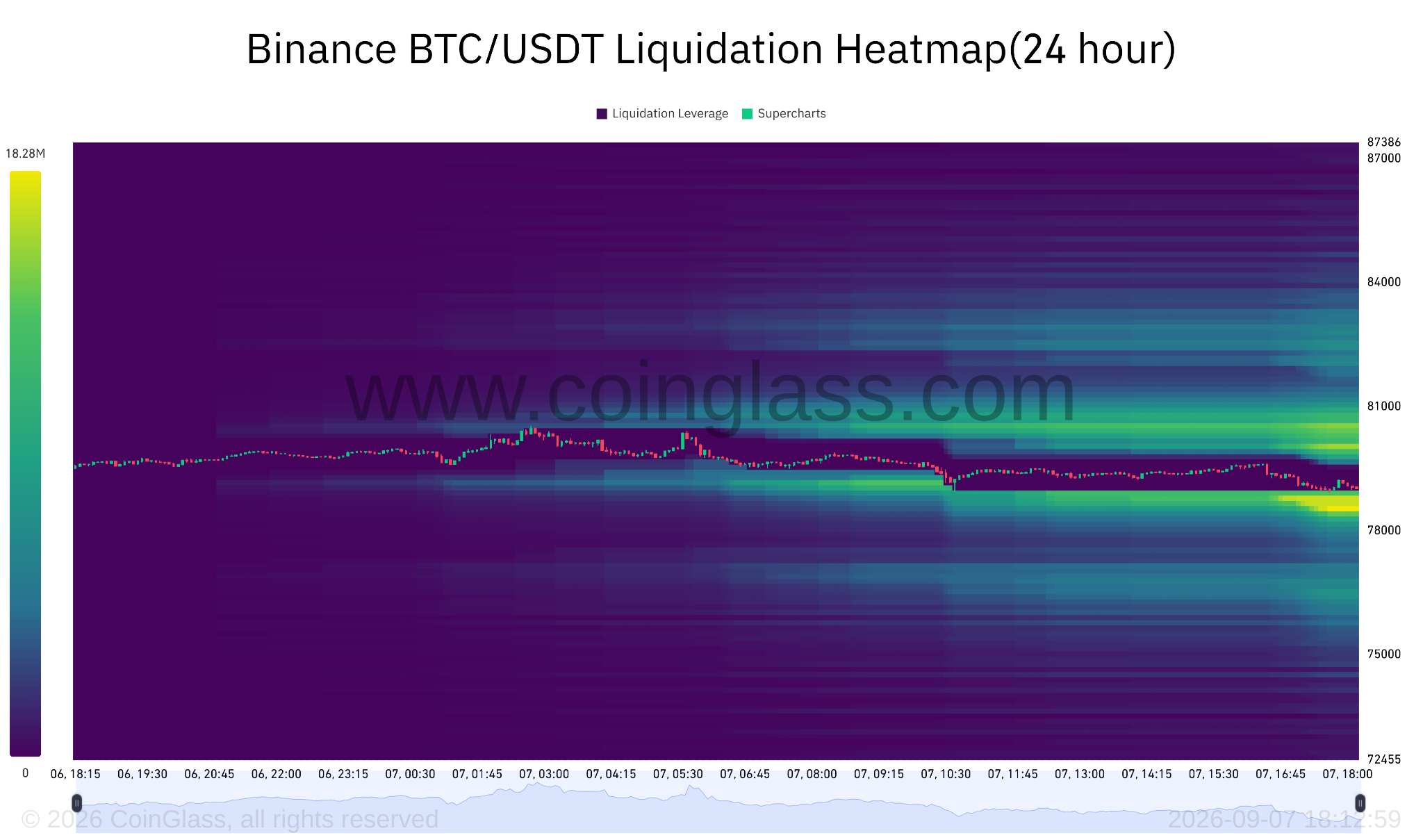
Crypto liquidation heatmap. Source: CoinGlass
In comments, trading company QCP Capital flagged declining overall volatility, suggesting that traders required external catalysts. These are due in the form of US inflation data on Thursday and Friday, which is likely to impact market expectations for interest-rate hikes by the Federal Reserve.
“Near-term volatility compression, despite approaching catalysts, reflects a market waiting for clarity rather than pricing in strong directional views,” QCP wrote in its latest analysis. It added that the “market is positioned for a directional break once the inflation data arrives.”
BTC price “resilience” draws attention
Despite moving in a confined range since Aug. 21, BTC/USD offered bullish signals and held the majority of its 25% gains from earlier last month.
Related: Here’s what happened in crypto today
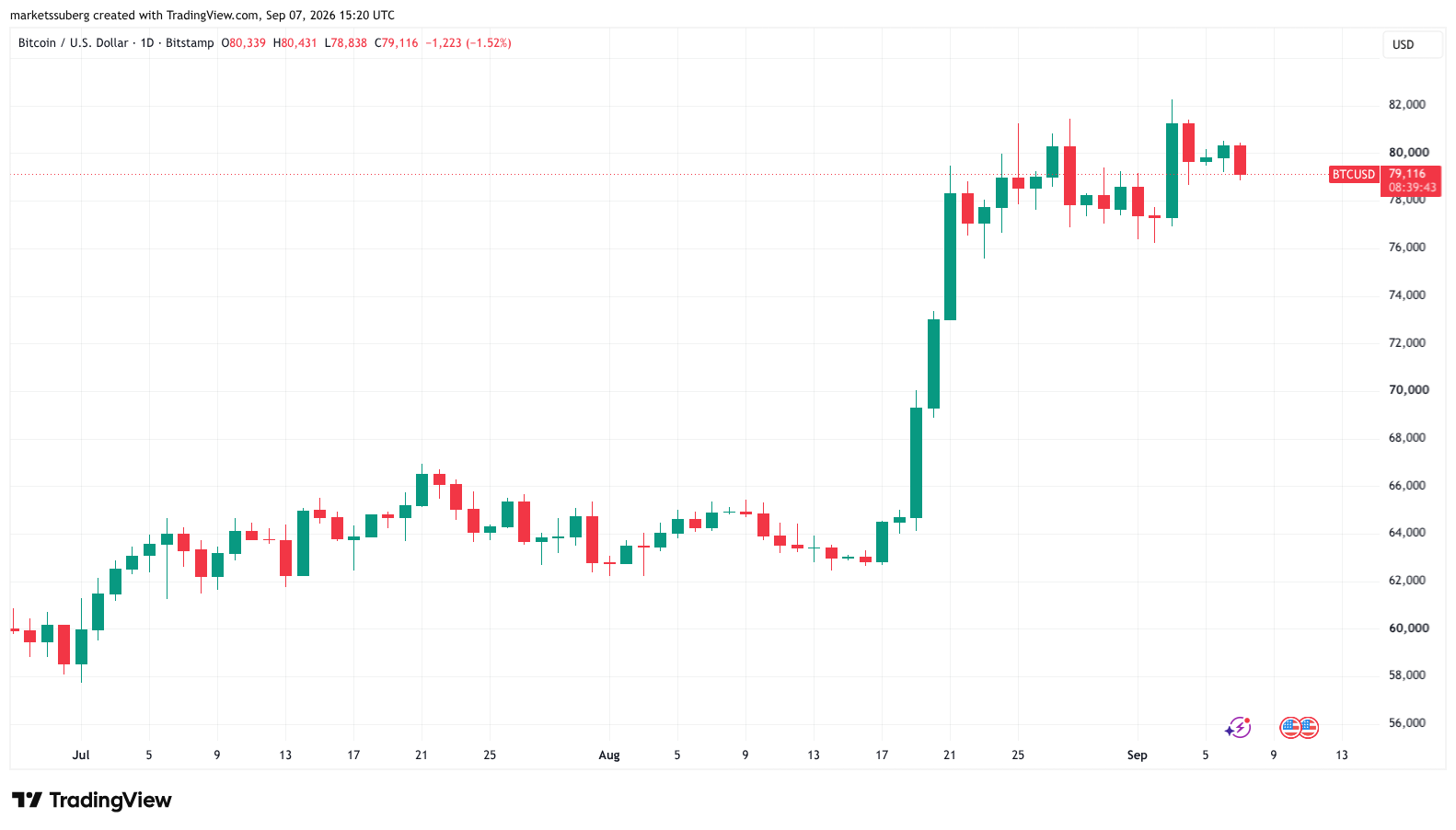
BTC/USD one-day chart. Source: Cointelegraph/TradingView
In comments sent to Cointelegraph, Ryan Lee, chief analyst at Bitget, noted that Bitcoin had digested last week’s US macro volatility trigger, which was a surprise uptick in nonfarm payrolls numbers.
“Bitcoin’s resilience is notable because stronger employment would normally put upward pressure on yields and the dollar, creating a tougher environment for risk assets,” he said.
“The market’s ability to absorb that repricing suggests investors are not treating a potential Fed hike as the only factor driving Bitcoin at current levels.”
As Cointelegraph reported, the US spot Bitcoin exchange-traded funds (ETFs) also remain on the radar following Thursday’s $730 million net inflows. This was the cohort’s highest single-day tally since January.


LAPTOP debuts Wednesday on Base, with nearly a third of the supply set to be burned if a slate of political and market outcomes — including a Democratic win in 2028 — comes good.

Three-month-old girl died ‘when her family joined grandfather for a night of fishing’: Four arrested over ‘murder’

Copper prices scale fresh record high as focus turns to tight supplies outside US

Philippines Eyes Payment Operator Freeze, Tighter VASP Checks





-

 Fashion3 days ago
Weekend Open Thread: Beyond Yoga
-
 Crypto World3 days ago
Bitcoin price stalls near $82K as key resistance holds
-

 Politics3 days ago
Best Gaming Laptops, CPUs, TVs, And Keyboards To Upgrade Your Set Up For GTA VI
-

 Tech3 days ago
The Birds Outside, Drawn For You Automatically
-

 Crypto World3 days ago
IMF Says El Salvador’s Post-Review Bitcoin Purchases Used No Public Funds
-
 Crypto World3 days ago
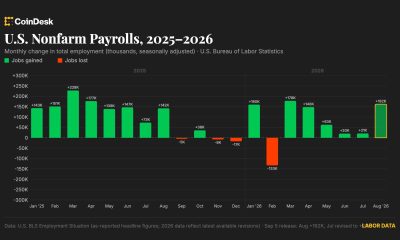
U.S. added stronger than expected 162,000 jobs in August as labor market bounced back
-

 Sports3 days ago
Alexandre Pato consortium’s Northampton Town investment approved
-

 Sports3 days ago
Commanders’ Chig Okonkwo is a top breakout fantasy football candidate
-

 Sports3 days ago
Golden Eaglets Drawn in Group B for 2026 WAFU B U17 Championship
-
 Crypto World3 days ago
XRP price breaks falling channel as bulls target $1.53
-

 Politics3 days ago
A new European chapter for Gibraltar
-

 Politics3 days ago
How To Avoid Winter Colds: 4 Everyday Habits That Spread Germs, Says Pharmacist
-

 Politics3 days ago
The House | Bin the lectures, bring gossip and be ready to banter: how the new PM should prepare for his Trump encounter
-

 Crypto World3 days ago
From warning to listing: UK’s largest retail investment platform opens access to crypto ETNs
-

 Crypto World3 days ago
FinCEN flags $12.7B tied to Southeast Asia crypto investment scams
-

 Tech3 days ago
A Worthy Android Ereader, With Some Tradeoffs
-

 Tech3 days ago
How To Edit Claude’s Memory
-

 Crypto World3 days ago
Trezor Data Breach Impacts 67,000 More US Customers
-

 Politics3 days ago
33 Cosy Autumn Home Decor Ideas: Blankets, Pumpkin Decorations, And Candles
-

 Tech3 days ago
beyerdynamic AVENTHO Y Debuts at IFA 2026 and Makes Wireless Headphones Less Disposable
You must be logged in to post a comment Login