

Crypto World
How to Build a LATAM Crypto Exchange Software That Scales Fast?

Cryptocurrency trading volumes in Latin America grew 63% and crossed $1.5 trillion between July 2024 and June 2025, establishing the region as one of the most crypto-progressive regions. In February 2026, Argentina, Brazil, and El Salvador dominated the headlines with noteworthy cryptocurrency developments. El Salvador plans a $100M tokenized investment program for localized SMEs, where Brazil considers eliminating crypto taxes and establishing a strategic Bitcoin reserve, and Argentina revokes the right to receive salaries in digital wallets. These signals demonstrate how LATAM governments and businesses are actively experimenting with new financial models.
Crypto finance group, a part of Deutsche Börse Group, entered LATAM after it sensed a “strong, concrete demand from institutions for well-structured, compliant crypto offerings”, in the words of Vander Straeten, the CEO.
If institutional capital and policy momentum are converging this fast, it is clear that LATAM crypto exchange development is commercially compelling in 2026 and beyond. However, this opportunity materializes only for platforms designed around the region’s real adoption mechanics.
What Actually Drives LATAM Digital Asset Adoption?
Crypto exchange software businesses can’t reach 200K users in LATAM by listing region-popular pairs or tokens or by increasing the leverage. The region’s digital asset adoption curve is driven by currency stability, cross-border transfer dependency, and mobile-first fintech habits.
By the end of 2025, LATAM had approximately 70 million unique crypto users, up from 73.7 million in Q3 2025 and 57.7 million earlier in the year. But the growth didn’t come from speculation but utility.
1. Inflation Hedging Via Stablecoins
Currency volatility remains the primary entry trigger in markets like Argentina, where inflation has stayed structurally high. In such markets, stablecoins function as everyday digital dollars rather than trading assets.
Stablecoins dominated more than 90% of exchange flows in Brazil, 62% in Argentina, and 48-60% region-wide. This proves that most users in the Latin American region hold balances for savings and payments, not trading.
2. Stablecoin Remittances Replacing Cash Corridors
LATAM received an estimated $165.1 billion in remittances in 2024, and another research predicted it would reach $174.4 billion by the end of 2025. Crypto has been increasingly used to bypass high-fee corridors.
Mexico, which is the second-largest corridor from the US, alone totaled $63.3 billion in remittances in 2024-25. Bitso, a leading crypto exchange software, handled over $6.5 billion in US-Mexico remittances, which totaled in 2024, representing more than 10% of the total corridor volume.
Stablecoin-based remittances cut costs by 50-80%, dropping from traditional 6-7% averages to 1-3%. High-fee LATAM corridors even benefit from 76% savings with stablecoins.
3. P2P and Social Money Behavior
Money movement in Latin America is socially mediated between families, communities, and informal networks, rather than institutionally intermediated. Crypto leads the peer-to-peer money movement in the region due to the popularity of social tipping and community payments. Many users from the region adopt wallets through contacts and not financial products.
Tron has sustained as a high-volume blockchain infrastructure supporting 78% of P2P transfers, which is an essential crypto exchange development feature for LATAM.
4. Mobile-Native Onboarding Expectations
LATAM fintech usage is mobile-centric, with 70% regional mobile penetration, and strong familiarity with chat-based payments. More users are expecting WhatsApp-style transfers and low-literacy onboarding flows with instant notifications and real-time balances in the application. So, crypto exchange software businesses in the region are competing with neobanks, not global trading apps.
In short, LATAM cryptocurrency exchange software scales when they behave like payment rails, not a trading terminal.
Essential Crypto Exchange Development Features Required to Reach 200K Users in Latin America
As stated above, the crypto adoption in LATAM comes from everyday dollar usage, social transfers, and entertainment-linked finance. The core stack, therefore, must combine payments, social, savings, custody, and engagement primitives from day 1.
1. Stablecoin-Centric Wallet Layer
The primary crypto exchange software development feature in LATAM isn’t order books but stablecoin wallets. Exchanges that nurture their in-built centralized or decentralized wallets can capture the audience that approaches crypto exchange apps as a dollar account. Here are essential crypto wallet components for LATAM exchanges:
- Multi-asset balances (USDT, USDC, crypto, and fiat)
- USD-denominated portfolio view as default
- Instant stablecoin swaps
- Near-zero-fee internal transfers
- Frictionless Onboarding
- Contact-based sending (phone / username)
2. Remittance & P2P Transfer Engine
As deduced from the statistics above, remittances create the strongest viral loop in the region. Peer-to-peer transfer engine forms another essential component for LATAM crypto exchange development. These features fetch revenues and act as customer magnets at the same time as each remittance/payment sender typically onboards 1-3 new users. So, for businesses planning to launch their digital asset exchange, the following capabilities are indispensable:
- Cross-border stablecoin transfers
- QR / phone-number payments
- P2P marketplace matching
- Chat-based or whatsapp style P2P transfers
- Local cash-out counterparties
- Corridor-specific liquidity routing
3. Local Fiat Rails
Instant and cost-efficient fiat access determines retention for crypto exchanges in LATAM. Users quickly abandon platforms that delay deposits and withdrawals beyond minutes or fail to support end-to-end money movement. For this reason, any cryptocurrency exchange software development targeting this region must implement Pix-style crypto-fiat rails as a foundational layer. These are the basic requirements:
- Brazil Pix-like instant rails
- Bank transfer APIs (SPEI-equivalent markets)
- Local PSP integrations
- Real-time deposit confirmation
- Instant fiat↔stablecoin conversion
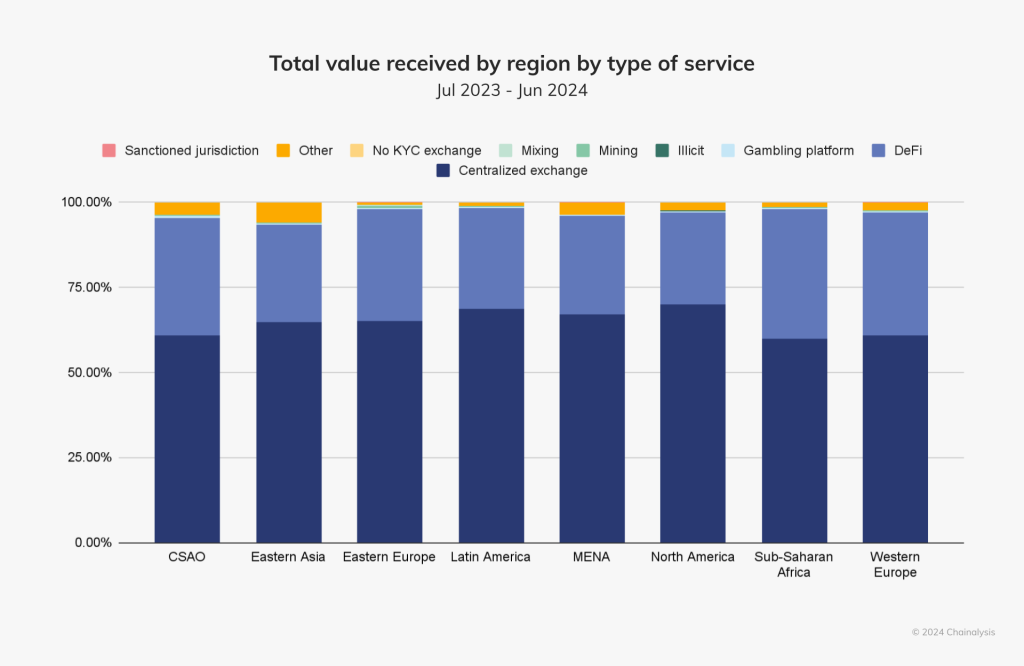
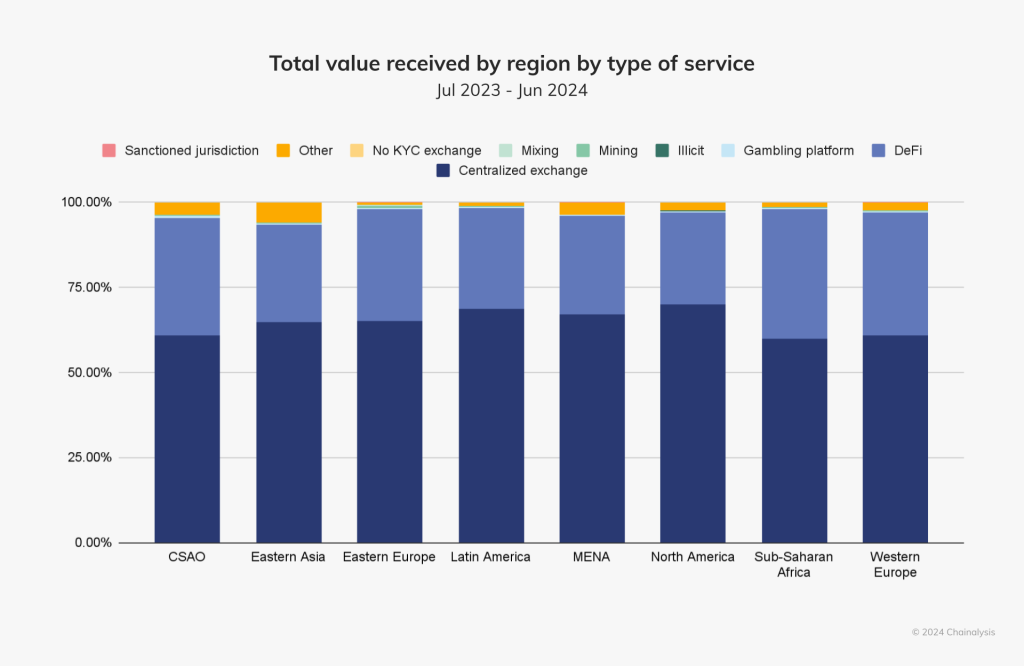
Centralized exchanges can seamlessly be integrated with existing banking systems, leveraging APIs, and can also include fiat-stablecoin/crypto rails effortlessly. This is one of the reasons why centralized exchanges (CEXs) are the most popular crypto services in the Latin American region.
4. Social & Creator Money Layer
In countries like Latin America, where money flows socially before it flows financially, community finance features accelerate onboarding and adoption. Money movement mostly occurs within creator communities, family groups, and informal networks rather than purely financial contexts. As a result, cryptocurrency exchange software in the LATAM region increasingly functions as a social finance platform where users interact, tip, and transact around personalities and communities. Implementing creator monetization and community finance tools, along with the following features inside the exchange helps exchanges engage a wider audience.
- Creator wallets with public handles
- Stablecoin tipping & micro-payments
- Paid groups or gated channels
- Revenue split or referral distribution contracts
- Influencer referral wallets
- Community pools or shared wallets
Crypto trading platforms can also integrate Instagram-like feeds into their existing fintech platform to enhance the social effect of the platform. This way, the above-mentioned features make more sense.
5. Prediction Markets
In the LATAM region, speculative behavior is culturally linked to sports outcomes and macroeconomic events rather than traditional financial instruments. Prediction markets embedded inside crypto exchange software, therefore, attract users who may not engage with spot or derivatives trading but are comfortable with simple outcome-based participation. Cryptocurrency exchanges can create familiar entry points into digital asset usage and still generate liquidity, engagement, and revenue with the following:
- Football match outcome markets
- Election/inflation / FX outcome markets
- Simple yes/no contracts like Robinhood
- Stablecoin settlement pools
- Social rankings or leaderboards
6. Dollar Savings & Yield UX
Stablecoin savings represent one of the strongest retention drivers in inflation-prone Latin American economies, where users seek protection from local currency devaluation. Many users adopt crypto exchange wallets primarily to store digital dollars rather than to trade or transact. Crypto exchange software solutions that integrate accessible yield or savings interfaces can therefore retain liquidity and transition utility users into broader financial activity with gamification and rewards.
- One-tap stablecoin savings or vault accounts
- Transparent APY display in USD
- Recurring local-to-USD conversion
- Flexible withdrawals or redemption options
- Risk tier or yield source labeling
A LATAM exchange that reaches 200K users behaves as a dollar wallet, remittance network, social finance app with trading infrastructure and engagement layers operating in the background rather than the foreground.

Also Read>>>How To Launch Crypto Services With CNV-Ready White Label Exchange?
What are the UX Principles that Support Sustainable and Fast LATAM Crypto Exchange Software Growth?
As stated earlier, most LATAM cryptocurrency exchange software users are leveraging trading platforms for their financial needs. Exchanges that aim to scale quickly in the region must mirror familiar mobile money patterns and minimize cognitive and compliance friction at entry. Let’s again highlight the UX essentials for LATAM cryptocurrency exchange development:
1. USD-first balances as users in inflationary markets think in dollars even when transacting locally. Displaying portfolios and transaction values in USD by default aligns the app with real financial perception.
2. Simplified KYC entry and verification allow low-limit onboarding and accelerate first transactions while deferring heavier compliance steps to later stages of engagement.
3. WhatsApp-like transfers, chat-style sending, contact-based payments, and conversational confirmations reduce learning effort. Such financial experience matches how users already communicate over messaging apps.
4. Low-literacy-friendly flows can be created with icon-led actions, guided steps, and clear visual confirmations. This enables users across varied education levels to complete transfers and deposits without confusion.
5. Offline-friendly lightweight alerts, queued transaction updates, and low-bandwidth operation ensure efficient operation in environments with inconsistent connectivity.
Launch a LATAM-ready crypto exchange with Antier’s production-grade infrastructure
Closing: Why Most LATAM-Based Crypto Exchange Software Fail & How They Can Reach 200K Users in 6 Months
Many cryptocurrency exchange software launches in Latin America underperform, not because the markets lack demand, but because platforms are built around trading assumptions instead of regional money behavior. So, this is what businesses must avoid during crypto exchange development and launch;
- Launching trading before payments
- Providing USD as a secondary balance
- Slow fiat rails
- Heavy KYC at entry
- No cash-out liquidity
To make a crypto exchange software development project scale to hundreds of users in the first 180 days, crypto exchanges must primarily launch stablecoin wallets, local fiat rails, remittance loops, and social finance features.
This is why the fastest-growing LATAM cryptocurrency exchanges function less like trading terminals and more like payment networks layered with savings and social money features. Trading remains present, but it operates as a monetization layer that activates after users already rely on the app for everyday financial activity.
Antier offers LATAM-ready white label cryptocurrency exchanges and custom development solutions with the exact stack required to reach 200K users in 6 months. We support the full lifecycle from development and launch to growth and compliance. Connect today!
Frequently Asked Questions
01. What was the growth percentage of cryptocurrency trading volumes in Latin America between July 2024 and June 2025?
Cryptocurrency trading volumes in Latin America grew by 63% and crossed $1.5 trillion during that period.
02. What are some notable cryptocurrency developments in Argentina, Brazil, and El Salvador as of February 2026?
El Salvador plans a $100M tokenized investment program for SMEs, Brazil is considering eliminating crypto taxes and establishing a Bitcoin reserve, and Argentina has revoked the right to receive salaries in digital wallets.
03. What factors drive digital asset adoption in Latin America?
Digital asset adoption in LATAM is driven by currency stability, dependency on cross-border transfers, and mobile-first fintech habits, rather than speculation.


TLDR
- ProShares launched the GENIUS Money Market ETF (IQMM), designed to support stablecoin issuers with liquid, short-term U.S. government securities.
- The ETF is structured to comply with the GENIUS Act, which mandates stablecoin issuers to back their tokens with safe, liquid assets.
- IQMM focuses on cash and Treasury bills with maturities of 93 days or less, ensuring liquidity for stablecoin issuers.
- The GENIUS Act, signed into law in July, requires stablecoins to be backed 1:1 by assets that are easily convertible to cash.
- The launch of the ETF comes as the stablecoin market approaches $300 billion, with projections for significant growth in the coming years.
ProShares introduced the GENIUS Money Market ETF (IQMM) on Thursday, a product designed for the growing stablecoin market. This fund aims to support stablecoin issuers by investing in highly liquid assets that meet the requirements of the GENIUS Act. The move comes as the stablecoin sector is projected to grow significantly in the coming years.
ProShares IQMM ETF Targets Stablecoin Issuers
The ProShares GENIUS Money Market ETF (IQMM) was launched to address a gap in the stablecoin market. Under the GENIUS Act, stablecoin issuers must back their tokens with assets that are liquid and low-risk, such as U.S. Treasury bills. IQMM is designed to invest solely in short-term, liquid U.S. government securities, meeting the law’s reserve criteria.
The law restricts eligible reserve assets to Treasury bills with maturities of no longer than 93 days. ProShares designed the fund to comply with these rules, ensuring that issuers can quickly access liquidity without selling longer-term bonds at a loss during periods of market volatility.
GENIUS Act Compliance Ensures Stability
The GENIUS Act, signed into law last July, is central to the structure of IQMM. The law aims to create a safer, more stable environment for the stablecoin market by requiring 1:1 backing with liquid, safe assets. ProShares’ ETF aligns with the law’s requirement, ensuring that stablecoins are supported by assets that can easily be converted to cash.
By focusing on cash and short-dated government securities, the fund provides issuers with the liquidity needed for daily redemptions. This ensures that stablecoin issuers can meet user demands without having to sell more volatile, longer-dated securities during times of stress in the financial markets.
Stablecoin Market Growth Prompts Regulatory Action
The launch of the IQMM fund occurs as the stablecoin market approaches $300 billion in circulation, with Tether’s USDT and Circle’s USDC leading the sector. Policymakers are preparing for rapid expansion, with some forecasts suggesting stablecoin circulation could reach $2 trillion by 2028. Wall Street projections are more optimistic, with some firms predicting the market could grow as large as $4 trillion.
Treasury Secretary Scott Bessent has indicated that stablecoins could become a significant part of the financial system in the coming years. His forecasts suggest the market could grow substantially by the end of the decade.


A research paper at the U.S. Federal Reserve praised the usefulness of prediction markets — specifically looking at Kalshi — in getting a real-time handle on economic policy.
“Kalshi’s forecasts for the federal funds rate and [the U.S. Consumer Price Index] provide statistically significant improvements over fed funds futures and professional forecasters, all while providing continuously updated full distributions rather than infrequent point estimates,” according to the paper published on Thursday.
And the markets, in which retail investors can buy contracts in virtually any yes-no question in such diverse fields as economics, politics and sports, are looking at topics on a live basis that other sources of information don’t.
Prediction markets “provide unique insights — particularly for variables like [gross domestic product] growth, core inflation, unemployment and payrolls, for which no other market-based distributions currently exist.”
And in this study, Kalshi predictions “perfectly matched the realized federal funds rate by the day of each meeting since 2022, a feat not achieved by either surveys or futures.”
Part of the secret sauce that sets prediction markets apart as a useful tool may be the inclusion of retail participants, which makes them “distinct from institutionally dominated markets,” the paper noted.
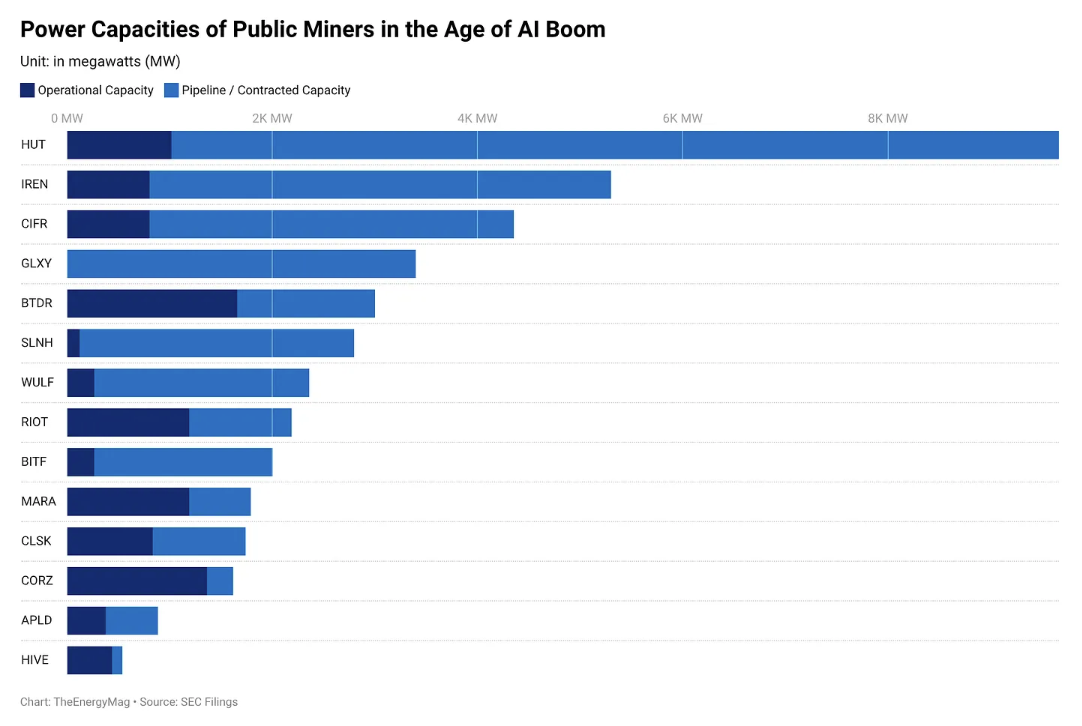
Public Bitcoin miners are planning about 30 gigawatts of new power capacity aimed at artificial intelligence workloads, nearly three times the 11 GW they currently have online, as they race to offset shrinking mining margins and reposition for the next growth cycle.
The buildout, compiled by TheEnergyMag across 14 publicly traded Bitcoin (BTC) miners, underscores how aggressively the industry is pivoting away from traditional hashpower amid persistently weak hashprice conditions.
On paper, the planned expansion amounts to what TheEnergyMag described as “a small country’s worth of power infrastructure.” In reality, much of the 30 GW sits in development pipelines, interconnection queues or early-stage plans, rather than operational facilities.

The widening gap suggests competition is shifting from ASIC efficiency to securing power, financing and delivering data centers on time.
“This is the megawatt arms race of the AI boom,” TheEnergyMag said, adding that monetization ultimately depends on whether AI demand remains strong enough to justify the scale of investment.
Related: The real ‘supercycle’ isn’t crypto, it’s AI infrastructure: Analyst
AI pivot delivers early revenue gains for some miners
The shift toward artificial intelligence infrastructure reflects an increasingly hybrid strategy among established Bitcoin miners, with some companies already reporting meaningful revenue contributions from AI and high-performance computing (HPC) workloads.
One example is HIVE Digital, which recently posted record quarterly revenue driven in part by its AI and HPC business lines. The company reported fourth-quarter sales of $93.1 million, up 219% year on year, even as Bitcoin prices declined during the period.
Investors, too, are attuned to the shift. Earlier this week, Starboard Value went public with its suggestion to Riot Platforms management that they accelerate the miner’s expansion into HPC and AI data centers.
The push to diversify comes as mining profits have taken a hit since the 2024 Bitcoin halving, which cut block rewards and squeezed margins across the industry.
Conditions have gotten even tougher since the fourth quarter, when heavy selling pressure sent Bitcoin tumbling from its record high above $126,000. Prices eventually stabilized in February, after briefly falling to below $60,000.
Despite these headwinds, US-based miners showed resilience at the start of the year, with output rebounding after a severe winter storm temporarily disrupted operations.

Related: Paradigm reframes Bitcoin mining as grid asset, not energy drain
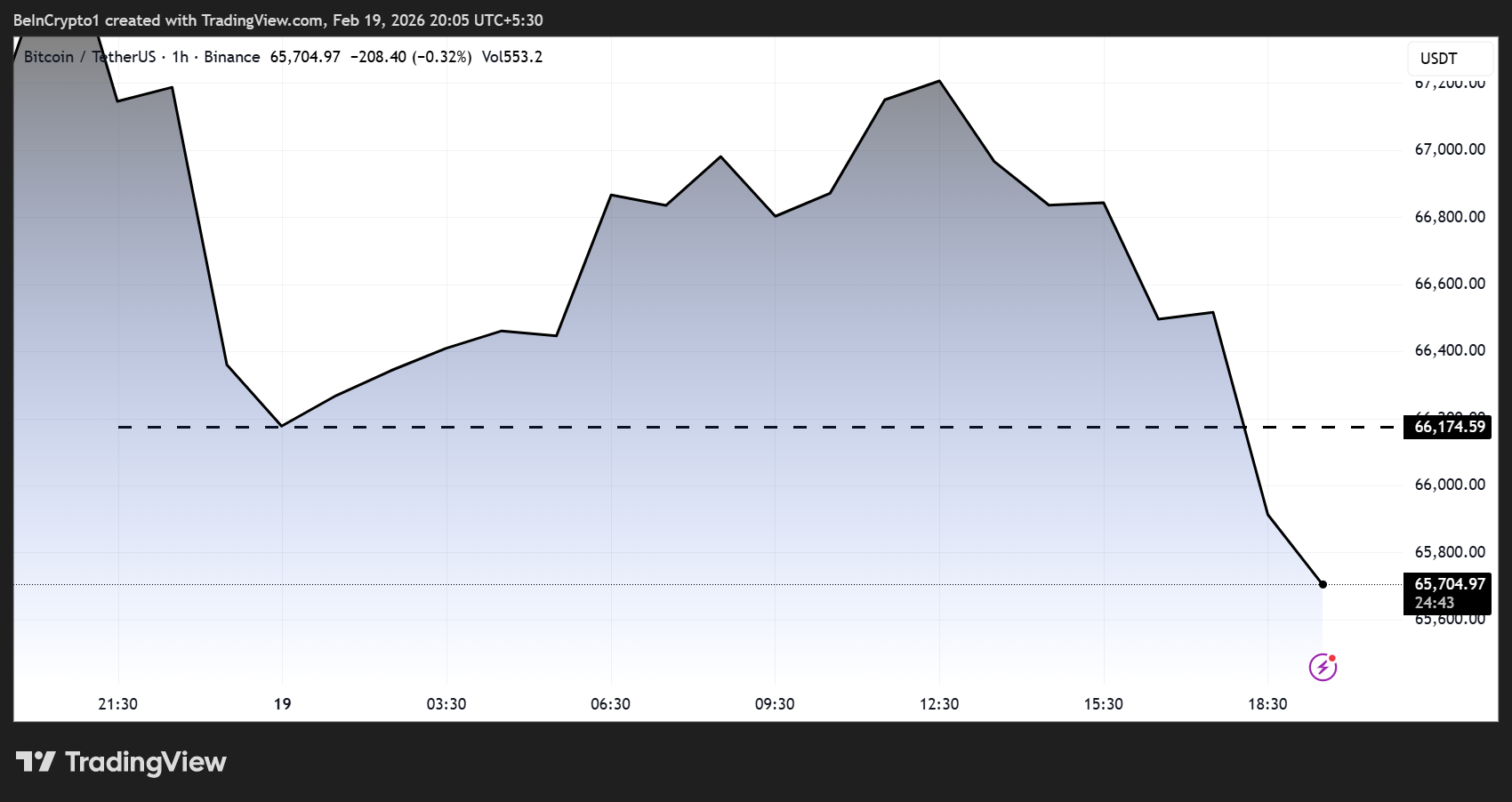
Bitcoin fell below $66,000 on Thursday following mixed US economic data. Initial jobless claims beat expectations, while the trade deficit widened sharply, fueling renewed risk-off sentiment in crypto markets.
Crypto markets in general were watching today’s data release, which featured among the economic data expected to influence Bitcoin sentiment this week.
Bitcoin Retreats Below $66,000 Amid Mixed US Economic Signals
The Labor Department reported 206,000 initial jobless claims, down from a revised 229,000 the prior week and well below market expectations of 225,000.
The four-week moving average also edged lower to 219,000, signaling a labor market that remains resilient despite ongoing economic headwinds.
At the same time, continuing claims, which track ongoing unemployment, rose by 17,000 to 1.869 million, slightly above forecasts of 1.860 million.
This reflects a stable but softening labor market, with limited new hiring but no dramatic layoffs.
“[These advanced numbers] support the thesis of a softer, yet stable, labor market with limited hiring but no dramatic job losses,” Truflation noted.
While the labor data might have suggested stability, markets were rattled by the unexpected jump in the US trade deficit.
The Treasury Department reported that the trade gap surged to $70.3 billion in January, well above the $55.5 billion expected and the prior $53.0 billion print.
The widening deficit reflects growing external imbalances amid persistent domestic demand. This adds a layer of uncertainty for investors already witnessing complex macro conditions.
Despite signs of cooling inflation, Truflation data shows prices remaining below 1% since early February. Crypto markets reacted negatively. Bitcoin’s retreat below $66,000 coincided with broader crypto sell momentum, as traders digested the juxtaposition of strong employment, weak trade balances, and low inflation.
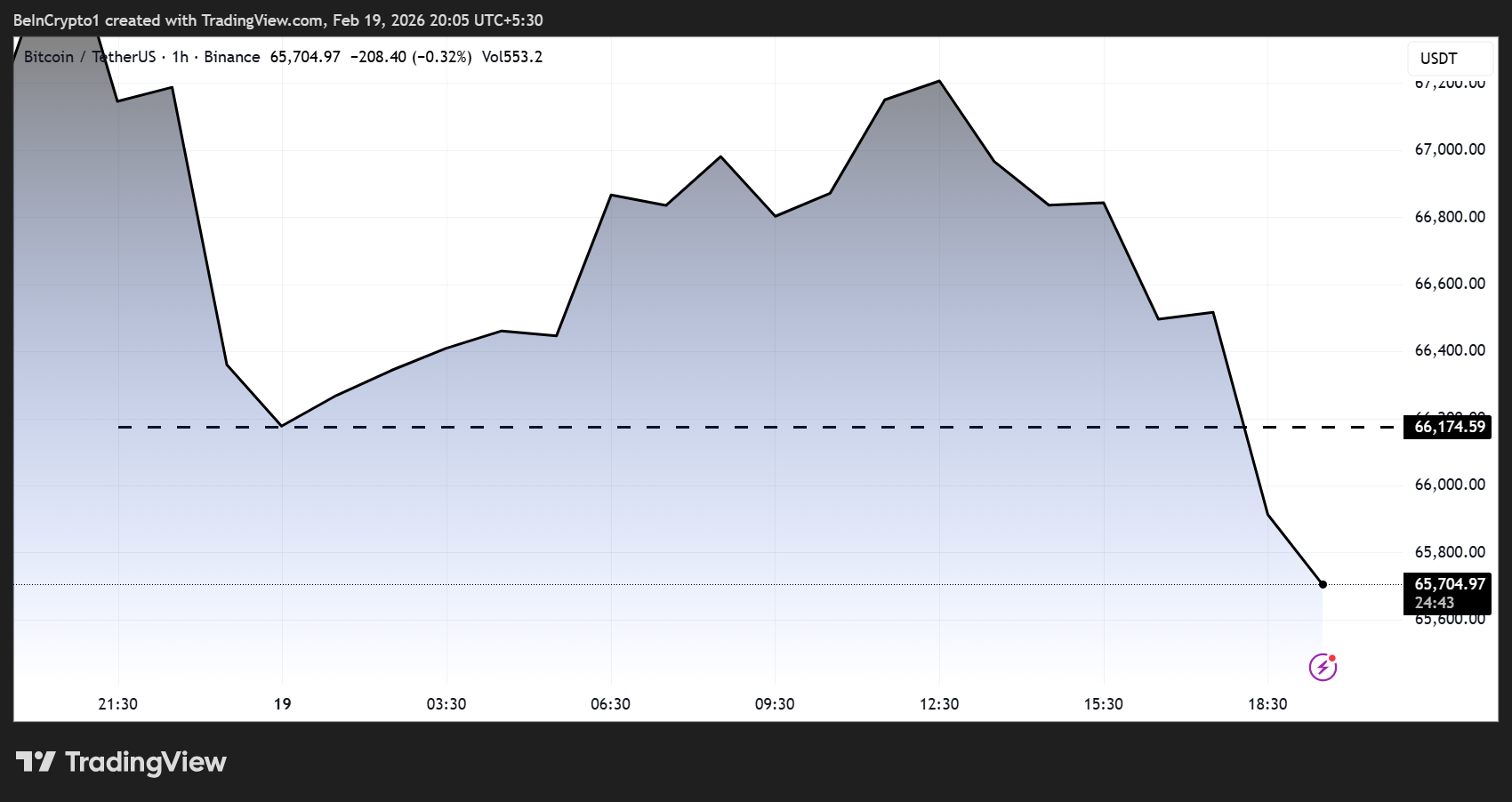
This highlights how technical market sentiment can amplify reactions to economic surprises. The latest macro environment has triggered cautious positioning, with investors reducing exposure amid heightened uncertainty.
The divergence between labor market resilience and a blowout trade deficit illustrates the current macroeconomic tension.
While the labor market data may temper fears of a sudden economic slowdown, the sharp increase in trade deficits could weigh on risk assets if it signals broader demand imbalances.
The interplay of strong employment figures, sub-1% inflation, and a widening trade gap is creating a delicate backdrop for both traditional and digital markets.
Traders will likely watch upcoming economic releases, particularly December PCE and core PCE, and the final Q4 GDP revision reports to gauge whether risk sentiment stabilizes or volatility intensifies further.


Neel Kashkari, president of the Federal Reserve Bank of Minneapolis, offered a blunt take on digital assets, arguing that cryptocurrencies, including bitcoin and stablecoins, have yet to prove real utility.
Speaking at the 2026 Midwest Economic Outlook Summit in Fargo, North Dakota on Thursday, he contrasted the everyday utility of artificial intelligence (AI) tools with cryptocurrencies.
“Crypto has been around for more than a decade, and it’s utterly useless,” he said, while AI “has real long term potential for the U.S. economy.”
After asking the audience who had used AI tools like ChatGPT or Gemini in the past week, Kashkari posed a second question: “raise your hand if you’ve bought or sold something with bitcoin.”
When the discussion turned to payments and stablecoins, Kashkari said he’s unconvinced the technology improves on existing financial rails. “I hear these words and I like, it’s just, it’s like a buzzword salad,” he said. “What can I do with the stablecoin that I can’t do with Venmo today?”
Pressed on stablecoins being used for cheaper and faster cross-border payments, Kashkari argued that proponents quickly concede that those benefits aren’t aimed at U.S. consumers. While he admitted that adoption in emerging countries is rising, the said the tech still faces technical problems.
While stablecoin advocates promise instant transfers, he said, recipients still need to convert into local currency for everyday payments like buying groceries, which can be expensive.
Kashkari’s skepticism stands in stark contrast to the Trump administration, which has increasingly championed bitcoin and U.S. dollar-backed stablecoins as key strategic tools.
Treasury Secretary Scott Bessent argued that regulated stablecoins can extend the greenback’s dominance in global payments and reinforce its status as the world’s reserve currency, strengthening U.S. financial influence. President Trump also signed an executive order in March to create a strategic bitcoin reserve, which Bessent was an advocate for.


Disclosure: This article does not represent investment advice. The content and materials featured on this page are for educational purposes only.
Cloud mining is gaining traction ahead of 2026 as investors seek low-cost, hassle-free access to Bitcoin mining, with platforms like Hashbitcoin leading a growing field of global providers.
Summary
- Hashbitcoin tops the 2026 rankings with daily payouts, transparent operations, and a beginner-friendly setup, plus a $15 trial bonus.
- Major platforms, including BitFuFu, Binance, ECOS, and NiceHash, offer flexible contracts, industrial infrastructure, and stable returns.
- Other notable options, such as Genesis Mining, KuCoin, HashShiny, Bitdeer, and Kryptex, broaden access with low entry costs, automation, and global availability.
As 2026 approaches, cloud mining has rapidly become the preferred choice for investors. Amid the current challenging economic climate, more and more people are seeking secure, low-barrier ways to participate in Bitcoin mining without purchasing expensive ASIC miners or dealing with complex technical setups. Cloud mining perfectly meets this demand, allowing users to easily start earning Bitcoin daily.
With Bitcoin prices continuing to rise and mining difficulty increasing year by year, choosing a reliable cloud mining platform has never been more important. Here’s a compiled list of the top 10 trusted cloud mining platforms for 2026.
1. Hashbitcoin
Hashbitcoin is a leading cloud mining platform designed to provide users with a secure, efficient, and user-friendly mining experience. Developed by MRK Financial Management Limited, Hashbitcoin aims to make cryptocurrency mining accessible to everyone, no hardware, no maintenance, and no prior experience required.
Why Choose Hashbitcoin?
Investors choose Hashbitcoin for three key reasons:
Transparent mining structure
Hashbitcoin provides real hash power supported by robust and eco-friendly mining farms. All mining operations, profit calculations, and payments follow a clear, DAO-governed structure, ensuring transparency with no hidden fees.
Fast daily bitcoin payments
Users can track their earnings in real-time, with profits automatically paid out every 24 hours, helping miners build a stable daily passive income stream.
Beginner-friendly experience
Hashbitcoin offers a simple, guided process that makes it easy for even complete beginners to get started. Anyone can create an account, activate a plan, and start earning immediately. Additionally, all new users receive a $15 free trial bonus to begin mining at no cost.
Key features of Hashbitcoin (2026 Update)
- Total hash power: 16 EH/s
- Active users: Over 10 million worldwide
- Global coverage: Available in more than 220 countries and regions
- Supported cryptocurrencies: Bitcoin (BTC), Litecoin (LTC), Dogecoin (DOGE)
- System type: Fully managed cloud mining system
- Uptime guarantee: High uptime ensures stable mining performance
- Customer support: 24/7 dedicated support team
- New user bonus: $15 free registration bonus for all new users
As one of the few platforms combining massive mining capacity, global reach, and reliable daily payouts, Hashbitcoin has become a top choice for investors worldwide.
How to start earning Bitcoin with Hashbitcoin
Hashbitcoin simplifies the mining process into three easy steps:
Step 1: Register for a free account
New users can visit the Hashbitcoin website and register using their email and password. Once registered, they’ll automatically receive a $15 free mining bonus to start mining right away.
Step 2: Choose a mining plan
Then, they can select a plan that fits their budget and daily earning goals. Once activated, mining begins automatically, requiring no further action.
Step 3: Collect daily Bitcoin earnings
Users’ earnings are settled every 24 hours and credited directly to their accounts. Once they meet the minimum withdrawal limit, they can withdraw their Bitcoin or reinvest it into new mining plans.
Key advantages of Hashbitcoin Mining contracts:
- No hidden fees; all costs are transparent.
- Daily profits are automatically distributed.
- Paid plans refund the initial principal upon contract completion.
- Real-time mining data, including hash rate and earnings, is displayed on the dashboard.
- 24/7 risk control systems ensure secure and stable operations.
Hashbitcoin’s transparency and commitment to prioritizing miners’ interests make it one of the most popular cloud mining platforms on the market.
Hashbitcoin referral and affiliate program
Hashbitcoin offers one of the most lucrative affiliate programs in the mining industry, including:
- Unlimited referrals: Users can refer as many users as they like to join Hashbitcoin.
- Daily passive income: Users can earn up to 3% commission from the profits of their referred paying users.
- Automatic tracking and payments: All referral earnings are calculated automatically and credited to user accounts.
Importantly, referral commissions do not reduce the earnings of the referred users. This allows investors, influencers, and content creators to build an additional source of cryptocurrency income at no extra cost.
2. BitFuFu
BitFuFu is a globally recognized cloud mining brand that operates a wide network of industrial-grade mining facilities. Its partnerships with major hardware manufacturers ensure a reliable and transparent platform.
Key advantages:
- Industrial-grade mining farms
- Flexible contract durations
- Stable daily Bitcoin payouts
3. Binance Cloud Mining
As the world’s largest cryptocurrency exchange, Binance offers official cloud mining services where users can easily purchase hash power and earn daily Bitcoin profits.
Key advantages:
- Strong global reputation
- Transparent fee structure
- Simple onboarding process, ideal for beginners
4. ECOS Mining
ECOS is a regulated cloud mining company based in the free economic zone of Armenia, offering legitimate Bitcoin mining services.
Key features:
- Fully compliant and regulated operations
- Stable daily earnings
- Mobile app for mining management
5. NiceHash
NiceHash is one of the largest hash power marketplaces in the world, connecting buyers and sellers of mining power and offering flexible mining options.
Key advantages:
- Flexible mining contracts
- Fast daily payouts
- Established reputation since 2014
6. Genesis Mining
As one of the earliest cloud mining platforms, Genesis Mining has built a strong reputation with thousands of users worldwide.
Key features:
- Long history of operation
- Support for Bitcoin and multiple altcoins
- Easy-to-manage contract
7. KuCoin Cloud Mining
KuCoin integrates cloud mining into its trading platform, allowing users to rent hash power and earn daily rewards without owning hardware.
Key advantages:
- Beginner-friendly platform
- Secure and transparent mining environment
- Daily Bitcoin payouts
8. HashShiny
HashShiny is a popular platform offering low-cost cloud mining plans with daily Bitcoin rewards, ideal for new users.
Key features:
- Low entry cost
- Automatic mining switching
- Easy registration and operation
9. Bitdeer
Bitdeer provides high-quality cloud mining services supported by top-tier mining farms across multiple continents, catering to both short-term and long-term investors.
Key features:
- Transparent daily earnings
- Flexible contract durations
- Verified industrial-grade mining farms
10. Kryptex Mining
Kryptex combines cloud mining with mining software, offering users flexible earning options.
Key features:
- Fast earnings updates
- User-friendly interface
- Low withdrawal thresholds
Conclusion
After evaluating multiple platforms, Hashbitcoin stands out as the best choice for 2026 due to its:
- Transparent mining structure: High hash power capacity governed by decentralized systems ensures transparency.
- Daily payouts: Earnings are credited every 24 hours, allowing users to withdraw funds anytime.
- Beginner-friendly system: Zero barriers to entry, with a $15 free trial bonus for new users.
- Global trust: Serving over 10 million users in 220+ countries.
Users can sign up on Hashbitcoin to claim their $15 free bonus and start their cloud mining journey today.
Disclosure: This content is provided by a third party. Neither crypto.news nor the author of this article endorses any product mentioned on this page. Users should conduct their own research before taking any action related to the company.


Robinhood’s (HOOD) testnet has logged four million transactions in its first week that its testnet chain is live, CEO of the investment platform Vlad Tenev said on X on Thursday.
The Robinhood Chain, which focuses on tokenization and trading, comes at a time where centralized exchanges are looking to building their own blockchain infrastructure even as the broader Ethereum ecosystem debates its future.
“Developers are already building on our L2, designed for tokenized real world assets and onchain financial services,” Tenev wrote.
Testnets are risk-free environments for developers to test code and experimental features ahead of its mainnet going live. The two stages of a network’s development could be compared to a flight simulator and a commercial flight.
The Robinhood Chain’s testnet has arrived against the backdrop of a larger reckoning in the Ethereum world.
Earlier this month, Ethereum co-founder Vitalik Buterin declared that the protocol’s long-held layer-2 (L2) rollup-centric roadmap “no longer makes sense,” arguing that many rollups have fallen short of full decentralization and that Ethereum’s base layer is scaling faster than expected.
That philosophical shift has fueled chatter in the Ethereum community about what scaling and meaningful decentralization may look like in 2026. But while some in the developer community push for new frameworks, Tenev and other centralized players appear to be doubling down on proprietary chains and tokenized markets as a way to capture users and liquidity.
The contrast underscores a growing divide in crypto’s direction. While Ethereum’s core architects reassess how scaling should evolve on the base layer, major trading platforms are looking to control more of the stack themselves. For exchanges, owning the infrastructure could mean tighter user capture, new revenue streams and greater influence over how tokenized markets take shape.
Read more: Robinhood starts testing its own blockchain as crypto and tokenization push deepens
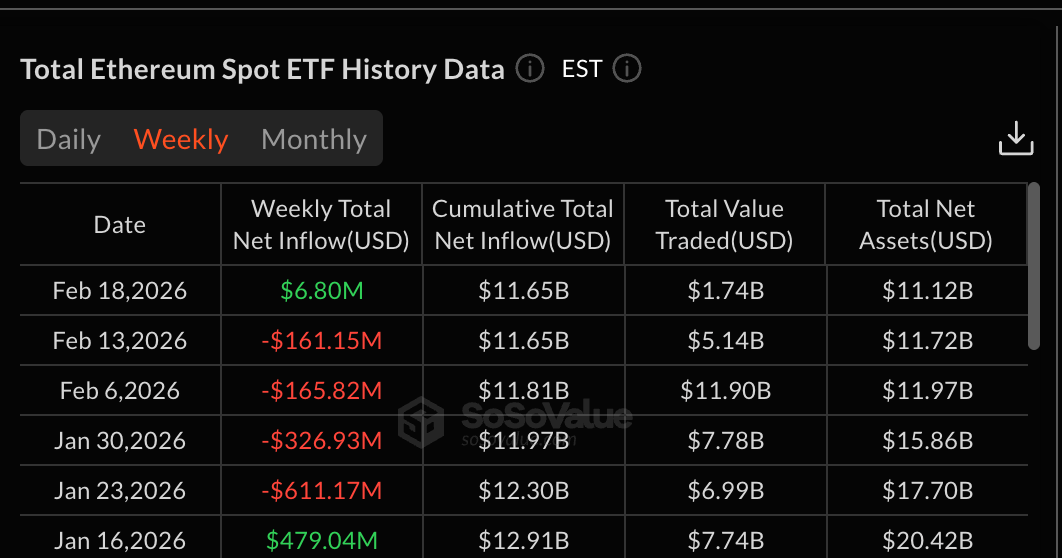
Ethereum has finally broken a four-week streak of continuous ETF outflows. The week ending February 18 recorded inflows, marking the first sign of returning institutional demand. At the same time, whale wallets have started accumulating again. Yet long-term holders continue selling into every Ethereum price bounce.
This creates a direct conflict that could decide whether Ethereum’s price recovery continues or stalls.
Sponsored
Sponsored
ETF Outflow Streak Ends as Whale Accumulation Begins
Ethereum spent four straight weeks under consistent institutional selling pressure. Spot Ethereum ETFs recorded net outflows in the weeks ending January 23, January 30, February 6, and February 13. This sustained selling reflected weak institutional confidence and coincided with Ethereum’s broader price decline.
That trend has now changed. The week ending February 18 saw a net inflow of $6.80 million. This shift suggests institutional selling pressure has paused, at least temporarily. When ETF flows turn positive after extended outflows, it often signals early stages of stabilization. However, the inflow figures are still weak and not at par with the outflow strength, yet.
Want more token insights like this? Sign up for Editor Harsh Notariya’s Daily Crypto Newsletter here.
At the same time, whale accumulation has returned. Data shows wallets holding large amounts of Ethereum increased their holdings from 113.50 million ETH on February 15 to 113.63 million ETH currently. This represents an increase of 130,000 ETH. At the current price, this equals roughly $253 million worth of Ethereum accumulated in just a few days.
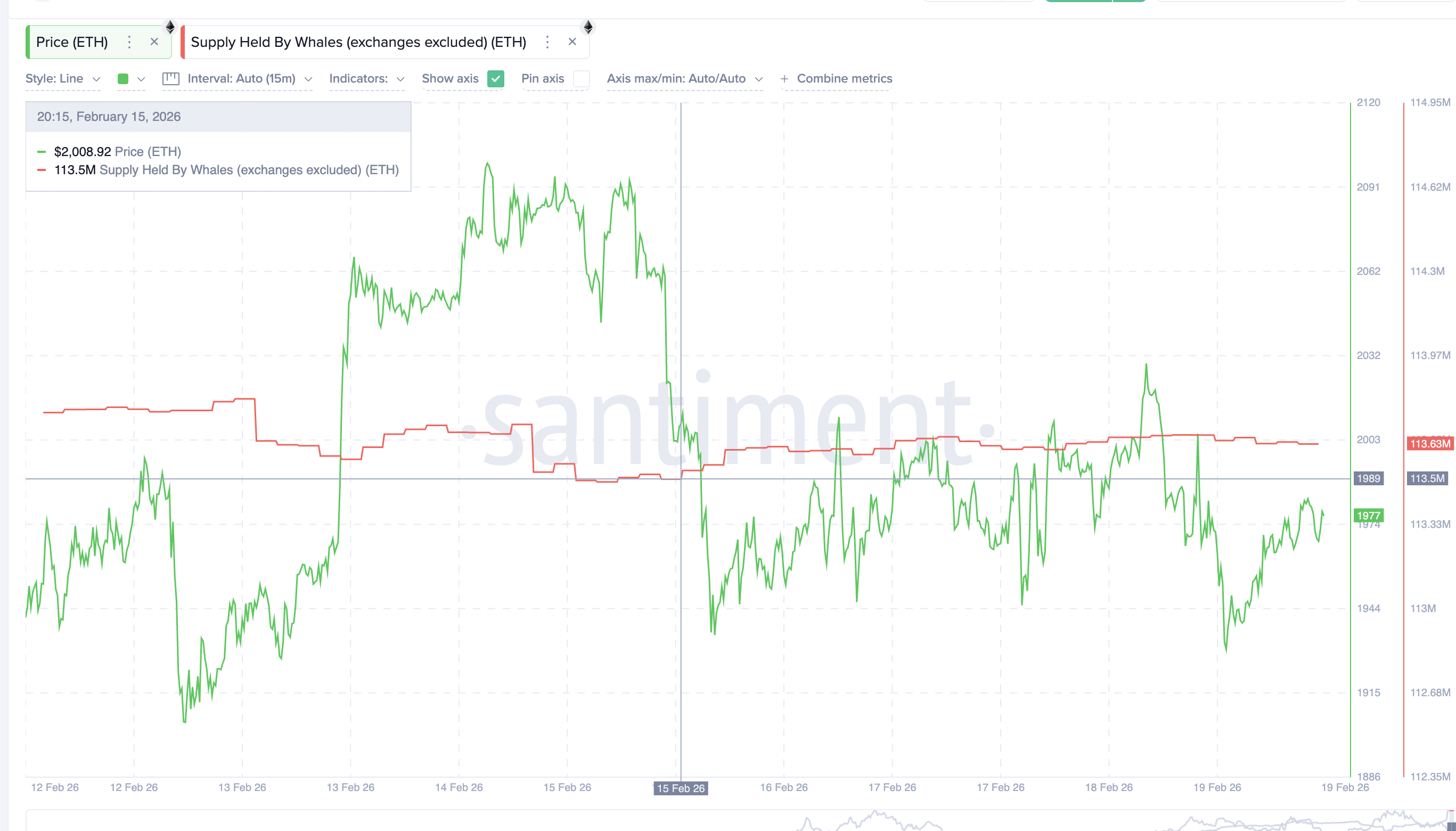
Whale accumulation during weakness is important because large investors often position early before broader recoveries begin. However, this growing optimism faces resistance from another group of investors.
Sponsored
Sponsored
Ethereum Price Flashes Bullish Divergence, But Long-Term Holders Continue Selling
Ethereum’s 8-hour chart shows a key momentum signal that has historically preceded price bounces.
Between February 2 and February 18, Ethereum’s price formed a lower low. This means the price dropped below its previous support level. But during the same period, the Relative Strength Index (RSI) formed a higher low. The RSI measures buying and selling strength and this pattern is called bullish divergence.
This signal has already proven effective twice earlier this month. The first bullish divergence formed between February 2 and February 11. Ethereum’s price then rallied 11%. The second divergence appeared between February 2 and February 15. This led to another 6% recovery.
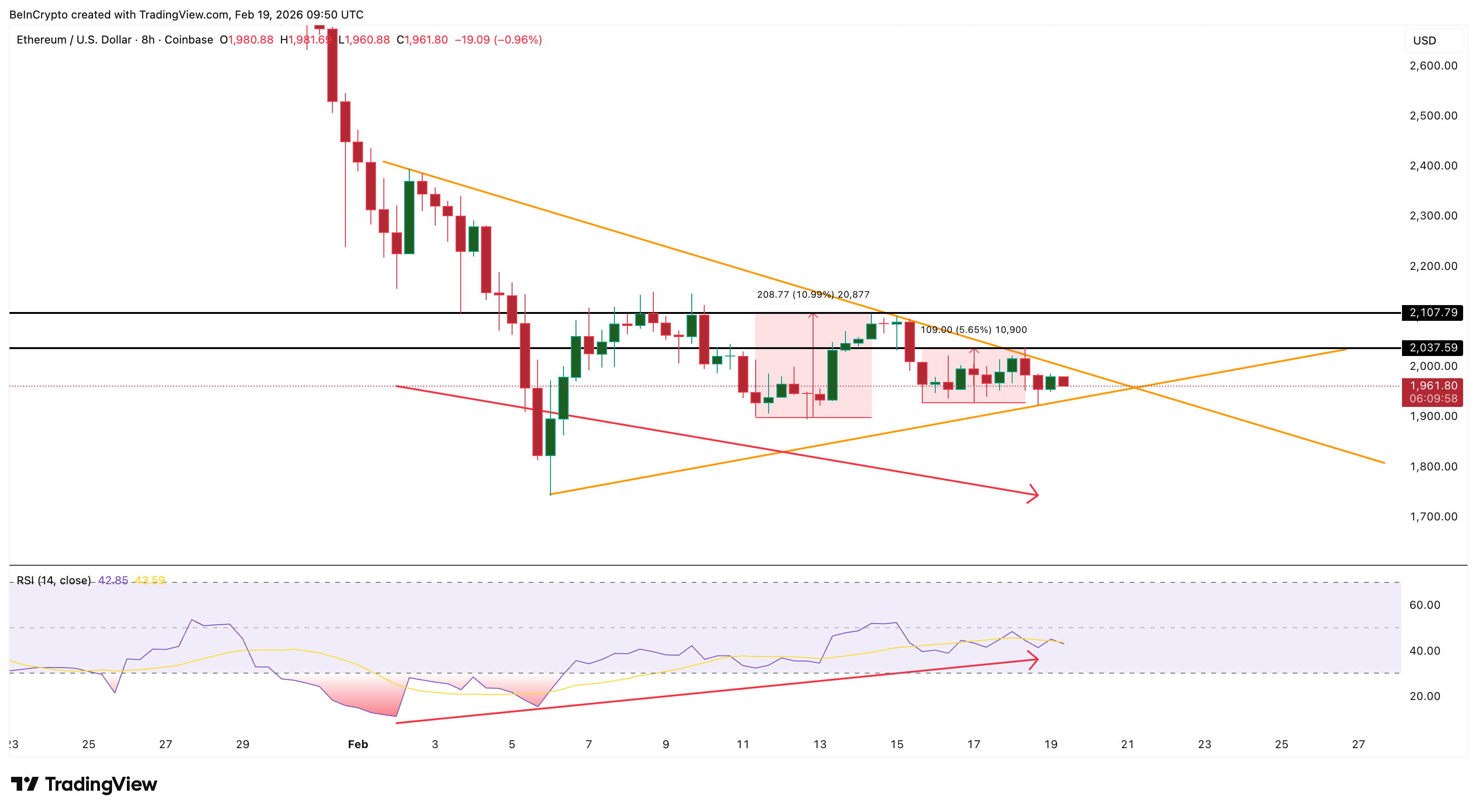
Both these ETH bounces happened while ETF outflows were still ongoing, showing that buyers were already attempting to regain control. Now, ETF inflows have returned, and whales are accumulating. This increases the probability that another bounce attempt could happen.
Sponsored
Sponsored
However, long-term holders are moving in the opposite direction. The Hodler Net Position Change measures whether long-term holders are accumulating or selling. A negative value means long-term holders are distributing their holdings.
On February 17, long-term holders sold 34,841 ETH over the rolling 30-day period. By February 18, that number increased to 38,877 ETH. This represents a sharp increase in selling pressure in just one day, even as bullish divergence signals appeared.
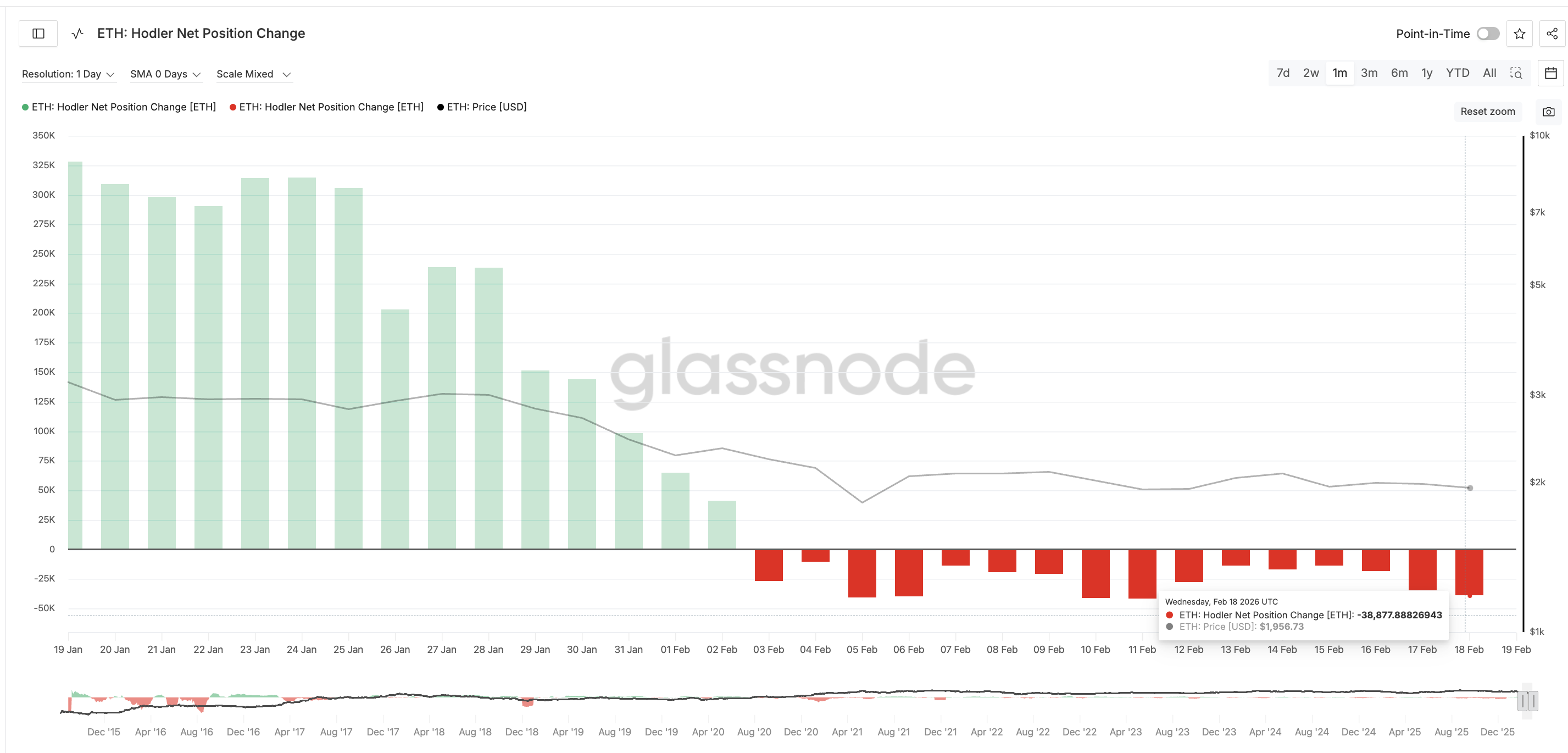
This shows long-term holders are using price strength to exit positions. The same behavior was visible during earlier February rallies. Both previous bounces failed to sustain upward momentum because long-term holder selling capped the recovery.
This creates a clear conflict. Whale accumulation and ETF inflows support recovery, while long-term holder selling limits upside potential, hinting at a clear risk. This conflict is now reflected directly in Ethereum’s price structure.
Sponsored
Sponsored
Triangle Pattern Reveals Critical Levels
Ethereum is currently trading inside a symmetrical triangle pattern on the 8-hour chart. This pattern forms when the price moves between converging support and resistance lines.
A symmetrical triangle represents balance between buyers and sellers. In Ethereum’s case, buyers include whales and institutional investors returning through ETF inflows. Sellers include long-term holders distributing their positions.
This balance explains why Ethereum remains stuck in consolidation.
The first key resistance level sits near $2,030. This level stopped the previous recovery attempt. A successful move above this level would signal strengthening momentum and also confirm the triangle breakout. The next major resistance stands at $2,100, another bounce blocker. Breaking this level would confirm a stronger recovery and could open the path higher.
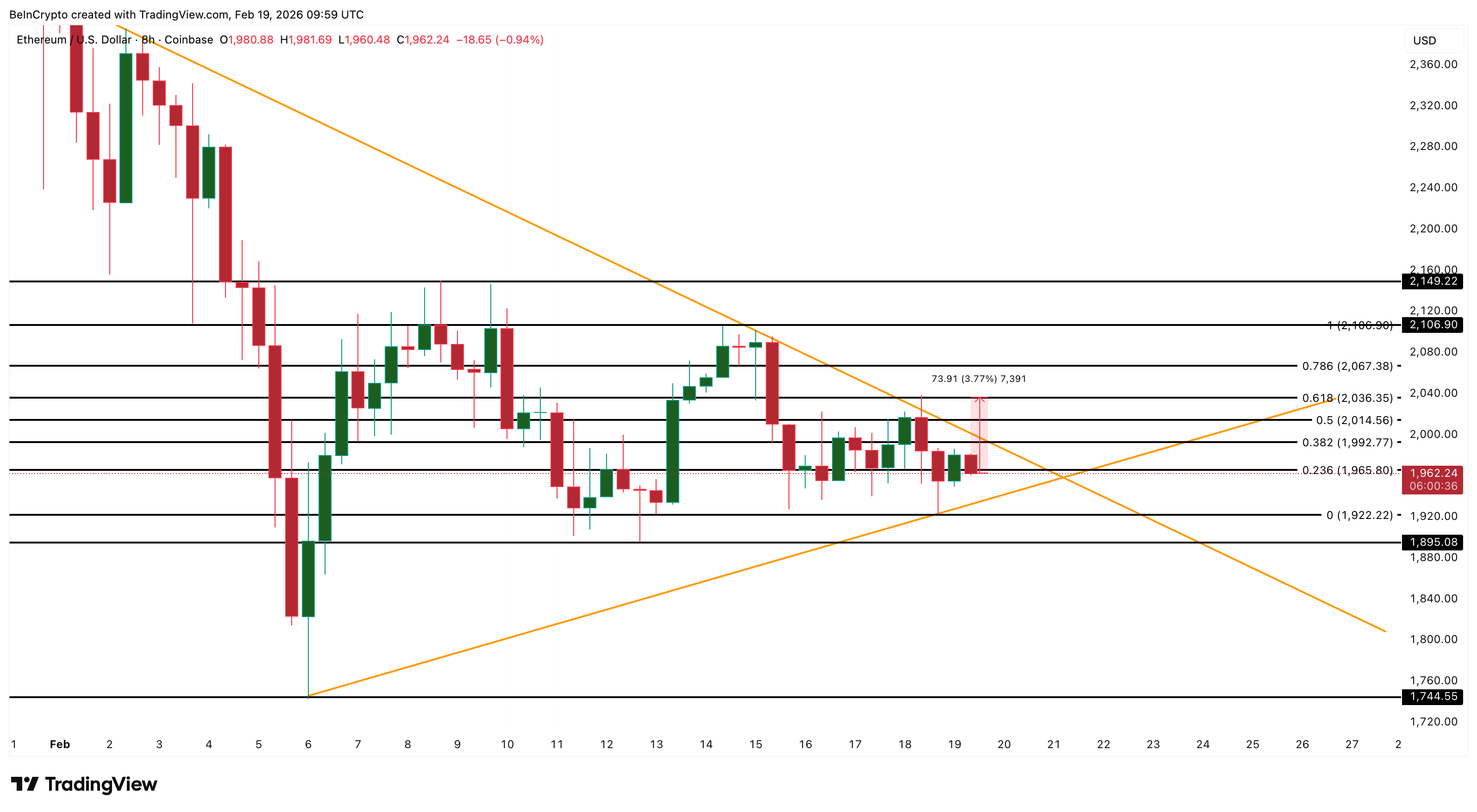
However, downside risks remain. Immediate reclaim level sits at $1,960. Failure to hold this level could push Ethereum down to $1,890. A deeper decline could extend toward $1,740 if selling pressure accelerates.
Sui crypto just stepped into the big boys area.
the first SUI ETFs are now live in the US, Canary Capital and Grayscale both launched products today. And they come with staking yield baked in.
Key Takeaways
- Canary Capital’s SUIS is actively trading on the Nasdaq, while Grayscale’s GSUI launched on the NYSE after converting from a trust.
- Both funds offer staking rewards, a first-of-its-kind feature for US spot crypto ETFs that allows investors to capture network yield.
- The listings arrive as SUI trades near $0.95, down roughly 40% over the last 30 days amidst broader altcoin market capitulation.
Why Sui Crypto ETFs With Staking Matter
While spot Bitcoin and Ethereum ETFs have attracted over $140 billion in inflows, they notably lack staking mechanisms due to initial regulatory hurdles.
The new SUI ETFs from Canary and Grayscale actually can stake the tokens. They tap into Sui delegated proof of stake system and earn rewards. That yield can help offset the usual management fees.
For institutions, that is a big deal. They do not just want price exposure. They want income too.
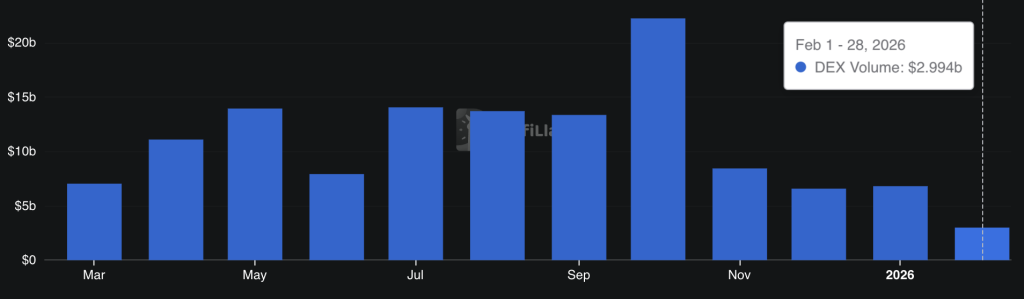
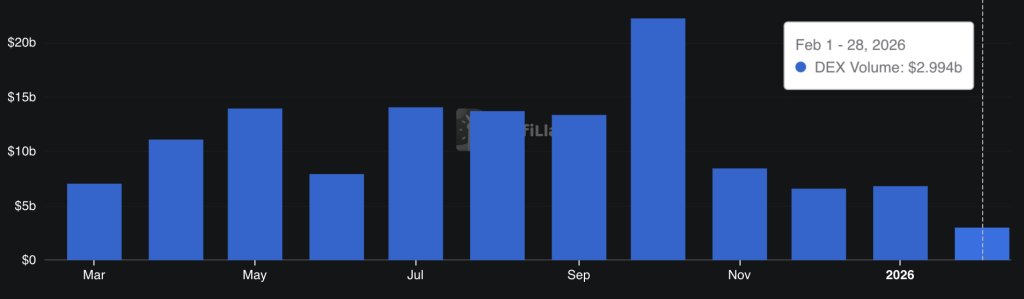
Demand for smarter products is rising rapidly. However, the SUI chain itself has been in decline over the past couple of months. We’re now in mid-January, and DEX volume is at $3B. It may outperform this January, but it is still lower than last year’s numbers.
Breaking Down the ETF Structure
Canary Capital’s ETF is live on Nasdaq under SUIS. It sits under the 1940 Act, which means tighter oversight.
That usually attracts the more cautious money. CEO Steven McClurg made it clear. Investors get direct access to net staking rewards.
At the same time, Grayscale flipped its old Sui trust into an ETF called GSUI on the NYSE. The fee is 0.35%, waived for the first three months or until assets hit $1B.
And here is the kicker. 100% of the tokens were staked at launch. Classic Grayscale move. Turn legacy trusts into spot ETFs and scale fast.
Discover: Here are the crypto likely to explode!
The post Canary and Grayscale Launch Sui ETFs With Staking Rewards in the US appeared first on Cryptonews.
Dash, a layer-1 blockchain protocol with privacy-preserving features, announced on Thursday the integration of Zcash’s “Orchard” shielded pool into the Dash Evolution chain, a secondary layer on the L1 network that supports smart contract functionality.
The integration will go live following the completion of cybersecurity audits and is expected to launch in March, according to an announcement shared with Cointelegraph.
Initially, the integration will support basic transfers of Zcash (ZEC) from one party to another on the Evolution chain, with subsequent upgrades adding Orchard’s privacy features for tokenized real-world assets (RWAs), the announcement said.
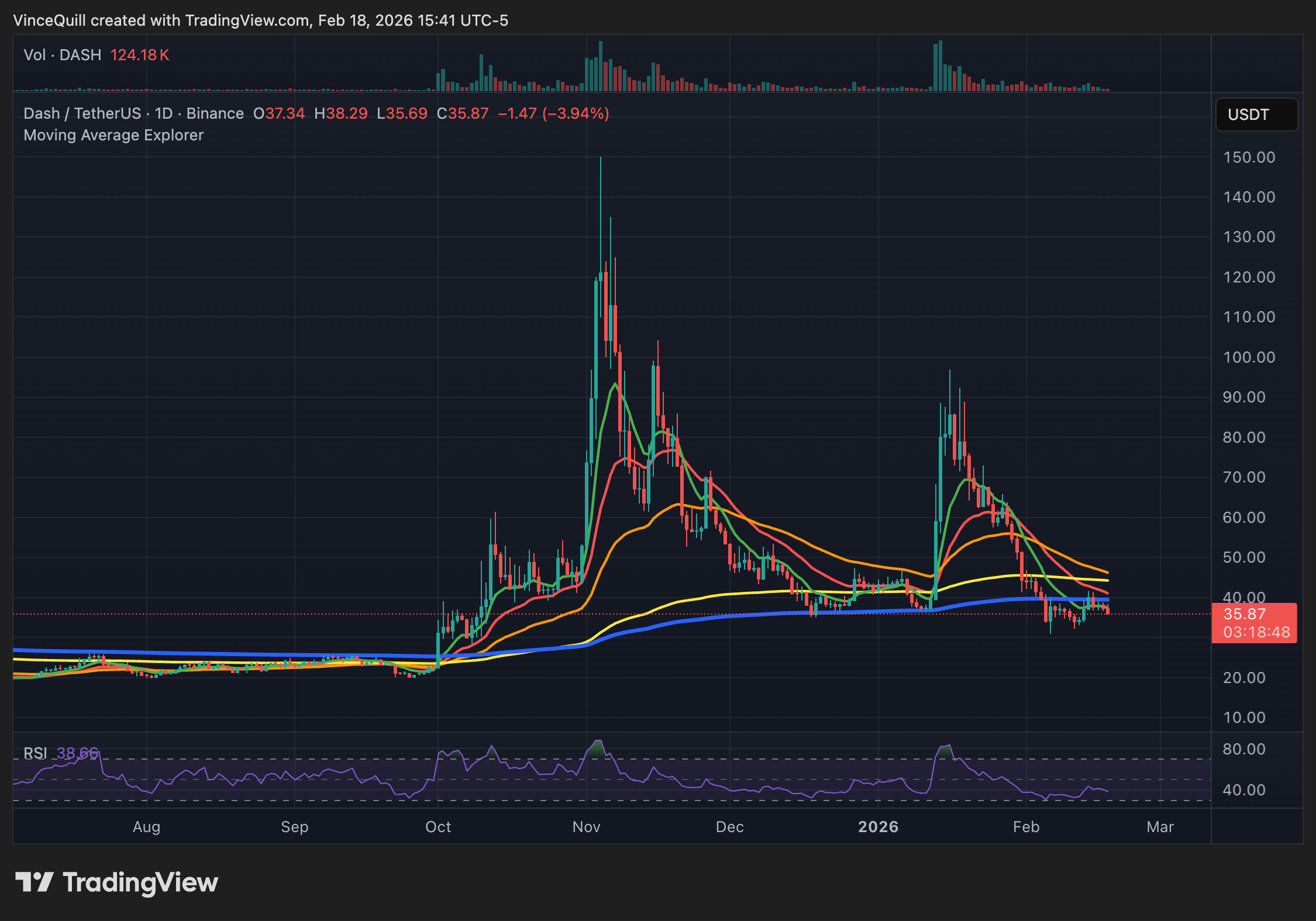
The price of the DASH (DASH), the native token of the network, surged by over 125% in January. Dash briefly reached a local high of about $96 on the Binance crypto exchange before retracing to current levels.

Onchain privacy protocols and privacy blockchain tokens gained significant momentum in 2025 and early 2026, with proponents of the technology framing it as a response to increased financial surveillance from governments and corporations.
Related: Starknet taps EY Nightfall to bring institutional privacy to Ethereum rails
Lack of privacy is holding back crypto payments, while the tech comes under fire
“Lack of Privacy may be the missing link for crypto payments adoption,” according to Changpeng Zhao (CZ), the co-founder of the Binance cryptocurrency exchange.
Businesses will not adopt blockchain technology unless privacy-preserving tools can shield payments, which contain sensitive information about employee compensation, CZ said.
Transaction data could also reveal information about key partnerships and other trade secrets to competitors, Avidan Abitbol, a former business development specialist for the Kaspa cryptocurrency project, told Cointelegraph.
Agata Ferreira, assistant professor at the Warsaw University of Technology, argues that true financial privacy is achieved through a combination of regulation, culture and code, rather than simply protecting onchain metadata.
User anonymity can still be breached, and ownership of privacy tokens can be determined through forensic analysis and law enforcement investigation, according to critics of the technology, like author and Bitcoin (BTC) advocate Saifedean Ammous.

In January 2026, Dubai’s Financial Services Authority (DFSA), a financial regulator for the emirate, banned privacy tokens, including ZEC and XMR (XMR), the native token of the Monero privacy protocol.
The ban does not prevent citizens from holding the tokens, but does prohibit regulated crypto exchanges from selling the tokens to new users, highlighting the tension between state regulators and privacy technology.
Magazine: 2026 is the year of pragmatic privacy in crypto: Canton, Zcash and more

INSANE XRP NEWS!!! USA MOVING FORWARD WITH XRP???? (THIS IS HUGE)

Refuse collectors experiencing ‘aggressive and threatening behaviour’

Orphaned Baby Macaque Punch-kun Goes Viral at Japanese Zoo


-

 Video3 days ago
Bitcoin: We’re Entering The Most Dangerous Phase
-

 Tech5 days ago
Luxman Enters Its Second Century with the D-100 SACD Player and L-100 Integrated Amplifier
-

 Crypto World2 days ago
Can XRP Price Successfully Register a 33% Breakout Past $2?
-

 Sports3 days ago
GB's semi-final hopes hang by thread after loss to Switzerland
-

 Video6 days ago
The Final Warning: XRP Is Entering The Chaos Zone
-
 Tech3 days ago
The Music Industry Enters Its Less-Is-More Era
-

 Business2 days ago
Infosys Limited (INFY) Discusses Tech Transitions and the Unique Aspects of the AI Era Transcript
-

 Entertainment1 day ago
Kunal Nayyar’s Secret Acts Of Kindness Sparks Online Discussion
-

 Video2 days ago
Financial Statement Analysis | Complete Chapter Revision in 10 Minutes | Class 12 Board exam 2026
-

 Crypto World6 days ago
Bhutan’s Bitcoin sales enter third straight week with $6.7M BTC offload
-

 Tech1 day ago
Retro Rover: LT6502 Laptop Packs 8-Bit Power On The Go
-
 Sports13 hours ago
Clearing the boundary, crossing into history: J&K end 67-year wait, enter maiden Ranji Trophy final | Cricket News
-

 Entertainment19 hours ago
Dolores Catania Blasts Rob Rausch For Turning On ‘Housewives’ On ‘Traitors’
-

 Business1 day ago
Tesla avoids California suspension after ending ‘autopilot’ marketing
-

 Crypto World6 days ago
Kalshi enters $9B sports insurance market with new brokerage deal
-
 NewsBeat4 days ago
The strange Cambridgeshire cemetery that forbade church rectors from entering
-

 Crypto World22 hours ago
WLFI Crypto Surges Toward $0.12 as Whale Buys $2.75M Before Trump-Linked Forum
-
 Crypto World7 days ago
Ethereum Price Struggles Below $2,000 Despite Entering Buy Zone
-
 NewsBeat4 days ago
Man dies after entering floodwater during police pursuit
-

 NewsBeat5 days ago
UK construction company enters administration, records show