Crypto World
How to Build a LATAM Crypto Exchange Software That Scales Fast?

Cryptocurrency trading volumes in Latin America grew 63% and crossed $1.5 trillion between July 2024 and June 2025, establishing the region as one of the most crypto-progressive regions. In February 2026, Argentina, Brazil, and El Salvador dominated the headlines with noteworthy cryptocurrency developments. El Salvador plans a $100M tokenized investment program for localized SMEs, where Brazil considers eliminating crypto taxes and establishing a strategic Bitcoin reserve, and Argentina revokes the right to receive salaries in digital wallets. These signals demonstrate how LATAM governments and businesses are actively experimenting with new financial models.
Crypto finance group, a part of Deutsche Börse Group, entered LATAM after it sensed a “strong, concrete demand from institutions for well-structured, compliant crypto offerings”, in the words of Vander Straeten, the CEO.
If institutional capital and policy momentum are converging this fast, it is clear that LATAM crypto exchange development is commercially compelling in 2026 and beyond. However, this opportunity materializes only for platforms designed around the region’s real adoption mechanics.
What Actually Drives LATAM Digital Asset Adoption?
Crypto exchange software businesses can’t reach 200K users in LATAM by listing region-popular pairs or tokens or by increasing the leverage. The region’s digital asset adoption curve is driven by currency stability, cross-border transfer dependency, and mobile-first fintech habits.
By the end of 2025, LATAM had approximately 70 million unique crypto users, up from 73.7 million in Q3 2025 and 57.7 million earlier in the year. But the growth didn’t come from speculation but utility.
1. Inflation Hedging Via Stablecoins
Currency volatility remains the primary entry trigger in markets like Argentina, where inflation has stayed structurally high. In such markets, stablecoins function as everyday digital dollars rather than trading assets.
Stablecoins dominated more than 90% of exchange flows in Brazil, 62% in Argentina, and 48-60% region-wide. This proves that most users in the Latin American region hold balances for savings and payments, not trading.
2. Stablecoin Remittances Replacing Cash Corridors
LATAM received an estimated $165.1 billion in remittances in 2024, and another research predicted it would reach $174.4 billion by the end of 2025. Crypto has been increasingly used to bypass high-fee corridors.
Mexico, which is the second-largest corridor from the US, alone totaled $63.3 billion in remittances in 2024-25. Bitso, a leading crypto exchange software, handled over $6.5 billion in US-Mexico remittances, which totaled in 2024, representing more than 10% of the total corridor volume.
Stablecoin-based remittances cut costs by 50-80%, dropping from traditional 6-7% averages to 1-3%. High-fee LATAM corridors even benefit from 76% savings with stablecoins.
3. P2P and Social Money Behavior
Money movement in Latin America is socially mediated between families, communities, and informal networks, rather than institutionally intermediated. Crypto leads the peer-to-peer money movement in the region due to the popularity of social tipping and community payments. Many users from the region adopt wallets through contacts and not financial products.
Tron has sustained as a high-volume blockchain infrastructure supporting 78% of P2P transfers, which is an essential crypto exchange development feature for LATAM.
4. Mobile-Native Onboarding Expectations
LATAM fintech usage is mobile-centric, with 70% regional mobile penetration, and strong familiarity with chat-based payments. More users are expecting WhatsApp-style transfers and low-literacy onboarding flows with instant notifications and real-time balances in the application. So, crypto exchange software businesses in the region are competing with neobanks, not global trading apps.
In short, LATAM cryptocurrency exchange software scales when they behave like payment rails, not a trading terminal.
Essential Crypto Exchange Development Features Required to Reach 200K Users in Latin America
As stated above, the crypto adoption in LATAM comes from everyday dollar usage, social transfers, and entertainment-linked finance. The core stack, therefore, must combine payments, social, savings, custody, and engagement primitives from day 1.
1. Stablecoin-Centric Wallet Layer
The primary crypto exchange software development feature in LATAM isn’t order books but stablecoin wallets. Exchanges that nurture their in-built centralized or decentralized wallets can capture the audience that approaches crypto exchange apps as a dollar account. Here are essential crypto wallet components for LATAM exchanges:
- Multi-asset balances (USDT, USDC, crypto, and fiat)
- USD-denominated portfolio view as default
- Instant stablecoin swaps
- Near-zero-fee internal transfers
- Frictionless Onboarding
- Contact-based sending (phone / username)
2. Remittance & P2P Transfer Engine
As deduced from the statistics above, remittances create the strongest viral loop in the region. Peer-to-peer transfer engine forms another essential component for LATAM crypto exchange development. These features fetch revenues and act as customer magnets at the same time as each remittance/payment sender typically onboards 1-3 new users. So, for businesses planning to launch their digital asset exchange, the following capabilities are indispensable:
- Cross-border stablecoin transfers
- QR / phone-number payments
- P2P marketplace matching
- Chat-based or whatsapp style P2P transfers
- Local cash-out counterparties
- Corridor-specific liquidity routing
3. Local Fiat Rails
Instant and cost-efficient fiat access determines retention for crypto exchanges in LATAM. Users quickly abandon platforms that delay deposits and withdrawals beyond minutes or fail to support end-to-end money movement. For this reason, any cryptocurrency exchange software development targeting this region must implement Pix-style crypto-fiat rails as a foundational layer. These are the basic requirements:
- Brazil Pix-like instant rails
- Bank transfer APIs (SPEI-equivalent markets)
- Local PSP integrations
- Real-time deposit confirmation
- Instant fiat↔stablecoin conversion
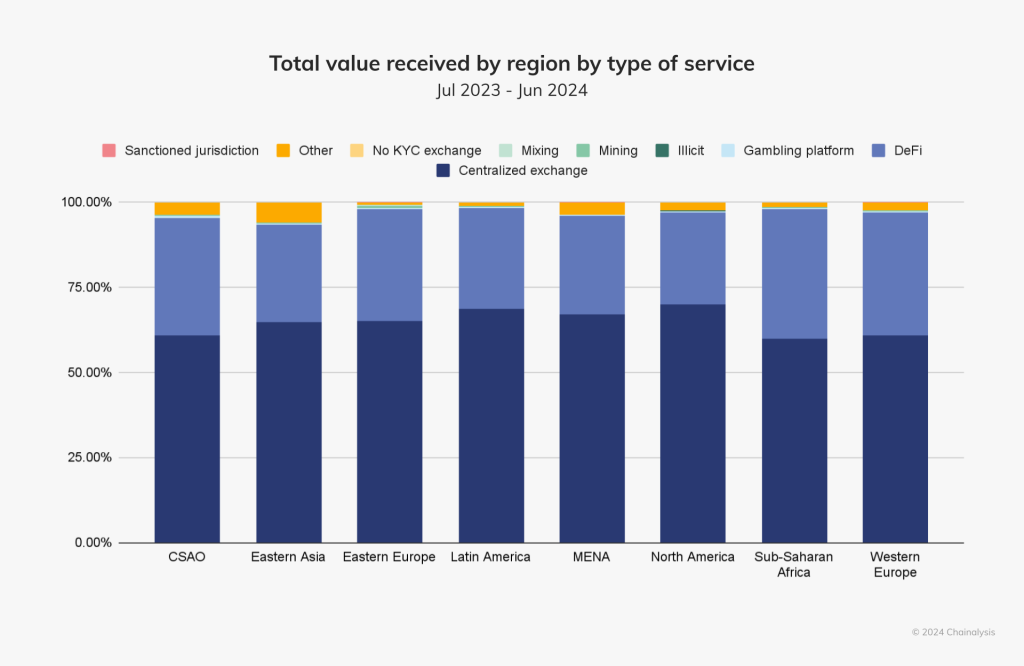

Centralized exchanges can seamlessly be integrated with existing banking systems, leveraging APIs, and can also include fiat-stablecoin/crypto rails effortlessly. This is one of the reasons why centralized exchanges (CEXs) are the most popular crypto services in the Latin American region.
4. Social & Creator Money Layer
In countries like Latin America, where money flows socially before it flows financially, community finance features accelerate onboarding and adoption. Money movement mostly occurs within creator communities, family groups, and informal networks rather than purely financial contexts. As a result, cryptocurrency exchange software in the LATAM region increasingly functions as a social finance platform where users interact, tip, and transact around personalities and communities. Implementing creator monetization and community finance tools, along with the following features inside the exchange helps exchanges engage a wider audience.
- Creator wallets with public handles
- Stablecoin tipping & micro-payments
- Paid groups or gated channels
- Revenue split or referral distribution contracts
- Influencer referral wallets
- Community pools or shared wallets
Crypto trading platforms can also integrate Instagram-like feeds into their existing fintech platform to enhance the social effect of the platform. This way, the above-mentioned features make more sense.
5. Prediction Markets
In the LATAM region, speculative behavior is culturally linked to sports outcomes and macroeconomic events rather than traditional financial instruments. Prediction markets embedded inside crypto exchange software, therefore, attract users who may not engage with spot or derivatives trading but are comfortable with simple outcome-based participation. Cryptocurrency exchanges can create familiar entry points into digital asset usage and still generate liquidity, engagement, and revenue with the following:
- Football match outcome markets
- Election/inflation / FX outcome markets
- Simple yes/no contracts like Robinhood
- Stablecoin settlement pools
- Social rankings or leaderboards
6. Dollar Savings & Yield UX
Stablecoin savings represent one of the strongest retention drivers in inflation-prone Latin American economies, where users seek protection from local currency devaluation. Many users adopt crypto exchange wallets primarily to store digital dollars rather than to trade or transact. Crypto exchange software solutions that integrate accessible yield or savings interfaces can therefore retain liquidity and transition utility users into broader financial activity with gamification and rewards.
- One-tap stablecoin savings or vault accounts
- Transparent APY display in USD
- Recurring local-to-USD conversion
- Flexible withdrawals or redemption options
- Risk tier or yield source labeling
A LATAM exchange that reaches 200K users behaves as a dollar wallet, remittance network, social finance app with trading infrastructure and engagement layers operating in the background rather than the foreground.

Also Read>>>How To Launch Crypto Services With CNV-Ready White Label Exchange?
What are the UX Principles that Support Sustainable and Fast LATAM Crypto Exchange Software Growth?
As stated earlier, most LATAM cryptocurrency exchange software users are leveraging trading platforms for their financial needs. Exchanges that aim to scale quickly in the region must mirror familiar mobile money patterns and minimize cognitive and compliance friction at entry. Let’s again highlight the UX essentials for LATAM cryptocurrency exchange development:
1. USD-first balances as users in inflationary markets think in dollars even when transacting locally. Displaying portfolios and transaction values in USD by default aligns the app with real financial perception.
2. Simplified KYC entry and verification allow low-limit onboarding and accelerate first transactions while deferring heavier compliance steps to later stages of engagement.
3. WhatsApp-like transfers, chat-style sending, contact-based payments, and conversational confirmations reduce learning effort. Such financial experience matches how users already communicate over messaging apps.
4. Low-literacy-friendly flows can be created with icon-led actions, guided steps, and clear visual confirmations. This enables users across varied education levels to complete transfers and deposits without confusion.
5. Offline-friendly lightweight alerts, queued transaction updates, and low-bandwidth operation ensure efficient operation in environments with inconsistent connectivity.
Launch a LATAM-ready crypto exchange with Antier’s production-grade infrastructure
Closing: Why Most LATAM-Based Crypto Exchange Software Fail & How They Can Reach 200K Users in 6 Months
Many cryptocurrency exchange software launches in Latin America underperform, not because the markets lack demand, but because platforms are built around trading assumptions instead of regional money behavior. So, this is what businesses must avoid during crypto exchange development and launch;
- Launching trading before payments
- Providing USD as a secondary balance
- Slow fiat rails
- Heavy KYC at entry
- No cash-out liquidity
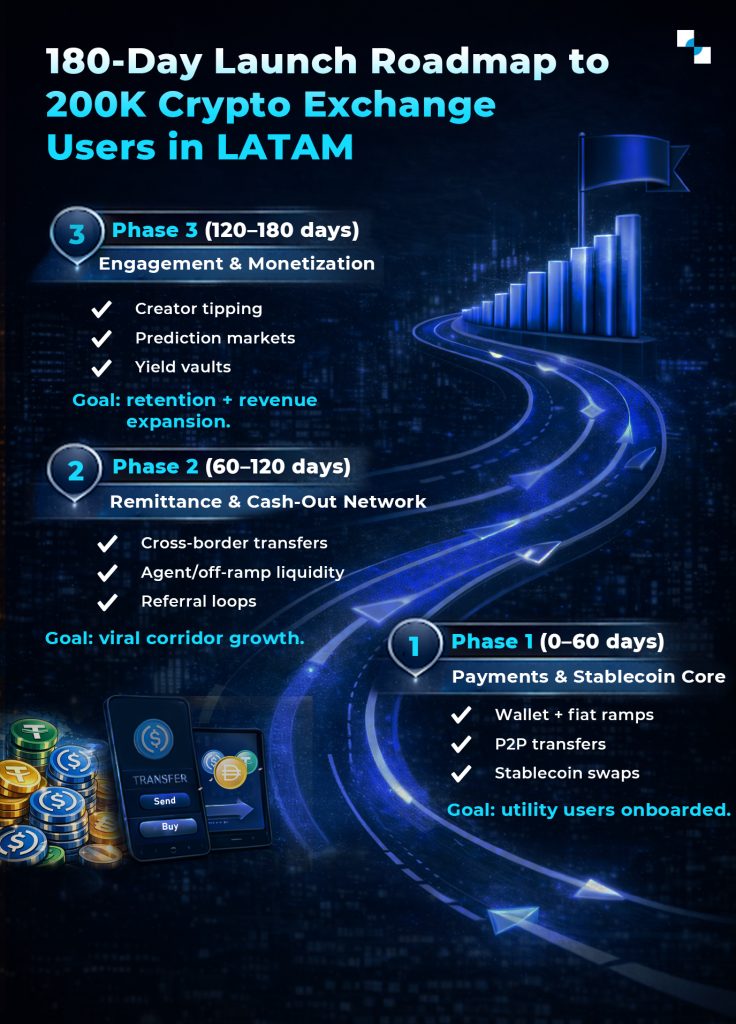
To make a crypto exchange software development project scale to hundreds of users in the first 180 days, crypto exchanges must primarily launch stablecoin wallets, local fiat rails, remittance loops, and social finance features.
This is why the fastest-growing LATAM cryptocurrency exchanges function less like trading terminals and more like payment networks layered with savings and social money features. Trading remains present, but it operates as a monetization layer that activates after users already rely on the app for everyday financial activity.
Antier offers LATAM-ready white label cryptocurrency exchanges and custom development solutions with the exact stack required to reach 200K users in 6 months. We support the full lifecycle from development and launch to growth and compliance. Connect today!
Frequently Asked Questions
01. What was the growth percentage of cryptocurrency trading volumes in Latin America between July 2024 and June 2025?
Cryptocurrency trading volumes in Latin America grew by 63% and crossed $1.5 trillion during that period.
02. What are some notable cryptocurrency developments in Argentina, Brazil, and El Salvador as of February 2026?
El Salvador plans a $100M tokenized investment program for SMEs, Brazil is considering eliminating crypto taxes and establishing a Bitcoin reserve, and Argentina has revoked the right to receive salaries in digital wallets.
03. What factors drive digital asset adoption in Latin America?
Digital asset adoption in LATAM is driven by currency stability, dependency on cross-border transfers, and mobile-first fintech habits, rather than speculation.