
Crypto World
Europe’s top regulator questions Polymarket and Kalshi’s EU access, warns of authorization gaps



ESMA said that event contracts may fall under existing EU binary-options bans, crypto-asset frameworks like MiCA or national gambling laws.


OpenAI is taking aim at some of Wall Street’s most labor-intensive tasks with a new version of ChatGPT designed to research companies, analyze financial data and generate the presentations that investment bankers rely on.
The product unveiled Thursday, called ChatGPT for Financial Services, is a tailored version of its enterprise product, ChatGPT Work, that was made with “design partners” Morgan Stanley and Evercore, according to OpenAI’s Vice President of Product, Nick Turley. It uses the AI company’s latest and most advanced model, GPT-6 Astra.
The rollout puts OpenAI deeper into territory traditionally occupied by Wall Street’s entry-level bankers, the recent college graduates called analysts and associates that the industry has employed for decades to research deals and create pitchbooks. It also showcases the company’s continued push into enterprise offerings as it gears up for what is widely expected to be a blockbuster IPO.
“We’re effectively teaching ChatGPT to research like an analyst and back up its conclusions like an analyst as well,” Turley said during a briefing announcing the new product.
OpenAI has spent much of the last year racing to win over business customers in the fiercely competitive enterprise market, where it’s working to fend off rivals including Anthropic and Google. Anthropic announced its own tailored solution for Wall Street, Claude for Financial Services, last year.
Sarah Friar, OpenAI’s finance chief, told investors in August that the company’s enterprise business accounted for more revenue than its consumer business, which took off following the launch of ChatGPT in 2022.
Turley told reporters during the briefing OpenAI plans to release tailored solutions for “a number of sectors” beyond financial services.
In a live demonstration of the new offering, Turley showed the platform analyzing a potential M&A target, pulling financial figures from industry-standard data sources and creating a formatted PowerPoint deck based on a bank’s preformatted style guide.
“It’s very easy to make slides that look good, but it’s much harder to make slides [that] actually make sense,” Turley said. “To get here, ChatGPT had to choose the relevant peers. It had to pull the prices into a spreadsheet. It had to check the chart against the data, and it had to explain the selloff and the rebound.”
Banker disruption?
What separates this version from the product it’s based on, ChatGPT Work, is native data access from LSEG, Daloopa and Pitchbook that furnishes the system with things like financial statements and earnings transcripts, as well as automated access to users’ existing data subscriptions.
Other features tailor-built for finance include citations that allow users to trace data back to source filings and audit charts, as well as administrative controls for sensitive deal materials.
While Turley said that there was “a ton of demand” for this version of ChatGPT, which is initially geared toward investment banking and equity research, he declined to name banks that have signed on for it.
When asked by CNBC whether this latest version of ChatGPT would reduce the need for investment banks to hire junior bankers, Turley framed the release as an efficiency boost that maximizes productivity per employee.
“If you study the life of an analyst or of a banker, depending on the industry, they’re working 100-hour weeks,” Turley said. “I think in the same way that Microsoft Excel transformed the industry and allowed them to produce better analysis faster, you will see technology like this do the same.”
Still, the product raises fundamental questions for an industry long built on a rigorous apprenticeship model. If generative AI can execute multistep tasks like research and pitchbook formatting in minutes, Wall Street will be forced to rethink how it trains, and how many it needs, of its next generation of dealmakers.
Last month, Chris Churchman, the Goldman Sachs partner in charge of one the bank’s flagship AI projects, warned that the automation of tasks that help train junior bankers risks causing “cognitive atrophy” in the next generation of financiers.
“Reasoning is still important,” Churchman said at the time. “You still need to reason about [problems] and structure it into an argument, and now we’re delegating reasoning.”
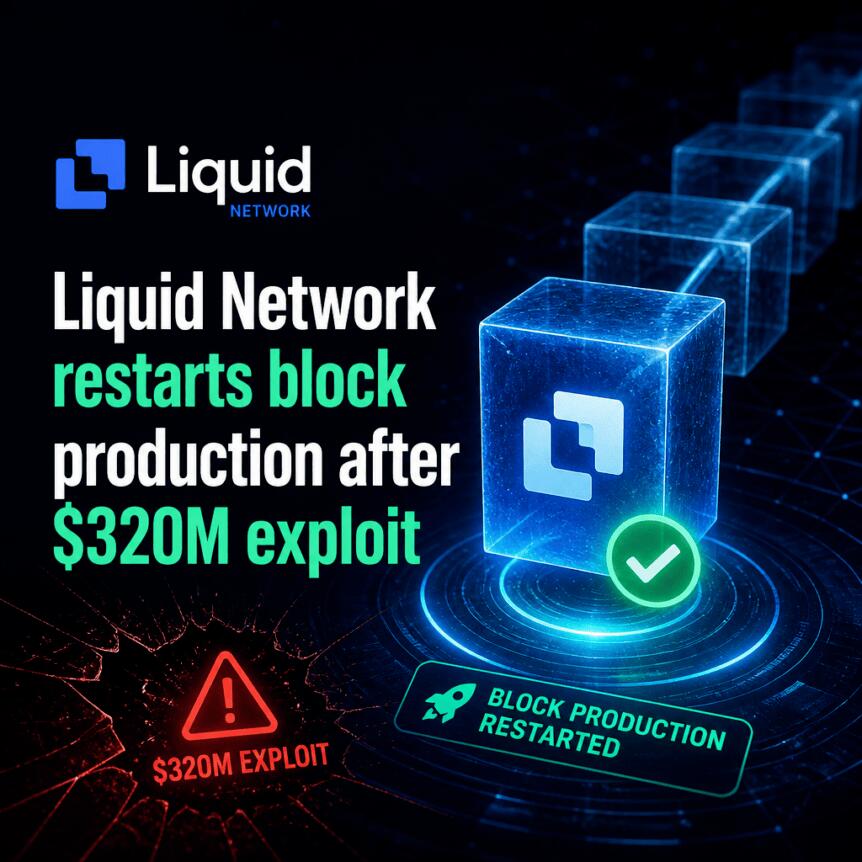
The Liquid Network has restarted block production after a major Bitcoin withdrawal tied to a vulnerability in Elements, the open-source software that underpins the sidechain. Liquid said it is bringing the system back in a cautious, staged way—enabling block creation while keeping transaction processing and peg operations paused as it continues recovery and monitoring.
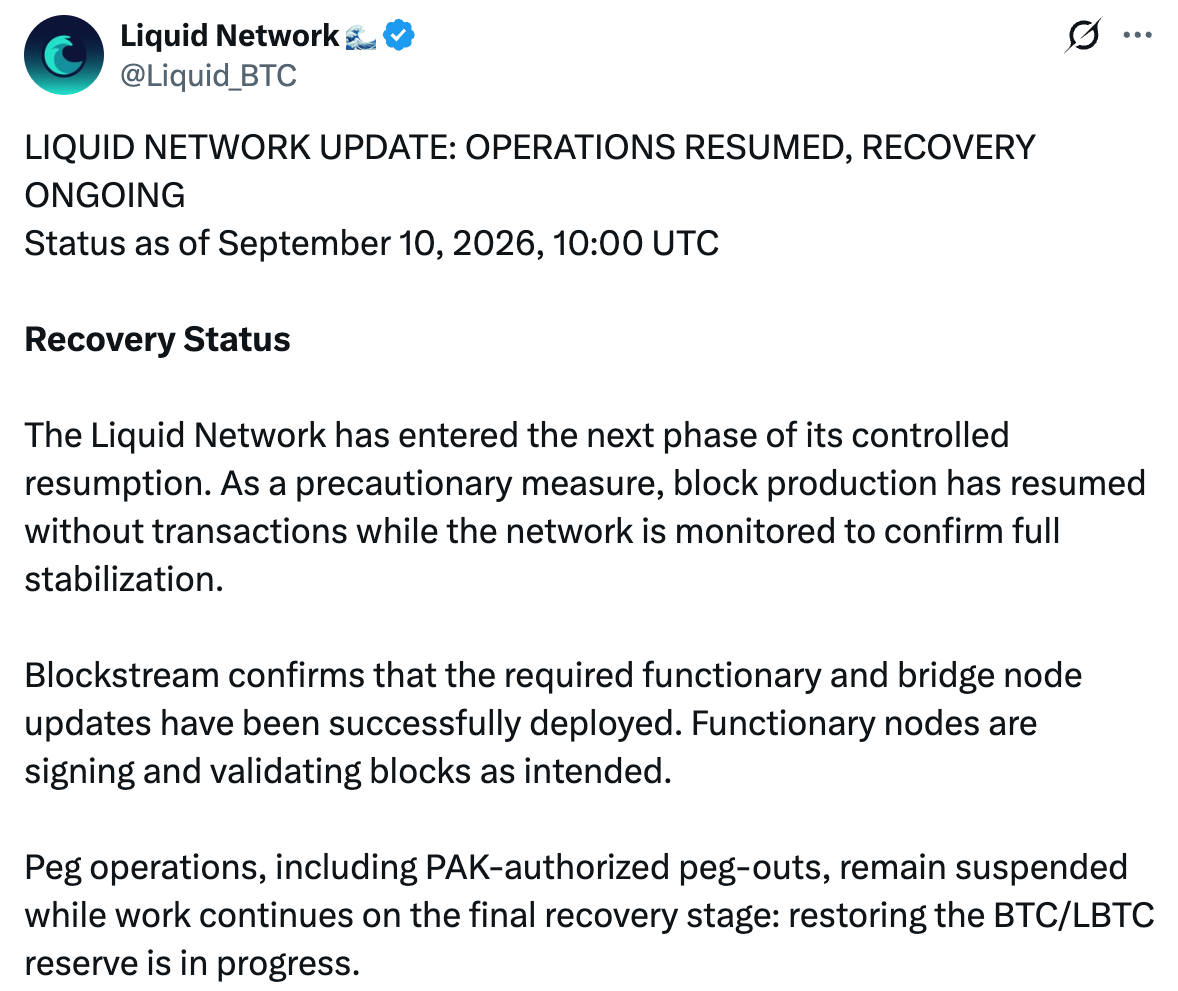
In a Thursday update shared on X, Liquid stated that block production resumed “without transactions” as a safety measure. The network is now being monitored to “confirm full stabilization,” while required updates to its functionary and bridge nodes have been deployed.
Key takeaways
- Liquid resumed block production, but transactions and peg-related activities remain suspended during recovery.
- Liquid says functionary nodes are now signing and validating blocks properly after updates.
- Peg operations, including PAK-authorized peg-outs, are still paused until Liquid restores its BTC/L-BTC reserve.
- An earlier emergency Elements update (v23.3.4) targeted a proof-verification cache weakness linked to the incident.
Block production returns—transactions still offline
Liquid’s latest status update frames the restart as a precaution rather than a full operational return. According to the network, block production is running “without transactions,” meaning the chain can produce blocks while the system avoids handling live transaction traffic until the team is satisfied that everything is functioning as intended.
Liquid also emphasized that it has pushed the necessary changes to its functionary and bridge node infrastructure. It said functionary nodes are now signing and validating blocks as expected, which is a critical capability for the network’s consensus behavior.
For users and builders, the distinction matters. Restarting block generation can help confirm that parts of the network stack are functioning, but suspending transaction processing reduces operational risk and prevents additional complexity during an ongoing stabilization period.
Peg operations remain paused pending reserve restoration
Even with block production back online, Liquid made clear that peg operations are not restarting yet. Peg processes—specifically including PAK-authorized peg-outs—remain suspended while the network works to restore its BTC/L-BTC reserve.
That pause underscores the core issue behind the exploit: the withdrawal affected the network’s ability to honor the peg mechanism safely. Liquid’s next steps therefore hinge not only on software hardening, but also on whether the relevant reserves and linked components are returned to a fully healthy state.
Emergency Elements patch hardened proof verification caches
The resumed activity comes on the heels of an earlier intervention. A day before the restart, Liquid released an emergency update to Elements—version 23.3.4—after the incident was tied to a proof-verification cache vulnerability.
Liquid’s emergency update focused on “hardening cache keys used for range proofs” as part of its recovery plan. In practical terms, range proofs are part of how confidential transaction values can be verified without revealing the underlying amounts. If proof verification behavior can be influenced in unexpected ways due to caching or keying issues, an attacker may find routes to disrupt assumptions about what has been validated.
By addressing cache key handling, Liquid signaled that the recovery plan requires both patching the software layer and verifying that the patched infrastructure behaves correctly across the federation’s node operators.
What happened during the September withdrawal
Liquid paused operations on Sept. 6 after actors claiming to be “white-hat hackers” withdrew about 4,000 BTC—worth roughly $320 million at the time—from the network’s federation wallet. This withdrawal represented about 95% of the wallet’s roughly 4,200 BTC balance.
According to earlier coverage referenced by the Liquid Network’s own updates, the withdrawal involved L-BTC originating from a bug in Elements, the open-source software that underlies Liquid. That linkage is important because it narrows the scope of the underlying cause to a specific layer of the system: the confidential transaction/proof verification components and how they interact with caching and range proof validation.
Following the withdrawal, the actors returned 3,400 BTC—worth about $270 million at the time—after Blockstream confirmed that affected bridge nodes had been patched. Earlier reporting also indicated that 598 BTC (roughly $46 million at current prices) remained outstanding as of Sept. 7.
That sequence—withdrawal, patch confirmation, partial return—helps explain why recovery is taking multiple steps. Even after software changes are deployed and some funds are returned, the peg mechanism can’t safely resume until reserves and operational invariants are fully restored.
Liquid’s current “without transactions” approach appears designed to separate network health verification (block signing/validation) from settlement and peg flows that require complete confidence in reserves and security assumptions.
What to watch next for Liquid users
Liquid has not given a restart timeline for transaction processing or peg-outs, so the immediate watchpoints are whether the network confirms “full stabilization” under live conditions and whether the BTC/L-BTC reserve is restored sufficiently to lift the peg suspension. For anyone using Liquid for token transfers or peg activity, the next operational update on peg resumption will likely be the most consequential signal.


The London-based challenger bank tapped a Canadian custodian to meet the Financial Conduct Authority’s regulatory requirements. It now expects to roll out retail tokenized deposits by November.
Solana is up nearly 33% over the past month, following the market’s broader resurgence since August 19.
It currently trades just south of the $100 psychological mark, and multiple market observers expect a new rally soon. Others are more cautious, seeing a risk of a double-digit correction.
The Upward Scenario
X user Ash Crypto recently claimed that SOL is displaying “one of the most bullish setups in crypto right now,” pointing to three major signals that have all flipped in favor of the bulls. According to the analyst, those include the first green monthly candle in 10 months, the monthly MACD, which is on the verge of a bullish cross, and the monthly RSI, which has finally broken a two-year downtrend.
The Black Bull and Gerla also chipped in. The former described SOL as “a $500 token trading at $100,” while the latter believes the asset has completed its manipulation phase and could now be gearing up for a surge towards $500 and then $1,000.
Whale activity and strong institutional interest reinforce the positive scenario. A few days ago, analytics platform Lookonchain revealed that the large investors known as HURDw purchased almost $30 million worth of SOL over the last three weeks. For his part, X user Ted disclosed that a whale scooped up $9 million in Solana, opining that smart money has shifted its focus to altcoins.
Spot SOL ETFs have posted mainly green candles lately, signaling growing appetite for the asset from hedge funds, pension funds, and other conservative investors. This requires the issuers of these products (Bitwise, Fidelity, Grayscale, VanEck, Franklin Templeton, and other financial giants) to buy Solana tokens, thus potentially setting the stage for a further price increase.

Moreover, SOL’s Relative Strength Index (RSI) has plunged below 30, indicating that the asset has entered oversold territory and could be gearing up for a surge. The ratio runs from 0 to 100, where climbing above 70 is interpreted as bearish.

Major Plunge Ahead?
X users BATMAN and Crypto with Haris ₿ are among the pessimists. The former thinks SOL appears to be weakening, adding that the Stochastic oscillator is also forming a bearish divergence.
Crypto with Haris ₿ revealed that his trades are currently at an unrealized loss of over $180,000 but refused to close the positions, anticipating a crash for BTC to $62,000 and a plunge for SOL to $80.
The post Top Solana Price Predictions as SOL Bulls Battle to Hold the $100 Line appeared first on CryptoPotato.


Anthropic employee Evan Hubinger earned 30 million X views on Wednesday by predicting the end of the world and putting the chance of AI killing all humans within a decade at above 10%.
However, before worrying about super intelligent AI agents going rogue, Hubinger worked at one of the world’s oldest crypto companies, Ripple.
Commenting on Hubinger’s viral claim, Galaxy Research’s Alex Thorn used his connection to Ripple and the XRP community to poke fun. The price of XRP today is still lower than its January 2018 high.
Hubinger’s resume notes that he worked for Ripple’s Software Engineering department. Years later, the company would seek financing at up to a $50 billion valuation, backing most of that valuation with its corporate XRP holdings.
Ripple gave its intern real crypto work
Although Hubinger started working at Ripple while in school, his resume describes much mre than mere coffee duty. He claims that he “worked on designing Interledger, a trustless system for cross-currency transactions between arbitrary agents.”
Hubinger also boasts of other work at the company, claiming he “wrote a tool to do cryptographically secure wallets for financial institutions.”
His LinkedIn adds work on the build process for rippled, server software powering parts of the XRP Ledger.
Hubinger now leads Anthropic’s Alignment stress-testing team. Its mandate is to prevent alignment failures by AI models, which is industry-speak for AI agents working on secret goals outside of the scope that humans specified.
Read more: AI sirens go fishing at XRP Las Vegas
AI extinction ‘everyday topic’ in Silicon Valley
Hubinger later clarified “To be clear, as we say in our latest Risk Report, I think the risk from present models is low. What I am worried about is superintelligence arising from recursive self-improvement.”
Recursivity refers to the ability of AI to train and generate new AI without human input.
Ripple CTO Emeritus David Schwartz has argued that AI safety rules could threaten freedom of speech.
Former Ripple Vice President Emi Yoshikawa wrote in August that AI extinction risk was becoming an everyday conversation topic in Silicon Valley.
Got a tip? Send us an email securely via Protos Leaks. For more informed news, follow us on X, Bluesky, and Google News, or subscribe to our YouTube channel.


The exchange is offering up to 10x leverage on private-company valuations alongside 100 tokenized stocks and ETFs.

Coinbase has struck a partnership with payments and financial-technology platform Moov to bring stablecoin infrastructure to over 1,000 community banks and credit unions in the U.S. The companies say the integration is designed to help these smaller institutions support stablecoin payment acceptance, settlement, and real-time funding using Coinbase’s regulated digital-asset infrastructure.
In its announcement, Coinbase framed the effort as a way to expand practical stablecoin use beyond large banks and into retail-focused financial services. The planned infrastructure also includes options for businesses and merchants to access Coinbase custodial accounts, alongside payment-related features for consumer and commercial workflows.
Key takeaways
- Coinbase and Moov plan to connect stablecoin payment acceptance and settlement for 1,000+ community banks and credit unions.
- The infrastructure is positioned for consumer payments, merchant settlement, and payout use cases.
- Coinbase’s regulated digital asset infrastructure will be combined with Moov’s payments platform to enable real-time funding.
- The initiative lands as major U.S. banks continue experimenting with stablecoin rails and issuance programs.
- Non-bank players are also building stablecoin offerings, such as wallet-and-card products tied to public blockchain infrastructure.
Community institutions get a stablecoin payments pathway
The partnership is aimed at a segment of the U.S. financial system that typically has fewer internal resources to build stablecoin capabilities from scratch. Coinbase describes the effort as using its regulated digital asset infrastructure together with Moov’s payments layer to deliver stablecoin payment acceptance, settlement, and real-time funding to Moov’s customer base.
Coinbase specifically notes that the resulting setup is intended to support a range of transactional scenarios, including consumer stablecoin payments and merchant settlement and payouts. It also highlights that businesses and merchants would have access to Coinbase custodial accounts, which can be a key requirement for institutions trying to manage stablecoin holdings and transaction flows under existing operational controls.
For investors and operators, the practical significance is less about speculative token adoption and more about distribution: if community banks and credit unions can integrate stablecoin features into existing payment and funding rails, stablecoin usage may spread through retail banking channels rather than only via crypto-native apps.
How this fits into broader U.S. stablecoin experimentation
Coinbase’s Moov tie-up arrives amid continued activity from larger U.S. banks exploring stablecoin infrastructure. The announcement follows a report that U.S. Bank, the fifth-largest commercial bank in the U.S., completed a live cross-border payment using its proprietary USBDC stablecoin on the Stellar blockchain. Earlier coverage also described how major institutions are testing the mechanics of faster settlement and payment interoperability while working within regulatory and operational constraints.
Meanwhile, industry momentum at the issuer level has been building. Earlier this month, 21 financial institutions—including Bank of America, Citi, Goldman Sachs, Deutsche Bank, and UBS—announced plans to form a company intended to issue stablecoins, including a U.S. dollar-denominated stablecoin in the first half of 2027. While that initiative is distinct from Coinbase and Moov’s partnership (it centers on issuance rather than payments enablement for community institutions), it signals that stablecoins are moving from pilot concepts toward structured plans.
What remains uncertain is how widely these efforts will translate into everyday consumer usage and whether stablecoin payment adoption at community institutions will accelerate as product offerings mature. Still, partnerships like this one suggest a shift toward practical integration—bringing stablecoin capabilities closer to the customer journeys that banks already serve.
Competition isn’t only from banks: non-bank stablecoin products expand
Stablecoin infrastructure development is not limited to banks and regulated financial groups. Non-bank competitors are also pushing into consumer-facing experiences built on stablecoin rails.
In August, Western Union reportedly partnered with stablecoin infrastructure provider Rain to launch a digital wallet and Visa-branded card that allows users to hold and spend a U.S. dollar-backed stablecoin. That kind of product matters because it reduces friction for users who want stablecoin functionality without needing to manage accounts on exchanges or understand custody setups directly.
Compared with Western Union’s wallet-and-card approach, Coinbase and Moov’s collaboration is more institution-centric—designed to let banks and credit unions deliver stablecoin payment services within their own offerings. Together, these parallel tracks highlight a broader market pattern: stablecoins are being embedded both in traditional distribution networks (banks and merchants) and in consumer fintech interfaces.
Why custody and settlement design could be the real battleground
Coinbase’s mention of custodial accounts for businesses and merchants points to an important operational theme in stablecoin adoption: beyond sending value, institutions must solve for storage, controls, compliance requirements, and settlement processes.
Coinbase says the Moov partnership will enable stablecoin payment acceptance, settlement, and real-time funding by combining regulated infrastructure with Moov’s payments platform. The inclusion of real-time funding and settlement features suggests the partnership is oriented toward transaction handling that can fit into banking operations, rather than simply facilitating on-chain transfers.
For community banks and credit unions, the appeal is straightforward: they may be able to access stablecoin capabilities through established infrastructure layers rather than building internal systems for custody and settlement. For merchants and businesses, the ability to connect stablecoin workflows with custodial services could reduce operational overhead and speed time-to-launch—though the extent of availability, pricing, and rollout timelines were not specified in the announcement.
As the U.S. stablecoin landscape continues to evolve—through bank experiments, planned issuance efforts, and consumer-facing wallet products—partnerships that translate infrastructure into day-to-day payments may shape which models gain traction first.
What to watch next
Readers should track how Coinbase and Moov roll out the integration across Moov’s community bank and credit union network, and whether early pilots expand into broader merchant and consumer payment flows. Just as important will be how these projects align with the wider U.S. banking ecosystem’s stablecoin infrastructure tests and forthcoming issuance plans.


When Lynn Henderson walks into her local grocery store in British Columbia, she has one label at the top of her mind: “Made in Canada.” The 47-year-old is among a drive of Canadian consumers who are attempting to boycott U.S. products in a show of solidarity amid the ongoing trade war. “Even when I’m shopping with my toddler, he now asks specifically, ‘Oh, are these apples Canadian?’ And he will ask that before putting it in the cart,” Henderson tells TIME, noting that it’s a family effort. It costs more, she admits, but it’s worth “knowing that money is staying here in Canada and not going south at the border.”
The resurgence of the “Buy Canadian” movement comes amid a deepening U.S.-Canada trade dispute that shows no signs of waning. Canada’s retaliatory tariffs on U.S. goods took effect Tuesday, with Prime Minister Mark Carney matching the economic pressure imposed by the U.S. after trade negotiations collapsed last month. The U.S. has since announced a ban on Canadian dairy, motorcycles, and most alcoholic beverages. It’s all unfolding against the backdrop of U.S. President Donald Trump repeatedly talking of his ambitions to annex Canada and make it the 51st state.
While Carney’s government is going toe-to-toe with the Trump Administration, he’s urging the general population to take action, too.
“The most powerful actions have come from you: Buying Canadian and travelling in Canada,” Carney told Canadians in a national address Tuesday. “Decisions taken at the kitchen table, not the boardroom table.”
Other lawmakers have shared similar calls to action. “‘Buy Canadian’ reflects the economic solidarity Canadians are showing at a time when it matters most,” Quebec minister Joël Lightbound said in a statement to TIME. “By supporting one another and investing in what we build here at home, we are building Canada strong.”
Canadian consumers have responded en masse to the call. A Build Canada poll conducted Aug. 31-Sept. 4 found that many are already making sacrifices at the tills, as 69% of respondents reported “choosing Canadian products despite higher prices” and 55% said they had “stopped buying specific American brands.” Reports also indicate a surge in demand for Canadian products.
As the trade war stretches on, here’s what to know about the revitalized “Buy Canadian” movement, the people behind the U.S. products boycott, and what the data says about the effectiveness of the consumer-driven action.
The resurgence of the “Buy Canadian” movement
Campaigns promoting Canadian-made goods date back at least to the early 20th century, when Canadian manufacturers began pushing their “Made in Canada” products.
Among consumers, the effort has evolved into the “Buy Canadian” initiative, which encourages residents to support local businesses and industries as much as they can.
The movement skyrocketed last year in the midst of the trade war sparked by Trump’s tariffs. Businesses and consumers alike vowed to shun U.S. products, with Canada-based media publishing advisories on “how to shop Canadian.“
As the tariffs loomed in February 2025, a survey by accounting firm KPMG found that 93% of consumers wanted retailers and grocery stores to identify and promote Canadian products.
In late 2025, the Canadian government launched the “Buy Canadian Policy, to protect and prioritize Canadian workers and industries, and strengthen Canada’s domestic economy.”
Henderson, a public relations consultant, says Trump’s threats against Canada’s sovereignty last year signified a turning point.
“Canadians have felt for generations that these are not just our allies, but our friends, and neighbors,” she says. “Nobody wants to be spoken about like that by their friends and neighbors. It’s really hurtful.”
The reignited trade rift has revived Henderson’s passion for patriotic shopping, and she’s actively refrained from purchasing items, such as a new iPhone, that don’t align with her efforts. “I don’t want to spend that money to support an American business,” she says.
How consumers dedicated to the movement are approaching the challenge
Consumers in Canada are finding different ways to navigate how best to boycott U.S. goods and services, putting extra time in at the grocery store to ensure they are buying Canadian as often as they can.
Although she prioritizes Canadian products, Henderson is also open to items from other countries.
“We’re discovering that there’s some incredible produce from around the world,” she says. “We don’t actually need to get oranges from the U.S. anymore, because we can get oranges from Brazil or South Africa, and they’re fantastic.”
Brian Leonard, a 37-year-old who works in the coffee industry and lives in New Brunswick, is similarly passionate when he heads to the grocery store, and firmly believes in starting each day with a “Buy Canadian” mindset.
“For me, it always begins first thing in the morning with a cup of coffee. Buying coffee that is roasted locally in Canada,” Leonard tells TIME. “The first decision of your day can be something that sets up your whole day to be part of the movement.”
The way in which Canadians have been re-energized to support more local products has been “astounding,” Leonard adds. “I had a call yesterday, and the person mentioned they had switched dish soap because they realized the soap they were buying was American-made,” he says.
The topic of patriotic shopping is dominating business groups on Facebook and elsewhere, bringing further attention to the movement.
These social media groups have become a gateway for people to come together when seeking out Canadian alternatives to U.S. products. The “Made in Canada – Canadian Products” Facebook group, for example, boasts 1.4 million members. Similarly, the Reddit forum r/BuyCanadian has more than 250,000 members and nearly 7,000 weekly contributions.
For some, the efforts extend beyond trips to the grocery store and online checkouts.
Henderson is also now avoiding U.S. travel. “I live very close to the border. It used to be very common to just [cross over] and go to Seattle, go to Trader Joe’s, or outlet malls, and we will not do that now,” she says. ”We’d rather explore Canada.”
Meanwhile, Shireen Jeejeebhoy, a 63-year-old writer based in Toronto, says she has also deleted WhatsApp, stopped using Zoom, and is even trying to find alternatives to Google and Apple products.
“These things are really difficult to divest yourself from,” she tells TIME, explaining that she uses the website “Unplug America”—an online initiative aimed at replacing American tech products with Canadian equivalents—for guidance. “There are some things in the digital world that Canada does not have, and so I’m looking to the U.K., the E.U., or India for alternatives.”
However, even someone as dedicated to the movement as Jeejeebhoy struggles to find alternatives for everything.
“My skin doesn’t react well to most sunscreens, and as much as I’ve tried Canadian brands, there’s only one American brand that actually works well [for me] at an SPF 50,” she says, admitting it’s proven to be difficult. “So, as much as I want to use the Canadian brand sunscreen, I have to use a particular American product.”
Leonard identifies with the struggle, admitting it can be “overwhelming to a lot of people to try to completely overhaul everything they buy,” as people have different budgets and needs.
Taking part in the movement doesn’t have to be a rigid commitment, nor does it mean you should deprive yourself of life’s little treats, the consumers who spoke to TIME agreed upon.
Is the Buy Canadian movement working? Here’s what the data says
The shift away from American products could have significant economic consequences for Canada, where the U.S. accounted for 67.2% of Canadian goods and services exports in 2025, making it the country’s largest trading partner by far.
The Bank of Montreal (BMO) estimated in April 2025, following the initial resurgence of the “Buy Canadian” movement, that the shift in consumer attitudes could redirect roughly C$10 billion to the Canadian economy annually.
“If we are directing C$10 billion or so of economic activity back into Canada, that would otherwise be bleeding out to the U.S., then that’s a direct benefit,” Robert Kavcic, director and senior economist at BMO, tells TIME.
The Bank of Canada released an analysis in February “assessing the Buy Canadian movement one year later.”
It found that households had shifted their food spending away from U.S. products and towards Canadian ones. “The shift is modest but clearly visible. In March 2025—as trade tensions escalated—the proportion of food spending on Canadian products went up by approximately 2% relative to January 2025, while the proportion spent on U.S. products fell by a similar amount. And what started in March wasn’t short-lived—it persisted through the summer,” read the analysis.
Kavcic explains that “a certain share of that spending is now reallocated domestically,” thus benefiting the Canadian economy.
“I don’t know if Canadians can do a lot more than what they have already, because there’s a cost to that. There are certain families or workers that have to travel back and forth to the U.S., and there’s a cost to buying Canadian,” he says.
Despite these challenges, statistics from the Canadian Survey on Business Conditions, for the first quarter of 2026 over the last 12 months, found that 16.6% of businesses had changed their marketing to promote Canadian products. Among retailers, the figure was 41.6%, showing a clear push toward promoting domestically made goods.
The Liquid Network has resumed block production following a $320 million Bitcoin withdrawal, although transactions and peg operations remain suspended as recovery efforts continue.
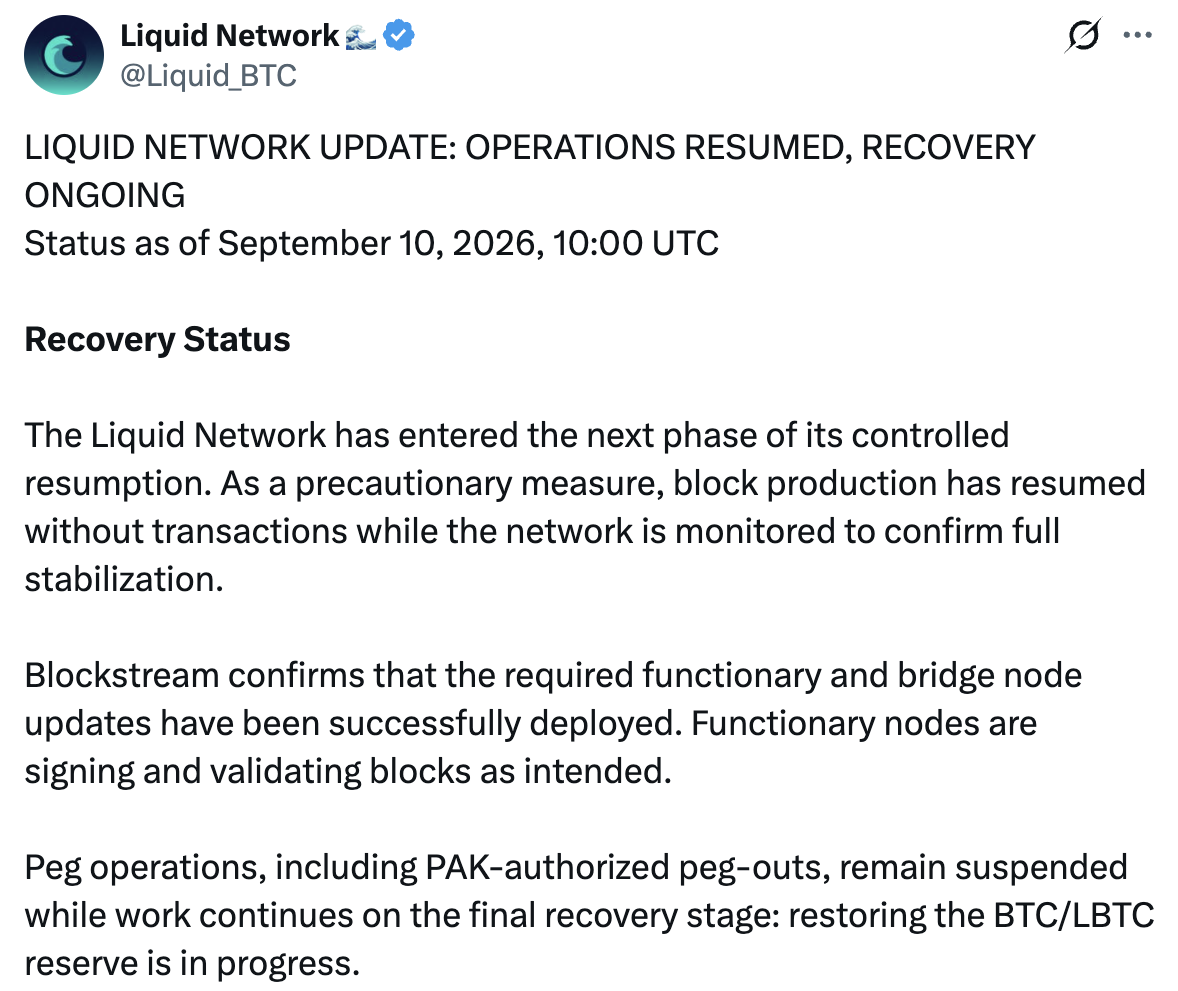
In a Thursday post on X, Liquid said block production had resumed “without transactions” as a precaution while the network is monitored to “confirm full stabilization.” Required updates to its functionary and bridge nodes have been deployed, with functionary nodes now signing and validating blocks as intended.
Peg operations, including PAK-authorized peg-outs, remain suspended while the network works to restore its BTC/L-BTC reserve.
A day earlier, Liquid released an emergency update to Elements, the software underlying the network, to address the proof-verification cache vulnerability linked to the incident. The update, Elements v23.3.4, hardened cache keys used for range proofs as part of the network’s recovery plan.
Source: Liquid Network
$270 million in Bitcoin returned after exploit
Liquid paused operations on Sept. 6 after actors claiming to be white-hat hackers withdrew about 4,000 Bitcoin (BTC), worth roughly $320 million, from the network’s federation wallet.
The withdrawal represented about 95% of the wallet’s roughly 4,200 BTC balance and involved L-BTC originating from a bug in Elements, the open-source software underpinning Liquid.
The actors subsequently returned 3,400 BTC, worth about $270 million at the time, after Blockstream confirmed that affected bridge nodes had been patched. About 598 BTC, worth roughly $46 million at current prices, remained outstanding as of Sept. 7.
Magazine: Token buybacks are booming. But are they good for crypto projects?


Jenson becomes the prediction market’s first CFO as Polymarket builds its regulated U.S. exchange and global platform.

OpenAI ChatGPT for Financial Services targets work of junior bankers

Dodgers Reportedly Call Up Top Prospect Josue De Paula

Azure SQL Data Sync stops taking newcomers before 2027 execution


-
 Tech2 days ago
Memory prices are slowing because buyers ran out of money
-

 Business16 hours ago
Micron Stock Climbs Above $1,031 as AI Memory Crunch and a $50 Billion Outlook Fuel the Rally
-

 Crypto World2 days ago
Bitcoin price risks $76K drop as $78K support weakens
-

 Business17 hours ago
AMD Stock Climbs After Management Lifts 2027 Data Center Outlook Toward $70 Billion in AI Sales
-

 Crypto World2 days ago
Ethereum price stalls below $2,500 as ADX drops to 11
-

 Crypto World2 days ago
Robinhood Stock: How To Take Advantage With Reduced Risk
-

 NewsBeat2 days ago
What went right this week: an ‘historic’ fall in violent crime, plus more
-

 Crypto World18 hours ago
Bitcoin price risks $70K if $78K neckline breaks
-
 Crypto World1 day ago
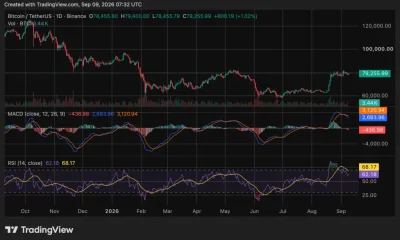
Bitcoin price holds near $79K as cycle drawdowns narrow
-
 Sports2 days ago
Phones confiscated, players sent home: Pakistan’s England tour turmoil revives memories of Mohammad Amir, Salman Butt and Mohammad Asif’s 2010 Lord’s spot-fixing scandal | Cricket News
-

 NewsBeat2 days ago
England up in reading, maths and science rankings as Scotland and Wales dip
-

 Business2 days ago
Meta debuts long-awaited personal AI agent, Muse
-
 Crypto World2 days ago
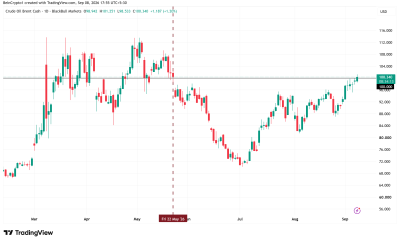
Brent Crude Oil Moves Above $100 for the First Time in 3 Months
-

 Crypto World2 days ago
Intel Stock Jumps 9% on Chip Price Hike Report, US Stake Gains $36 Billion
-

 Crypto World2 days ago
Pump Fun and Kraken delete Hunter Biden $LAPTOP promotion
-
 Tech2 days ago
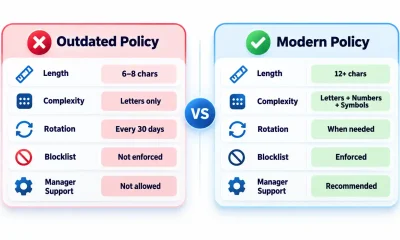
Strong Password Policy and Password Manager Guide
-

 Business2 days ago
ServiceTitan, Inc. (TTAN) Q2 2027 Earnings Call Transcript
-

 Crypto World2 days ago
Visa expands stablecoin card network to 160 programs
-

 Business2 days ago
Egyptian TV Presenter Sarah Khalifa, 11 Others Sentenced To Death In Major Drug Trafficking Case In Cairo
-
Business2 days ago
Xometry at Goldman Sachs Communacopia + Technology Conference 2026: growth, AI and Siemens
You must be logged in to post a comment Login