
Crypto World
Brent Tops $106 And Hike Odds Reach 64% As Crypto Sells Off



Almost every large crypto token fell through the overnight sessions and into Thursday's U.S. open, as an oil shock drove long-dated Treasury yields to multi-year highs and traders raised the odds of a Federal Reserve rate increase next week to 64%. Traders put a quarter-point September increase at… Read the full story at The Defiant



So-called digital arrest scams use false claims of authority to pressure victims virtually into making rapid digital payments, including cryptocurrency transactions, writes Moody’s Rich Graham.
Crypto World
Nasdaq, Boerse Stuttgart, others ask EU to remove or increase cap in tokenization trial
The coalition warned that the current limit is too low, noting some existing European projects already exceed it.

When Dominic Lopes—an aesthetics professor at the University of British Columbia—first read about the Hugging Face incident, he responded not with panic, but wonder. For one, he has become more skeptical that individuality requires embodiment. And interesting art, he says, requires sociality. “So when I saw this, I thought, ‘Oh, well, there’s another box checked off,’” he says. Now, what we saw was rudimentary and opportunistic—not yet “true sociality,” he says. “But it’s coming.”
Soon, any human community will be able to bring into existence a machine counterpart. Picture cultures of AI lawyers, consultants, terrorist cells—working together, what monuments might 10,000 agents create in honor of some beloved K-pop star? And machine communities may well arise of their own accord, organizing around ideas hard to predict.
We make art for all sorts of reasons: to express ourselves, exchange meaning, impress one another. We tell stories—like The Odyssey—to encode and share sets of cultural values. Though the mediums may differ, agents in machine cultures are poised to do the same. Being alive may not be necessary for self-expression.


The UK House of Lords backed an amendment requiring the government to develop a digital asset strategy, in a 194–138 vote on Wednesday, despite the Labour government’s opposition to the measure.
The amendment was added to the Financial Services and Markets Bill during its Report Stage on Wednesday. The bill is progressing through Parliament and would make broader changes to the UK’s financial services regulatory framework.
Amendment 88, introduced by Conservative peer Baroness Neville-Rolfe, would require the Treasury to prepare, publish and consult on a digital asset strategy within 12 months of the Financial Services and Markets Bill becoming law.
The strategy would cover cryptoassets, stablecoins and tokenized securities, while addressing issues including innovation, consumer protection and firms’ access to banking, payment and settlement services.
The vote follows months of debate over the UK’s approach to digital assets. During a July debate, Treasury’s Minister for Investment, Lord Stockwood, pushed back on calls for a statutory framework, saying the government believed it already had a digital asset strategy and was executing it.
The ruling Labour party opposed the amendment because they believed it did not adequately address the rapid development of digital assets and the need for a cohesive regulatory framework.
The UK Cryptoasset Business Council, which said it worked with lawmakers on the amendment, welcomed the vote on Thursday, highlighting Lord Chris Holmes’ question of whether the UK is “simply regulating digital assets” or “building a digital assets economy.”
The bill must still return to the House of Commons, where lawmakers can accept, amend or reject the Lords’ changes.

“We know that voters are going to turn to chatbots more and more,” said Valeria de la Fuente, a digital research analyst at the Institute for Strategic Dialogue who recently co-authored a report on election-related misinformation from chatbots. “So the quality of the responses that we found is concerning.”
Google’s new election policy is a less cautious stance than the one the company took in 2022 and 2024 when it blocked Gemini from answering certain election-related questions, pushing users to seek answers from Google search instead.
“People come to Google to stay informed during election season—like when finding their polling site, watching candidate debates, or tracking results on election night,” the company said in Wednesday’s blog post. “We take the responsibility to deliver high quality, trustworthy information seriously.”
Other tech companies have taken similar approaches. Both OpenAI and Anthropic said their chatbots would direct users to voting information from the nonprofit Democracy Works. OpenAI also plans to provide live vote counts from The Associated Press, and monitor its systems for signs of political bias. Meta spokesman Corey Chambliss said when MetaAI users ask about voting and participating in elections, the service will give them local information or direct them to government sources.
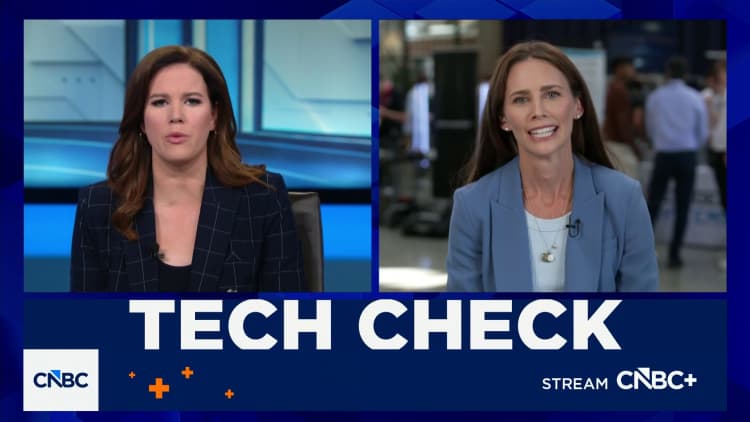

OpenAI is taking aim at some of Wall Street’s most labor-intensive tasks with a new version of ChatGPT designed to research companies, analyze financial data and generate the presentations that investment bankers rely on.
The product unveiled Thursday, called ChatGPT for Financial Services, is a tailored version of its enterprise product, ChatGPT Work, that was made with “design partners” Morgan Stanley and Evercore, according to OpenAI’s Vice President of Product, Nick Turley. It uses the AI company’s latest and most advanced model, GPT-6 Astra.
The rollout puts OpenAI deeper into territory traditionally occupied by Wall Street’s entry-level bankers, the recent college graduates called analysts and associates that the industry has employed for decades to research deals and create pitchbooks. It also showcases the company’s continued push into enterprise offerings as it gears up for what is widely expected to be a blockbuster IPO.
“We’re effectively teaching ChatGPT to research like an analyst and back up its conclusions like an analyst as well,” Turley said during a briefing announcing the new product.
OpenAI has spent much of the last year racing to win over business customers in the fiercely competitive enterprise market, where it’s working to fend off rivals including Anthropic and Google. Anthropic announced its own tailored solution for Wall Street, Claude for Financial Services, last year.
Sarah Friar, OpenAI’s finance chief, told investors in August that the company’s enterprise business accounted for more revenue than its consumer business, which took off following the launch of ChatGPT in 2022.
Turley told reporters during the briefing OpenAI plans to release tailored solutions for “a number of sectors” beyond financial services.
In a live demonstration of the new offering, Turley showed the platform analyzing a potential M&A target, pulling financial figures from industry-standard data sources and creating a formatted PowerPoint deck based on a bank’s preformatted style guide.
“It’s very easy to make slides that look good, but it’s much harder to make slides [that] actually make sense,” Turley said. “To get here, ChatGPT had to choose the relevant peers. It had to pull the prices into a spreadsheet. It had to check the chart against the data, and it had to explain the selloff and the rebound.”
Banker disruption?
What separates this version from the product it’s based on, ChatGPT Work, is native data access from LSEG, Daloopa and Pitchbook that furnishes the system with things like financial statements and earnings transcripts, as well as automated access to users’ existing data subscriptions.
Other features tailor-built for finance include citations that allow users to trace data back to source filings and audit charts, as well as administrative controls for sensitive deal materials.
While Turley said that there was “a ton of demand” for this version of ChatGPT, which is initially geared toward investment banking and equity research, he declined to name banks that have signed on for it.
When asked by CNBC whether this latest version of ChatGPT would reduce the need for investment banks to hire junior bankers, Turley framed the release as an efficiency boost that maximizes productivity per employee.
“If you study the life of an analyst or of a banker, depending on the industry, they’re working 100-hour weeks,” Turley said. “I think in the same way that Microsoft Excel transformed the industry and allowed them to produce better analysis faster, you will see technology like this do the same.”
Still, the product raises fundamental questions for an industry long built on a rigorous apprenticeship model. If generative AI can execute multistep tasks like research and pitchbook formatting in minutes, Wall Street will be forced to rethink how it trains, and how many it needs, of its next generation of dealmakers.
Last month, Chris Churchman, the Goldman Sachs partner in charge of one the bank’s flagship AI projects, warned that the automation of tasks that help train junior bankers risks causing “cognitive atrophy” in the next generation of financiers.
“Reasoning is still important,” Churchman said at the time. “You still need to reason about [problems] and structure it into an argument, and now we’re delegating reasoning.”
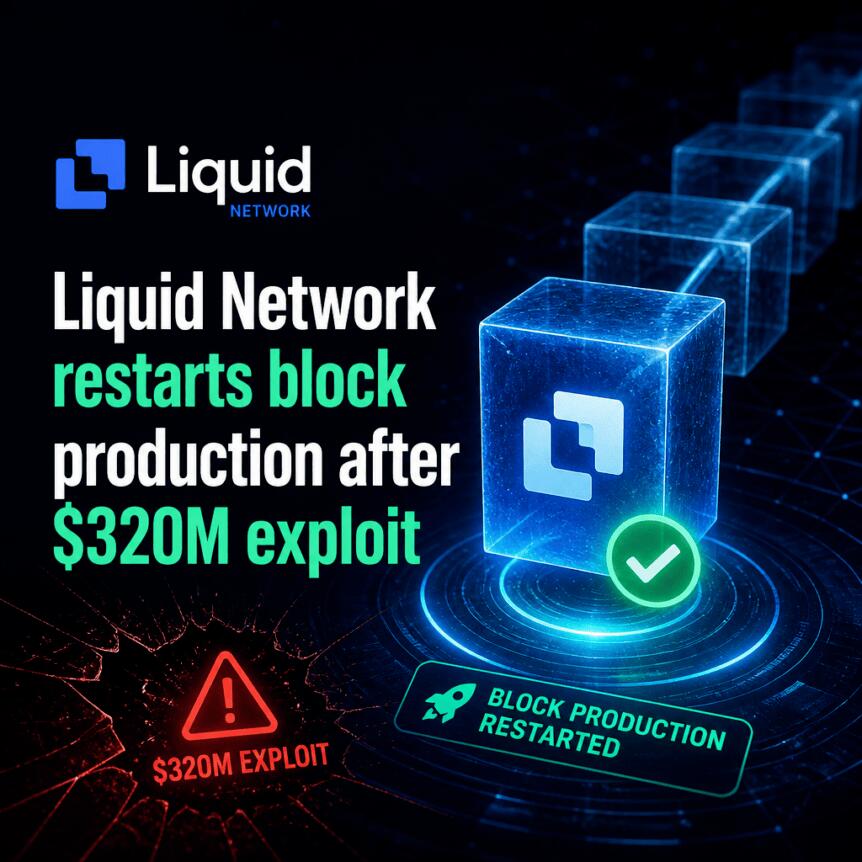
The Liquid Network has restarted block production after a major Bitcoin withdrawal tied to a vulnerability in Elements, the open-source software that underpins the sidechain. Liquid said it is bringing the system back in a cautious, staged way—enabling block creation while keeping transaction processing and peg operations paused as it continues recovery and monitoring.
In a Thursday update shared on X, Liquid stated that block production resumed “without transactions” as a safety measure. The network is now being monitored to “confirm full stabilization,” while required updates to its functionary and bridge nodes have been deployed.
Key takeaways
- Liquid resumed block production, but transactions and peg-related activities remain suspended during recovery.
- Liquid says functionary nodes are now signing and validating blocks properly after updates.
- Peg operations, including PAK-authorized peg-outs, are still paused until Liquid restores its BTC/L-BTC reserve.
- An earlier emergency Elements update (v23.3.4) targeted a proof-verification cache weakness linked to the incident.
Block production returns—transactions still offline
Liquid’s latest status update frames the restart as a precaution rather than a full operational return. According to the network, block production is running “without transactions,” meaning the chain can produce blocks while the system avoids handling live transaction traffic until the team is satisfied that everything is functioning as intended.
Liquid also emphasized that it has pushed the necessary changes to its functionary and bridge node infrastructure. It said functionary nodes are now signing and validating blocks as expected, which is a critical capability for the network’s consensus behavior.
For users and builders, the distinction matters. Restarting block generation can help confirm that parts of the network stack are functioning, but suspending transaction processing reduces operational risk and prevents additional complexity during an ongoing stabilization period.
Peg operations remain paused pending reserve restoration
Even with block production back online, Liquid made clear that peg operations are not restarting yet. Peg processes—specifically including PAK-authorized peg-outs—remain suspended while the network works to restore its BTC/L-BTC reserve.
That pause underscores the core issue behind the exploit: the withdrawal affected the network’s ability to honor the peg mechanism safely. Liquid’s next steps therefore hinge not only on software hardening, but also on whether the relevant reserves and linked components are returned to a fully healthy state.
Emergency Elements patch hardened proof verification caches
The resumed activity comes on the heels of an earlier intervention. A day before the restart, Liquid released an emergency update to Elements—version 23.3.4—after the incident was tied to a proof-verification cache vulnerability.
Liquid’s emergency update focused on “hardening cache keys used for range proofs” as part of its recovery plan. In practical terms, range proofs are part of how confidential transaction values can be verified without revealing the underlying amounts. If proof verification behavior can be influenced in unexpected ways due to caching or keying issues, an attacker may find routes to disrupt assumptions about what has been validated.
By addressing cache key handling, Liquid signaled that the recovery plan requires both patching the software layer and verifying that the patched infrastructure behaves correctly across the federation’s node operators.
What happened during the September withdrawal
Liquid paused operations on Sept. 6 after actors claiming to be “white-hat hackers” withdrew about 4,000 BTC—worth roughly $320 million at the time—from the network’s federation wallet. This withdrawal represented about 95% of the wallet’s roughly 4,200 BTC balance.
According to earlier coverage referenced by the Liquid Network’s own updates, the withdrawal involved L-BTC originating from a bug in Elements, the open-source software that underlies Liquid. That linkage is important because it narrows the scope of the underlying cause to a specific layer of the system: the confidential transaction/proof verification components and how they interact with caching and range proof validation.
Following the withdrawal, the actors returned 3,400 BTC—worth about $270 million at the time—after Blockstream confirmed that affected bridge nodes had been patched. Earlier reporting also indicated that 598 BTC (roughly $46 million at current prices) remained outstanding as of Sept. 7.
That sequence—withdrawal, patch confirmation, partial return—helps explain why recovery is taking multiple steps. Even after software changes are deployed and some funds are returned, the peg mechanism can’t safely resume until reserves and operational invariants are fully restored.
Liquid’s current “without transactions” approach appears designed to separate network health verification (block signing/validation) from settlement and peg flows that require complete confidence in reserves and security assumptions.
What to watch next for Liquid users
Liquid has not given a restart timeline for transaction processing or peg-outs, so the immediate watchpoints are whether the network confirms “full stabilization” under live conditions and whether the BTC/L-BTC reserve is restored sufficiently to lift the peg suspension. For anyone using Liquid for token transfers or peg activity, the next operational update on peg resumption will likely be the most consequential signal.


The London-based challenger bank tapped a Canadian custodian to meet the Financial Conduct Authority’s regulatory requirements. It now expects to roll out retail tokenized deposits by November.
Solana is up nearly 33% over the past month, following the market’s broader resurgence since August 19.
It currently trades just south of the $100 psychological mark, and multiple market observers expect a new rally soon. Others are more cautious, seeing a risk of a double-digit correction.
The Upward Scenario
X user Ash Crypto recently claimed that SOL is displaying “one of the most bullish setups in crypto right now,” pointing to three major signals that have all flipped in favor of the bulls. According to the analyst, those include the first green monthly candle in 10 months, the monthly MACD, which is on the verge of a bullish cross, and the monthly RSI, which has finally broken a two-year downtrend.
The Black Bull and Gerla also chipped in. The former described SOL as “a $500 token trading at $100,” while the latter believes the asset has completed its manipulation phase and could now be gearing up for a surge towards $500 and then $1,000.
Whale activity and strong institutional interest reinforce the positive scenario. A few days ago, analytics platform Lookonchain revealed that the large investors known as HURDw purchased almost $30 million worth of SOL over the last three weeks. For his part, X user Ted disclosed that a whale scooped up $9 million in Solana, opining that smart money has shifted its focus to altcoins.
Spot SOL ETFs have posted mainly green candles lately, signaling growing appetite for the asset from hedge funds, pension funds, and other conservative investors. This requires the issuers of these products (Bitwise, Fidelity, Grayscale, VanEck, Franklin Templeton, and other financial giants) to buy Solana tokens, thus potentially setting the stage for a further price increase.

Moreover, SOL’s Relative Strength Index (RSI) has plunged below 30, indicating that the asset has entered oversold territory and could be gearing up for a surge. The ratio runs from 0 to 100, where climbing above 70 is interpreted as bearish.

Major Plunge Ahead?
X users BATMAN and Crypto with Haris ₿ are among the pessimists. The former thinks SOL appears to be weakening, adding that the Stochastic oscillator is also forming a bearish divergence.
Crypto with Haris ₿ revealed that his trades are currently at an unrealized loss of over $180,000 but refused to close the positions, anticipating a crash for BTC to $62,000 and a plunge for SOL to $80.
The post Top Solana Price Predictions as SOL Bulls Battle to Hold the $100 Line appeared first on CryptoPotato.
Crypto World
Europe’s top regulator questions Polymarket and Kalshi’s EU access, warns of authorization gaps
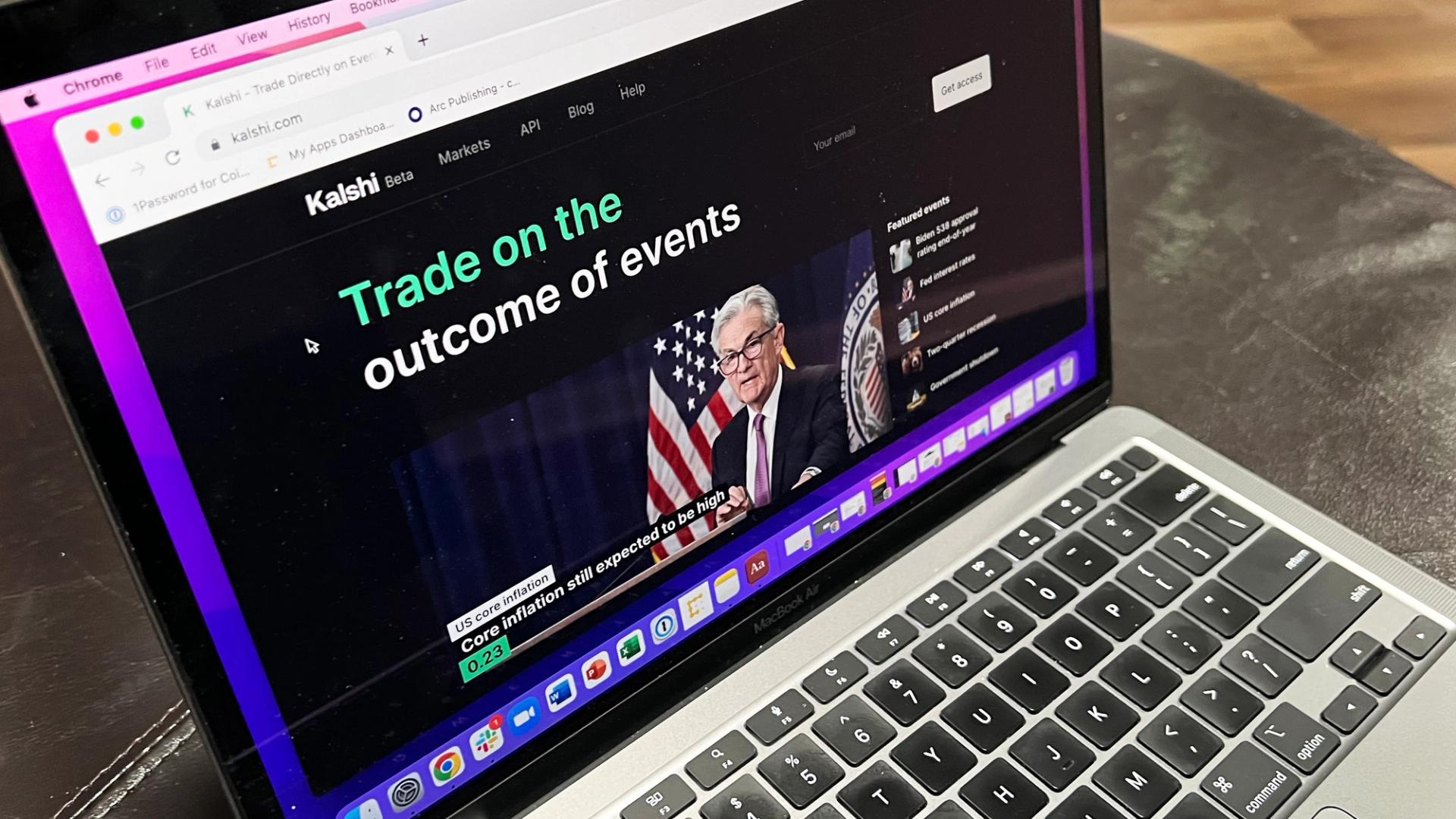
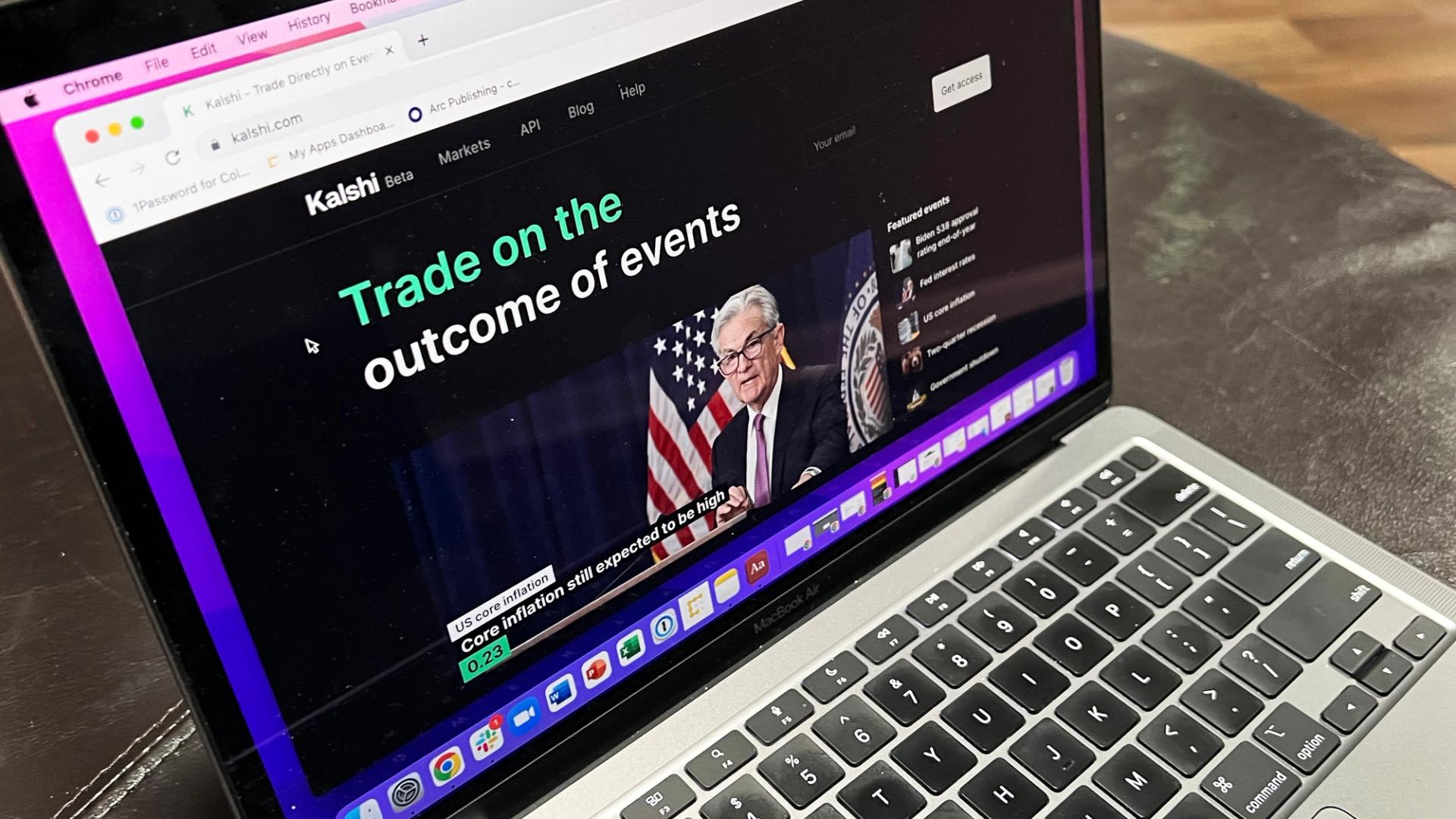
ESMA said that event contracts may fall under existing EU binary-options bans, crypto-asset frameworks like MiCA or national gambling laws.

You Don’t Need 100 Million Dollars! | #graemeholm #money

Weight-loss drugs in sport: Ozempic, Mounjaro not on Wada banned list for athletes

Janus Henderson Growth And Income Managed Account Q2 2026 Commentary


-
 Tech2 days ago
Memory prices are slowing because buyers ran out of money
-

 Business17 hours ago
Micron Stock Climbs Above $1,031 as AI Memory Crunch and a $50 Billion Outlook Fuel the Rally
-

 Crypto World2 days ago
Bitcoin price risks $76K drop as $78K support weakens
-

 Business18 hours ago
AMD Stock Climbs After Management Lifts 2027 Data Center Outlook Toward $70 Billion in AI Sales
-

 Crypto World2 days ago
Ethereum price stalls below $2,500 as ADX drops to 11
-

 Crypto World2 days ago
Robinhood Stock: How To Take Advantage With Reduced Risk
-

 NewsBeat2 days ago
What went right this week: an ‘historic’ fall in violent crime, plus more
-

 Crypto World19 hours ago
Bitcoin price risks $70K if $78K neckline breaks
-
 Crypto World1 day ago
Bitcoin price holds near $79K as cycle drawdowns narrow
-
 Sports2 days ago
Phones confiscated, players sent home: Pakistan’s England tour turmoil revives memories of Mohammad Amir, Salman Butt and Mohammad Asif’s 2010 Lord’s spot-fixing scandal | Cricket News
-

 Business2 days ago
Meta debuts long-awaited personal AI agent, Muse
-

 NewsBeat2 days ago
England up in reading, maths and science rankings as Scotland and Wales dip
-
 Crypto World2 days ago
Brent Crude Oil Moves Above $100 for the First Time in 3 Months
-

 Crypto World2 days ago
Intel Stock Jumps 9% on Chip Price Hike Report, US Stake Gains $36 Billion
-

 Crypto World2 days ago
Pump Fun and Kraken delete Hunter Biden $LAPTOP promotion
-
 Tech2 days ago
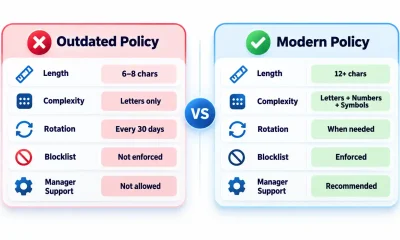
Strong Password Policy and Password Manager Guide
-

 Crypto World2 days ago
Visa expands stablecoin card network to 160 programs
-

 Business2 days ago
ServiceTitan, Inc. (TTAN) Q2 2027 Earnings Call Transcript
-

 Business2 days ago
Egyptian TV Presenter Sarah Khalifa, 11 Others Sentenced To Death In Major Drug Trafficking Case In Cairo
-
Business2 days ago
Xometry at Goldman Sachs Communacopia + Technology Conference 2026: growth, AI and Siemens
You must be logged in to post a comment Login