



Connect with us

Crypto World

North Korea using foreign IT workers to pass job interviews

Published

on

North Korea using foreign IT workers to pass job interviews

North Korea (DPRK) is now using remote workers from third countries, including Iran and Lebanon, to aid its efforts to infiltrate US companies and obtain money to fund its weapons programs, NBC reported on Friday.

An alert issued in July by the US government and several foreign agencies said North Korean IT workers “seek out contracts with the intent of remitting their salaries to their parent North Korean agencies. They also pose an insider threat to companies and are involved in data exfiltration, cryptocurrency theft, and theft of sensitive information.”

As the US and other governments have moved to counter North Korea’s efforts, the DPRK has turned increasingly to third-country IT workers to pass job interviews, the report said. After work contracts are obtained, the positions are usually taken over by North Korean operatives.

NBC reported that foreign IT workers had been scouted on LinkedIn, with some offered $500 monthly in cryptocurrency to work part-time as “interview associates.”

Advertisement

Related: Consensys unknowingly outsourced developer work to North Korean

The DPRK’s increasingly sophisticated tactics may be meeting with some success.

Cointelegraph reported in May, citing cybersecurity company CrowdStrike, that North Korean state-affiliated hackers and threat actors were responsible for more than $2 billion in crypto losses in 2025, a 51% year-on-year increase.

The Bank of Korea estimates North Korea’s GDP increased 3.5% in 2025 in spite of global sanctions.

Advertisement

Magazine: Bitcoin adoption metrics say one thing, price action says another

Cointelegraph is committed to independent, transparent journalism. This news article is produced in accordance with Cointelegraph’s Editorial Policy and aims to provide accurate and timely information. Readers are encouraged to verify information independently.

Source link

Continue Reading
Click to comment

You must be logged in to post a comment Login

Leave a Reply

Crypto World

Bitcoin’s 24% Rally Hit a Wall: CryptoQuant Reveals What Comes Next

Published

on

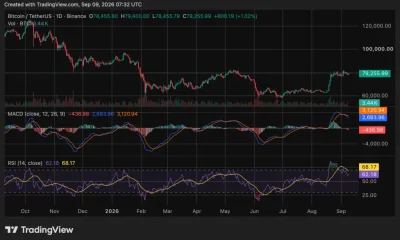
The analyst at CryptoQuant weighed in on BTC’s notable price resurgence, which drove the asset from under $65,000 to over $82,000 within a few weeks, and, more specifically, on the subsequent rejection and what could follow around the corner.

They believe the overall setup remains constructive, but the cryptocurrency has to overcome a stack of technical and on-chain resistance levels, which are right in front of it.

Which Level Decides BTC’s Fate?

The weekly report by CryptoQuant identified Bitcoin’s 365-day moving average, currently located at $81,700, as the asset’s most important level. Recall that BTC briefly exceeded that level at the start of September, but the bears stepped up and quickly rejected the move.

Historically, bull markets have “officially” begun once the cryptocurrency closes above this moving average. A successful close above $81,700 could confirm a new bullish phase and open the door for another major leg up. However, its continuous inability to break through could lead to a longer consolidation phase or even to a more profound decline.

Advertisement

On the downside, bitcoin’s rally won’t be confirmed by simply moving past the $81,700 obstacle, as there are a few others on the way up. At first, CryptoQuant found the 3x Metcalfe valuation band, which sits at $83,600 and stands as the next big resistance. This level halted BTC in May and has previously coincided with important cycle turning points.

If taken down, there’s one more at $88,700, which is the trader realized-price upper band. History shows that selling has intensified once the cryptocurrency approaches this line because active traders begin sitting on increasingly large unrealized profits.

539K BTC

CryptoQuant noted that the most immediate problem is considerably closer as long-term holders sold as much as 539,000 units between $77,100 and $80,200 throughout the year, creating what the analysts described as the heaviest nearby on-chain supply wall.

Bitcoin would need to absorb this supply before making another convincing attempt north, while the downside is better defined. The 200-day MA around $70,000 represents the first major technical support, followed by another substantial on-chain cluster between $62,000 and $65,000, where approximately 476,000 BTC were accumulated this year.

Advertisement

Overall, CQ’s analysts are still bullish on BTC, but under one critical condition: the asset must clear $81,700 soon, then $83,600, and eventually $88,700 before the recovery can develop into a more profound rally.

The post Bitcoin’s 24% Rally Hit a Wall: CryptoQuant Reveals What Comes Next appeared first on CryptoPotato.

Source link

Advertisement
Continue Reading

Crypto World

The Cyclospora Outbreak, By the Numbers

Published

on

The Cyclospora Outbreak, By the Numbers

The outbreak marked the largest of cyclosporiasis, a gastrointestinal illness caused by a parasite known as Cyclospora cayetanensis, in the country’s known history. 

People become infected by the parasite by consuming contaminated food or water; in the U.S., outbreaks of cyclosporiasis have often been tied to fresh produce. While some people may not experience any symptoms, others who become infected by the parasite may report “explosive” bowel movements. 

In July, federal public health officials announced that they were investigating an outbreak of these infections in several states, eventually linking the cases to contaminated processed iceberg lettuce from Taylor Farms de Mexico. On July 17, the company recalled all of its iceberg lettuce products that were sourced from central Mexico, which it said it did “out of an abundance of caution.”

The CDC said on Friday that the number of recent cyclosporiasis cases tied to this summer’s outbreak “has significantly declined.” At the height of the outbreak, before the Taylor Farms recall, the CDC was reporting more than 1,000 cases in one day, but in August, the agency was reporting less than two each day.

Advertisement

“At this time, there is no risk of people getting sick with cyclosporiasis from this source,” the CDC said. “The best-by dates for all product linked to this outbreak have passed and it is no longer available in stores or restaurants.”

But, the agency added, the Food and Drug Administration is continuing with its investigation to determine how the lettuce product tied to the outbreak this summer was contaminated with Cyclospora cayetanensis.

Here’s what to know about the toll the outbreak took across the country.

How many people died in the Cyclospora outbreak this summer?

Advertisement

Michigan public health officials revealed last month that the two individuals who died had “significant underlying health conditions that may have been impacted by cyclosporiasis and dehydration.”

Cyclosporiasis rarely becomes fatal; most people without underlying conditions recover even without receiving treatment.

How many people were sickened in the Cyclospora outbreak this summer?

According to the CDC, 12,883 people across the country were sickened by the parasite in the outbreak this summer, though the agency has said that the true number is likely even higher than that because people often recover from cyclosporiasis without seeking medical attention and so are never tested for the parasite. Of those confirmed cases, 570 were hospitalized.

Advertisement

In a typical year, the U.S. reports only a few thousands cases of cyclosporiasis. The five-year average of cases per year between 2018-2022, for instance, was just 3,285, according to data shared by the Colorado Department of Public Health & Environment. And of those individuals, less than 200, on average, were hospitalized.

Which states were affected by the Cyclospora outbreak this summer?

Twenty-one states were affected by the Cyclospora outbreak this summer. Michigan was the hardest hit, with the CDC reporting more than 5,700 cases there. Ohio and Missouri also saw high numbers, reporting 2,871 and 1,071 cases, respectively. States including Indiana, Kentucky, Kansas, Nebraska, Illinois, Pennsylvania, and Oklahoma saw case numbers in the triple digits.


Source link

Advertisement
Continue Reading

Crypto World

The AfD’s Dark Agenda for Germany

Published

on

The AfD's Dark Agenda for Germany

The AfD won voters away from all its mainstream rivals, winning over 82,000 voters who had previously supported the governing Christian Democratic Union of Germany (CDU). But one of the more striking consequences of the Sept. 6 election in Saxony-Anhalt was that the AfD energized people who had stopped voting, and brought 170,000 of them—around a tenth of the local electorate—back to the ballot box. These are people who had largely given up on politics, and who, for years, have inhabited a parallel universe. Many of these voters regard Germany’s Nazi past as overblown and refuse to draw parallels between then and now. They also see centrist politics as the instrument of a deep state seeking to undermine their values.

While reporting from Saxony-Anhalt, I was reminded of a small incident I witnessed before the pandemic. I was walking along a street in Leipzig, one of the main cities of the former Communist East Germany, with a helpful contact, an intelligent local activist who had once worked for the Greens. As we passed the offices of MDR, the regional public broadcaster, she suddenly shouted, without provocation, “Lügenpresse”—“lying press,” or “fake news.” Startled, I asked what the station had done to earn her ire. “They don’t listen to the likes of me,” was all she could say. The more I pressed her to identify the specific source of her grievance, the more agitated she became.

Source link

Continue Reading

Crypto World

Clearpool’s Clear Token Migration Fuels XRP Ledger Growth

Published

on

Crypto Breaking News

XRP is drawing fresh attention as Clearpool pushes its institutional lending framework onto the XRP Ledger. The decentralized credit protocol is entering what it calls its next growth phase. This move ties XRP directly to a rising wave of institutional yield products.
Clearpool Expands Institutional Credit on XRP Ledger

Clearpool plans to build its lending infrastructure directly on the XRP Ledger network. The protocol will also migrate its CPOOL token to a new token called CLEAR. New participants will receive CLEAR for added capital, and existing holders will get a 1:1 swap.

The XRP Ledger offers a proven network, and institutional credit remains largely untapped there. Clearpool intends to deliver real-world, institutional-ready lending infrastructure on the chain. This positions XRP as a foundation for a broader credit ecosystem.

Two XRP Ledger standards support this shift: Single Asset Vaults and the Lending Protocol. Clearpool describes these as native, institutional-grade credit rails for XRP-based finance. The RLUSD stablecoin will serve as the regulated settlement asset within this system.

Advertisement

Ripple Backs XRP Ecosystem Growth Through Clearpool

Ripple has committed investment to help launch Clearpool’s yield products for XRP and RLUSD. This funding strengthens the broader push toward institutional-grade credit on the XRP Ledger. Ripple’s involvement signals continued confidence in XRP’s expanding financial use cases.

Earlier, Ripple partnered with Cicada Partners and Clearpool to launch an institutional credit fund. That fund will issue loans backed by real-world assets as collateral. The partnership reflects a coordinated effort to grow XRP-based lending markets.

Together, these moves link Clearpool’s protocol upgrade to Ripple’s wider strategy for XRP. Institutional demand for regulated, blockchain-based credit continues to grow steadily. XRP now sits at the center of that expansion.

CPOOL to CLEAR Migration Reshapes Token Supply

The migration to CLEAR will come with a full treasury recapitalization. Clearpool noted that 99% of CPOOL’s supply is already vested, and reserves are low. Additional resources are needed to fund further development and adoption.

Advertisement

Under the proposed plan, 70% of new CLEAR supply goes to existing token holders. The remaining allocation splits across the ecosystem, treasury, and contributors. Total CLEAR supply will rise from 1 billion to 1.125 billion at migration.

Over three years, circulating CLEAR supply is projected to reach 1.428 billion tokens. A buyback-and-burn mechanism will use half of protocol fees to purchase and destroy CLEAR. Community members now have fourteen days to weigh in before a Snapshot vote decides the outcome.

Risk & affiliate notice: Crypto assets are volatile and capital is at risk. This article may contain affiliate links. Read full disclosure

Source link

Advertisement
Continue Reading

Crypto World

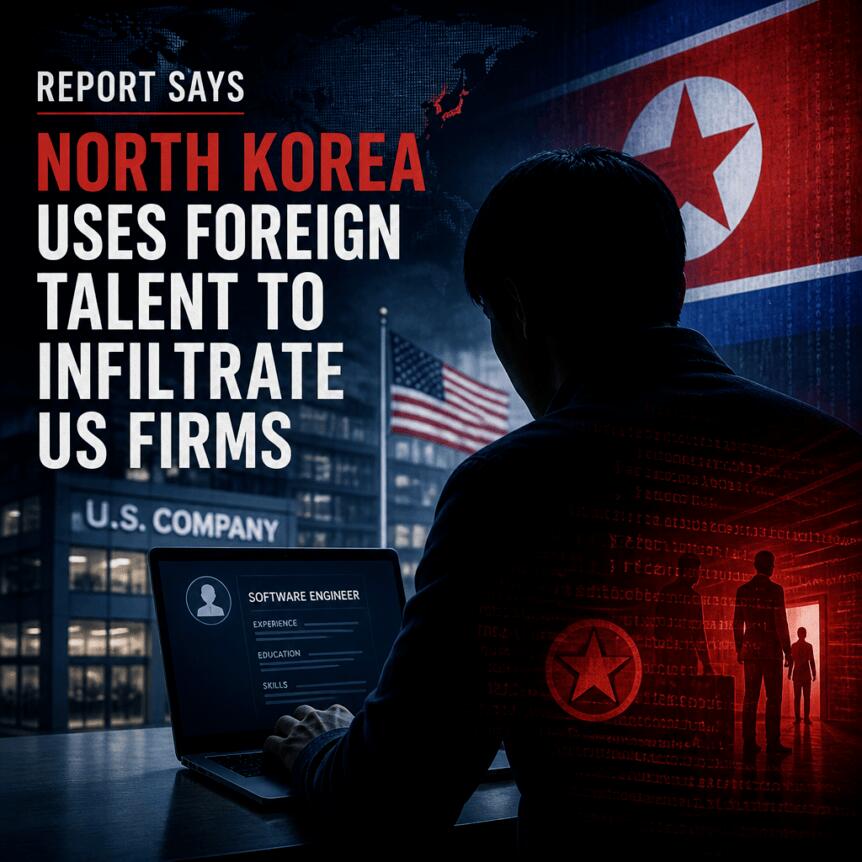
Report Says North Korea Uses Foreign Talent to Infiltrate US Firms

Published

on

Crypto Breaking News

North Korea appears to be expanding its use of remote IT workers in third countries as part of an increasingly targeted strategy to infiltrate U.S. companies and channel funds toward its weapons programs. NBC News reported on Friday that the scheme involves foreign-based job seekers—often recruited through mainstream platforms—who are then positioned to move contracts and access before being replaced by North Korean operatives.

The details come after a July warning issued by the U.S. government and multiple foreign agencies. The alert said North Korean IT workers actively look for contracts with the intention of remitting salaries back to their parent agencies. It also highlighted their potential as insider threats, citing participation in data exfiltration, cryptocurrency theft, and theft of sensitive information.

Key takeaways

  • U.S. and allied agencies have warned that North Korean IT workers seek contracts to funnel pay back to DPRK-linked agencies while posing insider and data-risk threats.
  • NBC reports North Korean efforts increasingly rely on third-country remote workers to pass job interviews, then hand over roles to DPRK operatives.
  • Recruitment tactics described by NBC include scouting on platforms like LinkedIn and offering cryptocurrency compensation for “interview associate” work.
  • Related reporting from earlier this year tied North Korea-linked hacking activity to large crypto losses, suggesting the operational model may be bearing fruit.
  • With economic pressure continuing, the scheme underscores why organizations should tighten identity, access, and payment controls for remote hiring.

From direct recruitment to third-country remote access

According to NBC’s report, North Korea’s approach has shifted toward leveraging remote workers outside the DPRK to gain entry into companies that may not otherwise connect the threat to North Korea. Instead of relying solely on traditional infiltration channels, the scheme centers on obtaining legitimate work contracts after successfully navigating hiring processes.

The reported workflow is straightforward but high-risk for employers: third-country IT workers are brought in to secure contracts and, after roles are established, are “usually” replaced by North Korean operatives. The operational logic is clear—create an initial foothold that looks normal from an outside hiring perspective, then transition to the underlying actors with access to systems, credentials, or internal knowledge.

NBC also said some foreign workers were recruited after being scouted on LinkedIn. In other cases, applicants were allegedly offered cryptocurrency payments to perform part-time “interview associate” tasks—work that can help them appear credible in recruitment pipelines while potentially aligning them with a longer-term operational goal.

Advertisement

The July alert and what it implies for corporate defenses

The July alert referenced by NBC is significant because it frames the threat not just as external hacking, but as a multi-stage infiltration risk that includes insider behavior. In that advisory, U.S. government and partner agencies described North Korean IT workers as contract-seekers who intend to remit earnings to DPRK agencies.

Just as importantly, the alert connects the labor recruitment angle to cyber outcomes. It described how these workers can function as insider threats to companies, while also being implicated in data exfiltration and cryptocurrency theft, along with theft of sensitive information. Even without additional details about each case in NBC’s report, the combined message is that the threat model includes both access and monetization.

For companies processing remote hires, this means that hiring risk is inseparable from security risk. Organizations that rely on remote onboarding, contractor access, or permissive internal tooling could be inadvertently enabling a pathway for identity compromise, unauthorized code and data handling, and lateral movement once the “handover” occurs.

Why cryptocurrency appears in the recruitment workflow

NBC’s reporting that some candidates were offered cryptocurrency as part of “interview associate” arrangements matters for two reasons. First, it signals that the recruitment pipeline may be designed to blend into existing work structures while still using mechanisms that are harder to trace than conventional payroll.

Advertisement

Second, it aligns with earlier warnings and reporting that tie North Korea-linked actors to crypto-enabled theft and financial diversion. In May, Cointelegraph reported—citing cybersecurity firm CrowdStrike—that North Korea state-affiliated hackers and threat actors were responsible for more than $2 billion in cryptocurrency losses in 2025, representing a 51% year-on-year increase. While that figure reflects cyber theft broadly rather than the specific “interview associate” step described by NBC, the throughline is consistent: crypto is both a tool and an outcome for DPRK-linked operations.

Sanctions pressure, economic indicators, and persistence

The recruitment strategy also fits a broader pattern of persistent activity despite sanctions. The report notes that the Bank of Korea estimated North Korea’s GDP increased 3.5% in 2025 even with global restrictions in place. That kind of resilience can be read as a reminder that threat actors do not need normalization of trade to sustain operations—alternative channels, including cybercrime and illicit financial routing, can help fill gaps.

For investors and builders in crypto and broader tech ecosystems, the implications extend beyond national security. North Korea-linked tactics reportedly combine labor infiltration with cyber operations and monetization. That combination increases the likelihood that compromised systems, stolen credentials, and exfiltrated data can feed downstream fraud and theft—potentially involving crypto at multiple stages.

As governments and companies tighten controls around known malware and exchange-related abuse, schemes that begin at recruitment and onboarding may become more attractive because they can bypass purely technical perimeter defenses.

Advertisement

What to watch next is whether more enforcement and advisories provide granular indicators—such as specific behaviors during remote hiring, payment patterns, or contract-approval structures—that organizations can use for earlier screening. In the meantime, the core concern is clear: if role handovers from third-country contractors to DPRK operatives are a recurring tactic, security teams should assume that “legitimate” employment pathways can conceal hostile intent.

Risk & affiliate notice: Crypto assets are volatile and capital is at risk. This article may contain affiliate links. Read full disclosure

Source link

Advertisement
Continue Reading

Crypto World

StarkWare Says it Confirmed a Quantum Safe Bitcoin Transaction on Mainnet

Published

on

StarkWare Says it Confirmed a Quantum Safe Bitcoin Transaction on Mainnet


StarkWare said a Bitcoin transaction using its Quantum Safe Bitcoin, or QSB, design was mined on mainnet without changing Bitcoin’s consensus rules. The transaction 305a24ff…ab07 was confirmed in block 964,199 on Aug. 26. Blockstream’s record shows that it combined 39,179- and 10,000-satoshi… Read the full story at The Defiant

Source link

Continue Reading

Crypto World

Moonwell Loses $8.7 Million To MAMO Price Manipulation On Base

Published

on

Moonwell Loses $8.7 Million To MAMO Price Manipulation On Base


Moonwell lost roughly $8.7 million on Thursday after an attacker manipulated the price of MAMO, a small-cap token the lending protocol accepts as collateral on Base, and used the inflated position to borrow real assets. The protocol had no faster remedy than shutting itself down. Moonwell's… Read the full story at The Defiant

Source link

Continue Reading

Crypto World

Ripple stablecoin chief sees $13 trillion corporate treasury opportunity for RLUSD

Published

on

Ripple stablecoin chief sees $13 trillion corporate treasury opportunity for RLUSD


Payments and capital markets are driving growth for Ripple’s $2.4 billion digital dollar as it looks to bring RLUSD to Europe under MiCA, the firm’s Jack McDonald said.

Source link

Continue Reading

Crypto World

At the U.S. Open, Ben Shelton Has America Believing Again

Published

on

At the U.S. Open, Ben Shelton Has America Believing Again

Two years ago, Taylor Fritz won his semifinal over fellow American Frances Tiafoe to reach the final against Jannik Sinner, who was on the cusp of winning his second major championship and cementing his status, along with Carlos Alcaraz, as the alpha dogs of their game. Sinner beat Fritz in straight sets in 2024—and has since won three more Grand Slam championships.

I was there the night Fritz reached that final. I wrote all about it. And truth be told, until Friday, I pretty much forgot about it.

Win or lose on Sunday, Shelton’s performance at this year’s tournament will be remembered. After all, he already outlasted Alcaraz, the defending U.S. Open champion and a seven-time Slam victor, in a five-set quarterfinal epic that ended at 3:33 a.m. Wednesday—the latest finish in tournament history. Shelton won in a 10-point, fifth-set tiebreaker. 

By defeating Tiafoe, a close friend whom he called “a big brother,” in Friday’s semifinal 4-6, 6-3, 6-3, 7-5, Shelton became the first Black American man to reach a U.S. Open final since the event’s stadium namesake, Arthur Ashe, in 1972. Shelton’s the first Black American man to reach a Grand Slam singles final since MaliVai Washington, who lost to Richard Krajicek of the Netherlands at Wimbledon in 1996.

Advertisement

Source link

Continue Reading

Crypto World

Ditching bonds for bitcoin: How crypto can tackle the AI-heavy portfolio dilemma

Published

on

Ditching bonds for bitcoin: How crypto can tackle the AI-heavy portfolio dilemma


Bitcoin Suisse says rising AI investment, government debt and weakening stock-bond diversification strengthen the case for adding bitcoin to traditional portfolios.

Source link

Continue Reading

Trending

Copyright © 2025