Connect with us

NewsBeat

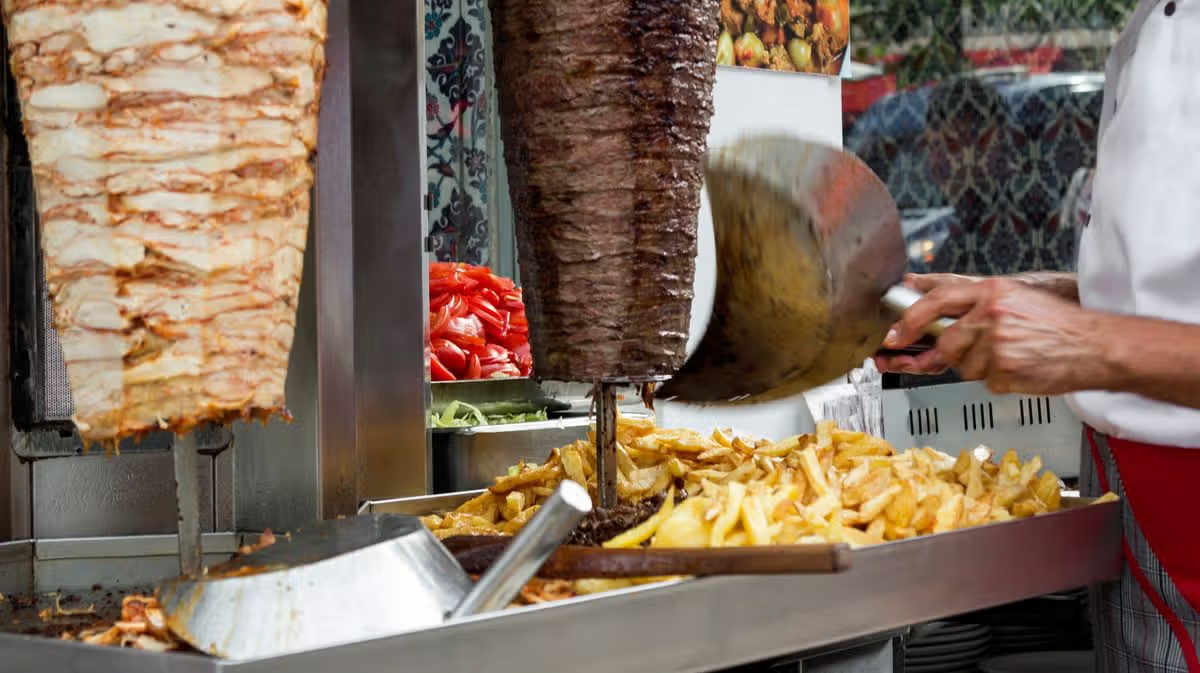
The 6 Cambridge kebab restaurants named among UK’s best

Published

on

Cambridgeshire Live

The businesses have featured on a shortlist from across the UK

Six Cambridge kebab businesses have been named as among the best in the UK. The 15th annual British Kebab awards are taking place on February 23, 2027.

Advertisement

The awards celebrate the best kebab businesses across the UK. On September 8, a shortlist of 500 semi-finalists were announced, including six in Cambridge.

The Cambridge businesses that made the shortlist are:

  • Little Petra – 60 Hills Road, Cambridge
  • Burwell Kebab Van – 21 The Causeway, Burwell
  • Diamond Kebab – Nicholson Way, Cambridge
  • Hungry Kebab – Davy Road, Cambridge
  • Gourmet Kebab – 105 Cambridge Road, Caxton, Papworth Everard
  • River Grill – 228 High Street, Cherry Hinton

Ibrahim Doğuş, founder of the British Kebab Awards, said: “Reaching our semi-finals is a genuine achievement, and in our milestone 15th year it is a proud moment for Cambridge and the hard-working families behind these businesses, who are part of the fabric of their communities.”

A gala night will be held on February 23 where the winners will be announced.

Do you want more of the latest Cambridgeshire news as it comes in from across the county? Sign up to our dedicated newsletter to make sure you never miss a big story from Cambridge or anywhere else in the county. You can also sign up to our dedicated Traffic and Crime newsletters for the latest updates on the topics you are most interested in.

Advertisement

Source link

Continue Reading
Click to comment

You must be logged in to post a comment Login

Leave a Reply

NewsBeat

the hurdles in enforcing UK’s ban on trade with illegal Israeli settlements

Published

on

the hurdles in enforcing UK’s ban on trade with illegal Israeli settlements

The key question about the UK’s decision to ban trade in goods and services from illegal Israeli settlements in the Occupied Palestinian Territories is whether – and how – such a ban can be enforced. To answer this question, it’s worth looking at how such sanctions are already enforced in similar situations.

Blood diamonds, the precious stones whose proceeds are used to finance war, are often cited as an example of the way countries can avoid trading in commodities that can contribute to harm. But the goods and services involved in the sanctions on West Bank settlements are far less valuable.

Exports include agricultural products like dates and olives, supporting – according UK foreign secretary to Ed Miliband – settler terrorism and ethnic cleansing. While blood olives might not have the same ring to it, enforcement challenges are similar to those with blood diamonds.

The announced sanctions have been widely reported as impossible to implement. The Foreign, Commonwealth and Development Office (FCDO) has previously expressed “reasonable concern” that the enforceability of sanctions would be undermined because distinctions between the internationally recognised area of Israel and the Occupied Palestinian Territories are not applied consistently. The FCDO also expressed concerns about over-compliance with sanctions and unintended consequences.

Advertisement

The sanctions build on existing law. The FCDO strongly advises “against conducting any economic and financial activities in illegal Israeli settlements”. Since 2005, products produced in Israeli settlements located within the territories occupied by Israel since 1967 are not entitled to benefit from preferential tariff treatment upon entry into the United Kingdom. A list of non-eligible locations is published at postcode level.

Provenance is important for many products, especially in the agri-food sector. But establishing the origin of products is challenging. In the West Bank, boundaries are more political than geographical. Olive trees in illegal settlements and neighbouring core Israeli territory are likely to share climate, geology, and even their irrigation water sources. This makes the olives indistinguishable.

With no way to determine the precise origin of all products imported from the West Bank, origin becomes a paper claim. The responsibility for verifying that claim lies with customs authorities. This is a significant challenge for often already stretched resources.

In the EU and UK, products from illegal settlements do not receive the same preferential treatment as products from other parts of Israel. Nevertheless, analysis from the Israel corporate and legal watchdog, the Global Echo Litigation Center of 30,000+ trade records estimates roughly one-fifth of Israeli shipments to the EU originate from a settlement.

Advertisement
Products originating from the West Bank at the Israel Products Center (IPC). IPC is challenging the upcoming ban on trade with Israeli settlements in the West Bank at the court in The Hague.
Sem Van Der Wal/ ANP

Their report highlights methods of obscuring or falsifying product origin. Some exporters include the postcode of an illegal settlement as the true origin of the product, claiming the location is in Israel. Others provide a false address within Israel. True origin can also be obscured by mixing products from Israel with those from settlements. This typically happens during packaging or further processing, for example of grapes to wine or olives into oil.

How sanctions can be enforced

Many other schemes exist to prevent products reaching certain markets. A prominent example is the Kimberley Process, which came into force in 2003 to stop the trade in blood diamonds. The cost of its certification processes and audits is trivial compared to the value of the diamonds and there are relatively few production points for diamonds. Nevertheless, the Kimberley Process has faced criticism for enabling diamond laundering. The cost of certification is more significant for products with a lower unit value, such as the ones exported from the West Bank.

An example of origin verification of agricultural products is the EU Deforestation Regulation, which aims to guarantee that the products EU citizens consume do not contribute to deforestation or forest degradation. Its requirement to submit precise origin information along the whole supply chain has been postponed twice because of the high implementation cost.

A winemaker stands next to barrels of wine in the Psagot winery in West Bank.
A winemaker in the Psagot winery in West Bank, just north of Jerusalem. These wines will be subject to sanction under the trade ban.
EPA/Jim Hollander

The simplified package, to be enforced from December 2026, is estimated to represent a roughly 75% cut in compliance costs compared to the original design. Detailed origin verification, as will be needed to enforce the announced sanctions on illegal settlements, is expensive.

The US’s Uyghur Forced Labor Prevention Act takes an alternative approach that shifts the burden of proof to importers. Importers have to provide clear and convincing evidence that any goods from the affected region are made without forced labour. They are then placed on a list of permitted importers. This approach could provide a blueprint for prior approval of entities rather than retrospective scrutiny of individual shipments from the West Bank.

Advertisement

For Russian-occupied Ukrainian territory, sanctions are in place prohibiting imports from non-government controlled Ukrainian territory.


À lire aussi :
UK plan to sanction Israel’s illegal West Bank settlements is a historic shift in tone and policy


The difference here is that Ukraine is involved in certifying origin. All goods from the West Bank, whether Palestinian exports or from settlements, depart through Israeli ports under Israeli authority. And, as Global Echo’s research has shown, these have been found to be untrustworthy on questions of origin certification.

This has design implications for supply chains that include products from the West Bank. Origin has to be established before exporting. A clear chain of custody must preserve identity and segregation so products of different origins are not mixed. Otherwise a ban on imports from the illegal settlements is meaningless.

Advertisement

Combined with shifting the burden of proof to a limited list of importers, a chain of custody could make the announced sanctions actually enforceable.

Unintended consequences

There are also concerns about unintended consequences of the announced sanctions. In terms of supply chains, these might include damage to trade with Israel, which includes pharmaceutical products, cosmetics and technology.

And, if new rules and regulations are seen as complex, they might deter companies from importing from the West Bank entirely, to the detriment of Palestinian exporters.

Ultimately, the question is not whether the UK can differentiate between settlement olives and Israeli ones. It is a question of who bears the cost of proving origin. Main UK imports from the occupied Palestinian territories include fruits and vegetables, as well as oils and fats.

Advertisement

Many Palestinians in the West Bank depend on agriculture for their livelihoods. Unless proof of origin is designed into supply chains, they will be the most severely affected.

Source link

Advertisement
Continue Reading

NewsBeat

Dentists and GPs offered training to spot early MND signs in UK first

Published

on

Dentists and GPs offered training to spot early MND signs in UK first

Jessica Lee, director of research at the My Name’5 Doddie Foundation, said: “MND is not common, its early signs can vary considerably and there is no single test that tells you conclusively that someone has it. That means people can move between different parts of the healthcare system before they reach the right specialist.

Source link

Continue Reading

NewsBeat

Jemima Goldsmith marries multi-millionaire financier Cameron O’Reilly as her cricket legend ex-husband remains seriously ill in Pakistani prison

Published

on

Jemima Goldsmith, 52, married a multi-millionaire financier this week (Goldsmith is pictured in July 2023)

Jemima Goldsmith – whose first husband, the cricket legend Imran Khan, is seriously ill in prison in Pakistan – has got married for a second time.

The Daily Mail can disclose that Jemima, 52, an award-winning film producer and close friend of the late Princess Diana, exchanged vows at the weekend with Cameron O’Reilly, 62.

The Irish-Australian is the son of Sir Anthony O’Reilly, the late media magnate and international rugby star.

The Mail on Sunday revealed in May that the pair had become engaged after a year-long romance.

Advertisement

Jemima’s brother Ben Goldsmith confirmed that the couple had got married and his wife, Jemima Jones, wrote online: ‘What a happy day!’

The newlyweds are understood to have met while Cameron was working as an executive producer on several documentaries and films.

He has four children while Jemima has two sons, Kasim and Sulaiman, with Imran, the former Pakistan cricket captain who became prime minister of his country.

Jemima and her sons are campaigning for his release from prison, where he has been languishing since 2023 on charges of corruption, which he vigorously denies.

Advertisement

Jemima Goldsmith, 52, married a multi-millionaire financier this week (Goldsmith is pictured in July 2023)

She tied the knot with Cameron O'Reilly (pictured), a smart meter and software investor and the son of Sir Anthony O'Reilly - the late media magnate and international rugby star

She tied the knot with Cameron O’Reilly (pictured), a smart meter and software investor and the son of Sir Anthony O’Reilly – the late media magnate and international rugby star

Goldsmith's first marriage was with cricket legend Imran Khan (The couple are pictured at their wedding in 1995)

Goldsmith’s first marriage was with cricket legend Imran Khan (The couple are pictured at their wedding in 1995)

Advertisement

After their nine-year marriage ended in 2004, Jemima had high-profile relationships with actor Hugh Grant, comedian Russell Brand and The Crown scriptwriter Peter Morgan.

A friend of Jemima and Cameron told the Daily Mail previously that the couple were friends ‘for a while’ before their relationship became romantic. 

The source added: ‘They first met through work and were friends for a while before that. They have been together as a couple for just over a year. He’s a very private person and Jemima is determined to protect that.’  

It is understood that many of Jemima’s family, including her brother Robin Birley, owner of London club 5 Hertford Street, have met Cameron and get on very well with him.

Advertisement

The Oxford graduate spent a decade working in his father’s media empire, Independent News & Media, and later the Australian group APN News & Media before stepping down as chief executive in 2000.

In 2003, he launched private equity fund Bayard Capital, buying the Swiss metering company Landis+Gyr. He served as chief executive before selling it to Toshiba for $2.3billion in 2011.

The wedding comes almost a year after the death of Jemima’s mother, Lady Annabel Goldsmith, the socialite after whom Annabel’s nightclub in Mayfair is named. Jemima’s father, the billionaire tycoon Sir James Goldsmith, died in 1997.

Khan (pictured in 2022) is being held in conditions described as 'barbaric' in a Pakistani prison

Khan (pictured in 2022) is being held in conditions described as ‘barbaric’ in a Pakistani prison

Advertisement

Jemima, an award-winning documentary maker, has meanwhile been campaigning for the release of Khan, from whom she divorced in 2005. 

The ex-cricketer turned politician was jailed in 2023 for corruption and remains behind bars after receiving further sentences in December last year in cases that he says are politically motivated. 

Lawyers said last month that Khan’s health had deteriorated in jail conditions described as ‘barbaric’, prompting intervention from a Supreme Court which saw him transferred to a private hospital. 

However, he was briefly taken instead to a government hospital where he was deemed fit to return to his cell – despite him reportedly losing 85 per cent of his vision in his right eye due to a blood clot.

Advertisement

Khan and Jemima’s sons, Sulaiman and Kasim, accused the British government of insufficient support and are hopeful to speak with Prime Minister Andy Burnham about it. 

Source link

Continue Reading

NewsBeat

Darlington exhibition explores the history of local buses

Published

on

Darlington exhibition explores the history of local buses

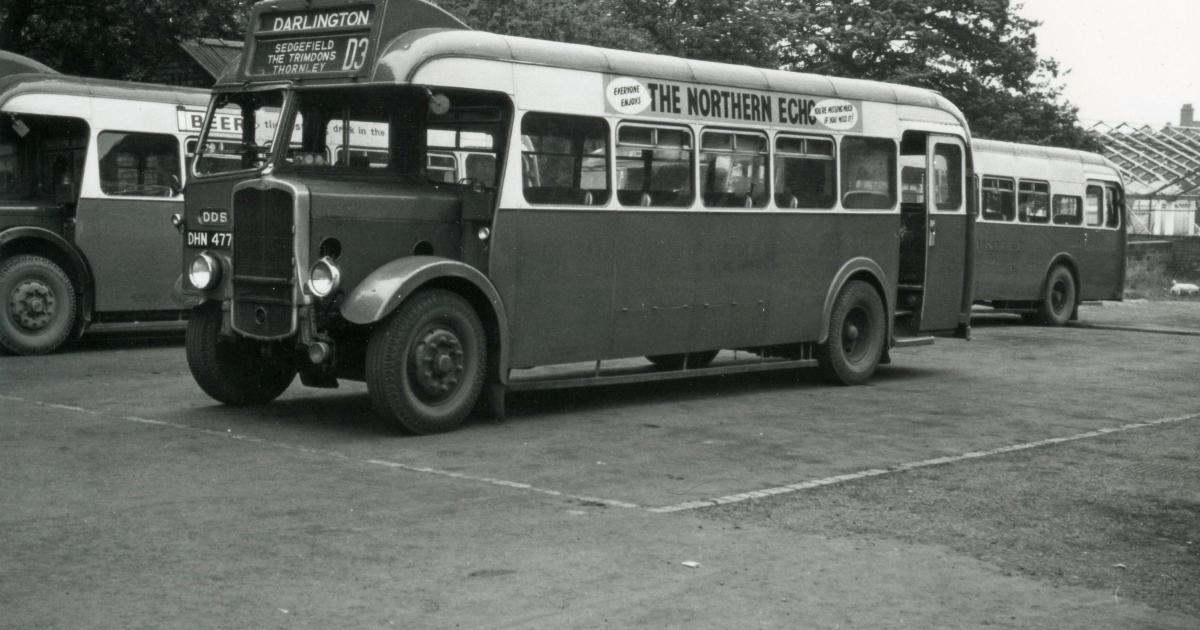
This month’s exhibition in Darlington library is all about buses in pictures and paraphernalia.

When there was a bus-based transport system, there needed to be places for buses to stop and for bus passengers to wait. The exhibition’s pictures show how High Row became lined, on both sides, with substantial waiting shelters, and also how from the 1920s to the 1960s, the Leadyard acted as a bus station.

High Row, with bus shelters lining the roadside. Picture: Darlington Centre for Local Studies (Image: Picture: Darlington Centre for Local Studies)

Leadyard was a street that led from the eastern side of the Market Place down to the River Skerne – it was beside the Bishop of Durham’s old palace and got its name because he apparently stored his lead here.

Looking up the Leadyard towards Darlington Market Place when it was lined with buses. Picture: Darlington Centre for Local Studies (Image: Picture: Darlington Centre for Local Studies)

It became a bus headquarters because United had an office in a former Unitarian church in the yard while Scott’s Greys, a legendary firm founded before the First World War by Fred Scott who owned only grey horses, had an office at the top of the yard.

Advertisement

A bus in the Leadyard at the stand going to Croft and Hurworth. Picture: Keith Kitching (Image: Keith Kitching)

While High Row got its shelters, Leadyard remained uncovered, and the exhibition includes a cartoon from the Echo’s sister paper, the Northern Despatch, from 1956 showing how long-talked-about plans for a proper bus station were being used by waiting passengers to keep the rain off their heads.

The Despatch cartoon of 1956 showing passengers trying to keep dry in the Leadyard before the Feethams bus station was built. Picture: Darlington Centre for Local Studies (Image: George Flynn)

The Feethams bus station opened in 1961 and lasted until 2008 when it became embroiled in a headline-grabbing battle.

United had evolved into Arriva which leased the bus station from Darlington council, but Arriva were merging with Stagecoach and talking of leaving the station. Tesco then stepped in and gave Arriva £25,000 to stop it passing the 51 years left on its lease to another bus company.

Tesco drew up plans to demolish the adjoining town hall and create a massive supermarket, but in council consultations, 78 per cent of townspeople objected to the “tescofication” of Darlington and planning permission was refused.

Advertisement

Instead, the Feethams leisure development – cinema, hotel and restaurants – grew up on the site of the bus station.

A 1950s recruitment advert, created by Arthur Hughes of the Art Shop, to go above the seats in Darlington’s buses. Picture: Darlington Centre for Local Studies (Image: Darlington Centre for Local Studesi)

TED HOYLE writes: “Around 1944, my father, Harry, began driving the Teesdale Queen bus service which had been started in Mickleton under the guise of Fawn Lea by Joe Wilson.

My father started driving after Joe had died, and I think the vehicle was an old Commer although it was replaced by a new one purchased from Comberhill Motors (a Wakefield bus dealer).

“Around 1950, my father bought the business from Mrs Wilson and he operated several services from Harwood to Darlington twice a month, Barnard Castle on Wednesday, Holwick to Middleton and Harwood to Middleton.

Advertisement

He also ran mystery trips and excursions to Morecambe Bay, Blackpool, the Lakes and Dumfries which were very popular as very few people owned a car.

“When the Tees Valley Railway from Barnard Castle to Middleton-in-Teesdale was closed, he won the contract to transport pupils to school.

He was then running 29-seater Bedford Duplex coaches because there were very few turning places in the dale.”

The Teesdale Queen was garaged at Harwood at the top of the dale beyond even High Force, where the lanes could only accommodate a small bus.

Advertisement

However, there was big demand, particularly on a Saturday night when the Cosy Cinema in Middleton shut and last orders were being called in the pubs.

The record for the number of people crammed on the 10pm 29-seater Teesdale Queen out of Middleton, going through hamlets like Newbiggin, Bowlees, Forest and Langdon Beck, was 90!

“When I came out of the army in 1964,” continues Ted, “I passed my PSV licence and drove for my father until he retired and sold out to Fred and Colin Jewitt in 1967.

“There were a few other coach firms at that time, Percival’s, Maude’s, Howson’s, Wright’s from Alston and Bond Brothers of Willington.

Advertisement

They were all striving to provide a service and make a living, but with the coming of the motor car, it was the end of an era.

“But not many could say that their father drove the Queen, and I was teased about it at school.”

IN south Durham in the late 1950s and 1960s, the lanes were full of London double-decker buses that local companies had bought cheap, due to a post-war surplus (Memories 789, 798 and 800).

They were known as RT, which may have stood for their model name, Regent.

Advertisement

“When I visited London Transport’s Broadway history centre in the 1970s, I was told ‘RT’ did indeed stand for ‘Regent’, just as ‘RM’ stood for ‘Routemaster’,” says David Leishman.

“The versions of RT were then given an extra letter, like ‘RMF’ for the extended, higher-capacity version.

“RTs ended up all over the world.

I have pictures of them in Malawi and Zambia in the 1970s, operating in Blantyre and Lusaka respectively.”

Advertisement

The Echo’s 1931 safe driving certificate (Image: Chris Lloyd)

LAST week, we told how before the introduction of the driving test, prospective drivers for Heather Bell buses, of Tow Law, were put through their paces by having a matchbox placed behind their stationary rear wheels on the steep Newton Cap bank in Bishop Auckland.

If they could pull away without squashing the matchbox, they got the job.

Which prompted Ian Ferguson in Low Newton to send in a certificate he found in the back of a 1938 brochure about the launch of RMS Mauretania.

It is a Northern Echo Safety First Certificate from 1931 which says that its delivery van driver, W Rennison of The Crossway, Darlington, had gone the whole year “free from any accident for which he was to blame”.

Advertisement

In those pre-test days, this was another way for employers to single out competent drivers.

The first compulsory driving test came into effect on June 1, 1935, although drivers who already had a licence did not have to sit it so for many decades there were drivers on Britain’s roads who had never passed a test.

It wasn’t until the 1968 Transport Act that separate tests for Public Service Vehicles, like buses, and Heavy Good Vehicles were introduced.

James & Mosley bus tickets from Croft Spa (Image: Chris Lloyd)

AN anonymous correspondent sends in these bus tickets from James & Mosley who operated from a garage in Croft Spa.

Advertisement

We guess they go back to before the Second World War.

“Croft Spa” then referred to the village in County Durham that is properly known as Hurworth Place even though it had Croft Spa railway station at its heart.

To this day there is a garage – the Oxford – in Hurworth Place where cars are repaired, but we think it was originally the home of Abbotts’ buses, founded by William Abbott and continued by his sons, Stanley, Walter and Frank.

They ran the first buses from Hurworth Place into the Leadyard in Darlington.

Advertisement

They were red and cream and had “Croft Spa” on their destination boards.

There was another bus garage on the North Yorkshire side of the river in Croft-on-Tees where the village hall is today.

We think this is where James & Mosley’s blue buses were based.

J&M, Abbotts and a third company, Hollands of Strait Lane, Hurworth, took it in turns to run hourly buses from Dalton, Croft, Hurworth and Neasham into Darlington.

Advertisement

Can you tell us any more about any of these companies? Do you have any old tickets relating to buses in our area? Please email chris.lloyd@nne.co.uk if you have a bus story…

And while we’re mentioning Croft, there are a couple of places left on this morning’s guided walk which leaves from the church at 10.30am, if you’ve not going anything better planned.

Fred Robinson’s auction is at the centre of this fair on Feethams Field with St Cuthbert’s Church in the background. The bus station was built on the field (Image: Unknown)

TIM BROWN in Ferryhill joins the bus theme with reminiscences about Darlington market following the articles in Memories 795 and 797.

“The two most important traders for the farming community were in front of the gates of St Cuthbert’s churchyard, Sam and Charles Turner’s farm supplies.

Advertisement

Here all manner of hand tools, hardware such as nails of every size, farm clothing, grass cutter blades, and harnesses and halters could be bought.

More importantly, in the era before combine harvesters, you could get binder twine there.

This was needed at harvest time and during winter for binding straw on the threshing machines.

The twine was often referred to as ‘Charlie band’.

Advertisement

The closest modern equivalents to the stall are probably Sam Turner’s farm shops at Northallerton and Piercebridge.

Arable farmers visited the Corn Exchange which was set up by the corn dealers in the Town Hall.

The farmers would bring samples of their grain to haggle with the dealers to secure the best price.

The Market Place was the centre of most of these activities with the old open air bus stands in Leadyard beside the churchyard.

Advertisement

A colder place to wait for buses is hard to imagine.

Progressing south to Feetham’s Field, there were weekly auctions, conducted by Stanley Robinson, disposing of all manner of furniture and household goods.

Farmers will also remember the cattle market at Bank Top, convenient for the railway yards, where the mart canteen had a reputation for pie and peas with a big mug of tea.”

Advertisement

Source link

Continue Reading

NewsBeat

Two brothers launched ‘vicious’ attack on Uber Eats delivery driver after he took too long to drop off their McDonald’s burgers

Published

on

Two brothers viciously attacked an Uber Eats delivery driver after he took too long to drop off their McDonald's burgers (Pictured: Charlie Campbell)

Advertisement

Two brothers launched a vicious attack on an Uber Eats delivery driver after he took too long to drop off their McDonald’s burgers. 

Charlie Campbell, 21, and Tyler Campbell, 23, assaulted courier Stephen Onwuegbule on January 13 following a late-night food order to their home. 

The brothers, of Chatham, Kent, became aggressive and attacked Mr Onwuegbule after he arrived with the McDonald’s order and berated him for ‘being late’. 

The pair surrounded the delivery driver, charging at him before hitting him with their fists until he was pushed to the floor. They then continued to punch Mr Onwuegbule until his lip was split and eye bloodshot. 

Advertisement

The brothers were later charged and admitted assault occasioning actual bodily harm (ABH) when they appeared in court in June, when pre-sentencing reports were ordered.  

They were sentenced together at Medway Magistrates’ Court on August 27. 

Both were handed 12-month community orders, which will see Tyler complete 15 rehabilitation sessions and Charlie complete 20.

They were both also ordered to carry out 300 hours of unpaid work and pay the victim £250 each in compensation, and will pay what they owe the court at a rate of £20 a month.

Advertisement

Two brothers viciously attacked an Uber Eats delivery driver after he took too long to drop off their McDonald’s burgers (Pictured: Charlie Campbell)

The brothers admitted to assault occasioning actual bodily harm (Pictured: Tyler Campbell)

The brothers admitted to assault occasioning actual bodily harm (Pictured: Tyler Campbell)

During their sentencing hearing, prosecutor Alan Balneaves told the court that Mr Onwuegbule was attacked in the early hours of January 13.

Advertisement

He said: ‘It was a McDonald’s delivery and it was 3.20am. He found the address, and both came out berating him for being late, but this was not the victim’s fault.

‘It was a group attack on one person. Both have no previous convictions.’

The court heard when the police arrived at the scene, the brothers admitted what they had done.

James Langridge, defending, told the hearing both his clients were young men who had a volatile upbringing and had suffered some significant trauma.

Advertisement

Mr Langridge said: ‘This can be dealt with by way of a community order which the report recommended; they would also welcome the chance to pay compensation to the victim.’

Magistrates told the pair they’d had a good discussion about what punishments they should receive.

The chairman of the bench called the incident ‘extremely serious’ and said jail time or a suspended sentence order was considered. 

However, they also said because of the recommendations in the pre-sentencing report, the early guilty pleas and the fact they were both of previous good character, the bench could mark the offences with high-level community orders.

Advertisement

The chairman said: ‘You did come close; the victim doesn’t deserve that sort of behaviour, but you have shown remorse.’

Magistrates didn’t put any restrictions on them ordering again from Uber Eats.

Do you have a story? Email caitlin.leng@dailymail.co.uk 

Advertisement

Source link

Advertisement
Continue Reading

NewsBeat

Crowds flock to Stanhope Show this weekend

Published

on

Crowds flock to Stanhope Show this weekend

The Weardale event celebrates countryside life with main-ring entertainment and expert-led classes.

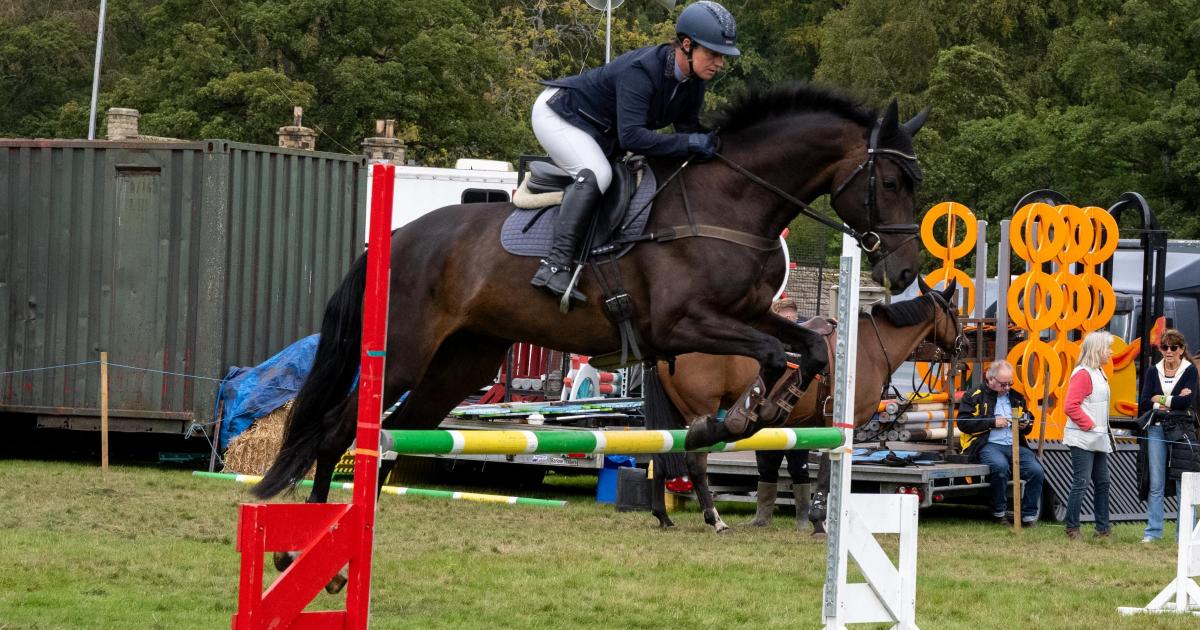
The popular show brings together British farming, rural skills and a wide range of activities including dog agility tests, stunt drivers, llama walks and World Championship Cumberland Wrestling.

The show ran on Saturday and Sunday (September 12 and 13).

Check out the pictures below:

Advertisement

(Image: ANDY FUTERS)

(Image: ANDY FUTERS)

(Image: ANDY FUTERS)

(Image: ANDY FUTERS)

(Image: ANDY FUTERS)

(Image: ANDY FUTERS)

(Image: ANDY FUTERS)

(Image: ANDY FUTERS)

(Image: ANDY FUTERS)

(Image: ANDY FUTERS)

(Image: ANDY FUTERS)

(Image: ANDY FUTERS)

(Image: ANDY FUTERS)

(Image: ANDY FUTERS)

(Image: ANDY FUTERS)

(Image: ANDY FUTERS)

(Image: ANDY FUTERS)

(Image: ANDY FUTERS)

(Image: ANDY FUTERS)

(Image: ANDY FUTERS)

(Image: ANDY FUTERS)

(Image: ANDY FUTERS)

(Image: ANDY FUTERS)

(Image: ANDY FUTERS)

(Image: ANDY FUTERS)

(Image: ANDY FUTERS)

Visitors could browse a diverse selection of high-quality trade stands, carefully chosen to create a unique and enjoyable shopping experience.

The stalls ranged from local producers to specialist retailers.

The event was held at Unthank Park, Stanhope.

Advertisement

Source link

Continue Reading

NewsBeat

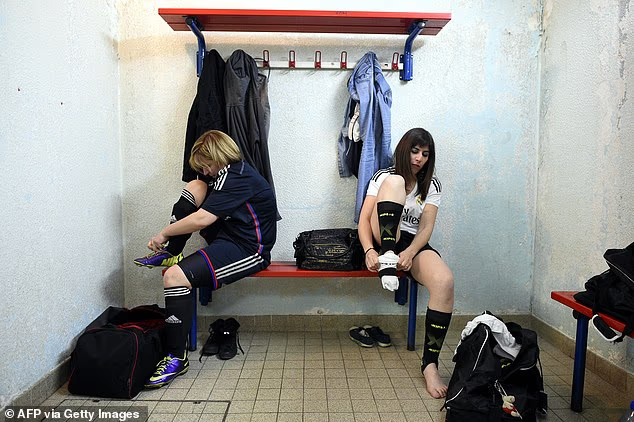
Fury as NSPCC say male teachers can supervise girls in changing rooms

Published

on

Male teachers will be allowed to supervise female pupils while they get changed at swimming pools or sports centres under new NSPCC guidance for schools

Advertisement

Male teachers will be allowed to supervise female pupils while they get changed at swimming pools or sports centres under new NSPCC guidance for schools.

The child protection charity has removed a policy that adults supervising pupils while they change should be the same sex as the children from its latest safeguarding briefing.

Campaigners and MPs last night called on the NSPCC to reinstate the policy, and accused the charity of making the change under pressure from transgender activists.

The NSPCC’s previous long-standing policy said: ‘Adults who are supervising children getting changed should be of the same gender as them.’ 

Advertisement

But in the children’s charity’s latest ‘safeguarding considerations for changing rooms’ briefing, this line has been removed entirely.

The NSPCC said it had made the change after a similar recommendation was removed from Department for Education (DfE) guidance that was updated this summer. But the DfE denied this last night and said no such recommendation was removed.

The NSPCC later said instead that it had made the decision based on a ‘variety of sources’.

Women’s rights campaigners said that instead of changing the reference from ‘gender’ to ‘biological sex’ – in line with April 2025’s Supreme Court ruling – the NSPCC ‘came to its own decision’ to remove the safeguarding guidance entirely.

Advertisement

Male teachers will be allowed to supervise female pupils while they get changed at swimming pools or sports centres under new NSPCC guidance for schools

Tory equalities spokesman Joy Morrissey described the NSPCC’s move as ‘completely unacceptable’, adding: ‘Male staff should not be supervising young girls while they are getting changed and nor should female staff be supervising young boys. That is just common sense.

‘The Government needs to urgently review this guidance and ensure there are clear safeguards for sex-based supervision. We must put the safety and wellbeing of children first.’

Advertisement

Maya Forstater, chief executive of Sex Matters, said it is ‘cowardly, weak and hypocritical of the NSPCC to try to pass the buck’ for scrapping the ‘common sense’ policy. She added: ‘This NSPCC guidance was never about equality law, or even the Supreme Court judgment. It was common-sense guidance, based on years of experience about how to safely supervise children changing.’

Ms Forstater accused the charity of ‘failing in its duty to provide guidance on protecting children from harm’ in a bid to do ‘what trans activists would prefer’.

She added: ‘As the leading UK body for the safeguarding of children, what is the NSPCC for if not to do its utmost to protect children? It appears instead to have decided that the safer route is to avoid offending trans activists, even if that puts the safety, privacy and dignity of children at risk.’ But the NSPCC denied it had made the decision under pressure from trans activists and said it may consider changing the guidance again when there is more direction from the Equality and Human Rights Commission.

A spokesman for the charity said its guidance was updated recently ‘to reflect the latest version of the Department for Education’s statutory guidance for schools’, but could not point to where the DfE’s guidance made such a recommendation.

Advertisement

The spokesman added: ‘It is categorically untrue to say that any updates to the NSPCC’s information briefing were made as a result of external lobbying.’

Advertisement

Source link

Continue Reading

NewsBeat

Body of man in 60s recovered from Yorkshire canal by police

Published

on

Body of man in 60s recovered from Yorkshire canal by police

The body of a man in his 60s was pulled from Ripon Canal on Sunday morning (September 13).

North Yorkshire Police said its officers were called to the scene in Boroughbridge Road, Ripon, shortly after 8.40am on Sunday.

A force spokesperson said the body was discovered by a member of the public.

Advertisement

They said there is “nothing to suggest any suspicious circumstances surrounding the death, and a file will now be prepared for the coroner”.

“Urgent enquiries are currently ongoing to identify and locate the man’s next of kin, who we believe may not be in North Yorkshire,” the police spokesperson said.

Boroughbridge Road was closed for most of the morning while emergency services and investigators carried out their work, but it has since reopened.

Advertisement

Source link

Continue Reading

NewsBeat

Middlesbrough restaurant The Birdcage has changed hands

Published

on

Middlesbrough restaurant The Birdcage has changed hands

Vicki Busby, Carl Blake and Rachel McLaine, the team behind The Birdcage, confirmed the sale in a social media post on Thursday (September 10).

The owners thanked customers for their support and described running the restaurant as a time filled with “incredible memories”.

Former owners, L-R: Vicki Busby, Rachel McLaine, and Carl (Image: The Birdcage)

They said: “The Birdcage has brought us so much happiness and so many incredible memories.

“We truly hope it brings its new owners just as much happiness as it has brought us, and we wish them every success with their exciting new chapter.

Advertisement

“Your support has meant more to us than we could ever put into words, and The Birdcage wouldn’t have been the same without you.”

Customers have called the restaurant the “best bottomless brunch” venue in the North East.

The Birdcage, Middlesbrough. (Image: TRIPADVISOR)

The trio said they are stepping away from The Birdcage, but staying in Teesside’s hospitality scene.

“It’s certainly not goodbye,” they said.

Advertisement

“The three musketeers are together again in Stockton at The Olive Branch and The Songbird, ready for our next adventure.”

The Olive Branch and The Songbird, both in Stockton, operated as “sister restaurants” to The Birdcage under Vicki, Carl and Rachel before the trio sold The Birdcage to focus on the other two venues.


The Birdcage’s new owners, Lisa and Paul Sargeant, introduced themselves on social media on Friday morning (September 11).

The couple said: “We’re looking forward to meeting you, hearing your stories, and hopefully giving you plenty more memories to add to them.

Advertisement

“The Birdcage is still The Birdcage – but now it’s our turn to put our stamp on it.

“There are already lots of plans, ideas and a few slightly bonkers things in the pipeline. We’ll be sharing them with you very soon.”

The Birdcage will honour all existing bookings and deposits transferred during the handover.

Customers with questions about upcoming bookings should contact the restaurant directly.

Advertisement

Source link

Continue Reading

NewsBeat

Ulster Unionists select Kyle Savage as Upper Bann candidate

Published

on

Belfast Live

“This is a constituency that punches above its weight, and it deserves a representative who is part of a team working together to make Northern Ireland stronger and more successful.”

The Ulster Unionist Party has selected Kyle Savage as its candidate for next year’s Assembly elections in the constituency represented by former party leader Doug Beattie.

Advertisement

Upper Bann MLA Mr Beattie resigned from the party in May, citing a “toxic atmosphere” under its current leadership, and now sits as an independent unionist.

Party leader Jon Burrows said Mr Savage “will have the full backing of the party” when he runs in the constituency.

Mr Savage is a twice deputy lord mayor of Armagh City, Banbridge and Craigavon.

Mr Burrows said: “He was selected by our members in Upper Bann because they know him, trust him and want him to be their voice at Stormont.

Advertisement

“This is a constituency that punches above its weight, and it deserves a representative who is part of a team working together to make Northern Ireland stronger and more successful.

“Kyle will be that representative, and he will have the full backing of the party behind him.”

Mr Savage said: “Upper Bann needs a bit of common sense.

“Not more slogans – someone who is out on the ground, honest about what has not worked, and determined to win this seat for people here.”

Advertisement

For all the latest news, visit the Belfast Live homepage here and sign up to our daily newsletter here.

Source link

Continue Reading

Trending

Copyright © 2025