
Crypto World
Japan finance firms add AI translation and QR payments



PayPay has added UnionPay QR payments across participating Japanese merchants while SMBC has begun deploying an OpenAI-powered interpreter to bank employees.
Summary
- PayPay added UnionPay QR payments through HIVEX at participating merchants across Japan on September 3.
- UnionPay App users can register cards issued in mainland China, Hong Kong and Macau directly.
- PayPay says its network now supports 36 overseas payment services spanning 17 markets for visitors.
- SMBC-Interpreter uses OpenAI’s GPT-Live-1 to return live voice translations alongside synchronized onscreen text for employees.
- SMBC says customer audio and translated output are neither stored nor used for model training.
PayPay said in a Sept. 3 release that UnionPay App users can now pay through its merchant network using the HIVEX payment platform. Sumitomo Mitsui Banking Corporation announced its separate SMBC-Interpreter rollout on Sept. 11.
The two companies have not announced a partnership between the products. PayPay’s expansion concerns payments made by overseas visitors, while SMBC’s application handles spoken communication between bank employees and customers.
PayPay brings UnionPay QR into its merchant network
Travelers can register UnionPay cards issued in mainland China, Hong Kong or Macau within the UnionPay App. At participating PayPay merchants, they can scan or present a payment code to complete purchases through the HIVEX network.
PayPay said the service can be used for purchases such as meals, accommodations and souvenirs. Prices appear in Japanese yen at the merchant, while the customer’s application calculates the amount in their home currency.
HIVEX connects domestic merchants to overseas mobile-payment services without requiring separate technical integration for every wallet. TBCASoft, which operates the platform, said UnionPay App payments became available at HIVEX-enabled PayPay locations in early September.
TBCASoft described the service as reaching more than 500 million linked UnionPay card users. The figure represents cards linked across UnionPay’s issuing network, not confirmed users of PayPay merchants in Japan.
Merchant availability can depend on a location’s PayPay and overseas-payment settings. PayPay’s use of “nationwide” refers to supported merchants across Japan and does not establish that every business accepting PayPay can process UnionPay App payments.
UnionPay’s international page says its QR service is accepted across 44 countries and regions outside mainland China. UnionPay reports more than 1.5 million overseas merchants, though the company does not provide a Japan-specific merchant total on that page.
PayPay says overseas payment coverage reaches 17 markets
Following the UnionPay integration, PayPay said its merchants can receive payments from 36 overseas cashless services representing 17 countries and regions. The company calculated that the supported markets account for approximately 80% of international visitors to Japan.
PayPay’s 80% figure concerns the countries and regions represented by its supported payment services. It does not mean 80% of overseas visitors have used the platform or completed a payment at a PayPay merchant.
A previous company announcement from October 2025 listed 28 overseas services across 14 countries and regions. PayPay said transaction value generated by overseas cashless services during fiscal 2024 was roughly three times its fiscal 2019 level. The company did not disclose the underlying yen totals.
The latest expansion adds another option for visitors from China, Hong Kong and Macau without requiring them to download PayPay. Card registration, account controls and transaction records remain within the UnionPay App.
PayPay has said it plans to pursue more agreements with overseas payment providers. No timetable, target market list or forecast for UnionPay transaction volume accompanied the September release.
SMBC uses GPT-Live-1 for live bank translation
In a separate Sept. 11statement, SMBC said it had developed SMBC-Interpreter for employees who need to communicate in foreign languages. The bank has started introducing the application in phases.
SMBC-Interpreter listens to speech and generates a translated voice response using OpenAI’s GPT-Live-1 model. Translated text appears on the screen at the same time, allowing employees and customers to review the wording during a conversation.
The bank said the dual output can help when a spoken exchange is difficult to follow. Employees can use the displayed text to confirm information while explaining services or checking operational instructions with customers.
SMBC described the application as an internal support tool. Its announcement did not identify supported languages, participating branches or the number of employees receiving access during the initial deployment.
No accuracy rate, response-time measurement or comparison with human interpreters appeared in the release. SMBC did not say whether staff must obtain human-language support for certain contracts, disclosures or regulated procedures.
The bank said neither the original audio nor the generated translation is stored in the application or connected external services. SMBC stated that the content is not used to train AI models. The release did not identify an external audit of those controls.
The deployments follow separate digital finance programs
SMBC’s interpreter joins the bank’s other work involving AI and digital finance, but the application does not process payments or digital assets. It is designed for communication during banking services.
As crypto.news reported in related coverage, Japan’s AI and blockchain finance proposal supports tokenized deposits and yen stablecoins. The proposal named SMBC, MUFG and Mizuho among institutions working on settlement systems, though it is separate from the employee translation application.
PayPay’s UnionPay connection uses conventional card-linked mobile payments. Neither PayPay nor TBCASoft described the system as a cryptocurrency, stablecoin or blockchain product.
No verified market reaction could be tied specifically to either announcement. PayPay is owned by LY Corporation and SoftBank Group interests, while SMBC operates within Sumitomo Mitsui Financial Group. Neither parent company issued a filing that quantified expected revenue, costs or earnings from these deployments.
UnionPay QR payments are already available at participating PayPay locations. SMBC said its interpreter is entering phased use, but the bank provided no completion date or public access plan.



The XRP Ledger has processed 3,254 transactions in one ledger, setting a reported single-ledger record on Sept. 14.
Summary
- The XRP Ledger processed 3,254 transactions in one ledger, according to validator operator Vet’s report.
- Most transactions reportedly transferred one drop of XRP, the network’s smallest native currency unit available.
- The transaction burst did not establish a permanent increase in the ledger’s sustainable processing capacity.
- XRPL adjusts its transaction target when validators close heavily loaded ledgers within expected timing limits.
- BatchV1_1 remained under validator voting and requires sustained 80% support before automatic mainnet activation occurs.
Validator operator Vet reported the figure after reviewing the ledger and said most entries were one-drop XRP payments. He described the activity as a possible throughput test, although the sender’s purpose has not been confirmed.
A drop is one-millionth of one XRP, making it the smallest unit recorded by the network. The high transaction count therefore represented many small transfers, not an unusually large amount of XRP moving between accounts.
The ledger index and initiating account were not identified in Vet’s public post. Without those details, the record claim relies on his analysis and cannot be compared through the post alone with every earlier ledger in XRPL history.
Tiny XRP payments dominated the record ledger
Most of the 3,254 transactions were simple payments carrying one drop of XRP, according to Vet. Simple native-asset transfers require less processing work than transactions involving decentralized exchange orders, NFTs or cross-currency payment paths.
“I don’t know why this person is doing these transactions, but it looks like throughput testing, probably,” Vet said. The description remains speculative because the account owner has not publicly explained the activity.
Transaction count does not show how much computational work a ledger required. A ledger containing thousands of direct XRP payments can place a different load on validators than one containing fewer trades, token operations or complex payment paths.
“Not all transactions are equal in load footprint,” Vet said. He estimated that 500 simple XRP payments could create less stress than 200 transactions that require extensive decentralized exchange processing.
Official XRPL documentation states that each validated ledger records the transactions applied to the preceding ledger state. The associated metadata provides the result and effects of each included transaction.
Transactions with a tesSUCCESS result completed their requested action. Entries carrying a tec result remain recorded and consume a fee, even when they fail to perform the requested operation. The reported total of 3,254 therefore describes included transactions, not necessarily 3,254 successful transfers.
XRP Ledger capacity uses an adaptive target
The XRP Ledger does not use one permanent transaction limit for every ledger. Its servers adjust operating conditions in response to transaction volume, network latency and consensus performance.
Vet said the network can raise its soft transaction target when a heavily loaded ledger closes within the expected period. When close times move beyond the preferred range, the network can reduce the target to help validators return to normal timing.
XRPL documentation says servers exchange proposals until trusted validators agree on a transaction set. Each server then calculates the new ledger state and distributes a signed validation containing the resulting ledger hash.
A supermajority of trusted validators must agree on the same hash before the ledger becomes validated. Once validated, its transactions and resulting state become final parts of XRPL’s ledger history.
The 3,254-transaction result consequently provides evidence that validators agreed on a ledger carrying that number of entries. It does not establish a new permanent throughput rate, because sustained capacity depends on transaction complexity, hardware, network conditions and consecutive ledger close times.
Throughput measured from one ledger differs from transactions per second over an extended period. A short burst can place many pending payments into a single ledger, while the following ledgers may return to normal activity.
No performance report from Ripple, the XRP Ledger Foundation or the network’s reference software maintainers had confirmed a permanent capacity change following the record. No service interruption or failed consensus round was reported in connection with the burst.
Recent activity has included heavier payments and trading
The record occurred after a period of increased XRPL payment and trading activity. In related coverage, XRP Ledger order-book volume rose 79% year over year during the second quarter of 2026, according to an Evernorth report.
Average daily order-book volume reached 3.57 million XRP during the quarter, while the number of daily traders fell from 1,864 to 1,111. Evernorth said average volume per trading account nearly tripled during the same comparison period.
Stablecoin transfers have created another source of network use. As crypto.news reported, RLUSD generated approximately $9 billion in first-half transfer volume on XRPL during 2026.
Such activity is separate from the one-drop transfers identified in the record ledger. No evidence cited by Vet connected the 3,254 transactions to RLUSD, institutional settlement, exchange trading or customer payments.
The sender could have been testing transaction submission, ledger packing or another technical process. The available account pattern does not confirm whether the activity came from a developer, institution, automated service or individual user.
BatchV1_1 moves through the amendment process
The record arrived while validators were considering protocol features introduced with version 3.3.0 of rippled, the network’s reference server software. The XRP Ledger Foundation released version 3.3.0 on Aug. 6.
Its proposed features include BatchV1_1, ConfidentialTransfer, DynamicMPT, PermissionDelegationV1_1 and Sponsor. Each feature follows the XRPL amendment process before it can become active across the main network.
BatchV1_1 would allow multiple transactions to be bundled and processed together. Official XRPL records say it replaces the earlier Batch amendment after developers found a critical bug in the original implementation.
The feature does not explain the 3,254-transaction ledger because BatchV1_1 had not completed mainnet activation when the activity occurred. Its presence in the server release means validators can review and vote on the amendment.
XRPL’s amendment rules require more than 80% support from trusted validators for two continuous weeks. If support falls to 80% or lower before the period ends, the countdown resets.
ConfidentialTransfer would introduce shielded balances and transfer amounts for Multi-Purpose Tokens while providing viewing mechanisms for authorized parties. DynamicMPT would permit issuers to change selected token settings unless they make those properties permanently immutable.
PermissionDelegationV1_1 replaces an earlier delegation feature that developers disabled after finding a critical bug. The updated amendment would let XRPL accounts assign limited permissions to other accounts after validator approval.
No activation date is guaranteed for amendments still under voting. Validator operators can change their votes, and the network checks amendment support around flag ledgers, which occur approximately every 15 minutes.


Key takeaways
- Cardano trades near $0.207 after falling more than 8% during the previous week.
- ADA’s long-to-short ratio of 0.88 indicates bearish positioning among derivatives traders.
- The funding rate turned positive at 0.0052%, showing a mild bullish bias despite the elevated short positioning.
- ADA must hold the $0.199-to-$0.200 support zone to avoid a decline toward $0.195, $0.173, or $0.150.
Cardano (ADA) traded near the critical $0.200 support zone on Monday after declining more than 8% during the previous week.
Although ADA remains above two important short-term moving averages, mixed derivatives data and sell-side pressure from large traders suggest that recovery attempts could encounter resistance at higher levels.
ADA long-to-short ratio signals bearish sentiment
Cardano’s derivatives indicators present a cautious and somewhat conflicting outlook.
CoinGlass data shows ADA’s long-to-short ratio at 0.91, close to its lowest level in a month. A reading below one indicates that traders hold more short positions than long positions, reflecting expectations of further price weakness.
However, Cardano’s funding rate turned positive on Monday, reaching 0.0052%. Positive funding means long-position holders are paying shorts, suggesting that some traders are positioning for a price recovery.
The contrast between the bearish long-to-short ratio and positive funding rate points to uncertainty rather than a clear directional consensus.
CryptoQuant’s market summary also signals caution. Large whale orders are appearing in ADA’s futures market, but sell-side activity remains dominant.
Both spot and futures markets are also showing signs of increased trading activity or “heating,” while several other indicators remain neutral.
Together, these factors suggest volatility could rise around the current support area. However, the dominance of large sell orders leaves Cardano exposed to further downside if buyers fail to defend $0.200.
Cardano holds above key moving averages
ADA traded at approximately $0.207 on Monday, remaining slightly above its 50-day exponential moving average at $0.199 and its 100-day EMA at $0.200.
Holding above these indicators gives Cardano’s short-term technical structure a mildly constructive tone despite the broader downward trend.
The Relative Strength Index stands at 50, indicating balanced momentum and consolidation. Meanwhile, the Moving Average Convergence Divergence indicator remains slightly negative, showing that bullish momentum has not yet strengthened enough to confirm a recovery.

Cardano’s immediate resistance sits at the 50% Fibonacci retracement level of $0.213. A move above that level could allow ADA to test the 61.8% retracement at $0.231.
Additional barriers are located at $0.236, the 200-day EMA near $0.240 and the horizontal resistance level at $0.245. ADA would need to break decisively through this cluster to improve its medium-term outlook.
A sustained move above $0.245 could bring the more distant $0.299 resistance level into focus.
Conversely, losing the 50-day and 100-day EMAs near $0.200 would expose the 38.2% Fibonacci retracement at $0.195. A deeper correction could then target the structural support levels at $0.173 and $0.150.


Key takeaways
- Pi Network traded above $0.097 on Monday after recording gains for two consecutive weeks.
- The Pi Core Team released SoloHost updates and Pi Desktop version 0.6.3 to improve reliability, app discovery, and developer tools.
- PI remains above its 50-day EMA at $0.094, while the RSI near 60 signals improving bullish momentum.
Pi Network (PI) extended its recovery on Monday, trading above $0.097 following two consecutive weeks of gains.
New ecosystem updates and improved developer tools are strengthening the network’s utility. However, PI continues to trade below major long-term exponential moving averages, leaving its broader technical outlook bearish despite improving momentum.
Pi Network releases SoloHost and Desktop updates
The Pi Core Team recently released updates for SoloHost alongside version 0.6.3 of Pi Desktop.
SoloHost updates have been released alongside Pi Desktop version 0.6.3! This improves app discovery, reliability, and developer tools.
Pioneers can more easily discover actively used SoloHost apps. Reliability improvements and developer resources, such as AI agents… pic.twitter.com/67SXkf4CMp
— Pi Network (@PiCoreTeam) September 10, 2026
According to the project, the updates improve application discovery, platform reliability, and the tools available to developers building within the Pi Network ecosystem.
Continued development could support greater application activity and expand PI’s utility. These improvements have accompanied the token’s recent recovery, with PI gaining 1.68% last week before extending its advance on Monday.
However, ecosystem developments will need to translate into sustained user activity and demand for the token to support a stronger long-term recovery.
PI holds above the 50-Day EMA
Pi Network traded near $0.097 on Monday, remaining slightly above its 50-day exponential moving average at $0.094.
Holding above this indicator gives PI’s short-term outlook a mildly bullish tone. The Relative Strength Index stands near 60, indicating that buying momentum is improving without reaching overbought territory.
The Moving Average Convergence Divergence indicator is also marginally positive, supporting the possibility of further short-term gains.
Nevertheless, the recovery remains tentative because PI continues to trade below its 100-day and 200-day EMAs. These indicators currently stand near $0.105 and $0.138, respectively, preserving the token’s broader bearish structure.
PI’s first major resistance is located at the 100-day EMA near $0.105. A sustained break above this level could strengthen the recovery and open the way toward the horizontal resistance at $0.118.

Beyond that, the 200-day EMA near $0.138 represents a more substantial obstacle. Reclaiming this indicator would be necessary to improve PI’s medium- to long-term technical outlook.
Failure to overcome the $0.105 resistance could leave the token consolidating around its current level or expose it to renewed selling pressure.
Immediate support sits at the 50-day EMA near $0.094. Holding this level would preserve PI’s improving short-term structure and allow buyers another opportunity to challenge overhead resistance.
A decisive decline below $0.094 could weaken the recovery and bring the horizontal support at $0.075 into focus.
If selling pressure intensifies, PI could revisit the former trendline-break area near $0.045, which represents a deeper structural support level.

US spot Bitcoin exchange-traded funds (ETFs) saw a sharp weekly reversal, posting $462.7 million in net outflows after three straight weeks of inflows. The shift came across all four trading sessions from Tuesday through Friday, according to data from Farside Investors, with the selling extending the slide into a fourth consecutive day.
Ether ETFs moved in the opposite direction over the same period, recording nearly $197 million in net inflows. Farside Investors reported that US spot Ether products drew $196.9 million during the four-day window, even as flows were choppy earlier in the week.
Key takeaways
- US spot Bitcoin ETFs recorded $462.7 million net outflows for the four-session week, reversing a three-week inflow streak.
- Bitcoin ETF outflows were broad-based across sessions, with Thursday’s $282.7 million withdrawal the largest daily outflow since July.
- Despite the weekly reversal, spot Bitcoin ETFs remain net positive for September, with $307.3 million in inflows through Friday.
- US spot Ether ETFs delivered $196.9 million in net inflows, led on Friday by BlackRock’s iShares Ethereum Trust ETF with $148.8 million.
Bitcoin ETFs reverse course after three-week inflow run
According to Farside Investors, Bitcoin ETF outflows unfolded across every session from Tuesday to Friday. The withdrawal week followed what the market data described as the strongest three-week inflow stretch of 2026, which ended after funds shed $166.8 million during the first two days of the holiday-shortened week.
The pressure intensified on Thursday, when US spot Bitcoin ETFs posted net outflows of $282.7 million—reported as the largest daily withdrawal since July. Friday’s outflow slowed to $13.2 million, but SoSoValue data indicates it still extended the streak of negative daily flows to four trading days.
That combination—one very large day followed by continued (though smaller) withdrawals—helps explain why the weekly total turned decisively negative. Investors watching ETF flows typically treat these reversals as short-term signals of changing risk appetite, especially when they break prior momentum rather than merely pausing inflows.
Which funds drove weekly Bitcoin outflows
Farside Investors’ breakdown shows that ARK 21Shares’ Bitcoin ETF led the weekly withdrawals with $234.2 million in net outflows. Grayscale’s Bitcoin Trust ETF followed with $129.1 million.
BlackRock’s iShares Bitcoin Trust ETF also saw withdrawals, losing $52.5 million over the week. Fidelity’s Wise Origin Bitcoin Fund recorded net outflows of $50.7 million. Together, the results suggest the reversal was not isolated to a single product—multiple major issuers posted negative weekly flow.
While daily volatility can be normal for ETF baskets, the fact that several large operators posted sizable weekly declines is notable for traders who monitor whether outflows are concentrated (often linked to specific investor behavior) or distributed across the complex.
Broader flow picture: still net positive for September
Even after the weekly reversal, spot Bitcoin ETFs remain in positive flow territory for the month. According to the report, through Friday these products have accumulated about $307.3 million in net inflows for September.
That matters because it changes how the week’s news may be interpreted. A negative week can reflect temporary positioning or macro-driven caution, but a still-positive month indicates that large inflows have not fully disappeared across the broader period. For market participants, the key question going forward is whether the ETF complex can stabilize its daily flows before monthly net gains start to erode.
Ether ETFs turn positive with strong Friday inflows
On the Ether side, US spot Ether ETFs recorded $196.9 million in net inflows over the same Tuesday-to-Friday period, per Farside Investors. The week’s flow pattern looked more uneven earlier, with $24.3 million in outflows on Tuesday, $34.7 million in inflows on Wednesday, and $29.9 million in outflows on Thursday.
Friday marked the turning point. The Ether funds drew $216.4 million in net inflows, flipping the four-day total into positive territory despite the earlier back-and-forth.
Product leadership also differed by day. BlackRock’s iShares Ethereum Trust ETF drove Friday’s inflows with $148.8 million, while 21Shares Core Ethereum ETF added $29.1 million. In practice, such leadership changes can help investors gauge where incremental demand is showing up within the Ether ETF lineup.
Overall, the contrast between Bitcoin’s outflows and Ether’s inflows in the same calendar window underscores how different investor demand can be across the two major spot ETF ecosystems. Rather than assuming flows will always move together, traders often watch whether capital rotates between Bitcoin and Ether depending on positioning, risk appetite, and broader market sentiment.
Looking ahead, the next signals to monitor are whether Bitcoin ETF outflows persist after the Thursday-heavy withdrawal day and whether Ether’s strong Friday inflow momentum can sustain through the following week—because the month-to-date net picture remains supportive for Bitcoin while Ether’s reversal will be tested by the next few sessions’ flow consistency.


A Hong Kong man in his 70s has lost more than HK$13 million ($1.67 million) after a self-described cryptocurrency investment expert contacted him through WhatsApp and directed him to a fake trading app.
Summary
- A Hong Kong man in his 70s lost more than HK$13 million after a supposed crypto investment expert from Singapore contacted him through WhatsApp.
- The victim bought USDT and ETH before transferring the assets to wallets specified by the scammer through a fraudulent investment app.
- The fake app displayed continuing profits, prompting the man to transfer more funds before he discovered the fraud when his withdrawal requests were rejected.
- Hong Kong police have received more than 40 recent investment scam reports involving combined losses exceeding HK$50 million.
Hong Kong police said the case was among more than 40 investment scams recently reported to authorities, with victims losing a combined total exceeding HK$50 million.
The latest case began when the elderly man received an unsolicited WhatsApp message from someone claiming to be a cryptocurrency investment expert from Singapore. The person introduced him to what was presented as a crypto platform offering favorable exchange rates, low fees and withdrawals at any time.
Following the instructions he received, the man opened a cryptocurrency wallet and purchased Tether (USDT) and Ethereum (ETH). He was then told to download an investment application supplied by the scammer and transfer the cryptocurrency to designated wallet addresses as investment capital.
Fake crypto investment app showed profits before withdrawals failed
Once the funds had been transferred, the fraudulent application displayed what appeared to be continuing investment profits, according to police.
Seeing his account balance rise inside the app, the victim became less suspicious and continued sending more cryptocurrency to the wallets provided by the scammer. The fraud only became clear when he tried to withdraw his funds and was repeatedly prevented from doing so under different pretexts.
By the time the victim realized the investment platform was fraudulent, his losses had exceeded HK$13 million.
Police disclosed the case through their CyberDefender social media page while warning residents against unsolicited investment advice and promises of large profits. Authorities urged investors not to download investment applications from unknown sources and to verify platforms through official channels before transferring funds.
The case follows another incident involving a Hong Kong retiree who was targeted through a similar approach earlier this year. In March, crypto.news previously reported that a 66-year-old retired man lost HK$6.6 million across three cryptocurrency scams after fraudsters approached him while posing as investment experts.
One of the schemes began with a WhatsApp message in September 2025. The victim was directed toward cryptocurrency investments and ultimately lost his savings after transferring funds under the scammers’ instructions.
Hong Kong crypto scams have used fake platforms to build trust
Fake balances and apparent investment returns have surfaced repeatedly in crypto fraud cases in Hong Kong.
In August, a woman in the city reportedly lost around $3.3 million after an online romantic partner directed her to a fraudulent crypto platform. The platform displayed supposed returns of more than 800% before withdrawals were blocked.
Hong Kong authorities recorded 25 romance-linked investment fraud cases during the week ending July 30, with combined reported losses approaching $9 million.
A separate investigation into the Fun Coffee investment scheme has involved a larger group of victims. By Aug. 6, police had received 255 reports connected to the Fun Coffee crypto scam, with reported losses reaching approximately HK$104 million.
Participants in the scheme were instructed to download an application, register accounts and transfer cryptocurrency, primarily USDT, to designated wallet addresses. Investors were offered different deposit plans carrying advertised annual returns of roughly 197% to 278%, according to police analysis.
Some users were initially able to withdraw small amounts, which investigators said reduced suspicion and encouraged larger deposits. Withdrawals stopped after the application ceased operating on July 20, while customer service channels stopped responding.
USDT remains common in investment scam payments
USDT has frequently appeared in crypto investment fraud because victims can be instructed to buy the stablecoin before transferring it directly to wallets controlled by scammers.
A Sept. 4 analysis from the U.S. Treasury’s Financial Crimes Enforcement Network linked approximately $12.7 billion in suspicious financial activity to digital asset investment scams largely associated with overseas scam compounds.
FinCEN reviewed 33,904 Bank Secrecy Act reports filed between September 2023 and December 2025. Money services businesses, most of them cryptocurrency companies, accounted for 55% of the reports and identified $5.5 billion in suspicious activity, while banks reported another $6.4 billion.
The agency found that scammers used at least 22 digital assets. Proceeds were commonly converted into stablecoins and almost exclusively into USDT before being transferred through decentralized finance protocols or overseas exchanges.
Hong Kong authorities have meanwhile continued warning residents about fraudulent websites and applications designed to imitate legitimate financial services. In July, Hong Kong Interbank Clearing Limited identified counterfeit websites using virtual wallets and cash reward offers to obtain users’ personal and banking information.
The fraudulent sites falsely presented themselves as connected to official services and attempted to persuade users to complete purported identity verification procedures. HKICL said the websites had no connection to the clearing company.
Police, in their latest warning, told residents not to trust people presenting themselves as investment experts with supposed methods for generating large profits. Investors were advised to avoid unknown investment applications and confirm a platform’s authenticity through official sources before committing funds.
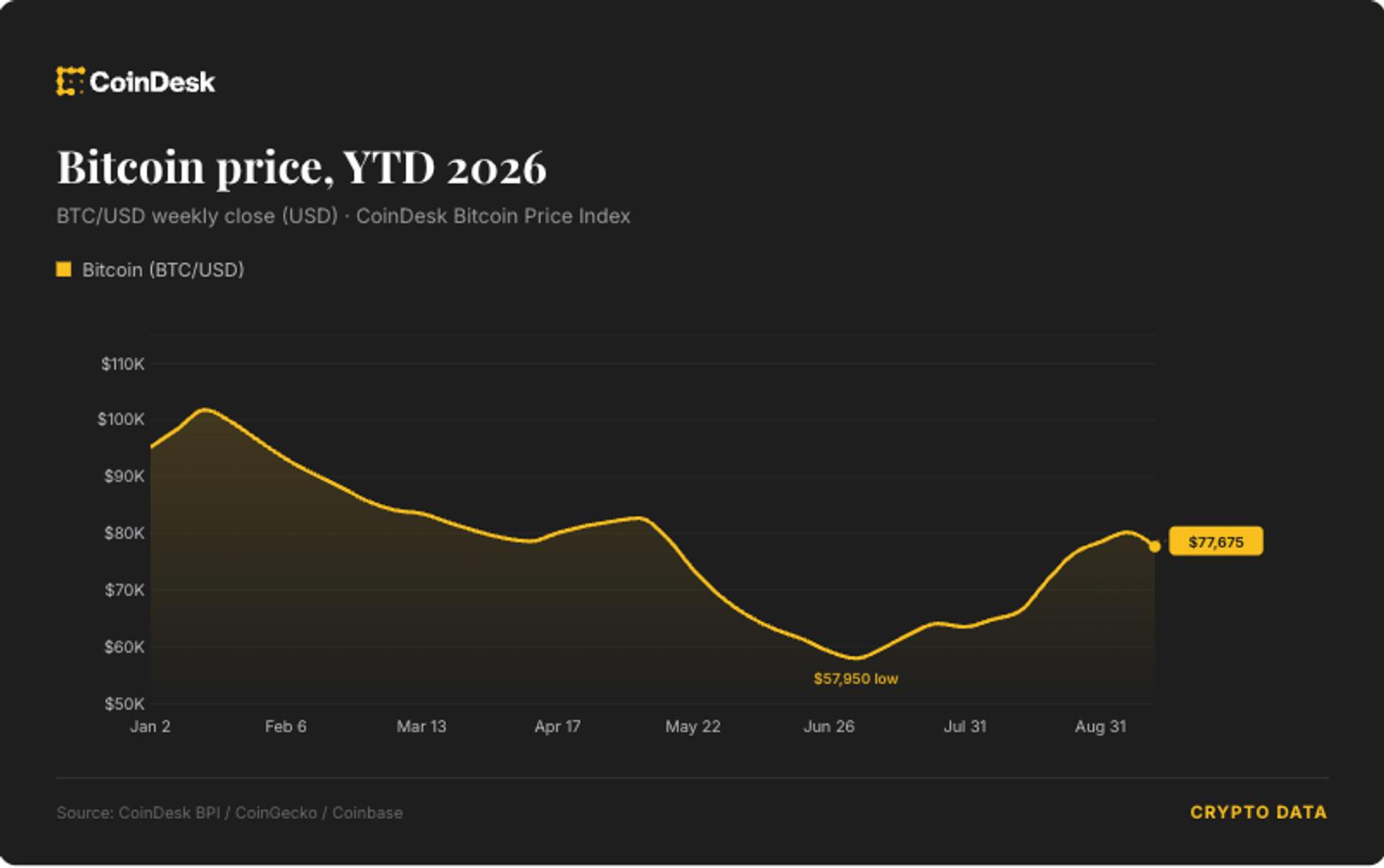
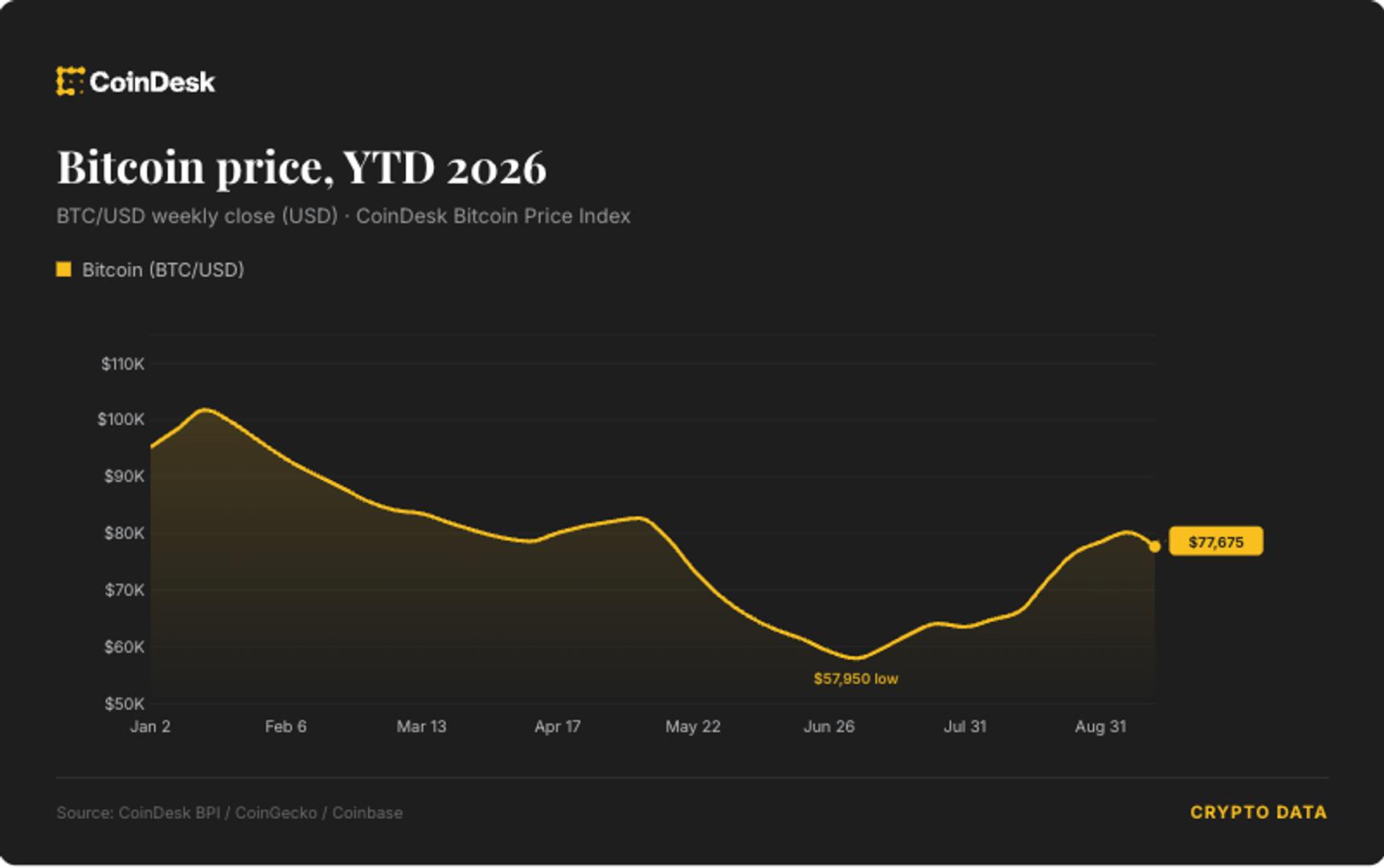
Bitcoin rose above $77,000 as calls to slow AI development hit technology shares, while rising oil prices added to market pressure.
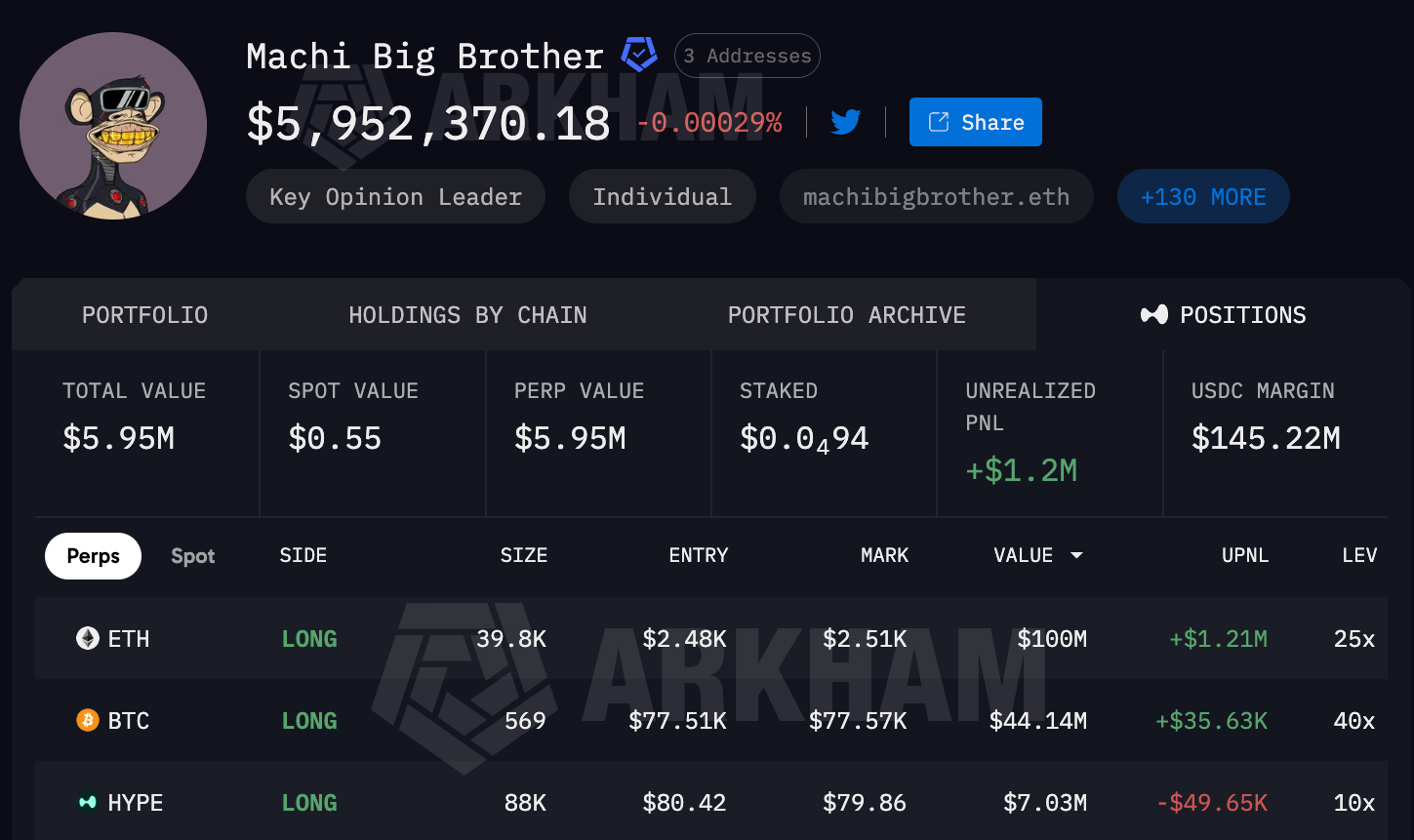
Machi Big Brother is holding $151.17 million in leveraged long positions on Hyperliquid against an account value of $5.95 million. Every position points in the same direction.
Arkham data shows the trader has taken no offsetting short exposure. Two of his three assets have fallen over the past week.
Machi Big Brother Stacks $151 Million Across Three Longs
The largest leg is Ethereum (ETH). Machi holds 39,800 ETH at 25x leverage, a position worth $100 million, according to Arkham. His entry sits near $2,480.

Bitcoin (BTC) follows at $44.14 million. That covers 569 BTC at 40x, the highest leverage anywhere in the book. The third leg is Hyperliquid (HYPE). He holds 88,000 tokens at 10x leverage, worth $7.03 million.
All three entries sit within roughly 1% of current marks. Unrealized profit across the account totals $1.2 million. The ETH leg supplies $1.21 million of that figure.
Bitcoin contributes just $35,630 on a $44.14 million position. HYPE, meanwhile, sits $49,650 in the red. Spot holdings on the tracked addresses come to $0.55. The rest of the account value sits in perpetual futures.
Follow us on X to get the latest news as it happens
Two of Three Assets Move the Wrong Way
Two of the three are already losing ground. Bitcoin has slipped 2.5% to around $77,548, while HYPE has fallen 7.3% to $79.86.
Only Ethereum held its ground. It trades at $2,510 and gained 0.6% on the week, which explains why it carries almost all of his profit.
The pullback follows a strong run. Over 30 days, HYPE has still climbed by 41.5%, Ethereum by 33.6%, and Bitcoin by 23.2%.
Institutional flows turned in the same week. Bitcoin exchange-traded funds (ETFs) shed $462.73 million in the week ending September 11, ending three straight weeks of inflows.
HYPE funds lost $26.42 million over the same period, breaking a five-week positive run. Ethereum products drew $197.11 million in inflows, marking a fourth consecutive weekly inflow.
Ethereum is carrying the entire book. Bitcoin and HYPE have both given ground, and the Federal Reserve meets on September 16 with high odds of a rate increase.
Higher rates typically weigh on risk assets, which would test the two legs where Machi holds heavy leverage.
Subscribe to our YouTube channel to watch leaders and journalists provide expert insights
The post Machi Big Brother Sits $150M Long With Two of Three Assets Down appeared first on BeInCrypto.
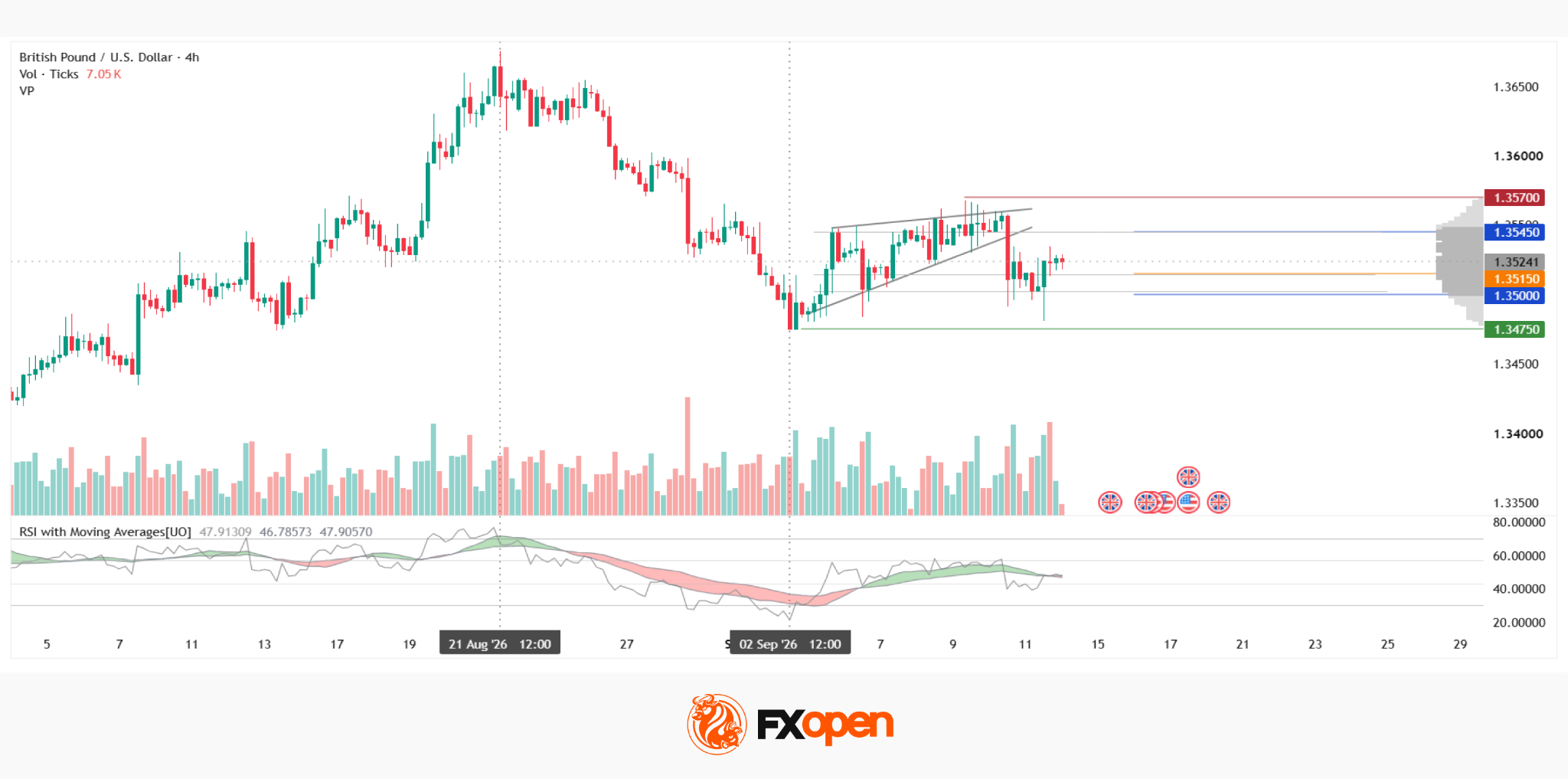
The foreign exchange market is heading into a busy week, with the Federal Reserve meeting on 15–16 September, followed by the Bank of England’s rate decision on 17 September. This sequence of central bank meetings, rather than individual macroeconomic releases, is shaping the current fundamental backdrop for the pound. Ahead of the decisions from the two major central banks, market participants are likely to remain cautious as they assess the future direction of monetary policy in the US and UK.
GBP/USD Technical Analysis
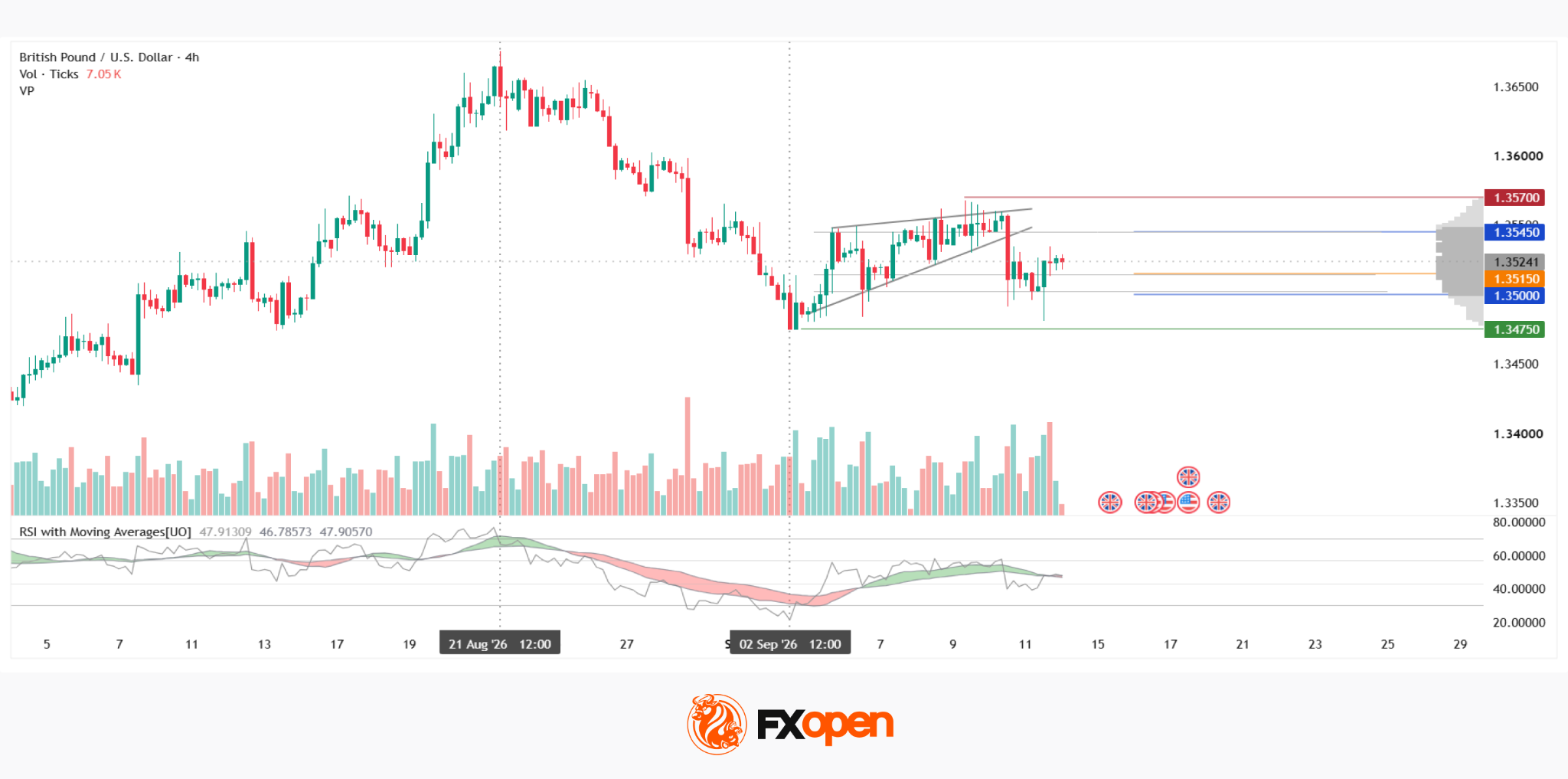
On the GBP/USD four-hour chart, a pronounced short-term downtrend developed between 21 August and 2 September, pushing the pair towards the green support level at 1.3475. From this low, the price began to recover, forming a rising wedge in which both boundaries slope upwards, although the lower boundary is rising at a faster pace. On 10 September, the price attempted to break below the wedge’s lower boundary, but the move has so far remained within the current market profile, with the price holding between its upper boundary at 1.3545 and the Point of Control (POC) at 1.3515.
If the breakout proves false and the price moves through the profile’s upper boundary, the red resistance level around 1.3570 could halt the advance. If the price does continue lower and breaks through both the POC and the profile’s lower boundary at 1.3500, market participants could turn their attention to the green support level at 1.3475. The RSI + MAs indicator shows readings of 48, 46 and 47, with all three measures sitting in the middle of the neutral zone, making it too early to confirm the breakout.
Key Takeaways
The attempted wedge breakout has yet to develop beyond the profile, while neutral RSI + MAs readings provide no clear indication of the next direction. More pronounced price action in the pair is likely to emerge as the Bank of England’s rate decision approaches.
Trade over 50 forex markets 24 hours a day with FXOpen. Take advantage of low commissions, deep liquidity, and spreads from 0.0 pips (additional fees may apply). Open your FXOpen account now or learn more about trading forex with FXOpen.
This article represents the opinion of the Companies operating under the FXOpen brand only. It is not to be construed as an offer, solicitation, or recommendation with respect to products and services provided by the Companies operating under the FXOpen brand, nor is it to be considered financial advice.
CNBC host Jim Cramer called CrowdStrike stock a “MUST BUY” on Monday, pointing to a post from company founder and CEO George Kurtz about securing artificial intelligence (AI).
Kurtz had argued that nobody can slow the AI frontier down. Therefore, he said, defenders must block attacks in real time instead of writing policy documents.
Kurtz Says Autonomous Campaigns Now Set the Pace
Kurtz was responding to an essay by Anthropic CEO Dario Amodei, who urged AI labs to pace the frontier. OpenAI CEO Sam Altman agreed, and rival AI leaders backed the call days later.
Amodei asked labs to accept outside evaluators with staff-level access. Anthropic and OpenAI have both committed to that step. Kurtz said CrowdStrike will bring front-line data to those talks.
Kurtz accepted the goal but rejected the timeline. Attacks no longer come from lone hackers, he wrote, but from coordinated AI agents that run entire campaigns at machine speed.
“The unit of threat is no longer the hacker. It’s an autonomous campaign. I call it the Agent-state,” George Kurtz, said.
He also pointed to SafeMind, an agentic defense system that CrowdStrike and Nvidia launched on Sept. 1. The team says it learns from every attack it blocks.
Cramer passed the thread on as the most important post his followers would read on a MUST BUY stock.
CrowdStrike Stock Cools After a Strong Year
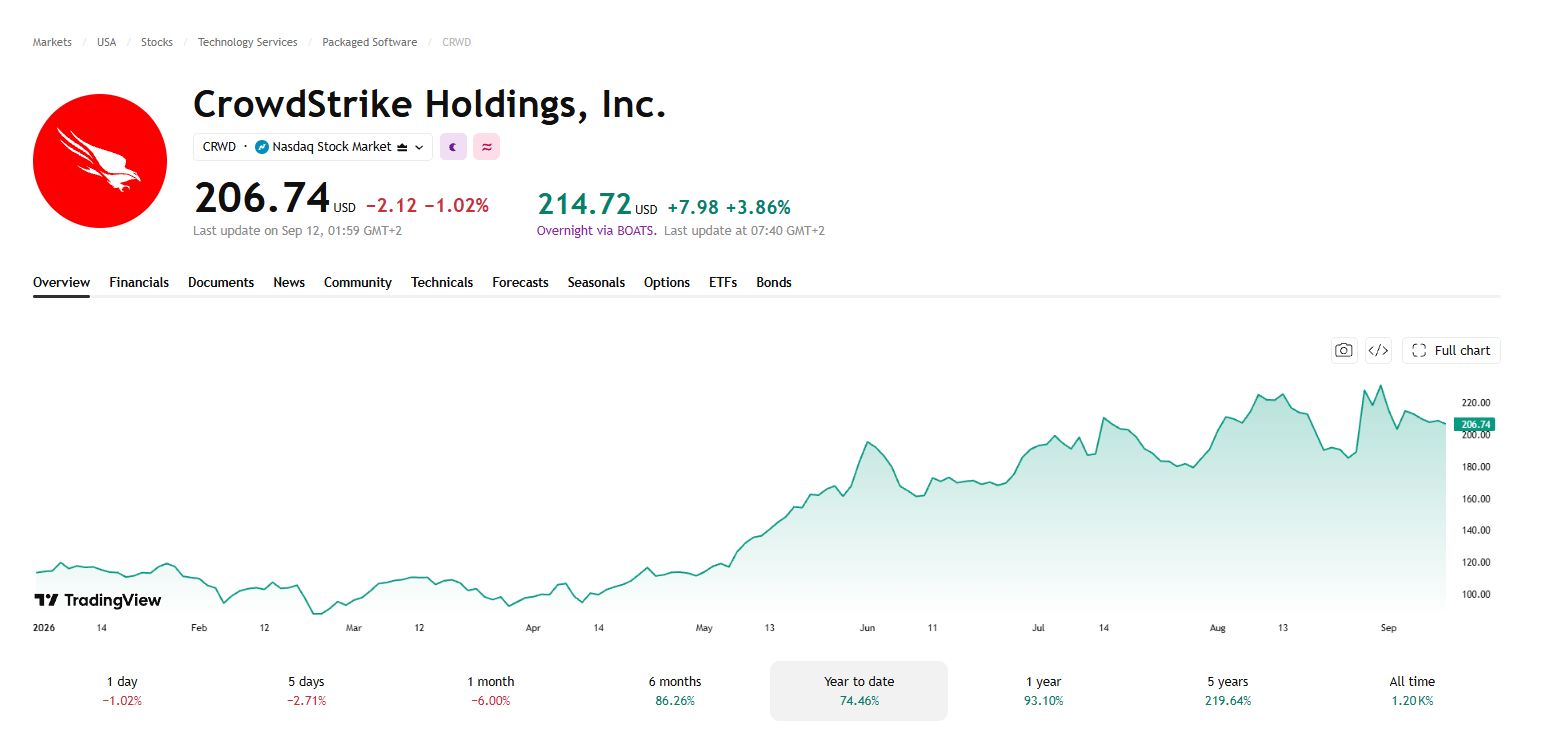
CrowdStrike stock closed Friday at $206.74. However, the shares have slipped 6% in a month, although they still hold a 74.46% gain for 2026.

Late August set the recent high. Record quarterly results sparked a sharp rally as companies widened their security budgets, yet the stock has drifted lower since then.
Cramer is not bullish on everything, however. He compared this market to 2018 and urged investors to trim their winners rather than sell in panic.
That makes CrowdStrike an exception in his current playbook. He has favored the sector before, naming cybersecurity among his 2026 investing themes in August.
Early buyers appear to agree. CrowdStrike changed hands at $214.72 in overnight trading, a gain of 3.86%.
The coming weeks will show whether Kurtz’s front-line pitch keeps buyers on his side, or whether the August high stays out of reach.
The post Jim Cramer Calls CrowdStrike a ‘MUST BUY' Over CEO's AI Security Post appeared first on BeInCrypto.


US spot Bitcoin exchange-traded funds (ETFs) posted $462.7 million in net outflows last week, reversing after three consecutive weeks of inflows, while Ether ETFs moved the other way with nearly $197 million in net inflows.
According to Farside Investors, the withdrawals ran across all four trading sessions from Tuesday to Friday. The outflows followed the strongest three-week inflow run of 2026, which ended after the funds shed $166.8 million in the first two days of the holiday-shortened week.
The selling deepened on Thursday, when US spot Bitcoin ETFs recorded net outflows of $282.7 million, their largest daily withdrawal since July. Friday’s outflow slowed to $13.2 million, but still extended the negative streak to four trading days, according to SoSoValue.
Related: Bitcoin fails to reclaim $80K as Bessent fuels yen strength around 153 per dollar
ARK 21Shares Bitcoin ETF led weekly withdrawals with $234.2 million in net outflows, followed by Grayscale’s Bitcoin Trust ETF with $129.1 million. BlackRock’s iShares Bitcoin Trust ETF recorded $52.5 million in net outflows over the week, while Fidelity’s Wise Origin Bitcoin Fund lost $50.7 million.
Despite the weekly reversal, spot Bitcoin ETFs remain in positive flow territory for September, with about $307.3 million in net inflows through Friday.
Ether ETFs record weekly inflows
On the flip side, US spot Ether ETFs recorded $196.9 million in net inflows over the same four-day period, according to Farside Investors.
The Ether funds had mixed flows earlier in the week, with $24.3 million in outflows on Tuesday, $34.7 million in inflows on Wednesday and $29.9 million in outflows on Thursday. The week turned positive on Friday, when the funds drew $216.4 million in net inflows.
BlackRock’s iShares Ethereum Trust ETF led Friday’s inflows with $148.8 million, followed by 21Shares Core Ethereum ETF, which added $29.1 million.
Magazine: Metaplanet equity backlash, SE Asia crypto funding doubles: Asia Express

Falconets Hit New Caledonia for 10, Set Up England Clash

The 9 buzziest startups from Y Combinator’s latest Demo Day, according to VCs

Cryptocurrency mu Rwanda: Menya byinshi kuri yo | Ese ubu buryo busimbura amafaranga asanzwe?

Memory prices are slowing because buyers ran out of money

The Latest Weird Thing to Play Doom Is the Mapped-Out Brain of a Fruit Fly

Micron Stock Climbs Above $1,031 as AI Memory Crunch and a $50 Billion Outlook Fuel the Rally
Cryptocurrency mu Rwanda: Menya byinshi kuri yo | Ese ubu buryo busimbura amafaranga asanzwe?

5 Financial Habits you should have.#ideapreneurnepal #financialfreedom #habitsofsuccessfulpeople

Chakravarthiki Video Song | Money Telugu Movie Songs | JD Chakravarthy | Jayasudha | Mango Music
-
Tech6 days ago
Memory prices are slowing because buyers ran out of money
-
 Tech20 hours ago
The Latest Weird Thing to Play Doom Is the Mapped-Out Brain of a Fruit Fly
-
 Business4 days ago
Micron Stock Climbs Above $1,031 as AI Memory Crunch and a $50 Billion Outlook Fuel the Rally
-

 Business4 days ago
AMD Stock Climbs After Management Lifts 2027 Data Center Outlook Toward $70 Billion in AI Sales
-
 Crypto World5 days ago
Bitcoin price risks $76K drop as $78K support weakens
-

 Fashion3 days ago
Weekend Open Thread – Corporette.com
-

 Crypto World6 days ago
Robinhood Stock: How To Take Advantage With Reduced Risk
-

 Crypto World3 days ago
XAG/USD: Silver’s Short-Term Rally Meets Its Moment of Truth
-

 Crypto World4 days ago
2 Chip Stocks Broke Out This Week. Neither Was Nvidia
-
 Crypto World5 days ago
Ethereum price stalls below $2,500 as ADX drops to 11
-

 NewsBeat6 days ago
England up in reading, maths and science rankings as Scotland and Wales dip
-

 Business3 days ago
10 Most-Streamed Songs On Spotify In 2026 So Far, Led By Ella Langley’s Dominant Run On The Charts This Year
-

 Crypto World3 days ago
OKX launches 10x OpenAI, Anthropic X-Perps in Europe
-

 Tech4 days ago
Battery life is the only iPhone 18 Pro and iPhone Duo upgrade I care about. Apple didn’t disappoint
-

 Crypto World3 days ago
Diesel Tops $6 a Gallon for the First Time as 28 States Set Records
-
 Crypto World6 days ago
Intel Stock Jumps 9% on Chip Price Hike Report, US Stake Gains $36 Billion
-

 Tech4 days ago
Apple Watch Ultra 4 vs Watch Ultra 3: Should you really spend another $799?
-

 Crypto World4 days ago
Bitcoin price risks $70K if $78K neckline breaks
-

 Crypto World6 days ago
Pump Fun and Kraken delete Hunter Biden $LAPTOP promotion
-

 NewsBeat5 days ago
What went right this week: an ‘historic’ fall in violent crime, plus more
You must be logged in to post a comment Login