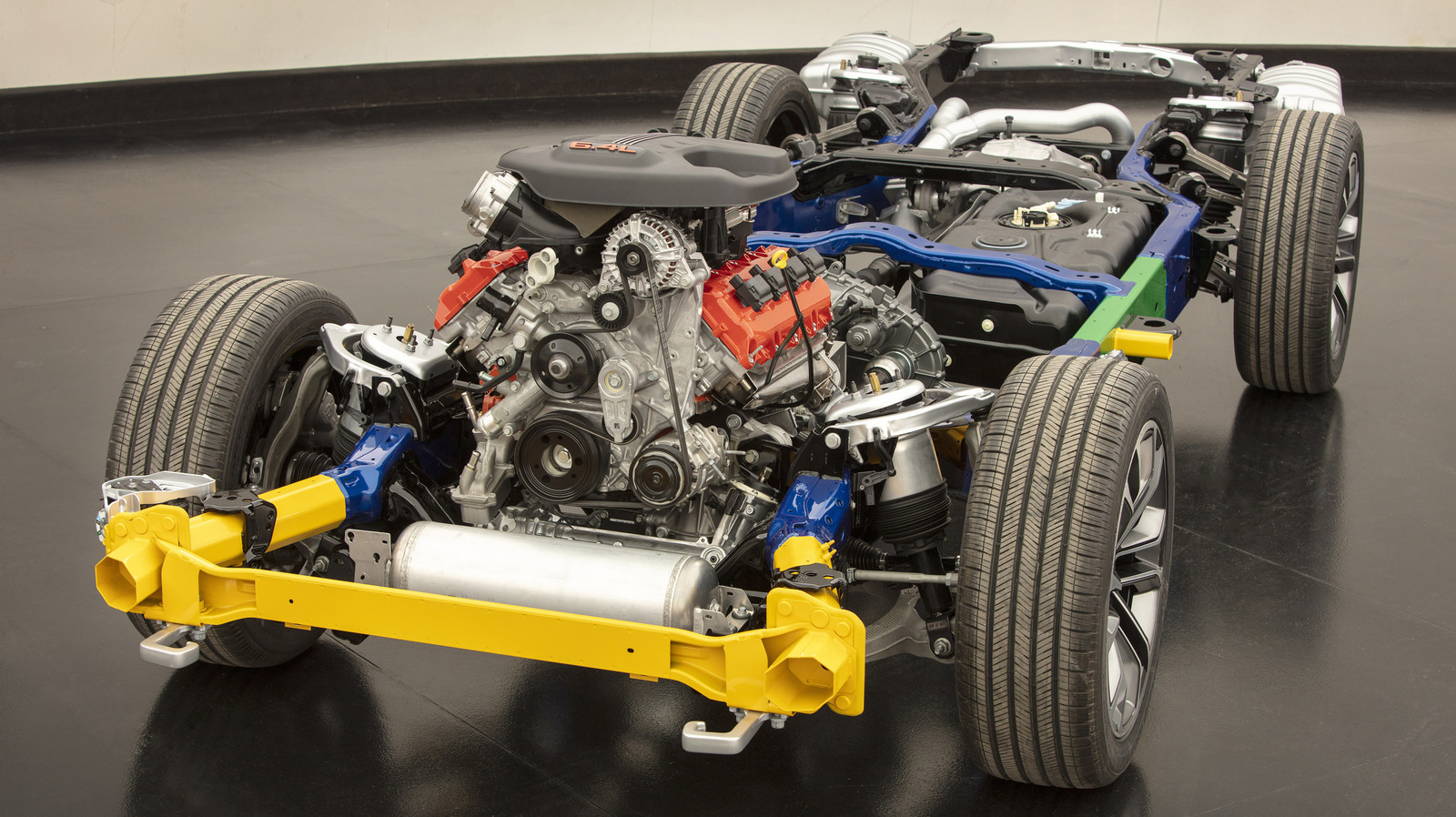
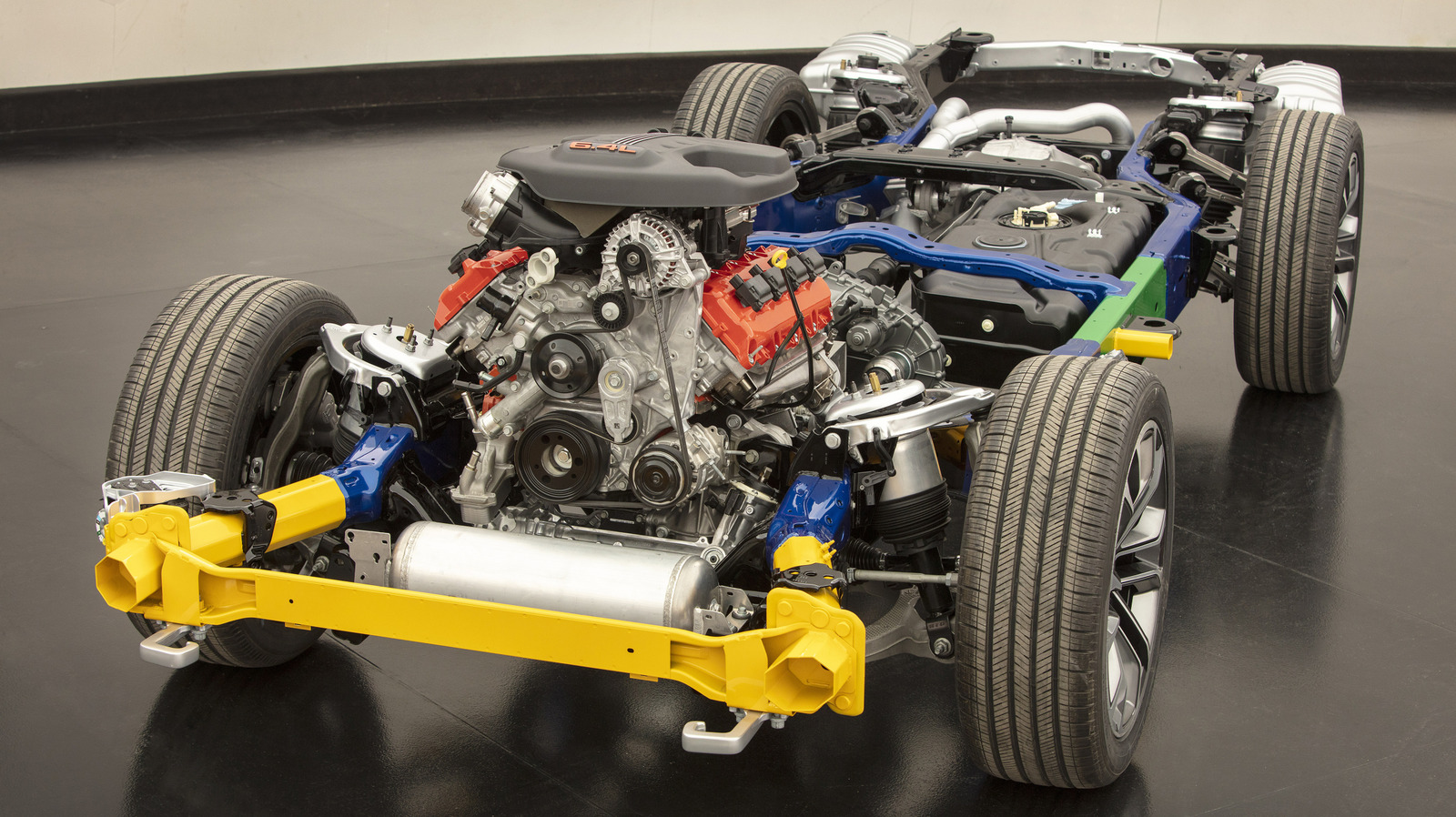
If you’re around gearheads enough (or you are one), you’ve probably heard the phrase “ladder frame” being used to describe a body-on-frame vehicle. So what does this mean? A ladder frame is a type of body-on-frame construction that uses horizontal crossmembers to hold the frame together, like a ladder.
So yes, a ladder frame vehicle is a body-on-frame vehicle. But not all body-on-frame vehicles are ladder frames. There are other types of body-on-frame construction, of course, but most of those designs have been phased out over the years. Ladder frames have just stood the test of time, falling firmly into the “If it ain’t broke, don’t fix it” category.
Advertisement
Ladder frames are very common today with big, full-size SUVs like the current Nissan Armada or Jeep Wagoneer. Even in the age of hybrids or otherwise increasingly electrified powertrains, manufacturers sometimes still need to rely on a simple, strong skeleton to hold the vehicle together.
Advertisement
Body-on-frame cars used to be commonplace
Oddly enough, body-on-frame construction used to be the norm for every car, not just trucks. And ladder-frames, specifically, are still in wide use today. If you look underneath a 1970s Ford Bronco, for example, you’re bound to see horizontal crossmembers on the frame just like any full-size SUV or truck today.
Advancements in safety (both for the occupants and pedestrians), material construction, and fuel efficiency drove automakers to favor unibody construction for vehicles that weren’t trucks or full-size SUVs. Still, apart from compact trucks like the Ford Maverick, you’d be hard pressed to find a modern mid-size or full-sized truck that doesn’t use at least some form of ladder-frame construction. The design lends itself to heavier workloads like towing, or hauling around a lot of weight in the bed. So, when you hear someone using the phrase “ladder-frame,” it’s not referring to anything all that exotic — it’s just the most common style of body-on-frame construction.
Silicon Valley giants and national security experts “are calling for action against Chinese companies engaged in model distillation,” reports CNBC. But “I would do nothing,” says Y Combinator CEO Garry Tan. “We could argue that there should be an American distillation regime.”
Distillation is the process of using the outputs of a more capable AI model to train a smaller or less capable one, sometimes illicitly… Anthropic has accused Chinese companies such as Moonshot AI, DeepSeek, and MiniMax of the practice, while OpenAI believes DeepSeek’s V3 and R1 model architectures were distilled from its own GPT-4 and GPT-4o models. In the midst of this, the U.S.’s National Security Agency, Cybersecurity and Infrastructure Security Agency, and Federal Bureau of Investigation released an official cyber security advisory warning on the topic on Tuesday…
But Tan believes regulators should focus less on curbing distillation and more on creating an equilibrium between open weight models and frontier models — as long as frontier models retain a price premium that allows their business model to remain feasible. “This is actually the ideal case. You want open weight models to give people freedom and access,” he explained. “If I were a regulator, that’s what I would go after.” Tan acknowledged that this is a hard balance to strike, calling it “a tightrope.” Nevertheless, he says it’s a balance worth pursuing — saying it “could result in the best possible outcome.”
Tan later told TechCrunch he’d like to see America with more open-weight options that aren’t Chinese, built by smaller U.S. open-weight AI labs using those same training techniques on products from America’s frontier AI labs:
Advertisement
Anthropic CEO Dario Amodei had previously publicly called on U.S. regulators to crack down on distillation. It’s notable that the commander of Silicon Valley’s prestigious and prolific startup accelerator doesn’t agree.
To be clear, Tan isn’t advocating for American AI labs to use stolen credentials to distill. He wants them to be free to come in the front door. In fact, his argument is twofold. He feels it’s an overreach for AI labs to dictate what their customers can do with the information their models share with them. He also notes that the proprietary AI labs didn’t ask permission when they vacuumed up as much human knowledge as they could to train their models. They famously ingested plenty of copyrighted material without the permission of those intellectual property holders. “Controlling what users and customers do with API calls to closed weight models feels constraining, and there’s a role government can play here to normalize the fact that access to intelligence that was trained on broad public access data should itself also be more a form of a public good than something locked away behind restrictive terms of service,” he told TechCrunch when asked why American labs should be free to distill, too…
To him, the true AI doomer scenario is for all the immense power of frontier AI to wind up in the hands of a single powerful, proprietary provider. “The nightmare scenario, the doomer scenario for AI is that there’s just one company,” he said. “It has the best access to capital. It has the best AI researchers. It runs away with it and suddenly there’s one company that’s monolithic. And that would be bad.”
Being able to monitor voltages and currents is essential for many applications, with the national electrical grid being no exception. The obvious complication here is that the voltages and currents are massively higher than for those other applications, making safely monitoring these somewhat of an engineering challenge. The used systems for current monitoring are detailed by [Jordan Taylor], also known as [The Electric Brit], in an explainer of grid-level current transformers (CTs) and associated elements that help to provide galvanic isolation for safe current measurements.
Even if the basic principles remain the same, when you’re dealing with currents of 5 kA and more, the associated clearances and penalties for getting a detail wrong increasingly correspondingly. The CTs help to implement over-current protection (OCP), over-voltage protection (OVP) as well as differential protection, which is useful to detect leakage and shorts, which could also happen inside the CT if the windings become damaged.
Any such failure condition can trigger a circuit breaker to be tripped, or other corrective measures to be taken. Incidentally this also how it can be detected when someone is tapping off power in an illicit manner. As with all transformers they’re never perfect due to issues like core saturation, and thus performing accurate measurements and picking the right type of transformer is an art in itself, as explained in the video.
Advertisement
Ultimately CTs and the associated equipment are what makes an AC power grid responsive to any changes and with it into the reliable foundation of modern-day society.
Japan’s Digital Agency has discovered a data breach that may have exposed around 246,000 record rows containing personal information of government employees.
The agency says that the attacker gained initial access by exploiting a vulnerability in a VPN device used by the Government Solution Service (GSS).
An investigation started on June 25, after the agency detected a large-scale file access from the account of a maintenance and operations staff member.
“On July 9th, it was discovered that a third party had used a vulnerability in a network-connected device (VPN) to gain access to the system and gain unauthorized access,” reads the announcement.
Advertisement
“On the same day, we suspended the account of the maintenance and operations personnel in question, cut off communication between the compromised equipment and the outside world, and prevented further unauthorized access.”
It is unclear what VPN product was affected or the vulnerability exploited in the breach. However, the Japanese agency said in a separate Q&A that the issue had a medium severity rating and was not a zero-day.
The investigation revealed that the following data may have been exposed:
236,000 names
231,000 email addresses
94,000 telephone numbers
1,000 physical addresses
Exposed individuals include government employees, public officials, and associated businesses and individuals who use the GSS system.
However, the incident did not expose personal data of the general public, and the potentially compromised information does not include My Number identification numbers, bank-account details, or pension numbers.
Advertisement
Also, the agency has not detected any cases of actual misuse of the impacted information, but still warned about the elevated risk of impersonation and phishing, urging people not to open links or attachments in unsolicited communications.
The Digital Agency reminded people that it will never ask for passwords or credit card information via email or phone.
Affected individuals will be contacted directly, and the agency also set up a dedicated support line.
The agency notified Japan’s Personal Information Protection Commission on July 15, and clarified that the delay in disclosing the incident to the public was due to the complexity of determining the intrusion path, identifying potentially affected information, and establishing who was affected.
Advertisement
The agency says the impact was limited to the affected system, with no confirmed unauthorized access, data leakage, or comparable breaches affecting other systems. It also noted that the incident and response operations didn’t impact government services availability.
Join Mikko Hyppönen and security leaders from the NFL, CHANEL, and Atlassian for a two-hour digital summit on what AI-speed attacks change, what defenders should stop doing, and how to validate, decide, fix, and re-validate at machine speed.
The ATH-R30x are great if you’re after entry-level, open-back studio reference headphones that deliver warmth and detail. They’re lightweight with soft earpads and, at £85, they’re an affordable way into open-back listening. There are slight downsides like a non-detachable cable and a slightly tight fit for larger ears. And it’s worth noting that you can also get the excellent Sennheiser HD 560S for around the same price
Warm, controlled and non-fatiguing
Comfortable fit with soft pads
Airy open-back sound
Affordable price
Cable isn’t detachable
Can pinch around ears
Not ideal if you need isolation
Better cans cost around the same price
Key Features
Advertisement
Review Price:
£85
Open-back reference design
Advertisement
Allows air to pass freely for natural, speaker-like audio delivery – but they don’t seal sound in
40mm dynamic drivers
Advertisement
Tuned for flat, transparent audio playback, rather than a bass-boosted sound
Lightweight frame
Advertisement
They’re made to be used for long listening sessions without headband pressure
Introduction
Audio-Technica’s ATH-R30x are affordable wired open-back headphones focused on use for audio production. They’re part of the brand’s R-series, which is all about a sound that prioritises accuracy, rather than the typical consumer bass boost and elevated highs. Like a lot of wired headphones, they have an open-back design to allow air to move freely, opening up a wider, more natural soundstage.
But it is worth saying that audio production is hardly the only use case for wired open-backs. In fact, my pair (the Sennheiser HD 560S) are some of my most-used cans because there’s a lot to be enjoyed about a natural, detailed listening experience with a wide soundstage. You don’t always want the “fun” V-shaped frequency response.
Advertisement
Wired open-backs can also be good for podcasters, video editors and gamers, and I think they hold a lot of appeal if your preferred music genres are classical and acoustic, as the accuracy rewards focused listening. If you’re making your first step into wired headphones, the ATH-R30x will seem like a good starting point, because they deliver all the essentials for a sensible £85 price point.
Unlike Bluetooth cans, there’s no ANC, no battery, no app and no controls – you’re paying for design, ergonomics and driver quality. So, whether you’re producing a podcast from your bedroom, an aspiring mixer on a budget or someone curious about “accurate” sound, this is an accessible entry into an expansive hobby.
Advertisement
Design
Lightweight at 210g
Removable and replaceable cups and headband
Non-removable 3-metre-long cable
The ATH-R30x are well-designed, with a minimalist, utilitarian look. They’ve got a black plastic frame, black metal mesh on the exterior of the ear cups (through which you can see the driver housing), and a suspended felt strap beneath a metal headband. This is a good way to distribute weight evenly across your head, and it works well for long-term comfort.
The circular ear cups are on the small side. They’re pleasant to wear, made of soft velour that feels plush and breathable when compared to leather or synthetic materials, but I was very aware of the cups at the bottom and top of my ears. I don’t have the largest ears, and I found them easy to wear for several hours at a time, but I’d say they’re not going to suit anyone with bigger ears!
Advertisement
Image Credit (Trusted Reviews)
Compared to the Sennheiser HD 560S, they have a much more relaxed clamping force, which may make them a better fit for some, but the bigger and softer ear pads of the Sennheisers make those my top choice for comfort in this price tier. The HD 560S weigh 30g more than the 210g of the ATH-R30x, though, so they are better if you want something lightweight. Either of these is lighter than battery-carrying wireless headphones.
Advertisement
One crucial thing to note is that the ATH-R30x doesn’t have a removable cable. It’s a fixed 3-metre cable that’s great for a studio desk, but it’s fairly long and can be difficult to manage. I found it got caught up in the wheels of my office chair a couple of times, so you have to be intentional about it.
A core benefit of wired headphones is being able to change cables, and that’s not something you can do here. With a cable this lengthy, you’re also not going to be plugging this one into a phone or laptop while you’re on the move!
Image Credit (Trusted Reviews)
Specification
40mm dynamic drivers
Fixed 3m cable
36ohms impedance
As the most affordable model in the brand’s R-series, you’d expect that these don’t quite have the tech of the pricier studio-grade headphones. Audio is handled by 40mm dynamic drivers, and Audio-Technica calls these a “professional open-back reference” model that delivers a spacious soundstage and natural clarity with minimal additional tuning or damping.
Image Credit (Trusted Reviews)
Advertisement
Yes, they’re made for mixing, mastering and creation. But, as mentioned above, there’s absolutely nothing stopping you from using these cans for casual listening, too. They have a frequency response range of 15 to 25,000Hz, and are low-impedance headphones at 36ohms, which means they’re easy to drive directly from phones or laptops without needing a beefy amp.
Advertisement
Sound Quality
Warm and clear reference sound
Honest and precise
Great imaging and instrument separation
For sound alone, Audio-Technica’s ATH-R30x are some of the best budget wired open-backs you can get. I can think of little else that challenges these at the £85 price point; it’s just that the Sennheiser HD 560S no longer cost anything like their original RRP of £179, typically available for £99 these days. So, would I recommend going for those or the newer R30x, if you’re on a tight budget?
The R30x handles instrument separation beautifully. One of my first test tracks was Perpetuum Mobile by the Penguin Cafe Orchestra, with its simple melody and mix of piano, rhythmic strings, and driving bassline. The R30x captures all elements and sounds well-balanced, with everything clear and easy to identify in the mix.
Image Credit (Trusted Reviews)
Moving on to pop music, I found these excellent for putting vocals front-and-centre in Chappell Roan’s Good Luck, Babe, and immersive when playing Post Malone’s Sunflower. The precise imaging helped me hear background vocals I tend to miss in the latter track, and the sound is smooth for easy listening.
Advertisement
They are slightly bass-light if you’re used to a bass-forward sound. I haven’t found that a big issue as they’re still warm and full-bodied enough for my tastes, while having great clarity for long listening sessions.
Image Credit (Trusted Reviews)
Unless you mind that they’re low on a sub-bass rumble, I reckon these offer an accurate sound for a sensible price. If you spend a little more on the Sennheiser HD 560S, you get a rendition that’s a little more analytical, and a soundstage that’s a little wider.
The R30x are just a touch warmer, and less fatiguing for a long listen. It’s honestly a close contest between the two.
Advertisement
But the removable cable and improved comfort of the Sennheisers mean they get my vote if you were deciding between them.
Advertisement
Should you buy it?
You want lightweight open-back headphones with a gentle clamp force
Advertisement
If you’re on a budget and want a natural sound with great imaging, there’s a lot to recommend about the impressive ATH-R30x. They’ve got a nice clamping force, soft velour earpads and a good fit and sound for long-term wear. At just £85, they’re tremendous headphones for the money.
Advertisement
You need to use them in any noisy places
It is worth saying that they’re not a great pick if you need them for noisy or public spaces. The sound leakage is significant, and people nearby can hear exactly what you’re playing at about 60% volume. Also, if you hate long cords or want a detachable cable you can swap out when it’s damaged, these aren’t the right choice.
Advertisement
Final Thoughts
Even if you’re not buying headphones for professional audio recording or mixing, the ATH-R30x are a great example of why wired open-back models are the top choice if you want detail, instrumental separation, and natural clarity. These are an excellent pair of cans for focused listening and musical enjoyment.
They’re far cheaper than premium wireless headphones, yet offer clear benefits for those willing to use a wire. There are minor compromises, like how the 3-metre cord isn’t removable and how the fit around your ears can be a little tight. Spend a little more, and you can get the Sennheiser HD 560S, which are fantastic open-backs for precise sound and have swappable cables and bigger ear cups, but feel tighter on the head.
Overall, as an entry point into critical audio listening, or for home mixing and producing, the ATH-R30x is a great value proposition that most people should be able to wear for hours on end, with smooth, warm and detailed sound quality.
How We Test
I spent two weeks putting the Audio-Technica ATH-R30x through its paces as my primary home listening headphones. I connected them directly to mobile and portable hardware, including a MacBook Air, Activo P1, FiiO Snowsky Echo Nano and an iPhone 17 Pro (with an Apple dongle).
Listening was split between streaming on Apple Music, Spotify and Deezer alongside hi-res FLAC playback from the digital audio players. Throughout testing, I used the Sennheiser HD 560S as a benchmark to gauge how the ATH-R30x compares to similarly priced open-back competition.
Tested for 2 weeks
Tested with real-world use
FAQs
Do you need a dedicated headphone amplifier to drive the ATH-R30x?
No. With a low impedance of 36ohms and decent sensitivity, the ATH-R30x can easily be driven directly from a laptop, smartphone, or tablet.
Advertisement
Is the cable on the Audio-Technica ATH-R30x detachable?
No, the ATH-R30x features a fixed 3-metre cable. If you damage the wire, it cannot be unclipped and swapped out like on other models.
Researchers warn Skullcandy Dime 3 earbuds on older firmware accept Bluetooth pairing from unknown devices with no user interaction required
When leveraged, it can be used to interrupt the owner’s connections, hijack playback, and even capture live microphone audio
The vulnerability has been patched in a newer firmware update available only on newer units, does not seem to be addressable for existing earbuds
Carnegie Mellon University’s CERT Coordination Center has warned Skullcandy’s Dime 3 wireless earbuds will accept a Bluetooth pairing request from a stranger’s device without the owner doing anything.
The resulting bond is permanent, and the only sign the owner gets is a spoken “new device paired” notification delivered after it has already happened, with zero user interaction to confirm the request.
The advisory covering the Dime 3 was written by CERT/CC’s Bob Kemerer and credits independent researcher Jacob Nowak, who had posted his findings to the Full Disclosure mailing list in early August after testing it on hardware he owned.
Latest Videos FromTechRadar
Advertisement
A fix deployed that covers virtually no existing users
What makes this worse is that, ironically, while Skullcandy was swift in addressing the issue affecting earbuds running firmware version 1.0.0.28 by rolling out a patched version 1.0.0.30, it seems to address the issue only in newly made units.
CERT notes that there seem to be no “consumer-accessible” methods to upgrade existing units to the newest firmware because it reportedly has no support via the companion app, as a Tom’s Guide review indicates.
A product without an update path that is user-accessible essentially means that its software flaws, or in this case, security issues, are here to stay for users who have had the bad luck of buying an earlier unit.
The underlying vulnerability, CVE-2025-20701, is not new and is not of Skullcandy’s making. It is one of three vulnerabilities that Dennis Heinze and Frieder Steinmetz of the German firm ERNW disclosed in June 2025 at the TROOPERS conference in Heidelberg, affecting Bluetooth systems-on-chip from Taiwan’s Airoha.
Sign up to the TechRadar Pro newsletter to get all the top news, opinion, features and guidance your business needs to succeed!
The Dime 3’s Bluetooth identifier names Airoha as its chipset vendor, and while Airoha shipped a fixed SDK to its customers in June 2025 and published its bulletin that August, owners of the earbuds are in a unique situation, to say the least.
Advertisement
The vulnerability’s severity is disputed: MediaTek (which owns Airoha) assigned it a relatively low 6.7 rating, while CISA’s vulnerability enrichment program later assigned it an 8.8 with a ‘high’ categorization.
A potential attacker is limited to what the earbuds can access, since the vulnerability is essentially limited to the earbuds, but one could still wreak havoc with that alone. It should allow for more than just disrupting a person’s routine by ‘hijacking’ one’s earbuds by essentially using their microphones on them to record conversations or, in an extreme theoretical case (requiring chaining with other exploits), impersonate the headset and pull contacts, call history, and even pass hands-free commands to a paired smartphone. The latter, however, would require a high technical skill set, being within a few meters of a victim, and a Bluetooth connection turned on on the paired smartphone.
For now, a vulnerability exists that Skullcandy should have been able to patch, exactly as Apple recently did for its Beats Studio Buds, but a lack of support for any third party apps on the budget earbuds is somewhat annoyingly resulting in an unpatchable vulnerability for existing users.
Apple’s latest iPhone and iPad software—iOS 27 and iPadOS 27—is here. While this release won’t make as big of a splash as Apple’s big Liquid Glass redesign in the prior version, there’s still plenty here that could change how you use your device.
iOS 27 and iPadOS 27 focus largely on stability improvements that you’ll notice in your everyday use. There are several quality-of-life improvements, like how Shortcuts are significantly easier to set up, but the big highlight is the Siri AI upgrade. Here’s everything you need to know.
Updated September 14, 2026: We’ve refreshed this story to reflect the latest updates and that iOS and iPadOS 27 are rolling out today.
Is Your iPhone or iPad Compatible?
Advertisement
Apple sometimes drops a few older devices from the support list with new versions of its operating systems, supposedly because the aging hardware can’t run the latest screen behaviors without feeling sluggish. (Apple typically supports iPhones and iPads for six to seven years.) But there’s good news this year. iPhones from 2019 and newer—the iPhone 11 and up, including the iPhone SE (2nd Gen)—will support iOS 27.
That means any iPhone that received iOS 26 is still compatible with iOS 27. If you’re unsure of your iPhone model, go to Settings > General > About and look at the model name.
iPads aren’t as straightforward, as they have a unique naming structure. Apple retired the “generations” moniker and is now using the chipset to denote the iPad model. You can check your iPad model using Apple’s support documentation. A few iPads are cut off from the iPadOS 27 update, including the 8th-gen iPad from 2020 and the 5th-gen iPad Mini.
iPad: 9th gen and later, including A16
iPad Mini: 6th gen and later, including A17 Pro
iPad Air 11-inch: 4th gen and later, including M2, M3, and M4
iPad Air 13-inch: M2 and later
iPad Pro 11-inch: 2nd gen and later
iPad Pro 12.9-inch: 4th gen and later
iPad Pro: M4 and later
How to Install iOS 27 or iPadOS 27
The final versions of iOS 27 and iPadOS 27 are here. Before installing, it’s very important that you back up your devices. Head to Settings, tap your name at the top, and select iCloud. Then tap iCloud Backup, and tap Back Up Now. Read our How to Back Up Your iPhone or iPad guide for other methods and more details.
Advertisement
Then, head to Settings > General > Software Update and choose iOS 27 or iPadOS 27 when you see the option. Installation will take several minutes, and your iPhone or iPad will restart, so set aside several minutes for the whole process.
Siri AI, the new assistant, will ask to index your phone or iPad to learn more about you, your apps, and your data so it can be more helpful. This indexing takes a while—anywhere from a few hours to a couple of days—so be prepared to wait a bit.
Apple Intelligence Only Works on Select iPhones
Remember—even if older iPhones and iPads receive the iOS 27 or iPadOS 27 update, that doesn’t mean all of the new features will be available. Apple Intelligence is still only compatible with the iPhone 15 Pro and newer and select iPads, meaning that several artificial intelligence features are unavailable on older devices.
Advertisement
Top New iOS 27 and iPadOS 27 Features
Here’s a top-line view of some of the biggest changes coming to iOS and iPadOS 27. The updates are largely the same across both operating systems.
Siri AI and a New Siri App
Courtesy of Apple
Siri is finally becoming “a more capable assistant,” or so Apple claims. The company says this is largely thanks to its third-generation foundation models, developed from the ground up with Google’s Gemini models. However, Apple says it isn’t using Google’s infrastructure to power Siri interactions and that no user data from Siri actions gets shared with Google.
Siri AI has an all-new look when you activate the assistant. It now resembles a glass orb. You can type or talk naturally to Siri, and there’s even a dedicated Siri app where you can revisit previous conversations or pick up where you left off on a different device. Siri is also now in the camera app, giving you a more direct way to start a visual search, much like Google Lens. You can even point the camera at a restaurant bill, and Siri can split the tab between you and your friends.
Advertisement
The assistant understands your personal context, so it can comb through your emails, messages, and photos to find relevant information based on your query. It can then take action on your behalf, whether that’s drafting an email in a specific tone or getting wine recommendations for a particular dish. Siri’s voice is more expressive, but you can also customize the assistant’s voice, its expressiveness, and its pace.
We’ve collated all the new things you can do with Siri AI if you want to try the revamped assistant.
Platform Stability Improvements
Courtesy of Apple
Apple has focused on making iOS run faster in this update. The company says app launches are up to 30 percent faster, newly captured photos in your Photo Library load up to 70 percent faster, and AirDrop transfers are up to 80 percent faster. The iPhone will do a better job switching between Wi-Fi and cellular, so you hopefully won’t have that awkward minute with no service while you wait for your device to switch networks as you leave the house. Many of these upgrades will affect older iPhone models, like the iPhone 11, thanks to a better-optimized CPU Scheduler.
Advertisement
Liquid Glass Refinements
Courtesy of Apple
Hate Liquid Glass? Love Liquid Glass? You have some options to make it work for your tastes in iOS 27. Apple says it has generally updated the design language to improve readability and contrast. App icons are sharper, for example. But you now finally have a slider in the Settings menu that lets you adjust the intensity of the Liquid Glass look, from super clear to more opaque. You can customize this in Settings > Appearance > Liquid Glass.
Child Safety Features
Courtesy of Apple
Apple spent a lot of time in the WWDC keynote talking up child safety features in iOS 27 and iPadOS 27. A new Setup Assistant lets parents choose system apps and other essential apps for the child when first setting up an Apple device. An Ask to Browse feature means any new websites the kids encounter in Safari get sent to a parent for approval, and a feature called Communication Safety prevents children from seeing nudity or violence in the Messages or FaceTime apps; those are blurred by default.
Android Auto is about to get a useful upgrade to its Google Maps experience. According to 9to5Google, Google has confirmed that the app will soon display your live speed, the posted speed limit, and traffic signals or stop signs, all without an active route selected. Since so much everyday driving happens on short or familiar trips where nobody bothers setting a destination, this update addresses a small but annoying limitation for Android Auto users.
What exactly is changing here?
Unsplash
Until now, seeing your speedometer, speed limit, and road sign alerts on Android Auto required you to actually start navigation to somewhere. That meant if you were just driving around town or heading somewhere routine, you missed out on that information entirely.
Google has now confirmed this limitation is going away, letting these features show up on your dashboard display regardless of whether you’ve typed in a destination. The rollout is happening gradually, so not everyone will see it right away, and there is currently no confirmed timeline for when it reaches all users.
Unsplash
Is anything else going on with the speedometer?
Some Android Auto users recently reported that their speedometer vanished entirely, which caused confusion. Google has confirmed it’s investigating this as a bug rather than an intentional removal of the feature. So while the expansion to work without navigation is a welcome upgrade, it is rolling out alongside an unrelated glitch that Google is still working to fix. For now, drivers should expect a mixed experience depending on their device and app version.
When shopping for a laptop, there’s a lot to consider — the battery life, the processing power, the way the keyboard feels — but none of it matters if the laptop doesn’t last. And when it comes to durability and longevity, there is one brand that rises above the others: Apple. Through surveys, testing, and comparison, you can get some insight into Apple’s reliability from professional reviewers and everyday users alike. One Reddit user stated: “Macs are still durable and well made. Most of mine have lasted over 10 years.”
Apple laptops are made with durable, lightweight metal, including an aluminum enclosure meant to endure daily use. Various components, like the keyboard and speakers, use internal metal support plates, which not only makes the laptops outwardly tough, but can also manage heat from the battery. Apple laptops’ software is considered equally reliable, with users noting they run into fewer performance issues than other brands. Apple itself even claims their tech runs into fewer glitches and crashes, based on collected data.
Advertisement
Here’s what top publications had to say about Apple laptops
Consumer Reports ranked Apple as the most reliable laptop brand after analyzing over 75,000 survey responses. Apple’s reliability score is well beyond other brands, including LG, HP, Samsung, and Lenovo. Consumer Reports determines reliability based on how many problems are likely to occur within three years of ownership. We’ve also put Apple at the top when it comes to laptop reliability, noting the impressive average lifespan of their MacBooks. Apple continues to have a reputation for quality.
CNET said the M5 MacBook Air is the overall best laptop of 2026. Its battery life and performance were nearly perfect scores, putting it at the top of the list. In their full review, they noted the laptop’s solid design and “remarkably consistent” chip performance.
Advertisement
Wired also put the same laptop at the top of its list due to all of its components being of the “highest quality.” The performance and battery life stood out once again. Of course, the M5 MacBook Air’s sleek design, durability, and performance comes at a price — multiple reviewers across various sites were bummed about the $1,299 base price, which is $200 more than the previous model.
While listening to a record with my youngest daughter the other day, the conversation turned to why anyone still listens to vinyl when streaming is “clearly so much better.” As a committed Lana Del Rey fan, she then explained that the long and somewhat operatic wait for Stove is apparently proof that records still matter, because vinyl takes months to press and Lana is not going to rush the thing merely because the rest of us have jobs and limited attention spans.
This was followed by a pointed discussion of the price of concerts, which was less philosophical.
Living at the Shore has its advantages. PNC Bank Arts Center, the Count Basie Center, and Asbury Park are all close enough that a good show can become a family night without requiring a hotel, airport security, or a second mortgage. That does not mean every artist announcement is an automatic yes. A Lana Del Rey tour, should one arrive anywhere within reasonable driving distance, would almost certainly trigger negotiations normally reserved for hostage situations.
There are limits. Even in a household with multiple turntables, more records than shelf space, and a somewhat elastic definition of “necessary.”
Advertisement
“Do you know who invented the turntable?” I asked as she wandered around the den holding the jacket for Craft Recordings and Bluesville’s recent reissue of Albert King’s I’ll Play the Blues for You.
“Not Taylor Swift.”
“That would be correct.”
“My teacher told us that it was Thomas Edison. Or maybe Billy Madison. I’m confused.”
Advertisement
TikTok needs to be banned.
“Thomas Edison did not invent the turntable. Edison did make significant contributions to sound recording and playback, including the invention of the phonograph, but he did not invent the turntable as we understand it today.”
“Edison’s phonograph, patented in 1878, was a mechanical device that used a rotating cylinder covered in tinfoil to record and reproduce sound. It had a hand-cranked mechanism to rotate the cylinder, and a stylus traced the grooves on the cylinder, producing sound vibrations that were amplified by a horn.”
Advertisement
Advertisement. Scroll to continue reading.
“The turntable, on the other hand, refers to the rotating platform on which vinyl records are played.”
“So how do you know it wasn’t Taylor Swift?”
“Have you ever heard of Emile Berliner?”
Advertisement
“Is he on TikTok or YouTube?”
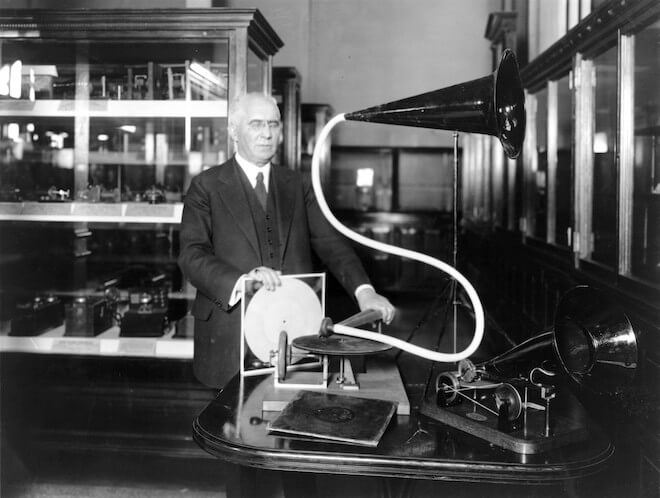
Emile Berliner
Emile Berliner (1851-1929) was a German-born inventor, engineer, and entrepreneur who made significant contributions to the fields of sound recording and communication. He is best known for his invention of the gramophone, a device that played flat disc records.
Born on May 20, 1851, in Hanover, Germany, Berliner immigrated to the United States in 1870. He initially worked as a merchant and bookbinder but soon turned his attention to inventing. In 1887, Berliner developed a new method of sound reproduction, which he named the gramophone.
Advertisement
Emile Berliner
Berliner’s gramophone used flat disc records made of a zinc disc coated with a compound called shellac. The records had spiral grooves that were created by a cutting stylus. The sound vibrations from the stylus were transmitted through a diaphragm and a horn, resulting in amplified sound. The gramophone offered several advantages over Edison’s cylinder-based phonograph, including easier production, longer playing time, and the ability to mass-produce records.
In addition to the gramophone, Berliner also made notable contributions to the development of the microphone and telephone technologies. He invented the carbon microphone, which became widely used in telephony and early sound recording. Berliner’s improvements to the telephone transmitter greatly enhanced its performance and efficiency.
Berliner was also an astute businessman and established the Berliner Gramophone Company in 1895. The company later merged with the Victor Talking Machine Company, forming the Victor Talking Machine Company, which became a major player in the phonograph industry.
Emile Berliner held numerous patents throughout his career and made significant advancements in sound recording and communication technologies. His invention of the gramophone and disc records laid the foundation for modern turntables and the widespread consumption of recorded music. Berliner’s contributions to the field of audio technology continue to influence the way we enjoy and experience music today.
The Most Significant Turntables
Do you remember your first turntable?
Advertisement
I inherited a Thorens TD-145 from my parents in 1983 as part of my Bar Mitzvah gift and it gave me over a decade of service before I upgraded to an Audiomeca Romance table designed by Pierre Lurne of Goldmund.
Advertisement. Scroll to continue reading.
Looking back I’m not entirely convinced that it was an upgrade but I did trade it in when I purchased a Michell Orbe SE in 1998; that table absolutely was a significant improvement and a great platform for a Wilson Benesch ACT 0.5 Tonearm and Benz Micro H2.0 high-output cartridge.
My ex-wife forced me to sell it during our rather quick and bloody divorce and it was painful to let that one go. I have never owned anything better and it’s unlikely that I would ever spend that kind of money on a turntable and cartridge again; especially not with college and private school tuition.
Advertisement
Three restored Thorens tables create wonderful music at home now and I’m not entirely sure that changing them would make a lot of sense. I also own a Yamaha YP-701 and NAD C 588.
Listening to records with my daughter sparked a different kind of conversation with some of our staff and my circle of audiophile friends.
Which tables were truly significant? We’ve included some tables from the late 1900s and the first part of the 20th century because they were indeed, very significant.
We could easily publish a list of the “best” turntables available right now but 99% of the planet could never afford them and will never have the opportunity to listen to one. This feels like a more interesting discussion.
Advertisement
What are we missing from this list? Please let us know.
Edison Phonograph
Edison Phonograph
Thomas Edison’s 1877 phonograph was not a turntable in the modern sense, but it was the first practical machine designed to both record sound and play it back. Built at his Menlo Park laboratory in New Jersey, the original device used a hand-cranked cylinder wrapped in tinfoil, rather than the wax cylinders that arrived later. A diaphragm and stylus translated sound into physical indentations in the foil; reversing the process allowed the machine to reproduce those vibrations as audible sound.
It was crude, fragile, and hardly hi-fi, but Edison’s invention established the essential idea that recorded music and speech could be captured, stored, and replayed at will. The flat disc record and the turntable would come later, but the phonograph was where the whole strange, expensive, shelf-consuming affair began.
Victor Talking Machine
Victor Talking Machine
Introduced by the Victor Talking Machine Company in 1906, the Victor Victrola was not the first disc phonograph, but it helped turn one into a desirable piece of furniture rather than an awkward mechanical contraption parked in the parlor. Its spring-wound motor rotated flat shellac discs without electricity, while the key innovation was the horn: Victor concealed it inside a handsome wooden cabinet instead of leaving a large external horn perched on top. That made the machine easier to live with and far more socially acceptable in the increasingly style-conscious American home.
Advertisement
The Victrola became one of the defining music machines of the early 20th century, and the company’s Nipper “His Master’s Voice” trademark became one of the most recognizable images in recorded sound. It was not high fidelity by any modern definition, but it brought the disc record, the home playback system, and the idea of owning music into the mainstream long before anyone argued about Bluetooth codecs or whether the pressing was “AAA.”
Philips 212 Electronic
Philips 22GA212 Electronic
Introduced in the early 1970s, the Philips 22GA212 Electronic was one of the more distinctive belt-drive turntables of its era. Its appeal was not that Philips had somehow invented electronic speed control, but that it combined a tacho-generator-regulated DC motor, floating subchassis, touch-sensitive 33, 45, and stop controls, and photo-electronic automatic shutoff in a relatively affordable domestic turntable.
Advertisement. Scroll to continue reading.
The 212 used feedback from its tacho generator to help maintain speed under changing load, while separate fine-speed controls and a stroboscopic platter ring allowed owners to make small adjustments. Philips claimed low wow and flutter, low rumble, and stable operation; the important point is that the deck tried to bring electronic control and convenience to a traditional suspended belt-drive design without making it look like laboratory equipment. The illuminated touch buttons were gloriously early 1970s, and remain one of the reasons the 212 has developed something of a cult following.
Advertisement
Garrard Model 301
Garrard 301
Launched in 1954, the Garrard 301 did not invent idler-wheel drive. That basic arrangement, in which a small rubber wheel transfers power from the motor to the platter’s inner rim, had already appeared in earlier phonographs and record changers. What Garrard did was apply the system to a serious transcription motor unit built for broadcasters, studios, and the growing number of home listeners who wanted something more substantial than a changer with a chrome arm and optimistic specifications.
The 301 used a powerful four-pole induction motor, a heavy platter, and an idler-drive system that delivered quick start-up, strong torque, and stable speed at 33⅓, 45, and 78 rpm. It was usually sold without a plinth, tonearm, or cartridge, allowing owners to build a system around it rather than accept a complete package chosen by someone in a sales office. The result was one of the first truly iconic high-fidelity turntables: industrial, durable, endlessly restorable, and still capable of sounding superb when properly rebuilt. A neglected example can be noisy and temperamental; a well-sorted one explains why the 301 has never really left the conversation.
Acoustic Research XA
Acoustic Research XA
Introduced in 1961, the AR XA was only $58 and what made it unique was how it handled vibration and how low its rumble measured. The package did not come with a cartridge but the price included the table, tonearm, stylus gauge, and dustcover.
The most interesting aspect of the design was its mounting system; Edgar Villchur realized that instead of attaching the motor, tonearm, and lightweight platter to the table’s top plate, it made more sense to mount the platter and tonearm to a sub platform which was suspended underneath the top plate at 3 very distinct points with damped springs with a low resonant frequency.
By doing so, the tonearm and record were isolated from footfalls and other acoustic vibration. Thorens and Linn would incorporate these concepts into their future tables.
Advertisement
Thorens TD-150
Thorens TD-150
Introduced in 1965, the Thorens TD 150 was a compact and rather unflashy turntable that changed the direction of serious belt-drive design. It was not the first commercially viable suspended-subchassis deck; that distinction belongs to the Acoustic Research AR XA of 1961. But Thorens took the basic idea of isolating the platter and tonearm from the motor and plinth with a three-point spring suspension, paired it with a belt-driven inner platter, and turned it into something more refined, more adaptable, and considerably more influential.
The TD 150 was also Thorens’ first true belt-drive turntable, replacing the belt-and-idler arrangement of the earlier TD 124 with a cleaner and more modern engineering approach. Its suspended subchassis helped reduce the transmission of motor vibration and external disturbance to the cartridge, while its removable armboard made it possible to fit alternative tonearms rather than live forever with the factory choice. That combination became the blueprint for a long line of Thorens models and, more importantly, helped inspire the Linn Sondek LP12 and much of the suspended-chassis cult that followed. Small, slightly wobbly when improperly set up, and far more important than it first appears, the TD 150 was one of the key turntables of the modern hi-fi era.
Thorens TD-124
Thorens TD-124
Introduced in 1957, the Thorens TD 124 was one of the great transcription turntables of the postwar hi-fi era: overbuilt, mechanically ingenious, and aimed at studios, broadcasters, and serious home listeners rather than anyone looking for a tidy all-in-one record player. Its most unusual feature was not a conventional idler drive, but a hybrid belt-and-idler system. A compliant belt linked the motor to a separate stepped pulley, which then drove the platter through an idler wheel. Thorens designed the arrangement to retain the torque and rapid start-up of idler drive while reducing the motor-borne vibration that could otherwise work its way toward the cartridge.
The TD 124 also used a substantial two-piece platter with a removable aluminum top section and a heavy main platter beneath, along with variable pitch adjustment, four speeds including 78 rpm, and interchangeable armboards for owners who wanted to fit their preferred tonearm. It was not a suspended-subchassis design; that came later with the TD 150. Instead, the TD 124’s reputation rests on its precision engineering, flexibility, and sheer durability. Properly restored and mounted in a serious plinth, it remains one of the most compelling vintage turntables ever made, with enough torque and authority to make many modern decks seem slightly apologetic.
The Technics SP-10 is the first direct-drive turntable.
Technics SP-10
Introduced in 1970, the Technics SP 10 was the first commercially available turntable to use a direct-drive motor, and it changed the industry almost immediately. Rather than relying on a belt or idler wheel to transfer power from the motor to the platter, the SP 10 placed the motor directly beneath the platter itself. That eliminated an entire chain of mechanical compromises and delivered unusually quick start-up, very low wow and flutter, and the kind of speed stability that broadcasters and mastering engineers could trust without keeping one eye on the strobe.
Advertisement
The original SP 10 was sold as a motor unit, leaving broadcasters, studios, and ambitious home listeners to supply the plinth, tonearm, and cartridge. It was built for work, not Instagram, and its plain industrial appearance gave little indication of how important it would become. The SP 10 helped establish direct drive as a serious alternative to belt and idler systems, and its successors became fixtures in radio stations and professional installations around the world. The SL 1200 may have become the cultural icon, but the SP 10 was the machine that opened the door and made precision direct drive impossible to dismiss.
Advertisement. Scroll to continue reading.
Linn LP12
Linn LP12
Introduced in 1973, the Linn Sondek LP12 became one of the most influential turntables in high-end audio, not because it invented the suspended belt-drive turntable, but because it turned that established idea into a long-running argument about where sound quality actually begins. Its three-point suspended subchassis, belt-driven inner platter, single-point bearing, and separate armboard followed principles already explored by Acoustic Research, Thorens, and Ariston. Linn’s contribution was to refine the formula, make it modular, and insist that the source component mattered more than the hi-fi industry had previously been willing to admit.
That “source first” philosophy became the LP12’s real legacy. Ivor Tiefenbrun and Linn persuaded a generation of dealers and listeners that a better turntable could extract more musical information from the record before the signal ever reached the amplifier or loudspeakers. The LP12 also became famously upgradeable, with improved bearings, subchassis designs, power supplies, tonearms, and cartridges allowing owners to keep updating the same basic deck over decades. It was expensive, fussy about setup, and capable of developing a bounce that could make a wooden floor feel like an enemy combatant, but it became a benchmark for musical timing, long-term ownership, and the modern high-end turntable market.
Technics SL-1200
Technics SL-1200
Released in 1972, the Technics SL 1200 began as a serious consumer direct-drive turntable, not as a purpose-built DJ tool. Its high-torque motor, heavy platter, die-cast chassis, stroboscope, and fine-speed adjustment gave it fast start-up and strong speed stability, qualities that quickly caught the attention of club DJs looking for a deck that could cue records precisely and survive a room full of bass, smoke, and people making bad decisions.
Advertisement
The version that truly changed music culture, however, was the SL 1200MK2 in 1979. Technics redesigned it with input from disco DJs, adding quartz-locked speed control, a more robust chassis and damping system, improved torque, and the familiar ±8 percent pitch slider that made beatmatching practical and repeatable. The MK2 became the working standard for clubs, radio stations, hip-hop DJs, and turntablists around the world. The original SL 1200 opened the door; the MK2 turned the turntable from a playback device into an instrument. It was rugged, precise, and so durable that many examples have outlived the clubs, DJs, and questionable carpet they were originally purchased to endure.
Rega Planar 3
Rega Planar 3
Arriving in the late 1970s, the Rega Planar 3 became one of the defining affordable audiophile turntables because it refused to confuse complexity with progress. Its formula was almost aggressively simple: a light, rigid plinth, belt drive, 12 mm glass platter, straightforward manual operation, and a tonearm designed to do its job without adding a small engineering department’s worth of unnecessary parts. In an era when many manufacturers were loading decks with controls, mechanisms, and enough brushed aluminum to open a minor space program, Rega focused on keeping energy where it belonged: in the record and cartridge.
The original Planar 3 was developed from Rega’s earlier Planet and Planar 2 designs, and later versions benefited enormously from the company’s RB300 tonearm, introduced in 1983. Rega has refined the platform repeatedly through the P3, P3 24, RP3, and current Planar 3 generations, but the core philosophy has remained remarkably stubborn: low mass, high rigidity, sensible engineering, and sound quality that does not require a second mortgage or a plinth the size of a dining table. It helped make serious vinyl playback attainable for a far broader audience and remains one of the few turntables that can reasonably claim to be both an entry point and a lifelong habit.
Dual 1219
Dual 1219
Introduced in 1969, the Dual 1219 was not the first automatic turntable, but it proved that convenience and serious record playback could coexist. Its idler-drive system, substantial platter, 33, 45, and 78 rpm capability, and gimbal-bearing tonearm gave it genuine hi-fi credentials, while its automatic mechanism could start a record, return the arm, and shut the machine down at the end of play.
It could be used for single records or as a changer for a stack of discs. Complex, sturdy, and very German, the 1219 remains proof that an automatic turntable did not have to sound like furniture with a motor.
Advertisement
Pro-Ject Debut Carbon
Pro-Ject Debut Carbon
Introduced in 2012, the Pro Ject Debut Carbon became one of the defining entry-level audiophile turntables of the vinyl revival. It did not invent the affordable belt-drive deck, and it was not the first Pro Ject Debut; that model had been around since 1999. What the Debut Carbon did was add a one-piece carbon-fiber tonearm to an already proven, sensibly priced platform, giving buyers a feature normally associated with considerably more expensive turntables.
Manual operation, belt drive, a steel platter, and a pre-fitted Ortofon 2M Red cartridge kept the formula straightforward. The Debut Carbon was never designed to impress people who enjoy polishing machined aluminum for sport. It offered an honest route into proper vinyl playback at a price that did not require the sale of a kidney or a second listening room. For a generation of listeners moving beyond suitcase players and all-in-one systems, it became a legitimate gateway to better analog sound.
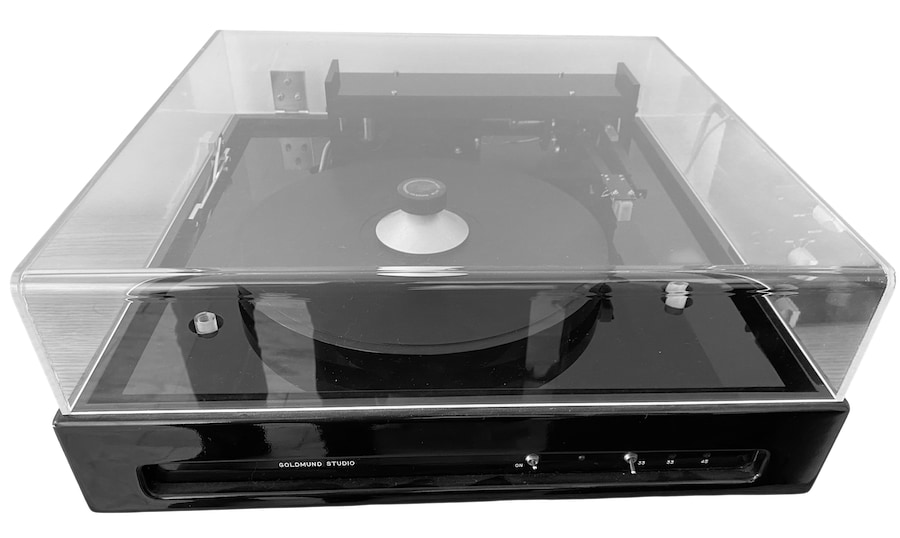
Goldmund Studio
Introduced in 1979, the Goldmund Studio helped define the modern high-end turntable as something more ambitious than a conventional record player on a well-made plinth. Goldmund combined direct drive, an acrylic platter, and its “Mechanical Grounding” approach, which focused on controlling and draining unwanted vibration through a rigid mechanical structure rather than simply trying to isolate everything from everything else.
The Studio was often paired with Goldmund’s servo-controlled T3 tonearm, and the combination looked unlike almost anything else on the market. It was expensive, unconventional, and not especially interested in winning over people who believed a turntable should resemble furniture. Its importance lies in how it pushed analog playback toward the modern cost-no-object era, where materials science, vibration control, industrial design, and tonearm geometry became part of the same rather elaborate argument.
Advertisement. Scroll to continue reading.
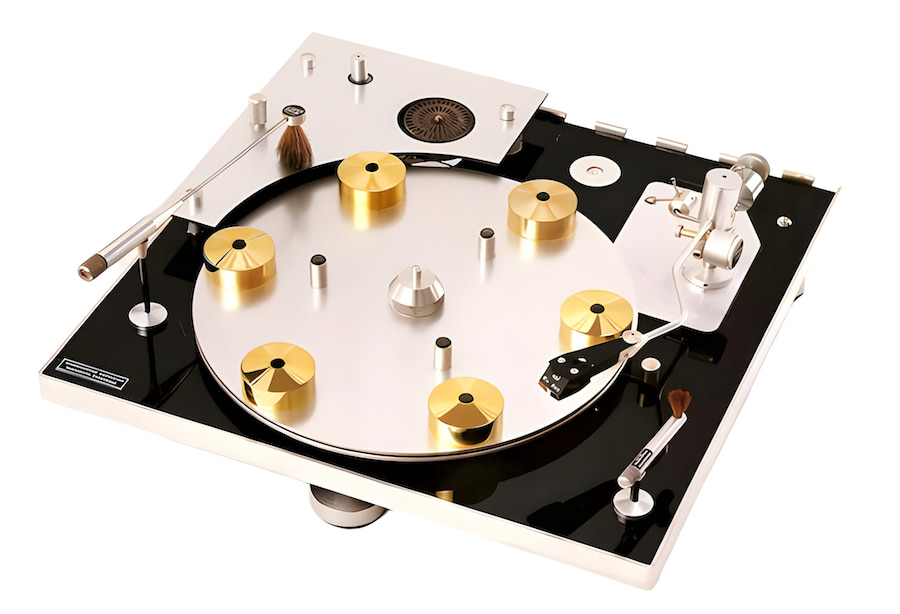
Transcriptors Hydraulic Reference
Introduced in 1964, David Gammon’s Transcriptors Hydraulic Reference was one of the most visually radical turntables ever made. This was a manual belt-drive design with a synchronous AC motor, a machined aluminum platter, and six conspicuous gold-plated brass inertia weights that made the whole thing look less like a domestic appliance than a piece of kinetic sculpture from a very well-funded Bond villain’s living room.
The “Hydraulic” name came from its unusual speed-control system: a vane interacted with silicone fluid in a well beneath the platter to provide fine regulation. The exposed acrylic, aluminum, and brass construction made the mechanism part of the experience rather than something to hide under a wood veneer. Its engineering was genuinely inventive, but its broader importance was cultural and aesthetic. The Hydraulic Reference appears in A Clockwork Orange, and a 1964 example sits in MoMA’s Architecture and Design collection. It did not create a dominant turntable template in the way the Thorens TD 150 or Technics SL 1200 did, but it permanently expanded the idea of what a record player could look like.
Years before developing AngelAi, Pavan Agarwal was already building mortgage software.
Earlier in his career at Sun West Mortgage Company, Inc. he developed ReverseSoft, a backend platform for reverse mortgage operations that, according to the company, was later adopted by lenders beyond Sun West. That work came after Agarwal had already spent time in several operational roles inside the business, including as a wholesale representative, brand representative and loan originator, while studying electrical engineering at UC Irvine. Those experiences gave him direct exposure to both the technology and the regulatory requirements that shape mortgage lending, long before he founded Celligence LLC or began developing AngelAi.
Reverse mortgage lending is one of the more specialized areas of the mortgage industry, with regulatory requirements and servicing responsibilities that differ from traditional home loans. Building technology for that market gave Agarwal early experience with the operational complexity that would later shape his work on AngelAi. According to the company, the experience of building ReverseSoft helped establish engineering principles that later carried into AngelAi, including an emphasis on traceability, regulatory consistency and structured decision-making.
Sun West today holds standing as a Ginnie Mae HMBS issuer, servicer and master servicer, a set of roles that places the company inside the infrastructure supporting government-insured reverse mortgages, alongside approvals across FHA, VA, USDA, Fannie Mae, and Freddie Mac. HousingWire has cited this standing in its coverage of Agarwal’s work in the space.
Advertisement
Reverse mortgages are typically used by senior homeowners drawing on home equity later in life, a population that depends on lenders with a strong operational track record in the product. Roles like issuer, servicer and master servicer require years of sustained compliance and infrastructure that cannot be assembled quickly, a demand that has only grown alongside an aging homeowner population in the United States.
Agarwal has continued to build on that foundation through AngelAi, the AI lending platform developed by his technology company Celligence. Trained on hundreds of thousands of real-world loan files together with the regulations governing those decisions at every jurisdictional level, the platform now facilitates lending decisions across FHA, VA, USDA, conventional, and reverse mortgage products. That development expanded on the operational grounding Agarwal first built through ReverseSoft, applying the same principles across a far broader range of lending products.
Today, AngelAi operates in more than 100 languages and runs on what Celligence describes as a deterministic architecture, allowing every underwriting decision to be traced back to the data and regulation behind it. Sun West fully warrants every decision the platform generates, extending into AngelAi the same emphasis on accountability and regulatory consistency that has shaped the company’s lending operations for decades, a throughline Agarwal has traced directly back to the discipline required to build reverse mortgage software correctly the first time.































![Qkyou - MONEY ft O-Neang [VIDEO LYRICS]](https://wordupnews.com/wp-content/uploads/2026/02/1770711855_maxresdefault-80x80.jpg)































You must be logged in to post a comment Login