Connect with us

Tech

Microsoft drafts ‘humanist AI code of conduct’ amid safety debate

Published

on

‘Humanist AI’ code of conduct spells out what Microsoft’s AI models should and shouldn’t do, and invites public feedback before a revised version lands later this year.

Microsoft AI has published a draft code of conduct for its AI models, opening a six-week public consultation on the rules it wants to govern their behaviour, from weapons and cybersecurity to emotional dependency.

The document, titled the Humanist AI Code of Conduct, was published yesterday (14 September) and is not currently used to train any AI models. A revised version is due toward the end of the year to guide 2027 model development.

The release comes days after individual researchers at Anthropic raised public concerns about AI risk. Jacob Coxon, who resigned from Anthropic, posted warnings about superintelligence risk on X last week, while Evan Hubinger, Anthropic’s alignment science lead, posted that he put the chance of catastrophic AI risk within a decade at greater than 10pc.

Advertisement

It also follows warnings from Anthropic’s Dario Amodei that it might be time to slow AI development, which drew a rare approval from rival OpenAI’s Sam Altman, and a somewhat predictable extreme reaction from the pro-AI US president who described the warnings as a ‘hoax’.

Microsoft’s code of conduct is a corporate governance framework. It sets out four objectives for AI models: maintaining human control and safety; avoiding anthropomorphism; supporting human flourishing; and reflecting plural values across different worldviews without being neutral on harm.

A section on Absolute Constraints prohibits models from assisting with chemical, biological, radiological or nuclear weapons, conducting offensive cyberoperations, evading human oversight, or engaging in large-scale manipulation.

The document also explicitly rules out any claim by its models to consciousness, feelings or legal personhood, framing this as a design principle rather than a disclaimer. It further prohibits romantic or companion-style AI interactions and the fostering of emotional dependency.

Advertisement

Microsoft says it convened focus groups with members of the public alongside experts in AI, law, ethics and policy while developing the document. The consultation period runs for six weeks from 14 September. Feedback can be submitted via the Microsoft AI website.

Don’t miss out on the knowledge you need to succeed. Sign up for the Daily Brief, Silicon Republic’s digest of need-to-know sci-tech news.

Source link

Advertisement
Continue Reading
Click to comment

You must be logged in to post a comment Login

Leave a Reply

Tech

12 in Ireland affected as Revolut leak exposes passport, bank data

Published

on

A total of 680 account holders have been affected globally.

It is understood that sensitive personal information belonging to 12 Revolut account holders in Ireland has been leaked in a data breach.

Last Saturday (12 September), Revolut said that it disclosed customer data to an unauthorised fraudulent party after receiving requests for information from an email with a government agency domain. The company mistakenly fulfilled the data requests before realising that the sender was phishing for data, it said in a community alert.

The leaked data includes full names, dates of birth, occupations, addresses and contact details, passports, drivers’ licenses, financial statements and facial verification images.

Advertisement

“Revolut recently identified a sophisticated external impersonation scam where an unauthorised third party utilised a legitimate government agency domain email to submit fraudulent requests for information,” a Revolut spokesperson said.

“Upon detection, we immediately blocked the address and alerted the relevant government agency as well as enforcement agencies, data protection, and financial regulators,” they added.

“Revolut systems and customer funds are unaffected. We have contacted the limited number of impacted individuals directly to inform them and provide support.”

A total of roughly 680 account holders are understood to have been affected globally. Revolut has more than 80m customers across the world, with roughly 3.4m based in Ireland.

Advertisement

The data leak comes as the fintech continues on its aggressive expansion campaign to establish itself as a licensed banking institution in major markets globally, including the UK, US, France, Australia, Mexico and Peru.

Reports from April suggest that the company is on its way to a $200bn valuation in an eventual initial public offering expected on or after 2028. It was last valued at $75bn after a major share sale last November.

It recently received approval to provide crypto services in the United Arab Emirates, adding to its more than 16m crypto customers across Europe and the UK. The fintech also announced its own euro-backed stablecoin called EURR last month.

Don’t miss out on the knowledge you need to succeed. Sign up for the Daily Brief, Silicon Republic’s digest of need-to-know sci-tech news.

Advertisement

Source link

Continue Reading

Tech

Congress has three AI bills and no timetable for a vote on any of them

Published

on

Three senators will put AI legislation in front of Congress this week, and none of them can say when it might be voted on.

John Kennedy, a Republican from Louisiana, plans to introduce a measure on Wednesday requiring developers to build a shutdown mechanism into their systems.

Bernie Sanders is hosting a briefing with AI researchers the same day and has a bill that would ban artificial superintelligence outright. Josh Hawley has already introduced bipartisan legislation covering national security, civil liberties and labour protections.

The Associated Press canvassed Congress on Tuesday and found the same answer in both parties, which is that nothing will move. Rick Scott, a Republican from Florida, ran through the list of things Congress has not finished, election security and a budget among them, and asked:

Advertisement

“So you think we’re going to get AI done?”

Mark Warner, Democrat of Virginia, put it as a rule: “We never do anything until we have a holy heck moment.”

What makes the stall unusual is who is asking. Dario Amodei said on Saturday that the industry must slow down, Sam Altman agreed the same day, and Elon Musk added his support. Rahm Emanuel, who ran Barack Obama’s White House, told the AP that in his whole career he had never seen it:

“I’ve never had an industry or a CEO ask for regulation and oversight.”

Donald Trump has answered the request repeatedly and in the negative. He called the case for limits a conspiracy on Monday, having dismissed extinction fears the week before, and one of his first acts upon returning to office was to rescind Joe Biden’s 2023 executive order on AI oversight.

JD Vance has been cautious about regulation. Mike Johnson said legislatures reflexively cover things in red tape, and suggested Trump summon the AI companies to a meeting rather than pass a law.

Advertisement

Senate Republicans are not uniformly with him. John Thune, the majority leader, told the AP that Congress can set guardrails around the more consequential threats “without harming our ability to stay ahead in the AI race”, and he is working with Amy Klobuchar on a bill that would give Washington power to block unsafe models and impose a duty of care on developers.

Hawley wants protections for workers, for children online and for people living near data centres, while saying plainly that frontier models will not blow up the world.

A bipartisan working group led by Chuck Schumer reported in 2024 that the United States should spend at least $32bn over three years on AI development and safeguards. Almost none of it followed.

Pressure from outside Congress has kept rising throughout it. Obama has been telling candidates they need an AI policy of their own; Max Stier of the Partnership for Public Service told the AP that delay will prove costly, and researchers at the labs have spent the summer warning publicly about what their employers are building.

Advertisement

David Sacks, until recently Trump’s AI adviser, told the same companies on Sunday to slow down quietly and stop asking Washington for anything in return.

None of the three bills has a committee date, a floor date, or a companion in the House. Kennedy’s kill switch arrives on Wednesday into a chamber whose own leader has said the votes are not there for the broader bill he is already negotiating.

Source link

Advertisement
Continue Reading

Tech

What an AI “slowdown” could look like

Published

on

This story appeared in Today, Explained, a daily newsletter that helps you understand the most compelling news and stories of the day. Subscribe here.

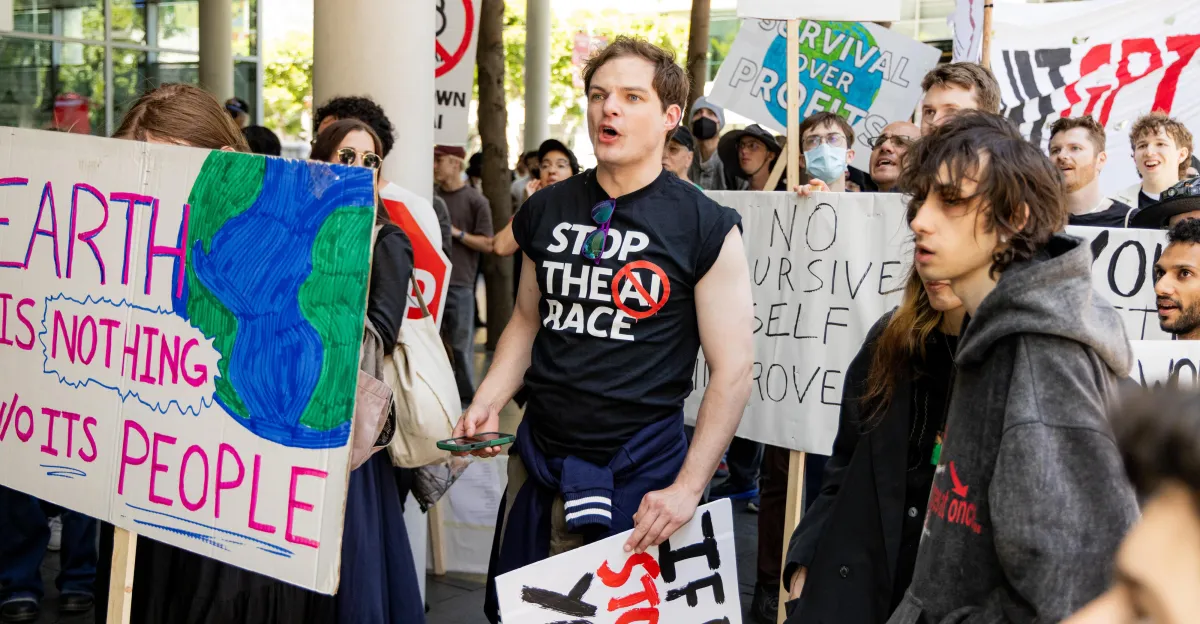
If you’d asked me yesterday what Steve Bannon and Bernie Sanders had in common, I might have said “white hair.” But after a wild week in which AI doomerism burst solidly into the mainstream, the right-wing provocateur and progressive senator are joining forces — with various religious leaders, lawmakers, and the actor Joseph Gordon-Levitt, no less — to express their deep concern about AI regulation.

Concern about cutting-edge AI models had been mounting for months as those models increasingly behaved in ways their makers didn’t expect. It exploded last week, when a researcher at the AI company Anthropic resigned publicly and warned that the people building AI “earnestly believe it could kill us all by the end of the decade.”

It sounds like science fiction. It is the stuff of science fiction. But it’s not a fringe position: Over the weekend, leading AI researchers and executives also warned that AI is developing dangerously fast and called for measures to rein it in. (We’ll run through those options in just a minute.)

Advertisement

Now, a wide spectrum of lawmakers, activists, and pundits are also calling for stronger safeguards — Sanders and Bannon among them. The pair will speak at an event billed as a “Pro-Human Assembly” in Washington on Tuesday alongside Republican Sen. Marsha Blackburn, Congressional Progressive Caucus chair Greg Casar, and the archbishop of San Francisco, among others.

But President Donald Trump is decidedly not on board, and it’s hard to see how any substantive AI regulations could pass without him.

“There is a SICK conspiracy going on against AI and Data Centers,” he wrote this morning on Truth Social, “and the only one happy about it is China.”

All three approaches have precedent in federal regulation, so they wouldn’t be (at least in theory) too tricky to stand up. The real roadblock, as always, is political. One AI researcher told Vox he worries we’ll miss the opportunity to regulate AI while waiting for lawmakers to get on the same page.

Advertisement

Even under threat of apocalypse, Washington, DC, moves far, far slower than Silicon Valley.

Source link

Continue Reading

Tech

Amazon Prime Video takes on TikTok with short-form news clips

Published

on

Amazon Prime Video is coming after TikTok with the addition of short-form news clips. The company said on Monday that it’s expanding its news coverage to include on-demand news clips offering both local and national stories. These will be available on TVs and other living room devices, but will soon roll out to the web and Prime Video’s mobile apps, the company said.

The clips will be available in the News destination within the Prime Video app in its Trending Topics and the Local News carousels. They join Prime Video’s existing local, national, and world news coverage from a number of major providers, which are available to everyone in the U.S. regardless of whether they have a Prime subscription.

Amazon could not yet confirm whether the clips on mobile would be oriented for vertical video or not, only that they would be considered short-form content on iOS and Android.

While TikTok is better known as an entertainment destination, it’s also, along with Instagram, increasingly a place where younger people get their news. Gen Z in particular often watches news creators and influencers on short-form apps, including YouTube Shorts. Amazon, which doesn’t have a true social destination of its own, is instead adding short-form video to Prime Video, in hopes of capturing Gen Z’s attention.

Advertisement

But Gen Z viewers are drawn to these social apps not necessarily because of the length of the clips, but rather because of how the information is presented. Based on findings from Pew Research, these younger news consumers want short-form news content that “feels organic, not over-produced.”

Prime Video is not the first streamer to add short-form clips to its content lineup. Peacock added support for short-form clips in March, followed by HBO Max and Netflix in July, then Disney+ in August. Combined, the updates represent an industrywide effort to meet viewers where they are — which is now often looking for entertainment in shorter bursts and consumable in moments or minutes instead of portions of hours or longer.

When you purchase through links in our articles, we may earn a small commission. This doesn’t affect our editorial independence.

Source link

Advertisement
Continue Reading

Tech

Why AI’s favorite label is under dispute

Published

on

The AI industry likes to abuse the word “open.” It appears in product releases, research papers, policy debates, and investor presentations. A company publishes model files to Hugging Face, developers run them on their own GPUs, and the release is quickly described as an “open source model.” Not necessarily. It may only be open-weight.

The difference is more than a technicality. It determines whether you can merely deploy a completed neural network or whether you can meaningfully inspect, reproduce, alter, and redistribute the system that produced it. A genuinely open source system should grant the freedom to do all of the above.

Weights are the learned numerical parameters created by training. Together with the model architecture and inference code, they allow a large language model (LLM) to function. You can download an open-weight model, self-host it, fine-tune it on internal documents, and avoid routing prompts through a proprietary API.

Advertisement

Open weights are publicly available. They matter because running them locally can offer greater control over data, privacy, costs, supplier API changes, and vendor lock-in. They’ve also helped build a large ecosystem of local-model runtimes, inference providers, fine-tuning tools, and specialized downstream models.

The Open Source Initiative (OSI), steward of the Open Source Definition (OSD), makes the distinction directly: “Open Weights refer to the final weights and biases of a trained neural network.” Those values determine how a model interprets prompts and produces outputs. Releasing them can let others fine-tune, adapt, or deploy the model. But the OSI adds that weights alone expose only “a fraction of the information required for full accountability.”

As James Landay, director of the Stanford Institute for Human-Centered AI (HAI), explained: “Open weights are progress. You can download the model, run it on your own machine, keep it out of someone else’s data pipeline. But you still can’t see how the thing was built, what it was trained on, or why it behaves the way it does. That’s not an open model. That’s open distribution.”

Without the training data or sufficiently detailed documentation, outsiders cannot determine which sources were used, what copyrighted or private material may have been included, how data was selected or removed, which languages and communities were underrepresented, whether benchmark data leaked into training, or what alignment and safety methods affected the model after pretraining.

Advertisement

Landay continued: “There’s a wide gap between open-weight AI and open source AI.” He contends that unless developers disclose training data or provide a “thoroughly documented, auditable account of it,” you can’t test, reproduce, or challenge the work in the fullest sense.

The OSI has its own definition of open source AI: the Open Source AI Definition (OSAID 1.0). It requires model parameters, including weights, to be made available under OSI-approved terms, but does not prescribe a specific legal mechanism for doing so.

Luca Antiga, CTO of Lightning AI and a prominent PyTorch contributor, has argued that OSAID’s treatment of weights leaves “a gaping hole that will make licenses less effective in determining whether OSI-licensed AI systems can be adopted in real-world contexts.”

Other open source figures have also criticized OSAID. Bruce Perens, author of the original OSD, denounced the OSAID in 2024. He later declared: “It’s not Open Source! … It’s unfortunate that the Open Source Initiative itself is now involved in Openwashing.”

Advertisement

He’s far from alone. Bradley Kuhn, policy fellow and hacker-in-residence at the Software Freedom Conservancy (SFC), and Red Hat Senior Commercial Counsel Richard Fontana have called for OSAID to be repealed, arguing: “The OSI acted too quickly to impose an overly ambitious policy compromise on the community. OSAID undeniably created a rift in the FOSS community; that rift seriously damaged the OSI’s reputation, authority, and influence. Meanwhile, OSAID shows no signs of having any positive policy influence on machine learning practitioners, the FOSS community, or regulators.”

OSI acknowledged when OSAID 1.0 was released in October 2024 that the definition would continue to evolve. Critics contend that its central shortcomings have yet to be resolved.

That said, the Linux Foundation’s Mike Dolan submitted the Open Model, Data, and Weights (OpenMDW) license to the OSI. The license has been around since 2025 and lists contributors from Amazon, Meta, IBM, Microsoft, and Nvidia, giving it substantial industry backing.

Conventional open source revolves around source code. LLMs are a different kettle of fish: they combine code, architecture, and numerical weights derived from training datasets that may be proprietary, copyrighted, or undisclosed. OpenMDW’s answer is to define separate terms for a model’s architecture, training data, and weights, bringing the components supplied by a licensor under one agreement.

Advertisement

It sounds reasonable to me, but the submission has encountered objections on OSI’s license review mailing list. As Stefano Maffulli, OSI’s former executive director, who led the organization while OSAID was being formulated, said: “I continue getting the impression that the OpenMDW review is tainted by an ideological bias: Because we don’t like big tech and AI now is big tech, then we don’t like AI; therefore, we’ll do anything to block it.”

It’s too late to bury our heads in the sand. As Stanford’s Landay put it: “Open weights answer ‘Can I run this?’ Open source answers ‘Can I trust this, improve it, and build the next thing on top of it?’ Right now almost everyone – American labs and Chinese labs alike – is answering the first question but nowhere close to the second.”

We need both. Whether OSI adopts OpenMDW is an open question. Still, OpenMDW and its supporters are at least trying to establish licensing terms that cover code, data, and weights together. Unless someone succeeds, “open AI” risks becoming an oxymoron – or merely another hollow tech marketing term. ®

Source link

Advertisement
Continue Reading

Tech

Italy’s Exein reaches unicorn status with $270m fundraising round

Published

on

The Italian cybersecurity start-up aims to fight AI hackers using AI-powered innovations.

Exein, an Italy-headquartered cybersecurity start-up that protects smart, connected devices from hackers, has joined the global collection of unicorns post a $270m funding round that brought the company to a $1.7bn valuation. The round was led by Headline, with participation from Sofina, Goldman Sachs and others.

Established in Rome in 2018 by CEO Gianni Cuozzo, Exein has additional offices in Germany, Taiwan and the US. The company builds technology to secure hardware at the processor level and is embedded in 2bn chips globally. Consumers include Nvidia, AWS and Mediatek, among others. 

Cuozzo told the Financial Times that the new investment is necessary to enable the organisation to compete on a global scale for limited cybersecurity and computing professionals. 

Advertisement

Additionally, Exein intends to release its own foundational model for AI security in 2027. Cuozzo explained, “We are moving from having security software to having a secure model that is running constantly on the device and will automatically react to attacks.”

He added, “Right now I think the hackers have the edge. Exein’s  plan is to use embedded AI technology to combat threats and provide “machine-based protection in a world of machine-based attacks”. 

As the world becomes more digitally connected and advanced, the risk of cybersecurity breaches is increasing. It was recently confirmed that 12 Irish account holders are among the 680 global consumers of Revolut who had their sensitive data exposed. 

Also, late last week OpenAI’s Sam Altman, announced that the company will not be going public this year as “Right now would be an ill-advised moment to go public.”

Advertisement

He explained that the company isn’t ready and that there is much to be done in the way of safety, alignment and showing how the industry and governments can work together.

Don’t miss out on the knowledge you need to succeed. Sign up for the Daily Brief, Silicon Republic’s digest of need-to-know sci-tech news.

Source link

Advertisement
Continue Reading

Tech

A Closer Look at the BG-5 Golden Dragon Fish, China’s Robot Arowana That Swims Without a Script

Published

on

China Autonomous Robotic Fish Surveillance
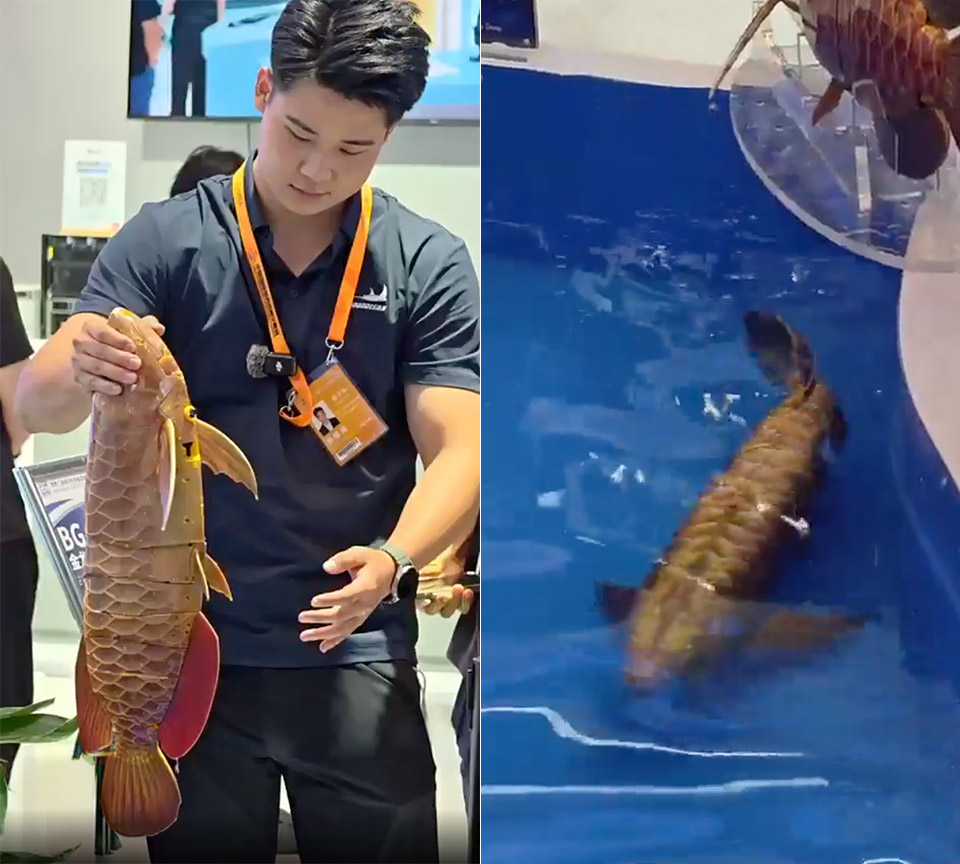
Crowds in Hall 3 at Beijing’s Shougang Park last week kept stopping at a small tank. A slender golden fish with layered scales was rising, sinking, and turning with a soft flick of its tail. Only after it changed course on its own did most people accept they were watching a machine, not an arowana that had wandered into a trade-fair display.

Boyagongdao Marine Technology Group debuted the BG-5 Golden Dragon Fish at the 2026 China International Fair for Trade in Services, and it was a huge hit. The robot is essentially a replica of the arowana’s long body and glossy gold coloring, down to the details. According to the catalogue’s specifications, it is 640 millimeters long, 204 millimeters wide, and 90 millimeters high, weighing around 3 kilograms. It is supposed to be capable of operating at depths of up to 5 meters and reaching speeds of up to 0.6 meters per second.


Insta360 X6, 8K 360 Camera with 1/1.1” Sensors
  • DUAL 1/1.1″ SENSORS & TRIPLE AI CHIP SYSTEM: Custom-built dual 1/1.1″ square sensors deliver unprecedented 360 image quality. Combined with a triple…
  • FLAGSHIP 8K50FPS 360 VIDEO: Hit record on our 360 action camera and capture your world in stunning native 8K50fps video. Every view, every highlight…
  • IN-HOUSE AI MODEL FOR EFFORTLESS 360 EDITING: Insta360’s own AI model, built specifically for 360 editing. New AI Director edits your footage…

According to those working on the exhibit, the fish was not programmed with a predetermined course; instead, the robot’s onboard sensors detect its surroundings and plans a new path as it goes. That’s kind of the purpose; canals, lakes, and tunnels change all the time, and a human operator just cannot keep up with every twist and turn.

The propulsion system is quite interesting, as it is a flexible tail with three joints divided into seven segments that work together to send a wave down the fish’s body, just like a real fish. There are no spinning propellers, so it’s much quieter and less noticeable than your usual underwater drone. All of the electronics are safely stored in the main cabin, which includes all of the high-precision sensors and a fancy global vision control system you’d expect for a task like this, as well as a modular layout to make servicing easy.

Advertisement


They have a version called the BG-5V that not only conducts path planning, task allocation, and formation control, but it can also coordinate with multiple units, so you could have a number of these robots working together to cover different parts of the ocean at once. This seems very fascinating, and it demonstrates how the same technology can be used for both a tank demo and a more complex work.

The device’s small size is also a significant advantage, since it can fit into shallow water and tight channels that larger drones cannot. Furthermore, it is meant to be quiet, allowing you to join a school of genuine fish and observe marine life, or to slide through water tunnels and hydropower sites without disturbing anything. The battery life and camera resolution were kept under wraps, although they did indicate it’s good for 5 meters, so it’s not a deep-ocean submarine. Even still, the combination of a looker that resembles an expensive aquarium fish, a tail that moves like one, and some extremely intelligent sensors is not difficult to understand, as this is a company with substantial underwater knowledge and the possibility for even more…

Source link

Advertisement
Continue Reading

Tech

New York Seizes a Dozen Celebrity Deepfake Websites

Published

on

For the best part of a decade, abusive deepfake “pornography” websites have published thousands of nonconsensual videos depicting women, including high-profile celebrities, politicians, and public figures, into sexual situations. Now, in what is likely the largest takedown of explicit deepfake websites to date, officials in New York have seized more than a dozen of the harmful sites.

On Monday, the Manhattan District Attorney’s Office announced the seizure of 12 domains which it says have been used for “unlawfully” sharing, publishing, and selling celebrity deepfake videos. Around 1,200 people—overwhelmingly women—were depicted in nonconsensual sexual images and videos on the websites, the office says. These included social media influencers, actors, activists, athletes, musicians, and politicians.

“These horrific violations of privacy follow victims into their careers and personal lives and take an immense toll on emotional and mental well-being,” district attorney Alvin Bragg said in a statement, urging potential victims to come forward and contact his office’s cybercrime bureau. The office says its investigations into who is responsible for the websites, plus those who uploaded damaging videos of victims, are ongoing.

The seizures, carried out under New York’s criminal procedure laws, mark perhaps one of the most significant and sweeping actions against websites hosting explicit deepfake videos since the technology first emerged at the end of 2017. As artificial intelligence technology has improved, a dark industry of websites, apps, and bots has appeared: They are designed to “undress” photos of women or create graphic sexual videos that include them. The images and videos are increasingly realistic and can be generated in seconds.

Advertisement

While deepfake technology is widely used against non-famous women and girls—often being shared in private social media groups—celebrities have spoken out about the many harms of being depicted in the content and the challenges of getting it removed. While laws against deepfakes have been slow to emerge, the US Take It Down Act increasingly allows images to be removed, with part of the law allowing law enforcement officials to take down and seize websites.

The Manhattan District Attorney’s Office has not publicly named the websites it has seized. However, ahead of Bragg’s announcement, WIRED independently observed several of the sites’ homepages being replaced by takedown notices—“THIS DOMAIN HAS BEEN SEIZED”—late last week, with the sites now saying they have been taken over following a seizure warrant issued by a New York State Supreme Court.

“The takedowns are a significant win in the fight against synthetic nonconsensual intimate imagery (NCII),” says Leonie Oehmig, a researcher at the Institute for Strategic Dialogue (ISD), who has studied the deepfake creation ecosystem. Oehmig says that enforcement of state laws shows that the harmful content can be tackled and that the seized sites don’t appear to be accessible if using VPNs to try and access them from other locations. “This shows that meaningful, coordinated enforcement is achievable even where regulation itself remains fragmented across jurisdictions.”

The websites were likely viewed millions of times. Many used names that included phrases such as “sex celebrity” or promised “real deepfakes.” They hosted false videos of some of the world’s most famous celebrities, with one saying, “various actresses’ faces are used for deepfakes.”

Advertisement

Videos could be several minutes in length and include fully sexually explicit scenes—often swapping the faces of celebrities or public figures into existing pornographic videos. Archived versions of the websites show some videos had been watched tens of thousands of times, with one of the websites claiming to have been online since 2018.

Source link

Continue Reading

Tech

PVanish says server count doesn’t matter, so it rebuilt the parts that do

Published

on


  • IPVanish just completed a two-year, ground-up network rebuild
  • The upgrade leans on faster ports, direct peering, and dual data centers
  • The provider now promises a 41% speed boost at peak times

IPVanish has just called time on a project most of its users never saw: a two-year, ground-up rebuild of its entire server network.

Server count, the company argues, is not what makes a network fast. How those servers are built, connected, and peered is what’s actually important. Anyone weighing up the best VPN for speed will want to pay attention.

Source link

Advertisement
Continue Reading

Tech

Magma GT on Mottarone, Genesis Lets the Supercar Concept Climb

Published

on

Genesis Magma GT Concept Supercar Tutte Bene Hillclimb
Genesis brought its Magma GT Concept to life on a 9-kilometer stretch of Italian mountain road last week. The mid-engined grand tourer, first shown as a still object at Le Mans in June, rolled onto the closed Strada Borromea on Mount Mottarone for the Tutto Bene Hillclimb, an invitation-only gathering of 85 cars overlooking Lake Maggiore.


Organizers Race Service and BorromeodeSilva treat the 51-corner route as a moving showcase of automotive design rather than a timed competition. Drivers have the freedom to make their own decisions and choose their own pace. Genesis seized this opportunity to show that their forest green coupe was more than just a beautiful design concept. You can now add 800 horsepower thanks to a twin-turbo 3.2 liter V8, identical to the one found in the GMR-001 hypercar, which is mounted out back and sends everything to the rear wheels.

Sale


LEGO Technic BMW M4 GT3 EVO Race Car 42226
  • BMW MODEL CAR KIT – Racing enthusiasts can fuel their imaginations with the LEGO Technic BMW M4 GT3 EVO Race Car (42226) building set for boys and…
  • AUTHENTIC DETAILS – This race car playset features iconic BMW detailing and is equipped with a working steering function, a detailed 6-cylinder…
  • BUILD, PLAY & DISPLAY – Kids can enjoy assembling their model car and racing it down an imaginary track, then display it on a shelf or table to…

The wet roads and rain pinging off the bodywork prevented the driver from really letting fly. Spectators had their umbrellas out as the Magma GT sat on the starting line, looking stunning. At the green, there was a brief period of wheelspin before the V8 kicked in and the car began to drive at a steady speed. Footage from the NM2255 Raw Car Sounds channel demonstrates how effectively the prototype goes through turns and pulls out even when the road becomes slippery.

Advertisement


When the driver opened the throttle, the valley filled with a deep rumbling from the exhaust. The sound was like that of a true mid-engine vehicle, not a muffled luxury sedan. Even at relatively low speeds, the automobile would begin to slide on the damp road. That’s a gentle reminder that Genesis wasn’t attempting to break any records with this one-off, but rather to keep it together. Still, the car appeared rooted and eager to do its job, with its low profile and broad stance just doing what the driver ordered it.

Genesis Magma GT Concept Supercar Tutte Bene Hillclimb
André Lotterer, fresh off his seventh-place finish at Lone Star Le Mans, was given the opportunity to drive the X Skorpio Concept over the same route for its European debut. Genesis also unveiled the GMR-001 and Box Buggy Concept, and with so many cars on the slope, things got a little chaotic. The Magma GT’s butterfly doors opened, revealing a lava orange leather interior that contrasted nicely with the green exterior.

Genesis Magma GT Concept Supercar Tutte Bene Hillclimb
Production is still years away, with rumors of a roadster, track-hardened variant, and GT3 racecar circulating. For one afternoon in the Italian Alps, the Magma GT only needed to climb, stay steady, and sound like it belonged with the luxury vehicles that often utilize these roads. It accomplished all three
[Source]

Source link

Advertisement
Continue Reading

Trending

Copyright © 2025