
Crypto World
US Crypto Tax Bill Leaves Out Mining, Staking Deferral



The US House Ways and Means Committee will consider a 114-page crypto tax package on Wednesday that leaves out a provision that would have allowed miners and stakers to defer taxation of rewards until the tokens are sold.
The Digital Asset Tax Certainty Act, H.R. 10357, was published alongside the committee’s markup notice on Monday. The package does not include the reward-timing provision contained in Representative Mike Carey’s Tax Clarity for Mining and Staking Act, introduced in June.
The provision would have allowed taxpayers to choose between recognizing newly created tokens as income when received or treating them similarly to self-created property and paying tax when sold.
Without the provision, mining and staking rewards would remain taxable when received or brought under the recipient’s control, potentially before they are sold for cash.
The package comes just as the Senate is considering whether to advance the CLARITY Act, which would determine how the US Securities and Exchange Commission and Commodity Futures Trading Commission divide oversight of the US crypto market.
House crypto package covers fees, stablecoins, wash sales
To be sure, the bill retains some of its mining and staking provisions. It would classify income from blockchain validator activities as ordinary income, establish whether it is sourced inside or outside of the United States and allow qualifying investment trusts to stake digital assets without losing their trust status.
The package would also prevent taxpayers from recognizing gains or losses when crypto is used to pay network or transaction fees of up to $10. It proposes special tax treatment for qualifying US dollar stablecoins and would allow qualifying digital asset loans to occur without being treated as taxable sales.
Other provisions would offer simplified accounting for widely traded crypto assets, extend wash-sale and constructive-sale rules to crypto and establish a voluntary disclosure program for taxpayers seeking to correct earlier digital asset tax violations.
Related: Trade groups seek to block Illinois crypto tax before January effective date
In June, the committee circulated seven crypto tax drafts ahead of a hearing on digital asset taxation. The proposals covered stablecoins, mining, staking and measures aimed at reducing the tax-reporting burden associated with crypto transactions.
In response, the Blockchain Association, Crypto Council for Innovation and Digital Chamber urged Congress to pass Carey’s legislation as introduced. The groups argued that taxing rewards before they can be sold creates liquidity problems for miners and stakers, while opposing an amendment that would have limited the deferral to five years.
Magazine: Why are AI’s biggest companies suddenly asking to slow down?

Your day-ahead look for Sept. 15, 2026
Bitcoin (BTC) speculators have held onto profits for nearly a month in what new analysis sees as a key sign of market strength.
Key points:
- Bitcoin short-term holders were in partial profit for the past month, marking the longest consecutive in-profit stint of 2026.
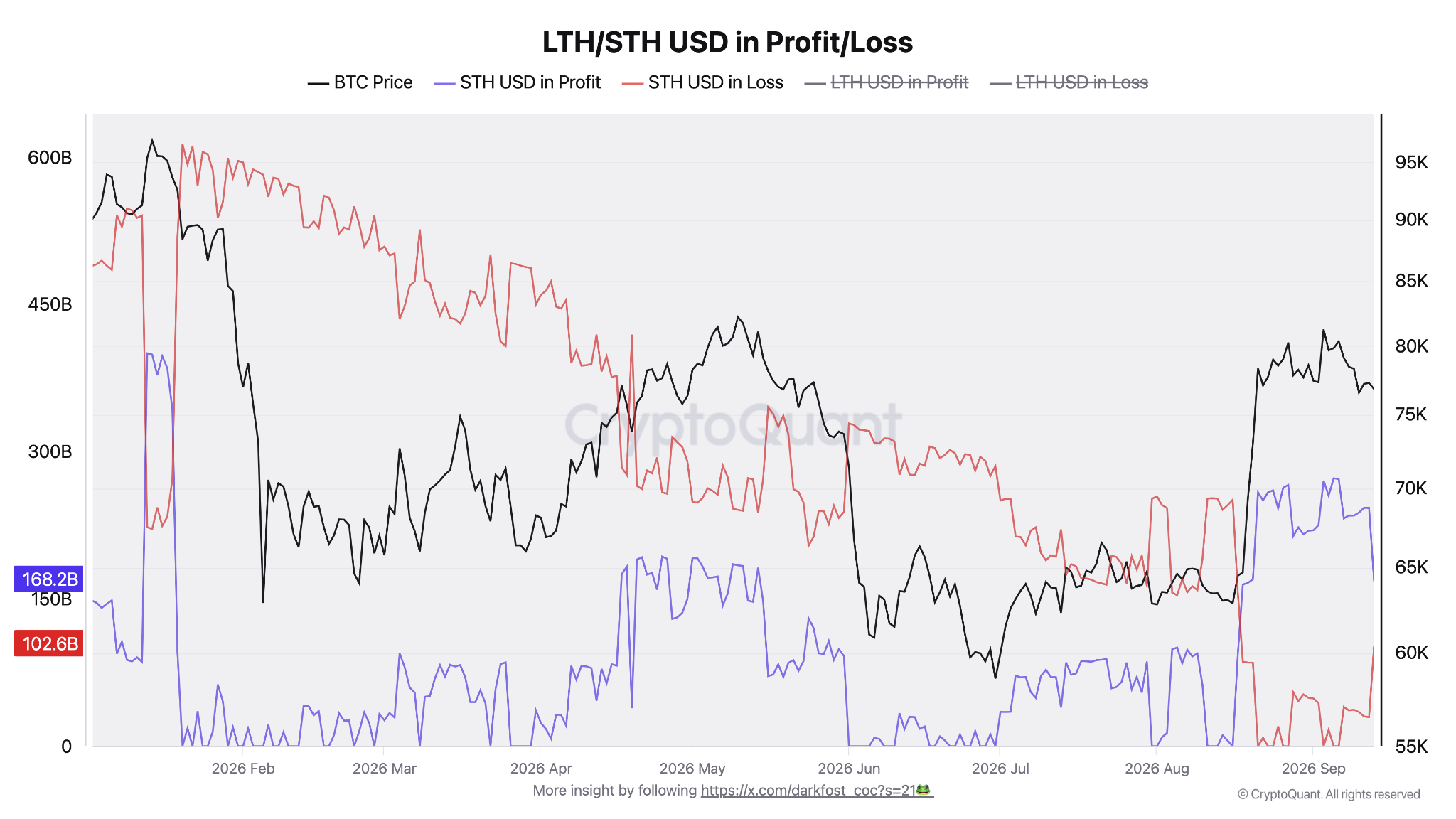
- STH profitability — a historical hallmark of bullish BTC price reversals — currently stands at $168.2 billion in profit versus $102.6 billion in loss.
- The broader Bitcoin investor base has stayed in net profit since Aug. 19.
Short-term holders boost optimism over BTC price comeback
Data from onchain analytics platform CryptoQuant shows that a subset of Bitcoin’s short-term holder (STH) cohort has been in profit since Aug. 16.
STH investors are wallets holding an unspent transaction output (UTXO) for less than six months. They correspond to newer buyers who are more sensitive to short-term price moves and volatility, adding or reducing exposure more readily than seasoned Bitcoin holders.
Since Aug. 16, the STH investor base has been split in terms of profits on their existing exposure. STH coins held in profit total $168.2 billion as of Tuesday, while $102.6 billion are held below acquisition price.
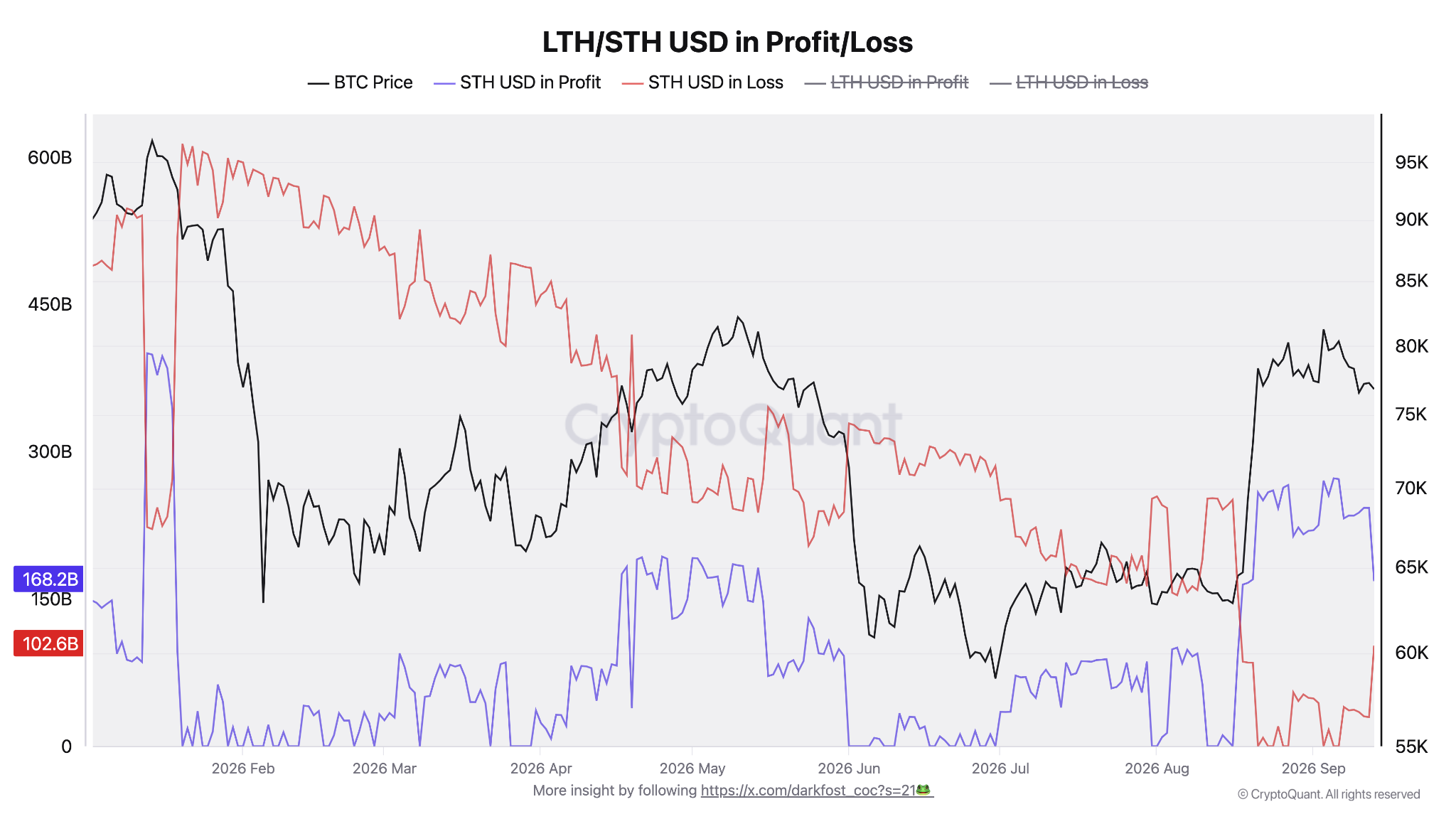
Bitcoin STH holdings in profit and loss. Source: CryptoQuant
To CryptoQuant, however, the ratio is less important than the fact that STHs have held onto at least some profit for 30 consecutive days.
“This is the first time STH have sat in profit territory for a sustained stretch since the market top. The last time was in January, but that episode didn’t last more than a week. In May, losses held by STH remained dominant,” it wrote in an accompanying blog post.
The phenomenon of lengthening uninterrupted periods of STH profitability is one that has characterized Bitcoin market recoveries throughout BTC price cycles. It was also observed at the end of Bitcoin’s 2022 bear market. CryptoQuant thus sees it as a prerequisite for the return of a long-term BTC price uptrend this cycle.
“The bear market trend only truly reverses once profits settle in for good STH and then push them to hold their positions and ride the upside,” it added.
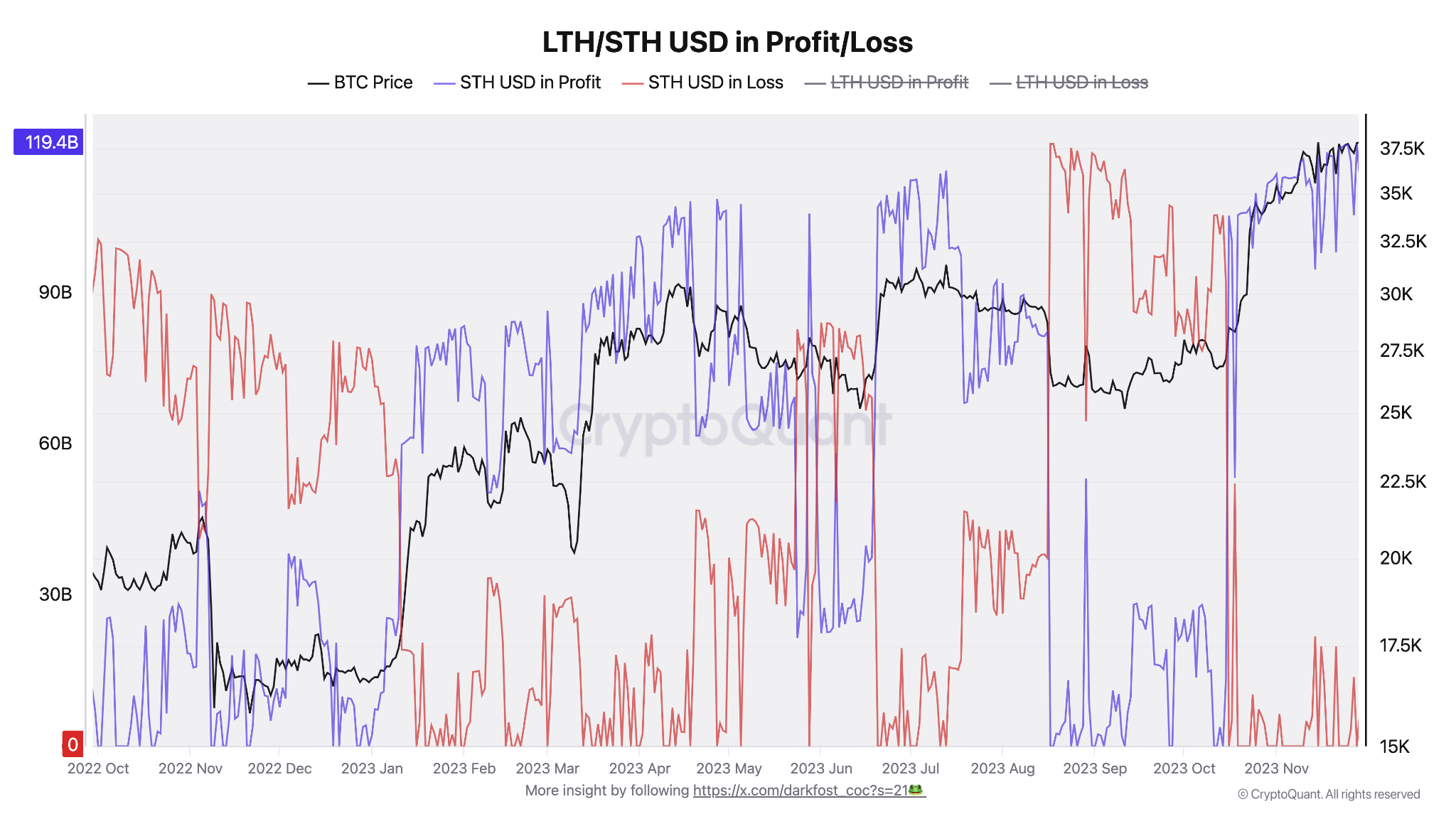
Bitcoin STH holdings in profit and loss through year-end 2023. Source: CryptoQuant
Newer investor cost bases cluster above $70,000
The data echoes a similar stint of aggregate profitability currently being witnessed across the Bitcoin investor base as BTC/USD retains the majority of its 25% August upside.
Related: CLARITY Act vote meets Fed rate hike: Five things to know in Bitcoin this week
As Cointelegraph reported, the spent output profit ratio (SOPR), which tracks net profits or losses across all investors, passed its breakeven level of 1 on Aug. 19 and has narrowly held above it since. Last week, onchain analytics suite Checkonchain argued that STH profitability in particular was “starting to look more like those early bull-market recoveries.”
STH profitability is currently being driven by entities holding between one and three months, CryptoQuant data shows, with that cohort having a cost basis (also known as realized price) at $63,372. The cost basis of the more mature end of the STH base — wallets holding for between three and six months — now sits at $73,190.
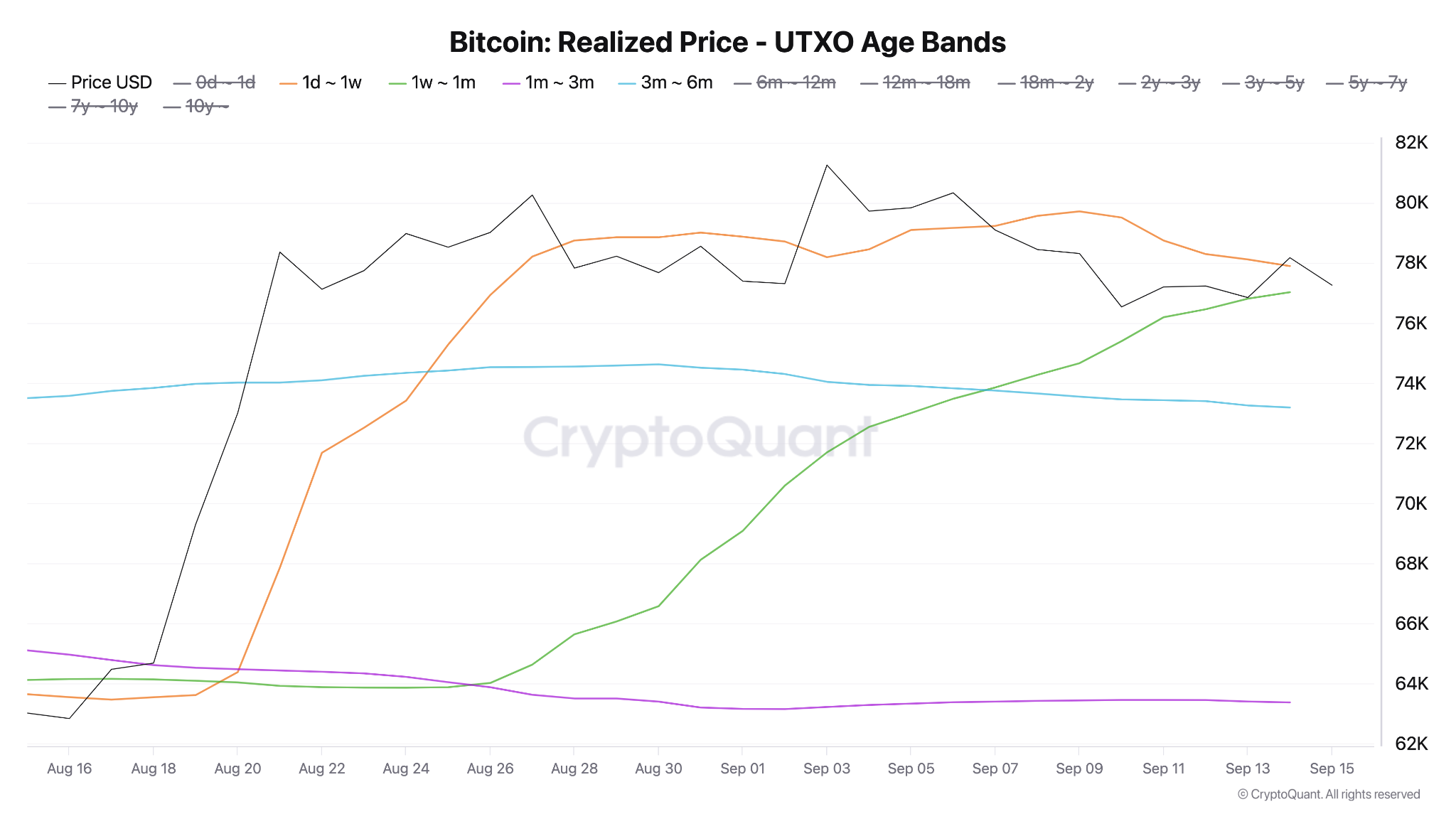
Bitcoin realized price by wallet age. Source: CryptoQuant


Fin.com has raised $20 million in seed funding as the New York payments startup expands infrastructure for moving stablecoins into local bank accounts and digital wallets.
Summary
- Fin.com raised $20 million in seed funding led by Expa and Uber cofounder Garrett Camp.
- Coinbase Ventures, Tenet Fund, Figure founders and several other investors participated in the financing round.
- Fin.com targets South Asia, Africa and the Middle East with stablecoin-based cross-border payment infrastructure services.
- The company says its platform supports 40-plus currencies and payouts across more than 30 countries.
- Stablecoin market capitalization stands near $305 billion, according to current DeFiLlama data tracked globally today.
Fortune reported on Sept. 15 that the financing closed in August and was led by Expa and Uber cofounder Garrett Camp, with Coinbase Ventures, Tenet Fund, founders of Figure, Mesh founder Bam Azizi, Second Sight Ventures and investors linked to sovereign and royal family offices in the Gulf and Africa participating. Fin.com did not disclose its valuation.
Founded by Nabeel Alamgir and Mustafa Dar, the company is building white-label payment infrastructure that lets businesses collect, convert and distribute money using a mixture of stablecoins and local banking rails. Its focus includes South Asia, Africa and the Middle East, regions the founders identified as central to the company’s expansion strategy.
Fin.com funding targets the stablecoin-to-fiat gap
Fin.com’s product focuses on a point in cross-border payments where blockchain settlement still depends on conventional financial systems: delivering digital dollars as spendable local currency. Alamgir described the company’s objective as solving the “last mile delivery problem,” referring to the process of moving funds from stablecoin rails into bank accounts and wallets.
Through one API, Fin.com says businesses can accept bank transfers, international wires and stablecoins while sending payouts to bank accounts, mobile wallets and local payment networks. Its current platform lists support for more than 40 currencies and payouts across over 30 countries, with USDC and USDT available as settlement assets.
The service supports local methods including ACH, SEPA, Faster Payments, PIX and UPI. On the payout side, Fin.com lists mobile-money services such as M-Pesa, GCash and Airtel Money among the available routes. The company says its routing technology selects payment paths based on factors such as speed, cost and availability.
Fin.com claims most transfers can settle in under 60 minutes, compared with the two-to-five-business-day window it assigns to conventional cross-border banking. The performance figures are company claims and will vary by corridor, banking partner, currency and compliance requirements.
Expa backed Fin.com after working with its founders
Fin.com’s relationship with Expa developed before the seed announcement. Dar joined Expa as an investor in 2023 after stepping away from private aviation company 24/7 Jet, while Alamgir previously founded restaurant technology company Lunchbox. The pair began working on Fin.com after reconnecting in late 2025.
Expa now lists Fin.com among its portfolio companies and describes the startup as an operating system for cross-border payments. The venture firm says the platform combines local payment networks with stablecoins for settlement through a single API. Expa identifies Alamgir and Dar as the founders and places the company in New York City.
Fortune reported that Expa founding partner Vitor Lourenço joined the investment after Dar moved from prospective investor to company cofounder. Garrett Camp, who founded Expa and co-founded Uber, participated in the seed financing.
Other investors bring direct exposure to crypto infrastructure and payments. Coinbase Ventures was the most active crypto-focused venture investor during the first half of 2026, completing 30 investments, according to data previously covered by crypto.news. Payments, DeFi and AI ranked among the main areas attracting its capital.
Fin.com focuses on emerging-market payment corridors
Fin.com has identified South Asia, Africa and the Middle East as priority regions. Besides New York, Fortune reported that the company has operations or offices in Las Vegas, Dubai, Dhaka, Bangalore and Lahore.
Its website gives several examples of how those corridors can work. For South Asian payments, Fin.com says it supplies infrastructure supporting local-currency accounts and stablecoin settlement for users receiving Indian rupees, Philippine pesos and Pakistani rupees. The examples are company case studies and should not be treated as independently audited transaction data.
For African routes, the company says its infrastructure can connect USDC settlement with local currencies including Nigerian naira and Kenyan shillings. Fin.com positions stablecoins as the middle settlement layer while recipients receive local money through banking or mobile-payment networks.
Its crypto service supports BTC, ETH, USDC and USDT, with options for automatic conversion into fiat and payouts to external wallets. Fin.com says it performs wallet screening, transaction monitoring and Travel Rule processing on covered transfers. Crypto payment documentation lists exchanges including Crypto.com and Kraken among supported payment channels.
The company’s legal structure remains relevant as it expands. Fin Inc. is a Delaware holding company, while regulated activities run through separate entities and payment partners. Current legal disclosures state that Wind Technologies holds a Dubai Financial Services Authority Innovation Testing Licence, which is limited to approved testing conditions.
Fin.com’s licensing page says the UAE authorization is not unrestricted permission for full-scale financial activity and notes that some standard protections may not apply during the testing phase. It states that financial transactions under the relevant entity cannot begin until an approved client-money account is in place.
Stablecoin payment infrastructure keeps drawing capital
Fin.com enters a market where venture firms have continued financing companies connecting stablecoins with bank accounts and local payment networks.
TransFi raised $19.2 million in March to expand stablecoin payment infrastructure across South Asia, Southeast Asia, Africa, the Middle East and Latin America. Its financing combined $14.2 million of Series A equity with a $5 million liquidity facility.
In June, El Dorado secured a $9 million Series A led by Paradigm, with Coinbase Ventures participating. The company said it was expanding stablecoin-powered payments across Latin America after processing more than five million transactions.
More recently, crypto.news reported that stablecoin payments startup Latitude raised $35 million in a Series A during the week ended Sept. 11, placing stablecoin cross-border payment infrastructure among the larger crypto venture deals announced immediately before Fin.com’s funding.
Current DeFiLlama data puts the total stablecoin market capitalization near $305 billion, with Tether’s USDT accounting for roughly 60.1% of supply and USDC remaining the second-largest stablecoin.
Fin.com said its business customers collectively serve more than 800 million end users, although it declined to identify those clients in Fortune’s report. The company plans to use the seed capital to continue building its cross-border network and payment infrastructure across the markets it has selected for expansion.


Once a household name in the DeFi sector, decentralized exchange Balancer is considering calling it quits.
In a proposal posted to the project’s governance forum, Balancer Labs CEO Marcus Hardt suggests a “phased sunset of the protocol.”
The post explains that none of the efforts to return to profitability, employed in response to last year’s hack, “converted into sustained revenue growth.”
Under Hardt’s proposal, Balancer’s $9 million treasury would be distributed to BAL holders, pro-rata.
Read more: Balancer exploit drains $129M in DeFi disaster
The problem
Launched just in time for 2020’s “DeFi summer,” Balancer innovated on the existing two-asset automated market maker model used by Uniswap and Bancor to introduce multi-asset pools and custom pool weighting.
It was a successful project in itself and was widely ‘forked,’ its popular v2 code has been used in 27 protocols across multiple blockchains, according to DeFiLlama data. Balancer’s total value-locked (TVL) peaked in November 2021 at over $3 billion, and now stands at just $58 million.
Then on its third iteration, Balancer’s v3 protocol was hit by a devastating exploit in November last year, with losses totalling almost $130 million and causing a ripple effect across the sector.
Both before and since, the project experienced a handful of smaller security incidents. The latest came just last month, when its original v1 codebase was exploited for over $200,000.
Read more: Osmosis took 74 days to discover 40-BTC Nomic exploit
Previously, in September 2023, Balancer lost approximately $1.2 million from “Boosted Pools” across its Ethereum and Optimism deployments. DeFiLlama’s database includes incidents from 2023 and 2020, totalling a further $1.3 million in losses.
The proposal
Hardt proposes an “orderly wind down,” which would include stripping back the DAO as much as possible and distributing treasury funds to BAL holders.
The wind down would see all pools moved to withdrawal-only mode on October 30, and the fate of DAO-owned assets beyond the treasury would be subject to a further vote.
The proposal brings forward a pending review of the recovery plan’s success, as Hardt feels that “waiting for the calendar would change the numbers, not the conclusion, and every month of waiting is spent from the treasury.”
He further detailed his reasoning in a post on X. The cost-reduction side of the recovery plan was a success, he claims, but protocol revenue failed to grow.
He “underestimated how much the exploit would continue to limit adoption,” which led to smaller sums deployed and hesitation from counterparties.
He also paid tribute to the Balancer team who kept v3 “safe,” “usable” and “alive,” during the “hardest year the protocol has had,” all as “smaller team and with less money.”
Shutdown season
Balancer’s decision comes as many other well-known DeFi projects opt to close down, or take a substantial pivot.
Last week, Harmony announced it would shut down its blockchain in response to “threats posed by state actors and AI agents.” It will move operations to Ethereum and plans a pivot to become “the remix economy for AI video.”
Popular DEX aggregator Odos Protocol shut down in July and beleaguered “real-world asset” lending platform Goldfinch threw in the towel the month prior.
Outside of DeFi, centralized exchange AscendEx announced its cessation of operations in early July, amidst concerns over liquidity to process pending user withdrawals.
Just hours ago, CoinEx gave its users a three-month deadline to withdraw assets, warning it would charge a 5% monthly custody fee from December 22.
Got a tip? Send us an email securely via Protos Leaks. For more informed news and investigations, follow us on X, Bluesky, and Google News, or subscribe to our YouTube channel.

Bitget, one of the world’s largest Universal Exchanges (UEX), has expanded its Open API infrastructure to support Contracts for Difference (CFDs), giving quantitative, algorithmic, and API traders programmatic access to global markets including gold, forex, stock indices, and crude oil alongside crypto.
The expansion addresses a practical challenge for multi-asset traders, where strategies operating across crypto and traditional markets often rely on separate systems, data flows and execution workflows. Existing Bitget API users can now extend their strategy frameworks into CFD markets without building a separate connection for those assets, bringing more of their research, monitoring and execution into the same API environment.
Through the CFD Open API, users can automate order execution, access account and real-time market data, transfer funds, and manage trading parameters including take-profit and stop-loss settings. This enables API users to manage programmatic strategies across crypto and CFD markets through Bitget’s broader trading infrastructure.
“Adding more markets is only one part of building UEX. Traders also need the infrastructure to interact with those markets in the way they already work,” said Gracy Chen, CEO of Bitget. “Multi-asset trading is about giving traders the tools to interact with those markets in the way that works for them. By extending API access to CFDs, we are enabling developers, quantitative traders, and other API users to incorporate global markets into the systems and strategies they already use.”
CFD Open API supports multiple CFD account modes. When placing orders, users are required to use the instrument code corresponding to their current CFD account configuration.
The API expansion comes as Bitget increases its investment in infrastructure for professional and institutional trading, as the platform continues to broaden access beyond crypto.
By extending API connectivity alongside its growing multi-asset offering, Bitget is building an ecosystem where users can access and manage crypto and traditional-market exposure through a more unified trading experience.
For more information, visit Bitget’s CFD Open API documentation here.
About Bitget
Bitget is a Universal Exchange (UEX), serving over 125 million users and offering access to over 2M crypto tokens, 500+ tokenized stocks, ETFs, commodities, FX, and precious metals such as gold. The ecosystem is committed to helping users trade smarter with its AI agent, which co-pilots trade execution.
Bitget is driving crypto adoption through strategic partnerships such as MotoGP™. Aligned with its global impact strategy, Bitget has joined hands with UNICEF to support blockchain education for 1.1 million people by 2027. Bitget is currently expanding in the tokenized TradFi market, providing some of the industry’s lowest fees and highest liquidity across 150 regions worldwide.
For more information, visit: Website | X | Telegram | LinkedIn | Discord
Risk Warning: Digital asset prices are subject to fluctuation and may experience significant volatility. Investors are advised to only allocate funds they can afford to lose. The value of any investment may be impacted, and there is a possibility that financial objectives may not be met, nor the principal investment recovered. Independent financial advice should always be sought, and personal financial experience and standing carefully considered. Past performance is not a reliable indicator of future results. Bitget accepts no liability for any potential losses incurred. Nothing contained herein should be construed as financial advice. For further information, please refer to our Terms of Use.
The post Bitget Expands Open API to Global CFD Markets appeared first on BeInCrypto.

The controversial crypto project has unveiled multiple updates over the past few weeks, yet the price of the native token has failed to capitalize on these developments significantly, though it’s still in the green monthly.
A major development scheduled for today (September 15) may finally benefit PI’s valuation, yet a delay is also possible.
Big Day for Pioneers or Another Disappointment?
The Core Team started the long process of protocol updates at the beginning of 2026. First, it implemented version 19.6, followed by many others, including v20.2, which laid the foundation for smart contract capabilities.
During the summer, it introduced versions 25 and 26, which actually surpassed their initial deadlines. Now all eyes are on v27, which is supposed to add more flexible and secure smart-contract authentication, giving accounts and apps better ways to authorize transactions. It will be the last update on that list and should be deployed later today (September 15).
Pioneers and community members have shared their enthusiasm for the upcoming development. X user drealFx, for instance, claimed the date is one of those “Pi watchers will remember.”
“Whatever happens after the upgrade, the real test begins when developers start turning the infrastructure into products people actually use,” they added.
Of course, a delay is also plausible because, as we mentioned above, Pi Network’s team has the habit of postponing important upgrades.
Other Dates to Monitor
Besides the protocol v27, set for today, the Pi Network community has also shifted its focus to September 24 and October 7-8. Some X users, including sunday peter, suggested that the project may unveil an announcement this month.
“The community is speculating because the Pi Core Team sometimes drops updates mid-month. No confirmation from Pi News or the Core Team so far. Treat it as rumor until they post,” they explained.
Meanwhile, rumors are circulating that Pi Network may have some form of presence at the crypto conference TOKEN2049 in Singapore, scheduled for October 7-8. Again, this is far from guaranteed and is likely speculation, given that the project served as a Gold Sponsor of the event last year.
PI Price Outlook
The project’s native token has posted an 11% monthly increase, following the broader crypto market’s resurgence during that period. Nonetheless, it remains 97% down from its all-time high of around $3 and currently trades at roughly $0.09 (according to CoinGecko).
Some analysts believe a further rebound could be in the cards. X user Crypto With Gopal claimed that the price is compressing between support and descending resistance, with volatility tightening and setting the stage for a decisive move.
“A breakout above the $0.096-$0.098 zone could push toward $0.103, while a breakdown risks the lower target near $0.086. Bullish bias — watching for the breakout,” he added.
Meanwhile, certain industry participants have floated the idea that Pi Network is about to introduce a burning mechanism that could positively impact PI’s price. However, the X account BSCN and others have rejected the development.
The post Important Pi Network News and PI Price Update: September 15 appeared first on CryptoPotato.


Poland has been drawn into a $378 million criminal case over failed Venezuelan oil contracts after new reporting traced part of a $230 million payment through USDT.
Summary
- Poland’s Orlen faces a $378 million criminal case over three failed Venezuelan crude oil contracts.
- OTS sent $330 million through Dubai intermediaries while contracted Venezuelan crude largely never arrived thereafter.
- Financial Times reporting says much of Hannon’s $230 million payment was converted into USDT afterward.
- Three former Orlen managers were indicted in August and could face 25 years imprisonment each.
- Former OTS chief Samer remains subject to Poland’s extradition request from the United Arab Emirates.
The FT reported on Sept. 15 that Orlen Trading Switzerland, the Swiss trading arm of Poland’s state-controlled energy group Orlen, agreed in late 2023 to purchase roughly six million barrels of Venezuelan Merey 16 crude in a transaction valued near $345 million. OTS advanced approximately $230 million through Dubai-based Hannon International, with much of the money reportedly converted into Tether’s USDT as brokers attempted to arrange payment inside Venezuela.
Polish authorities are examining a larger set of transactions. Warsaw prosecutors indicted three former managers on Aug. 7 over three oil contracts signed between August and December 2023, alleging their decisions caused $378 million, or around PLN 1.5 billion, in damage to Orlen and OTS. The defendants could face sentences of up to 25 years if convicted.
Poland’s oil deal sent $330 million through Dubai firms
The Venezuelan trade involved more than the $230 million payment now linked to Hannon. Reuters reported in 2024 that OTS sent a combined $330 million to two Dubai-based intermediaries, with Hannon receiving approximately $230 million and Horizon Global receiving another $100 million.
Venezuela’s state oil producer PDVSA did not receive the expected money, according to the Reuters investigation. Sources familiar with the transactions said the producer therefore did not allocate the crude cargoes that OTS expected to collect. Tankers chartered for the trade spent time waiting near Venezuela before leaving without the planned shipments.
The FT’s later investigation provided new detail on the $230 million Hannon leg. Its reporting said much of the payment was “largely transferred as Tether (USDT)” through a series of intermediaries. The report described traders moving information needed to conduct digital-asset transactions while attempting to complete payments to Venezuelan brokers.
The available reporting does not establish that cryptocurrency itself caused the commercial loss. Investigators are examining the contracts, counterparties, supervision and flow of funds, while the criminal charges concern alleged failures by executives to protect Orlen’s assets when the agreements were approved.
OTS ultimately received only a limited amount of petroleum product from the planned Venezuelan purchase, according to the FT. The bulk of the six million barrels covered by the contract did not arrive, while chartered tankers generated extra costs as they waited for cargo.
USDT became part of Venezuela’s oil payment system
The use of USDT in the Orlen transaction came during a period when Venezuela was increasing its use of cryptocurrency in oil sales.
As crypto.news previously reported, PDVSA began moving more crude and fuel transactions toward USDT as U.S. sanctions complicated access to conventional banking channels. Venezuelan oil officials said at the time that contracts could use different currencies and that cryptocurrency could be preferred in certain transactions.
Reuters had reported in April 2024 that PDVSA was gradually moving oil transactions toward Tether and had begun requiring some new customers to hold cryptocurrency in digital wallets. Sources told the publication that the company was requesting 50% prepayment in USDT for some spot cargoes as U.S. restrictions returned.
For trading firms, such structures could involve additional intermediaries because some established financial institutions would not process the payment routes required by PDVSA. The reported use of intermediaries does not by itself establish illegal conduct, and each transaction remains subject to its own sanctions, compliance and contractual circumstances.
Venezuela’s reliance on USDT has continued expanding outside oil transactions. Binance’s Venezuelan peer-to-peer market processed an estimated 1.389 billion USDT between June 11 and July 13, 2026, based on data from Ecoanalítica. The estimate concerns domestic P2P activity and is unrelated to the Orlen criminal proceedings.
Poland’s prosecutors put alleged damage at $378 million
Poland’s official loss figure is lower than some recent estimates of the total cost of the affair.
The Aug. 7 indictment states that three unfavorable crude contracts caused $378 million in alleged damage, equivalent to approximately PLN 1.5 billion. Prosecutors charged former Orlen board member Michał R., former OTS board member Marcin O., and former Orlen and OTS executive Filip W.
According to the filing, prosecutors allege the men acted jointly by failing to carry out supervisory duties and protect the interests of Orlen and its subsidiaries. The charges remain allegations and have not been proven in court. One defendant faces a separate accusation related to allegedly concealing assets from potential seizure.
The Polish Internal Security Agency, or ABW, said investigators carried out searches, questioned witnesses, reviewed documents and secured assets belonging to suspects during the investigation. The agency confirmed that the indictment concerns contracts entered into between August and December 2023.
The often-cited figure of roughly $424 million refers to a wider estimate. The FT calculated a higher overall cost after taking into account expenses beyond the alleged contract losses, including shipping and legal costs. Polish prosecutors have not adopted $424 million as the damage figure in the criminal indictment.
The distinction is important for reporting the case accurately: $378 million is the loss alleged by prosecutors, while approximately $424 million is a broader estimate that includes related costs.
Former OTS chief remains in separate extradition case
The criminal proceedings against the three indicted former managers do not cover former OTS chief Samer A., whose case remains separate.
Poland’s National Prosecutor’s Office said Samer was detained in the United Arab Emirates in January 2025 after authorities sought him through an Interpol Red Notice. The proceedings against him concern the same group of contracts that prosecutors say caused hundreds of millions of dollars in losses.
The August indictment confirms that Polish authorities are still seeking his extradition from the UAE. Prosecutors separated his case from the proceedings against the other three defendants because the extradition process had not been completed.
The ABW said its investigation into Samer remains active even though the other three defendants have now been sent for trial.
Polish investigators initially placed the suspected losses connected to Samer and other executives at approximately $370 million before refining the figure to $378 million in later proceedings. The current indictment uses the $378 million figure for the three contracts covered by the case.
The defendants indicted in August could each face up to 25 years in prison under the charges filed by the Warsaw Regional Prosecutor’s Office. Samer’s case will proceed separately if the UAE extradition process results in his return to Poland.
The proposed acquisition would use cash flow from precious metals sales to build bitcoin holdings.


Ethereum and Base are set to implement different account abstraction standards after efforts to agree on a shared account abstraction standard broke down last week.
Interoperability standards became secondary to each chain’s core goals, leading both to go their separate ways and “putting the burden on wallets,” Derek Chiang, founding member and researcher at Ethlabs, as well as a co-author of Ethereum’s EIP-8141 proposal, said in a Monday X post.
The divergence could require wallet developers to support separate transaction formats to provide a consistent experience across networks. Account abstraction allows programmable rules for authorizing transactions and paying fees.
Ethereum is now advancing Frame Transactions under EIP-8141 as a “headliner” item under its Hegotá upgrade, which would introduce native account abstraction and create a path toward post-quantum authentication. Separately, Base is developing native account abstraction via Keystore under EIP-8130, currently live on devnet.
The divergence also highlights different priorities between layer-1 and layer-2 blockchain networks. Chiang said L1s are increasingly focused on censorship, capture-resistance, open-source, privacy and security features, favoring different account standards, while scalability-focused L2s are more aligned with standards such as EIP-8130.
The researcher argued that the separation won’t necessarily result in a bad outcome, as both Ethereum and Base are now “free to innovate on AA to the maximal extent in accordance with their own visions.”
Ethereum developers could begin implementing Hegotá in late 2026 following Glamsterdam, arguably one of the most consequential upgrades of the year. Glamsterdam is designed to improve scalability, harden the L1, and make the network easier to use, with a mainnet launch expected sometime in the second half of 2026, according to Ethereum’s public roadmap.
Related: Standard Chartered forecasts SKY rising fivefold to $0.325 by 2028

Gate announced that, starting from September 16, it will partner with Circle for a full integration of Arc blockchain across core Web3 use cases, including Gate Trenches, Gate Wallet, and on-chain market data, providing users with one-stop services spanning asset discovery, wallet management, market tracking, on-chain trading, and cross-chain interactions. The integration further expands Gate’s multi-chain ecosystem, enabling users to more conveniently explore popular assets and emerging projects on Arc.
For new asset discovery and trading, Gate Trenches will also integrate Arc, supporting the discovery and trading of Arc ecosystem launch platforms and related assets. Users can quickly identify popular and newly issued tokens on Arc and participate in related on-chain trading, significantly shortening the path from asset discovery to trading.
At the same time, Gate Trenches will offer exclusive 0-Gas trading, eliminating gas fees to lower on-chain costs. By bridging asset discovery and trading, Gate Trenches will deliver a more efficient Arc new asset trading experience for users.
Gate Web3 will provide comprehensive support for Arc across core capabilities, including wallets, swaps, trading, market data, and ecosystem exploration. Users can manage Arc assets directly through Gate Wallet, including viewing, sending, and receiving native coins and contract tokens, checking transaction history, and connecting to DApps for on-chain interactions. Additionally, Gate Web3 will support market and limit trading on Arc, along with Pro Trading and Quick Trading, providing users with a more comprehensive on-chain trading experience.
In terms of on-chain trading infrastructure, Gate Web3 has completed the integration and compatibility with major Web3 protocols in the Arc ecosystem, including Uniswap V2, V3, and V4, providing Arc assets with more diverse liquidity sources. At the same time, Gate will continue to enhance trading and liquidity support on Arc to improve users’ trading experience and execution efficiency.
The full integration of Arc marks another important step in Gate’s ongoing enhancement of its multi-chain Web3 infrastructure. As emerging blockchain ecosystems continue to develop, user demand for popular asset discovery, on-chain trading, and cross-chain interactions continues to grow. Going forward, Gate will continue to expand its connections with blockchain ecosystems and refine services including asset discovery, trading, and cross-chain interactions, providing global users with a richer and smoother on-chain experience.
How to Experience the Arc Ecosystem
Users can log in to the Gate App or the relevant Gate Web3 page to experience the functions on the Arc Chain via the following path:
- Explore Arc ecosystem assets: Gate Web3 Mode – [Market Data] – [Markets] – [All Networks] – Select the Arc network
- Swap assets on Arc: Gate Web3 Mode – [Trade] – [Swap] – Select the Arc network
- Use Pro Trading: Gate Web3 Mode – [Trade] – [Pro] – Select the Arc network
- Explore popular new assets: Go to Gate [Trenches] and select the Arc network
About Gate
Gate, founded in 2013 by Dr. Han, is one of the world’s leading cryptocurrency and integrated financial services platforms. Serving over 60 million users globally, it supports trading across 5,200+ digital assets and 12,800+ stock assets, while providing access to a comprehensive range of TradFi assets, including metals, stocks, indices, forex, and commodities, delivering users a one-stop, multi-asset trading experience and blockchain-related services.
As an industry benchmark, Gate was among the first platforms to implement 100% Proof of Reserves. Its ecosystem includes Gate Wallet, Gate Ventures, Gate for AI Agent, and a wide range of products and services.
For more information, please visit: Website | X | Telegram | LinkedIn| Instagram | YouTube
Disclaimer:
This content does not constitute an offer, solicitation, or recommendation. You should always seek independent professional advice before making investment decisions. Note that Gate may restrict or prohibit certain services in specific jurisdictions. For more information, please read the User Agreement.
The post Gate Integrates Arc Support: Gate Trenches to Exclusively Support 0-Gas Trading appeared first on BeInCrypto.

Ether, solana, XRP likely to gain if Clarity Act progresses

Michael J. Fox Makes Emotional Confession At 2026 Emmys

Live Intraday Trading | Crypto Bitcoin Live | VP Financials


-
 Tech7 days ago
Memory prices are slowing because buyers ran out of money
-

 Business5 days ago
Micron Stock Climbs Above $1,031 as AI Memory Crunch and a $50 Billion Outlook Fuel the Rally
-

 Fashion4 days ago
Weekend Open Thread – Corporette.com
-

 Tech2 days ago
The Latest Weird Thing to Play Doom Is the Mapped-Out Brain of a Fruit Fly
-

 Business5 days ago
AMD Stock Climbs After Management Lifts 2027 Data Center Outlook Toward $70 Billion in AI Sales
-

 Crypto World7 days ago
Robinhood Stock: How To Take Advantage With Reduced Risk
-

 Crypto World6 days ago
Bitcoin price risks $76K drop as $78K support weakens
-

 Crypto World4 days ago
XAG/USD: Silver’s Short-Term Rally Meets Its Moment of Truth
-

 Crypto World5 days ago
2 Chip Stocks Broke Out This Week. Neither Was Nvidia
-

 Crypto World6 days ago
Ethereum price stalls below $2,500 as ADX drops to 11
-

 Business4 days ago
10 Most-Streamed Songs On Spotify In 2026 So Far, Led By Ella Langley’s Dominant Run On The Charts This Year
-

 NewsBeat7 days ago
England up in reading, maths and science rankings as Scotland and Wales dip
-

 Tech5 days ago
Battery life is the only iPhone 18 Pro and iPhone Duo upgrade I care about. Apple didn’t disappoint
-

 Crypto World5 days ago
OKX launches 10x OpenAI, Anthropic X-Perps in Europe
-

 Crypto World7 days ago
Intel Stock Jumps 9% on Chip Price Hike Report, US Stake Gains $36 Billion
-

 Crypto World4 days ago
Diesel Tops $6 a Gallon for the First Time as 28 States Set Records
-

 Tech6 days ago
Apple Watch Ultra 4 vs Watch Ultra 3: Should you really spend another $799?
-

 Crypto World5 days ago
Pi Network ships Protocol 27 on a network with 14 million users and zero DeFi
-

 News Videos4 days ago
Facing Financial Fears
-

 Crypto World7 days ago
CLARITY Act runs out of calendar as crypto regulation stalls
You must be logged in to post a comment Login