Three babies murdered by Lucy Letby could have been saved if NHS managers had called in police sooner, a public inquiry found today.
Lady Justice Thirlwall, who oversaw the hearings into the former neo-natal nurse’s crimes, said there had been a ‘complete failure’ to protect babies at the Countess of Chester Hospital.
She said managers and senior nurses never accepted consultants’ suspicions about Letby could be true – and ‘dysfunctional’ leadership from the senior executives led to a ‘prolonged delay’ in contacting police.
It was also ‘disgraceful’ that families of the babies were kept in the dark for years about fears children were being deliberately harmed and the lack of consideration shown to them was ‘reprehensible’, the senior Appeal Court judge said.
Instead of alerting the police, bosses prioritised the reputation of the hospital over the babies’ safety and commissioned external investigations which failed to discover why they were dying.
Relationships between the consultants raising concerns and executives ‘disintegrated,’ the judge said.
Instead of being treated as whistleblowers, hospital chiefs tried to ‘manage’ the doctors out of their jobs and threatened them with referrals to their professional regulator, the General Medical Council, when they continued to raise concerns and demand police be called in.
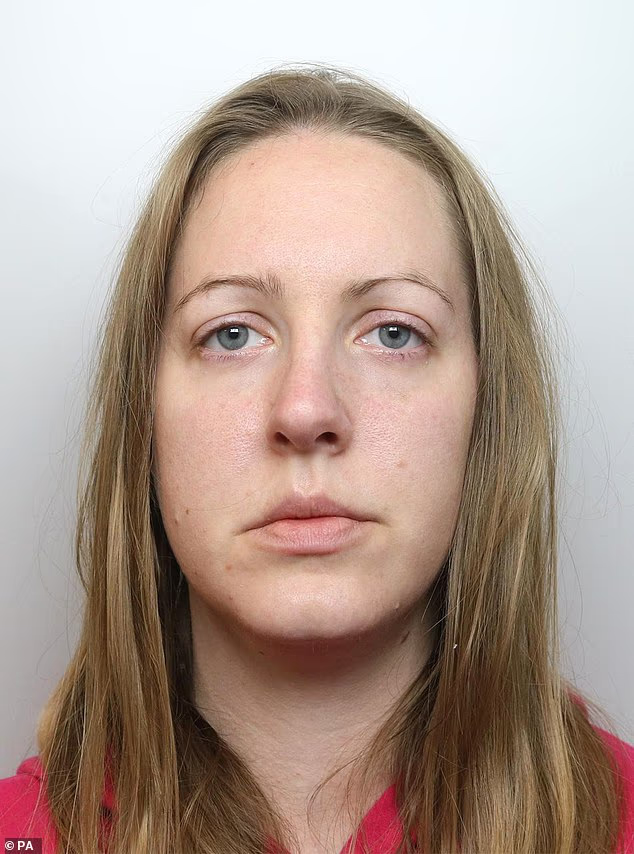
Letby, 36, is serving 15 whole-life sentences after being convicted of murdering seven infants and attempting to murder seven more, one of whom she attacked twice, between June 2015 and June 2016.
Letby was initially found guilty of murdering seven infants and attempting to murder seven more following a ten-month trial at Manchester Crown Court
Lady Justice Thirlwall pictured arriving at Liverpool Town Hall where she delivered her public inquiry report today
Chief executive of the Countess of Chester Hospital, Tony Chambers, is pictured with Camilla, the then Duchess of Cornwall, during a visit in 2014
Alison Kelly, the former director of nursing at the Chester hospital, arrives at the Thirlwall Inquiry at Liverpool Town Hall last year
The Countess’s former medical director Ian Harvey also evidence at the inquiry
Lady Justice Thirlwall said up to three children – two triplet brothers, known as Baby O and P, and a baby girl, known as Baby I, would have lived had hospital bosses not failed to implement proper safeguarding measures.
She agreed with lawyers for the families that an abnormal blood test, in August 2015, which showed Letby had poisoned a twin boy, known as Baby F, with insulin represented a ‘bright line’ in the timeline, after which point no harm should have been allowed to occur.
But the test was ‘disregarded’ by the consultant who reviewed it which meant Letby was allowed to continue her killing spree.
She also harmed up to seven more children – Babies G, H, J, K, L, M and N, at least one of which was left with brain damage and life-changing injuries – before being removed from the ward, in July 2016.
The failure to spot the significance of the blood test was an opportunity missed, as was an incident in February 2016, the judge said, when Dr Ravi Jayaram, a doctor who appeared on TV’s The One Show and This Morning, also failed to report his suspicions about Letby when he walked in on her ‘doing nothing’ to help a baby girl, whose breathing tube she was later convicted of dislodging.
However, Lady Justice Thirlwall also stressed that even the death of Baby A, in June 2016, would have attracted police involvement had it been reported under sudden death protocols because it was ‘unexpected.’
But no one thought the protocol applied in a hospital setting, so no officers were consulted at this stage.
‘Had the managers acted as and when they should have, the police would have been involved much sooner,’ the judge added.
The 822-page report, which followed seven months of live evidence from more than 130 live witnesses – including doctors, nurses, parents of the babies, organisations and experts – plus the examination of thousands of documents and emails, was published on Tuesday almost a year later than originally anticipated. The inquiry is estimated to have cost around £18.5million.
Letby was the face of the hospital’s fundraising drive. She murdered the babies in the hospital between June 2015 to June 2016
Dr Stephen Brearey, head of the neo-natal unit, told the inquiry a regulatory body for managers was needed
Senior paediatrician Dr Ravi Jayaram admitted he ‘should have had more courage’ and voiced his concerns about Lucy Letby
Lucy Letby killed and harmed patients at The Countess of Chester Hospital
She stressed that her report was not an ‘investigation into the criminal convictions or the guilt of Letby,’ who has already tried and failed twice to appeal her convictions.
Letby continues to maintain her innocence and the Criminal Cases Review Commission, the organisation that investigates potential miscarriages of justice, is currently reviewing a dossier of evidence submitted by her new defence team.
But Lady Justice Thirlwall said it was not her job to ‘second guess’ their findings.
She said: ‘My report describes dysfunctional management and governance; a gulf between hospital leadership and clinicians; and failure to understand the fundamentals of safeguarding.
‘There was a complete failure to protect babies on the neonatal unit at the Countess of Chester Hospital.
‘Many parents take the view that protecting the reputation of the hospital was more important to senior managers than keeping them informed about what was happening.
‘The lack of consideration shown to the parents at that time was reprehensible.’
The report makes a series of recommendations, including for all cots and incubators in all NHS neonatal units to be fitted with baby monitors to allow parents to observe their baby remotely on a livestream and to act as a ‘deterrent to those rare people who seek to harm babies.’
She also said access to insulin in hospitals must be strictly controlled with CCTV cameras installed in fridges.
And by next April, all Trusts must have in place ‘effective mechanisms for Board-level monitoring’ of all child and baby deaths, with a clear route to the hospital board for the escalation of ‘concerning data trends and patterns’, she said.
The judge said ‘no one’ at the hospital understood that they didn’t need to be sure of Letby’s guilt before they flagged her link to the spike in deaths as a safeguarding concern.
‘There was complete failure at all levels to invoke safeguarding procedures at any point,’ she said.
‘Looking for clinical or other explanations for deaths and collapses was not wrong, but once there was suspicion that Letby may be causing harm deliberately safeguarding steps should have been taken.
‘She should have been removed from the ward as a neutral act and matters could have been investigated without risk to babies. No one seems to have thought that safeguarding action is required when a member of staff is suspected of causing deliberate harm. Suspicion is enough.’
The report is critical of the senior nurses and managers, including chief executive Tony Chambers, the medical director Ian Harvey, and director of nursing, Alison Kelly.
The judge said that conflict between doctors and senior nurses, including Ms Kelly and Karen Rees, the director of nursing for urgent care, who were ‘tribal’ in their ‘unthinking loyalty’ to Letby because she was ‘one of their profession’ meant they refused to accept the consultants’ concerns which ‘distracted’ them from protecting the babies.
As the executive responsible for safeguarding, Ms Kelly should also have flagged the deaths to the hospital’s safeguarding board and the local safeguarding children board – but failed to do so.
She told the public inquiry it ‘never occurred’ to her that such baby deaths could be a safeguarding matter.
The judge said Ms Kelly ‘could not believe’ one of her nurses was causing their deaths and Mr Harvey, an orthopaedic surgeon, believed there must be a ‘clinical explanation’ – despite neither having any experience with treating premature babies.
The hospital board did not receive reports on any of the babies’ deaths, which the judge also said was a ‘serious failure of governance.’
There was also serious failure by inspectors from the Care Quality Commission, who visited the hospital in February 2016. Although the organisation had been made aware about the increased mortality, the inspection team were not given the data on the spike in deaths, so didn’t ask the relevant questions, the judge said.
By then, Eirian Powell, the head of the neo-natal unit, and Dr Stephen Brearey, the lead clinician, had drawn up a review of the baby deaths, which remained unexplained, and highlighted the link to Letby being on duty for all but one of them.
It was circulated to Ms Kelly, Mr Harvey and Ms Rees the following month, and Ms Powell asked Ms Kelly for a meeting to discuss it.
But she ‘ignored’ Ms Powell’s request for help and both she and Mr Harvey told the inquiry that the review did not raise significant concerns.
Lady Justice Thirlwall said this was a mistake and both ‘should have been worried.’
In May, Dr Brearey informed Ms Kelly that Letby had been moved from nights to day shifts, asking for a meeting before the nurse ‘who has been present for quite a few of the deaths and other arrests’ was allowed to return to nights again due to staffing pressures.
Only then, it seems, did the penny drop for Ms Kelly, who immediately emailed Ms Rees to exclaim: ‘This is potentially serious.’
But, at that meeting, on May 11, the consultants’ fears were ‘shouted down by the nurses and ignored by the executives,’ the report found.
The judge said: ‘The forceful views of the nurses and the absence of support for his concerns seems to have undermined his (Dr Brearey’s) confidence in his own views.
‘Even at this stage, he was not sure about Letby. He did not have to be sure. To take safeguarding steps, suspicion was enough. But no on was thinking of safeguarding.’
The deaths of the triplet brothers, baby O and Baby P, on consecutive shifts, in June 2016, was described by medics as ‘the tipping point.’
It prompted Dr Brearey to call Ms Rees, the executive on duty that evening, to demand Letby, who was due to work another shift the following day, be removed from the unit.
But the report found Ms Rees wrongly refused because she ‘did not accept that the doctors’ concerns were held in good faith.’
She told the inquiry she believed Dr Brearey and Letby were, or had been, in a relationship and even asked the nurse if he had ‘made a pass’ at her.
‘This was ridiculous,’ the judge said. ‘There was no evidence in support of this theory, but she believed it.’
Lady Justice Thirlwall described Ms Rees, who has since spoken out in support of Letby, saying she believes she is innocent, as ‘hostile’ and rejected her claims that Dr Brearey ‘bullied’ her during the phone conversation, saying the likelihood of that ‘was nil’.
Instead of removing Letby, she was allowed to continue working and the following day allegedly attacked another baby boy, Baby Q. The jury failed to reach a verdict on his alleged attempted murder.
The report said managers then refused to attend a meeting with the consultants and instead organised a meeting with Ms Powell and Anne Murphy, a nurse who ran the children’s ward, to devise a plan of action.
This involved Ms Powell supervising Letby and Mr Harvey commissioning an external review by the Royal College of Paediatrics and Child Health, and was presented as a ‘fait accompli’ to the consultants.
But, Lady Justice Thirlwell said: ‘To take a them and us approach where what was required were cool heads and reason was a serious failure by senior managers…No steps were taken to protect babies.’
Eventually, on June 29, the consultants met with the executive team. Earlier that day, Mr Harvey and Ms Kelly had agreed police needed to be called in, but, the judge said it was ‘striking’ that after informing chief executive Tony Chambers about the baby deaths, the decision was reversed.
‘I am satisfied that from the outset the senior managers, first Ms Kelly and Mr Harvey and, in late June 2016, Mr Chambers, dismissed the idea that Letby was deliberately harming babies,’ she said. ‘They did not believe it.’
The executives repeatedly told the inquiry that if the doctors had been so concerned they could have contacted the police themselves.
But the judge said: ‘The managers never considered whether the reason the doctors had not done so was because this was so serious that it needed to be dealt with at the most senior level of the hospital.
‘That the consultants may have doubted themselves did not occur to the managers either. The managers did not, however, doubt themselves. The difference between them and the paediatricians was stark.’
In the end Letby went on holiday and, on her return, was moved into an administrative role in the hospital’s Risk and Patient Safety Office.
As well as the RCPCH review, Mr Harvey later commissioned an independent neonatologist, Dr Jane Hawdon, to carry out a case review of each baby death and asked pathologist, Dr Jo McPartland, to look again at their post-mortems.
But the judge said he ‘drip-fed’ information to those carrying out these reviews, then ‘misled’ families of the babies about their findings.
Lady Justice Thirlwall said that after all the reviews there was still no explanation for several deaths.
‘The worry should have increased exponentially. Instead, it subsequently came to be said that Letby had been exonerated… given … nothing had changed, other than the exclusion of all the obvious non-criminal explanations, the failure to call the police at this stage is impossible to defend.’

















































You must be logged in to post a comment Login