
Crypto World
Crypto Industry Seeks US Regulatory Clarity After CLARITY Setback


US crypto policy momentum hit a wall as the Senate on Tuesday failed to advance the proposed CLARITY Act, leaving digital-asset firms to rely on agency rulemaking and shifting interpretations rather than a clear statutory framework. The procedural vote came up short of the 60 votes required to move forward—49-50 on a motion to invoke cloture.
Industry leaders described the outcome as disappointing but not necessarily final, pointing to potential regulatory action from the US Securities and Exchange Commission (SEC) and the Commodity Futures Trading Commission (CFTC). Still, lawyers and executives warn that without legislation, compliance timelines and market planning could remain exposed to ongoing administrative discretion.
Key takeaways
- The Senate voted 49-50 on a cloture motion for the CLARITY Act—short of the 60-vote threshold needed to advance the bill.
- Crypto firms are increasingly looking to SEC and CFTC rulemaking to “fill the legislative gap,” rather than expecting near-term certainty from Congress.
- Legal executives argue that agency guidance may prolong case-by-case assessments, increasing compliance burden and prolonging uncertainty for budgeting and product rollout.
- A reconsideration move by Senator Thom Tillis keeps the possibility of another cloture attempt alive, but timing uncertainty remains high.
Why the CLARITY Act’s procedural failure matters
At the center of Tuesday’s outcome was the Senate’s failure to invoke cloture, a procedural step that determines whether debate on the CLARITY Act can move forward. While the vote does not kill the bill outright, it delays the legislative path and underscores how difficult it can be to secure consensus in a divided chamber.
Industry executives said the result creates a meaningful setback—especially because the stakes are not only legal theory. A legislative framework would be expected to reduce the unpredictability of how digital assets are classified and regulated across different product types. Without it, market participants may remain dependent on regulator-by-regulator and fact-specific interpretations.
As this gap persists, the question for investors, builders, and exchanges becomes less about the promise of a future law and more about whether agencies can deliver stable, consistent rules quickly enough to support real-world planning.
Regulators as the next avenue for clarity
In the immediate aftermath, executives highlighted what they viewed as the most plausible alternative: rulemaking from the SEC and the CFTC. Ripple CEO Brad Garlinghouse said on X that continued regulatory work by both agencies could still provide the clarity firms need.
According to Garlinghouse, “the SEC, under Chair Atkins, and the CFTC, under Chair Selig, will continue to work hard to issue rules” to address the gap left by the stalled legislation. The comments align with earlier remarks from SEC Chair Paul Atkins during the Solana Policy Institute Summit on Monday, where he reaffirmed the agency’s commitment to clearer crypto rules regardless of legislative progress.
That “agency-first” approach may help address certain questions faster than Congress can. But it also changes how certainty is produced: rather than coming from a statute that applies broadly, clarity may depend on a series of rule proposals, comment periods, and final determinations—each of which can evolve over time.
Executives warn about “temporary reprieve” and case-by-case risk
Legal and compliance leaders cautioned that rejecting the bill may leave firms exposed to administrative discretion. NEAR chief legal officer Abhishek Vaidyanathan said the lack of legislation would force continued reliance on agency guidance rather than a definitive statutory framework.
In particular, Vaidyanathan argued that firms preparing budgets for 2027 would likely face another prolonged delay, pulling them back toward “case-by-case judgments and repeated legal work.” In his view, that is not just a legal inconvenience—it also affects how counterparties price risk when regulatory interpretation remains in flux.
Similarly, Bitget Wallet chief operating officer Alvin Kan told Cointelegraph that the bill’s failure maintains uncertainty about how securities, commodities, and money-transmission rules apply across different products. The practical effect is that product categories can face different compliance pathways even when they serve similar users, and the line between those categories can remain contested.
Another Senate attempt and what happens after this Congress
Despite Tuesday’s setback, the CLARITY Act discussion is not over. Senator Thom Tillis moved to reconsider the failed attempt, potentially allowing another cloture vote. That kept the door open for renewed procedural progress in the current session.
1inch chief legal officer Orest Gavryliak characterized the Tuesday result as a delay rather than a verdict, noting that legislation of this scale rarely moves in a straight line and that another cloture vote can be pursued.
Still, the odds of passage before the end of the current congressional term are far from certain. Vaidyanathan suggested that the “next Congress” may be the more likely opportunity to tackle crypto market structure, implying that legislative timing and election-driven priorities could become barriers.
He also pointed to near-term calendar constraints: the House has reportedly canceled weeks of September 21 and 28, while the Senate’s state work period begins October 5 ahead of the November 3 election. Those scheduling dynamics matter because even when support exists, floor time and procedural momentum can be difficult to sustain.
Market sentiment around the bill’s prospects also softened. Polymarket odds of the CLARITY Act being signed in 2026 fell to 5% on Tuesday, the lowest probability since the market opened in January, indicating that traders and bettors rapidly adjusted expectations following the cloture failure.
For readers trying to anticipate what changes next, the key watchpoints are whether Tillis’s reconsideration leads to another cloture vote and, in parallel, how quickly the SEC and CFTC move from commitments into concrete rule proposals and final guidance—because those will determine whether firms get durable clarity or continue to operate in a regime of shifting administrative interpretation.



Crypto traders holding long, or bullish, futures bets have taken a sharp hit over the past 24 hours after the Clarity Act failed a Senate procedural vote.
Exchanges liquidated about $571 million in long positions in that window, the highest tally since Aug. 22, according to CoinGlass. Shorts, or bearish bets, accounted for only about $100 million of the wipeout.
Bitcoin and ether longs absorbed the heaviest damage, with roughly $190 million liquidated in each. Analysts had flagged ether and DeFi tokens as the assets most likely to outperform bitcoin if the Senate voted yes. XRP longs lost about $30 million, while Solana longs lost about $22 million.
The data shows markets were positioned for continued upside, largely on hopes the Clarity Act would advance. Those hopes strengthened earlier this week after reports that President Donald Trump was willing to make concessions on the bill’s ethics provisions. The market responded: bitcoin, the largest cryptocurrency by market value, rose to nearly $80,000 from about $77,000 on Monday.

Ethereum price trades at $2,470 today, down 1.8% on the day, as the Clarity Act prediction odds fall to under 20% this week. That vote could be the catalyst that decides whether ETH reclaims $2,550 or slides back toward $2,180. There’s a third scenario nobody’s pricing in yet.
Ted Pillows notes that Ethereum has failed to secure a weekly close above $2,550, with his chart placing ETH near $2,522 against resistance at $2,546.78. Price still holds above the 50-week EMA at $2,386.63. Michaël van de Poppe’s hourly chart shows ETH rebounding from $2,448 support, while Daan Crypto Trades cautions the Clarity Act vote is only an initial legislative stage, not a done deal.
But Ethereum has gained 33.4% over 30 days despite a 46.3% annual decline, a divergence that tells its own story about cycle timing. The market is watching CPI data and Clarity Act headlines simultaneously, and Bitcoin’s price action is reacting to the same regulatory calculus.
Earn $50 and Enter $300K Prize Draw on EdgeX
Ethereum Price Prediction: Can ETH Hit $3,000 This Week?
ETH sits at $2,474, down almost 2% intraday, after printing an intraday low near $2,465 and a recovery high around $2,600. The pullback to $2,516 before easing further shows sellers are still active at resistance. Price remains above the 50-week SMA near $2,470.83, though barely, a razor-thin cushion.
The bull case happens when the Clarity Act passage triggers a reclaim of $2,550, exposing $2,800 resistance and putting the $3,000 target in play, per Pillows’ framework. The base case is a continued chop between $2,386 and $2,550 while the market digests legislative headlines in stages.

But one scenario that holders would rather not see? A renewed rejection that could send ETH toward $2,180, with deeper support near $1,965 and $1,713 if that level fails.
A weekly close above $2,546.78 would strengthen the bullish thesis considerably. For a different structural driver behind the same $3,000 target, this supply-side analysis is worth a look. For background on what’s actually in the bill, the Clarity Act draft details matter more than most traders assume.
Trade Ethereum on Bybit and Get a Chance to Win Our $1,000 USDT Airdrop
LiquidChain Targets Early Mover Upside as Ethereum Tests Key Levels
Holding ETH through this chop validates the long-term thesis, but let’s be honest, a move from $2,474 to $3,000 is just 21% upside on a $300B-plus asset. Solid, not spectacular. Capital chasing outsized returns is increasingly rotating toward earlier-stage infrastructure plays that sit beneath assets like ETH, BTC, and SOL rather than competing with them.
The Order rests. The architecture never sleeps. — LiquidChain (@getliquidchain) September 9, 2026
 ⟁https://t.co/vqvBcdSQYC pic.twitter.com/bNof4XHJ58
LiquidChain ($LIQUID) is a Layer 3 infrastructure project fusing Bitcoin, Ethereum, and Solana liquidity into a single execution environment. Its Unified Liquidity Layer and Single-Step Execution let developers deploy once and access all three ecosystems, backed by Verifiable Settlement.
The presale sits at $0.014955 per token with more than $960K raised so far.
Research LiquidChain directly before the presale closes.
Discover: The Best Token Presales
The post Ethereum Price Prediction: Today’s Clarity Act Could Send ETH Above $3,000 appeared first on Cryptonews.


Mark Zuckerberg stepped into the artificial intelligence (AI) extinction debate this week. He argued that market pressure already pushes AI labs to prioritize safety without new mandates.
The Meta (META) chief executive posted the remarks weeks after warning about superintelligence. He said the technology should empower individual users, not a handful of firms.
A Debate Zuckerberg Didn’t Start
In that August essay, he argued no single company or government should control superintelligent systems, favoring broad distribution instead.
The post arrived as Washington grapples with warnings from inside the AI industry itself. Anthropic researcher Jacob Coxon resigned this month, accusing his employer and OpenAI of rushing self-improving systems without adequate safeguards.
Coxon’s exit fueled a push to ban superintelligence outright. Senator Bernie Sanders and Representative Greg Casar lead that effort in Congress.
OpenAI safety researcher Marcus Williams separately put human extinction odds at 70% within three years. He added that the odds could fall if labs slow down or regulators intervene.
What Zuckerberg Actually Said
Zuckerberg argued that alignment, not restriction, will separate durable AI agents from failed ones. He said trust is becoming the industry’s most valuable feature.
People won’t want to use agents that are misaligned with them and that don’t do what they ask, so labs have a strong natural incentive to make their models more aligned.
Mark Zuckerberg made the remarks in a post on X.
He also pointed to Meta’s own record on safety. Meta delayed its Muse personal assistant from an initial April release date to address security concerns. Zuckerberg said Meta acted on its own, without waiting for industry-wide rules.
He also said Meta Superintelligence Labs (MSL) already uses independent evaluators to review its work. He argued rival labs could adopt similar outside review.
The Meta founder added that directing most compute to serving people, not self-improvement, keeps development safe.
Zuckerberg’s argument leaves the core disagreement unresolved. Critics want enforceable limits on self-improving AI, while Meta is betting on competition and self-interest.
Whether that balance holds may shape how Congress treats Zuckerberg’s push for speed on AI releases in the months ahead.
The post Mark Zuckerberg Joins the AI Doomsday Talk. What is He Saying? appeared first on BeInCrypto.
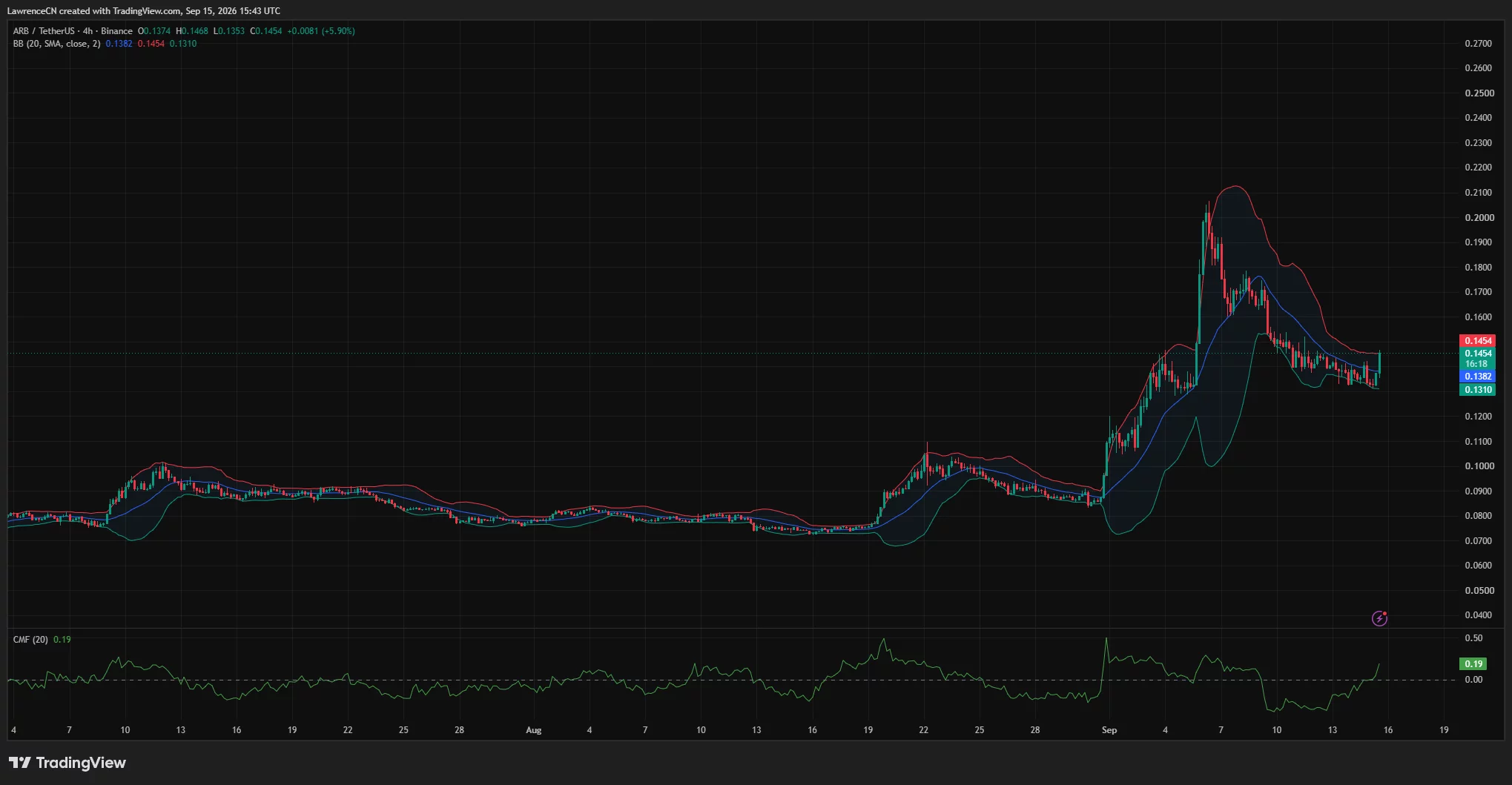
Arbitrum price rose nearly 9% on Sep. 15 as a bullish Standard Chartered forecast lifted interest in ARB, while the charts showed the token testing a dense resistance and liquidation zone near $0.155.
Summary
- Arbitrum price climbed 8.75% on the daily chart to approximately $0.145.
- Standard Chartered reportedly expects ARB to reach $10 by the end of 2030.
- Daily RSI recovered to 58.82, but MACD showed that broader momentum remained mixed.
- Liquidation data placed the largest nearby liquidity cluster between $0.154 and $0.156.
Arbitrum price rebounds toward $0.15
Standard Chartered initiated coverage of Arbitrum with a $10 price target for the end of 2030, according to a report based on comments from digital assets research head Geoff Kendrick. The forecast helped ARB recover from the support area it had tested after an earlier September rally.
Arbitrum (ARB) price traded near $0.1454 at the time of writing, up 8.75% for the daily session. The token opened at $0.1337, fell to $0.1314, and reached an intraday high of $0.1468.
The 4-hour chart recorded a 5.9% gain during the latest candle, with the price rising from $0.1374 to $0.1454. Buyers entered after ARB spent several days consolidating between approximately $0.131 and $0.145.
The rebound followed a volatile start to September. ARB climbed from below $0.09 to approximately $0.20 before sellers pushed it back toward $0.13. The daily chart still showed the token well below that monthly peak despite its latest gain.
Standard Chartered sees tokenization supporting ARB
Kendrick described Arbitrum as a potential blockchain for traditional financial institutions moving assets on-chain. The bank expects the tokenized-assets market to expand from about $340 billion to $4 trillion by the end of 2028.
Standard Chartered reportedly sees Robinhood Chain as evidence of that opportunity. The project uses Arbitrum technology, giving the network exposure to a platform focused on tokenized financial assets.
Kendrick expects Arbitrum’s monthly revenue to reach approximately $5 million in September, more than five times its level before Robinhood Chain launched. He argued that the higher revenue base could support a new valuation for ARB.
The bank set year-end targets of $0.50 for 2026, $1.50 for 2027, $3.50 for 2028, $6.50 for 2029, and $10 for 2030. Each level remains a Standard Chartered projection rather than a guaranteed price path.
A move from $0.1454 to $10 would require a gain of about 6,780%. ARB would also need to recover above several previous support and resistance areas left by its longer-term decline.
ARB faces resistance near $0.155
The 4-hour Bollinger Bands showed ARB reaching the upper band near $0.1454. Price also moved above the indicator’s middle line at $0.1382, while the lower band stood near $0.1310.
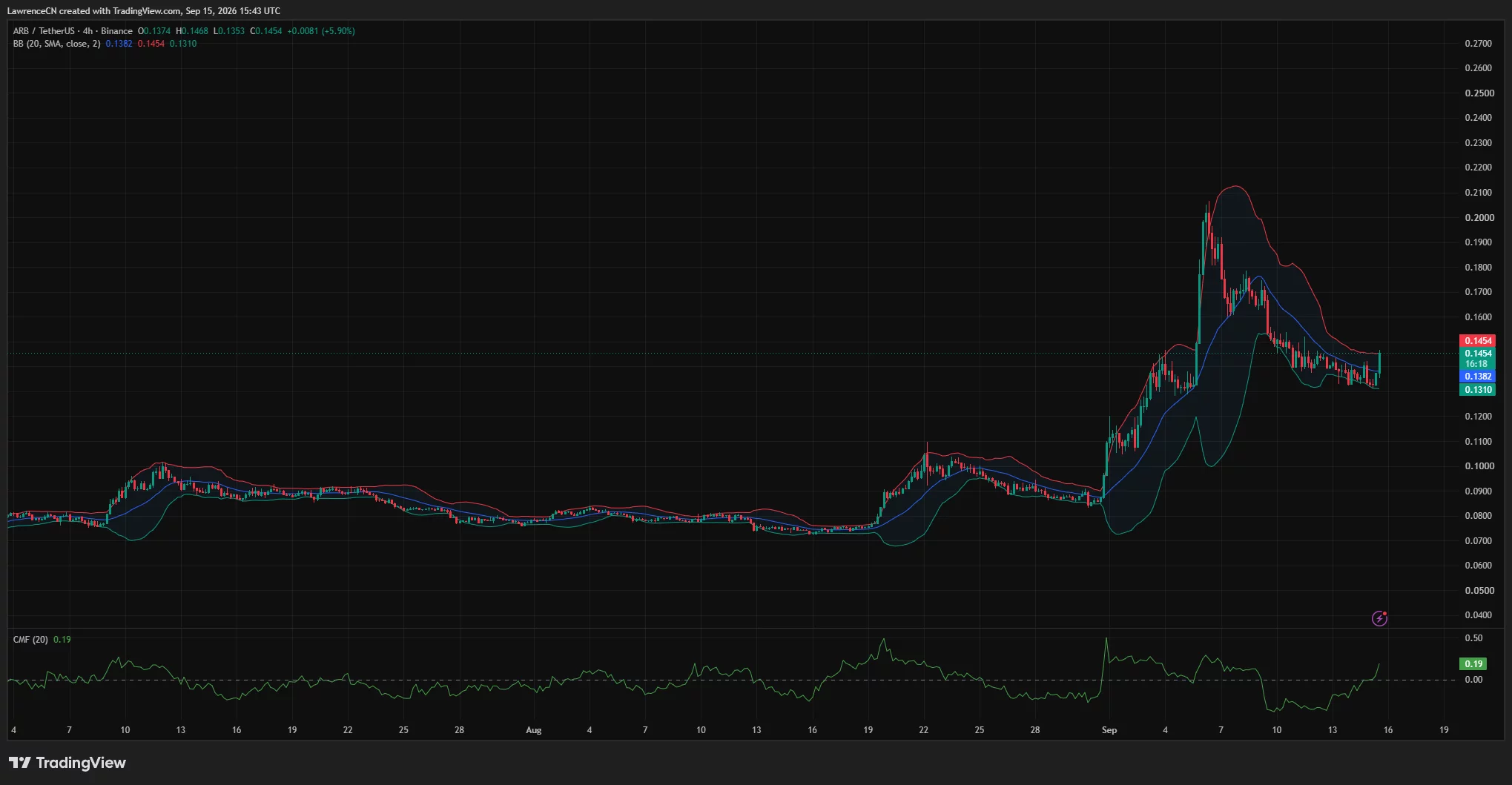
Closing above the middle band shifted the immediate structure in favor of buyers. However, trading against the upper band can leave the token open to a short-term pullback if demand does not continue.
Chaikin Money Flow rose to 0.19 on the 4-hour chart. The positive reading showed that buying pressure had strengthened during the rebound, supporting the move above $0.14.
The daily indicators offered a more cautious signal. ARB’s relative strength index stood at 58.82, above the neutral level of 50 but below the overbought threshold of 70. Its RSI average remained higher at 67.11, reflecting the loss of momentum after the early-September spike.
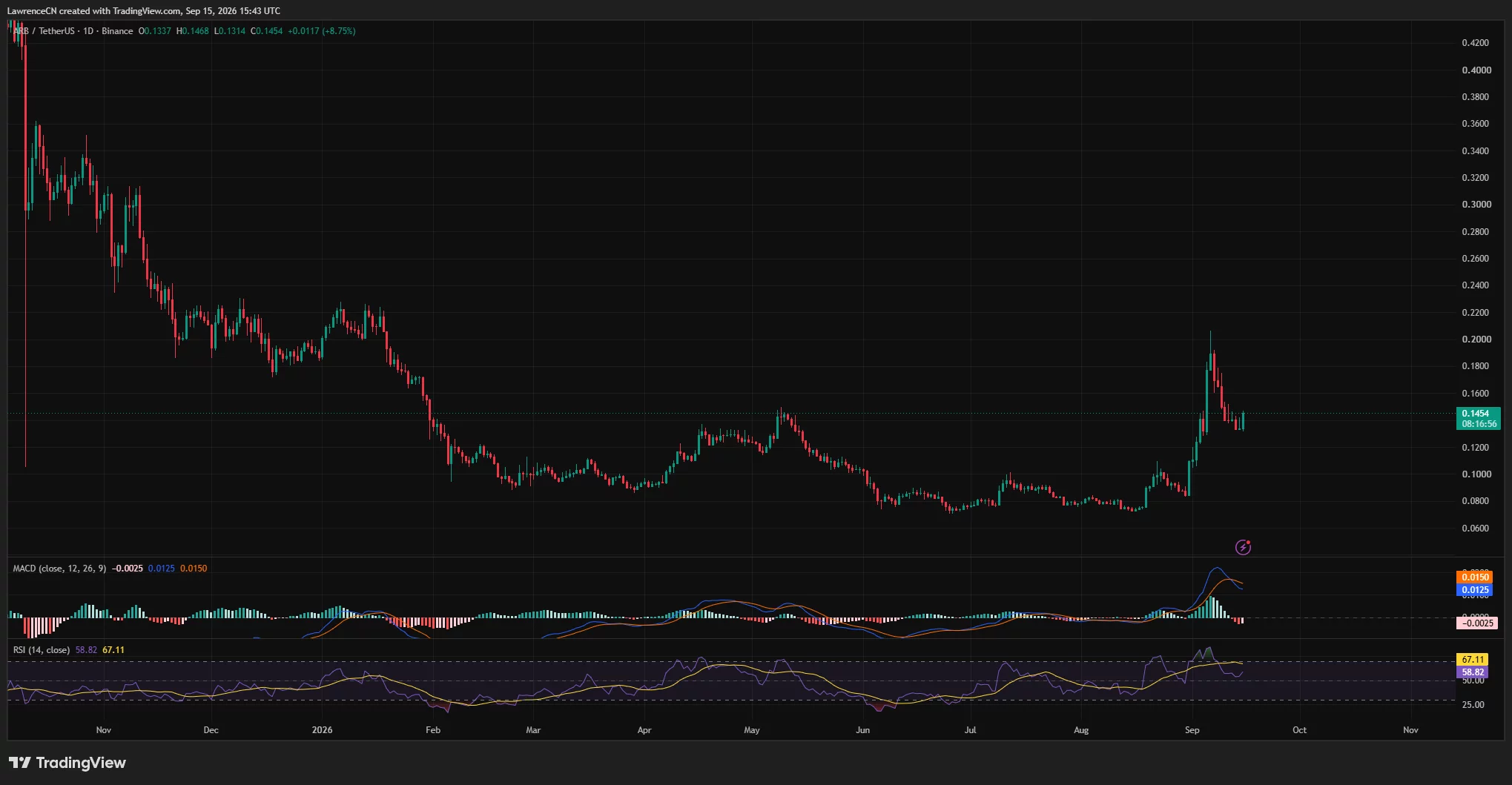
The daily MACD line stood at 0.0125, below the signal line at 0.0150. Its histogram had slipped to minus 0.0025, meaning the broader bullish impulse had not fully recovered despite the strong daily candle.
A close above $0.147 would expose the $0.150 psychological level. The one-week CoinGlass heatmap showed the strongest nearby liquidation concentration around $0.154–$0.156, making that area the next major test.
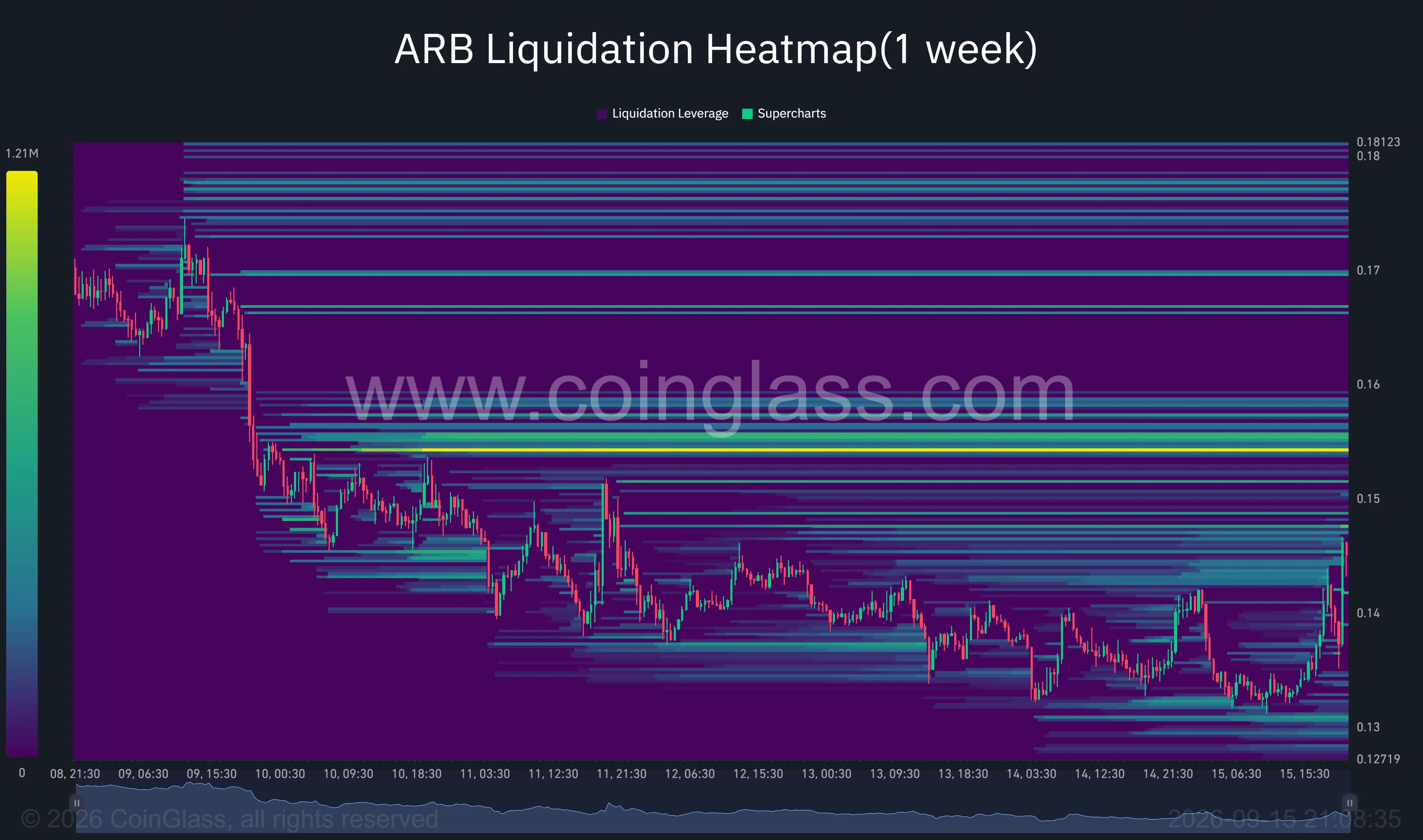
Further liquidity appeared between $0.158 and $0.160, followed by separate clusters near $0.166 and $0.170. A breakout through those zones could open a path toward the September peak between $0.19 and $0.20.
On the downside, $0.138 is the first short-term level to watch because it matches the 4-hour Bollinger midline. A loss of that level could return ARB to the $0.131–$0.133 support range, where the lower Bollinger Band and recent lows converge.
Analysts target $0.185 if support holds
Crypto analyst Michaël van de Poppe said ARB appeared to be holding its first support level and beginning to turn higher. He said the setup could lead to a sharp move toward $0.185 if the token breaks out.
The $0.185 target sits close to the upper part of ARB’s early-September trading range. Reaching it would require a gain of roughly 27% from $0.1454 and a break above the liquidation clusters near $0.155 and $0.170.
Altcoin Sherpa also identified the current area as support, attributing ARB’s recent strength partly to Robinhood-related activity. However, the analyst said the size of any continuation remained uncertain.
Both views depend on ARB holding its recent base. A daily close below $0.131 would weaken the recovery setup and place the breakout targets at risk.
Robinhood gives the rally a US market angle
Robinhood provides the clearest US connection to Standard Chartered’s thesis. CEO Vlad Tenev has described the company’s chain as being built for real-world assets, linking Arbitrum’s technology to a US brokerage seeking a larger role in tokenized finance.
The long-term effect on ARB will depend on network use, revenue generation, and the value captured by token holders. Standard Chartered’s forecast assumes that tokenization expands rapidly and that Arbitrum becomes a preferred infrastructure provider for financial firms.
For the immediate move, traders face a closer test at $0.154–$0.156. Holding above $0.138 keeps the short-term rebound intact, while a confirmed break through $0.156 would strengthen the case for an advance toward $0.17 and the analysts’ $0.185 target.
Disclosure: This article does not represent investment advice. The content and materials featured on this page are for educational purposes only.
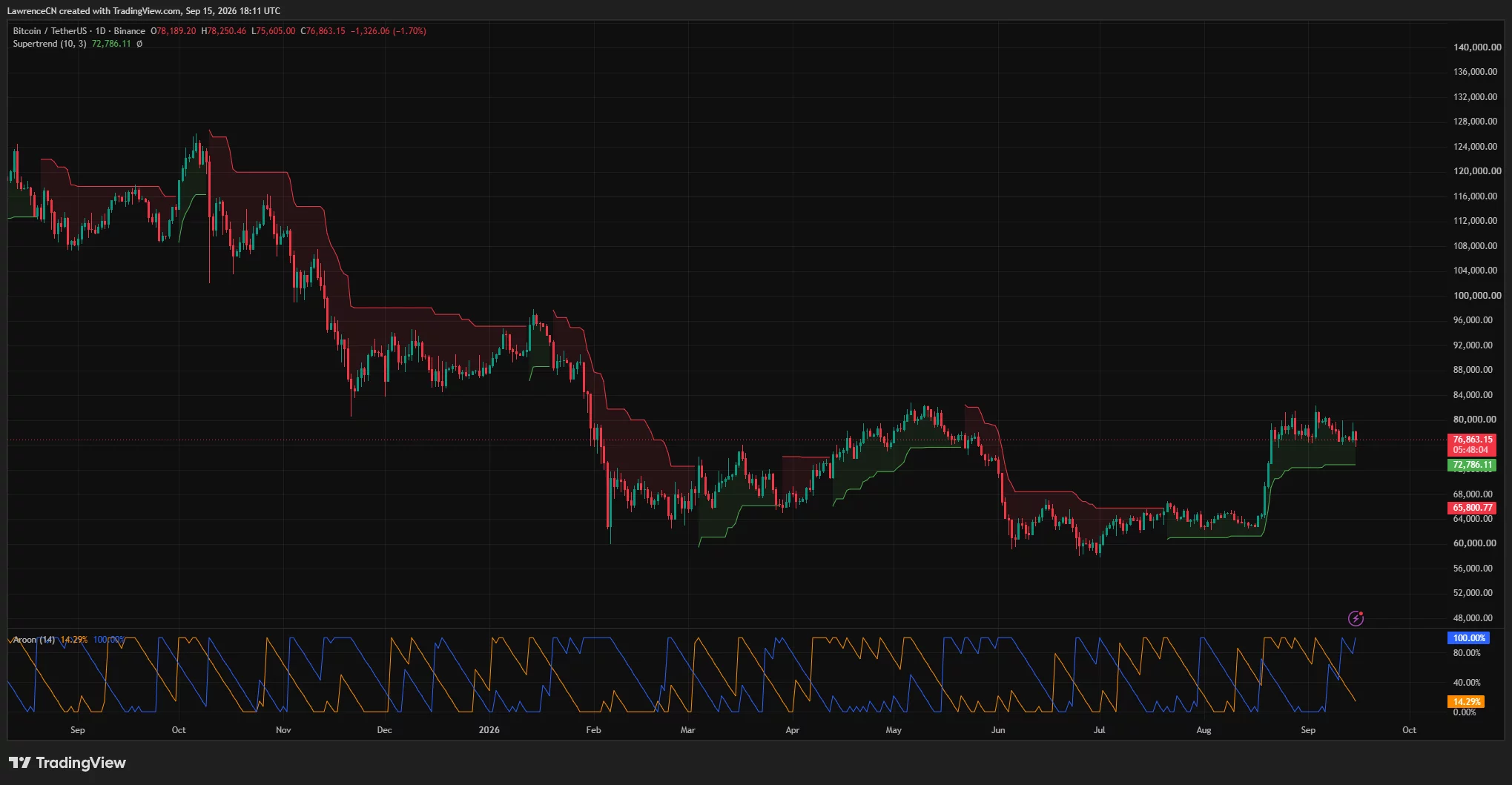
Bitcoin price slipped below $76,000 before recovering toward $76,900, with weak momentum and dense liquidation zones leaving the price vulnerable ahead of the CLARITY Act vote and Federal Reserve decision.
Summary
- Bitcoin price fell as low as $75,605 before recovering toward $76,900.
- The daily Supertrend remains bullish while 4-hour momentum lacks a clear direction.
- Liquidation clusters sit near $75,000 below and between $77,600 and $78,500 above.
- Analysts view $75,500–$76,000 as the key zone separating a rebound from a deeper fall.
Bitcoin price rebounds after falling below $76,000
According to data from crypto.news, Bitcoin (BTC) price traded near $76,863 at the time of writing after dropping 1.7% during the session. The cryptocurrency opened at $78,189, reached an intraday high of $78,250 and briefly fell to $75,605 before buyers pushed it back above $76,000.
The decline extended Bitcoin’s retreat from the $79,000–$80,000 region, where several recovery attempts have stalled since late August. Price action has since formed lower highs, showing that sellers remain active during rebounds.
Political uncertainty surrounding the Digital Asset Market Clarity Act contributed to the cautious mood. The U.S. Senate was preparing for a procedural vote requiring 60 votes to advance the legislation, while reports of disagreement between Democrats and Republicans reduced confidence in a deal.
Traders were also waiting for the Federal Reserve’s policy decision. The supplied market context showed that changing rate expectations, rising Treasury yields and elevated oil prices had reduced demand for risk assets, including cryptocurrencies.
Daily trend holds, but momentum sends a mixed signal
Bitcoin remains above the daily Supertrend level at $72,786, keeping the broader signal in bullish territory despite the latest decline. The indicator provides a wide cushion below the current market price, but it would offer little support if BTC loses the nearer $75,500–$76,000 demand area.
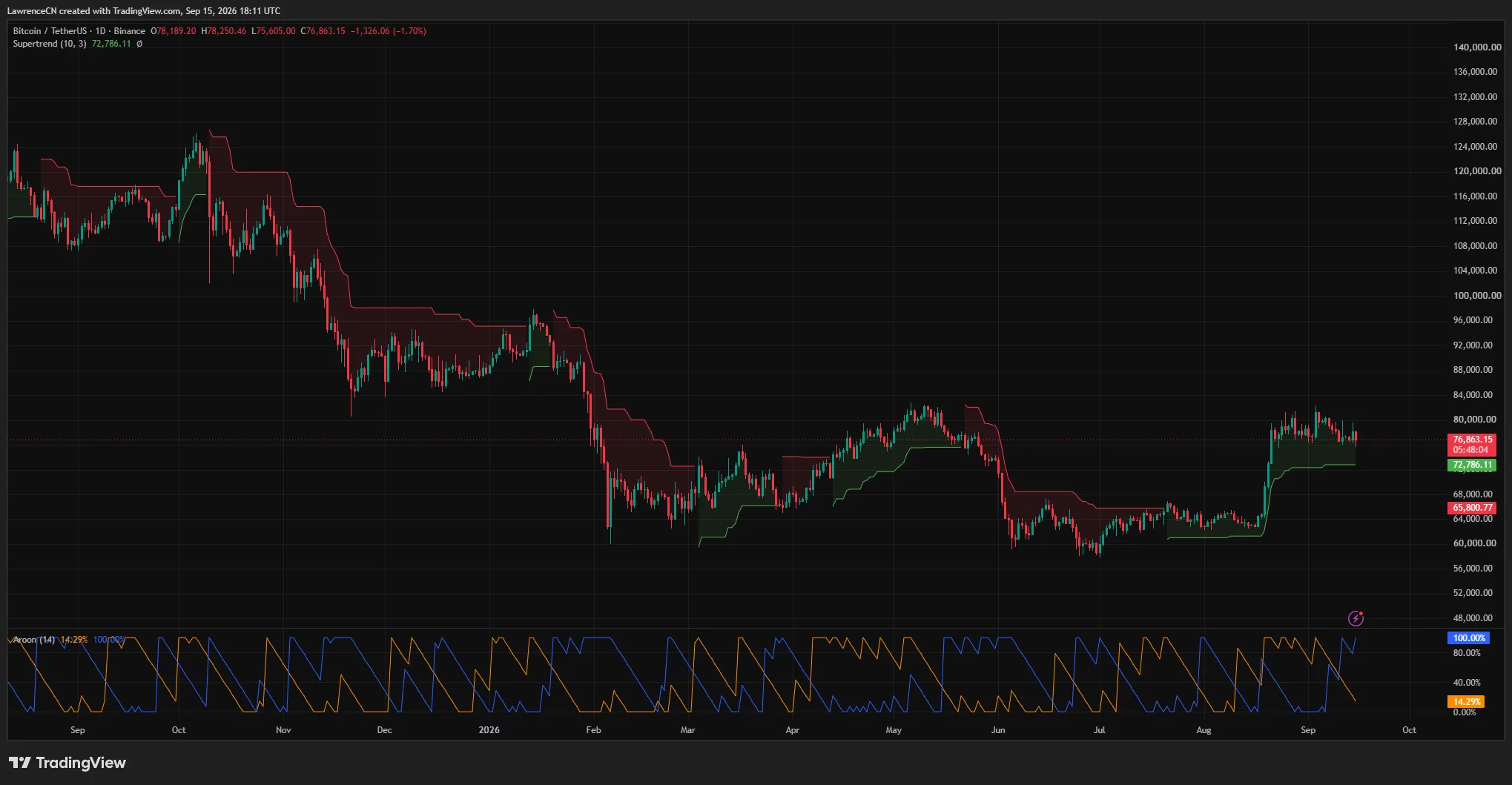
A sustained daily close below that zone would place the August breakout structure under pressure. The next visible support areas sit near $74,000 and the Supertrend level around $72,800.
The daily Aroon indicator presents a mixed reading. Aroon Up stands at 100%, showing that a recent high remains influential within the indicator’s lookback period. Aroon Down, however, has risen to 14.29% as the price moves closer to the lower end of its recent range.
The difference suggests that the wider trend has not fully reversed, although short-term weakness is building. Bitcoin must recover the $78,000–$80,000 area to restore a clearer upside structure.
A close above $80,000 would expose the recent highs near $81,000–$82,000. Failure to regain $78,000 would leave rallies vulnerable to renewed selling.
4-hour chart shows weak trend strength
The 4-hour chart confirms a less decisive short-term setup. Bitcoin traded near $76,869, below the Bollinger Bands’ middle line at $77,404 and close to the lower band at $76,180.
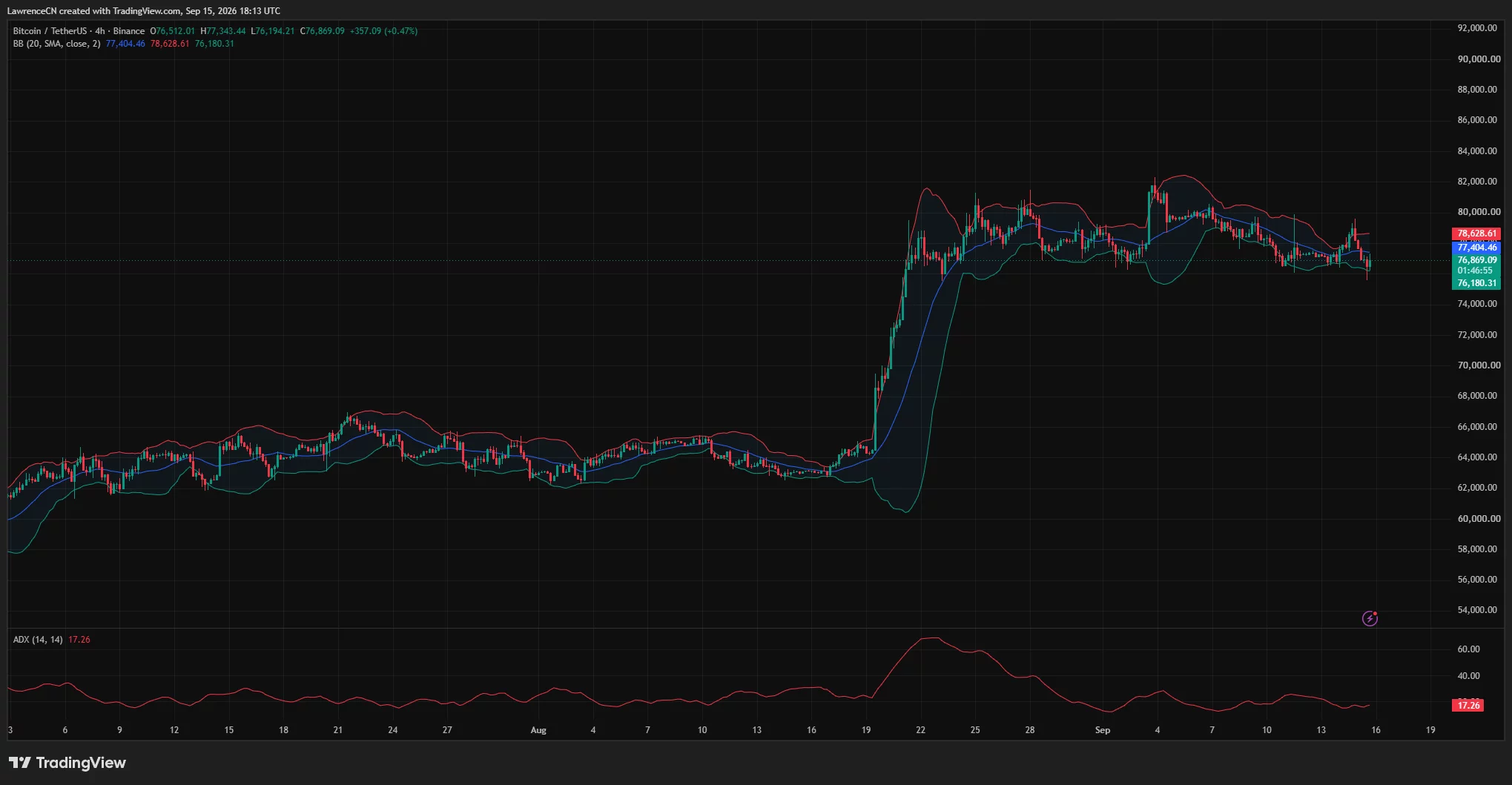
Trading near the lower band reflects persistent selling pressure, although it also leaves room for a short-term rebound if the lower boundary continues to hold. The upper Bollinger Band at $78,629 forms the next major resistance level above the midpoint.
Bitcoin’s 4-hour Average Directional Index stood at 17.26. An ADX reading below 20 typically points to weak trend strength, meaning neither buyers nor sellers have established firm control despite the sharp intraday swings.
The combination of a low ADX and price near the lower Bollinger Band favors continued consolidation unless BTC breaks decisively outside the range. A move above $77,400 would be the first sign of improving momentum, followed by resistance between $78,000 and $78,630.
On the downside, a 4-hour close below $76,180 would increase the risk of another test of $75,500. Losing the intraday low at $75,605 could then open the path toward $74,000.
Liquidation clusters could amplify the next Bitcoin move
The 24-hour CoinGlass liquidation heatmap shows concentrated leverage on both sides of the current price. The strongest nearby liquidity above Bitcoin appears around $77,600–$77,800, with another large cluster extending through approximately $78,200–$78,500.
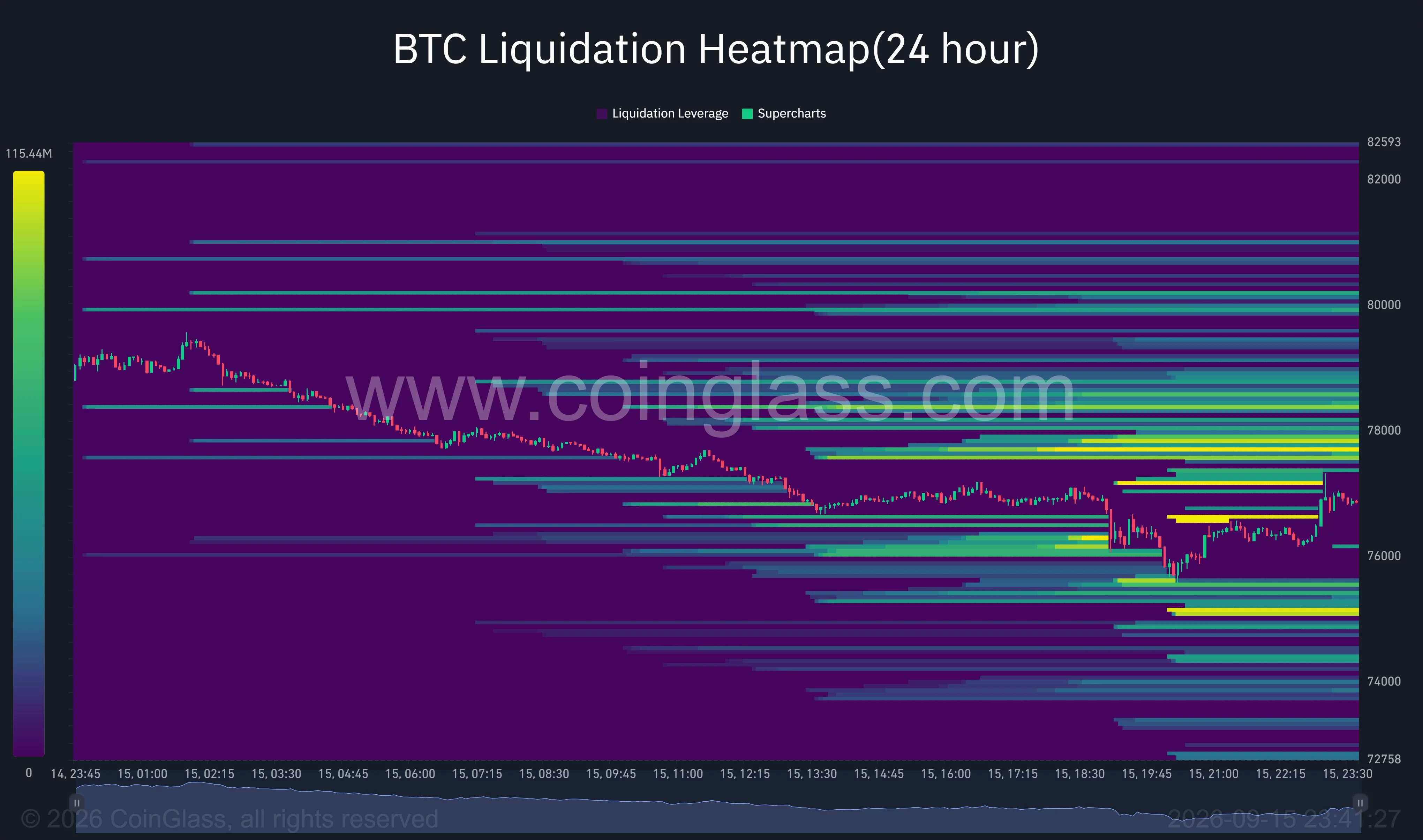
Additional liquidity is visible near $80,000. A rebound through $77,400 could draw the price toward these upper clusters as short positions face pressure.
Below the market, the clearest liquidation concentration sits close to $75,000, followed by smaller pools around $74,000 and $73,000. A break below $75,500 could therefore accelerate the decline as leveraged long positions are closed.
The two-sided concentration fits the weak ADX reading. Bitcoin remains inside a market where nearby leverage could pull the price sharply in either direction once the current range breaks.
Analysts identify $75,500 as Bitcoin’s key support
Pseudonymous trader Altcoin Sherpa called the current area a “do or die level” and said losing it could send Bitcoin toward $72,000. The analyst’s chart placed the main support band around $75,000–$76,000, broadly matching the daily and 4-hour technical levels.
Trader Lennaert Snyder said Bitcoin had swept the previous week’s low near $76,000 and reacted bearishly afterward. His preferred scenario involved a brief move below $75,500 followed by a rebound, rather than an extended breakdown.
Snyder’s chart mapped a wider demand zone around $75,000–$76,000 and identified overhead resistance near $78,000, $79,500, and $80,500. He tied the next major move to the CLARITY Act vote and the Federal Reserve decision.
The technical evidence leaves Bitcoin at a decision point. Holding $75,500–$76,000 could support a recovery toward $77,400 and $78,600, while a confirmed breakdown would bring $74,000 and the daily Supertrend near $72,800 into view.
Disclosure: This article does not represent investment advice. The content and materials featured on this page are for educational purposes only.

Christopher Phelan, chairman of the Council of Economic Advisers (CEA), said a Fed rate hike would be a mistake. The Federal Reserve is set to announce its rate decision today.
Phelan made the comments on CNBC’s Closing Bell Overtime, citing recent inflation data as the reason a hike is unnecessary. The Federal Open Market Committee (FOMC), the Fed’s rate-setting body, meets this week.
Inflation Data Undercuts the Case for a Hike
Phelan argued inflation has trended lower over the past three months. He pointed to every major gauge, including the Consumer Price Index (CPI) and the Personal Consumption Expenditures (PCE) index.
He noted the Fed held off on raising rates months ago when inflation ran hotter. That makes a hike now harder to justify, he said.
The debate comes as President Donald Trump has pushed the Fed to lower interest rates. A hike would move policy in the opposite direction Trump has publicly favored.
“No matter how you measure it, inflation is coming down. They didn’t choose to raise rates 3 months ago when inflation was higher. It doesn’t make sense to raise rates now in my view.”
Christopher Phelan, Chairman of the Council of Economic Advisers, via CNBC
What a Hike Would Mean for Markets
Phelan’s comments land as Bitcoin faces rising odds of a Fed hike this week. Traders have priced that scenario as a headwind for risk assets.
Higher rates tend to pressure Bitcoin (BTC) by making non-yielding assets less attractive next to bonds.
Fed Chairman Kevin Warsh has said the cheap-money era is ending. He has also signaled the Fed still has work to do on inflation, a stance Phelan pushed back against.
Fed watchers expect the committee to be closely divided again. A similar split emerged at the FOMC’s July meeting, when the panel held rates steady by a nine-to-three vote.
Whether Warsh sides with Phelan’s inflation reading, or with FOMC members favoring a hike, will shape borrowing costs. It will also shape risk appetite across markets in the sessions ahead.
Markets will watch Warsh’s press conference closely for signals on the final vote.
The post White House Adviser Phelan Warns Fed Rate Hike Today Would Be a Mistake appeared first on BeInCrypto.
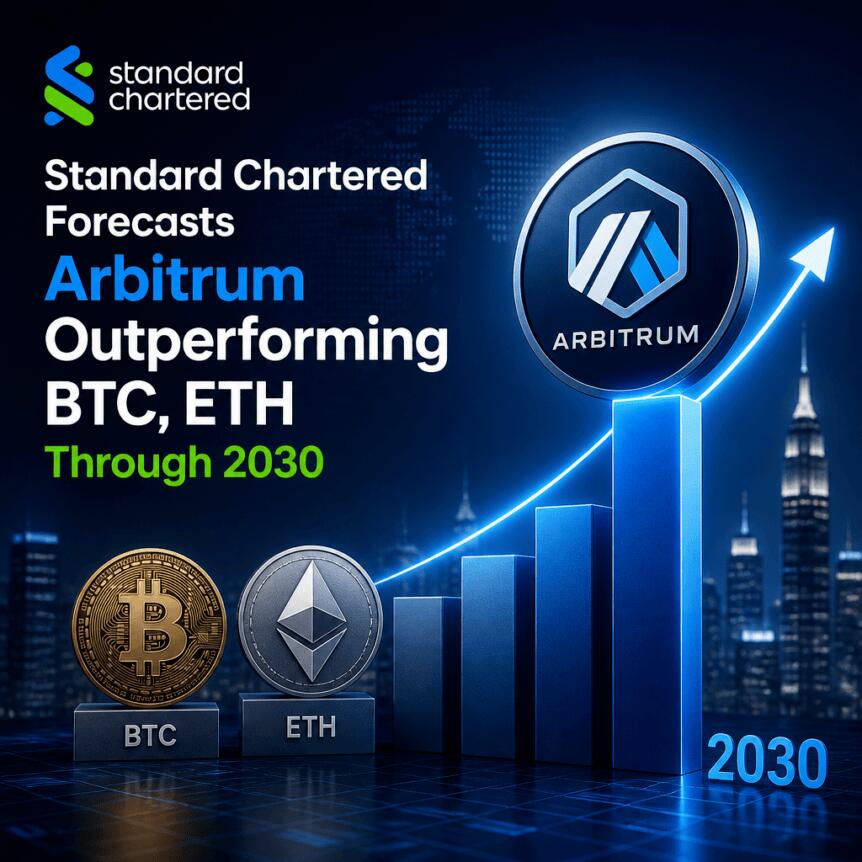
Standard Chartered is making the case that Arbitrum could become one of the strongest performers in crypto through 2030, arguing that the network’s revenue mechanics may benefit as traditional finance ramps up onchain activity. In a note shared with Cointelegraph, Geoff Kendrick, the bank’s global head of digital assets research, pointed to Arbitrum’s economic design as a potential source of growth beyond crypto-native usage.
Kendrick said Arbitrum receives 10% of the net protocol revenue generated by businesses building on the network. He highlighted Robinhood Chain—an Ethereum layer-2 initiative tied to the online brokerage Robinhood—as an early test case for how tokenization-focused applications could shift Arbitrum’s financial profile. According to Kendrick, the impact has already been visible in the network’s revenue run rate.
Key takeaways
- Standard Chartered forecasts Arbitrum’s protocol revenue share could meaningfully grow as more traditional financial assets move onchain.
- Arbitrum’s design gives it 10% of net protocol revenue from companies building on the network.
- Standard Chartered credits Robinhood Chain with materially changing Arbitrum’s economics, projecting $5 million revenue in September.
- Kendrick expects those economics could support a multi-year rise in ARB, potentially reaching $10 by 2030.
- Key risks include tokenization adoption slowing and increased competition from other chains.
Why Standard Chartered thinks Arbitrum’s revenue can scale
At the center of Standard Chartered’s bullish outlook is the idea that Arbitrum’s growth is not just about user activity, but about the network’s share of protocol revenues. Kendrick framed the pathway as follows: as regulated institutions and financial firms bring more assets onto blockchain infrastructure—especially through tokenized real-world asset (RWA) products—layer-2 networks that support these deployments could capture recurring value.
Robinhood Chain is presented as a concrete example of that dynamic. In the note, Kendrick argued that its launch has already affected Arbitrum’s economics. He stated that, at the current run rate, Arbitrum is expected to generate $5 million in revenue in September, which he said is more than five times the level it was at before Robinhood Chain launched in July.
For investors and traders, this matters because it shifts the narrative from “layer-2 usage” alone to “layer-2 monetization.” If tokenized asset workflows generate sustained protocol revenue, the token incentives and long-term demand for the network’s native asset could plausibly benefit. Standard Chartered’s framing is essentially that the token’s value proposition is tied to business adoption and network economics rather than only retail activity.
From protocol economics to ARB price assumptions
On price, Kendrick’s view is aggressive but anchored to the bank’s revenue-based logic. He expects Arbitrum’s economics to support a steady increase in ARB through the rest of the decade, forecasting that the token could reach as high as $10 by 2030. The bank’s projection implies roughly a 70-fold increase from current levels.
Standard Chartered also contrasted its outlook for Arbitrum with its expectations for Bitcoin and Ether over the same period, saying its projected returns for ARB would be far higher. While price forecasts are inherently uncertain, the bank’s stated method is noteworthy: the thesis is built around a growing revenue stream for the protocol rather than purely speculative momentum.
At the time of the note, ARB was valued at around $0.14, according to CoinGecko, after gaining 86% over the past month.
Tokenized real-world assets are the engine in the model
Standard Chartered’s argument is heavily influenced by the momentum in tokenization. Kendrick pointed to cumulative RWA tokenization nearing $39 billion, citing RWA.xyz data. The bank also reiterated its broader forecast that tokenized assets could reach $4 trillion by the end of 2028, as banks and asset managers bring more assets onchain.
In that scenario, layer-2 networks like Arbitrum are positioned as infrastructure providers. The bank’s logic is that when tokenization shifts from experiments to larger deployments, businesses building on these networks can generate net protocol revenue—part of which flows back to Arbitrum under the 10% share model.
Standard Chartered has previously tied its wider crypto views to tokenization growth, including a bullish stance toward Chainlink and the broader decentralized finance sector in the context of a growing onchain asset base. The Arbitrum note continues that through-line: as more “real-world” exposure is issued onchain, the infrastructure that supports issuance, settlement, and related services may capture more durable value.
Key uncertainties and competitive pressure
Despite its optimism, Kendrick highlighted risks that could derail the bank’s price framework. He identified two major uncertainties: a slower-than-expected pace of asset tokenization and more competition from alternate blockchains.
This is an important tension for readers to consider. Arbitrum’s potential upside depends not only on technical and adoption milestones, but also on whether tokenized assets concentrate on specific L2 ecosystems or diversify across multiple networks. If tokenization expands but spreads across competing platforms, Arbitrum’s revenue share—and therefore the earnings-to-token linkage Standard Chartered is leaning on—could be diluted.
There is also a timing element embedded in the forecast. Kendrick’s projected revenue run rate growth and the resulting ARB outlook assume that new deployments and monetization mechanisms ramp in a way that sustains protocol revenues over time. Any mismatch between “asset issuance growth” and “protocol monetization” would likely force the thesis to be recalibrated.
As the market digests this note, the next things to watch are whether tokenization activity on Ethereum layer-2s keeps accelerating and whether Robinhood Chain—or other tokenization-oriented deployments—continues to translate into measurable net protocol revenue for Arbitrum. The pace of tokenized asset adoption and the intensity of competition between alternative chains may determine how closely reality tracks Standard Chartered’s multi-year model.


X has launched its U.S. Cashtag Partner Program with five brokerage platforms, giving users a direct route from stock, ETF, and cryptocurrency discussions to eligible trading services.
Summary
- Five partners include Coinbase, Gemini, Kraken, Interactive Brokers, and Moomoo.
- Supported cashtags now display a “Trade” option that redirects users to a participating platform.
- U.S. users must complete transactions through the selected brokerage rather than directly on X.
- X has added the program after introducing interactive price charts and financial data through smart cashtags.
X Cashtag Program connects tickers with trading platforms
X said in an official announcement that the Cashtag Partner Program has gone live in the United States with Coinbase, Gemini, Kraken, Interactive Brokers, and Moomoo as its first participants.
When users tap a supported cashtag, they can view information tied to the stock, ETF, or cryptocurrency represented by the ticker. A new “Trade” option then lets them choose an available brokerage partner and continue the transaction on that company’s platform.
X does not appear to be executing the trades itself under the arrangement described in the announcement. Instead, the social platform connects users with participating financial companies, where account requirements, identity checks, asset availability, and other trading conditions apply.
Cashtags use a dollar sign before an asset symbol, such as $BTC for Bitcoin or $COIN for Coinbase shares. Traders already use the format to organize financial posts and follow conversations about specific assets. By attaching brokerage links to the feature, X has shortened the path between reading market commentary and opening a trading interface.
The program covers several types of financial companies. Coinbase, Gemini, and Kraken are known primarily for crypto trading, while Interactive Brokers provides access to stocks, options, futures, currencies, and other markets. Moomoo offers stocks, options, and cryptocurrency services through its respective regulated entities.
X did not provide a complete list of supported tickers in the announcement. Availability may differ across partners because each brokerage maintains its own product list and customer eligibility rules.
Smart cashtags laid the foundation for US trading links
As crypto.news reported in April, X introduced smart cashtags for iPhone users in the United States and Canada with live charts, asset-specific posts, and support for cryptocurrency contract addresses.
The earlier version allowed users to select the correct asset or smart contract when adding a ticker to a post. Selecting the cashtag opened a dedicated page containing price information and related discussions, reducing confusion between tokens that share similar names or ticker symbols.
Canadian users also received a trading link through Wealthsimple. At the time, X product head Nikita Bier said users in Canada would see a button that allowed them to move from a cashtag to the financial platform. U.S. trading had not yet been enabled through that rollout.
The new partner program brings the brokerage-link model to American users and increases the number of participating firms from the single Canadian integration. Its structure also keeps order execution within the brokerage selected by the user rather than adding an X-operated exchange to the social platform.
Mridul Singhai, X’s product engineering lead, said the feature narrows the distance between a ticker appearing on a timeline and the market linked to it. Users can open a live chart, read the conversation around an asset, and choose a partner when they decide to trade.
Live posts and price data remain part of the product. The trading button adds another action to the same asset page, but X has not said that a post, chart, or cashtag represents financial advice or a recommendation to transact.
Coinbase and Kraken extend X’s crypto trading route
For cryptocurrency users, the inclusion of Coinbase, Gemini, and Kraken gives the program connections to three established U.S.-focused exchanges. Customers still need an eligible account with the chosen company, and the exchange determines which assets and services are available in each jurisdiction.
Kraken has also expanded beyond its original crypto business. In August, the exchange added 7,000 stocks for eligible European Economic Area customers, placing traditional U.S.-listed shares beside more than 700 tokenized xStocks and over 600 crypto assets.
Kraken entered U.S. stock trading in 2025 before extending the service into Europe through its Cyprus investment firm. Its EEA product lets eligible customers choose between traditional shares and tokenized representations, although the products have different structures and regulatory conditions.
Earlier in 2026, Kraken-backed xStocks also introduced on-chain trading for more than 70 tokenized equities across Ethereum and Solana. Kraken said in March that the platform had processed $25 billion in total volume, including $3.5 billion in on-chain transactions, and had reached 80,000 on-chain holders.
Coinbase has likewise added U.S. stocks and ETFs to its main platform, allowing eligible customers to manage traditional securities and crypto through one account. The Cashtag Program gives X users another entry point to participating services without transferring the actual trade to X.
American users remain subject to each provider’s onboarding process, state-level availability, and product restrictions. A cashtag may therefore display market information even when a particular user cannot trade the asset through every listed partner.
X ties financial conversations to its Everything App plan
Monique Pintarelli, SpaceXAI’s head of global advertising, described the partner program as a way to connect financial discussions on X with an action that users can take through a brokerage.
“People come to X to discover what’s happening, shape the conversation, and act in real-time on what matters to them,” Pintarelli said. “Our Cashtag partners make it possible to move seamlessly from discovery and conversation to a brokerage, without breaking the moment.”
The rollout adds another financial feature to X as the company develops its planned Everything App model. In March, an X Money examination described the service as an in-platform wallet designed for peer-to-peer transfers, bill payments, and other financial products.
X Money has since rolled out peer-to-peer transfers, direct deposits, a debit card, and yields on eligible balances. Its payment functions remain separate from the Cashtag Partner Program, which routes investment activity to outside brokerages rather than holding or executing the trade within the social platform.
X previously secured money-transmitter licenses across more than 40 U.S. states and Washington, D.C., and registered with the Financial Crimes Enforcement Network as part of its payment-service preparations. The company also partnered with Visa to support transfers between bank accounts and X Money wallets.
Singhai said users who post or tap a ticker can now reach a live chart, follow the discussion around the asset, and continue to one of the brokerage partners. X has not disclosed when the Cashtag Partner Program may add more financial firms or expand beyond the United States.
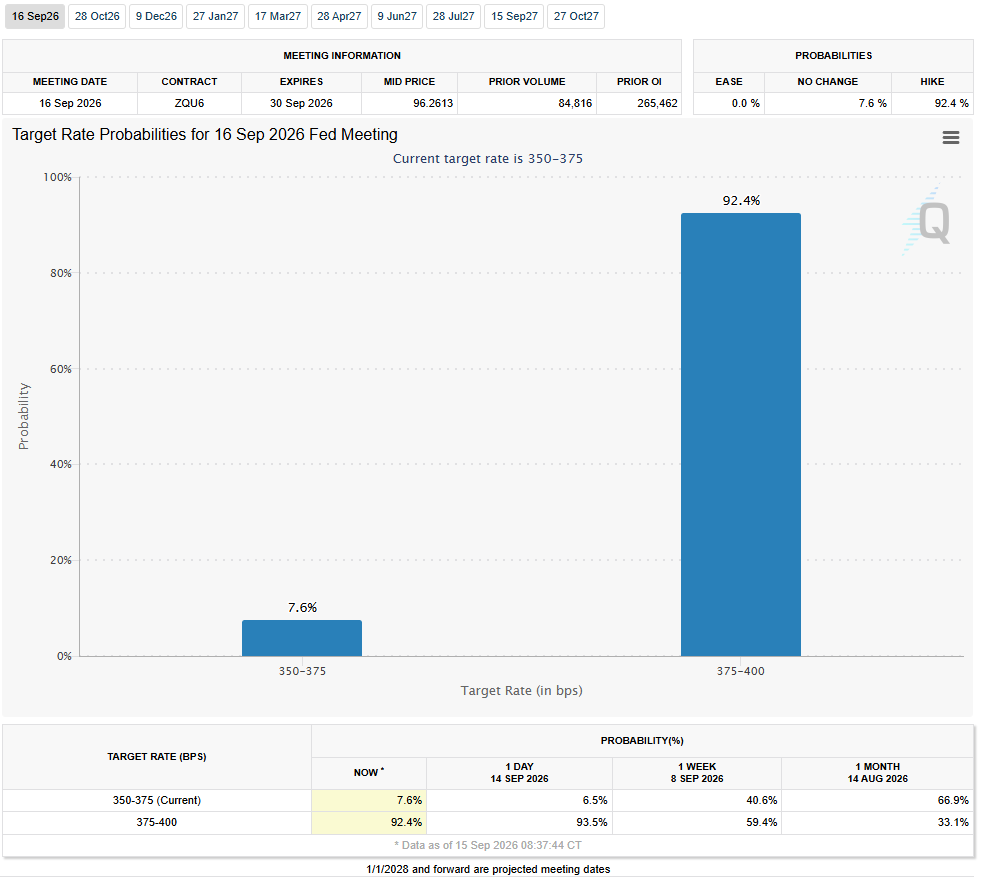
Traders are bracing for a rare stretch of synchronized tightening this week, with the Federal Reserve and the Bank of Japan (BOJ) both leaning toward a rate hike within 48 hours of each other.
The Fed announces its decision Wednesday afternoon, with futures markets pricing an over 80% chance of a quarter point increase. The BOJ, however, follows two days later, on Friday.
Rate Hike Odds Build on Both Sides of the Pacific
A CNBC survey of 18 economists, conducted Sept. 9 to 14, found 89% expect the BOJ to raise its benchmark rate by 25 basis points to 1.25%, a fresh three-decade high. Respondents cited accelerating inflation, rising wages and pressure from Washington.
“The Trump administration has effectively checked any potential move by a Takaichi administration to block the Bank of Japan from raising interest rates.”
Takahide Kiuchi, executive economist at Nomura Research Institute, told CNBC.
Not every economist agrees on the pace. Jesper Koll, expert director at Monex Group, expects a single 50 basis point move instead. Meanwhile, Carlos Casanova, senior economist for Asia at Union Bancaire Privée (UBP), expects the BOJ to hold steady, arguing the data does not yet support a faster hiking cycle.
About 61% of respondents see the yen trading between 155 and 160 per dollar over the next month.
Fed Fighting Against a Hike
Fed odds have swung just as sharply. From a coin flip in late August to a strong 92% favorite for a hike now, a repricing that has coincided with the yen’s monthly gain against the dollar.

The pair’s moves would, moreover, add to a broader pattern BeInCrypto’s biggest macro risk analysis has flagged, in which the Fed, the European Central Bank and the BOJ could all tighten in the same window for the first time since 2006.
Traders now turn to the Fed’s dot plot and any BOJ dissent votes for clues on how fast the two economies’ rate paths converge.
A double hike would narrow the Tokyo-Washington rate gap for the first time in years. The implications for carry trades and risk appetite heading into the fourth quarter.
The post Bank of Japan, Fed Rate Hikes Expected Same Week: Will Yen Rally? appeared first on BeInCrypto.


What compelled hundreds of thousands of people around the world to invest in the initial public offering of Elon Musk’s SpaceX this summer? It certainly wasn’t the company’s financial metrics.
Despite the success of its core rocket business, the company is burning through a prodigious amount of money. Yet SpaceX still managed to pull off a record-breaking IPO, transforming Musk into the world’s first trillionaire.
Although an outlier, the SpaceX IPO is not unique. It is merely an extreme manifestation of two remarkable trends that have become increasingly hard to ignore in financial markets: ordinary investors are a huge and growing force, and their feelings can often trump fundamentals.
This is becoming apparent around the world, but nowhere more so than in the U.S., where ordinary people have embraced speculation both as a way to get rich and as a reflection of their own beliefs with perhaps greater zeal than anyone else on the planet.
The first point is easy to quantify. Ordinary retail investors now account for over 20% of U.S. stock market activity, according to estimates by Jefferies, an investment bank. That is roughly twice the level of a decade ago and means that they now account for almost as much trading volume as mutual funds, hedge funds, and banks combined. The impact on markets is apparent everywhere.
The latter point is harder to prove with hard numbers, but the anecdotal evidence is heaping up. To the consternation of many traditional investors, what securities you buy have become almost like an extension of one’s identity—whether that is the stock of a dowdy utility or racy computer games maker, cryptocurrencies, or even dabbling in the newfangled prediction markets.
Finance has long shaped America. But today, I would argue, this shape has become deformed. When did investing stop being merely financial and become an expression of identity? Why do individual Americans see investing as a chance to prove who they are and what they are worth?
And what does this pressure say about who America is as a country, collectively?
American stakes
The roots of this uniquely American phenomenon of conjoined identity and rampant speculation can arguably be traced back over a century to the titanic bond-sale program that financed the U.S. entry into the First World War.
When the U.S. formally declared war on Germany in 1917, the task of figuring out how to pay for the army, navy, and weapons America needed fell to President Woodrow Wilson’s son-in-law, Treasury Secretary William McAdoo.
McAdoo was an athletic, photogenic, and decisive former lawyer and streetcar executive. He fizzed with energy and was as progressive in his business policies as he was regressive in his racial politics (McAdoo advocated forcefully for gender equality and what today we would call “stakeholder capitalism”, but introduced segregation at the Treasury, and was later endorsed by the Ku Klux Klan when he unsuccessfully ran for president).
McAdoo knew that taxes alone couldn’t shoulder the entire burden of the war, given the scale of the money needed. The problem was that the U.S. government bond market had by then shriveled up. The size totaled under $1 billion, and most of it was stuffed away in bank vaults rather than traded.
Moreover, most ordinary Americans were oblivious to what a bond even was. Wall Street bankers pointed out to McAdoo that there were probably only about 350,000 bondholders in a country of about 100 million inhabitants at the time. They therefore recommended that the Treasury Secretary limit his first bond sale to $1 billion, and target established investors with a juicy interest rate of at least 5 percent. Even this, they felt, would be ambitious.
Yet McAdoo balked at their pessimism. “It was true that [Americans] know little or nothing about government bonds, but we would tell them,” he wrote in his memoirs. To thrill the public, he decided to dub the bonds “Liberty Loans,” and set up a sprawling War Loan Organization to mass-market them.
Life, Liberty Loans, and the pursuit of happiness
It proved a stunning success. Wherever you went in the U.S. those days, you would gaze at a billboard, stumble over an exhibition, be handed a leaflet, enjoy a cake sale, be accosted at work, or get dragged into a march that were all designed to tout Liberty Loans.
When bankers initially struggled to communicate with the masses, celebrities like Charlie Chaplin were enlisted to burnish the pitch. Edward Bernays—often considered the father of modern public relations and the author of a pioneering book on propaganda in the 1920s—orchestrated sophisticated plays on patriotism, sentiment, or personal political yearnings to entice investors who might have been put off by the paltry interest rates on offer.
Often, the push to subscribe to a Liberty bond sale crossed over into crass shaming. Sometimes, so-called “dollar slackers” were even confronted with naked intimidation from groups who pressured people to buy bonds.
The Atlantic excoriated this as “borrowing with a club”, and warned that “mob rule by the rich, with the able assistance of hoodlums” could stir support for socialists. Even future president Warren Harding complained that the selling drives were “hysterical and unseemly”.
Nonetheless, Liberty Loans were genuinely popular. Buying them became a communal expression of belonging that crossed social, racial, and religious lines in a divided, polyglot nation. In fact, the War Loan Organization deliberately stoked competition among different groups to see who would demonstrate the greatest fealty to America—as evidenced by the volume of their bond purchases. This was particularly important for many women and Black Americans, who hoped that herculean efforts to help support the war might further their aspirations for equal treatment.
All told, the Treasury sold five low-cost mammoth Liberty Loans to finance the war, which raised an astonishing $21.4 billion. Relative to the size of the U.S. economy then and now, this is the equivalent of selling approximately $9 trillion of bonds today. Thus, an unprecedented feat of financial salesmanship transformed a war that was initially not overwhelmingly popular into a unifying national endeavor.
An investing identity crisis
Unfortunately, this unity quickly dissolved when the war was over, with America wracked by racial unrest, labor strife, and social tensions. Women received the right to vote in 1920, but the wartime efforts of Black Americans and other minorities were mostly ignored. McAdoo’s later career was blighted by financial scandal and two unsuccessful Ku Klux Klan-supported tilts for the presidency.
Nonetheless, his Liberty Loans proved transformative for the fabric of America’s financial system. It is hard to overstate just how impactful the bond sales were for the country’s culture of investment.
Remember, when the Treasury Secretary first asked bankers for an appraisal of the Treasury market’s health at the start of the war, they had estimated that only 350,000 Americans owned bonds. By the end of the conflict, about 34 million Americans had purchased some form of federal bond—over a third of the country at the time.
This spilled over into the stock market as well. Researchers have later studied the long-run county-level data on how American households save money and found that areas with greater Liberty bond program participation were far more likely to invest in bonds and stocks in the future as well. In fact, a paper published by the National Bureau of Economic Research last year estimated that 20% fewer Americans would have held stocks had the Liberty Loan campaigns not been conducted.
The legacy has long been apparent in both the unusual scale and nature of how Americans invest. But social media and gamified trading apps are now obliterating the always-blurry lines between investing, speculation, and pure gambling. As Warren Buffett observed in 2023: “Markets now exhibit far more casino-like behavior than they did when I was young. The casino now resides in many homes and daily tempts the occupants.”
And leaders like JPMorgan Chase CEO Jamie Dimon have directly likened increasingly popular prediction markets to gambling—while caveating that “people have been gambling forever.”
Political polarization is now introducing a new and arguably dangerous element to the phenomenon. The cohesion fostered by the Liberty Loan program and its feelings-first marketing has been distorted into yet another force that is driving Americans apart.
Which brings us back to SpaceX. For some investors, SpaceX is an overhyped and overpriced monstrosity, run by a controversial and mercurial founder. For others, betting on SpaceX is an expression of faith. They believe in Musk and his visions of spacebound data centers, thinking machines, robots that can mine Mars, and ultimately, interplanetary travel. To them, today’s stock price is a humdrum secondary concern.
This is more widespread than you might think. Even members of Congress have been found to signal their beliefs through their investment activities. “For U.S. legislators, the stock market functions not only as a venue for wealth accumulation but also as a stage for identity signaling,” a paper published earlier this year noted.
But you need not be a finance professor to see that this is a dangerous trend. Markets work best when decisions are based on fundamentals, not feelings. And by reflecting America’s political polarization, identity investing can also accentuate it. Unfortunately, as the Liberty Loan story indicates, the reality may be that the American zeal for speculation and a willingness to sometimes let emotions trump rationality may always have been intertwined.
The extent may wax and wane according to the market cycles, but by now they might be impossible to separate.

Money Speaks #motivation #mindset #selfimprovement

Newspaper headlines: ‘Complete failure to protect babies’ and ‘Sterling mess’

Stock Market Faces Potential Rate Hike As Benchmark Yield Hits 5%



-

 Fashion4 days ago
Weekend Open Thread – Corporette.com
-

 Business6 days ago
Micron Stock Climbs Above $1,031 as AI Memory Crunch and a $50 Billion Outlook Fuel the Rally
-

 Tech3 days ago
The Latest Weird Thing to Play Doom Is the Mapped-Out Brain of a Fruit Fly
-

 Business6 days ago
AMD Stock Climbs After Management Lifts 2027 Data Center Outlook Toward $70 Billion in AI Sales
-

 Crypto World5 days ago
XAG/USD: Silver’s Short-Term Rally Meets Its Moment of Truth
-

 Business5 days ago
10 Most-Streamed Songs On Spotify In 2026 So Far, Led By Ella Langley’s Dominant Run On The Charts This Year
-
 Crypto World6 days ago
2 Chip Stocks Broke Out This Week. Neither Was Nvidia
-

 Crypto World6 days ago
Pi Network ships Protocol 27 on a network with 14 million users and zero DeFi
-

 Tech5 days ago
Battery life is the only iPhone 18 Pro and iPhone Duo upgrade I care about. Apple didn’t disappoint
-

 Crypto World5 days ago
Diesel Tops $6 a Gallon for the First Time as 28 States Set Records
-

 Crypto World5 days ago
OKX launches 10x OpenAI, Anthropic X-Perps in Europe
-

 Tech6 days ago
Apple Watch Ultra 4 vs Watch Ultra 3: Should you really spend another $799?
-

 News Videos5 days ago
Facing Financial Fears
-
 Tech7 days ago
Modders have already found two ways to make DLSS 5 playable, and neither one is Nvidia’s
-
 Crypto World6 days ago
Bitcoin price risks $70K if $78K neckline breaks
-
 Crypto World7 days ago
Bitcoin price holds near $79K as cycle drawdowns narrow
-

 Entertainment6 days ago
Case Sees Major Update As Jury Deliberations Begin
-

 Crypto World2 days ago
Elon Musk Drops a Bombshell: Grok 5 Could Be the AGI Breakthrough
-

 Business3 days ago
Rivals Sam Altman and Elon Musk Rally Behind Dario Amodei’s Call for a Slowdown in AI Development
-
Crypto World5 days ago
Ethereum Price Analysis: Consolidation at $2.5K Tests Momentum as On-Chain Activity Surges
You must be logged in to post a comment Login