
Crypto World
Ana Valdez Is Making Business Leaders Recognize Latino Economic Power


She is often met with disbelief. “People are saying, ‘It can’t be that my housekeeper produces $4.4 trillion,’” Valdez recounts, laughing. “I mean, literally, these are the kind of comments I hear.”
Valdez grew up in Mexico City and studied at the prestigious Tecnológico de Monterrey, housed on a modernist campus south of Monterrey’s skyscrapers. Later, back in Mexico City, she worked as a senior account executive with Nielsen. It was there that Valdez saw the power of market research to change the look of entire cities. Nielsen would tell multinational companies where untapped customers lived, and those companies would then flood those markets with commercials, new stores, and billboards to reach them.
In 1996, Valdez became an immigrant, moving to the U.S. to work for the Clinton Administration. She moved to Los Angeles to support Clinton and Vice President Al Gore’s reelection campaign in ’97 and has called L.A. home ever since. Even with a high-powered background, Valdez had to fight the feeling that she was starting over in the States. In Mexico, saying she went to Tec meant something; in the U.S., it went over people’s heads. That personal experience, as much as her background, made her a natural fit for the LDC.
The LDC was founded in 2010, when a small group of business leaders and former politicians decided to push back against “harmful stereotypes” about Latinos among the business community. The officially nonpartisan organization pursues this goal using market research—the kind of work Valdez did at Nielsen. It might not look like a march in the streets or a political campaign, but the central thesis of LDC’s work is that transforming the way businesses see their Latino customers can change the world: it evolves the TV people watch, the stores they walk into, the language they use.
Valdez began as a development consultant with the LDC before becoming president and CEO in 2015. She says that, in boardrooms and corner offices, her pitch is easy: ditch Latino stereotypes and get rich, or hold onto them and fail. She points to the growing popularity in the U.S. of Latin music and Mexican food-and-beverage brands, from Bad Bunny to Modelo beer. “For those decision makers that know the numbers, and are tracing the source and the root of pop culture today, they’ll be in great position in the coming years,” Valdez says. “Those who don’t recognize it,” she warns, “will not.”

Crypto World
Ethereum Price Prediction: ETH Shrugs Off CLARITY Act and Fed Decision, Could Break $3,000

Ethereum sits at $2,400, dropping a brutal 4% on the day amid its bullish price prediction a week earlier. The largest altcoin absorbed a legislative gut-punch and is staring down a Fed decision that would rattle most assets, yet whale wallets are still buying.
The CLARITY Act failed to clear the 60-vote cloture threshold in the Senate on Tuesday, triggering an immediate 5% drop toward $2,400 as regulatory clarity got pushed further down the road. Despite that, the setback hasn’t broken the underlying bid.
Exchange netflow data shows reserves falling by 159K ETH over five days, while wallets holding 10K-100K ETH, or the whale cohort, added roughly 200K ETH to their stacks over the past week. Retail, meanwhile, dumped about 192K ETH, continuing a distribution pattern that’s held since January.
Add in $121 million of spot ETH ETF inflows on Monday, and $216.4 million on Friday, and the divergence between institutional accumulation and retail selling becomes the real story heading into Thursday’s FOMC decision.
Trade ETH on Bybit and Get a Chance to Win Our $1,000 USDT Airdrop
Ethereum Price Prediction: Will ETH Hit $3,000 This Week?
ETH is consolidating in a triangle pattern between support at $2,405–$2,485 and resistance at $2,535–$2,600. The 20-day EMA near $2,425 has held as a floor through the recent pullback, and volume has stayed constructive rather than capitulatory, a sign this dip is more consolidation than reversal.
A decisive close above $2,600 would confirm the breakout, opening a run toward the $2,800–$3,000 zone that Bitget’s analysts are flagging as the next psychological target. If ETH instead grinds sideways, the $2,400–$2,550 range could hold until the Fed decision clears the calendar.

A break below $2,350 would invalidate the setup and reopen the August lows near $1,880. With a 92.3% priced-in probability of a 25bp hike per the CME FedWatch tool. Thursday’s outcome is largely baked in, and the real risk is the accompanying commentary. Full breakdown available in this Ethereum price prediction.
Earn $50 and Enter $300K Prize Draw on EdgeX
LiquidChain Targets Early Mover Upside as Ethereum Tests Key Levels
ETH holders riding this consolidation are positioned reasonably well, but let’s be direct: a move from $2,400 to $3,000 on a trillion-dollar-plus asset is a solid 25% swing, not a multi-bagger. For traders chasing asymmetric upside, that math pushes attention toward earlier-stage infrastructure plays instead.
The Order rests. The architecture never sleeps. — LiquidChain (@getliquidchain) September 9, 2026
 ⟁https://t.co/vqvBcdSQYC pic.twitter.com/bNof4XHJ58
That’s the lane LiquidChain ($LIQUID) is building in. Liquid is a Layer 3 network fusing Bitcoin, Ethereum, and Solana liquidity into one execution environment. The presale is priced at $0.014956 with $960K raised so far.
Its pitch centers on a Unified Liquidity Layer and Single-Step Execution, letting developers deploy once and tap all three ecosystems rather than fragmenting liquidity across chains. Verifiable Settlement rounds out the architecture.
Research LiquidChain before the next price hike.
Discover: The Best Token Presales
The post Ethereum Price Prediction: ETH Shrugs Off CLARITY Act and Fed Decision, Could Break $3,000 appeared first on Cryptonews.


Benchmark 10-year government bond yields surged to decades-high levels across five major economies this week. The US and UK hit marks last seen in 2007, while Japan reached a level unseen since 1996.
Germany’s 10-year yield climbed to its highest point since 2009, while France’s reached a level not seen since 2008. Oil above $100 a barrel is reigniting inflation fears ahead of a cluster of central bank meetings this week.
A Synchronized Repricing
The moves mark one of the broadest bond selloffs in years. Renewed Middle East hostilities have pushed crude prices higher, threatening to reignite consumer inflation.
That pressure has pushed yields to levels Bitcoin has never seen since the asset’s creation.
Heavy government debt issuance is compounding the pressure. US bonds’ worst decade in more than two centuries adds to the supply investors must absorb. Japan’s debt load, above 200% of gross domestic product, leaves Tokyo especially exposed to rising borrowing costs.
Why Yield Matters
Higher long-term yields ripple into mortgage rates, corporate borrowing, and government budgets. Analysts single out France as the most exposed among major economies.
“The most vulnerable sovereigns are those combining large fiscal deficits, elevated debt burdens and reliance on external capital. France stands out among developed markets.”
Masahiko Loo, senior fixed income strategist at State Street Investment Management, told CNBC.
Markets are also bracing for the Fed’s rate decision this week, with traders pricing high odds of a hike. That could either steady or extend the global selloff.
The synchronized rise across the US, Europe, and Japan is not a single-country story. It reflects a broader repricing of sovereign risk and inflation expectations. Whether the trend stabilizes or accelerates further may hinge on how central banks respond in the coming days.
The post Not Just the US: Global Bond Yields Hit Multi-Decade Highs. Time to Worry? appeared first on BeInCrypto.


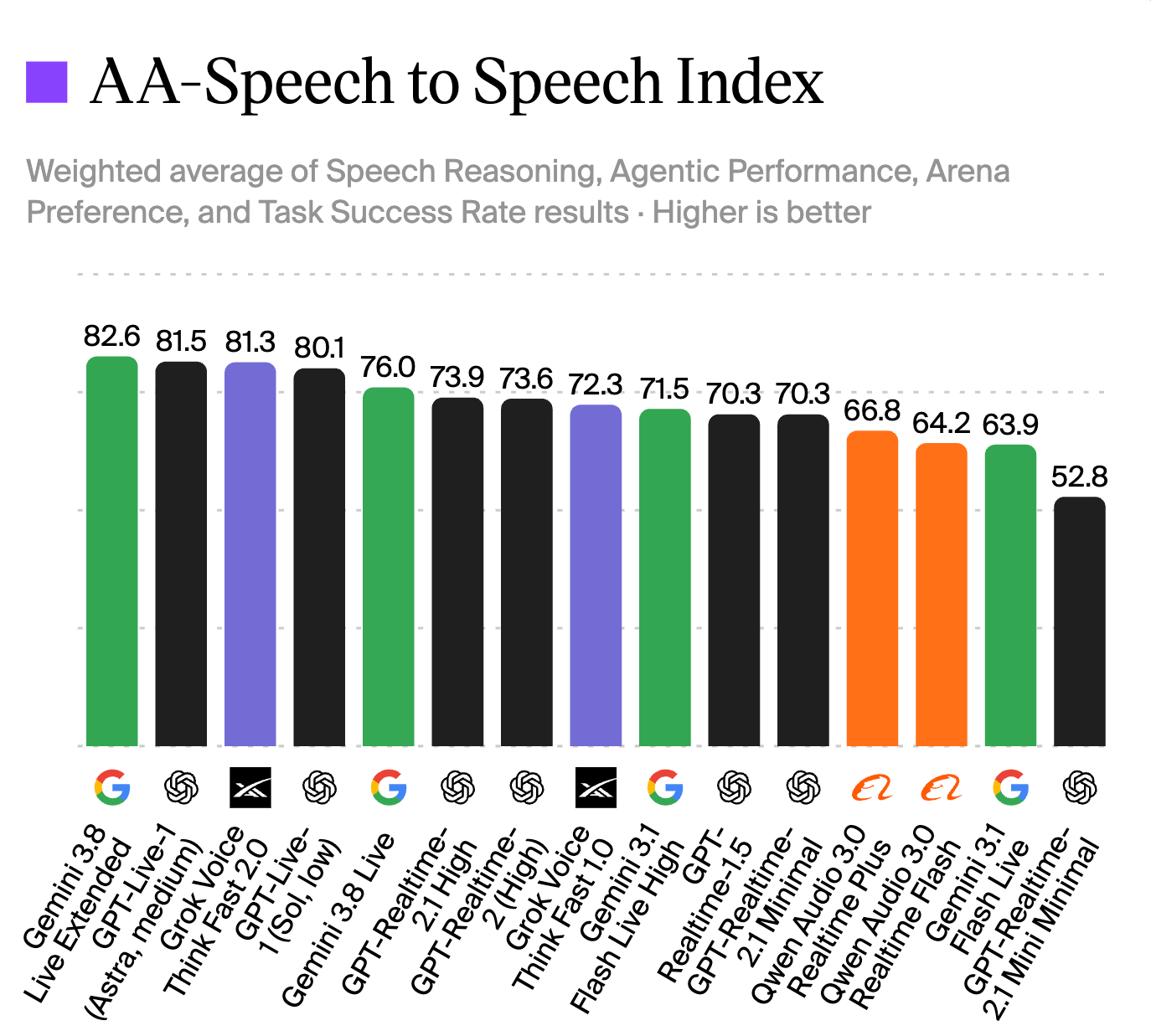
Google released Gemini 3.8 Live and Gemini 3.8 Live Extended Thinking on September 15, calling them its most advanced audio models yet.
The two models talk, reason, and handle tasks. But how do they rank with independent analysts? The Extended Thinking version topped Artificial Analysis’ Speech-to-Speech Index at 82.6, ahead of GPT-Live-1 and Grok Voice.
Follow us on X to get the latest news as it happens
How the Benchmarks Rank Google’s Newest Conversational AI Model
Artificial Analysis’s Index averages speech reasoning, agentic performance, arena preference, and task success rate.
Gemini 3.8 Live Extended Thinking, tested at high reasoning effort, debuted in first place. GPT-Live-1 Astra followed at 81.5 and Grok Voice Think Fast 2.0 High at 81.3.

The standard Gemini 3.8 Live placed fifth with a score of 76.0. Both variants beat Gemini 3.1 Flash Live High, which scored 71.5.
The agentic gap is wider. Extended Thinking reached 68.6% on the Tau Voice benchmark, against 37.7% for the previous generation.
On the speech reasoning benchmark, Extended Thinking scored 97.7%, edging Grok Voice at 97.2%. However, it trailed Qwen Audio 3.0 Realtime Plus, which scored 99.2%.
Human Testers Still Reach for the Older Gemini Model
Price is where the distance opens up. The standard model runs $0.84 per hour of input audio. That is roughly half its predecessor’s $1.75 and the Index’s cheapest rate.
Extended Thinking runs at $3.50 per hour. That undercuts GPT-Live-1 Sol at $4.47 and Grok Voice Think Fast 2.0 High at $4.80.
Latency fell as well. Average time to first audio dropped to 1.18 seconds, compared with 2.99 seconds for the older Gemini model.
Listeners, however, are not fully sold. Gemini 3.1 Flash Live still leads in preference in blind Speech Agent Arena conversations, with an Elo of 1096.
Gemini 3.8 Live sits second at 1083. The Extended Thinking variant trails at 990, despite completing 89.1% of its tasks.
Voice AI is now being graded on two scales that point in different directions. Benchmarks reward the model that reasons hardest. Preference rewards the one who talks best. Google is currently leading both, with different models.
Subscribe to our YouTube channel to watch leaders and journalists provide expert insights
The post Google Just Released Its Most Advanced Audio Model. Here Is How It Ranks appeared first on BeInCrypto.
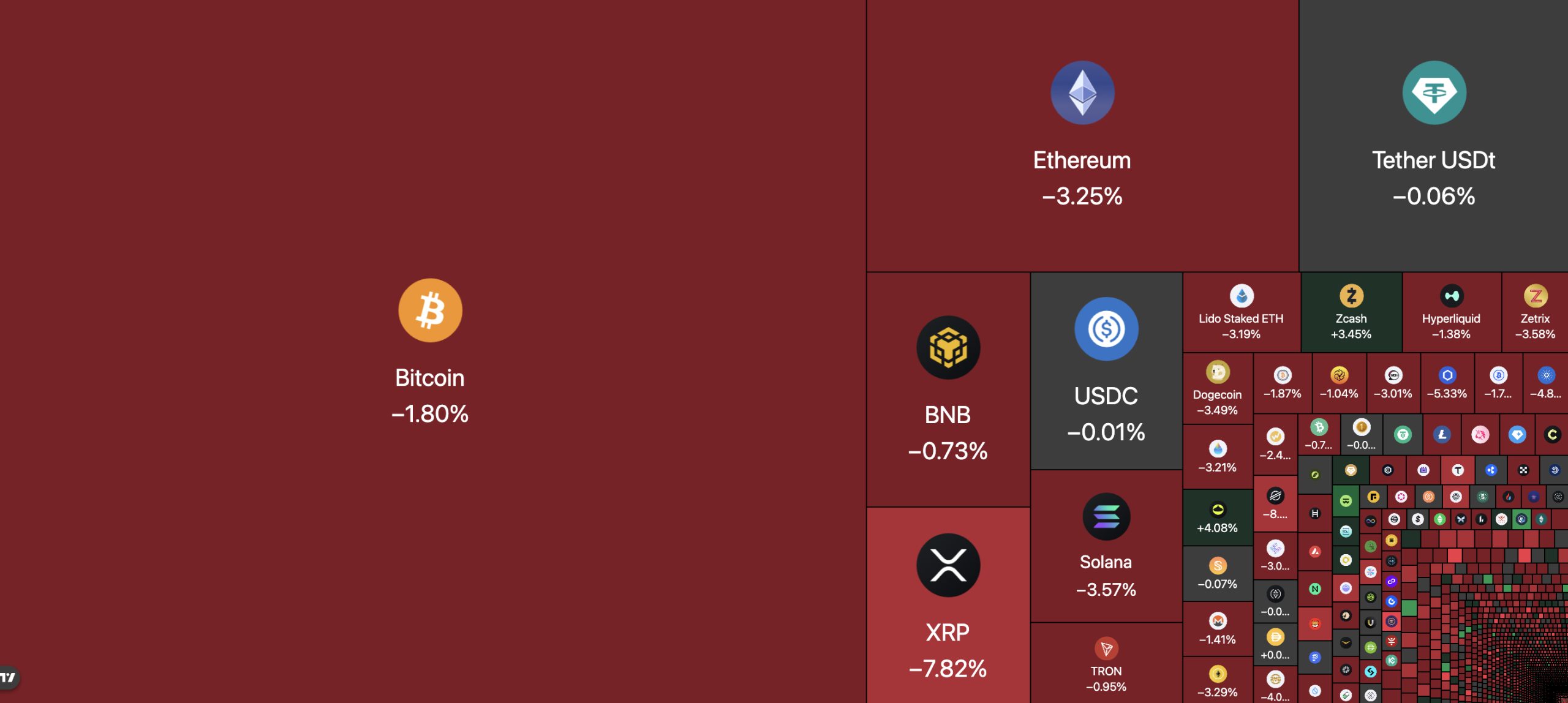
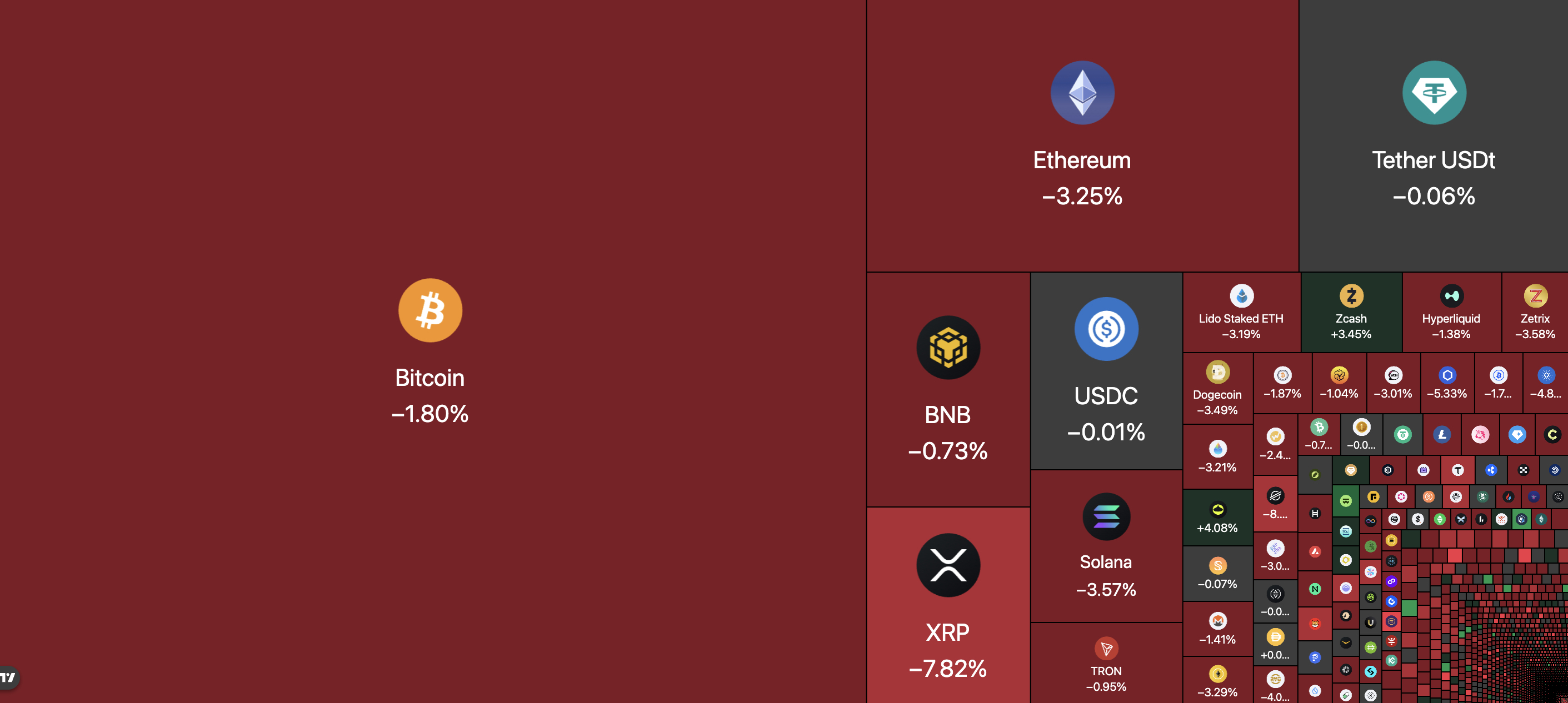
Bitcoin price fell 4% in US trading and stabilized at around $75,900 as of 8 a.m. in London. The decline came after the US failed to advance a key crypto regulatory bill, weakening industry sentiment ahead of a potential Federal Reserve interest-rate hike.
The combination puts regulatory developments and monetary policy at the center of the market backdrop. We see that the whole crypto market was also weaker after steep declines during the US session.
The immediate regulatory issue was the US failure to advance a key crypto bill. Reuters had reported before the vote that the Senate was preparing to take a procedural vote on the Clarity Act, a measure that could help determine the bill’s fate. The legislation would address legal ambiguity around whether tokens qualify as securities or commodities, according to Reuters.
That setback arrived while investors were also assessing the prospect of higher US interest rates. Bloomberg described the regulatory disappointment as weighing on sentiment just ahead of a potential Fed hike. The two developments provided the context for Bitcoin’s US-session decline and the broader weakness across crypto assets.
Reuters reported on Sept. 14 that traders assigned an 85% likelihood to a rate hike on Wednesday following hot inflation data. That figure was a snapshot of expectations reported at the time, rather than a permanent measure of market consensus.
Earn $50 and Enter $300K Prize Draw on EdgeX
What the Rate Odds Do, and Do Not?
Rate probabilities reflect market pricing and can change as new economic information arrives. CME FedWatch says its probabilities of future Federal Reserve target-rate changes are implied by prices for 30-Day Fed Funds futures. Its methodology makes it a reference for how interest-rate traders are pricing upcoming policy decisions.
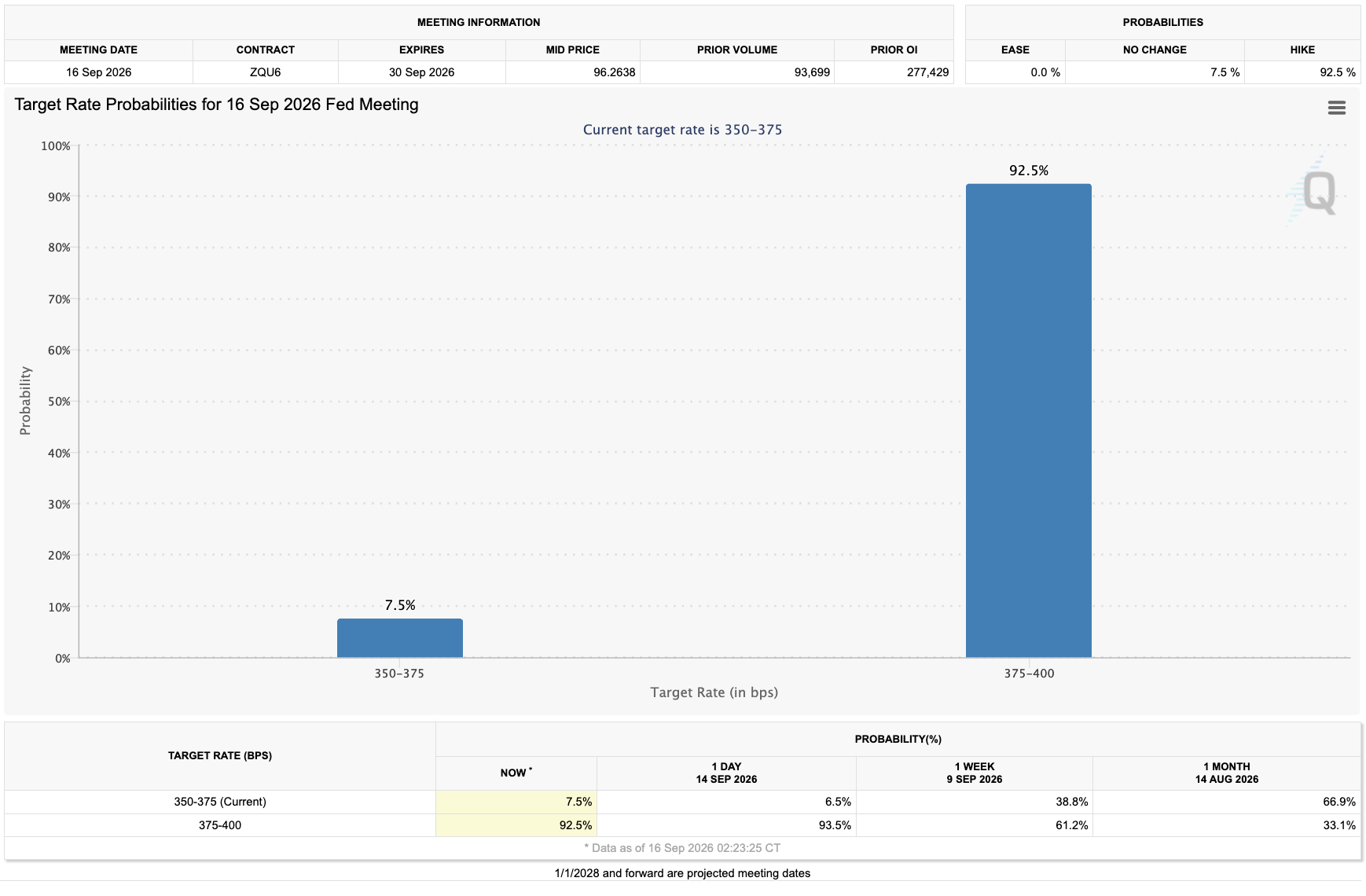
The available reporting supports the existence of elevated hike expectations, but it does not establish a precise causal chain between any one market variable and Bitcoin’s 4% decline. The reported backdrop was a potential rate increase alongside the failure to advance the US crypto bill.
Reuters also noted that elevated inflation had raised expectations of a Fed hike and that long-end bond yields were nearing 5%, creating more competition for capital. The report described a rate increase as a challenge for speculative assets, including Bitcoin.
Trade the Odds and Make Your Prediction Count With $25 For Free on Kalshi
The Next Bitcoin Price Test
The Federal Reserve decision is the next scheduled policy event highlighted in the reporting. The decision would test the optimism that had returned to Bitcoin after its late-August rebound. Bloomberg similarly identified a potential Fed rate increase as an immediate source of pressure for the crypto market.
The regulatory question remains separate from the rate decision. The failed effort to advance the bill leaves the legislation’s future unresolved, while the Fed’s policy decision concerns the interest-rate outlook. Together, those issues frame the near-term conditions facing Bitcoin after its decline in US trading.
Bitcoin’s level near $75,900 at 8 a.m. in London marked the point of stabilization reported by Bloomberg. The broader crypto market, however, remained weaker after the steep US-session declines.
Discover: The Best Token Presales
The post Bitcoin Price Stabilizes Near $75,900 After 4% US-Session Drop appeared first on Cryptonews.

Fundstrat’s Tom Lee expects the Federal Reserve to raise interest rates by 25 basis points today, arguing the move could still spark a substantial equity rally rather than derail one.
The Federal Open Market Committee (FOMC), the Fed’s rate-setting panel, meets today, with a decision expected at 2 p.m. ET. Lee said the hike would remove pressure for further increases, a shift he called bullish for stocks, since it would send Treasury yields lower.
Why Lee Sees the Hike as Bullish
Lee said the Fed does not need to hike to curb inflation. He cited Goldman Sachs data on four temporary distortions, portfolio fees, flash memory, tariffs, and energy.
Together, they add 1.7 percentage points to headline Personal Consumption Expenditures (PCE) inflation.
Those distortions should fade within six months regardless of Fed action, Lee said. He estimated they could cut PCE by about 100 basis points on their own.
Still, Lee said the coming hike likely reflects market pressures rather than the Fed’s own read on the economy.
“I don’t know if the Fed really needs to accelerate that process.”
— Tom Lee, CNBC
Lee expects markets to treat the hike as the last of this cycle. He pointed to heavy cash on the sidelines and a string of down days as fuel for a rebound.
S&P 500 Target and the AI Trade
Lee reiterated his view that corporate earnings have not yet peaked. He pointed to depressed housing investment as room for growth, potentially adding $30 to $50 to S&P earnings.
He said the S&P 500 could top 8,200 by year-end, extending earlier bullish stock calls. Technology and software shares, he added, are leading the gains.
Lee added that artificial intelligence (AI) remains central to US economic growth, even as recent developments raise new safety and oversight questions.
Lee still expects a larger pullback later this year, tied to margin debt, leverage, and initial public offering (IPO) activity. For now, he said pessimism itself is why markets have not yet peaked.
The post Tom Lee Sees Fed Rate Hike Today: Predicts a Big Equity Rally appeared first on BeInCrypto.
Crypto World
The Fed rate decision is shaping up to be a nightmare for Warsh. Bitcoin might still shine


According to Brooks, the primary narrative is not today’s anticipated rate hike, but rather the additional policy tightening expected later this year. Warsh may therefore struggle to deliver a message that aligns with the aggressive pricing currently seen in the markets.
“Tomorrow’s Fed meeting is a nightmare for Warsh. There’s no way he can live up to all the hikes priced, so the press conference will likely disappoint markets. The Dollar is likely to fall and long yields likely to rise,” Brooks said.
A weaker dollar typically supports dollar-denominated assets, including bitcoin and gold, reflecting a well-documented negative correlation between digital assets and the U.S. Dollar Index (DXY). Further, as Brooks noted, longer-duration Treasury yields are likely to rise if the press conference disappoints.
The yield catalyst
While rising yields are traditionally a bearish signal for non-yielding assets like bitcoin and gold, some observers note that the underlying driver matters. In this instance, yields are expected to climb due to an inflation signal from the Federal Reserve rather than an optimistic economic growth outlook, a crucial distinction that alters the typical market playbook.
According to a JPMorgan scenario analysis shared by Barchart, if the Fed hikes rates without delivering explicit, hawkish forward guidance, investors could conclude that current monetary policy remains too accommodative, prioritizing economic growth over restraining inflation.
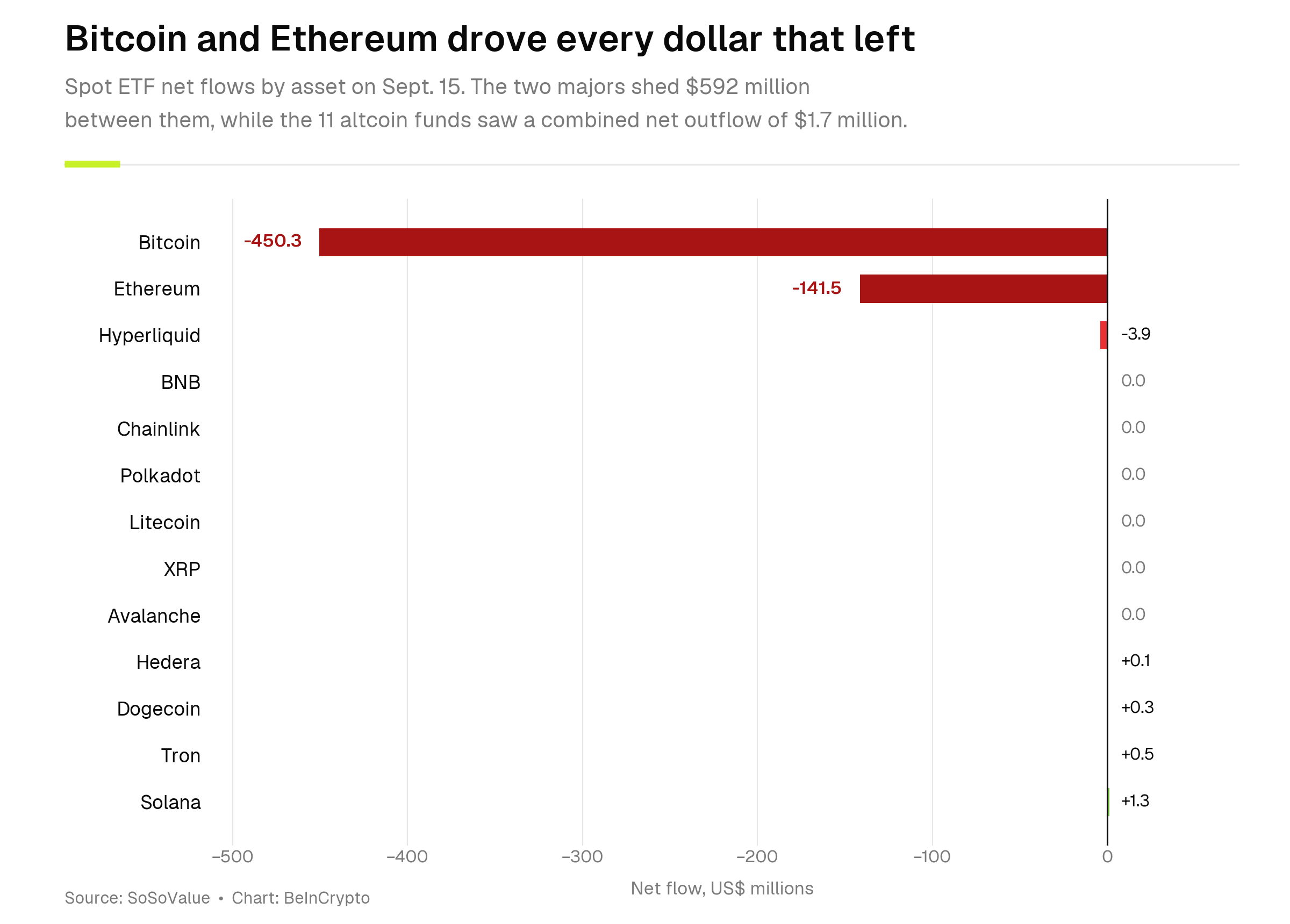
Bitcoin (BTC) and Ethereum (ETH) spot ETFs shed a combined $592 million on September 15. Both products posted their deepest single-day outflows in months.
The outflows landed as the CLARITY Act failed to advance in the US Senate. The setback pulled prices lower, and capital followed them out.
Ethereum ETFs Record Their Worst Session Since January
Ethereum (ETH) funds lost $141.47 million, their largest daily outflow since January 30, according to SoSoValue data.
Nothing in that stretch came close. The worst session in between drained $136.4 million on March 19.
The selling followed four straight weeks of inflows. ETH products took in $1.94 billion over that run, peaking at $824.4 million in late August.
Bitcoin funds gave up $450.33 million, their worst session since June 25. Outflows hit $462.7 million last week, the heaviest since early July, after three weeks of heavy buying.
Trading volume told the same story. Bitcoin products saw turnover of $4.35 billion, compared with a 30-day average of $2.74 billion. Ethereum volume more than doubled its own baseline.
Follow us on X to get the latest news as it happens
Altcoin Funds See Mixed Performance
Hyperliquid (HYPE) was the only altcoin product to record an outflow. Its funds lost $3.89 million, extending a September decline of $18.04 million.
Four funds drew money in. Solana (SOL) ETFs led with $1.35 million. Tron (TRX), Dogecoin (DOGE), and Hedera (HBAR) added less than $500,000 each.

Six funds recorded no activity at all. BNB (BNB) XRP (XRP), Chainlink (LINK), Avalanche (AVAX), Polkadot (DOT), and Litecoin (LTC) all logged zero flows. The 11 altcoin funds ended the day with a combined net outflow of $1.66 million. They hold $3.55 billion between them.
Both ETH and BTC ETFs still sit in positive territory for September. Bitcoin funds hold a $17.1 million net gain month to date, while Ethereum funds carry $307.4 million. One session, however heavy, has not erased the month.
The Federal Reserve announces its rate decision on Wednesday, a second policy test within 24 hours.
Subscribe to our YouTube channel to watch leaders and journalists provide expert insights
The post Bitcoin, Ethereum ETFs Bleed $592 Million as Clarity Act Fails in Senate appeared first on BeInCrypto.


Phemex CEO Federico Variola says AI has been a ‘net negative’ for crypto, despite the crypto exchange announcing an AI-focused transformation earlier this year.
Speaking on Cointelegraph’s Chain Reaction, Variola said AI has diverted capital away from the industry, while empowering attackers and driving up cybersecurity costs for smaller teams — pressures that risk pushing crypto toward greater centralization.
“It’s difficult to be bullish about AI in crypto,” he said. “Liquidity have been significantly diverted to to that industry on one side. On the other hand, AI has empowered a lot of bad actors that have been exploiting protocols.”
“It’s difficult to envision a world in which AI is going to favor crypto specifically as an industry, since a lot of the fixes that we see actually encourage more centralization rather than less centralization.”
Variola’s assessment offers a skeptical view of AI’s impact on crypto. It also comes after his crypto exchange announced an AI transformation in February, when he outlined plans to embed the technology across product development and internal operations, though his latest views focused on the broader crypto industry.
AI raises stakes for crypto security
Variola’s take also comes as AI has been linked to recent crypto exploits.
In July, attackers drained roughly $116 million in Bitcoin from more than 5,200 addresses affected by a Coldcard hardware wallet flaw that is widely believed to have been discovered through the malicious use of AI.
Coinkite CEO Rodolfo Novak warned developers at the time that the “sober reality” is that AI-assisted code review can now uncover bugs that outpace the industry’s most seasoned experts.
“AI has empowered a lot of bad actors that have been exploiting protocols, whether with social engineering or… finding vulnerabilities,” said Variola, adding that small teams working on protocols will no longer operate without a massive cybersecurity budget.
He also warned that the AI threats could make self-custody and decentralized finance less appealing.
“As AI becomes more pervasive, and whether it is your devices being hacked or social engineering, or all these kinds of strategies that are empowering threat actors, that makes DeFi a lot less appealing for a retail user because you have to worry about so many things that you didn’t have as much before.”
On the other hand, security experts have also highlighted AI’s defensive potential. CertiK senior blockchain investigator Natalie Newson told Cointelegraph in April that “AI can also be one of the biggest defenses,” even as she warned that the technology was making attacks more sophisticated.
Despite his assessment of AI’s overall impact, Variola said he sees practical benefits with AI agents, specifically to help investors build a portfolio or help them make better trading decisions. However, Variola said he did not expect AI agents to fully replace human trading decisions.
“At the end of the day, still it will be up to the user to make the final decision. So I don’t think that agents will ever replace that action of taking the trade.”
Magazine: Why are AI’s biggest companies suddenly asking to slow down?
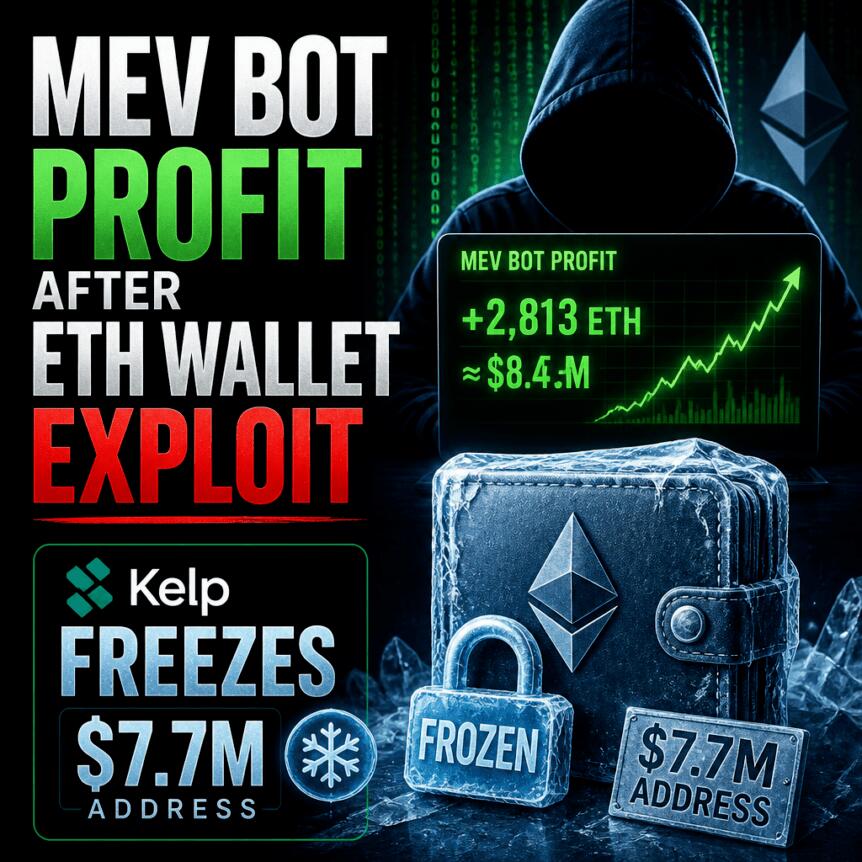
An attempted extraction of roughly $7.7 million worth of rsETH from an Ethereum Safe was disrupted after an MEV bot intercepted the transfer. Blockchain security firm Blockaid says the incident began with a malicious custom module attached to the victim wallet, which redirected liquidity into a setup designed to unwrap into rsETH.
According to Blockaid, about $7.73 million in rsETH had been compromised when it reported the attack. However, a separate automated actor captured the tokens first, and the receiving address was then placed under a short 24-hour pause by the rsETH protocol’s operator, Kelp.
Key takeaways
- Blockaid attributes the initial loss to a custom module connected to an Ethereum Safe wallet that was used to route tokens into a malicious Uniswap v4 hooked pool.
- An MEV bot (“Yoink”) front-ran the exploiter and obtained the rsETH before the attacker could control the funds.
- Kelp responded with a 24-hour pause at the receiving address level, while stating rsETH remains fully backed and its core contracts were not impacted.
- Minting, withdrawals, and integrations reportedly continued normally during the investigation.
How the Safe-to-rsETH extraction attempt worked
In its report, Blockaid described an exploitation path that leveraged Ethereum Safe’s module system. The attacker used a public “keeper multicall” to invoke a custom Uniswap v4 liquidity module associated with the victim Safe, steering funds into an attacker-created liquidity environment.
That attacker-controlled pool was configured so that aEthrsETH could be unwrapped into rsETH, effectively converting the routed position into the token the attacker intended to extract. Blockaid identified the affected wallet as a Safe belonging to an unidentified user, and said rsETH losses were on the order of $7.73 million at the time of its initial update.
Blockaid’s post also links the broader incident to a specific on-chain transaction on Etherscan, where the follow-on movement of assets showed how the attempted outflow unfolded.
The MEV bot that changed the outcome
Rather than letting the original exploiter take custody of the rsETH, an MEV bot known as Yoink stepped in first. As described in Blockaid’s account, Yoink monitors blockchain transactions for profitable opportunities, and in this case front-ran the step needed to capture control of the tokens.
Blockaid pointed to Etherscan transaction data showing Yoink transferring approximately 18.93 ETH—roughly $46,000 at the time of the observed conversion—to an address labeled as a “block builder” within the same transaction. While the figures relate to the bot’s subsequent transfer rather than the initial rsETH amount, they illustrate that the MEV opportunity was executed quickly after the exploit transaction entered the mempool.
In practical terms, MEV front-running did not “prevent” the exploit attempt from being constructed; it instead redirected the settlement outcome by capturing the assets before the attacker could complete its intended withdrawal path.
Kelp’s response: a targeted pause, not a protocol shutdown
After the MEV bot intercepted the tokens, Kelp—described as the protocol behind rsETH—placed the address that received the funds under a 24-hour pause. The move was aimed at temporarily preventing transfers from that destination while security experts investigated.
Kelp said the measure was a precaution at the wallet/address level and emphasized that the protocol’s own contracts were not the affected component. In a statement posted on X, Kelp characterized the pause as “a precautionary, wallet-level measure only,” adding that rsETH “remains fully backed.”
Importantly for holders, Kelp also indicated operational continuity: minting, withdrawals, and integrations were continuing normally as the investigation proceeded. The protocol’s messaging suggests that any risk exposure was contained to the exploited Safe/module pathway rather than a systemic contract vulnerability.
What remains uncertain—and what investors should watch
Based on Blockaid’s description and Kelp’s response, the incident centers on an attacker leveraging a custom module connected to a specific Safe, while Kelp asserts its core contracts were not compromised. Even with that reassurance, the episode underscores how Safe module permissions can be a critical control surface: if a malicious module is enabled or if the wallet is tricked into executing a malicious multicall, assets can be routed into nonstandard flows.
With Kelp’s 24-hour pause window now the immediate timeline focal point, the next questions are whether the paused address can be safely recovered, whether further addresses or transactions are linked to the same exploit chain, and whether similar module-based patterns emerge elsewhere. Readers tracking rsETH should also watch for updates from Kelp and security researchers on post-incident analysis and any guidance aimed at Safe/module operators.

UK food wholesaler falls into administration after 6 years

UK inflation pushed up by petrol and diesel price rises

Ethereum Price Prediction: ETH Shrugs Off CLARITY Act and Fed Decision, Could Break $3,000



-

 Fashion5 days ago
Weekend Open Thread – Corporette.com
-

 Business6 days ago
Micron Stock Climbs Above $1,031 as AI Memory Crunch and a $50 Billion Outlook Fuel the Rally
-

 Tech3 days ago
The Latest Weird Thing to Play Doom Is the Mapped-Out Brain of a Fruit Fly
-

 Business6 days ago
AMD Stock Climbs After Management Lifts 2027 Data Center Outlook Toward $70 Billion in AI Sales
-

 Crypto World5 days ago
XAG/USD: Silver’s Short-Term Rally Meets Its Moment of Truth
-

 Business5 days ago
10 Most-Streamed Songs On Spotify In 2026 So Far, Led By Ella Langley’s Dominant Run On The Charts This Year
-

 Crypto World6 days ago
2 Chip Stocks Broke Out This Week. Neither Was Nvidia
-

 Crypto World6 days ago
Pi Network ships Protocol 27 on a network with 14 million users and zero DeFi
-

 Tech6 days ago
Battery life is the only iPhone 18 Pro and iPhone Duo upgrade I care about. Apple didn’t disappoint
-

 Crypto World5 days ago
OKX launches 10x OpenAI, Anthropic X-Perps in Europe
-

 Crypto World5 days ago
Diesel Tops $6 a Gallon for the First Time as 28 States Set Records
-

 Tech6 days ago
Apple Watch Ultra 4 vs Watch Ultra 3: Should you really spend another $799?
-

 News Videos5 days ago
Facing Financial Fears
-
 Crypto World6 days ago
Bitcoin price risks $70K if $78K neckline breaks
-

 Entertainment6 days ago
Case Sees Major Update As Jury Deliberations Begin
-

 Business3 days ago
Rivals Sam Altman and Elon Musk Rally Behind Dario Amodei’s Call for a Slowdown in AI Development
-

 Crypto World2 days ago
Elon Musk Drops a Bombshell: Grok 5 Could Be the AGI Breakthrough
-
Crypto World5 days ago
Ethereum Price Analysis: Consolidation at $2.5K Tests Momentum as On-Chain Activity Surges
-
Crypto World7 days ago
Ripple Price Prediction: What to Expect for XRP as a Major Macro Week Approaches
-

 Business6 days ago
Western Digital Slips 2.7% as AI Storage Rally Cools After Record Cash and Guidance
You must be logged in to post a comment Login