
Crypto World
Bitcoin’s most-used software is getting a major update. Here’s what actually changes



Bitcoin Core, the software used to run Bitcoin nodes, has moved its next major update into final testing with changes to transaction fees, block processing and the way wallets build transactions.
The first release candidate for Bitcoin Core 32.0 was tagged on Sept. 14, starting the final testing cycle before developers aim to release the finished version on Oct. 10, according to the project’s release schedule.
Bitcoin Core lets a computer independently check transactions and blocks against Bitcoin’s rules rather than relying on another service. Version 32 does not change those rules.
Bitcoin Core currently estimates how much a user should pay for a transaction largely by looking at the fees attached to transactions that made it into previous blocks. Version 32 adds a second estimator that looks at transactions currently waiting to be confirmed.
The software will compare the two and can recommend the lower fee when current network conditions support it. That should let estimates fall more quickly when congestion clears instead of continuing to reflect more expensive transactions from earlier blocks, according to the draft release notes.


Key takeaways
- Bitcoin traded near $75,950 after falling more than 1% on Tuesday.
- Ethereum and XRP declined more than 4% and 9%, respectively.
- BTC remains above its 50-day, 100-day, and 200-day EMAs.
Bitcoin (BTC) traded near $75,950 on Wednesday after declining more than 3% during the previous session as the CLARITY Act failed to advance in the US Senate.
Ethereum and XRP suffered steeper losses, falling more than 4% and 9%, respectively. Despite the market-wide pullback, Bitcoin remains above its major exponential moving averages, preserving its broader bullish structure.
Traders now await the Federal Reserve’s interest-rate decision and Chair Kevin Warsh’s forward guidance, which could determine the cryptocurrency market’s next major move.
CLARITY Act failure pressures crypto prices
The cryptocurrency market weakened on Tuesday after the CLARITY Act failed to secure sufficient support to advance in the Senate.
The setback reduced expectations that Congress would soon establish a comprehensive regulatory framework for the US digital-asset market. Bitcoin fell more than 3%, while greater selling pressure across altcoins pushed Ethereum and XRP sharply lower.
Prices stabilized on Wednesday, but uncertainty surrounding US monetary policy kept buyers cautious.
The Federal Reserve’s rate decision and subsequent guidance could influence liquidity expectations, Treasury yields, and demand for risk assets. A more restrictive outlook could extend the crypto market’s correction, while a less hawkish message may support a recovery.
Bitcoin maintains bullish EMA structure
Bitcoin continues to trade above its 50-day, 100-day, and 200-day exponential moving averages, which are clustered between approximately $71,400 and $73,600.
The 50-day EMA stands at $73,581, while the 200-day EMA is positioned slightly lower at $73,108. The 100-day EMA provides additional support at $71,391.
This configuration remains constructive because BTC is trading above all three averages and the shorter-term 50-day EMA remains above the longer-term indicators.
However, Bitcoin must defend this support cluster to prevent the recent pullback from developing into a deeper correction.
Bitcoin’s Relative Strength Index has slipped to approximately 49, placing it near neutral territory.
The reading indicates that neither buyers nor sellers have established strong momentum. However, the decline from higher levels shows that bullish demand has weakened following Tuesday’s sell-off.
The Moving Average Convergence Divergence indicator remains negative and below the zero line. This suggests that Bitcoin’s broader bullish structure is still intact, but short-term momentum currently favors consolidation or further downside.

The 50-day EMA at $73,581 represents Bitcoin’s first important support level. If sellers push BTC below that level, the 200-day EMA at $73,108 could provide the next line of defense. A deeper correction would place the 100-day EMA at $71,391 in focus.
Failure to hold the entire moving-average cluster could expose the lower horizontal support levels at $66,500 and $62,300.
On the upside, Bitcoin faces significant resistance near $85,000. A sustained recovery above that barrier would signal renewed bullish strength and potentially restart the broader uptrend.


Key takeaways
- ETH traded near 0.03167 BTC as its performance against Bitcoin weakened.
- A potential double top has formed with two peaks around 0.03344 BTC.
- A close below the 0.03078 BTC neckline could trigger a 10% decline toward 0.0283 BTC.
Ethereum is showing signs of further underperformance against Bitcoin as a potential double-top pattern develops on the ETH/BTC daily chart.
Ether traded near 0.03167 BTC on September 16 after failing to sustain its latest advance. Weakening momentum, growing regulatory uncertainty, and a sharp increase in ETH deposits to Binance support a cautious near-term outlook.
A confirmed breakdown below 0.03078 BTC could send the pair approximately 10% lower toward 0.0283 BTC.
ETH/BTC double top signals potential decline
The ETH/BTC chart has formed two comparable peaks near 0.03344 BTC, with the first appearing in August and the second in September.
This structure resembles a double top, a bearish reversal pattern that develops when buyers repeatedly fail to break through the same resistance level.
The pattern’s neckline sits near 0.03078 BTC. Ethereum would need to record a decisive daily close below this level to confirm the bearish setup.
Subtracting the pattern’s height from the neckline produces a downside target around 0.0283 BTC. Reaching that level would represent an approximately 10% decline from Ether’s current value against Bitcoin.
Ethereum momentum weakens
The ETH/BTC Relative Strength Index has fallen toward 50 after previously moving above the overbought threshold of 70.
Although the RSI remains slightly above neutral, its retreat indicates that the momentum supporting Ethereum’s August-to-September recovery is fading.
Ether is still holding marginally above its 20-day exponential moving average at approximately 0.03162 BTC. A strong rebound from this moving average could delay or prevent the bearish breakdown.
A sustained move above the two peaks at 0.03344 BTC would invalidate the double-top scenario and restore a more bullish relative outlook for ETH.
The bearish technical setup emerged as the US Senate failed to advance the Digital Asset Market Clarity Act on September 15.
The procedural vote received 50 votes in favor and 49 against but fell short of the 60 votes required to move the legislation forward. A procedural vote change by Senator Thom Tillis preserves the possibility of reconsidering the measure.
The setback triggered a wider cryptocurrency sell-off. Bitcoin declined approximately 4% to around $75,900, while shares of major crypto companies, including Coinbase and Circle, also fell.
Regulatory uncertainty can encourage traders to favor Bitcoin over more risk-sensitive assets such as Ethereum. This could increase pressure on the ETH/BTC pair and bring the 0.03078 BTC neckline back into focus.
Binance receives 709,400 ETH in one day
Ethereum deposits to Binance have also increased sharply, creating another potential source of selling pressure.
Approximately 709,400 ETH moved onto the exchange on September 11, marking the highest daily inflow since June, according to CryptoQuant. Several recent sessions also recorded inflows exceeding 500,000 ETH, considerably above typical July and August levels.
Rising exchange inflows increase the amount of ETH immediately available for trading. Although transfers to exchanges do not necessarily mean holders intend to sell, unusually large deposits can precede higher market supply and increased volatility.

The elevated inflows reinforce the cautious outlook created by Ethereum’s weakening relative momentum and the CLARITY Act setback.
ETH/BTC bulls must defend 0.03078
The bearish scenario depends on ETH/BTC closing decisively below the 0.03078 BTC neckline. Confirmation could open the path toward the measured target of 0.0283 BTC.
However, support from the 20-day EMA near 0.03162 BTC could allow Ether to rebound. A break above 0.03344 BTC would invalidate the double top and signal renewed Ethereum strength against Bitcoin.
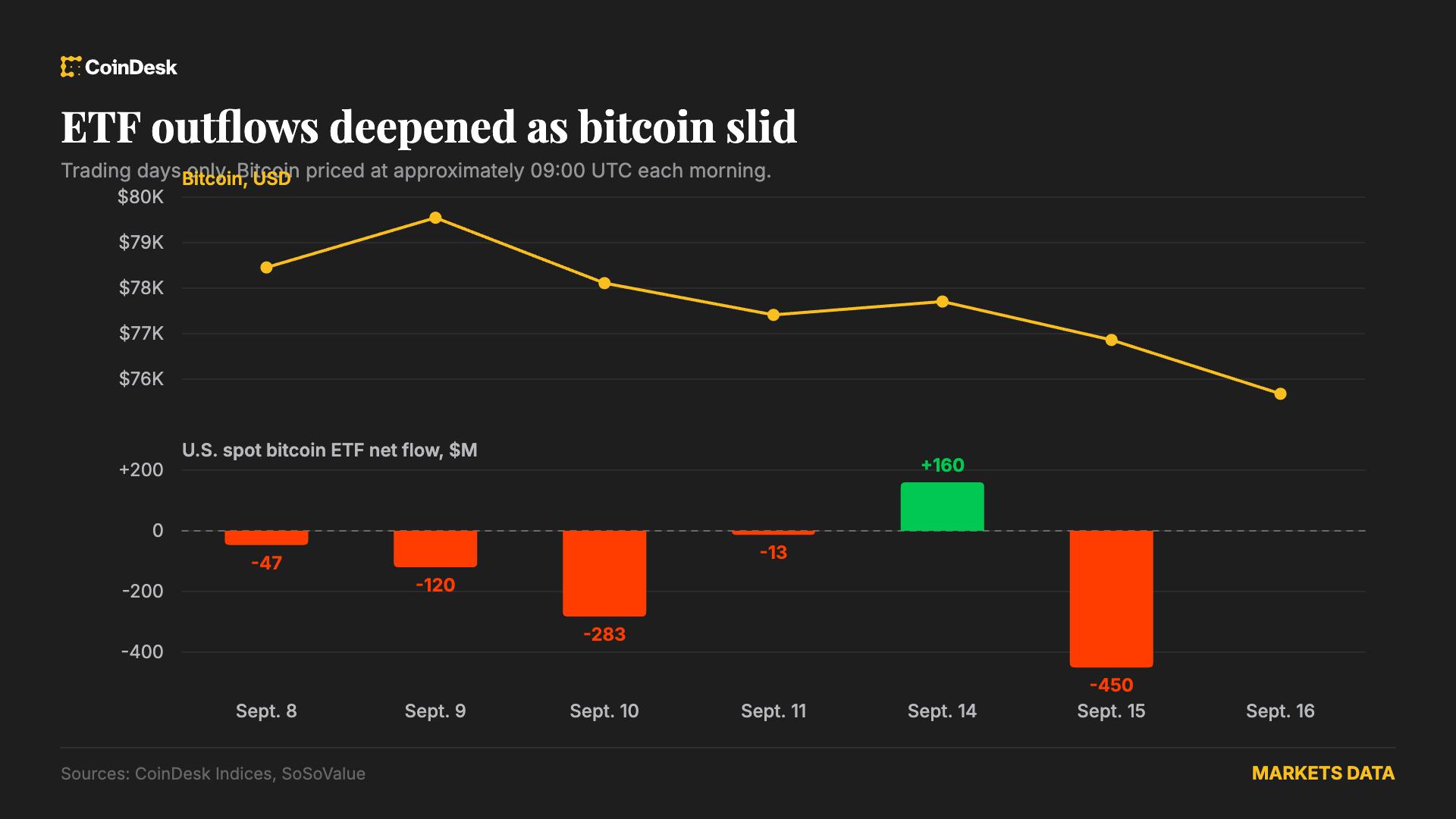
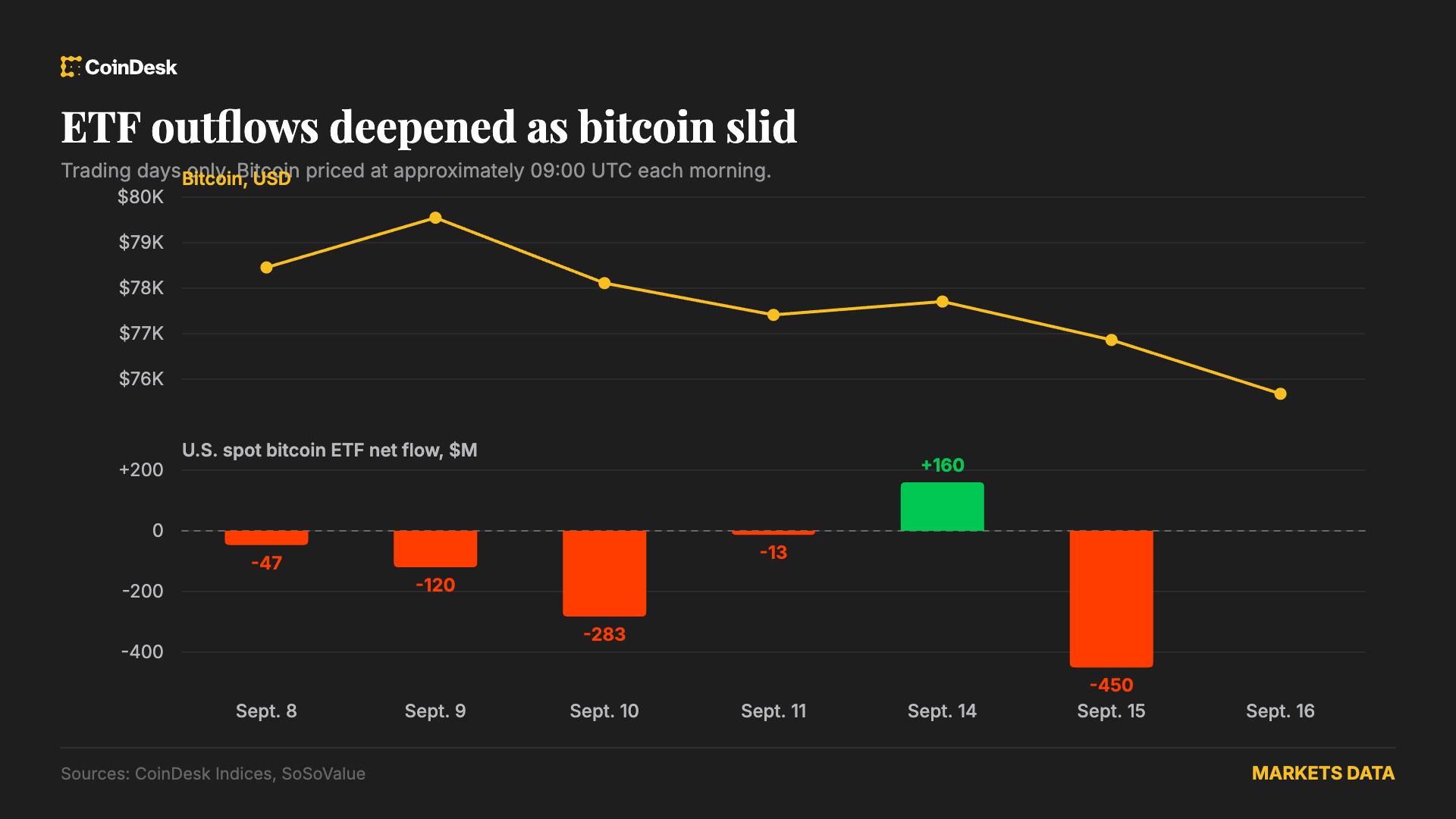
U.S. spot bitcoin ETFs shed $450 million on Tuesday, according to SoSoValue, the heaviest single-day outflow since June 25, after the U.S. Senate declined to advance the Digital Asset Market Clarity Act.
Bitcoin is little changed since midnight UTC, after dropping following the vote, which garnered around 10 fewer votes than the 60 required. Among those opposing the motion were seven Democrats who had spent months negotiating the text.
The CoinDesk 20 Index also held its loss, dropping less than 0.1% since midnight after falling 4.6% on Tuesday in the steepest decline since June 5.
Attention now switches to the Federal Reserve, which announces its interest-rate decision later today, with an increase having been the market’s base case going into the meeting.
The bill’s failure effectively ends any prospect of market structure legislation clearing the Senate this year, with Congress expected to be under split control in January.
Bitcoin’s 24-hour drop of 1.7% seems muted compared with slides in the tokens most exposed to U.S. regulatory treatment.
Stellar fell 9.6% over 24 hours and XRP lost 8.1% Among CoinDesk 100 constituents, a full 95 lost value over the period.
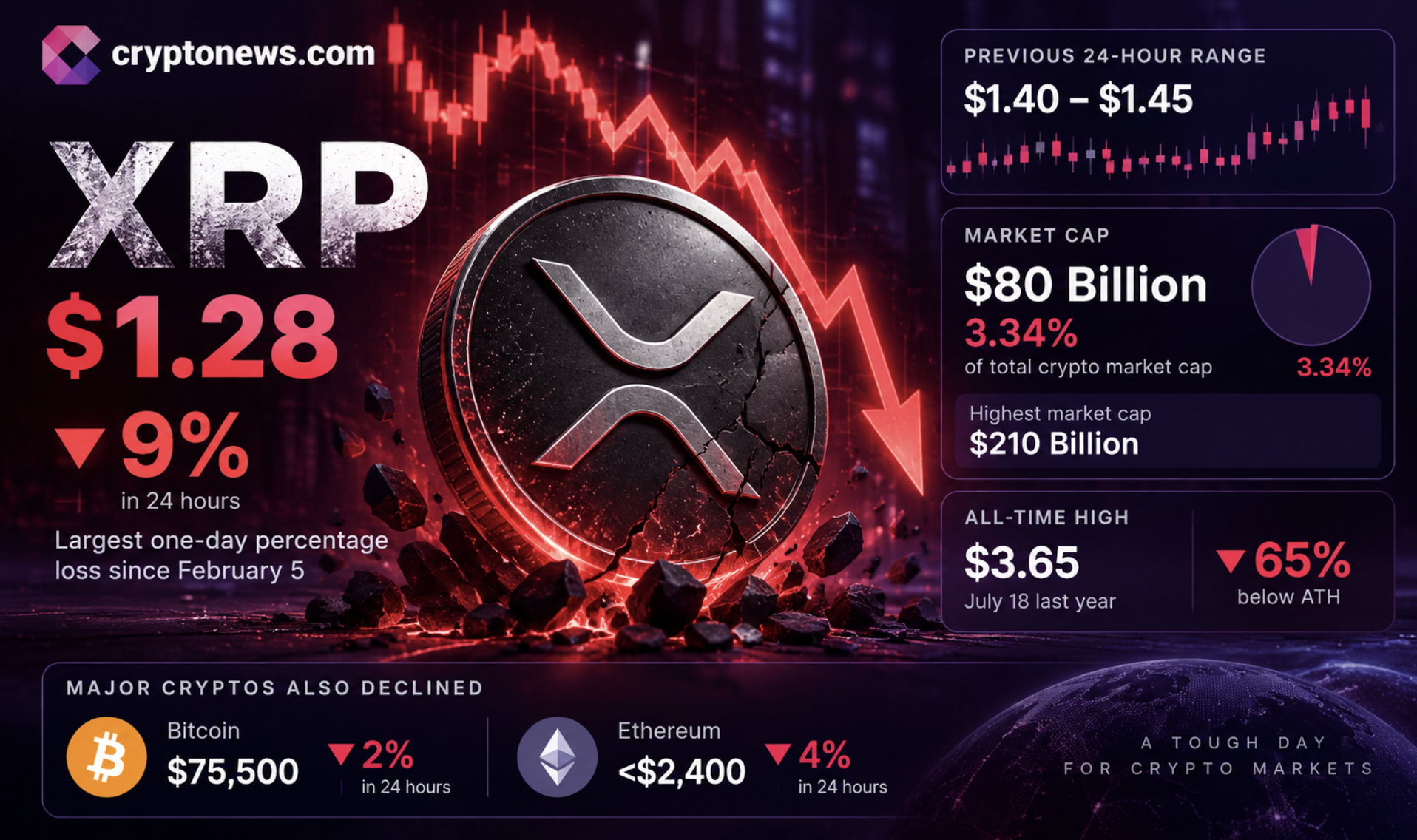
XRP price trades at $1.28, down 9% on the day. The decline was XRP’s largest one-day percentage loss since February 5. The move placed attention on how the token would trade after the sharp fall, as it was trading between $1.40 and $1.45 in the previous 24 hours.
The decline reduced XRP’s market cap to $80 billion, or 3.34% of the total cryptocurrency market cap. XRP’s highest market capitalization was at $210 billion. As this is being reported, the XRP price remains 65% below its all-time high of $3.65, set on July 18 last year.
Other major cryptocurrencies also declined during the session. Bitcoin was last at $75,500, down 2% on the day, while Ethereum traded at under $2,400, down 4%. Those declines provide important market context for XRP’s move.
Trade XRP on Bybit and Get a Chance to Win Our $1,000 USDT Airdrop
Why the $1.28-$1.30 Zone Matters for XRP Price?
XRP is trading at $1.28 after another sharp move lower, with the token down 0.7% over the past 24 hours. The decline becomes more significant across longer timeframes, with XRP down 8.2% over seven days and 10.4% over the past month.
Trading activity remains substantial, with XRP recording approximately $80.46 billion in 24-hour volume. Its market capitalization stands at around $5.88 billion, while the latest price action shows a volatile move lower after several failed recovery attempts.

Discover: The Best Token Presales
At $1.28, XRP is now testing a much lower level following the recent selling pressure. The immediate question for traders is whether buyers can stabilize the price around this area or whether another wave of selling pushes XRP toward fresh lows.
The chart data also shows a volatile recovery attempt followed by another sharp move lower. XRP briefly rebounded from an earlier decline before sellers returned, pushing the price back toward $1.28. That price action makes the current level an important area to watch as the market searches for a potential stabilization point.
For now, the combination of a 10.4% monthly decline and substantial trading volume keeps the focus on whether buyers can absorb the remaining selling pressure.
Earn $50 and Enter $300K Prize Draw on EdgeX
The post XRP Price Loses 10% as Crypto Weakness Deepens appeared first on Cryptonews.


We have watched the alternative play out before. When regulators told websites to obtain consent, they specified the goal and not the method, and the market answered with the cookie banner, the pop-up you dismiss a hundred times a week without reading. Crypto built its own version: upload your ID to everyone. A passport copy in a hundred databases, protecting almost no one and enriching whoever breaches the weakest of them.
And this is only the rehearsal. The internet is being rebuilt around software that acts on our behalf, and the familiar sorting of traffic into “bot” or “human” is already breaking down. A third category is emerging: verified agents transacting, with permission, for real people. Those agents will move money, and they will have to prove they are authorized and what they are allowed to do, at machine speed and machine volume. If they inherit today’s model and drag their owner’s full identity through every service they touch, we will not have a handful of honeypots. We will have billions of them, refreshed continuously, that never sleep.
The $320 million will most likely come back. The addresses, the IDs, and the faces will not. The lesson of these weeks is not that we need higher walls around the data we hoard. It is that we are hoarding data we never needed to collect. The technology to prove without surrendering already exists: provable, private, and portable, for people today and for their agents tomorrow. The only question is whether we adopt it before the honeypot becomes the permanent architecture of both.


I am on hold with music that is no doubt the same music played on loop in the fifth circle of hell. It’s been 35 minutes. It will be 50 minutes before the system will hang up on me because I am not a leaf in its automated customer-service decision tree. I am angry and frustrated. There is no way to talk to an actual human.
My credit card company referred me to a monitoring service when its data systems were breached (again). The monitoring service sends me a sexual-predator alert about my file. What? I can’t get into my account because my password won’t work, and I have to be on the site to change my password.
I call the customer-service number and try to get myself routed to a human by saying the word “agent” 25 times. By the time I get to an actual human, she sympathizes and says that the magic word is “fraud”—you always get to a human immediately because in the case of fraud, the credit card company is the victim. The fraud humans can route you to other humans who can help me change my password. It turns out that no one thinks I’m a sexual predator, I just live in the vicinity of one.
Sound familiar? In the increasingly automated world of customer service, custom service—actual humans who can solve problems and answer questions—is on the wane. What we increasingly get are automated customer-service systems that are frustrating to deal with and don’t solve our problems. Most people call customer service only when something is not working, but it seems that these systems are designed to address “common” problems—problems that you don’t necessarily have. When there are no people to be found to explain things to, you may end up in an endless loop, having a bot tell you the same annoying irrelevant thing over and over. How is that customer service?
In my own fantasy world, customer service is custom service—service that targets my needs and my problems, suggests good solutions, and assists me in implementing them, all via a human who can take into consideration the tangible and intangible contexts relevant to a remediation that fits my needs.
Sounds dreamy, doesn’t it?
Such solutions actually exist in the real world. For instance, in Northampton there is a store that sells bras. When you go there, there are expert humans who work with you to find and fit bras that work for your body. I understand that this is an experience that half of the people around the world (and many of my readers) will never have, but trust me, it’s wonderful. The experts at the store help triage a myriad of choices of bras: different colors, cup sizes, wired and unwired styles, different fabrics, and other options. They listen carefully as you tell them about the kinds of clothes you wear, your lifestyle, and your preferences. In the end, you can get something that really works for you and enjoy the experience of getting there. That experience is way different than choosing something on Amazon and hoping it will fit.
The bra store is all about custom service rather than homogenized, automated customer service. Custom service works there because the bra store is not a mega-company with millions of customers. Plus, we’re probably a ways away anyway from automated systems that will find and fit your bra.
My experience with automated customer service is that it homogenizes individuals and the problems they are likely to have and separates them from the people who can actually help.
Look, I understand that it’s harder and more expensive to do customer service at scale—when you have millions of customers—and that there’s no cost-effective way to hire enough people to give everyone a personalized experience. But there’s something else going on, something we should not lose in cyberspace: a real sense of respect for your customer and an understanding that without satisfied customers, businesses can cease to exist.
You can do custom service at scale with millions of customers. Some companies do this well and they invariably earn my loyalty. When I have a question about my Fidelity account that I can’t answer by going to the website or chatting with the chatbot, I can call Fidelity. Within a relatively brief amount of time, the bot who answers the phone verifies my voice and connects me with a human who can track down the answer to my question. Something similar happens when I call USAA Insurance. In 2025, USAA was in the Fortune 100 and Fidelity was the third-largest mutual fund company in the U.S.
Apple also has a phone number that connects me with real humans who can help solve problems. In addition, they have brick-and-mortar stores with a “Genius Bar” staffed by actual humans who apparently are not allowed to make me feel stupid. (OK, most of these folks are not geniuses, but they understand Apple products and systems way better than I do.) You probably have your own list of companies that make it easy for you to deal with them and easy for you to solve problems. My guess is that all or most of them have knowledgeable humans available early and often.
Digital technologies should help us do things better, not worse. Algorithmic efficiency is not a substitute for human empathy and judgment. Can’t we create a cyberspace that has both?
Reprinted from Better Tech: Putting People First in Cyberspace by Francine Berman with permission from MIT Press. Copyright 2026.


Security researchers have traced more than 1,500 KREMLIN malware infections after uncovering a Brazilian banking campaign that uses Ethereum smart contracts to update attack infrastructure and malicious browser extensions to steal credentials and session data.
Summary
- Elastic tracked KREMLIN across seven campaigns using malicious browser extensions against Brazilian banking users primarily.
- Ethereum smart contracts let KREMLIN operators update command servers and payload locations without changing malware.
- Elastic observed 1,515 infected systems contacting its registered canary domain, with 98.75% located in Brazil.
- KREMLIN manipulates Chromium Secure Preferences to install malicious Chrome and Edge extensions without user approval.
- Researchers traced 82 USDT transfers through the wallet used to deploy and update malicious contracts.
Elastic Security Labs disclosed the operation in a Sept. 14 technical report after tracking the activity under REF9334 since May 2025. Researchers followed seven campaigns over roughly 15 months and linked the latest versions to Chrome and Microsoft Edge extensions capable of collecting browser credentials, cookies, session tokens and other sensitive information.
SlowMist issued a threat-intelligence alert on Sept. 16 drawing attention to the blockchain component of the operation, including three Ethereum contracts linked to changing command-and-control infrastructure.
Despite the name KREMLIN, Elastic said it found no evidence connecting the campaign to Russia. The toolkit name comes from the malware author’s handle, while the lures impersonate Brazilian banks, use Portuguese-language text and overwhelmingly reach systems located in Brazil.
KREMLIN uses Ethereum contracts as changing address books
Ethereum entered the operation in May 2026, when researchers observed the first malicious smart contract tied to KREMLIN’s infrastructure.
Elastic traced the first contract to May 19. It stored configuration values pointing infected systems toward locations used for the installer and malicious browser extension. Later contracts changed the structure and eventually moved to a key-value configuration model that could be updated by the operator.
The current contract identified by Elastic is 0xCD7360A83E5cdbBbbbcEB0e78748babA6740d07b. Researchers said it remained in use when their report was published. Earlier contracts included 0x902EDbFECFF38f285Bf26283fB9cEB3700061873 and 0x64Def0A6099c4DE9C413B108EAae85A3C7457615.
The contracts do not represent an exploit of Ethereum’s consensus system or smart-contract platform. Elastic found that the attackers used the blockchain as a dead-drop resolver: infected machines read configuration values from the contracts to locate external infrastructure controlled or abused by the operators.
Such a design lets operators change infrastructure references by updating on-chain values while leaving the initial malware unchanged. Elastic recorded contract updates pointing toward different domains and hosted files, including a main-v2 configuration change on Aug. 13.
Crypto.news reported in 2025 that malicious npm packages were using Ethereum smart contracts to retrieve command infrastructure. ReversingLabs researchers described a comparable model in which blockchain data contained locations used to reach attacker-controlled servers.
Microsoft found ClickFix campaigns using BNB Chain smart contracts to retrieve malware instructions. Microsoft’s findings involved a separate campaign but showed another example of public blockchains being used as infrastructure for malware configuration.
Malicious extensions can enter Chrome and Edge without approval
KREMLIN’s browser component uses a technique that lets an unauthorized extension appear properly registered inside Chromium-based browsers.
Elastic said the installer modifies Chrome or Edge’s Secure Preferences data and regenerates the HMACs and encrypted integrity hashes the browser expects. Once those values match, the malicious extension can load even though the user never approved an installation through the official extension store.
The technique itself predates the KREMLIN campaign. Security firm Synacktiv documented the approach in 2025 under research titled The Phantom Extension, showing how an attacker with access to a Windows system could alter Chromium preference records and load an extension through internal browser mechanisms.
KREMLIN operationalized that technique for financial theft. Elastic’s analyzed extension masqueraded as software called AVSync and requested access to tabs, cookies, browser storage and web requests. It could collect saved browser data and intercept information during active web sessions.
The malware gathers browser databases containing login information, cookies and stored form data. Elastic found that it acquired encryption material needed to access protected browser data before sending collected information to attacker-controlled infrastructure.
Initial infection still requires execution of a malicious file. Elastic said the campaign distributes JavaScript files disguised as bank receipts, invoices or corporate documents. Once a victim executes the lure, the loader checks the environment before progressing through later stages.
Brazilian financial brands impersonated in campaign material included Banco do Brasil, Caixa, Bradesco, Sicoob, C6 Bank, Inter, BTG, Safra, PagBank, PicPay, Santander and Mercado Pago.
Elastic counted 1,515 infected hosts after disrupting a kill switch
Elastic gained an unusually direct measure of the campaign’s reach after researchers noticed that KREMLIN checked an unregistered internet domain as part of its anti-analysis process.
The malware was designed to test whether the domain responded. A successful response caused the program to assume it was operating inside an analysis sandbox and terminate itself. Elastic registered the previously unused domain and pointed it to infrastructure the researchers controlled.
Infected machines then began contacting the newly registered address. Elastic counted 1,515 systems at the time of publication, with 98.75% geolocated in Brazil. Researchers said the number was rising quickly.
Registering the domain turned KREMLIN’s own anti-analysis check against the campaign. Machines reaching the domain interpreted the response as evidence of a sandbox and stopped progressing through the infection chain.
Elastic cautioned that the intervention was temporary. “This has temporarily degraded and manipulated the campaign’s defense mechanisms,” the researchers wrote, saying the interruption could give defenders more time to locate and clean affected endpoints.
The systems remained infected, meaning the registration did not automatically remove KREMLIN from compromised computers. Elastic’s report said the affected machines had been prevented from moving beyond the relevant infection stage while the canary remained effective.
The geographic data supports the researchers’ earlier assessment that Brazil is the campaign’s primary target. Portuguese-language filenames, fake error messages and Brazilian financial brands appeared repeatedly across the recovered samples.
Ethereum wallet activity links multiple KREMLIN campaigns
On-chain analysis helped Elastic connect different stages of the malware operation. Researchers identified a single Ethereum wallet used to deploy malicious contracts and update their configurations. The address was financially active before the first KREMLIN-linked contract appeared, giving investigators a transaction trail spanning more than a year.
Between June 19, 2025, and Aug. 24, 2026, Elastic identified 82 USDT transfers associated with the wallet. The recorded activity totaled approximately 20,778.97 USDT received and 19,016.96 USDT sent. Researchers said individual transfers could not be conclusively classified as malware-development funding.
Transaction timing provided another attribution clue. Elastic found that much of the wallet activity lined up with working hours in the UTC-3 time zone used by São Paulo, although the researchers presented Brazil as a plausible operator location instead of a confirmed attribution.
The campaign has changed tooling during its lifespan. Earlier waves distributed PULSAR RAT, while the newer Ethereum-linked branch introduced REMCOS RAT alongside the custom browser extension. Elastic identified two related chains during this period, including one that uses a legitimate signed SentinelOne executable as part of the loading process.
Security teams can use the indicators published by Elastic Security Labs and its accompanying public IOC repository to check endpoint, browser and network telemetry for artifacts tied to the campaign. Elastic mapped the activity to MITRE ATT&CK techniques covering execution, persistence, credential access, browser extensions, command-and-control and data exfiltration.
Brazilian crypto users were targeted by separate WhatsApp-distributed malware in late 2025. That campaign targeted banking, fintech and cryptocurrency credentials but was not linked to REF9334.
Elastic’s latest published blockchain timeline shows KREMLIN’s contract configuration being modified through August, while its infrastructure observations extend into late August 2026. The researchers said the 0xCD7360…d07b Ethereum contract remained in use when the Sept. 14 report was prepared.
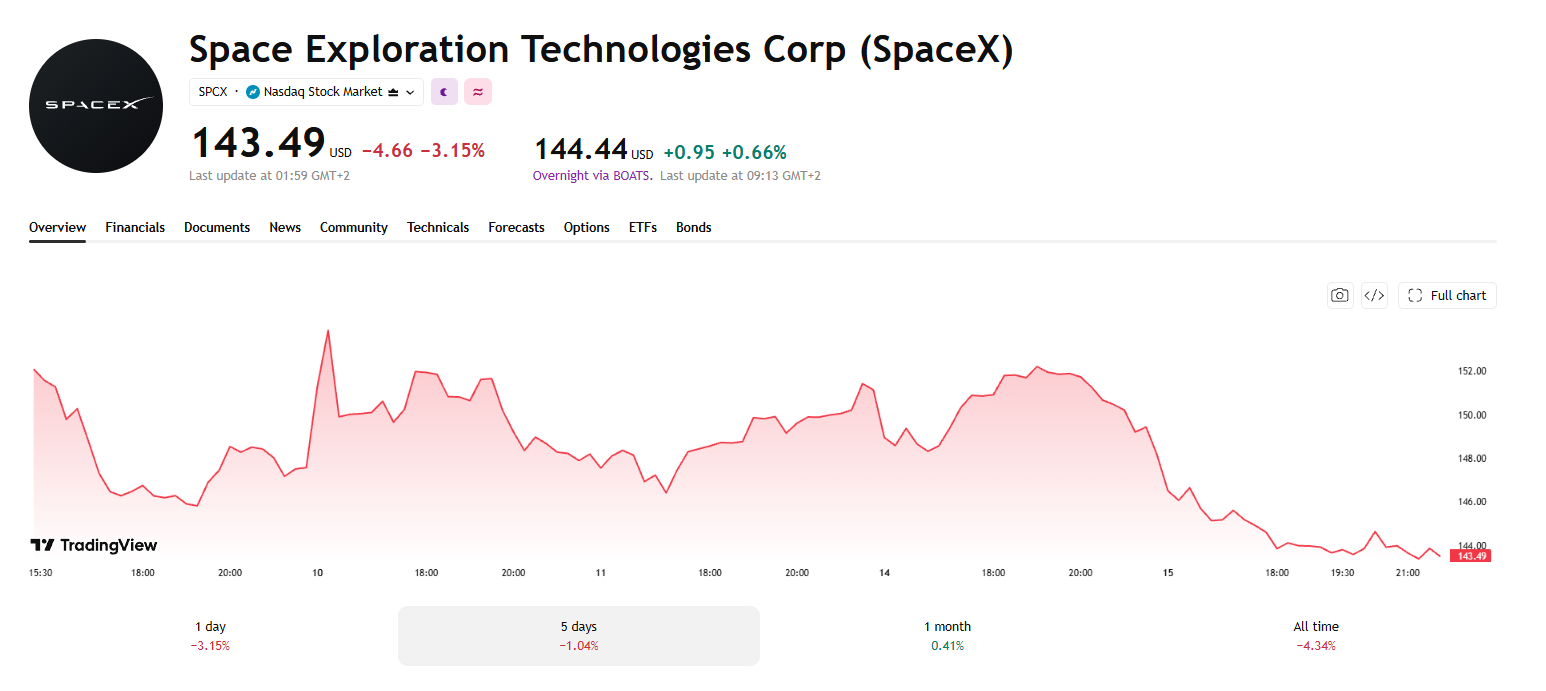
Cathie Wood says a single Starship launch could generate $1 billion in revenue, a projection that would make the $1.75 trillion SpaceX IPO look cheap in hindsight.
The ARK Invest founder tied that figure to Elon Musk’s goal of 10,000 flights a year by 2030. Her post followed fresh data on how much revenue Starlink earns per unit of launched capacity.
Cathie Wood Calls the SpaceX IPO a Deep Value Bargain
The math starts with Starlink. An ARK Invest analyst puts Starlink connectivity revenue near $19 million a year per terabit per second (Tbps) of network capacity. One Starship carries roughly 61 Tbps, so a full load adds close to $1 billion in recurring Starlink revenue rather than a one-off launch fee.
Multiply that by 10,000 launches a year, and Starship alone would bring in $10 trillion. Therefore, Wood argues, buyers of the $1.75 trillion listing will look back on it as deep value.
That step assumes every flight carries Starlink capacity. Musk, however, has framed the 10,000 target against commercial air travel, a transport business that earns no connectivity revenue.
Early investors have little to show so far. SPCX priced at $135 in June and closed its first session at $161. The stock has since spent weeks below its IPO price.

Starship Revenue Math Rests on 10,000 Flights a Year
The revenue per Tbps is already sliding. ARK data puts it at $21 million in 2023, $23 million in 2024, and $19 million in 2025. The analyst says that decay is expected as capacity grows.
Launch cadence is the wider gap. Falcon 9 flew 165 times last year, while Starship has flown twice since the June listing. Both flights stayed suborbital, so the V3 satellites released in July re-entered and burned up within roughly 20 minutes.
The next mission aims to reach Earth orbit for the first time and carries 26 operational V3 units. That flight would also become the first Starship launch to earn commercial revenue.
Wood is not the loudest bull on the stock either. Dan Held sees falling launch costs pushing SpaceX toward a $100 trillion valuation within two decades. ARK, meanwhile, keeps adding to its position.
Still, $10 trillion a year would top the output of every economy except the United States and China. For now, the bargain call rests on a flight rate Starship has yet to reach.
The post Cathie Wood Calls the $1.75 Trillion SpaceX IPO a Bargain: Here's Why appeared first on BeInCrypto.


Bitcoin traders aren’t exactly panicking about Wednesday’s expected Federal Reserve rate hike, but they aren’t taking many chances either.
Markets are pricing a 92.5% chance the Fed raises rates for the first time in three years after strong employment data and stubborn inflation. Bitcoin has spent the past 24 days stuck between roughly $76,000 and $80,000, with volatility falling to a one-month low.
For some traders, the quarter-point hike is already old news.
“The bond market has done its job and fully priced in tomorrow’s hike,” said Chris Sullivan of Hyperion Decimus. In his view, the bigger shock could come if the Fed doesn’t hike, since that could leave investors wondering what policymakers see that markets don’t.
Crypto investors are still putting some money out of harm’s way.
Talos has seen a 28% net buying tilt toward stablecoins ahead of the meeting, according to research analyst Cooper Duschang. Around previous Federal Open Market Committee meetings, investors showed an average 8% selling tilt toward stablecoins.
Appetite for the two largest cryptocurrencies has moved in the other direction. Bitcoin buying conviction has dropped to 3% from 10%, while ether has fallen to 9% from 23%.

Some of the disparities are cultural in the making—and don’t make a ton of sense. On the streets, men disproportionately ride, meaning cycling is masculine, right? Not really. Packs of cyclists are derisively referred to as “MAMILS,” as in Middle-Aged Men in Lycra. Meanwhile, step into a spin class, and you may likely see only women clipping in. Context, it turns out, is everything.
More broadly, exercise has become a luxury good. It was the Yuppies who made marathoning and high-end road bicycles so popular. Today, people are just as likely to commute by bicycle in households that have more than $200,000 in income as they are in households that bring in between $50,000 and $75,000. Many of the people commuting by bike are choosing to do so. They have alternatives.
Not everyone is so lucky. Transportation injustice is real. Too often, urban renewal projects destroy neighborhoods of color for the sake of white commuters’ convenience. We should be conscious of these historic injustices. But working to undo wrong and encouraging groups of people who don’t currently bike to do so don’t need to be mutually exclusive. And it shouldn’t be controversial.
Bitcoin holds above key moving averages despite CLARITY Act sell-off

Daredevil Officially Rekindles His Best Romance

Man United face missing out on millions as leaders in JJ Gabriel transfer race emerge



-

 Fashion5 days ago
Weekend Open Thread – Corporette.com
-

 Business6 days ago
Micron Stock Climbs Above $1,031 as AI Memory Crunch and a $50 Billion Outlook Fuel the Rally
-

 Tech3 days ago
The Latest Weird Thing to Play Doom Is the Mapped-Out Brain of a Fruit Fly
-

 Business7 days ago
AMD Stock Climbs After Management Lifts 2027 Data Center Outlook Toward $70 Billion in AI Sales
-

 Business5 days ago
10 Most-Streamed Songs On Spotify In 2026 So Far, Led By Ella Langley’s Dominant Run On The Charts This Year
-

 Crypto World5 days ago
XAG/USD: Silver’s Short-Term Rally Meets Its Moment of Truth
-

 Crypto World6 days ago
2 Chip Stocks Broke Out This Week. Neither Was Nvidia
-

 Tech6 days ago
Battery life is the only iPhone 18 Pro and iPhone Duo upgrade I care about. Apple didn’t disappoint
-

 Crypto World7 days ago
Pi Network ships Protocol 27 on a network with 14 million users and zero DeFi
-

 Crypto World6 days ago
OKX launches 10x OpenAI, Anthropic X-Perps in Europe
-

 Crypto World5 days ago
Diesel Tops $6 a Gallon for the First Time as 28 States Set Records
-

 Tech7 days ago
Apple Watch Ultra 4 vs Watch Ultra 3: Should you really spend another $799?
-

 News Videos5 days ago
Facing Financial Fears
-

 Crypto World7 days ago
Bitcoin price risks $70K if $78K neckline breaks
-

 Business6 days ago
Western Digital Slips 2.7% as AI Storage Rally Cools After Record Cash and Guidance
-

 Entertainment7 days ago
Case Sees Major Update As Jury Deliberations Begin
-

 Business3 days ago
Rivals Sam Altman and Elon Musk Rally Behind Dario Amodei’s Call for a Slowdown in AI Development
-
Crypto World7 days ago
Ripple Price Prediction: What to Expect for XRP as a Major Macro Week Approaches
-

 Crypto World2 days ago
Elon Musk Drops a Bombshell: Grok 5 Could Be the AGI Breakthrough
-
Crypto World6 days ago
Ethereum Price Analysis: Consolidation at $2.5K Tests Momentum as On-Chain Activity Surges
You must be logged in to post a comment Login