
Crypto World
Circle Arc mainnet launches with USDC gas



Circle has launched the public mainnet of Arc on Sept. 16, bringing its USDC-powered Layer 1 blockchain online with institutional validators, more than 20 fiat stablecoins and tokenized funds available from launch.
Summary
- Circle launched Arc mainnet with USDC as gas and deterministic sub-second settlement for financial applications.
- Arc supports twenty-two fiat stablecoins, while BUIDL, USYC, JAAA and JTRSY launch natively at launch.
- Eleven institutional validators join Circle initially, including BlackRock, DTCC, Visa, Mastercard and Standard Chartered globally.
- Circle minted ten billion ARC tokens, while stating no public token launch has occurred yet.
- Circle previously agreed to sell 807.5 million ARC tokens privately for $242.2 million in proceeds.
Circle said in itsofficial Arc mainnet announcement that the network uses USDC as its native gas asset, provides deterministic settlement in under one second and supports Ethereum Virtual Machine applications, allowing developers to use Solidity contracts and familiar Ethereum development tools.
The public opening follows an Arc testnet that processed more than 700 million transactions, according to Circle’s launch announcement. Circle’s second-quarter SEC filing had recorded 502 million cumulative testnet transactions and 2.8 million transacting wallets as of June 30, showing that activity continued climbing before the September launch.
Circle Arc mainnet uses USDC for transaction fees
Arc’s fee design removes the need for users to hold a separate volatile network asset to submit ordinary transactions. Fees are denominated and paid in USDC, while Arc’s gas documentation says the network is designed to keep costs predictable as transaction demand changes.
The network pairs that model with deterministic sub-second finality. Once Arc finalizes a transaction, the network design does not rely on the probabilistic confirmation periods associated with some other blockchain systems. Arc is running under a permissioned Proof-of-Authority model at launch.
EVM compatibility gives developers access to Ethereum-based tooling without requiring them to rewrite Solidity applications for a separate programming environment. Arc’s mainnet uses chain ID 5042, while USDC functions as its native currency for gas accounting.
Circle has connected Arc with Cross-Chain Transfer Protocol and Circle Gateway, extending asset movement and liquidity access across more than 20 supported blockchain networks. The company says developers can use burn-and-mint and lock-and-mint infrastructure to distribute supported assets between Arc and other chains.
As crypto.news previously reported, Arc combines an EVM execution environment with a stablecoin-denominated fee model and institutional validator structure.
Circle’s Q2 2026 filing with the SEC confirms that the private mainnet started in May. More than 100 partners were participating by July 20 across payments, capital markets, digital assets and technology.
BlackRock, Visa and DTCC join the validator cohort
Arc begins public operations with Circle and 11 named institutional founding validators.
Circle’s founding validator announcement identified BlackRock, DTCC, Galaxy, ICE, Mastercard, MoneyGram, SBI Group, Standard Chartered, Sumitomo Corporation, Visa and Worldpay, now part of Global Payments.
BlackRock’s digital-assets head Robbie Mitchnick said purpose-built networks can serve specific financial-market uses and stated that Arc “appears clearly well positioned to serve stablecoin and payment use cases at scale.” The statement represents BlackRock’s assessment of the network, not a guarantee of adoption.
Banks working with or building around Arc include BNY, BTG Pactual, HSBC, Lead Bank, Societe Generale, Standard Chartered and State Street, according to the Arc mainnet ecosystem announcement.
Payment firms named in the same launch materials include Mastercard, MoneyGram, Visa, JCB, Global Payments and Thunes.
Crypto.news reported on Circle’s institutional Arc rollout and validator plans, including the involvement of major financial and payments companies.
Circle CEO Jeremy Allaire described Arc as the company’s most important product introduction since USDC and said, “USDC was step one. Arc is the network built for what comes next.” His statement describes Circle’s strategy and does not guarantee future network adoption.
More than 20 stablecoins and tokenized funds are available
Arc’s day-one asset list includes 22 fiat-linked stablecoins: USDC, EURC, AUDD, AUDF, BRLA, CADD, CHFAU, EURAU, GBPA, JPYC, KRW1, MXNB, QCAD, SEKAU, TRYB, wARS, wBRL, wCLP, wCOP, wMXN, wPEN and ZARU.
Circle StableFX is live on Arc for programmable foreign-exchange activity across more than 20 fully reserved stablecoins. Circle says the service uses atomic payment-versus-payment settlement, while participating market makers provide FX liquidity.
Tokenized financial products available natively include BlackRock’s BUIDL, tokenized by Securitize; Circle’s USYC; and Janus Henderson’s JAAA and JTRSY products. Circle states that these assets can interact with lending, trading and collateral markets available through Arc applications.
Access restrictions still apply to individual products. Circle specifically states that USYC is available only to non-U.S. persons under its Securities Act definition, with further eligibility restrictions possible. Arc’s existence does not remove those product-level requirements.
Circle introduced cirBTC on Arc as a programmable representation of Bitcoin. The company says cirBTC can be converted 1:1 from BTC, cbBTC or WBTC without conversion fees and is intended for collateral and liquidity applications.
On the application side, Aave and Morpho are supporting Arc’s lending markets from launch. Aero and Uniswap provide trading infrastructure, while Circle named a longer group of applications covering swaps, perpetual trading, NFTs and cross-chain execution.
Binance, Bybit, Kraken, KuCoin, OKX, Upbit and several other exchanges are listed by Arc as live access points. Circle said Coinbase is expected to become available later, making its status different from the exchanges described as live on launch day.
Agent wallets and developer tools arrive on day one
Circle has placed automated software transactions near the center of Arc’s product design. Circle Agent Stack provides policy-controlled wallets and USDC nanopayments, while Arc Portal allows users to create agent wallets, specify spending limits and authorize defined financial tasks. Arc Studio uses natural-language prompts to generate application components and smart contracts for deployment on the network.
Circle’s launch release cited Dune data showing USDC accounted for 98.8% of agent-driven transaction volume measured in the referenced dataset. The figure relates to the cited agent-payment activity and should not be interpreted as USDC’s share of every autonomous software payment globally.
Arc App Kits provide packaged software components for applications. Onramp Kit supports fiat-to-USDC funding through methods including debit cards and Apple Pay, while Earn Kit connects applications to lending opportunities such as Morpho without requiring users to leave the original interface. Privacy, however, is not fully deployed across the network. Circle’s launch release describesopt-in privacy as “in development for network-wide release.”
Circle has proposed confidential smart-contract infrastructure intended for institutional applications. Circle’s current disclaimer says the scope, functionality and rollout schedule can still be changed, delayed or discontinued.
Arc supports optional post-quantum signatures today, according to Circle, while further protections remain under development. Circle cautions that quantum-resistant cryptography remains an evolving research area and does not guarantee future immunity from security threats.
Circle minted 10 billion ARC but public launch remains undecided
Circle completed the genesis mint of 10 billion ARC tokens in the United States during launch week, creating the network’s planned initial supply. Network transaction fees continue to be payable in USDC. TheARC token whitepaper describes the token as a potential coordination asset for network security, governance and other functions if Arc moves from Proof of Authority to Proof of Stake.
Circle currently points to 2027 for exploring that transition, but its launch documents make clear that the timing and final design remain subject to change. Circle states that the genesis mint “is not a commitment to publicly launch ARC.” Its Arc launch post separately says “No ARC token has been launched,” referring to public availability.
Public availability should be distinguished from Circle’s existing private token-sale agreements.
The company’sJune 30 Form 10-Q says Circle had agreed to sell 807.5 million ARC tokens to institutional investors at $0.30 each, producing approximately $242.2 million in gross contracted proceeds.
Circle had received $222 million by June 30 and booked the presale proceeds as deferred revenue. The private sale implied a $3 billion fully diluted network valuation, according to the same SEC filing.
The initial $222 million round involved investors including a16z crypto, BlackRock, Apollo Funds, ARK Invest, ICE, Janus Henderson and Standard Chartered Ventures. Circle’s subsequent SEC disclosure states that purchasers face lockups lasting at least one year after Arc transitions to Proof of Stake or delegated Proof of Stake, with further transfer restrictions potentially extending until four years after that transition.


Markets are pricing roughly a 90% probability of a 25-basis-point Federal Reserve rate hike at the September FOMC meeting, according to the Danske Research Team.
The team revised its own call this week and now expects that outcome. For Bitcoin watchers, the key distinction is between market expectations and a confirmed policy decision: the hike is still expected, but it has not yet been delivered.
The research team says tightening now likely represents the path of least resistance, given current market pricing and its longstanding view that rate hikes are eventually on the horizon.
— *Walter Bloomberg (@DeItaone) September 16, 2026
 WHAT TO WATCH TODAY — U.S. MARKETS
8:30 AM ET — Retail Sales
8:30 AM ET — Import & Export Prices
10:30 AM ET —  EIA Oil Inventories
1:00 PM ET — Treasury Auction
2:00 PM ET —  FOMC RATE DECISION + DOT PLOT
2:30 PM ET —  Fed Chair Kevin Warsh Press Conference…
At the same time, it does not regard the decision as completely settled. That leaves the meeting relevant not only for the headline rate decision, but also for the details released alongside it.
Readers following FOMC odds into the September rate decision should distinguish between the reported 90% probability and any broader claims about how Bitcoin or other assets are positioned. The supplied research supports the market-pricing estimate, but it does not provide a verified assessment of Bitcoin positioning, leverage, or current price action.
Will the Expected Hike Be the Main Bitcoin Catalyst?
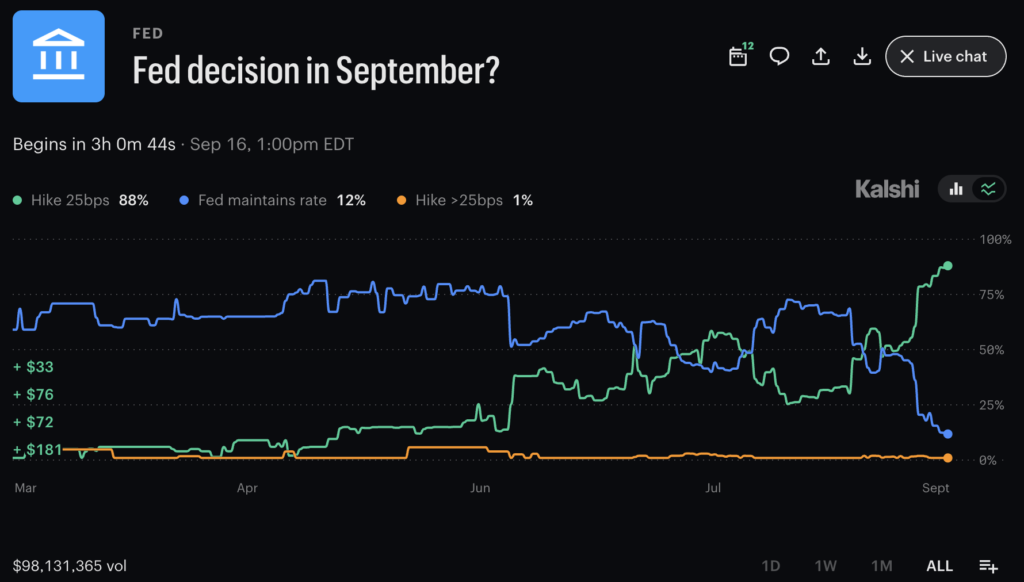
The Danske Research Team identifies the FOMC meeting as the week’s main US event. Alongside its expected 25-basis-point hike, the team expects the Fed to publish updated economic projections and a fresh set of rate projections, commonly called the dot plot.
The vote itself is also worth watching. Danske Research Team expects two or three dissenters in favor of holding rates, even as it maintains its call for a hike. That expectation underscores that the meeting is not a done deal. The final decision and any recorded dissents will provide the clearest evidence of how the committee resolved that tension.
The projections also carry an expected qualification. The team still expects the FOMC to publish the dots even if Fed official Warsh again chooses not to submit personal rate-path views. If that happens, the published material would still be available, but it would not include Warsh’s personal submission.
Supercharge Your Trading in 2026 With BloFin AI Trading Bots
What the Fed FOMC Signal Could Mean for Bitcoin
For Bitcoin-focused market analysis, the meeting presents several elements to monitor: the rate decision, the vote count, updated economic projections, and the dot plot.
Available evidence shows that the market strongly expects a hike and that projections and dots are expected to be published. It does not establish a specific Bitcoin reaction to any of those elements.
Commentary about the dot plot, future policy language, or a possible press-conference message should therefore be treated as market interpretation rather than a conclusion supplied by the primary research.
Likewise, it would be premature to describe any particular outcome as bullish or bearish for Bitcoin without independently verified market evidence.
The immediate question is not whether market pricing confirms it. It does not. The reported probability reflects expectations ahead of the meeting, while the FOMC’s decision will determine the actual policy outcome. The same caution applies to claims about risk assets, crypto-market volatility, or how fully expectations are reflected in trading activity.
Make Your Prediction Count With $25 For Free on Kalshi
The post Bitcoin’s Next Fed Test Is Today’s FOMC Meeting: Will $75K Hold? appeared first on Cryptonews.

After bolting to a record high in July on a second-quarter earnings beat, Garmin (GRMN) stock stumbled off its peak. A leader in global positioning systems and wearable technology, and rival to Apple (AAPL) in the smartwatch space, Garmin continues to cling to trigger a breakout and cling to key moving averages as it secures a spot on the Investor’s…
Copyright ©2026 Investor’s Business Daily, LLC. All rights reserved. 87990cbe856818d5eddac44c7b1cdeb8
Bitcoin (BTC) is stuck in a narrow price range as investors wait for the U.S. Federal Reserve to announce its interest-rate decision on Wednesday. Selling has slowed, but buying has not been strong enough to push BTC clearly higher.
According to Bitfinex Alpha, Bitcoin has traded within a 5.5% range for more than 24 sessions, keeping the market quiet. The report says the next move could depend on whether new demand returns after the Fed decision, as traders have built positions at both ends.
Selling Eases, but Buyers Remain Cautious
About 840,000 BTC have a cost basis within this narrow range, meaning they were bought at prices inside it. Glassnode’s sell-side risk ratio has fallen to seven basis points, showing that long-term holders are taking fewer profits.
Newer investors now account for most of the remaining supply, but trading activity remains low. In other words, sellers have become less aggressive without a strong wave of new buyers stepping in.
Leverage has also built up around the current price levels, which could make any breakout more volatile. CoinGlass data show about $1.95 billion in possible short liquidations near $82,000, while long positions are concentrated around $75,000 to $76,000.
Institutional demand has also weakened, adding another obstacle to a sustained move higher. U.S. spot Bitcoin ETFs saw over $460 million in outflows last week, selling approximately 5,900 BTC, while Ether ETFs took in $196.9 million. September ETF flows remain positive, but recent outflows show weaker institutional demand could limit Bitcoin’s upside.
Inflation Keeps Pressure on the Fed
Inflation is adding another challenge, with August prices rising 0.4% from the previous month and 3.4% over the year. Core inflation eased to 2.4%, but gasoline prices rose 3.9%, and diesel reached $5.65 per gallon.
Higher energy costs could keep inflation elevated, especially as Brent crude trades above $100 a barrel and U.S. strategic reserves fall to 285.4 million barrels. This could reduce expectations for easier monetary policy and keep pressure on interest rates.
Markets now see an 88.5% chance of a 25-basis-point rate hike on September 16. The U.S. 10-year real Treasury yield has risen to 2.55%, making non-yielding assets such as Bitcoin less attractive to some investors.
The post Bitcoin Stays Stuck as Traders Wait for the Fed’s Next Move appeared first on CryptoPotato.
Crypto World
LatAm telco VIVA taps Avalanche-based Iris for stablecoin settlement and dollar reserves


Between 2012 and 2025, global mobile data traffic grew more than 50% annually while operator service revenue increased less than 1% per year, according to McKinsey figures cited by Iris.
Telecom operators bring something financial apps often spend heavily trying to build: customers, verified identities and distribution.
That can be particularly powerful in emerging markets.
“In the U.S. the operator is like one rail among many,” Ava Labs Chief Business Officer John Nahas told CoinDesk. In markets such as Bolivia, by contrast, “the mobile carrier is often the rail that people do everything on.”
That is why Iris expects its initial expansion to focus on Latin America and potentially parts of Africa and Asia rather than the U.S., Nahas said.
VIVA offers an early test of whether that model can translate into better economics for carriers. Nahas said a super-app product used by VIVA helped reduce churn among prepaid mobile customers by 33% while increasing their lifetime value by 35%.
“When you start to see numbers like this, it just starts making a lot of sense,” he said, adding that Iris now needs more real-world case studies.
Stablecoins behind telecoms
Iris runs on a dedicated Avalanche Layer 1, giving the network control over its settlement, operating and compliance requirements. USDi serves as the settlement asset, while also giving VIVA the option to hold eligible operating reserves in dollars.
In VIVA’s case, using U.S. dollar stablecoin for settlements also means having the option to hold eligible operating reserves in U.S. dollars, which is particularly relevant in markets with volatile local currencies.


The central point of the deal is Payward is trying to bring a popular offshore and onchain trading product into a regulated U.S. structure while keeping trade matching and recordkeeping on Hyperliquid.
“A U.S. client would open a futures account with Payward’s registered broker and trade new perpetual futures contracts on Hyperliquid, cleared through the same clearinghouse that already supports the crypto perpetual contracts Payward offers U.S. clients today,” said Jon Pham, head of U.S. derivatives.
Payward acquired Bitnomial in May for $550 million. It bought NinjaTrader Clearing for $1.5 billion in 2025.
Perpetuals are derivative products that allow investors to place positions on the price movements of an underlying digital asset without owning the asset itself. Unlike traditional futures contracts, perps do not expire and can be maintained indefinitely. Traders make or receive periodic funding payments to keep their positions open.
The markets will run on Hyperliquid’s public blockchain, whose onchain order book matches and records trades. Bitnomial Exchange and Bitnomial Clearinghouse would act as the HIP-3 deployer, creating, owning and administering the market and clearing and settling the contracts. NinjaTrader Clearing, Payward’s registered futures commission merchant, would carry client accounts.
Payward did not disclose a fee schedule, expected trading volumes, details of any economic arrangement with Hyperliquid or a planned launch date. A Kraken spokesperson said it could not speculate on the potential revenue this would bring to the company, and did not address questions about expected trading volumes.
Yesterday morning, the head of the US Treasury proudly reported in front of Congress that the government had just run two of its best bond auctions in decades.
By 1pm, the Treasury conducted its worst 20-year bond auction in history.
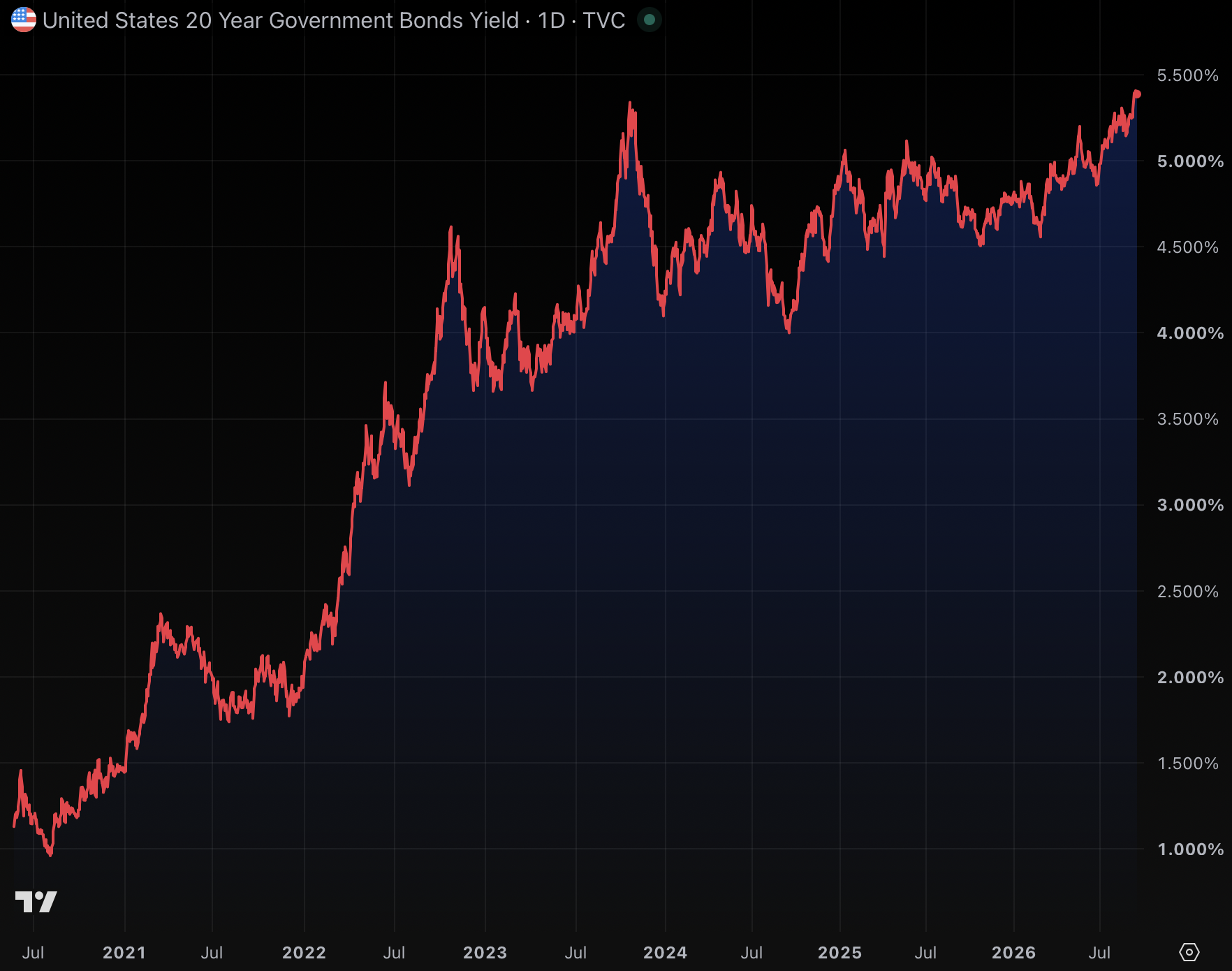
On Tuesday, the US government had to pay a record-breaking 5.42% interest yield-to-maturity to sell its auction of 20 year maturity bonds — the most expensive cost of capital the US government has paid for Treasuries of this maturity since modern record-keeping began in 1986.
On a bit of a technicality, the government avoided paying 5.42% interest on the bonds, instead paying 5.125% yet selling them below par to mathematically offer 5.42% de facto yield to purchasers.
Worse, the particular type of investors Washington needs for offloading its sovereign debt — foreign investors — bought the lowest percentage ever of that $13 billion auction.
Record cost to borrow money for 20 years
Bond auctions aren’t complicated. The US Treasury offers IOUs, and buyers around the world name the yield they’ll accept.
At each live auction, yield-to-maturity is focus. The bond’s effective interest rate is the cost of capital for the US government.
The higher the yield, the less creditworthy the US government is in the opinion of bond traders. With $40.1 trillion and rising of outstanding debt that costs taxpayers over $1.1 trillion per year in interest payments, US debt-to-GDP at 123% is a growing concern for bond investors.
Tuesday’s sale was terrible on three counts.
The rate was the start of the disaster. Twenty-year bonds traded around 5.40% minutes before the sale and cleared at 5.42%. In other words, Washington paid more than the open market was charging at the end, just to find sufficient takers to fully clear the auction.
Traders call that additional 0.02% a two basis point “tail,” and it was the worst tail for any 20-year auction since 2024.
Second, the crowd mix was terrible. So-called “indirect bidders” are Treasury auction participants like foreign central banks and overseas buyers.
Like any sovereign, the US wants to sell as much of its debt to buyers abroad as possible.
Instead, indirect bidders took just 52.5% of yesterday’s auction, lower than August’s 62.9% and the lowest percentage on record for any 20-year Treasury auction since the 1980s besides a small, idiosyncratic $25 million special auction in 2021.
Third, the liquidity or depth of demand was thin as well, as measured by the bid-to-cover ratio. Specifically, bids covered yesterday’s bond sale 2.57 times, below the 2.65 average of the previous six auctions.
Read more: How the bond market helped push BTC to all-time high
Did Scott Bessent expect no one would notice?
Given the historically bearish turnout for yesterday’s Treasuries sale, anyone could rightly be curious as to why Secretary Scott Bessent had so little foresight when boasting about the supposed strength of US creditworthiness during yesterday’s Congressional testimony.
To be fair, despite the immediate embarassment, Bessent actually had a real basis for his positive remarks for a few hours prior to 1pm.
Indeed, last week’s 10-year and 30-year bond sales went smoothly.
Indirect bidders took a healthy 79.5% of the $22 billion 30-year bond sale on September 10, for example. That success was true and fleetingly newsworthy.
Questioned at a US House hearing, Bessent leaned in.
“We then proceeded to have the two most successful treasury auctions that we’ve had in 20 years, and the US bond market, since President Trump has come in, has been the best performing bond market in the developed world.”
Connecticut Democrat Jim Himes wasn’t buying it. “Wait, wait, wait. The 10-year went up by 20 basis points. How can you say it was successful?” he asked, hours before the 20-year auction supplied an even worse data point.
Treasury yields provide the floor under which banks price mortgage and corporate borrowing rates. The household version, i.e. the average 30-year mortgage rate in the US, costs homeowners an alarming 6.76%.
Interest expense on the national debt now costs more than $1.1 trillion a year and is the US government’s second biggest expense behind Social Security payments.
The next 20-year US bond auction is scheduled for October 21, 2026.
Got a tip? Send us an email securely via Protos Leaks. For more informed news and investigations, follow us on X, Bluesky, and Google News, or subscribe to our YouTube channel.

The evaluation was based on three key evaluation pillars: Financial Performance, Reputation Analysis, and Online Engagement.
The first dimension, Financial Performance, was assessed through a detailed analysis of financial metrics, such as revenue per employee and funding amount. These metrics provided insight into the financial stability, growth potential, and operational efficiency of the companies. This dimension accounted for 50% of the total score.
The second dimension, Reputation Analysis, evaluated how companies and their digital health solutions are publicly perceived. Using social listening techniques, the analysis captured sentiment, visibility, and perceived credibility by examining publicly available content, such as news coverage, blogs, forums, and social media activity. This dimension contributed 30% to the total score.
The third dimension, Online Engagement, measured the reach and engagement levels of companies through their digital platforms. Website traffic served as the key indicator of user engagement. This dimension made up 20% of the overall score.
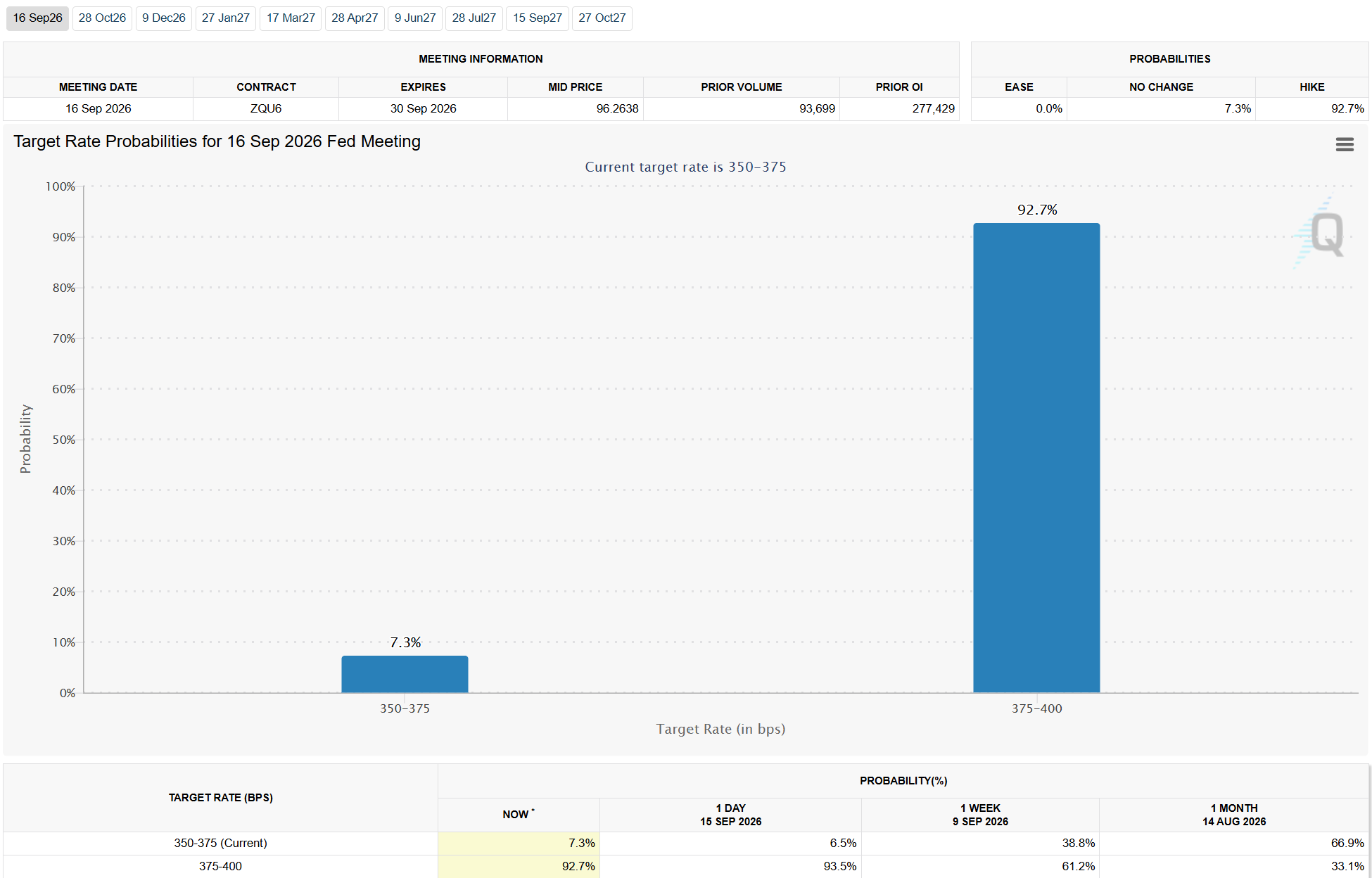
Interest rate futures put a 92.7% chance on the Federal Reserve raising rates on Wednesday. That leaves traders worried across both the crypto and stock markets. Because Donald Trump appointed Kevin Warsh with one single promise: cut interest rates. But Warsh can’t deliver that with inflation running at 3.4%
So, how will the market react, and which way will Bitcoin move?
Why a Pause is the Closest thing Warsh can give Trump
The Fed’s target range sits at 3.50% to 3.75%. The CME FedWatch tool put the odds of no change at 7.3% on Wednesday morning, with zero odds of a cut.

Trump picked Warsh for the job and watched him sworn in at the White House in May. Even ahead of the swearing-in, the president was already treating his would-be chair as an ally.
Wharton professor Jeremy Siegel has argued that Trump pressure and midterms are the only forces still blocking a hike. White House economic adviser Christopher Phelan said a move this week would be a mistake. Midterm elections are seven weeks away.
Former Fed governor Stephen Miran made the data case against hiking in an interview this week.
“If you held in June and July and become more hawkish as the inflation data come down, it speaks to an incoherent reaction function,” he shared.
Follow us on X to get the latest news as it happens
What Bitcoin and Gold Did the Last Time the Data Surprised
Rate expectations set the cost of holding assets that pay no interest. Bitcoin and gold both sit in that group, so cheaper money tends to help them.
The Bitcoin price held near $76,022 as of this writing, down 1.17% in 24 hours. Gold traded around $4,340 an ounce, up 1.4% on the day.

The August inflation report on September 11 showed how fast both react. Bitcoin fell from roughly $77,100 to $76,050 inside a minute. Gold slid from $4,353 to $4,292, then recovered.
BeInCrypto flagged hike odds near 90% that day. Pricing has since hardened to 92.7%.
KPMG chief economist Diane Swonk told the Associated Press that a hike now could pull long-term rates lower later. Warsh’s press conference, not the quarter point itself, is what traders will parse.
The post 93% Chance of a Fed Rate Hike Today. What Happens to Bitcoin Now? appeared first on BeInCrypto.
The CLARITY Act did not receive enough support in the US Senate, so it could not move to official discussion. This triggered a correction in the broader cryptocurrency market, while the upcoming FOMC meeting may worsen the sector’s condition.
The prevailing expectation is that interest rates in the USA will rise by 0.25%, yet analyst Ali Martinez assumed the central bank may be forced to keep the benchmark unchanged, which could propel a BTC price rally. Here’s why.
Influence From Trump?
Martinez started his thesis by noting the CLARITY Act failure and describing it as “a major setback for one of Trump’s crypto-policy objectives ahead of the November midterms.”
Then, he revealed that the odds of a 25-basis-point rate hike following the FOMC meeting, scheduled for later today (September 16), are roughly 93%, with only a small minority expecting the figure to stay the same.
According to the analyst, the smaller group may actually get it right this time. He pointed to the approaching midterms in the US, arguing that Trump needs a political win and that another rate increase could create more economic pressure, possibly hurting his chances of success.
“That could weigh on Kevin Warsh and the FOMC’s decision-making,” he said.
Martinez thinks that such a surprise move could trigger a powerful rally across risk assets, with BTC (which has rarely risen after the past 14 FOMC decisions) potentially surpassing $82,000.
“This is my wild prediction. Not the consensus view. Trump needs a win. A no-hike decision could give markets exactly the surprise they need to rally,” he concluded.
However, another angle is worth considering. The widely expected rate hike may already be priced in, making Fed Chair Warsh’s press conference the key event to watch. It will take place immediately after the FOMC meeting, and any signals of further rate increases could negatively impact BTC and altcoins. On the other hand, a softer tone and remarks that the central bank has made progress on inflation could lead to a solid rebound.
Massive Shorts Ahead of the Meeting
X user Max Crypto revealed that a mysterious whale opened a $50 million short position on BTC and a $15.8 million short on ETH ahead of the central bank’s crucial decision.
Usually, such major bets fuel speculation that the trader may have access to inside information. However, the whale’s win rate is around 40.6%, meaning their track record is far from flawless.
Meanwhile, another anonymous trader (with a staggering 100% win rate) recently opened multi-million shorts on BTC, ETH, and ZEC before the CLARITY Act vote. As mentioned above, the bill did not move forward for official discussion, and the crypto market headed south.
The post Wild Bitcoin Prediction Ahead of the FOMC: Here’s What Could Trigger a Pump appeared first on CryptoPotato.
XRP fell about 8% over the past 24 hours, one of the worst showings among the top cryptocurrencies, after the US Senate failed to advance the Digital Asset Market CLARITY Act on Tuesday.
The drop left XRP down well over 10% for the week, well behind Bitcoin and most other major coins, and it shows how closely tied the token’s price still is to progress on crypto legislation in Washington.
The Selling Was Not Just Profit-Taking
XRP’s price ran from around $1.46 per CoinGecko data to near $1.27, with analyst Xaif Crypto noting that its cumulative volume delta (CVD) cratered to negative 10.5 million as the price dumped.
“Sellers aren’t hiding anymore, this is aggressive dumping not just profit taking,” they wrote on X.
The selloff tracked the Senate vote almost exactly. Cloture on the bill, formally known as H.R. 3633, needed 60 votes and got 49. Every yes vote came from Republicans, and four of their own broke ranks to vote no.
Furthermore, Senators Gillibrand, Warner, Booker, Warnock, Gallego, Alsobrooks, and Cortez Masto all voted no after months of talks, meaning no Democrats crossed over to support it.
The CLARITY Act is meant to divide oversight of digital assets between the SEC and CFTC and bring exchanges, brokers, and dealers under a new federal registration regime, provisions the market had been pricing ahead of the Tuesday vote.
At the time of writing, CoinGecko data put XRP around $1.28, down over 8% in 24 hours and more than 10% in seven days. The picture looks different further out, with the Ripple token still up close to 29% over the past 30 days, even after this week’s drop, although it remains down more than 56% across one year and about 65% below its all-time high of $3.65 from July 2025.
Bitcoin and the Rest of the Market Also Slipped
The broader market was also under pressure, with Bitcoin slipping around 2.0% over the same 24 hours to trade near $75,000, while its share of the total crypto market remained above 56%. On its part, Ethereum dropped close to 4%, which saw it trading a few bucks under $2,400.
Stellar dipped even harder than XRP, shaving nearly 9% from its value, while BNB was only slightly ruffled, with its price dropping less than 1%.
Zcash gained about 3%, and Hyperliquid fell more than 2% over the same period, while Dogecoin slipped 3.7% and Solana lost over 4%, in line with the rest of the market’s retreat.
For XRP, the immediate price damage does not change its legal position, as pointed out by Ripple CEO Brad Garlinghouse, who also stated that his company “has never been stronger” despite the CLARITY setback.
The post Why XRP Was Hit Hardest After the CLARITY Act Senate Failure appeared first on CryptoPotato.

M56 crash involving HGV and three cars causes major delays

Intel Stock Rises On Talk Of Fab Deal With SK Hynix
Bitcoin’s Next Fed Test Is Today’s FOMC Meeting: Will $75K Hold?



-

 Fashion5 days ago
Weekend Open Thread – Corporette.com
-

 Business7 days ago
Micron Stock Climbs Above $1,031 as AI Memory Crunch and a $50 Billion Outlook Fuel the Rally
-

 Tech3 days ago
The Latest Weird Thing to Play Doom Is the Mapped-Out Brain of a Fruit Fly
-

 Business7 days ago
AMD Stock Climbs After Management Lifts 2027 Data Center Outlook Toward $70 Billion in AI Sales
-

 Business5 days ago
10 Most-Streamed Songs On Spotify In 2026 So Far, Led By Ella Langley’s Dominant Run On The Charts This Year
-

 Crypto World5 days ago
XAG/USD: Silver’s Short-Term Rally Meets Its Moment of Truth
-

 Crypto World6 days ago
2 Chip Stocks Broke Out This Week. Neither Was Nvidia
-

 Tech6 days ago
Battery life is the only iPhone 18 Pro and iPhone Duo upgrade I care about. Apple didn’t disappoint
-

 Crypto World7 days ago
Pi Network ships Protocol 27 on a network with 14 million users and zero DeFi
-

 Crypto World6 days ago
OKX launches 10x OpenAI, Anthropic X-Perps in Europe
-

 Crypto World5 days ago
Diesel Tops $6 a Gallon for the First Time as 28 States Set Records
-
 Tech7 days ago
Apple Watch Ultra 4 vs Watch Ultra 3: Should you really spend another $799?
-

 News Videos5 days ago
Facing Financial Fears
-

 Crypto World7 days ago
Bitcoin price risks $70K if $78K neckline breaks
-

 Business6 days ago
Western Digital Slips 2.7% as AI Storage Rally Cools After Record Cash and Guidance
-

 Entertainment7 days ago
Case Sees Major Update As Jury Deliberations Begin
-

 Business3 days ago
Rivals Sam Altman and Elon Musk Rally Behind Dario Amodei’s Call for a Slowdown in AI Development
-

 Crypto World2 days ago
Elon Musk Drops a Bombshell: Grok 5 Could Be the AGI Breakthrough
-
Crypto World6 days ago
Ethereum Price Analysis: Consolidation at $2.5K Tests Momentum as On-Chain Activity Surges
-
 Crypto World7 days ago
Ethereum price breakout hinges on a close above $2,535
You must be logged in to post a comment Login