
Crypto World
Revolut ID thefts highlight KYC’s dangers: Here’s how to fix it



Zero-knowledge technology could let companies verify who you are without storing your identity documents. So why isn’t it already standard practice?

Crypto World
S&P 500 Trucking Stock JB Hunt Dives On CFO’s Earnings Warning Amid Surging Diesel Costs

Shares of J.B. Hunt plummeted 12% on Wednesday morning after the trucking company warned of an impending earnings decline. The morning’s drop made it the worst-performing stock on the S&P 500. During a Morgan Stanley conference late Tuesday CFO Brad Delco front ran the bad news. Costs were rising faster than J.B. Hunt (JBHT) could raises its prices, setting up…
Copyright ©2026 Investor’s Business Daily, LLC. All rights reserved. 87990cbe856818d5eddac44c7b1cdeb8
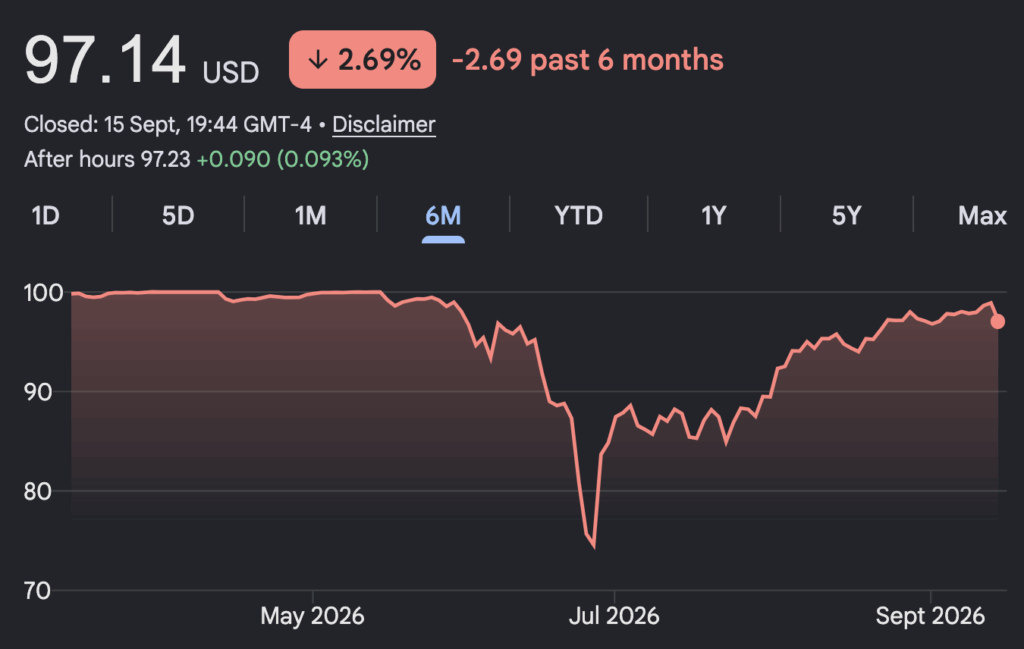
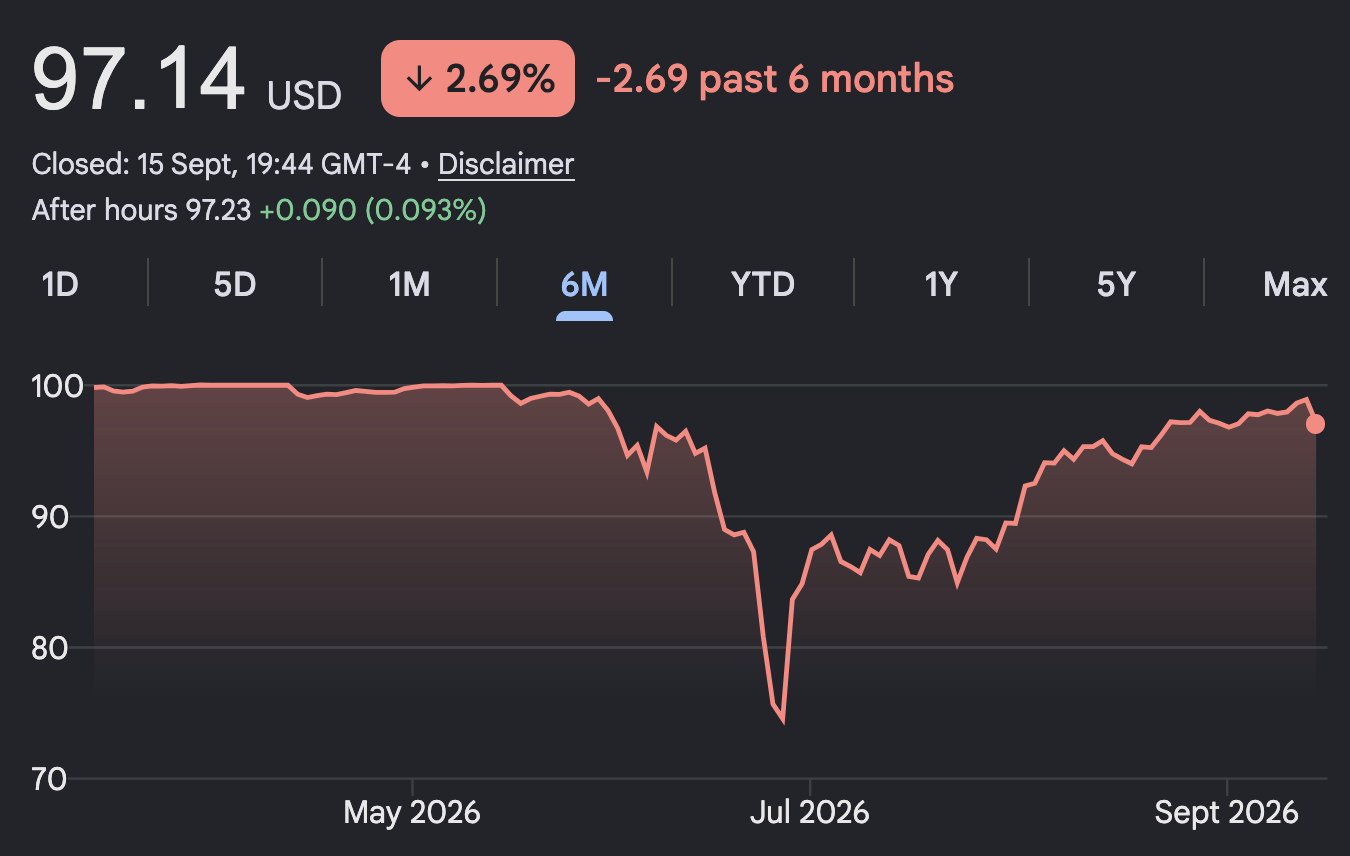
It’s been four months, over 120 days, since Strategy’s dividend vehicle, STRC, broke parity and the executive leadership made getting it back to its $100 peg its absolute, number one priority.
Since then, it’s never, not even for a second, managed to get back to parity.
This week, however, as Strategy continued a major shift in its business model — repurchasing shares of STRC instead of buying BTC — it seemed as though it would finally succeed, with STRC cruising to $99 on Monday.
Unfortunately, it wasn’t meant to be.
The next day, STRC fell back to nearly $97. There’s no evidence of further internal purchases yet.
Read more: MSTR has lost 75% of its value since STRC began trading
More STRC sellers than buyers
Despite months of buying its own dividend vehicle, countless promises, and Strategy executives claiming that STRC is priority number one for the firm, the asset has remained stubbornly off-parity.
The CLARITY Act failing to pass only hurt the company’s cause more, with Strategy down 7% on the day.
In the meantime, Strategy Chairman Michael Saylor has continued to incessantly repost strange, bullish Bitcoin AI videos.
Got a tip? Send us an email securely via Protos Leaks. For more informed news and investigations, follow us on X, Bluesky, and Google News, or subscribe to our YouTube channel.
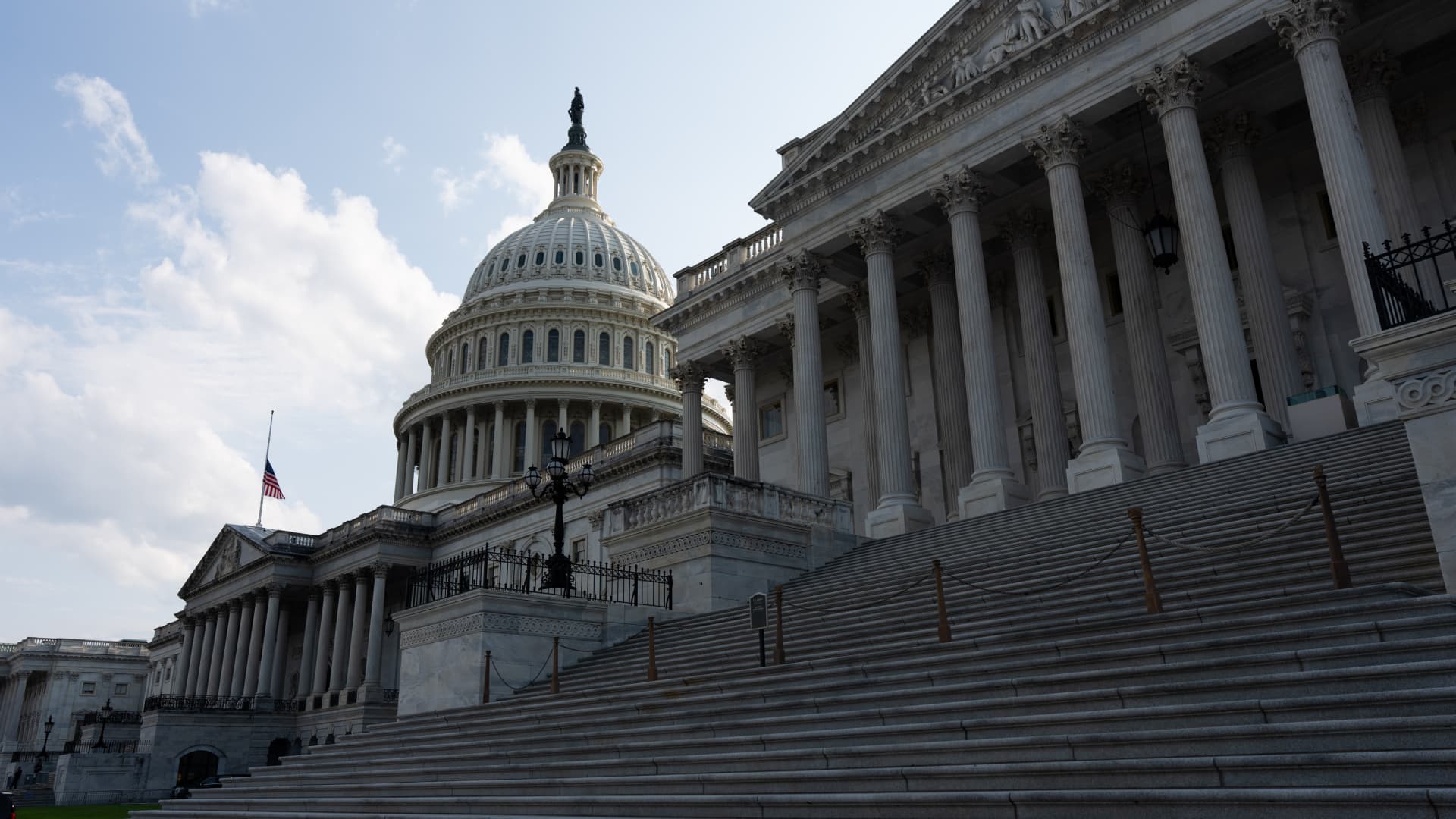
The U.S. Capitol in Washington, July 22, 2026.
Aaron Schwartz | Bloomberg | Getty Images
The battle for the U.S. Senate is still tight, but prediction market traders think Democrats have one of their best chances yet of taking the upper chamber.
Speculators on Kalshi now give Democrats a 54% chance to win the Senate, nearly matching a level reached in mid-April. On Polymarket, the odds are even higher, with a 59% chance that Democrats wrest control.
Republicans are defending majorities in both the U.S. House of Representatives and Senate this November, but the upper chamber was always viewed as more difficult for Democrats to flip. Republicans already control 20 of the 33 Senate seats up for grabs this year, and Democrats would have to flip several states where President Donald Trump won by 10% or more in 2024 — including Alaska, Texas and Ohio — to take control.
Odds that the Democrats win the Senate have improved significantly in 2026 on prediction markets. Before the U.S.-Iran war began on Feb. 28, Republicans had about 60% odds to hold onto the Senate on both Kalshi and Polymarket. Odds declined as rising gas prices rove down Trump’s approval rating.
Odds that Democrats would win the Senate topped Republican odds of keeping control in April, but the GOP’s chances recovered in May and throughout the summer as the U.S. and Iran deescalated the war, easing pressure on gas prices.
GOP fortunes have darkened in recent weeks. U.S. oil prices are now above $100 per barrel, gasoline is above $4 a gallon nationally and diesel prices are at an all-time high. Pediction market traders now think gas prices will hit new highs this year.
This week has brought several high-quality polls showing Democrats with a favorable environment heading into November. A New York Times/Siena University poll released Wednesday showed likely voters nationwide favoring Democratic candidates over Republicans in their congressional districts by close to 9 percentage points.
Disclosure: CNBC and Kalshi have a commercial relationship that includes customer acquisition and a minority investment.
Crypto World
Wirex One Launches Publicly on Arc, Bringing Stablecoin Private Banking to the Mass Affluent Market

London, September 16, 2026 – Wirex, the global stablecoin infrastructure provider, has today launched Wirex One, the first stablecoin neobank built for the growing segment of mass affluent consumers, to the public. The platform is a day-one launch partner on Arc’s mainnet, delivering a private banking experience with true asset ownership.
Following a closed beta that amassed over 20,000 users in testing since June, Wirex One is now available globally.
Wirex One launches as part of Wirex’s wider integration with Arc, making Arc available as a settlement layer for any partner issuing cards and accounts through the Wirex API. Arc is an open blockchain network built for the world’s financial markets, real-time money movement, and agentic economic activity.
Wirex One was created for an underserved market. The global private banking market is projected to grow by over 10% annually to reach $1.24 trillion by 2035, yet a large segment of affluent individuals remain structurally underserved: too wealthy for retail banking, but below the minimum for traditional private banking. Stablecoins are closing that gap, enabling secure, borderless wealth management that the traditional financial system cannot provide.
Wirex One brings private banking onchain, managing everyday spending, yield, overseas transfers, borrowing, and investing from a single place. Arc was strategically chosen as the foundation for Wirex One due to its stablecoin-native, payments-optimised design, with a built-in privacy layer and real-time settlement.
Paired with Privy’s non-custodial wallet technology, it gives users complete ownership over their assets and institutional-grade security, without the complexity that typically comes with crypto wallets.
At launch, key features include:
- Stablecoin-funded card with up to 8% cashback in USD, instantly spendable in everyday life
- Access to selected crypto and stablecoin yield features
- Support for a wide range of crypto assets
- Multi-currency accounts, with fee-free FX and ATM withdrawals globally
- Ability to send and receive via SEPA, ACH, Faster Payments, card transfers, and crypto transfers
- Innovative membership model, offering higher rewards, fee-free trading, dedicated account management, and 50% off premium subscriptions for leading AI and financial platforms for higher tiers
Pavel Matveev, Co-Founder & CEO of Wirex, said: “A new wave of fintech apps are being built on stablecoin rails, and they all need the same foundation: regulated issuing, accounts, settlement, and yield. Wirex One is our own consumer platform built on that infrastructure, redefining what a private bank can be: a bank you control, not one that controls you. Every partner integrating with Wirex’s infrastructure gets the same rails, the same scheme access, and now the same day-one access to Arc.”
Today’s announcement is a major milestone in Wirex’s vision to build a unified, onchain suite of financial services for consumers and businesses on their stablecoin infrastructure, which recently reached $2 billion annualised card spend volume. In the coming weeks, Wirex One will expand to include tokenised equities and perpetuals.
More information about Wirex One, including card availability in supported jurisdictions, is available at Wirex’s website.
Developers can learn more about integrating with Wirex’s infrastructure on Arc here. The list of supported countries can be viewed here. Rewards are valued in USD
About Wirex
Wirex is the global stablecoin infrastructure behind a complete banking stack. Through a single API, any app, wallet or fintech can launch regulated accounts, cards, payments, payouts, yield, cashback and travel, settled in stablecoins, on any chain. Wirex is one of the few crypto-enabled platforms with principal membership of both Visa and Mastercard, settling in USDC and EURC without an intermediary bank.
Wirex builds its own products on that same infrastructure, through the same API: Wirex One, a stablecoin neobank for consumers, with Wirex Private as its highest membership tier; Wirex Business for companies; and Wirex Agents, giving AI agents the ability to transact onchain.
Trusted by over 8 million users since 2014, Wirex has processed more than $20 billion in transactions across 130 countries, and created the first crypto-enabled card in 2015. Built on a decade-long track record of regulatory compliance, enterprise-grade security and onchain innovation, Wirex is creating a financial system where money moves globally and instantly, giving consumers and businesses true ownership, privacy by architecture, and access to the next generation of global payments and settlement.
Disclaimers:
Arc is an open L1 blockchain launched by Arc Network Services LLC (“Arc LLC”) and operated by a permissioned validator set. Arc LLC provides software services only and does not offer regulated financial or advisory services. Arc has not been reviewed or approved by the New York State Department of Financial Services or any other regulatory authority.
The Arc network is provided “as is” and “as available.” Use of Arc involves inherent risks associated with blockchain technology, including smart contract vulnerabilities, network disruptions, and the absence of recourse for transaction errors or losses. The ability to transact on Arc depends on the ability to obtain and use USDC to pay gas fees. Neither Arc LLC nor any permissioned validator is responsible for the content, accuracy, legality, or functionality of third-party applications, protocols, or services built on or integrated with Arc. You are solely responsible for features or services you provide to users, including obtaining any necessary licenses or approvals and otherwise complying with applicable laws.
All Arc features may be modified, delayed, or cancelled at any time without notice. Nothing herein constitutes a commitment, warranty, guarantee or legal, regulatory, tax, or investment advice.
The post Wirex One Launches Publicly on Arc, Bringing Stablecoin Private Banking to the Mass Affluent Market appeared first on BeInCrypto.

Markets are pricing roughly a 90% probability of a 25-basis-point Federal Reserve rate hike at the September FOMC meeting, according to the Danske Research Team.
The team revised its own call this week and now expects that outcome. For Bitcoin watchers, the key distinction is between market expectations and a confirmed policy decision: the hike is still expected, but it has not yet been delivered.
The research team says tightening now likely represents the path of least resistance, given current market pricing and its longstanding view that rate hikes are eventually on the horizon.
— *Walter Bloomberg (@DeItaone) September 16, 2026
 WHAT TO WATCH TODAY — U.S. MARKETS
8:30 AM ET — Retail Sales
8:30 AM ET — Import & Export Prices
10:30 AM ET —  EIA Oil Inventories
1:00 PM ET — Treasury Auction
2:00 PM ET —  FOMC RATE DECISION + DOT PLOT
2:30 PM ET —  Fed Chair Kevin Warsh Press Conference…
At the same time, it does not regard the decision as completely settled. That leaves the meeting relevant not only for the headline rate decision, but also for the details released alongside it.
Readers following FOMC odds into the September rate decision should distinguish between the reported 90% probability and any broader claims about how Bitcoin or other assets are positioned. The supplied research supports the market-pricing estimate, but it does not provide a verified assessment of Bitcoin positioning, leverage, or current price action.
Will the Expected Hike Be the Main Bitcoin Catalyst?
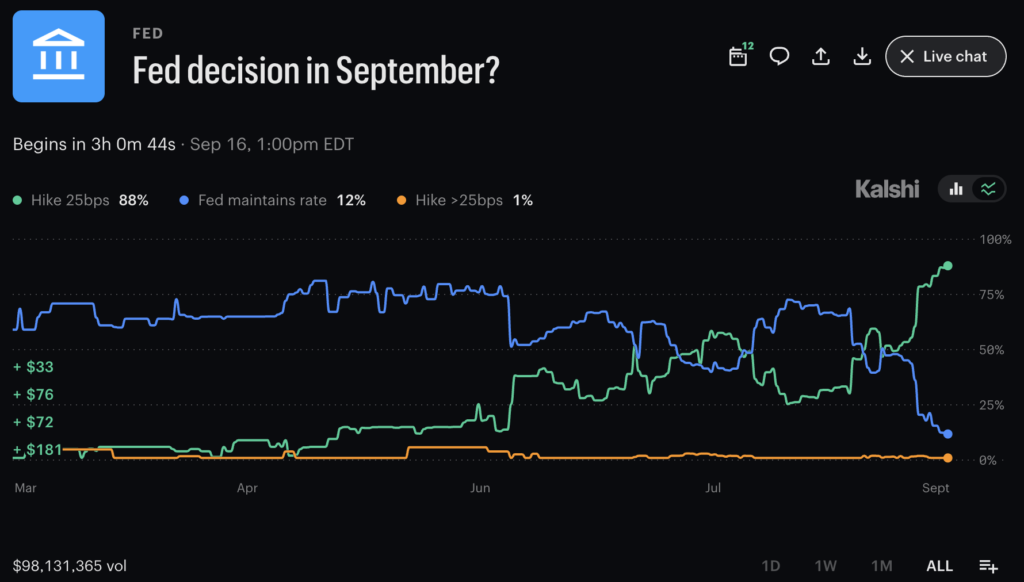
The Danske Research Team identifies the FOMC meeting as the week’s main US event. Alongside its expected 25-basis-point hike, the team expects the Fed to publish updated economic projections and a fresh set of rate projections, commonly called the dot plot.
The vote itself is also worth watching. Danske Research Team expects two or three dissenters in favor of holding rates, even as it maintains its call for a hike. That expectation underscores that the meeting is not a done deal. The final decision and any recorded dissents will provide the clearest evidence of how the committee resolved that tension.
The projections also carry an expected qualification. The team still expects the FOMC to publish the dots even if Fed official Warsh again chooses not to submit personal rate-path views. If that happens, the published material would still be available, but it would not include Warsh’s personal submission.
Supercharge Your Trading in 2026 With BloFin AI Trading Bots
What the Fed FOMC Signal Could Mean for Bitcoin
For Bitcoin-focused market analysis, the meeting presents several elements to monitor: the rate decision, the vote count, updated economic projections, and the dot plot.
Available evidence shows that the market strongly expects a hike and that projections and dots are expected to be published. It does not establish a specific Bitcoin reaction to any of those elements.
Commentary about the dot plot, future policy language, or a possible press-conference message should therefore be treated as market interpretation rather than a conclusion supplied by the primary research.
Likewise, it would be premature to describe any particular outcome as bullish or bearish for Bitcoin without independently verified market evidence.
The immediate question is not whether market pricing confirms it. It does not. The reported probability reflects expectations ahead of the meeting, while the FOMC’s decision will determine the actual policy outcome. The same caution applies to claims about risk assets, crypto-market volatility, or how fully expectations are reflected in trading activity.
Make Your Prediction Count With $25 For Free on Kalshi
The post Bitcoin’s Next Fed Test Is Today’s FOMC Meeting: Will $75K Hold? appeared first on Cryptonews.

After bolting to a record high in July on a second-quarter earnings beat, Garmin (GRMN) stock stumbled off its peak. A leader in global positioning systems and wearable technology, and rival to Apple (AAPL) in the smartwatch space, Garmin continues to cling to trigger a breakout and cling to key moving averages as it secures a spot on the Investor’s…
Copyright ©2026 Investor’s Business Daily, LLC. All rights reserved. 87990cbe856818d5eddac44c7b1cdeb8

Bitcoin (BTC) is stuck in a narrow price range as investors wait for the U.S. Federal Reserve to announce its interest-rate decision on Wednesday. Selling has slowed, but buying has not been strong enough to push BTC clearly higher.
According to Bitfinex Alpha, Bitcoin has traded within a 5.5% range for more than 24 sessions, keeping the market quiet. The report says the next move could depend on whether new demand returns after the Fed decision, as traders have built positions at both ends.
Selling Eases, but Buyers Remain Cautious
About 840,000 BTC have a cost basis within this narrow range, meaning they were bought at prices inside it. Glassnode’s sell-side risk ratio has fallen to seven basis points, showing that long-term holders are taking fewer profits.
Newer investors now account for most of the remaining supply, but trading activity remains low. In other words, sellers have become less aggressive without a strong wave of new buyers stepping in.
Leverage has also built up around the current price levels, which could make any breakout more volatile. CoinGlass data show about $1.95 billion in possible short liquidations near $82,000, while long positions are concentrated around $75,000 to $76,000.
Institutional demand has also weakened, adding another obstacle to a sustained move higher. U.S. spot Bitcoin ETFs saw over $460 million in outflows last week, selling approximately 5,900 BTC, while Ether ETFs took in $196.9 million. September ETF flows remain positive, but recent outflows show weaker institutional demand could limit Bitcoin’s upside.
Inflation Keeps Pressure on the Fed
Inflation is adding another challenge, with August prices rising 0.4% from the previous month and 3.4% over the year. Core inflation eased to 2.4%, but gasoline prices rose 3.9%, and diesel reached $5.65 per gallon.
Higher energy costs could keep inflation elevated, especially as Brent crude trades above $100 a barrel and U.S. strategic reserves fall to 285.4 million barrels. This could reduce expectations for easier monetary policy and keep pressure on interest rates.
Markets now see an 88.5% chance of a 25-basis-point rate hike on September 16. The U.S. 10-year real Treasury yield has risen to 2.55%, making non-yielding assets such as Bitcoin less attractive to some investors.
The post Bitcoin Stays Stuck as Traders Wait for the Fed’s Next Move appeared first on CryptoPotato.
Crypto World
LatAm telco VIVA taps Avalanche-based Iris for stablecoin settlement and dollar reserves


Between 2012 and 2025, global mobile data traffic grew more than 50% annually while operator service revenue increased less than 1% per year, according to McKinsey figures cited by Iris.
Telecom operators bring something financial apps often spend heavily trying to build: customers, verified identities and distribution.
That can be particularly powerful in emerging markets.
“In the U.S. the operator is like one rail among many,” Ava Labs Chief Business Officer John Nahas told CoinDesk. In markets such as Bolivia, by contrast, “the mobile carrier is often the rail that people do everything on.”
That is why Iris expects its initial expansion to focus on Latin America and potentially parts of Africa and Asia rather than the U.S., Nahas said.
VIVA offers an early test of whether that model can translate into better economics for carriers. Nahas said a super-app product used by VIVA helped reduce churn among prepaid mobile customers by 33% while increasing their lifetime value by 35%.
“When you start to see numbers like this, it just starts making a lot of sense,” he said, adding that Iris now needs more real-world case studies.
Stablecoins behind telecoms
Iris runs on a dedicated Avalanche Layer 1, giving the network control over its settlement, operating and compliance requirements. USDi serves as the settlement asset, while also giving VIVA the option to hold eligible operating reserves in dollars.
In VIVA’s case, using U.S. dollar stablecoin for settlements also means having the option to hold eligible operating reserves in U.S. dollars, which is particularly relevant in markets with volatile local currencies.
The central point of the deal is Payward is trying to bring a popular offshore and onchain trading product into a regulated U.S. structure while keeping trade matching and recordkeeping on Hyperliquid.
“A U.S. client would open a futures account with Payward’s registered broker and trade new perpetual futures contracts on Hyperliquid, cleared through the same clearinghouse that already supports the crypto perpetual contracts Payward offers U.S. clients today,” said Jon Pham, head of U.S. derivatives.
Payward acquired Bitnomial in May for $550 million. It bought NinjaTrader Clearing for $1.5 billion in 2025.
Perpetuals are derivative products that allow investors to place positions on the price movements of an underlying digital asset without owning the asset itself. Unlike traditional futures contracts, perps do not expire and can be maintained indefinitely. Traders make or receive periodic funding payments to keep their positions open.
The markets will run on Hyperliquid’s public blockchain, whose onchain order book matches and records trades. Bitnomial Exchange and Bitnomial Clearinghouse would act as the HIP-3 deployer, creating, owning and administering the market and clearing and settling the contracts. NinjaTrader Clearing, Payward’s registered futures commission merchant, would carry client accounts.
Payward did not disclose a fee schedule, expected trading volumes, details of any economic arrangement with Hyperliquid or a planned launch date. A Kraken spokesperson said it could not speculate on the potential revenue this would bring to the company, and did not address questions about expected trading volumes.
Yesterday morning, the head of the US Treasury proudly reported in front of Congress that the government had just run two of its best bond auctions in decades.
By 1pm, the Treasury conducted its worst 20-year bond auction in history.
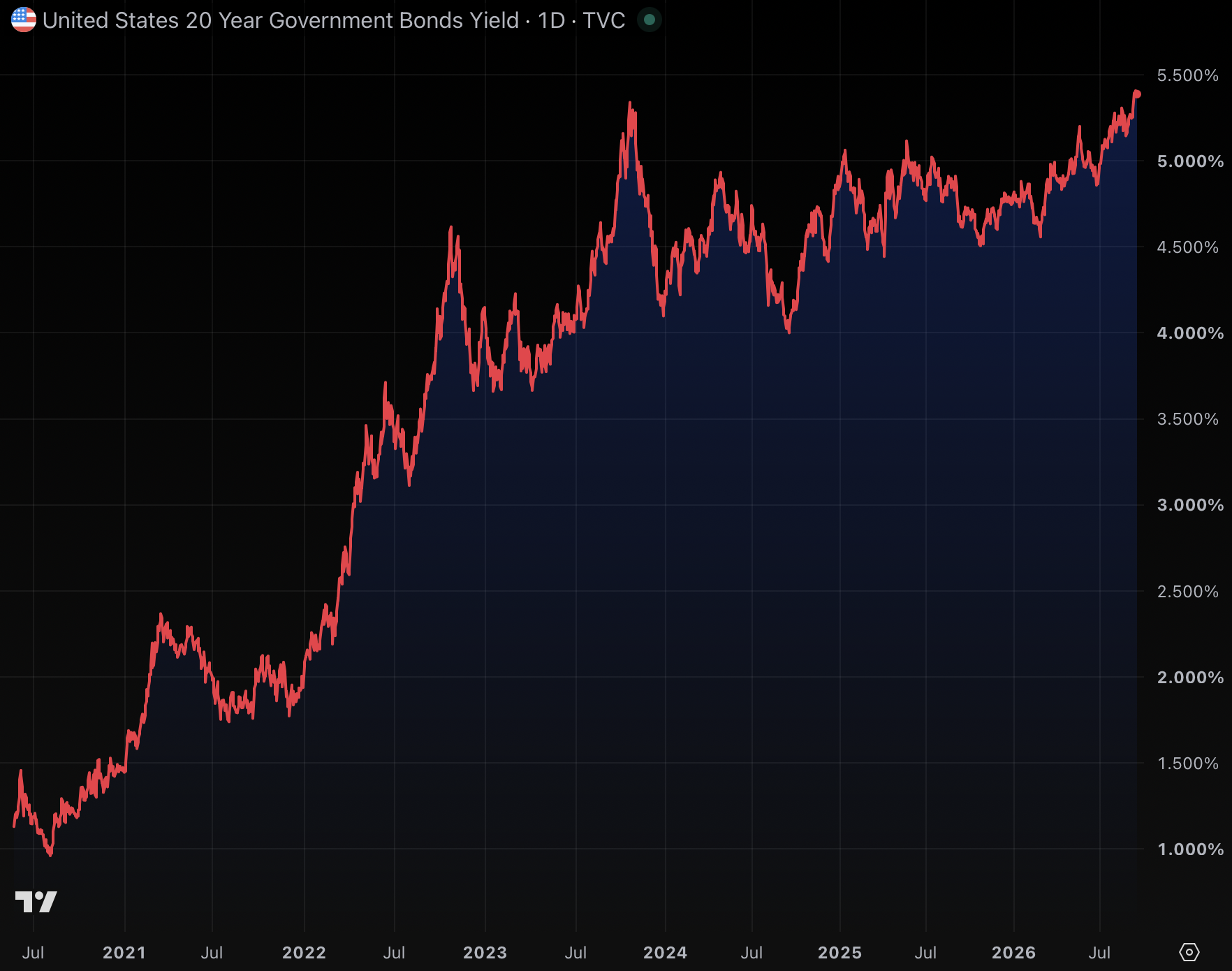
On Tuesday, the US government had to pay a record-breaking 5.42% interest yield-to-maturity to sell its auction of 20 year maturity bonds — the most expensive cost of capital the US government has paid for Treasuries of this maturity since modern record-keeping began in 1986.
On a bit of a technicality, the government avoided paying 5.42% interest on the bonds, instead paying 5.125% yet selling them below par to mathematically offer 5.42% de facto yield to purchasers.
Worse, the particular type of investors Washington needs for offloading its sovereign debt — foreign investors — bought the lowest percentage ever of that $13 billion auction.
Record cost to borrow money for 20 years
Bond auctions aren’t complicated. The US Treasury offers IOUs, and buyers around the world name the yield they’ll accept.
At each live auction, yield-to-maturity is focus. The bond’s effective interest rate is the cost of capital for the US government.
The higher the yield, the less creditworthy the US government is in the opinion of bond traders. With $40.1 trillion and rising of outstanding debt that costs taxpayers over $1.1 trillion per year in interest payments, US debt-to-GDP at 123% is a growing concern for bond investors.
Tuesday’s sale was terrible on three counts.
The rate was the start of the disaster. Twenty-year bonds traded around 5.40% minutes before the sale and cleared at 5.42%. In other words, Washington paid more than the open market was charging at the end, just to find sufficient takers to fully clear the auction.
Traders call that additional 0.02% a two basis point “tail,” and it was the worst tail for any 20-year auction since 2024.
Second, the crowd mix was terrible. So-called “indirect bidders” are Treasury auction participants like foreign central banks and overseas buyers.
Like any sovereign, the US wants to sell as much of its debt to buyers abroad as possible.
Instead, indirect bidders took just 52.5% of yesterday’s auction, lower than August’s 62.9% and the lowest percentage on record for any 20-year Treasury auction since the 1980s besides a small, idiosyncratic $25 million special auction in 2021.
Third, the liquidity or depth of demand was thin as well, as measured by the bid-to-cover ratio. Specifically, bids covered yesterday’s bond sale 2.57 times, below the 2.65 average of the previous six auctions.
Read more: How the bond market helped push BTC to all-time high
Did Scott Bessent expect no one would notice?
Given the historically bearish turnout for yesterday’s Treasuries sale, anyone could rightly be curious as to why Secretary Scott Bessent had so little foresight when boasting about the supposed strength of US creditworthiness during yesterday’s Congressional testimony.
To be fair, despite the immediate embarassment, Bessent actually had a real basis for his positive remarks for a few hours prior to 1pm.
Indeed, last week’s 10-year and 30-year bond sales went smoothly.
Indirect bidders took a healthy 79.5% of the $22 billion 30-year bond sale on September 10, for example. That success was true and fleetingly newsworthy.
Questioned at a US House hearing, Bessent leaned in.
“We then proceeded to have the two most successful treasury auctions that we’ve had in 20 years, and the US bond market, since President Trump has come in, has been the best performing bond market in the developed world.”
Connecticut Democrat Jim Himes wasn’t buying it. “Wait, wait, wait. The 10-year went up by 20 basis points. How can you say it was successful?” he asked, hours before the 20-year auction supplied an even worse data point.
Treasury yields provide the floor under which banks price mortgage and corporate borrowing rates. The household version, i.e. the average 30-year mortgage rate in the US, costs homeowners an alarming 6.76%.
Interest expense on the national debt now costs more than $1.1 trillion a year and is the US government’s second biggest expense behind Social Security payments.
The next 20-year US bond auction is scheduled for October 21, 2026.
Got a tip? Send us an email securely via Protos Leaks. For more informed news and investigations, follow us on X, Bluesky, and Google News, or subscribe to our YouTube channel.

S&P 500 Trucking Stock JB Hunt Dives On CFO’s Earnings Warning Amid Surging Diesel Costs

Ravindra Jadeja returns to ODI squad, Dhruv Jurel pips Rishabh Pant; Rohit Sharma stays | Cricket News

Why Kids Still Struggle to Read After Third Grade



-

 Fashion5 days ago
Weekend Open Thread – Corporette.com
-

 Business7 days ago
Micron Stock Climbs Above $1,031 as AI Memory Crunch and a $50 Billion Outlook Fuel the Rally
-

 Tech3 days ago
The Latest Weird Thing to Play Doom Is the Mapped-Out Brain of a Fruit Fly
-

 Business7 days ago
AMD Stock Climbs After Management Lifts 2027 Data Center Outlook Toward $70 Billion in AI Sales
-

 Business5 days ago
10 Most-Streamed Songs On Spotify In 2026 So Far, Led By Ella Langley’s Dominant Run On The Charts This Year
-

 Crypto World5 days ago
XAG/USD: Silver’s Short-Term Rally Meets Its Moment of Truth
-

 Crypto World6 days ago
2 Chip Stocks Broke Out This Week. Neither Was Nvidia
-

 Crypto World7 days ago
Pi Network ships Protocol 27 on a network with 14 million users and zero DeFi
-

 Tech6 days ago
Battery life is the only iPhone 18 Pro and iPhone Duo upgrade I care about. Apple didn’t disappoint
-

 Crypto World6 days ago
OKX launches 10x OpenAI, Anthropic X-Perps in Europe
-

 Crypto World5 days ago
Diesel Tops $6 a Gallon for the First Time as 28 States Set Records
-
 Tech7 days ago
Apple Watch Ultra 4 vs Watch Ultra 3: Should you really spend another $799?
-

 News Videos5 days ago
Facing Financial Fears
-

 Crypto World7 days ago
Bitcoin price risks $70K if $78K neckline breaks
-

 Business6 days ago
Western Digital Slips 2.7% as AI Storage Rally Cools After Record Cash and Guidance
-

 Entertainment7 days ago
Case Sees Major Update As Jury Deliberations Begin
-

 Business3 days ago
Rivals Sam Altman and Elon Musk Rally Behind Dario Amodei’s Call for a Slowdown in AI Development
-

 Crypto World2 days ago
Elon Musk Drops a Bombshell: Grok 5 Could Be the AGI Breakthrough
-
Crypto World6 days ago
Ethereum Price Analysis: Consolidation at $2.5K Tests Momentum as On-Chain Activity Surges
-
 Crypto World7 days ago
Ethereum price breakout hinges on a close above $2,535
You must be logged in to post a comment Login