Connect with us

Tech

Heat Domes: Meet The Quiet And Oppressive Take On The Thunderdome

Published

on

One of the nice things about the weather is that even if it’s bad right now, it’ll definitely be changing soon and maybe even for the better. There is one exception to this rule, however, and that comes in the form of heat domes, which are weather systems whereby a region of air becomes isolated from the surrounding systems. This creates effectively a greenhouse, with hot air remaining trapped and moisture unable to get in.

Although until recently not very common, this weather phenomenon poses a major challenge to any flora and fauna that finds itself trapped in a heat dome. With nights being about as hot and stifling as the days with their blue skies unbroken by any cloud cover and no rain for potentially weeks on end, it poses severe hydration, cardiovascular, and other challenges to any affected lifeforms.

Hot Summers Vs Heat Domes
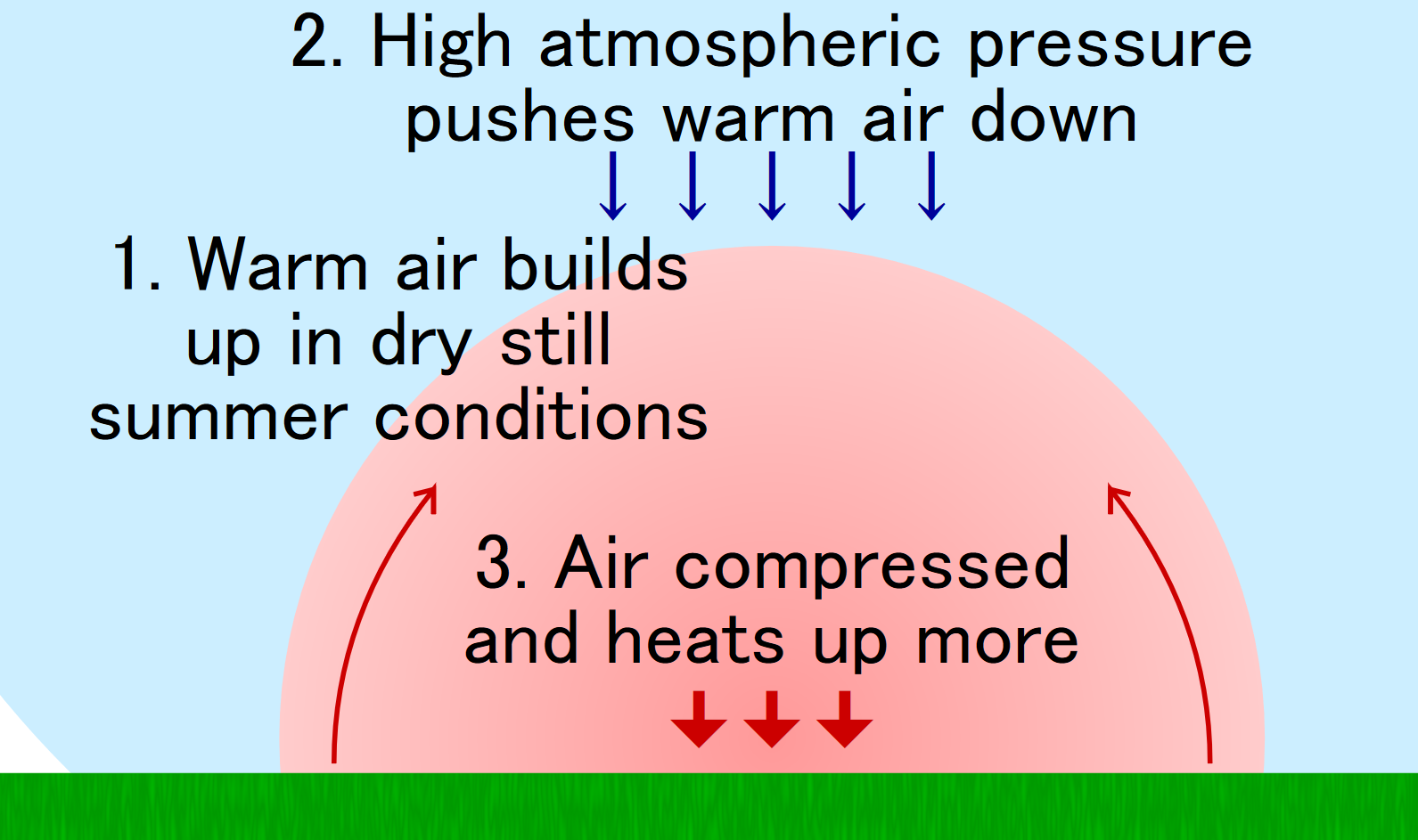
Formation of a heat dome. (Credit: Cmglee, Wikimedia)

Although it can be easy to mix up hot summer weeks, heatwaves, and heat domes, these terms all have their own specific meaning and implications. Each season has its own typical weather patterns and associated minimum- and maximum temperatures. These exact values have also fluctuated over the centuries and millennia due to a variety of factors, but the important detail is whether this typical maximum temperature is exceeded in a significant manner.

A heat dome is, for instance, not just a heatwave. The exact definition of a heatwave is not universal, but in general it means at least a couple of days of day-time temperature excursions well above this average maximum. In the UK for example at least two days are required before it is officially termed a ‘heatwave’. These heatwaves have become more common as global surface temperatures have increased on account of anthropogenic climate change.

A heat dome requires two factors to form, the first being a period of calm, warm weather, the second being a large area of high pressure that remains in place for an extended period of time. As the hot air rises, the high pressure in the higher atmosphere layers pushes back on this air, compressing it and causing adiabatic heating.

Advertisement

This creates a cycle in which the increasingly warmer and drier soil is exposed to the relentless Sun in the cloudless sky, with even nights bringing barely any change. What keeps this stagnant air from dissipating an “atmospheric block”.

Weather Block

An Omega block. (Credit: UK Metrological Office)

There are two types of blocks: omega and diffluent blocks. The omega block is commonly observed with heat domes, creating the Ω-shaped pattern from which it derives its name.

How long these blocks persist can differ wildly. The UK experienced a very hot Summer in 1976 when such a block persisted for months and thus drove up temperatures. Generally they last on the order of days to weeks.

Because of how heatwaves and heat domes overlap without a clear distinction, once you add a blocking system the UK’s Met Office prefers to call them ‘persistent summer blocking highs’, as this is their most defining feature. This can also be seen pretty well on maps of the 2021 Western North America heat wave.

Pacific Heat 2021
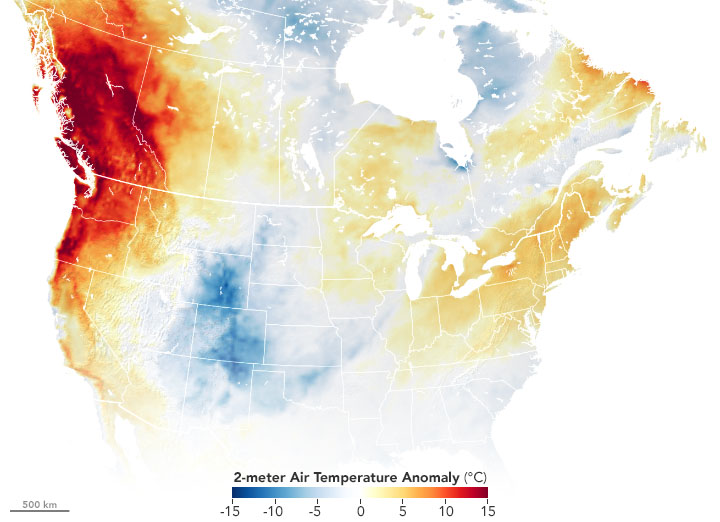
NASA Earth Observatory image of temperature anomalies on June 27th, 2021 compared to 2014-2020 average for the same day during the 2021 western North America heat wave (Credit: NASA)
NASA Earth Observatory image of temperature anomalies on June 27th, 2021 compared to 2014-2020 average for the same day during the heat wave (Credit: NASA)

Affecting much of Western North America from late June through early July, this extreme heatwave broke many records, including the highest temperature ever measured in Canada, at 49.6 °C. Eventually classified as a heat dome, by the time it dissipated around 1,400 excess deaths among the human population were recorded, as well as countless more deaths among farm animals, in addition to the highly destructive Lytton wildfire and general damage to agriculture.

In this case a block ensured that this area of static hot air could not dissipate or otherwise experience some cooling air from the Pacific.

Advertisement

The formation of this block was predicted by meteorologists after they observed warm, moist air from torrential rains in China make its way across the Pacific with help from the jet stream. At this time the Southwestern US was already experiencing a drought, setting the stage for the heat wave by providing additional heat to the Pacific Northwest.

As can be seen in the below barometric chart of the time, this led to the air transported by the jet stream to become trapped in between low pressure areas, exerting downwards pressure on the area below that was already enjoying a warm summer.

Pressure chart during the 2021 heat wave. (Credit: NOAA)

A similar phenomenon occurred over Europe during the summer of 2026, with multiple heatwaves involving heat domes forming and persisting for weeks on end. Previous summers in Europe had already significantly warmer and drier than previously, creating the conditions for a record-breaking summer.

With the blistering 2025 European summer already causing many wildfires and excess mortality cases, the summer of 2026 was by all metrics more severe. This raises the awkward question of we can expect things to only get worse from here, not just in Europe but worldwide.

Heat In The System

Ultimately the mechanisms that drive the formation of heatwaves and heat domes become more effective when there is more thermal energy in the system. This means more torrential rains, a higher surface temperature, more droughts and so on.

Advertisement

Of all of Earth’s continents, Europe is the one that is warming up the fastest, with already 2.3 °C above preindustrial levels in 2022. Although there are ways to adapt to a drier, hotter climate, including for our thermal power plants, ideally we would reduce the amount of energy in the Earth’s weather systems.

Doing this means effectively reverting as much as possible of anthropogenic climate change by not adding greenhouse gases to the atmosphere, including SF6 which is still very common in switching gear, including that installed in wind turbines. Even as we build out our grids with more clean power, it’s of course essential to also keep an eye on grid stability.

Ultimately this increase in heatwaves, and worse, is largely a human-made phenomenon which fortunately means that we also have the power to make the planet cool down again. As fascinating of a meteorological phenomenon a heat dome is, it’s definitely one of those things that’s best enjoyed once every generation or less.

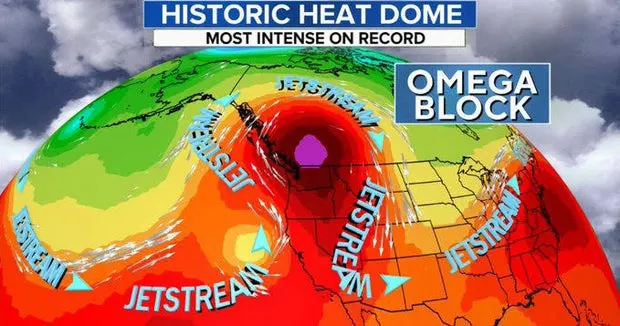
Overdone weather graphics from the 2021 Pacific Heat Dome from CBS News.

Advertisement

Source link

Continue Reading
Click to comment

You must be logged in to post a comment Login

Leave a Reply

Tech

First Look at PV7, Kia’s Bigger Electric Van That Arrives Built for Pallets, People, and Pop-Tops

Published

on

Kia PV7 Electric Van Reveal
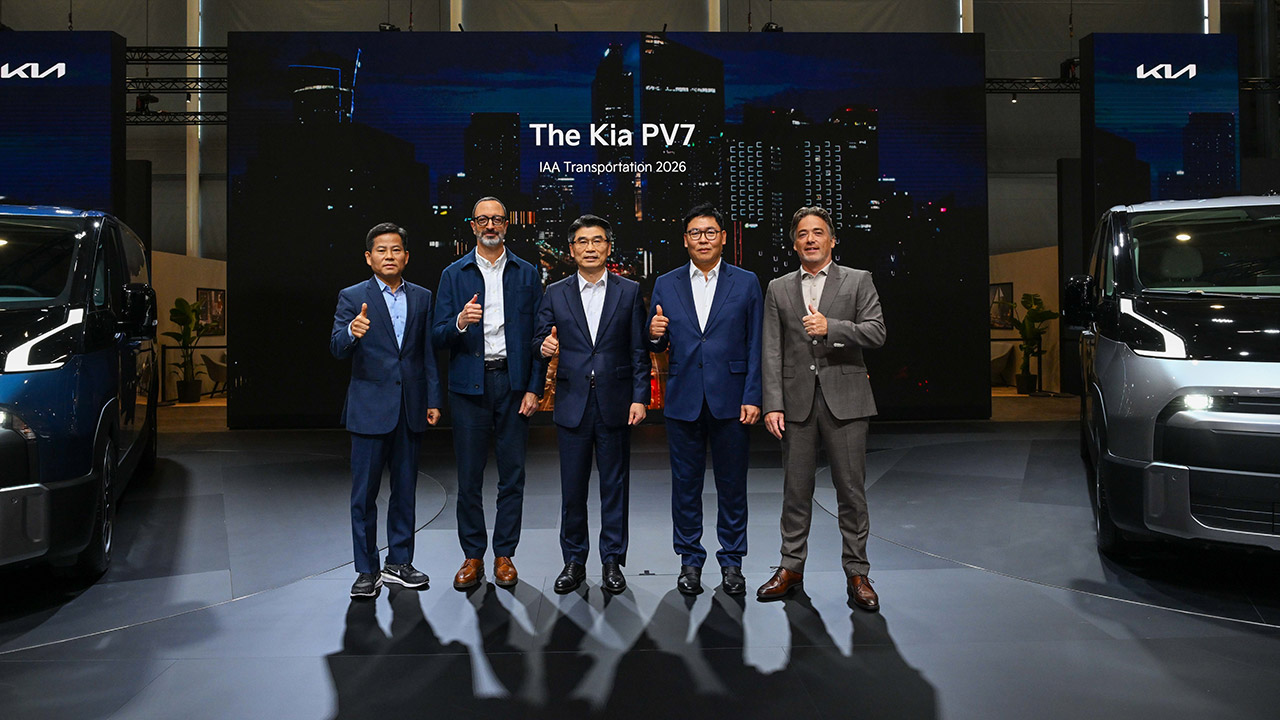
Kia rolled out the PV7 this week at IAA Transportation 2026 in Hannover as the second all-electric model in its Platform Beyond Vehicle family, a step up from the smaller PV5 that went on sale last year. This one targets the midsize light-commercial segment that fleets actually live in, with a blunt one-box shape, short overhangs, a visor-like dark band wrapping the windshield, thin daytime running lights that climb the A-pillars, and chunky wheel arches that give the sides more presence than a typical delivery box. Passenger and Cargo versions share the same Long shell for now, with Compact, high-roof, chassis-cab, and conversion bodies promised later as Kia works toward 23 variants.



The Long PV7 is about two feet longer than the PV5, measuring 5,350mm in length, 1,995mm in width, and 1,990mm in height, with a wheelbase of 3,500mm. It falls just shy of being a long-wheelbase Ford Transit Custom or Volkswagen Transporter. A specialized skateboard for the E-GMP.S powertrain keeps the floor flat from bulkhead to tail, lowering the Cargo Long’s loading height to 550mm and allowing three Euro pallets to be easily slipped in. The standard roof Cargo model carries 6.1 cubic meters, while the High Roof version holds a spacious 8.0 cubic meters. The payload is a reasonable 1,165 kilos on the Long model and 1,200 kilograms on the Compact, with D-ring tie-downs and an option of lift-up or twin-swing tailgates for easy maneuvering around tight alleys.

Sale


LEGO Speed Champions Mercedes-AMG G 63 & SL 63 Building Toys – Kids Pretend Play Toy Cars for Boys…
  • 2 Mercedes toy cars for kids – LEGO Speed Champions Mercedes-AMG G 63 & Mercedes-AMG SL 63 vehicle playset for boys and girls ages 10 and up and…
  • 2 driver minifigures – Each buildable vehicle toy comes with a driver minifigure wearing a Mercedes outfit so kids can role-play fast-paced races
  • Authentic Mercedes design – Each collectible car model features design details from the real life versions, including front grilles, hoods, wheels…


The floor houses two nickel-cobalt-manganese battery packs, one with a capacity of 71.5k.Wh capacity is tailored at shorter journeys, while the Long Range Cargo’s 96.2kWh pack is quoted as good for over 460km (286 miles) on the WLTP cycle, though official homologation is still waiting. The front motor can generate up to 200kW and 420 newton-metres, which are transmitted to the front wheels during launch; a twin motor all-wheel-drive system is planned for later. In addition to this, the 800-volt system represents a significant departure from the PV5’s 400-volt configuration. When connected to a 350kW DC charger, the pack can charge from 10 to 80 percent in roughly 20 minutes. There are dual ports as standard, a front AC/DC intake, and an optional rear-side AC port, allowing you to connect in regardless of how your bay is laid out. Vehicle-to-load outlets allow you to power equipment or even a campground refrigerator without having to bring out a generator.

Advertisement

Kia PV7 Interior
Kia PV7 Interior
Kia PV7 Interior
In terms of passenger layouts, you start with the 7-seat option, which includes rail-mounted Easy Remove chairs that fold or may be taken out completely, and then progress to 9 seats in most markets or 11 seats in Korea. Behind the wheel, you’ll find a lovely sleek digital cluster paired with a 12.9 or 14.6-inch screen running the Pleos Connect system on Android Automotive, with Gleo voice control for all the essentials like navigation, climate, and messages. You still have physical climate controls, and there’s a fold-down console table that serves as a convenient work area when needed. If you opt for a cargo cab, you can choose between a 2- or 3-seater, and the dedicated heavy-load drive mode improves response when the floor is stacked, but for fleet managers, Kia also offers a Business Solutions portal and Uptime monitoring, which provides information on charging, maintenance, and predictive alerts.

Kia PV7 Cargo
Kia PV7 Cargo
Kia PV7 Cargo
The PV5 has already shown to be a good foundation for camper builders, but the PV7 raises the bar with an extra length and around 10cm more breadth, which translates into a lot more kitchen space, a wider bed, and a little more breathing space. Sussex Campervans has already begun sketching out ideas for its PV7 ‘Kingfisher’ layout, which will include a pop top roof, a side kitchen, induction hobs, and even space for four people to sleep below. Kia has been welcoming conversion specialists this year, and it is depending on that network, as well as its industry-leading guarantee, to avoid all of the extra labor from becoming a nightmare. If the mid-size van sells well, the club is considering a larger PV9 for 2029.

Kia PV7 Reveal
Kia PV7 Reveal
Kia PV7 Reveal
Sales are expected to begin in South Korea and Europe in the second half of 2027, from the same Hwaseong factory that currently makes the PV5. Expect additional markets and body types to follow. We’ve already seen some prototypes being tested on US roads, but Kia hasn’t said when or how much it will cost. For the time being, the PV7 is a serious work van with adequate range, charge speed, and a level floor to make it a viable option for fleets, shuttle operators, and anyone looking for an electric van that can transport three pallets on Monday and sleep four by Friday.

Source link

Continue Reading

Tech

AI Is Set to Increase Storage Demand, but Only 38% Are Fully Prepared: Seagate

Published

on

AI adoption is growing across businesses, but it is also creating a bigger need for data storage. As organizations use AI for more tasks, they need to store and manage more data. Seagate’s new 2026 Data Infrastructure Readiness Report shows that 99% of organizations expect AI to increase their storage needs over the next three years. However, only 38% say they are fully prepared to handle this demand.

AI Is Creating a Bigger Storage Challenge

AI adoption is increasing the amount of data businesses need to store and manage. As more companies use AI, their storage requirements are also growing. Seagate says 99% of organizations expect their storage needs to rise over the next three years. Moreover, 32% expect their storage requirements to grow by more than 50%. However, only 38% say they are fully prepared for this increase. This gap shows why businesses need to plan their storage infrastructure alongside their AI investments.

Deploying AI at scale requires not only high-performance computing systems but also reliable data and strong storage infrastructure. According to a Seagate report, data readiness is the biggest barrier, cited by 53% of firms. Storage infrastructure ranks next at 43%, while compute availability ranks third at 27%. Energy availability is another constraint, accounting for 24%. These constraints may hamper firms’ efforts to deploy and use AI.

Meanwhile, 98% of firms believe AI is creating strategic importance for storage infrastructure. The main barriers include AI strategy maturity (16%), followed by budget and resources (14%). Data management and governance also account for 14%.

Advertisement

AI Investments Are Increasing the Value of Data

A person using the ChatGPT app
Solen Feyissa/Unsplash

Businesses are experiencing actual results from investing in artificial intelligence and increasing the value of data in the process. “Seagate found that 86% of companies have achieved at least moderate to significant returns on AI investment.” 33% of them achieved significant returns on investment in AI. These ROI results prompt enterprises to treat data as an asset for a long time. At the same time, enterprises need infrastructure that enables data storage, management, and access. 76% consider data center investment one of their top three infrastructure priorities. For 20%, it is their highest infrastructure investment priority.

Sustainability Is Becoming Part of AI Infrastructure Planning

As AI workloads grow, businesses are also paying closer attention to their energy use and environmental impact. Seagate says 77% of organizations have delayed or restructured AI infrastructure expansion due to sustainability or energy concerns. This includes 36% that have significantly restructured their plans. Meanwhile, 97% believe extending infrastructure lifecycles can improve sustainability. 94% also expect their storage operations to become more sustainable over the next five years. AI-driven energy consumption leads the environmental concerns at 52%, while carbon emissions from energy consumption follow at 51%. Seagate’s Sustainable Scaling approach aims to address these issues by growing AI capacity while improving efficiency, sustainability, and long-term data value.

Source link

Continue Reading

Tech

Why Kids Still Struggle to Read After Third Grade

Published

on

This week, two guests look at the same problem from opposite ends. One has the data on how far struggling middle school readers have fallen. The other has watched it happen in real time, in a classroom, one comprehension question at a time. Reading recovery has largely worked in this country, except for this one group, and neither guest thinks that’s a coincidence. Both point to the same root cause: the fixes that worked for younger readers were never designed to reach kids once they’re already behind in middle school.

The Recovery That Left Some Kids Behind

Post-pandemic reading scores have mostly been trending up, but Megan Kuhfeld’s research at NWEA found one exception: the lowest-performing middle school readers, who are losing ground every year instead of catching up. She explains why the literacy reforms that worked so well in the early grades stop helping right when these students need them most, and what a handful of states are doing differently. Kuhfeld also lays out just how long real recovery takes, and why she thinks of it as a multi-year effort rather than a single fix.

Where Comprehension Breaks Down

Dacia Toll spent years running schools before co-founding Coursemojo, an AI literacy platform. She explains why so many kids who read fluently in fourth grade suddenly can’t answer a basic comprehension question by sixth, tracing it to two forces that hit at the same time: texts get harder, and the background knowledge needed to make sense of them gets more specialized. She also draws a sharp line between AI tools that just hand students an answer and ones built to send a struggling reader back into the text to work it out for themselves, and makes the case for why that distinction matters more than most classroom AI policies currently account for. Neither guest thinks this gap closes by accident, and neither do we.

Listen to the episode:

Advertisement

Stories Mentioned in This Episode
Reading Scores Continue to Drop for Many Middle Schoolers by David Weldon
AI Can Help One of K-12’s Biggest Challenges: Middle School Reading by Dacia Toll

This Week with EdSurge is a weekly podcast from EdSurge. Subscribe to the EdSurge newsletters for more news and analysis on education and technology.

Source link

Advertisement
Continue Reading

Tech

MediaTek goes all-in on flagships with its first 2nm smartphone chip

Published

on

First look: MediaTek has introduced its first smartphone processor made using TSMC’s 2-nanometer manufacturing process, stepping up its efforts to win more business in the high-end phone market. The Dimensity 9600 Pro is designed for flagship phones and includes a dedicated neural processing unit for generative AI tasks that run on the device. MediaTek said the chip improves prompt processing by 51% compared with the previous generation before an AI model begins producing a response.

The company also announced the Dimensity 9600M, a 3nm chip aimed at a wider range of flagship phones. MediaTek said handsets using both processors will launch soon, though it did not identify the manufacturers or provide a specific timeframe.

The new chips arrive as phone makers look for ways to run more AI features locally. On-device processing can reduce the need to send data to remote servers and may improve response times for certain tasks. It also requires more computing power inside the phone, particularly from neural processing hardware.

MediaTek is using the 2nm process for the 9600 Pro as it tries to compete more aggressively in premium phones, a segment where Qualcomm has a strong position. Higher-end devices generally offer better returns for chip suppliers, while AI features have become an important selling point for manufacturers.

Advertisement

The move also reflects changes in the broader smartphone market. Flagship phone prices are rising as manufacturers add more advanced components, larger storage capacities, and new hardware designs. Apple’s foldable iPhone, announced last week, will cost up to $3,199 in the US for its highest-storage version.

MediaTek corporate senior vice president JC Hsu said the company is working with phone makers to contain the effect of higher component costs on consumers. AI demand has put pressure on supplies of advanced components and manufacturing capacity.

“As the overall market moves to higher prices, I believe there is still room for us to increase our share of the flagship segment,” Hsu told Reuters.

MediaTek has supplied mobile chips to Chinese phone makers including Xiaomi, Oppo, and Vivo. The Dimensity 9600 Pro and 9600M give those companies, as well as other handset makers, new processors for phones that place greater emphasis on AI features.

Advertisement

The company is also extending its AI strategy beyond smartphones. It has been developing data-center and custom-chip products as cloud providers and technology companies spend heavily on AI infrastructure.

MediaTek said its first AI accelerator for a major US cloud service provider is expected to enter mass production in the fourth quarter. The company did not identify the customer.

Source link

Advertisement
Continue Reading

Tech

iPhone 18 Pro stars in new Shot on iPhone exhibit

Published

on

Apple is putting the iPhone 18 Pro into the hands of three acclaimed photographers to see what its redesigned camera system is capable of.

Announced at September’s “Surprise and Shine” event, Apple’s iPhone 18 Pro brings several changes to the iPhone camera system. These include a variable aperture and improved low-light photography.

As with previous iPhone generations, Apple has handed the device to professional photographers to demonstrate what its cameras can produce.

Apple’s latest Shot on iPhone project is “What Holds Us,” a photography exhibition featuring work shot entirely on iPhone 18 Pro. The exhibition includes work from photographers Alex Prager, Jack Davison, and Jimmy Chin.

Advertisement

Kathy Ryan, former New York Times Magazine photography director, curated the exhibition. It centers around the theme of human connection.

“What Holds Us” opens in New York City on September 18 and runs through September 20. Apple says the exhibition will later travel to London and Shanghai.

Jimmy Chin

Jimmy Chin is a climber, adventure photographer, and Academy Award-winning filmmaker known for documenting people in extreme environments. For the exhibition, Chin photographed climbers in British Columbia’s Bugaboo Mountains.

“I’ve always been interested in human passion and meaning, and where that intersects with the raw beauty of wild landscapes,” explains Chin. “When you spend a lot of time in these places, you start to look at things differently. You start to see the details.”

Advertisement
Steep jagged granite peak rising above snowy slopes, with a tiny climber in red near the summit, dramatic clouds and distant mountain range under a deep blue sky

Image credit: Jimmy Chin via Apple

He used the iPhone 18 Pro for close-ups, action shots, and large panoramas while working in the mountains.

Utilizing an iPhone, effectively a point-and-shoot camera, allowed Chin to carry less while working in difficult conditions. This was a huge boon for both practicality and safety, as during Chin’s time on the mountain, winds reached up to 70 miles per hour.

Jack Davison

Jack Davison is a portrait photographer and director known for high-contrast images using strong blacks and whites. His work for “What Holds Us” focuses on people interacting with clay and chalk.

Advertisement
Two black-and-white panels showing a person's skin covered in thick, cracked, scaly patches: a close-up outstretched hand on the left and a bare back with one hand resting on it on the right

Image credit: Jack Davison via Apple

“I genuinely was blown away by the camera on iPhone 18 Pro,” Davison notes. “There was something about the quality of the imagery that felt like a huge leap. Not just from a technical standpoint, but in its ability to create more artistic and surreal images.”

The resulting images are visceral, with subjects covered in clay as they themselves become human sculptures. Ryan was particularly impressed with the contrasts, highlights, and shadows Davison achieved without a darkroom.

Alex Prager

Alex Prager is known for staged, cinematic photographs that often feature large groups of people and heavily constructed scenes. Her work for the exhibition combined overhead crowd scenes with tighter portraits of individual subjects.

Advertisement

Prager used the iPhone 18 Pro’s camera system to move between those perspectives while shooting on a Los Angeles soundstage.

Confetti-strewn floor at a party, viewed between large plaid-clad legs, with a woman in a yellow dress standing center stage under bright lights while seated guests watch in the background

Image credit: Alex Prager via Apple

“Photography has changed a lot, and this particular camera is more like a video stream, in essence, which also shapes how we approach images today — more like video with higher output in our photo albums and on social media,” Prager explains.

“It was exciting for me to think about all of this while harking back to a timeless crowd winding down from a celebration.”

Advertisement

Ryan believes that Prager’s method of working showed what the iPhone 18 Pro was capable of.

“She was able to take advantage of iPhone’s ease of use and adaptability while also maintaining the high production values seen on a major film set,” Ryan said.

Source link

Advertisement
Continue Reading

Tech

Bill Gates is betting $1 billion that AI can help save global health

Published

on

On stage at Davos in the Swiss Alps earlier this year, Bill Gates, before an audience of the global do-gooding elite, announced a $50 million partnership between his foundation and an unlikely new ally, OpenAI, aimed at improving healthcare in Rwanda.

Just a month earlier, the Gates Foundation had released a harrowing report about widespread global health cuts and collapsing foreign aid infrastructure, documenting a rise in child deaths for the first time this century. But at Davos, even as the US hemorrhaged funding for vaccines, maternal healthcare, and HIV treatment, the Microsoft co-founder struck an optimistic tone.

“Using innovation, using AI,” Gates told Reuters, “I think we can get back on track.”

As it turns out, the partnership was just an opening salvo for what’s become a wholesale embrace of AI by the world’s largest global health philanthropy. A $200 million partnership with Anthropic came just a few months later. And then, this Tuesday, the Gates Foundation announced a plan to dole out a jaw-dropping $1 billion over the next two years for scaling up AI interventions across healthcare, education, and agriculture around the world.

Advertisement

The sense that AI will soon change everything, and mostly for the worse, has perhaps never felt so pressing and alarming as it does right now. But this hefty new commitment is premised on the idea that AI could eventually make our lives much better too. In a country like America, AI requires massive investments and buildout — in the grid, in power, in technology, in water. In many parts of Africa, already infrastructure-poor, the foundation is effectively betting that AI can compensate for some of the infrastructure that isn’t in place or that has been lost — and offer a new layer that can help in education, in delivering healthcare, and more.

The Gates Foundation’s new commitments include projects to improve how farmers analyze their crops, how doctors diagnose patients, and how students learn. Some have already proven to be quite effective, according to the foundation, with one tool improving the accuracy of medical diagnoses by 16 percent across several Kenyan clinics. “In poorer countries with enormous health worker shortages and lack of health systems infrastructure,” Gates wrote on his blog earlier this year, “AI can be a game-changer in expanding access to quality care.”

Last year’s foreign aid cuts were unfathomably destructive for some of the world’s poorest countries, shuttering thousands of clinics and perhaps hundreds of thousands of classrooms in places where critical workers and supplies were already stretched thin. No, AI cannot deliver a baby, administer a vaccine, or manage a classroom — not yet, at least — but it can, the Gates Foundation hopes, help ease the burden and augment the quality of care for nurses and teachers now tasked with serving far more people than any one person should.

“This is the most transformative technology of our lifetime,” Mark Suzman, CEO of the Gates Foundation, told me, and while there are “very real risks and challenges” surrounding AI, it also presents genuine opportunities to tangibly improve many people’s lives.

Advertisement

It is a tantalizing premise: we can’t afford to build clinics, hire teachers, or lay new power lines, but perhaps AI could create the digital infrastructure needed to help billions of people do more with what they have — or rather, with what’s left. The question is, can the right layer of innovation help bolster a buckling system, even as the physical and logistical infrastructure surrounding it crumbles?

Is AI really what global health needs right now?

Most Americans have yet to see AI improve their lives in meaningful ways, much less those living in poverty or in countries where only a sliver of the population has ever used ChatGPT.

But those numbers in the developing world are slowly changing, a shift enabled in part by other global health funders convinced that as foreign aid dries up, AI could soon help the world do more with less. The Trump administration itself is on board with this thinking, so long as it benefits American tech companies. Last year, the State Department announced a $150 million partnership with the drone company Zipline to transport medical supplies in several countries.

Advertisement
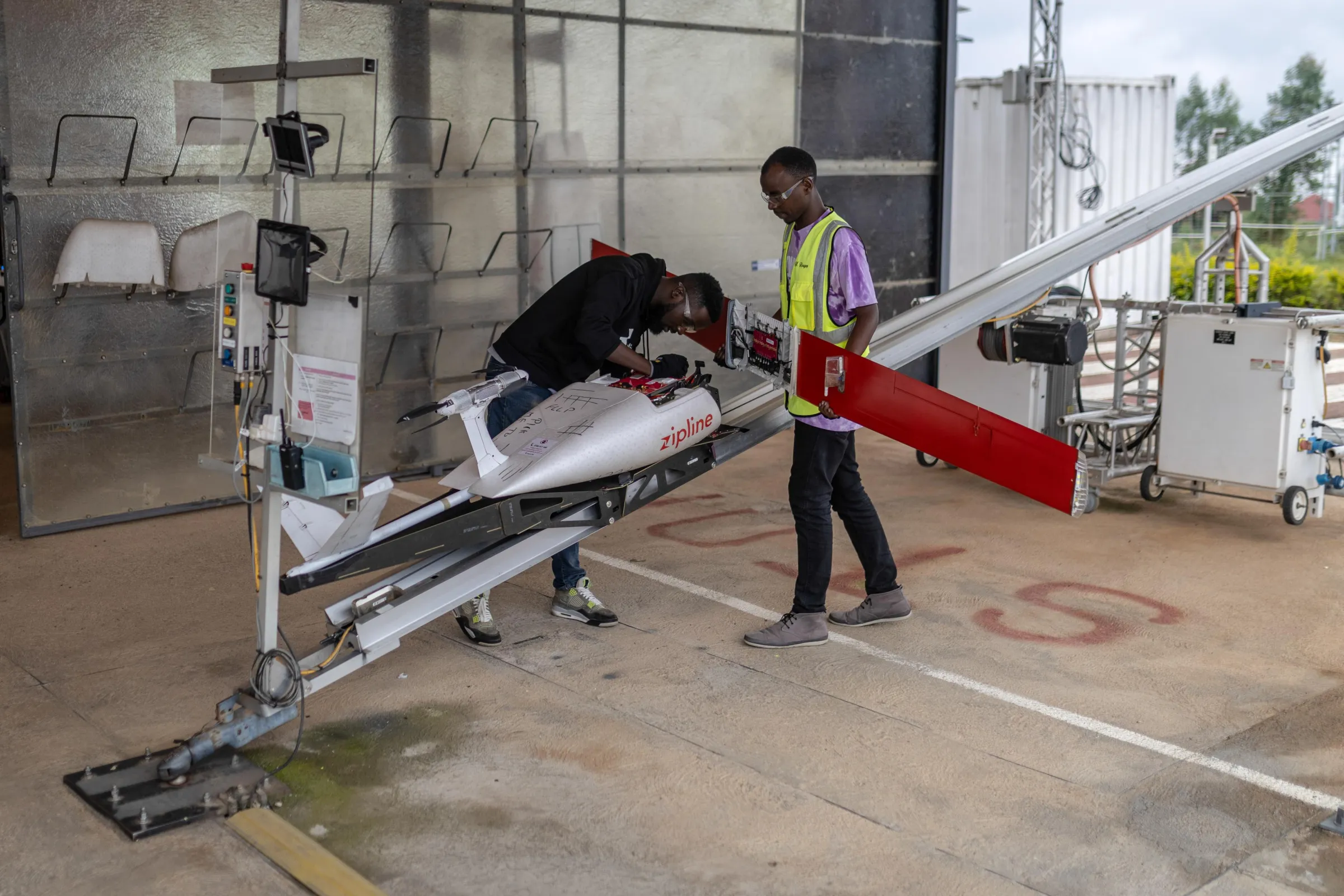
Employees assemble a blood delivery drone before its launch at a Zipline drone nest launching site near Kigali, Rwanda, on Thursday, April 4, 2024. Zipline, a drone medical delivery service first developed in Rwanda and Ghana, now primarily operates in the US in partnership with Novant Health and customers including Walmart. Photographer: Guillem Sartorio/Bloomberg via Getty Images

A Zipline delivery drone being assembled in Rwanda.
Guillem Sartorio/Bloomberg

To Zipline’s credit, an NPR reporter in Rwanda last month found that the company’s drones were already saving lives in places with poor road infrastructure, where driving to the nearest hospital can take hours on winding hills, but where drones can deliver crucial blood transfusions within minutes.

And yet, for Rwandans to benefit fully from these high-tech deliveries, they need staffed clinics to visit. As a result of foreign aid cuts, some of those literal landing spots are now on the verge of closing in some of the nation’s most vulnerable rural corridors. “Without the underlying infrastructure, like roads, energy and power and unless there is accessibility, rural and otherwise,” Enoh Ebong, president of the global development department at the Center for Strategic and International Studies, told NPR, “then all of these solutions will stop short.”

But just as medical delivery drones still need a clinic to fly to, most of these interventions require some layer of physical infrastructure — roads, schools, power, and quite obviously, broadband — to function. Satellite imagery shows that some rural communities in sub-Saharan Africa quite literally went dark in the aftermath of USAID cuts. It will be much harder for their kids to prompt an AI math tutor, or for a local farmer to download a weather app.

“We’re seeing this very much as a both/and,” Suzman told me, calling more traditional funding for education and healthcare “the bedrock for long-term economic growth,” which AI is meant to supplement, not replace. But, in practice, foreign aid cuts have left serious cracks across much of that bedrock, which could make it harder for state-of-the-art solutions to function as intended.

Advertisement

It is obviously not incumbent on the Gates Foundation to pay for all of this alone – nor would it even be feasible for them to do so. And for the record, plenty of the foundation’s other grant programs are not AI-related at all. But this tension does speak to a broader question that may be felt most acutely in a context like global health, but ultimately one that touches us all: Do we spend our scarce resources on the digital infrastructure of the future at the peril of our needs right now? Could you justify buying the new $1,999 folding iPhone if you can barely afford to buy groceries?

The answer is not actually always an easy one. It is not for us to say, for example, that just because a community lacks reliable running water, its people should be excluded from the benefits (and encumbrances) of the smartphone, especially if that smartphone can connect them to health advice they could never access otherwise, or guidance that could help them survive a drought.

In some parts of the world, digital forms of banking arrived long before local brick-and-mortar branches did, instantaneously connecting countless people to a cheap and secure way to save and send their cash to family and friends in need. It is certainly possible that AI, or at least the kind of applications the Gates Foundation funds, could one day have a similarly transformative effect on how people access personalized levels of care, education, and other services in places without the resources to do so otherwise.

That is the hope, but it is also hard right now to believe uncritically in a technology that, as Gates himself blogged just last month, “will either be the greatest equalizer ever invented, or the worst source of injustice,” ushering in “one of the most turbulent times in human history.”

Advertisement

In an interview with the New York Times soon after, he seemed convinced that AI will likely do more harm than good. “I don’t like bringing bad news to people, and I don’t like saying that innovation may be a net negative,” he said. “But that’s where we are.”

Now he wants billions of people around the world to use it? Yes, Suzman said, because if not, then inevitably the best parts of AI — the potential for exponentially better cancer treatments, for example — will go only “to those who can pay for it,” while the worst parts of it will fall, as they so often do, on those who benefit the least. “These decisions are being made now,” he said, “and the decisions being made now will then probably shape the following two decades.” Here’s hoping they’re good ones.

Source link

Continue Reading

Tech

From school nuggets to insect kibble: How the next generation of faux meats aims to win over skeptics

Published

on

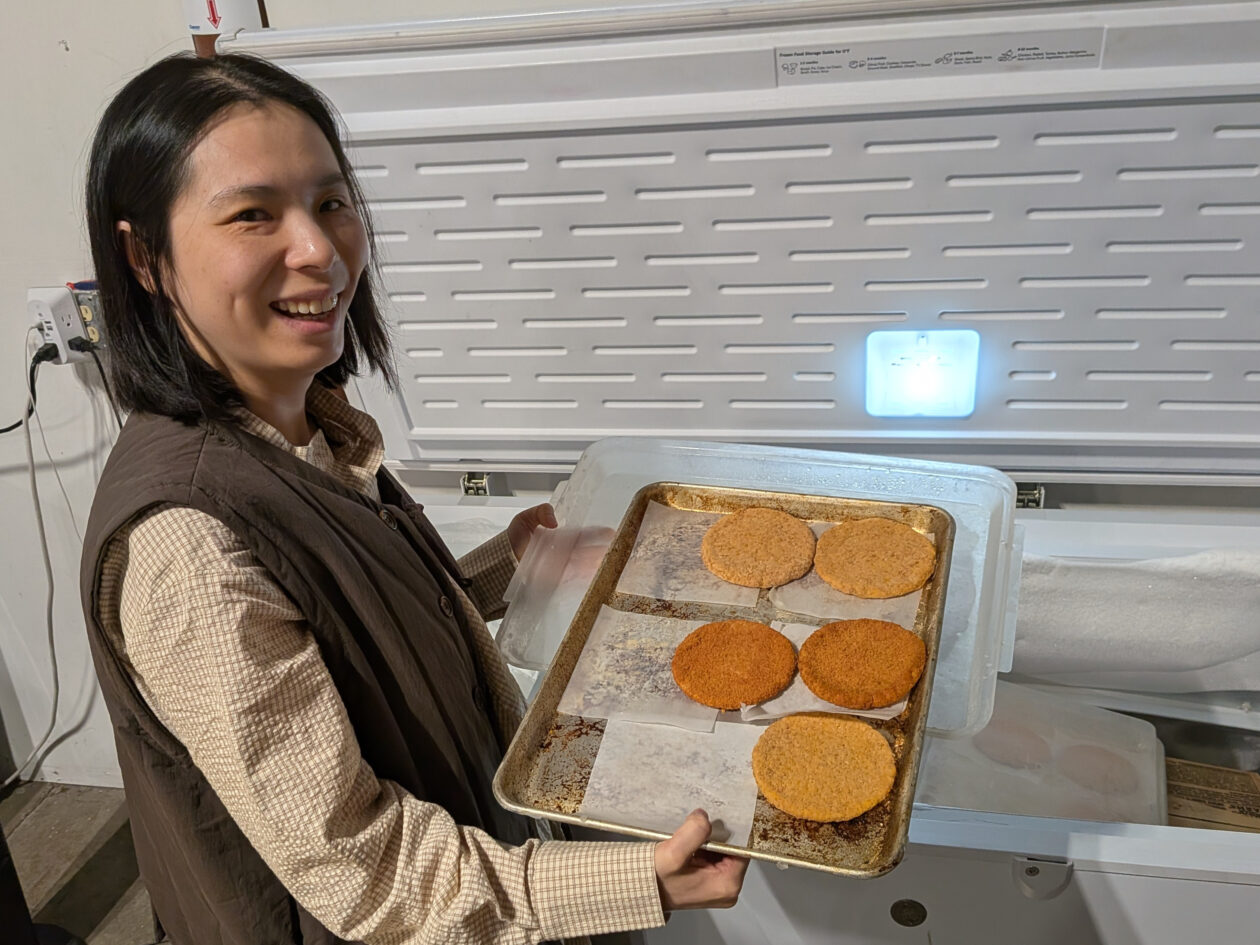
Taoran Wang, senior food scientist at Rebellyous Foods, displays a tray of experimental chicken patties. (GeekWire Photo / Lisa Stiffler)

geekwire.com/positivecharge (publish that page or it 404s).
============================================================ –>

.pc-sub-wrap{container-type:inline-size;}
.pc-sub{background:#0f3d33;border-radius:6px;padding:12px 16px;margin:14px 0;font-family:Helvetica,Arial,sans-serif;font-size:14px;line-height:1.5;color:#fff;}
.pc-sub strong{color:#a3e635;}
.pc-sub a{color:#fff;text-decoration:none;white-space:nowrap;}
/* collapse when the strip’s own width is tight */
@container (max-width:620px){
.pc-sub{font-size:13px;padding:10px 12px;white-space:nowrap;overflow-x:auto;-webkit-overflow-scrolling:touch;}
.pc-sub .pc-full{display:none;}
}
/* fallback for browsers without container-query support */
@media (max-width:560px){
.pc-sub{font-size:13px;padding:10px 12px;white-space:nowrap;overflow-x:auto;-webkit-overflow-scrolling:touch;}
.pc-sub .pc-full{display:none;}
}

Subscribe to Positive Charge:
Apple Podcasts,
Spotify,
Amazon Music,
All Episodes

More than 40 years ago, the first commercial veggie burger made its debut in London markets as packets of dehydrated ingredients that were mixed with water and shaped into patties. Today’s alternative proteins are unrecognizable in comparison, featuring cell-cultivated meats grown in brewery-style stainless steel tanks, fake sushi and faux burgers that “bleed.”

The sector saw a surge in the early 2020s to become a $1 billion market, but enthusiasm has wilted of late. Beyond Meat, for example, has seen its stock plummet following its 2019 IPO, and only 11% of U.S. households purchased faux meat last year.

Advertisement

Yet repeat purchases remain strong, global demand is rising, and academic research as well as entrepreneurial R&D are advancing the field.

“Any new emerging technology always goes through challenges in scaling, economics, [and] consumer acceptance,” said Rohan Shirwaiker, director of the Bezos Center for Sustainable Protein at North Carolina State University. “The trajectory, I think, is in the right direction.”

Alternative proteins fall into three categories, and they can be combined in some products:

Plant-based: Made from ingredients including soy, beans, peas, lentils and wheat.

Advertisement

Fermentation-produced: Uses organisms such as fungi, bacteria, yeast and algae to act as ingredients themselves or as tiny factories producing compounds including proteins found in milk or eggs, or specific fats.

Cell-cultivated meats: Derived from animal cells and grown in nutrient-rich broth, then coaxed into fat or muscle tissue.

Consumers buy alternative proteins because of environmental concerns around climate impacts and the land and water footprint of livestock; health worries about cholesterol and saturated fats; and ethical objections to factory farming. And experts say that as the global population grows, there won’t be enough beef, chicken and fish to meet protein needs.

But there are significant hurdles to adoption. The faux meats are generally more expensive. People are unsure about the technologies used to make the foods. Consumers need to adapt to different flavors and textures and have worries that the alternatives are “ultra-processed” foods.

Advertisement

Nuggets for schools

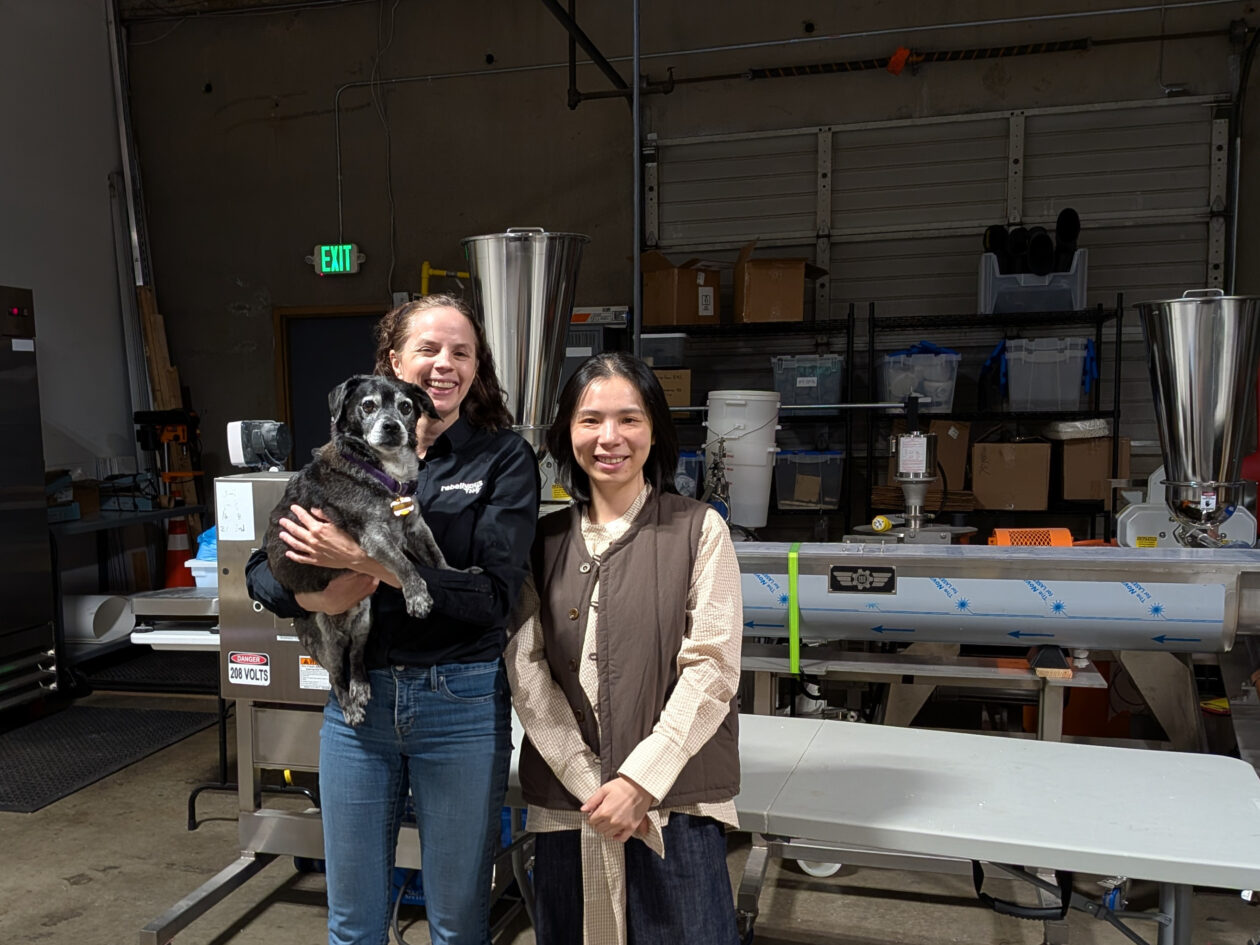
Rebellyous CEO Christie Lagally Bradburn, holding Barney the company pup, and senior food scientist Taoran Wang stand alongside an autonomous food production prototype at the startup’s R&D facility near Seattle. (GeekWire Photo / Lisa Stiffler)

Rebellyous Foods, a startup churning out faux chicken nuggets for 6 million U.S. school kids, runs its R&D operations out of an office park south of Seattle.

“We want people to feel good about what they eat, and so our products have a relatively short ingredient list,” said Christie Lagally Bradburn, founder and CEO of Rebellyous. That includes soy protein, yeast-based flavoring and salt, oil and water, and a binder called methyl cellulose found in products such as bread and salad dressing.

Despite being derived from plants, the Rebellyous kickin’ nuggets have a meat-like texture absent the gristle and mystery bits. The flavor, Lagally Bradburn said, is often compared to Campbell’s chicken noodle soup. The brand also has spicier options targeting food service at hospitals and correctional facilities.

Lagally Bradburn’s background is in designing manufacturing equipment, including roles at Boeing creating tools to build airplanes faster, better and cheaper. An ethical vegan, she wanted to apply that skill set to replacing meat, and in 2017 she launched Rebellyous to do it. Her goal: an automated, continuously operating system for producing affordable and tasty fake chicken products.

The company developed its Mock 3 system, capable of producing more than 5,000 pounds of faux chicken per hour. The device was installed in a facility north of Seattle, but the operators recently shuttered the site on short notice. So Rebellyous is working with its long-term partner in New Mexico which uses a conventional manufacturing system.

Advertisement

The hope is to find a new home for the Mock 3 while also developing its Mock 4, a smaller, cheaper, simpler device.

“Our goal is to run a financially sound company, to be there for the schools,” Lagally Bradburn said, as well as play a role in addressing climate change, human health and animal welfare issues.

Cricket kibble

Anne Carlson, CEO of Jiminy’s, with her dogs Tuco and Hopper. (Photo courtesy of Carlson)

While Rebellyous targets human food service, other startups are focused on four-legged consumers. About a decade ago, Anne Carlson was planning a career change when her daughter shared that she didn’t want children due to climate worries.

“I realized that I couldn’t just do a normal job after that,” she said. “Building a better future for her was everything.”

Carlson, a pet-industry veteran, noted UCLA research showing U.S. pets account for 25% to 30% of the environmental impact of domestic meat consumption. That led her to pursue insects as alternative proteins for pets, starting with crickets, then adding black soldier fly larvae.

Advertisement

In 2020, her company, called Jiminy’s, became the first in the country to be approved by the FDA and an association that regulates animal food standards to sell cricket-based dog foods.

“It’s less land, less water and almost no greenhouse gases,” Carlson said of the bug proteins. One acre of land used to raise 265 pounds of chicken protein will provide 60,000 pounds of cricket protein.

Jiminy’s sells kibble, treats and dental chews that provide essential amino acids and show benefits for dogs with allergies and digestion issues. The products typically cost more than animal-based foods, but are cheaper than prescription diets.

The San Francisco Bay Area startup still has to win over owners who are squeamish about insects — but they needn’t be, Carlson said.

Advertisement

“People think that when they open the bag, it’s going to be a bag full of bugs. It is absolutely not that,” she said. The product looks and smells like typical dog food, so “it’s not scary at all.”

Path to profitability

Some potential Jiminy’s customers are afraid the bug-based dog food will include whole insects, but products actually resemble conventional kibble. (Jiminy’s Photo)

One area of growing concern centers on ultra-processed foods and whether alternative proteins fall under that category.

Shirwaiker, director of the Bezos Center, notes that while some products contain high sodium or fat, processing itself can be beneficial by removing harmful elements, improving texture and preserving nutrition.

“If we are using processing to get the right texture, something that consumers will like without sacrificing the nutrition, I don’t think that’s a bad thing at all,” he said. “So it’s really a matter of perspective and trying to separate process from nutrition in some way.”

Rebellyous and Jiminy’s leaders said they clearly disclose ingredients and keep them simple to put those fears to rest. The biggest hurdle, both said, was bringing down costs while supply-chain prices keep rising.

Advertisement

Even so, the startups are on the verge of profitability, their CEOs said. Carlson said Jiminy’s operates in the black some months and is growing faster than the pet industry overall. Because Rebellyous primarily serves schools, it’s profitable during much of the year, but business slows in the summer, Lagally Bradburn said.

Both founders remain optimistic about the long-term horizon.

“Sometimes when you’re in it, it can be hard to see the forest for the trees,” Lagally Bradburn said. “But the truth is that overall, the world is becoming more sustainable.”

Sources and references

Interviews:

Advertisement

Additional sources:

Lisa’s favorite protein nut balls:

  • 1 C old-fashioned oats
  • 1 C peanut butter, other nut butter, or combo
  • ⅓ C honey
  • ⅓ C chopped, roasted nuts (peanuts, almonds, pecans, etc.)
  • ⅓ C semi-sweet or bittersweet chocolate (chips or chopped)
  • 2 Tbs protein powder
  • 1 tsp vanilla extract
  • ¼ tsp cinnamon 
  • ½ tsp salt
  • ⅓ C shredded coconut (optional)
  • 2 Tbs chia seeds (optional)
  1. Combine all ingredients in a large bowl and mix well.
  2. Form into balls measuring about 2 Tbs, arrange on a pie tin or plate, chill.

Source link

Continue Reading

Tech

Hisense RoamView S6 Is a 32-Inch 4K Touchscreen Smart Display That Rolls From Room to Room

Published

on

At CES 2026Hisense unveiled the S6 FollowMe, which is company’s response to the growing lifestyle TV category that includes Samsung’s MovingStyle and LG’s StanbyME 2 portable TVs. All are going after users who want screens that follow their daily routines, not dictate them.

Whether it’s streaming, video calls, recipe browsing, casual web use, or light smart-home control, the S6 FollowMe, along with its competitors, is positioned less as a TV replacement and more as a mobile digital hub that fits into real homes without demanding a redesign.

However, since its CES debut, there is a new wrinkle to the story. Hisense has made the strategic move to rename the S6 FollowMe as the RoamView, with the model number 32S6S.

Hisense RoamView vs. LG StanbyME 2 vs. Samsung MovingStyle: What They Have in Common

These TVs, or more accurately smart displays, are built around the idea that screens should adapt to how people use them rather than lock users into one room or one position. Instead of being anchored to a wall or cabinet, these displays are designed to move throughout the home, shifting between entertainment, light productivity, and casual interaction depending on where and how they are being used.

Advertisement
hisense-roamview-vertical

The RoamView

The RoamView features a 32-inch 4K UHD touchscreen mounted on a wheeled stand that supports tilt, rotation, height adjustment, and easy movement around the house.

The display can shift from floor height to table height using the included pedestal base or easel stand, making it practical to use from a couch, desk, kitchen counter, or dining table without forcing awkward viewing angles.

hisense-roamview-rotate

Since the RoamView is designed to be moved around as needed, it incorporates a rechargeable battery with a 10-hour use life. Also, it features an anti-glare, low-reflection screen to accommodate different lighting conditions. Built-in Wi-Fi 6 support provides the bandwidth needed for stable streaming, browsing, and smart-home interaction. The RoamView also provides access to Google Gemini AI Assistant.

Stacking Up Against Samsung and LG

Although the Hisense RoamView, LG StanbyME 2, and Samsung MovingStyle have a lot in common, each offers its own take on this growing TV and smart display category. For a deeper look at all three options, check out our previous article on the Hisense S6 when it was previously announced at CES 2026.

Price & Availability

The Hisense RoamView (model 32S6S) is available for $1,199.99 at Best Buy and Amazon.

Advertisement. Scroll to continue reading.
Advertisement

Source link

Continue Reading

Tech

Caviar’s Nine-Piece iPhone Duo Jobs Edition Boasts a Turtleneck Fragment

Published

on

Caviar iPhone Duo Jobs Edition
Caviar returned to its favorite Apple relic and sealed a scrap of Steve Jobs’ black turtleneck inside the company’s first foldable phone. Only nine iPhone Duo Jobs Editions will leave the workshop. Each one costs at least $15,990, close to eight times the $1,999 starting price of a regular 256GB Duo.


Apple unveiled the Duo on September 9. When closed, the 5.4-inch outer Super Retina XDR screen conducts ordinary chores. When the 7.6-inch inner display is opened, it becomes the largest screen Apple has ever used on an iPhone. Grade 5 titanium, a precision hinge designed to disguise the crease, two 48-megapixel cameras, the A20 Pro CPU, and Touch ID in the side button remain exactly as Apple designed them. Caviar avoids making contact with the hardware.

Sale


Samsung Galaxy Z Fold8 Unlocked Android Smartphone, 256GB Graphite
  • CREATED FOR YOUR CONTENT: Any way you turn it, the new Galaxy Z Fold8 gives you a fuller viewing experience. Designed with your content in mind, this…
  • WORLD’S LIGHTEST FOLD¹: Galaxy Z Fold8 is the newest foldable phone for content on the go. Unfolded, it fits movies and books for an immersive…
  • THE BRIGHTEST DISPLAY ON A GALAXY PHONE: Our brightest smartphone display² provides you with a comfortable view, whether you’re inside or outside…


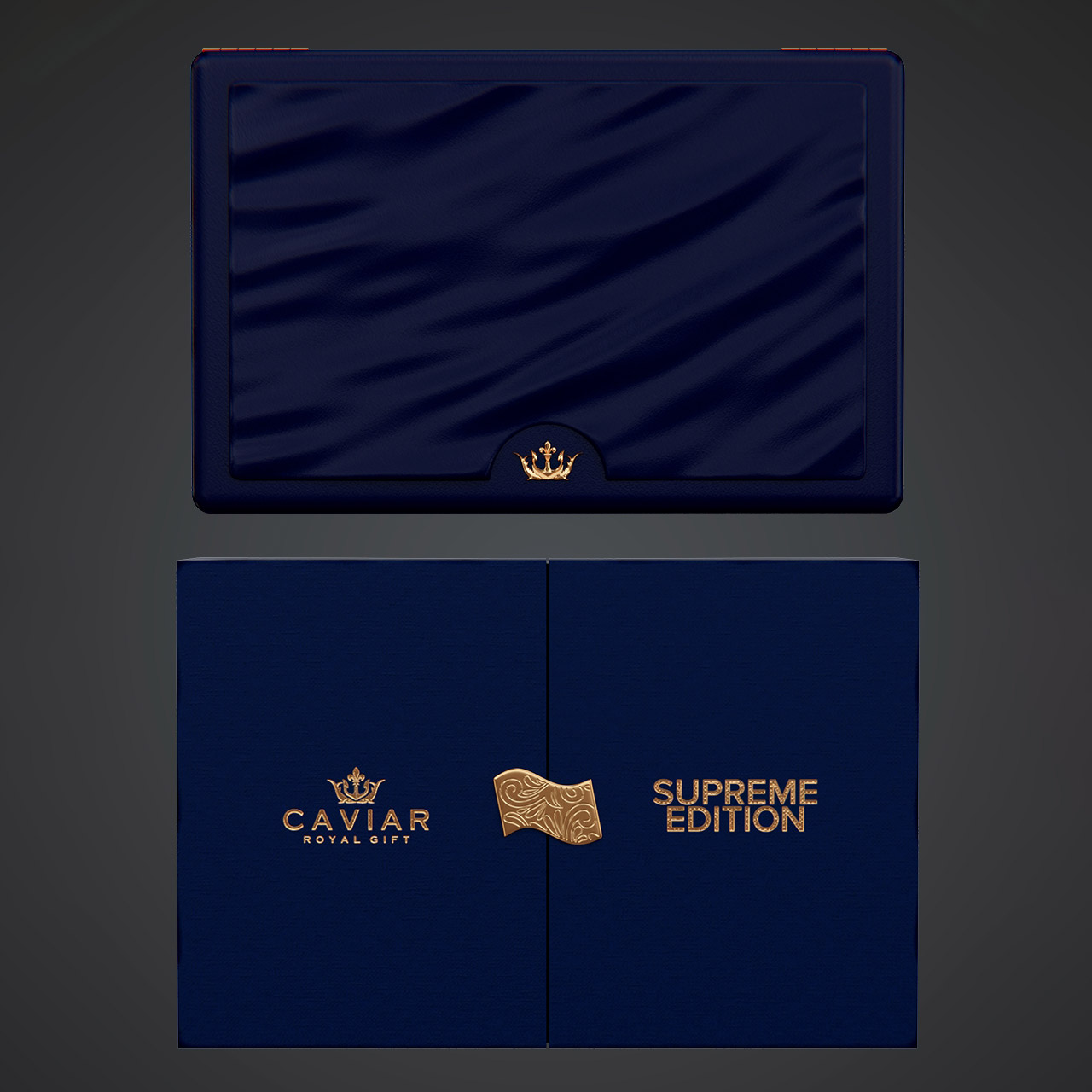
Caviar’s treatment includes a raised three-dimensional Apple logo with a verified remnant of the turtleneck Jobs wore during NeXT demonstrations. A PVD-coated titanium central panel rests beneath polished titanium, with guilloché engraving on the upper part and frame. Jobs’ signature is inscribed in the metal. Each unit is accompanied with a multi-level certificate.

Advertisement

Caviar iPhone Duo Jobs Edition
Packaging follows the same collector logic. A locked outer case plated with 24-karat gold houses a wood-and-leather Blue Wave box, a gold-plated Caviar coin, and the standard signature key. Production begins after payment and typically ships within a few business days.

Caviar iPhone Duo Jobs Edition
Caviar used the same strategy on the iPhone 17 Pro earlier this year, inserting a near identical scrap of fabric in nine phones that sold for just over $9,600 and immediately sold out. Instead, this version uses Apple’s newest and most expensive form factor. Other Caviar Duo customized use crocodile leather and gold, but the Jobs Edition features a genuine piece of the company’s creator.

Source link

Continue Reading

Tech

ExpressVPN’s new Fortify router nearly triples VPN speeds to 900Mbps for your entire home

Published

on

Most VPN apps protect only the device they’re installed on, leaving smart TVs, game consoles, and security cameras completely unshielded. 

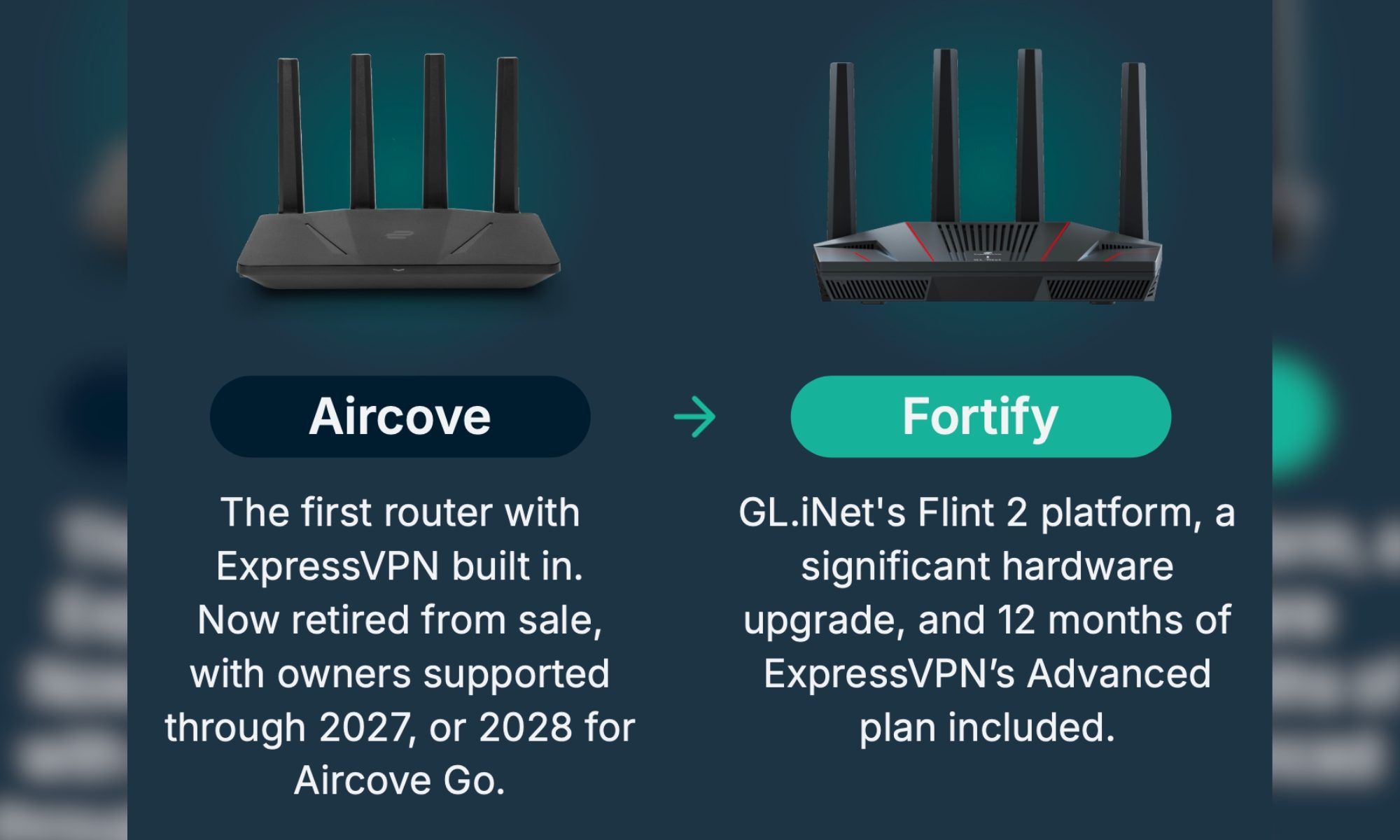
ExpressVPN’s solution has long been network-level encryption via its dedicated routers, but its latest release shifts gears entirely. The newly announced Fortify router replaces the aging Aircove lineup with a substantial hardware upgrade.

So what exactly changed with Fortify?

Built in partnership with GL.iNet on its Flint 2 platform, Fortify swaps Aircove’s dated Wi-Fi 5-era hardware for Wi-Fi 6 AX6000 with 4×4 MU-MIMO. That also brings a generational jump in overall VPN throughput.  

WireGuard speeds now reach up to 900Mbps, nearly triple Aircove’s 330Mbps ceiling. A quad-core processor and genuine Multi-Gig ports back the speedy, protected connection and keep up with modern fiber connections. The new router has six ports total: two 2.5 Gbps Multi-Gigabit Ethernet ports and four 1 Gbps Gigabit LAN ports. 

Whether it’s a multi-device smart home setup, a remote working setup, a small business that’s operating out of a house and its garage, or a multi-cabin office setup that spans across the floor, the Fortify router can not only handle multiple devices at once, but also keep the entire network safe and encrypted. 

Advertisement

What happens to Aircove?

Aircove and Aircove Go are both being pulled from sale. However, existing owners will still get security updates through 2027 and 2028, respectively. To help with the upgrade, the company is also offering a 20% discount toward Fortify. 

Every Fortify purchase also bundles a full year of ExpressVPN’s Advanced plan (around $120 in value), plus a password manager, email privacy tool, and a few days of travel eSIM data. Fortify launches September 16th at $199.99, first through GL.iNet’s own site. Amazon availability will follow shortly after.

Aircove Fortify
Wi-Fi standard AX1800, 2×2 MU-MIMO AX6000, 4×4 MU-MIMO
VPN speed (WireGuard) Up to 330 Mbps Up to 900 Mbps
Ethernet ports Standard Gigabit Two 2.5 Gbps + four 1 Gbps
Device capacity Limited Up to 86 devices, 1,500 sq ft

The real story is partnering with GL.iNet rather than building hardware in-house. It lets ExpressVPN focus on the VPN and privacy software it’s known for, while outsourcing router engineering to a company with a proven platform in the Flint 2.

Source link

Advertisement
Continue Reading

Trending

Copyright © 2025