

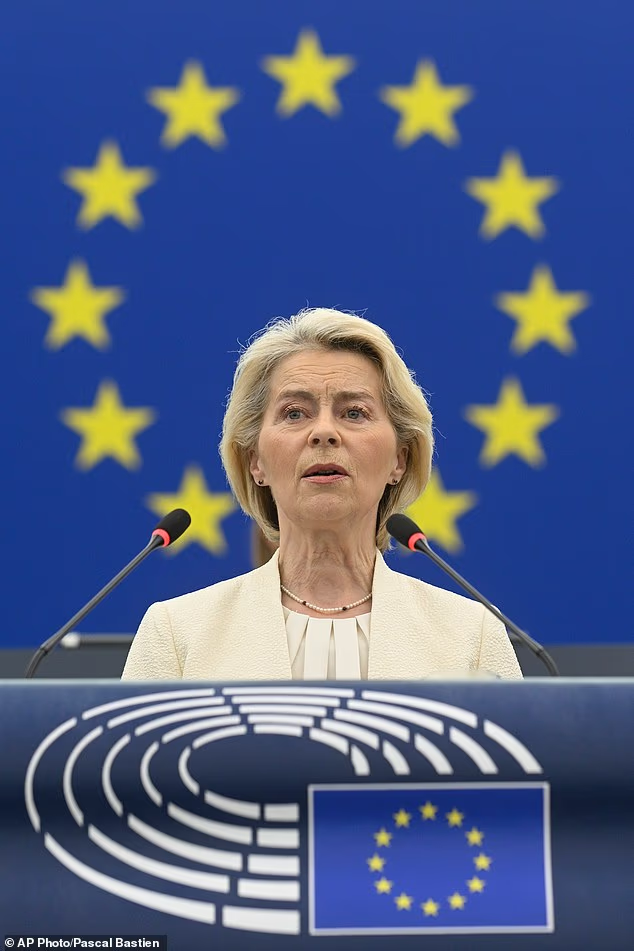
Brussels was hit with a furious backlash today after announcing unprecedented plans for Canada to become an ‘associate member’ of the bloc – without asking EU capitals to sign off on the proposal.
EU diplomats told the Mail they were kept in the dark and first learnt of the proposal when Ursula von der Leyen, the EU Commission boss, unveiled it during a keynote speech.
During the top Eurocrat’s annual State of the Union speech to the European Parliament, she repeatedly love-bombed Canadian premier Mark Carney – who was in the chamber – saying Brussels wanted ‘to bring the relationship with Canada to the highest level possible.’
But to the surprise of diplomats from the EU’s 27 member nations, who would have to sign off the move, she gushed: ‘Dear Mark, I said we must urgently reimagine our partnerships. So, I would like to work with you on opening the door for Canada to be the first associate member of the EU.
‘We share one ocean, one set of values, one way of seeing the world. And we will now build our shared future as well – thank you for being here.’
But the attempt to flatter the former Governor of the Bank of England backfired, with diplomats saying they were never briefed about the proposal and that, in effect, ‘associate membership’ doesn’t even exist.
EU diplomats accused Brussels of ‘over-reach’, an accusation often levelled against Eurocrats by UK Brexiteers before Britain left the bloc.
One EU diplomat told the Mail: ‘This bombastic announcement is just not right.
EU diplomats told the Mail they were kept in the dark and first learnt of the proposal when Ursula von der Leyen, the EU Commission boss, unveiled it during a keynote speech today

Mark Carney looked on as Ursula von der Leyen, the EU Commission boss, love-bombed him and his nation

Ursula von der Leyen, the EU Commission boss, said she wanted Canada to become an ‘associate member’ – but EU diplomats pointed out the category in effect doesn’t exist
‘There will be a summit at the end of October, so logically they will talk about deepening the relations.
‘But no one has ever seen an associate membership and no idea what it means in practice. Canada is a valuable partner for the EU, one of the few currently in the world where we share the values, so it is nothing against Canada.
‘But first and foremost the member states should be the ones to express what kind of relationship the EU wants to have with any third country.’
Another added: ‘She kept this bit of associate membership out of the text until the last moment. She also did not mention it up front to EU member states.
‘It seems like she is a bit too far out in floating this. Everyone is positive about Canada, and wants to strengthen the relationship.
‘But there is a lot of uncertainty about what von der Leyen envisages by coining this label.’
They added that, in reality, the most that can likely be hoped for is a deeper trading relationship rather than ‘associate membership’, which implies Canada taking part in EU programmes that it would be forced to pay into, becoming more politically integrated and potentially even having a say over the bloc’s rules.
But there would be huge barriers to overcome to establish closer ties, as swathes of Canada’s regulations are at present incompatible with EU single market rules, with high taxes on the bloc’s alcohol exports another thorny issue.
Under EU law, any granting of membership would have to be approved by the 27 member states, which is another reason they were wrong-footed.
By contrast, Brussels has always rebuffed Britain for past attempts to ‘cherry pick’ the areas where it wants to align with the bloc while also diverging in other ways after Brexit.
In her speech, Ms von der Leyen added: ‘Mark, your presence here is a symbol of the enduring friendship between our people.
‘Our cultural, historical and personal links run deep within the fabric of our societies.
‘And thanks to CETA (a trade pact), our trade in goods has grown by 75 per cent in less than a decade…But above all, dear Mark, Europe and Canada believe in democracy.’
She said the areas in which both sides could work together more closely included ‘a tech alliance’, adding: ‘We will integrate defence industrial bases.
‘We will make the Arctic a flagship joint project. We will work on energy, critical minerals and batteries. On AI, quantum, cyber and economic security.
‘This is a partnership not against anyone else, but for our common strength.’
But the move threatens to further sour relations between Brussels and Washington, with US President Donald Trump’s administration locked in an escalating trade war with Canada.
The speech may even ruffle feathers in Downing Street, as the UK by contrast has faced resistance to greater co-operation in areas such as defence procurement despite repeated attempts by former premier Sir Keir Starmer to cosy up to Brussels.
An EU Commission spokesman said: ‘Working in close coordination with our member states and the European Parliament, we will aim to create a new form of partnership that has not existed until now – building the closest imaginable form of association with a partner outside Europe.’
They added that this would ‘span a wide range of areas’, but did not list any beyond what was in Ms von der Leyen’s speech.

















































You must be logged in to post a comment Login